e99 Online Shopping Mall

Geometry.Net - the online learning center Help  
Home  - Composers - Wagner Richard (Books)

  1-20 of 100 | Next 20
A  B  C  D  E  F  G  H  I  J  K  L  M  N  O  P  Q  R  S  T  U  V  W  X  Y  Z  

click price to see details     click image to enlarge     click link to go to the store

$17.43
1. Decoding Wagner: An Invitation
$12.43
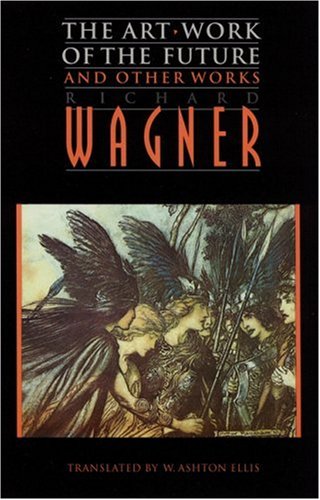
2. The Art Work Of The Future
$53.95
3. Imagined Germany: Richard Wagner's
$31.95
4. Richard Wagner's Prose Works
$25.00
5. Opera and Drama
$10.13
6. Beethoven
$9.07
7. Siegfried Idyll and Faust Overture
$17.85
8. Wagner's Ring of the Nibelung
 
9. Richard Wagner: The stage designs
 
$72.58
10. Selected Letters of Richard Wagner
$21.90
11. The Darker Side of Genius: Richard
$30.00
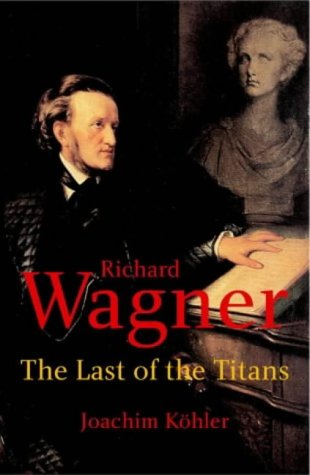
12. Richard Wagner: The Last of the
 
13. The life of Richard Wagner: 1848-1860
$5.84
14. Aspects of Wagner (Oxford Paperbacks)
$6.03
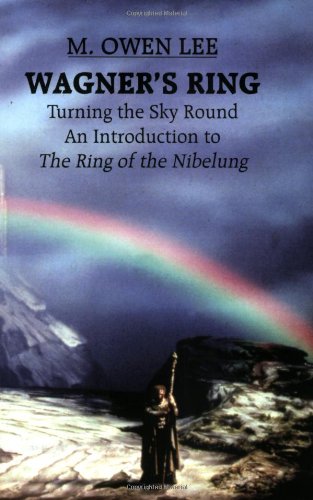
15. Wagner's Ring: Turning the Sky
$35.00
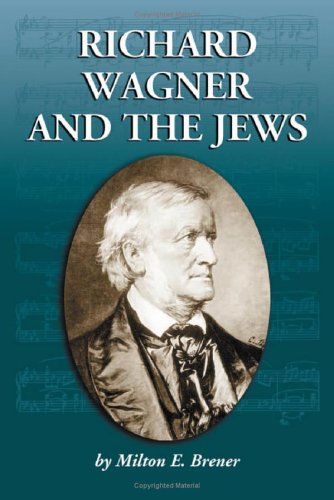
16. Richard Wagner And the Jews
$14.75
17. Wagner on Music and Drama: A Compendium
$28.50
18. Richard Wagner: Der Fliegende
$12.59
19. Overtures and Preludes in Full
$19.27
20. Siegfried in Full Score

1. Decoding Wagner: An Invitation to His World of Music Drama (includes 2 CDs)
by Thomas May
Paperback: 220 Pages (2004-12-22)
list price: US$27.95 -- used & new: US$17.43
(price subject to change: see help)
Asin: 1574670972
Average Customer Review: 5.0 out of 5 stars
Canada | United Kingdom | Germany | France | Japan
Editorial Review

Amazon.com
In the voluminous Wagner bibliography, Thomas May's book occupies a special place. Concise but remarkably information-packed and accompanied by two CDs of excerpts, it is addressed to those who seek a deeper understanding of Wagner's operas. The controversies--artistic, human and moral--generated by Wagner's innovative ideas and reprehensible behavior frequently obscure the greatness of his achievements. May performs an extraordinary feat: although unflinchingly aware of Wagner's arrogance, self-aggrandizement, duplicity, faithlessness, hedonism, greed, political opportunism, chauvinism, and anti-Semitism, he communicates boundless admiration for the composer andpassionate love for his works. Suggesting that the very schism between Wagner's flawed character and idealistic aspirations inspired "monumentally stirring meditations on the contradictory range of human experience," he correlates and reconciles his "monstrous ego" with his sublime genius. The evolution of Wagner's operas, from his early and incomplete attempts to the late, often extensively revised masterpieces, culminated in a lofty artistic vision: the "total artwork" which, combining all the arts, would result in heightened experience and spiritual elevation. Wagner wrote his own texts, considering poetry and music inseparable and himself equally master of both, an assessment not universally shared. May takes the librettos very seriously, following them from their historical or mythological origin to their final form with formidable but unobtrusive erudition. Among his references are the Buddha, Aristotle, Shakespeare, Thomas Mann, and T.S. Eliot, and he must have read everything about Wagner as well as Wagner's own often repellent autobiographical, theoretical, and political writings (which make one wish he had written nothing but music). May's musical analyses are equally riveting and absorbing. He traces the operas' ever-increasing depth, breadth, and grandeur, the growing importance and masterful use of the unifying leitmotif and the "Wagnerian" orchestra, and the often hidden strands that connect them despite their individual uniqueness. Opera lovers spurred by May's book to hear these works performed could not wish for a more knowledgeable, illuminating, and inspiring guide. --Edith EislerBook Description
This guide aims to unlock the world of Richard Wagner and his works, his monumental achievements, and, ultimately, the great emotional power inherent in his art. Decoding Wagner presents a straightforward, fresh overview of what Wagner attempted to achieve with his "artwork of the future." Two accompanying full-length CDs illustrate and trace his growth as a composer. ... Read more

Customer Reviews (4)

5-0 out of 5 stars interesting book with cds
This well writen book has an analysis of all Wagner operas. I found it helpful, used together with the Metropolitan Opera site.

5-0 out of 5 stars An opera celebration
I used to be an opera singer and I have to say this is a fabulous book for any fan of Wagner. Tom May has done a terrific job of making this difficult material accessible, and the accompanying CDs help considerably. Even if you feel you have read everything there is to read about the maestro, you will find this book absorbing and very illuminating. Plus you'll probably want to buy a new recording of Tristan und Isolde as well [maybe the most beautiful music ever written, in my humble opinion].I think Amazon may sell that too.LOL


5-0 out of 5 stars Very solid overview of Wagner's operas - 2 Good Music CDs
I found this tobe an excellent overview of Wagner and his operas ina book of only 200 pages or so. This book is for someone who is fairly familiar with the plots of Wagner's operas -- no plot summaries are presented -- and givesa good sense of how Wagner developed as both a composer and dramatist.The book is written mostly around the ten major operas wrote -- a chapter for each with an extra chapter to introduce the Ring. Although the book is relativelyshort, the reader learns a lot about Wagner's sources,his use of these sources, and key features of the individual operas. A portion of the discussion of the operas is tied to the CDs - one for the Ring and the other for the non-Ring operas.The CDs are primarily "greatest hits" - from the operas, with text making reference to different points on the CD in terms of timing.

This book is probably not the first book you read on Wagner-- I would recommend "Wagner Without Fear" by William Berger as an introduction to Wagner and his work. For other readers, this book really provides quite a bit of diverse information in a small space. The book is well-written and meets the needs of many readers in that it written around individual operas. A reader can go right to the opera of interest, but I think may will also want to read through the entire book to better understand the context of individual operas and their placein Wagner's development.

The book has a good bibliography (though it would have been nice to have some annotation).

The book isa goodvalue as is, but with the 2 CDs (primarily BMG recordings), it becomes an excellent value. Any reader interested in Wagner should consider owning this book.5 stars.

5-0 out of 5 stars Accessible, lively and well-written
This is a terrific read: entertaining and briskly paced. May considers historical and social factors in Wagner's work without bogging down the reader with theory or dull historicism. In fact, this work brings me a greater appreciation for Wagner than I thought possible (I'm not, my apologies, an opera fan). I would recommend it to the casual theater goer, the fine arts critic, opera fans, and anyone interested in music or 19th century theater. ... Read more


2. The Art Work Of The Future
by Richard Wagner
Paperback: 120 Pages (2004-06-30)
list price: US$19.95 -- used & new: US$12.43
(price subject to change: see help)
Asin: 1419152734
Canada | United Kingdom | Germany | France | Japan
Editorial Review

Book Description
If Mind has manufactured Nature, if Thought has made the Actual, if the Philosopher comes before the Man: then Nature, Actuality and Man are no more necessary, and their existence is not only superfluous but even harmful; for the greatest superfluity of all is the lagging of the Incomplete when once the Complete has come to being. In this wise Nature, Actuality and Man would only then have any meaning, or any pretext for their presence, when Mind-- the unconditioned Spirit, the only cause and reason, and thus the only law unto itself--employed them for its absolute and sovereign pleasure.Download Description
If Mind has manufactured Nature, if Thought has made the Actual, if the Philosopher comes before the Man: then Nature, Actuality and Man are no more necessary, and their existence is not only superfluous but even harmful; for the greatest superfluity of all is the lagging of the Incomplete when once the Complete has come to being. In this wise Nature, Actuality and Man would only then have any meaning, or any pretext for their presence, when Mind-- the unconditioned Spirit, the only cause and reason, and thus the only law unto itself--employed them for its absolute and sovereign pleasure. ... Read more


3. Imagined Germany: Richard Wagner's National Utopia (German Life and Civilization, Vol. 29)
by Hannu Salmi
Hardcover: 229 Pages (1999-08)
list price: US$53.95 -- used & new: US$53.95
(price subject to change: see help)
Asin: 0820444162
Canada | United Kingdom | Germany | France | Japan
Editorial Review

Book Description
Richard Wagner (1813-1883) has often been regarded as a symbol of "Germanness." Despite this view, few studies have been undertaken regarding his nationalistic thinking. Imagined Germany focuses on Wagner's idea of Deutschtum, especially during the unification of Germany, 1864-1871. Salmi discusses how Wagner defined Germanness, what stereotypes, ideas, and sentiments he attached to it, and what kind of state could realize Wagner's natural ideals. ... Read more


4. Richard Wagner's Prose Works
by Richard Wagner
Paperback: 440 Pages (2007-03-15)
list price: US$31.95 -- used & new: US$31.95
(price subject to change: see help)
Asin: 140674963X
Canada | United Kingdom | Germany | France | Japan
Editorial Review

Book Description
RICHARD WAGNERS PROSE WORKS. RICHARD WAGNERS PROSE WORKS TRANSLATED BY WILLIAM ASHTON ELLIS EDITOR OP THE MEISTER, ETC. VOL. I. THE ART-WORK OF THE FUTURE, c. SECOND EDITION LONDON KEGAN PAUL, TRENCH, TRUBNER CO., LTD. . 1895 CONTENTS OF VOLUME I. PAGE NOTE TO SECOND EDITION ..... v TRANSLATORS PREFACE ..... vi AUTHORS INTRODUCTION TO THE COLLECTED WORKS . xv AUTOBIOGRAPHIC SKETCH ..... i ART AND REVOLUTION, WITH INTRODUCTION . . 21 THE ART-WORK OF THE FUTURE . . . .69 WlELAND THE SMITH . . . . . . 215 ART AND CLIMATE ...... 249 A COMMUNICATION TO MY FRIENDS .... 267 APPENDIX ....... 393 SUMMARY ....... 397 INDEX ........ 409 NOTE TO SECOND EDITION. r pHE first edition of this first volume of Richard Wagners Prose Works, as rendered into English, was issued to Members of the Wagner Society London Branch and to Subscribers, in serial parts of 32 pages each, during the years 1891 and 1892. Its issue in book-form to the public, however, did not take place until the end of January 1893, and the stock is already exhausted so that Wagnerians may congratulate themselves upon the existence of a far more active interest in the masters philosophic and artistic thought than his opponents had foretold, or than we ourselves had dared to hope. In a like regard I may record the fact that, owing to a widely expressed desire on the part of the Press, the publication of the remaining volumes has been hastened, with the result that volumes ii and iii are already in the publics hands, and present indications warrant me in trusting that their second edition, also, will be necessary at no distant date. As to the matter of the present edition, it has been reprinted from the stereos taken from the first, and therefore differs in no material respect. Beyond the correction of the errata notified on page 396 of that first edition, the only alteration is that of the page now directly under the readers eye. In the original edition it was occupied by the following Dedication, which I now have the honour to repeat To Frau Cosima Wagner this English rendering of Richard Wagners Prose Works, construed under the shelter of the London Branch of the Wagner Society, is respectfully dedi cated by the translator, in the hope that the outcome of his labours may in some small measure help to further that great Work of Bayreuth which She has inherited from her husband and is so devotedly carrying forward. WILLIAM ASHTON ELLIS. LONDON, February 1895. TRANSLATORS PREFACE IN view of the curious range of theories erroneously attributed to the Bayreuth master, the need of a complete English version of Wagners Prose is obvious. A passage here and there has often been dragged from its context, maltreated, and made to point a moral with which, in the original, it had nothing whatever to do while, on the other hand, the most valuable commentaries upon his own artistic works lie buried in the native German of Wagners writings, because folk have been scared away from read ing them by the report that his style is impossible. To the latter subject I shall presently return meanwhile as an example of the phantom theories, I may adduce the following from an exhaustive article on Poetry in the last edition of the Mncyclop dia Britannica 1885 We must be cautious how we follow the canons of Wagner and the more enthusiastic of his disciples, who almost seem to think that inarticulate tone can not only suggest ideas but express them can give voice to the Verstand, in short, as well as to the Vernunft of man... ... Read more


5. Opera and Drama
by Richard Wagner
Paperback: 416 Pages (1995-06-28)
list price: US$25.00 -- used & new: US$25.00
(price subject to change: see help)
Asin: 0803297653
Average Customer Review: 5.0 out of 5 stars
Canada | United Kingdom | Germany | France | Japan
Editorial Review

Book Description

With Richard Wagner, opera reached the apex of German Romanticism. Originally published in 1851, when Wagner was in political exile, Opera and Drama outlines a new, revolutionary type of musical stage work, which would finally materialize as The Ring of the Nibelung. Wagner's music drama, as he called it, aimed at a union of poetry, drama, music, and stagecraft.
In a rare book-length study, the composer discusses the enhancement of dramas by operatic treatment and the subjects that make the best dramas. The expected Wagnerian voltage is here: in his thinking about myths such as Oedipus, his theories about operatic goals and musical possibilities, his contempt for musical politics, his exaltation of feeling and fantasy, his reflections about genius, and his recasting of Schopenhauer.
This edition includes the full text of volume 2 of William Ashton Ellis's 1893 translation commissioned by the London Wagner Society.
... Read more

Customer Reviews (2)

5-0 out of 5 stars The Essential Wagner
This book is Wagner's seminal essay where he fully explains his principles and opinions regarding opera and music.If you like his operas, this is the one book that is a must have on your reading shelf.

In 1893, the London Wagner Society published an English translation of Wagner's 8 volume collected works.This is volume 2 of that series.It contains the full text of "Oper und Drama", translated as "Opera and Drama".Our old friend, William Ashton Ellis, did the stilted but essential English translations.

Much of what Wagner wrote has nothing to do with music, and quite a large portion is pretty forgettable.However, this book is important, and goes a long way toward helping you understand his music.

5-0 out of 5 stars READ IT
Well, to sum it up I simply have to say: Wagner wrote it, so you should read it ... Read more


6. Beethoven
by Richard Wagner
Paperback: 52 Pages (2006-10-17)
list price: US$16.95 -- used & new: US$10.13
(price subject to change: see help)
Asin: 1430442034
Canada | United Kingdom | Germany | France | Japan
Editorial Review

Book Description
This cry is answered in the most positive manner by Music. Here the world outside us speaks to us in terms intelligible beyond compare, since its sounding message to our ear is of the selfsame nature as the cry sent forth to it from the depths of our own inner heart. The Object of the tone perceived is brought into immediate rapport with the Subject of the tone emitted: without any reasoning go-between we understand the cry for help, the wail, the shout of joy, and straightway answer it in its own tongue.Download Description
This cry is answered in the most positive manner by Music. Here the world outside us speaks to us in terms intelligible beyond compare, since its sounding message to our ear is of the selfsame nature as the cry sent forth to it from the depths of our own inner heart. The Object of the tone perceived is brought into immediate rapport with the Subject of the tone emitted: without any reasoning go-between we understand the cry for help, the wail, the shout of joy, and straightway answer it in its own tongue. ... Read more


7. Siegfried Idyll and Faust Overture in Full Score
by Richard Wagner
Paperback: 112 Pages (2005-11-04)
list price: US$14.95 -- used & new: US$9.07
(price subject to change: see help)
Asin: 0486446328
Canada | United Kingdom | Germany | France | Japan
Editorial Review

Book Description

Written as a birthday gift for his wife, Cosima, Siegfried's Idyll was given its premiere performance on Christmas morning on the steps outside their bedroom. In contrast, Faust Overture is what remains of Wagner's opera based on the Goethe novel. Paired together in one affordable volume, these works collect two different sides of Wagner's compositional mastery.
... Read more

8. Wagner's Ring of the Nibelung
by Stewart Spencer, Richard Wagner, Barry Millington
Paperback: 384 Pages (2000-11)
list price: US$29.95 -- used & new: US$17.85
(price subject to change: see help)
Asin: 0500281947
Average Customer Review: 5.0 out of 5 stars
Canada | United Kingdom | Germany | France | Japan
Editorial Review

Book Description
The full German text with a new translation and commentaries. There has long been a need for a modern English translation of Wagner's Ring--a version that is reliable and readable yet at the same time is a true reflection of the literary quality of the German libretto. Stewart Spencer's well-reviewed translation, which follows the verse form of the original exactly, has filled that niche. It reads smoothly and idiomatically yet is the result of prolonged thought and deep background knowledge. The translation is accompanied by Spencer's introductory essay on the libretto and a series of specially commissioned texts by Barry Millington, Roger Hollinrake, Elizabeth Magee, and Warren Darcy that discuss the cycle's musical structure, philosophical implications, medieval sources, and Wagner's own changing attitude to its meaning. With a glossary of names, a review of audio and video recordings, and a select bibliography, the book serves as an essential complement to Wagner's great epic. 16 b/w illustrations. ... Read more

Customer Reviews (7)

5-0 out of 5 stars Beautiful
I studied "The Nibelungenlied" in college and was so mesmerized by the story that I had a linden leaf tattooed on my back.Since then, I have read Nordic sagas of the Siegfried legend.This was my first read of Wagner's comprehensive version.It was, quite simply, outstanding.

Wagner draws from all versions of the legend.In addition to "The Nibelungenlied," he uses "The Saga of the Volsungs" and other Nordic versions such as the prose and poetic "Edda."

Wagner's ambitious work was composed under the nationalistic fervour of 19th Century Germany.He believed "The Nibelungenlied" to be for Germany what "The Iliad" was for Greece or "The Aeneid" was for Rome.Thus he populates his German forests and rivers with mythological gods and faeries, and his human heroes are imbued with heroic courage and strength reminiscent of Achilles and Aeneas.

In his poetry, Wagner proves himself a genius.Like other masters of language, he deftly balances storytelling, emotion, and philosophy.Stewart Spencer's translation is excellent, especially in capturing Wagner's emphasis on alliteration.

See also Wagner's libretto for "Troilus and Cressida," another brilliantly written opera based on a medieval german text (by Gottfried von Straussberg).

I highly recommend this book.There are seldom times a book will give me chills, and it happened several times when reading this book.And if you are interested in the Siegfried saga, check out The Nibelungenlied.

5-0 out of 5 stars The most compelling translation in the English language
My first English Ring was Andrew Porter's "singable" translation. It was my introduction to a world of sound-rhymes that is difficult to render even in German (a running joke in Bayreuth was that singers were asked to first translate the text to German, before starting work!!!). Whenmy focus turned to meaning of words and sentences, I've discovered the Spencer translation, the most up-to-date version available in English. Besides an annotated text (with alternate endings included - previous versions of course...), comparingword roots with Wagner's own sources, we are also presented with introductory essays by Wagner scholars, filled with insight and devoid of one-sidedness so common in music scholarship. For everyone looking for THE version of Der Ring in English.

5-0 out of 5 stars Excellent summaries and translations of the operas
This is a very useful set of libretti and translations.The introductory material and the synopses are also of great use.

5-0 out of 5 stars Great addition to any Wagner library
This book would be an excellent addition to anyone interesting in Wagner's Ring cycle for a number of reasons.

First, the translation, which takes up three quarters of the book, is well done, with German and English directly compared on a line by line basis, complete with alternate or discarded or rejected versions of the libretto included in an appendix.The translation itself seems outstanding; some of Wagner's phrasing is difficult or impossible to directly translate into English, but even in the most convoluted or confusing cases the result is clear and compelling.

Second, there is a thematic guide to many of the most important leitmotifs Wagner developed (67 in this case), and in the translation of the libretto the authors have noted where these occur on a line by line, or sequential basis.This is of tremendous help as a reference for further study when listening and relistening to the music.

Third, while there is only little commentary on the operas and on Wagner's compositional journey through the Ring, there are a few photos from past performances, comparing vastly different sets for the same scenes, which are interesting.There could have been quite a bit more of this.

Finally, the glossary of character names could be useful to the student.

Overall, this is an excellent resource and reference to use while listening to the Ring, and for analyzing Wagner's libretto itself.

5-0 out of 5 stars Thank you, Mr. Spencer
Thank you, Mr. Spencer. You have given us something very special. You have given us a complete English translation of Der Ring Des Nibelungen, and it's possibly the most Wagnerian translation ever put on paper. You have given us more knowledge about the Ring Cycle by giving us commentaries about Wagner and his mission to change the way we look at operas. You have also given us B & W pictures of recent renderings of the Ring Cycle, from the Bayreuth Festival to the New York Metropolitan Opera. And for that, we are very grateful. A+ ... Read more


9. Richard Wagner: The stage designs and productions from the premières to the present
by Oswald Georg Bauer
 Unknown Binding: 302 Pages (1982)

Asin: B0007BSE0U
Canada | United Kingdom | Germany | France | Japan

10. Selected Letters of Richard Wagner
by Richard Wagner, Stewart Spencer, Barry Millington
 Hardcover: 1030 Pages (1988-05)
list price: US$35.00 -- used & new: US$72.58
(price subject to change: see help)
Asin: 0393025004
Canada | United Kingdom | Germany | France | Japan

11. The Darker Side of Genius: Richard Wagner's Anti-Semitism (Tauber Institute for the Study of European Jewry Series)
by Jacob. Katz
Paperback: 172 Pages (1986-06-15)
list price: US$22.00 -- used & new: US$21.90
(price subject to change: see help)
Asin: 1584652403
Canada | United Kingdom | Germany | France | Japan
Editorial Review

Book Description
Richard Wagner's anti-Semitism considered in the context of his time, place, and aspirations rather than in relation to his later appropriation by the Nazis. ... Read more


12. Richard Wagner: The Last of the Titans
by Joachim Kohler
Hardcover: 704 Pages (2004-12-11)
list price: US$42.00 -- used & new: US$30.00
(price subject to change: see help)
Asin: 0300104227
Average Customer Review: 3.5 out of 5 stars
Canada | United Kingdom | Germany | France | Japan
Editorial Review

Book Description

In this new biography of Richard Wagner, Joachim Köhler draws on social and political analysis, documentary interpretation, and psychological insights to paint a rounded picture of Wagner as both a controversial historical phenomenon and a complex human being.
Köhler’s reading of the letters, diaries, and other documents of the main protagonists, some of them unfamiliar even to seasoned Wagnerians, results in some breathtaking but convincing reappraisals. He examines Wagner’s love affairs with Jessie Laussot, Mathilde Wesendonck, and Judith Gautier and assesses their lasting emotional effect. He re-evaluates Wagner’s relationships with his mother, step-father, sister, and—most revealingly—his wife, Cosima, a relationship seen as based on fear rather than love. Köhler explores the philosophical roots of Wagner’s work, which the composer himself deliberately obfuscated. And he analyzes Wagner’s relationship with King Ludwig, whom Wagner is revealed to have blackmailed, and with Nietzsche, whom he tried to destroy.
The traumas of his youth haunted Wagner throughout his life, as his emotional development underlay his notorious anti-semitism. Köhler’s interpretation of Wagner’s dreams, as recorded in Cosima’s diaries, offers astonishing insights into the paranoia and insecurity of a man who was one of the leading composers of his age.

... Read more

Customer Reviews (6)

5-0 out of 5 stars Richard Wagner The Last of the Titans
The most thorough, most complete treatise concerning this master of German Opera I have ever encountered.

3-0 out of 5 stars Not as bad as I thought it would be, but....
Joachim Kohler has made a career out of writing intellectually dishonest, crass books on both Richard Wagner and Friedrich Nietzsche, and while I expected more of the same here, this weighty tome actually possesses some merit.

As far as reliable biography goes, Kohler's book is more responsible than Gutman's Richard Wagner: The Man, His Mind, and His Music (but, again, that's not saying all that much), and Kohler does present some interesting analysis regarding Wagner's phobias, dreams and obsessions. The problem that arises here, though, is one that plagues all such psycho-biographies; that is Kohler's conclusions are purely subjective & cannot be conclusively proven.

Some of the reviewers here have made the remark that this is more of a philosophy book than a biography, and this is entirely correct. If one has little desire to wade through the theorizing of Feuerbach, Schopenhauer, Schelling, Hegel and Kant, then that person would be much better served in reading either Watson's or Millington's bios on Wagner. But if you are interested in seeing the philosophical backbone of Wagner's work, Kohler's book can be stimulating. I think Kohler is correct in discerning Schelling's influence in Wagner's thought, as well as his emphasis on Hegel's ideas on Wagner. Kohler is incorrect, in my opinion, in stating that Schopenhauer's thought had virtually no impact on Wagner. While it's true that Wagner's most "Schopenhauerian" work, Tristan und Isolde, is just as much in debt to Feuerbach, Schopenhauer's negation of the individual consciousness and the primacy of the Will are indeed pervasive presences in the opera. Wagner's Meistersinger & Parsifal are even more patently Schopenhauerian.

Kohler's views on Der Ring are also interesting, but again, those views are entirely subjective, and one can easily argue against them.

Having discussed the book's merits, there are also some major flaws. Nietzsche & King Ludwig are both portrayed as hapless victims of Wagner's megalomania, and Liszt is portrayed as an artist whom Wagner shamelessly [...] and blatantly copied. There is no doubt that Nietzsche & Ludwig were both psychologically wounded by Wagner (the man was quite a pill, after all), but neither men were utter victims, and both profited from their association with Wagner, and said as much. In regards to Liszt, Wagner was definitely influenced by him, but by the time of Die Walkure, Wagner had far surpassed his mentor.

Kohler addresses Wagner's notorious anti-Semitism, and it must be said, Kohler's murky analysis of Wagner's worst vice is almost as murky as Wagner's anti-Semitism. There are much more responsible (and clearer) examinations of Wagner's ugly hatred in the books The Darker Side of Genius, The Tristan Chord, and Ring of Myths. I recommend reading these first, and then coming back to this book.

Finally, we have Cosima. I never liked her, and it's easy to agree with Kohler's assessment of her as a self-righteous, manipulative woman. But I think it's also fair to say that she adored her husband (a quick glance through her diaries will prove that), and Kohler is off the beam in stating that their relationship was based primarily on fear.

Anyway, if you have the time and patience, this is a worthy read, but if you aren't inclined to wade through 700 pages of subjective psycho-biography and philosophical meanderings, then I would stick with a more manageable volume. In any event, I'm off to listen to Act II of Tristan.

3-0 out of 5 stars A philosophy book, not a biography
Let's begin by saying that this is a very difficult book, dense in style and at times obscure in its arguments. Stewart Spencer deserves high praise for his lucid translation.

What this book most emphatically is NOT is a biography. Rather, it is a set of semi-philosophical musings on the themes of Wagner's music dramas. There is NO narrative, and readers ignorant of the track of Wagner's career will be lost. Koehler is hung-up on Wagner's relation with his step-father and his sisters. Moreover, in this account Cosima is an ogre fresh from the pages of the Brothers Grimm at their nastiest. Koehler's Wagner is glad to die at age 69 just to get away from her. This Wagner is also a Freudian's wet dream, with speculations that range from the interesting to the absurd.

It is NOT a good first--or even second--book on Wagner. For biography try Ronald Taylor; for philosophy read Bryan Magee's exceptionally fine "Wagner and Philosophy" (American title: "The Tristan Chord").

What this book IS is that it's much better than some of the crap Koehler has previously published. (For a book-length pathology of "post hoc ergo propter hoc" give his "Wagner's Hitler" a perusal. His logical fallacies will have you rolling with laughter out of your chair.) I am glad I read this book, difficult as it was. I learned a lot--or at least was exposed to some thought-provoking ideas.

In sum, I'd recommend this book only to die-hard Wagnerians fairly well steeped in the literature already.

3-0 out of 5 stars The good, the bad and the ugly
I found the German idealistic readings of the Ring insufferably pompous. They left me with a feeling of utter disgust both with Wagner's mistake at having gotten involved with the whole thing in the first place and with Kohler, for taking it's philosophical pretensions so seriously, with nary a single intelligent comment re the MUSIC. HOWEVER, the devastating critique of the oft-mentioned (not least by W) Wagner/Schopenhauer connection, and the much-deserved and well-documented trashing of Cosima make the book very worthwhile in spite of the aforementioned.

3-0 out of 5 stars Could've been so much better than it is
Joachim Koehler, at his best, writes well. So well, that it's a pity his book is marred by a NATIONAL ENQUIRER type of prurience, by wild unconvincing generalizations, and by an almost complete absence of interest in Wagner's actual music - which is, after all, the reason why Wagner matters today.

Having discussed the present volume's virtues and failings at 2,000-word length in the February 14, 2005 AMERICAN CONSERVATIVE, I shall simply say here: this should've been the one-volume Wagner biography that all Wagnerians were longing for, but it isn't. Best to stick with the Wagnerological surveys of Bryan Magee, Rudolph Sabor, Deryck Cooke, and (more recently) Milton Bremer for greater insight than Koehler offers. The really hard-core Wagnerian will also want, within handy reach, Ernest Newman's four-volume account. ... Read more


13. The life of Richard Wagner: 1848-1860
by Ernest Newman
 Unknown Binding: 588 Pages (1937)

Asin: B0008AFQZG
Canada | United Kingdom | Germany | France | Japan

14. Aspects of Wagner (Oxford Paperbacks)
by Bryan Magee
Paperback: 112 Pages (1988-11-10)
list price: US$14.95 -- used & new: US$5.84
(price subject to change: see help)
Asin: 0192840126
Average Customer Review: 4.5 out of 5 stars
Canada | United Kingdom | Germany | France | Japan
Editorial Review

Book Description
The man whom W.H. Auden called `perhaps the greatest genius that ever lived' has inspired extremes of adulation and loathing. In this penetrating analysis, Bryan Magee outlines the range and depth of Wagner's achievement, and shows how his sensational and erotic music expresses the repressed and highly charged contents of the psyche. He also examines Wagner's detailed stage directions, and the prose works in which he formulated his ideas, and sheds interesting new light on his anti-semitism.This new edition has been extensively revised. It includes a fresh chapter, `Wagner as Music'. ... Read more

Customer Reviews (10)

4-0 out of 5 stars 4 and 1/2 for Being TOO SHORT!
Magee ended up outdoing himself in his later work "The Tristan Chord". And this is worth overall 4.5 stars for the same reasons: balanced, eminently insightful writing and just enough quirkiness to keep the interest at a high level throughout.

I guess it says alot for this book that I knocked off a half star entirely for its brevity. You end up wanting MORE at the end. Maybe I should have just relented and given this one 5 huh?

5-0 out of 5 stars Think outside the opera box
Even though this book is years old, the ideas remain fresh and challenging. Questions of pacing in performance (maybe the dreaded longueurs are not necessary), and origins of Wagner's antiSemitism (an interesting twist on the privilege of the cultural outsider).
An easy read, something to discuss at intermission.

4-0 out of 5 stars Brilliantly
This may seem odd, but to those of you interested enough to read reviews of this short book of essays on Wagner written nearly 40 years ago, my first advice is to read (no, run!) to Byran McGee's "Tristan Chord," published only a couple years ago, which in my humble opinion is one of the two greatest analytical works of Wagner's operas published in the last century.(The other is Deryck Cooke's "I Saw the World End"--an analysis of the "Ring" first published in 1979.)

McGee in that longer book and in this shorter collection of brief essays exemplifies the finest qualities of the English in his Wagner criticism:common sense, plain language, brilliant argumentation.He is such a relief from scholars (sorry, particularly German scholars) who think that opaque or convoluted rhetoric suggests depth.That's a [...].Mr. McGee by comparison is fresh air...and his brilliance is self-evident.

This is a short book, six essays, each well defined on various aspects of Wagner.Two are clearly the most interesting:first, McGee's analysis of why Wagner's music excites such passion (pro or con)--i.e., what makes that music so affecting, so transcendant, so "dangerous" to many of us.He explores our guilty pleasure in Wagner better than any author has ever done.And second, his book offers a very interesting essay on the reasons for the flowering of Jewish intellectuals who so dominated and contributed to late 19th and early 20th century culture after over a thousand years of Jewish irrelevance to wider Western culture.

Those two essays make the book definitely worth acquiring and reading.The other essays are fine, if less sparkling.But I cannot emphasize enough:if you have any interest in Wagner, you must acquire Mr. McGee's "Tristan Chord."It is the best overall key to understanding Wagner's operas in print today.

5-0 out of 5 stars Concise Examination of a Master Composer
More than any other figure in the classical Canon, Richard Wagner (1813 - 1883) has provoked a dichotomy of passion in regards to his music, character and legacy.Bryan Magee's *Aspects of Wagner*, a series of concise, articulate essays about the composer and theorist, confronts both sides of the polarization, examining the essential components that inspire such adulation, probing with unusual insight the negative connotations ever associated with mere mention of the name.

These aspects, in brief:

THEORY:After the success of Lohengrin, Wagner took a six-year break from composing to recharge the cylinders, theorize and re-examine the operatic form.The result of this sabbatical would shake the foundations of the Canon.For Wagner, no longer would drama be a means to a musical end - window-garnishing syntax to embellish the sonic - instead, music would be the means with which to express the dramatic ~emotion~ of the piece.Music would emphasize, shift and elucidate to the passage of the text, a notion that has proved indescribably influential: the whole of modern film-symphonic owes its debt to this innovation.

JEWS: A virulent anti-Semitist, repelled by the physical aspect of Jews and critical of their compositional abilities - "shallow and artificial" - Wagner espoused these opinions in the public forum and, in reality, reflected the mindset of mainstream German society during his time.Further propagated by Wagner's widow and offspring, these views influenced Hitler as a youth and were taken verbatim for his totalitarian platform. Wagner's demand for Judiasm to be eradicated, via renouncement of faith and conversion to Christian theism, was corrupted by the Nazi propagandists as a call for physical annihilation.More fuel for the critical fire! And yet, one of Wagner's closest companions, Hermann Levi, was a Jew, and conducted the premiere of Parsifal; moreover, Wagner's worldview of pacifism and assimilation doesn't jive at all with the Fascist manifesto - the Nazis took what was useful and abandoned the 'feel good' vibes. Bryan Magee doesn't really address any of this, however: rather, he theorizes as to ~why~ Wagner considered Jews inferior artists, especially in regard to the fact that three of the dominant geniuses of our modern culture were Jewish - Marx, Freud and Einstein.Magee points to the cultural repression of Judaism throughout hundreds of years, an isolationist subjugation that was only beginning to disintegrate by the start of 19th century; the flowering of Jewish intellect - and assimilation of Western culture - would take several generations to unfold.The resultant revolutionary thought of the triumvirate above, undeniable in their influence, stemmed from an outward contemplation and subsequent deconstruction of the adopted conventional standards.Indeed, Wagner's original essays are surprisingly insightful as to the underlying reasons for the artifice of Jewish composers of his day, though the eventual intellectual aptitude they would bring to the table undoubtedly eluded the composer.

IDOLATRY: As much the subject of abject idolatry as venomous refutation, Wagner is a love-or-hate figure, with little ground of compromise between. Magee theorizes that this is because the music, in harmonic construction and theme, gives expression to all that unconscious and repressed in the human mind, including Oedipal sexuality, unleashed eroticism, moral questioning and violence; the tonal qualities stir forth base, animalistic urges to the forefront, taboos further exemplified by the stage-work.The composer's emphasis on the undercurrents of the psyche predated modern psychology by fifty years: thus the subconscious ~rejection~ of many to his music, and its appeal to the more questing intellect.

INFLUENCE: A short list: Gustav Mahler, Anton Schonberg, Richard Strauss, Dvorak, Piotr Tchaikovsky, Claude Dubussy, Edward Elgar, Dmitry Shostakovich, Anton Bruckner; James Joyce, Bernard Shaw, Marcel Proust, D.H. Lawerence, Oscar Wilde, E.M. Forster, Thomas Mann, Virginia Wolff; T.S. Elliot, Baudelaire, Lytton, Ezra Pound; Nietzsche and Freud.When one contemplates the authority these people had over their disciples, the position of Wagner, in terms of all aspects of modern thought, truly staggers the mind, and lends credit to Magee's conclusion that "...Wagner has had greater influence than any other artist on our culture of the age."

PERFORMANCE: The greatest compositions can never reach true interpretation, according to Magee; each conductor brings something different to the performance, and only reaches an approximation of that on paper - even the creator fails to achieve a definitive performance! Magee also goes into depth about what is needed to properly stage a Wagner spectacle, and uses the model of Bayreuth's opera house, constructed by the composer himself, as the epitome surroundings.Wagner set the orchestra out-of-sight, so as not to distract the audience from the on-stage drama; he arranged the acoustics of the opera house to give emphasis to the words, with the music hovering beneath as counterpoint and ambient emphasis.Another issue in this essay is the conflict that arises in non-German speakers listening to Wagner.With the text so critical to the overall appreciation, and the differences of semantic inflection taken into account, there are two choices: learn German, or seek out the better translations that, although conforming to the grammar, sometimes lose the power of meaning.

MUSIC: Magee criticizes the (then) contemporary adaptation of Wagner's sound-cycles to politically-correct allegory.Wagner deliberately utilized myth and archetypes to simplify the narrative and give emphasis on emotional undercurrents; using it as critical commentary on current issues (1960's) was, to Magee, a debasement of Wagner's ideal.Magee also notes how difficult it is to write about the music ~itself~: thus the glut of media talking about every aspect of Wagner *except* that which he is most famous for, that which firmly set his place on the Romantic pantheon!

This book serves as an insightful analysis of Wagner, in all his complexities and contradictions.Recommended for the student of the classical Canon.

5-0 out of 5 stars Brilliant
This penetrating essay on Wagner's works is deceptively brief.Magee's analysis is brilliant and right on target.He manages to say in a few well chosen words what other books ramble on about for pages.This book is well written, authoritative, and masterful.I can't recommend it highly enough. ... Read more


15. Wagner's Ring: Turning the Sky Round
by M. Owen Lee
Paperback: 122 Pages (2004-08-01)
list price: US$10.95 -- used & new: US$6.03
(price subject to change: see help)
Asin: 0879101865
Average Customer Review: 5.0 out of 5 stars
Canada | United Kingdom | Germany | France | Japan
Editorial Review

Book Description
Commentary on and a concise, lucid interpretation of the opera world's most complex masterwork, expanded from the author's popular intermission talks during Met Opera broadcasts."Anyone, whether knowledgeable or not, will profit by reading it..."- Opera Quarterly ... Read more

Customer Reviews (15)

5-0 out of 5 stars Concise and illumuninating - more than a mere précis
In this slender volume, Fr. Lee not only provides a neat summary of Wagner's epic, but an ample and insightful look at the political and philophical underpinnings of the opera's genesis. His discussion of Schopenhauer's influence, albeit a surface treatment, never overwhelms the reader.Nor does the discussion of the leitmotives bog the reader down and detract from a lively and personal narrative.Highly recommended.

5-0 out of 5 stars Wagner's Ring With New Eyes and Ears
I found Father Owen Lee's interpretation of Wagner's Ring concise, beautifully written and coherent. I was utterly mesmerized and could not put the book down until I had read it.

5-0 out of 5 stars Great introduction to the Ring
Father Lee's book is essentially a fleshing out of some radio commentary given on the Ring cycle.While it is a short book and a quick read, it is insightful, deep, and well worth study and discussion.

There is no single 'correct' way to interpret Wagner's giant gesamtkunstwerk, one reason why so many books of interpretations and analysis of the pieces struggle for shelf space.This one makes a worthy addition to the pile.

Readers new to the Ring will find the synopsis and discussion of each opera informative and most valuable in getting them started to a basic understanding.Those more familiar with the Ring should find much to think about and compare with their own or other interpretations.

Supplemental to the text are suggested recordings, short reviews of additional books worth investigating, and a brief list of some of Wagner's more well-known musical motifs.There are more complete such lists and references available, but again for the novice these will all be of great help.

I found Lee's book informative, fascinating, and useful.

5-0 out of 5 stars Superb introduction for the novice.
This little book is an excellent introduction for folks like myself who have tried for years to make sense of the cycle.The narration gives a plot synopsis followed by the author's view of the meaning behind the drama.I have always been fascinated by Wagner's Ring Cycle though I do not know German.I have been very intrigued by the music.Well this book gave me a tiny little bit to get me going.

Much of Father Owens' analysis may not meet with everyone's interpretation of the cycle but it does make one think.

There is a section at the end that contains written music.My knowledge of reading music is very scant so I just ignored that section.It is not germane to the narrative because one can get these examples by listening to the work.For good examples getAn Introduction To Wagner's Der Ring Des Nebulungenby Deryck Cooke on CD. Mr. Cooke'sCD gives audio examples that one can appreciate without knowing how to read music.

4-0 out of 5 stars exquisitely succinct interpretation and introduction....
to one of the most multi-layered works of art in existence.

I have wanted to see this opera series for over 20 years, ever since I saw an opera properly prepared by a Wagner fanatic.Finally, I was in a place where I could, so I turned to the various preparations that I could find.

This short book was indisputably one of the best, and it doesn't shy from bold pronouncements and interpretations.Lee is a classical scholar of great learning and brings together a huge range of sources in this 100plus-page book.

First, he gives a synopsis.Then, he interprets it, with full awareness that the reader may disgree.While the content is covered by other reviewers here, I wanted to say that this added immensely to my experience of this uniquely complex work of near-modern art.Plus, it is aimed that at erudite admirers, but to those (like me) desperate for an anchor as I approach the unique intensity of Wagner.

While it relies a bit too heavily on depth psychology, which places this interpretation at a certain time, it is never dogmatic and addresses many of the other philosophical ideas that underlie it.This is my only caveat.Truly great works of art are re-interpreted by every age, and this one will be too.In addition, it cannot be the only source one approaches - you need to listen to the music as well, so this is one supplement.

Warmly recommended. ... Read more


16. Richard Wagner And the Jews
by Milton E. Brener
Paperback: 343 Pages (2005-12-21)
list price: US$35.00 -- used & new: US$35.00
(price subject to change: see help)
Asin: 0786423706
Average Customer Review: 4.5 out of 5 stars
Canada | United Kingdom | Germany | France | Japan
Editorial Review

Product Description
It is well known that Richard Wagner, the renowned and controversial 19th century composer, exhibited intense anti-Semitism. The evidence is everywhere in his writings as well as in conversations his second wife recorded in her diaries. In his infamous essay "Judaism in Music," Wagner forever cemented his unpleasant reputation with his assertion that Jews were incapable of either creating or appreciating great art.

Wagner's close ties with many talented Jews, then, are surprising. Most writers have dismissed these connections as cynical manipulations and rank hypocrisy. Examination of the original sources, however, reveals something different: unmistakeable, undeniable empathy and friendship between Wagner and the Jews in his life. Indeed, the composer had warm relationships with numerous individual Jews. Two of them resided frequently over extended periods in his home. One of these, the rabbi's son Hermann Levi, conducted Wagner's final opera--Parsifal, based on Christian legend--at Wagner's request; no one, Wagner declared, understood his work so well. Even in death his Jewish friends were by his side; two were among his twelve pallbearers.

The contradictions between Wagner's antipathy toward the amorphous entity "The Jews" and his genuine friendships with individual Jews are the subject of this book. Drawing on extensive sources in both German and English, including Wagner's autobiography and diary and the diaries of his second wife, this comprehensive treatment of Wagner's anti-Semitism is the first to place it in perspective with his life and work. Included in the text are portions of unpublished letters exchanged between Wagner and Hermann Levi. Altogether, the book reveals astonishing complexities in a man long known as much for his prejudice as for his epic contributions to opera. ... Read more

Customer Reviews (3)

5-0 out of 5 stars One Of The Very Best Books About Wagner
Despite a few notable exceptions, Milton Brener's Richard Wagner and the Jews is nearly the only book that deals fairly with the famed opera composer's anti-Semitism; and as such, this book is a welcome corrective to some of the more shrill anti-Wagner screeds of the last few decades. Brener does not intend to excuse Wagner; he merely comes closer than most in explaining him.

Besides being probably the greatest artist who ever lived, Wagner was also a bundle of contradictions. However, this bundle of contradictions never seemed to be able to realize that he was just that. Indeed, Wagner did possess anti-Semitic attitudes, but his anti-Semitism was of a different stripe than that espoused by the Nazis. Wagner called for Jewish assimilation within the German population, which certainly did not conform with later Nazi policy. Like many a 19th-Century anti-Semite, Wagner seems to have seen Jewishness as almost an abstract, metaphysical concept. Of course, that does not excuse him. He did indeed say vile things about Jews, and he needs to be held accountable for those attitudes, but to simply (and wrongly) call him a proto-Nazi is not only intellectually dishonest, it wrongly stains the reputation of an artist who created stupendous, deeply human works-of-art.

As Brener also points out, there is nothing inherently anti-Semitic in any of Wagner's great works of art. Unfortunately, some writers, such as Robert Gutman, seem to have a compulsion to find even the most tenuous, implausible Anti-Semitic connections in Wagner's work. It is simply impossible to find such links. There is not the slightest overt connection to anti-Semitism in any of Wagner's works, and if there are any such covert links, then one would have had to have entered the composer's mind to see them. Wagner's many genuine friendships with Jews complicate Gutman's position even more.

This is simply a fabulous book. And, along with The Darker Side of Genius and The Ring of Myths, it is also the most responsible volume available that deals specifically with Wagner's most famous character flaw.

Also included, as an appendix, is the composer's infamous essay, "Judaism in Music". While the essay is bitter and paranoid, it is helpful for a frame of reference to the preceding 300 pages. Needless to say, I find Wagner's argument that Jews are incapable of generating higher culture to be utterly worthless. Schoenberg & Mahler (and many other Jewish artists) obviously dismantle that argument, and as for Wagner's claim that Jews are incapable of high art because they are "rootless", we only need to look at Aaron Copland, a man of Lithuanian Jewish heritage, who used Appalachian & Mexican melodies and rhythms to create incredible works of art.

5-0 out of 5 stars Wagner gets his day in court
Having read many books on the life of Wagner over the years, I can safely say that this biographical sketch by Brener ranks among the best.The author is a retired attorney who is also a music and art critic.Like most of us who love Wagner's music, Brener is troubled by the composer's less than admirable traits -- his manipulation of his friends, his skipping out on debts, and particularly his anti-Semitism.How could a man who wrote some of the most moving music and insightful music dramas in Western civiilzation be such a defective human being?Brener sets out to understand Wagner the man in human perspective and succeeds admirably.He focuses mainly on Wagner's public views of "the Jews" and his private, long-standing and meaningful friendships with many individual Jews.A retired lawyer, he has done his homework, deposed all the key witnesses, and developed an argument that leaves no stone unturned.Brener makes a compelling case for Wagner as a nuanced human being rather than the black and white monster as some biographers portray him.In addition, the book is extremely well written and hard to put down.I came away with a greater appreciation of Wagner and a deeper understanding of the nature of prejudice.Highly recommended.

4-0 out of 5 stars A solid, readable study
This is not the usual diatribe that we expect on Wagner's Antisemitism. Instead it is a biography focusing on the composer's relations with the Jews. Brener makes a sharp distinction between "the Jews" in Roman type and the same phrase in italic, the former representing Wagner's Jewish friends, the latter the Jewish community that he despised.

The main characters are Karl Tausig, Heinrich Porges, Joseph Rubinstein, and Hermann Levi--all close associates of Wagner and all Jewish. The chapters on Levi are especially revealing, a sharp challenge to orthodox opinion by such scholars as Peter Gay. The analysis of Wagner's major tract on the subject, "Judaism in Music," is adequate.

Brener is a good writer with a refined sense of tone and wit. He knows the primary literature backwards and forwards. His mastery of the secondary sources seems less secure but still sufficient for his purposes. Obviously he has visited most of the places he discusses, for his descriptions of them (both then and now) are vivid.

His theme is summed up in a concise sentence that concludes his preface: "I do not beleive that, at the deeper levels, the man who created Tristan und Isolde, Parsifal, and Der Ring des Nibelungen could possibly have been the monster that so many have painted." He proves his point well.

I enjoyed this book and learned much from it. I recommend it wholeheartedly to fellow Wagnerians. ... Read more


17. Wagner on Music and Drama: A Compendium of Richard Wagner's Prose Works (A Da Capo Paperback)
by Richard Wagner
Paperback: 448 Pages (1988-04-01)
list price: US$20.00 -- used & new: US$14.75
(price subject to change: see help)
Asin: 0306803194
Average Customer Review: 5.0 out of 5 stars
Canada | United Kingdom | Germany | France | Japan

Customer Reviews (1)

5-0 out of 5 stars WAGNER IN HIS OWN WORDS
A prolific writer of both opera and prose, Wagner has always been engulfed in controversy. Over the past century and a half, a great deal has been written about him; the book stores are full of such works.After a while, one gets tired of constantly reading what other people think of Wagner.In this book, you can read his own words.

His collected prose extends to 8 volumes of densely packed type. Wading through them is a daunting task. This book is a carefully chosen selection of those writings where Wagner specifically talks about music, opera, or drama. If you are more interested in Wagner the musician than Wagner the political polemicist, this book is for you.

This is a reprint of the 1964 edition by Dutton. It contains the following sections: Cultural Decadence of the Nineteenth Century; The Greek Ideal; The Origins of Modern Opera, Drama, and Music; The Artwork of the Future; Wagner's Development; Bayreuth; Politics. You will find gems such as the original plot for The Ring, and an interesting essay where Wagner describes how he "fixed" some of Beethoven's symphonies.

Is Wagner a brilliant, far-reaching visionary who changed the course of art and philosophy for the next century, or a superficial, self-centered despot with a mercurial thought process? Now, you can decide for yourself. ... Read more


18. Richard Wagner: Der Fliegende Holländer (Cambridge Opera Handbooks)
Paperback: 240 Pages (2000-11-06)
list price: US$34.99 -- used & new: US$28.50
(price subject to change: see help)
Asin: 0521587638
Canada | United Kingdom | Germany | France | Japan
Editorial Review

Book Description
This handbook provides an in-depth account of the origins, style, and performance history of Der fliegende Holländer (The Flying Dutchman), universally acknowledged as Wagner's first truly significant, original work. Designed for scholars, performers and the opera-going public, the book examines the biographical impulses behind the opera's conception, its place in the composer's career, its literary sources and production history. There is also a detailed survey of how generations of performers have interpreted the musical score. Rare pictures from important and influential productions complete this invaluable guide. ... Read more


19. Overtures and Preludes in Full Score
by Richard Wagner
Paperback: 288 Pages (1996-09-30)
list price: US$19.95 -- used & new: US$12.59
(price subject to change: see help)
Asin: 0486292010
Average Customer Review: 5.0 out of 5 stars
Canada | United Kingdom | Germany | France | Japan
Editorial Review

Book Description

This handsome affordable volume includes the Overtures to The Flying Dutchman and Rienzi; the Overture and Introduction to Act III of Tannhäuser; the Preludes to Acts I and III of Lohengrin; the Prelude and Liebestod from Tristan and Isolde; the Prelude to Act I of Parsifal; and the Prelude to Act I of Meistersinger.
... Read more

Customer Reviews (3)

5-0 out of 5 stars SUPERB PRESENTATION, AFFORDABLE PRICE !!!
FOR A CLASSICAL MUSIC LOVER, THIS IS A REALIZATION OF ADREAM, TO HAVE IN YOUR HANDS THE WORK OF RICHARD WAGNER. WHEN YOU FOLLOW THE MUSIC READING THE SCORE, YOUR EXPERIENCE OF MUSIC IS COMPLETE! THIS BOOK HAS THE CORE OF THE WAGNERIAN WORK,- HIS MOST IMPORTANT PRELUDES TO HIS LEGENDARY OPERAS-.
HIGHLY RECOMMENDED TO THE SERIOUS CLASSICAL MUSIC LOVERS, FULFILL YOUR MUSICAL EXPERIENCE, ENJOY COMPLETELY THE MAGNIFICENT WAGNER MUSIC,READING THIS NEAT EDITION OF THE MAIN WAGNER'S PRELUDES.

5-0 out of 5 stars my favorite scores
Contains Rienzi, Der Fliegende Hollander, Tannhauser, and Die Meistersinger overtures, as well as Lohengrin, Tristan und Isolde, and Parsifal preludes.Great works.Most of the engraving is quite clear, with the exception of Rienzi, which looks like a grainy photocopy (at times difficult to distinguish between natural and sharp accidentals, etc.).All in all, a wonderful resource.

5-0 out of 5 stars my favorite scores
Contains Rienzi, Der Fliegende Hollander, Tannhauser, and Die Meistersinger overtures, as well as Lohengrin, Tristan und Isolde, and Parsifal preludes.Great works.Most of the engraving is quite clear, with the exception of Rienzi, which looks like a grainy photocopy (at times difficult to distinguish between natural and sharp accidentals, etc.).All in all, a wonderful resource. ... Read more


20. Siegfried in Full Score
by Richard Wagner
Paperback: 439 Pages (1983-03-01)
list price: US$29.95 -- used & new: US$19.27
(price subject to change: see help)
Asin: 0486244563
Average Customer Review: 4.5 out of 5 stars
Canada | United Kingdom | Germany | France | Japan
Editorial Review

Book Description

The 3rd opera in Wagner's monumental tetralogy, Der Ring des Nibelungen, is reproduced here, complete and unabridged, from the first edition (1876). Wagner enthusiasts, opera lovers and musicians will appreciate this affordable edition of an influential Romantic-era masterpiece.
... Read more

Customer Reviews (2)

5-0 out of 5 stars Excellent, high-quality yet cheap reproduction of 1st-Edition score of great opera!
Keith Dillon has already said much of what needs be said about this score.Ideally I'd have given it a 4.5 or even only 4 stars due to 2 faults with those initial Schott editions - except Mr. Dillon has already beaten me to it (yet his review is warmer...)!Consequently, I'll raise my mark to counter-balance given the low price.[Getting the current Schott Complete-Wagner Works Edition, which does follow proper conventions, surely would cost a king's ransom...]

The faults are:1) Inconsistency about ordering of instruments and/or voices per system; 2) Slightly less than ideal clarity in printing due to the styles/fonts of engraving then used.

Regarding the first point:it was a period of transition from an initial time where other instruments and voices would be inserted between the upper strings (violins, violas) and the low ones (which still were notated à la "Continuo" function long after that style of composition had died) versus today's systematisation where everything is grouped by order of class of instruments and/or voices (woodwinds, brass, percussion, harps, keyboards, solo-voices, choral-voices, strings - going from top to bottom in a system).That full-transition hadn't quite finished yet (it so did around 1910 with Peters' editions of the Wagner operas - "Tristan und Isolde" used the old order Wagner used, whereas "Die Walküre" and "Parsifal" were in the new order - other composers like Richard Strauss were already established however with the new order...).

Also, as an extra challenge, tenor voices (in this case: Siegfried, Mime) are notated using the tenor clef - not that I mind;however, others might.

Anyway, those are minor quibbles - in compensation one knows that he's dealing with very reliable scores proofed (if I recall correctly) by Wagner himself, with few mistakes if any - all of which can be corrected by listening to appropriate recordings.Definitely recommended!

4-0 out of 5 stars The Return of the Walkure
Siegfried is the third opera in Wagner's tetrology, the Ring of the Nibeling. It tells the story of Siegfried, the young hero who bursts through a ring of fire to saves Brunnhilde, his aunt and eventual lover,from a fate of eternal sleep. This opera contains remarkable music, such asBrunnhilde and Siegfrieds' love duets, and the prophetic twittering of theforest bird. As with Das Rheingold, Dover republished the B. Schott's Sohneedition, which means that what we see on the page was approved by Wagnerhimself. Again, Dover editions are reasonably priced, easy to read, andcapable of enduring all reasonable, and some unreasonable wear and tear.Dover's Siegfried is large enough to conduct from, which isn't always truewith Dover's Wagner scores. In any case, a copy of this score belongs inthe home of all self respecting Opera lovers. ... Read more


  1-20 of 100 | Next 20
A  B  C  D  E  F  G  H  I  J  K  L  M  N  O  P  Q  R  S  T  U  V  W  X  Y  Z  

Prices listed on this site are subject to change without notice.
Questions on ordering or shipping? click here for help.

site stats