e99 Online Shopping Mall

Geometry.Net - the online learning center Help  
Home  - Composers - Schuller Gunther (Books)

  1-20 of 67 | Next 20
A  B  C  D  E  F  G  H  I  J  K  L  M  N  O  P  Q  R  S  T  U  V  W  X  Y  Z  

click price to see details     click image to enlarge     click link to go to the store

$12.57
1. Early Jazz: Its Roots and Musical
$9.98
2. Musings: The Musical Worlds of
$47.95
3. The Swing Era: The Development
$15.09
4. The Compleat Conductor
 
5. Musings: The Musical Worlds of
$38.65
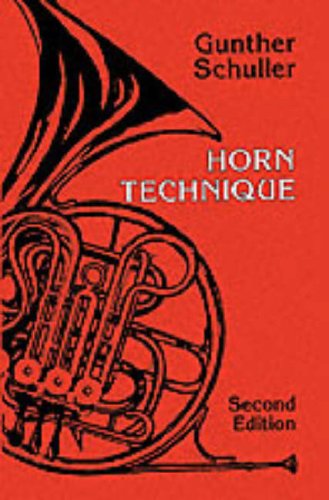
6. Horn Technique
 
7. Early Jazz: Its Roots & Musical
$95.00
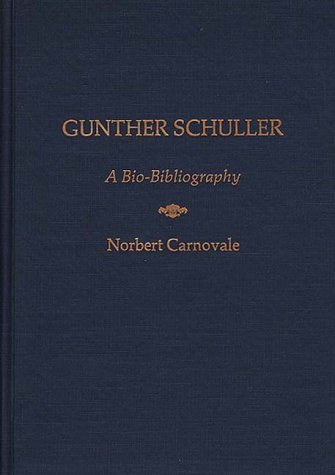
8. Gunther Schuller: A Bio-Bibliography
 
$15.95
9. Annual Review of Jazz Studies
$9.95
10. Biography - Schuller, Gunther
 
11. Musings: the musical worlds of
 
12. Early Jazz : its roots and musical
$110.00
13. THE SWING ERA: THE DEVELOPMENT
 
14. BIG BAND JAZZ FROM THE BEGINNINGS
 
$17.18
15. Journey Into Jazz: Full Score
$10.71
16. Duo Sonata
 
17. BIG BAND JAZZ
 
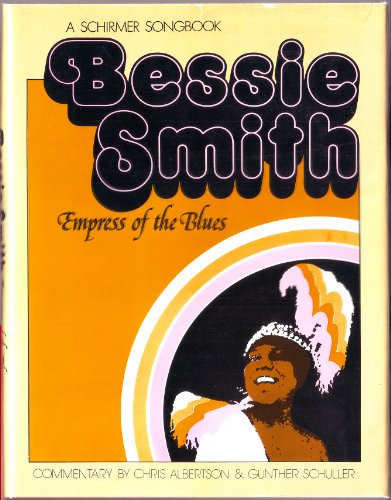
18. Bessie Smith: Empress of the Blues
 
19. Early Jazz: Its Roots and Musical
 
$30.39
20. Concerto No. 3 for Orchestra:

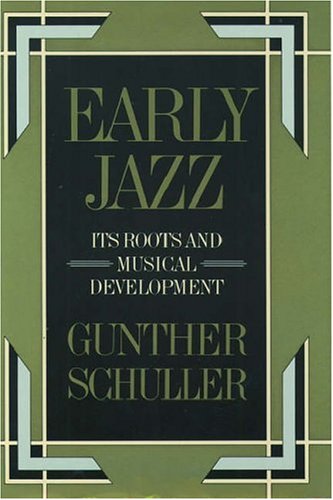
1. Early Jazz: Its Roots and Musical Development (History of Jazz)
by Gunther Schuller
Paperback: 416 Pages (1986-06-19)
list price: US$21.95 -- used & new: US$12.57
(price subject to change: see help)
Asin: 0195040430
Average Customer Review: 5.0 out of 5 stars
Canada | United Kingdom | Germany | France | Japan
Editorial Review

Book Description
This classic study of jazz by renowned composer, conductor, and musical scholar Gunther Schuller was widely acclaimed on its first publication in 1968.The first of two volumes on the history and musical contribution of jazz, it takes us from the beginnings of jazz as a distinct musical style at the turn of the century to its first great flowering in the 1930's.Schuller explores the music of the great jazz soloists of the twenties--Jelly Roll Morton, Bix Beiderbecke, Bessie Smith, Louis Armstrong, and others--and the big bands and arrangers--Fletcher Henderson, Bennie Moten, and especially Duke Ellington--placing their music in the context of the other musical cultures and languages of the 20th century and offering original analyses of many great jazz recordings. Now reissued in paper, Early Jazz provides a musical tour of the early American jazz world for a new generation of scholars, students, and jazz fans. ... Read more

Customer Reviews (4)

4-0 out of 5 stars understanding jazz
the author gunther does a magnifent jobof affording a history of the evolution of jazz, thisin a most scholarly fashion. thus making at times somewhat academic effecting a use of words whose understanding may be elusive to the ordinary reader.

5-0 out of 5 stars essential reference
You can argue with Schuller, and in fact, that's half the fun.He's not always right, but he's always interesting.If you're listening to early jazz and an unfamiliar band comes on, you'll be unable to resist looking them up in this book, so put the book next to the radio.

5-0 out of 5 stars The best musical examination of 20s jazz
Jazz criticism tends to run in two groups: one, the biographical/anecdotal(often marvelous to read), and two, word pictures of how the music made thewriter feel (often awful to read).Gunther Schuller's "EarlyJazz" does what any undergraduate musicology major would do: examinethe music note by note, and explain what's going on.While this is not aneasy book to read for people like me who have no musical training (ortalent, for that matter), it is an absolutely essential book nonetheless. Schuller goes through each major musician and movement of the twenties, andshows exactly what is occurring.What worked best for me was to have therecording he was discussing playing while I read, so I could hear what hewas talking about.Anybody in love with the early music of Armstrong orEllington needs to tackle this book sooner or later.

5-0 out of 5 stars An American Heritage.
I can't believe that no-one has reviewed this wonderful book until now. It is one of the cornerstones of jazz criticism, and the first one not written by one of these annoying pipe-smoking, foot-tapping listeners you alwaysnotice sitting at tables beside the bandstand at jazzclubs, but by a veryfine musician who has actually been 'one of the cats'. O.K., he is a Frenchhorn-player, but jazz buffs who are 'in the know' with the work of JuliusWatkins and John Graas won't mind. But seriously: His chapters onArmstrong, Jelly Roll Morton (some thirty years before the Dirty DozenBrass Band decided to dedicate a whole CD to the music of this first truly'jazz composer'), but especially Fletcher Henderson and Duke Ellington willenlighten everyone who is looking for a critical assesment of the music andis tired of the endless re-telling of the phoney 'romantic' storiessurrounding this music. And for the people who think they know abouteverything: One chapter is enirely dedicated to what is known as'territory' bands, the bands that only played their home town and theregion around it. Many a gem of inspired music can be unearthed in thischapter. P.S. O.K., I'm biased. Mr. Schuller autographed my hardcover copyof the book when he was conducting the Dutch Radio Symphony Orchestra, andI gatecrashed at a rehearsal. ... Read more


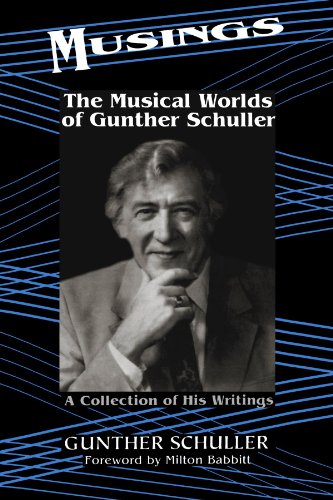
2. Musings: The Musical Worlds of Gunther Schuller: A Collection of His Writings
by Gunther Schuller
Paperback: 320 Pages (2002-08-29)
list price: US$16.95 -- used & new: US$9.98
(price subject to change: see help)
Asin: 0306809028
Canada | United Kingdom | Germany | France | Japan
Editorial Review

Book Description
"Scholar, composer, conductor, teacher, author, music publisher, indefatigable advocate--Gunther Schuller isn't merely a musician; he's a monopoly."So wrote Alan Rich of New York Magazine in 1978, and his description still holds.
Musings is a marvelous introduction to Schuller and his extraordinary range of musical experience, taste, and learning.The book is devided into four sections offering a rich sampling of Schuller's musical interests. In Part I, "Jazz and the Third Stream," Schuller gives us his definitions of
jazz as well as insightful pieces on such figures as Duke Ellington, Sarah Vaughan, Lee Konitz, Sonny Rollins, and Cecil Taylor.Part II, "Music Performance and Contemporary Music," includes pieces on conducting, the future of opera, the question of a new classicism, and the works of Monteverdi and
Stravinsky,Part III shows us "Schuller the Composer" with such pieces as "Shapes and Designs," "Composing for Orchestra," and "In Praise of Winds," as well as Schuller's own thought about his controversial opera The Visitation.The final section, "Music Esthetics and Education," finds Schuller
reflecting on such matters as form, structure, and symbol in music, and the need for broadening the audience for quality music.
From the scholarly to the popular and the polemical, Musings will delight Schuller's admirers and win new converts.
About the Authors:
Gunther Schuller is the author of Early Jazz which Nat Hentoff proclaimed a "remarkable breakthrough in musical analysis of jazz." In addition to composing and conducting, Schuller has been President of the New England Conservatory of Music in Boston. ... Read more


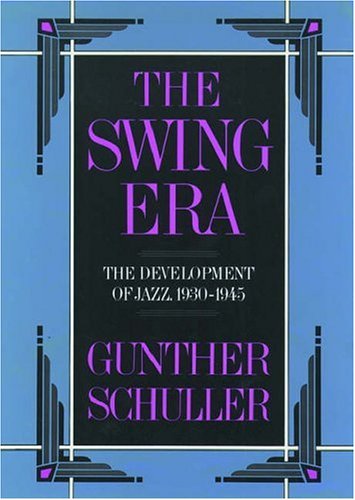
3. The Swing Era: The Development of Jazz 1930-1945
by Gunther Schuller
Textbook Binding: 944 Pages (1989-03-02)
list price: US$35.00 -- used & new: US$47.95
(price subject to change: see help)
Asin: 019504312X
Average Customer Review: 4.5 out of 5 stars
Canada | United Kingdom | Germany | France | Japan
Editorial Review

Book Description
Here is the book jazz lovers have eagerly awaited, the second volume of Gunther Schuller's monumental The History of Jazz.When the first volume, Early Jazz, appeared two decades ago, it immediately established itself as one of the seminal works on American music.Nat Hentoff called it "a
remarkable breakthrough in musical analysis of jazz," and Frank Conroy, in The New York Times Book Review, praised it as "definitive.... A remarkable book by any standard...unparalleled in the literature of jazz." It has been universally recognized as the basic musical analysis of jazz from its
beginnings until 1933.
The Swing Era focuses on that extraordinary period in American musical history--1933 to 1945--when jazz was synonymous with America's popular music, its social dances and musical entertainment.The book's thorough scholarship, critical perceptions, and great love and respect for jazz puts this
well-remembered era of American music into new and revealing perspective.It examines how the arrangements of Fletcher Henderson and Eddie Sauter--whom Schuller equates with Richard Strauss as "a master of harmonic modulation"--contributed to Benny Goodman's finest work...how Duke Ellington used
the highly individualistic trombone trio of Joe "Tricky Sam" Nanton, Juan Tizol, and Lawrence Brown to enrich his elegant compositions...how Billie Holiday developed her horn-like instrumental approach to singing...and how the seminal compositions and arrangements of the long-forgotten John Nesbitt
helped shape Swing Era styles through their influence on Gene Gifford and the famous Casa Loma Orchestra.Schuller also provides serious reappraisals of such often neglected jazz figures as Cab Calloway, Henry "Red" Allen, Horace Henderson, Pee Wee Russell, and Joe Mooney.
Much of the book's focus is on the famous swing bands of the time, which were the essence of the Swing Era. There are the great black bands--Duke Ellington, Count Basie, Jimmie Lunceford, Earl Hines, Andy Kirk, and the often superb but little known "territory bands"--and popular white bands like
Benny Goodman, Tommy Dorsie, Artie Shaw, and Woody Herman, plus the first serious critical assessment of that most famous of Swing Era bandleaders, Glenn Miller. There are incisive portraits of the great musical soloists--such as Art Tatum, Teddy Wilson, Coleman Hawkins, Lester Young, Bunny Berigan,
and Jack Teagarden--and such singers as Billie Holiday, Frank Sinatra, Peggy Lee, and Helen Forest. ... Read more

Customer Reviews (6)

4-0 out of 5 stars An incredibly informative mess
Where to begin? Schuller wants to talk about everything - he doesn't want to miss a single band. It's not like Vol. 1 - Early Jazz where he aims and fires. Here everything is scattershot, all over the place. And two ideas come back over and over in a kind of subconscious fashion: one, the idea that riffing is a sign of knee-jerk, insufficently compositional thinking; two, that innovation in Jazz is connected to being "ahead of one's time". If I had lots of time on my hands, I'd catalog these recurrences - Oxford University Press, you're supposed to catch these things! For all of his knowledge, Schuller is insufficiently scholarly - the chapter on Basie is absurd in its criticisms of Basie for not being a compositional thinker like Ellington. I hate to get all racial, but it seems like Schuller doesn't appreciate many of the blacker aspects of Black music. And it's fine that Schuller didn't do all of his own transcriptions - but he should've at least approved them all. Bobby Stark's solo showing up next to a passionate discussion of Red Allen's solo on Henderson's King Porter Stomp gave that one away...

What did I learn from this book? Well...it made me go out and check out Bob Crosby's band more. The section on Horace Henderson was really informative. The book is filled with great things, but even on the level of basic syntax and sentence structure there are so many problems. Just to pick out one of many tortured phrases - Page 253:"I am referring to the curious fact that Basie's music is rarely memorable thematically ( nor is it in terms of timbre or color ). Nor is it WHAT? In speech, we'd understand: "memorable" . But this is supposed to be a History...how hard would it have been to bring this all in line?

If it weren't the only book of its kind...but it is. Someday there'll be more, and we'll be able to appreciate the good things about this one, and forget about the anomalies and longeurs. I hope I'll be around to see that day.

5-0 out of 5 stars Monumental accomplishment
To get some idea of the achievement between these pages, just stop to think that Gunther Schuller listened to some 30,000 recordings, famous and obscure, from the period between 1930 and 1945, in chronological order for each band or performer.It took him fourteen years.

Now you might think after all that that he would emerge with brain so fuzzy, ears so buzzed, that he could not write intelligently about the music, so submerged had he been for so long.But au contraire--this is the most lucid, the best anthology of any jazz era I've ever seen.No one could argue it isn't the most comprehensive.Schuller analyzes bands big and small, famous and unknown, national and "territory."

Some of his opinions go against the critically-accepted grain, which seems to have ruffled a few other reviewers here, but his point of the survey, I think, was to go beyong "lazy, complacentlistening" and evaluate each work afresh.So we have a Count Basie orchestra that, while indisputably fine, isn't quite the jazz sin qua non that it's often held out to be.As Schuller points out--accurately, I think--Basie's band was a triumph because of the magnificent soloists, but frankly the arrangements were often uninspired and formulaic, the tunes undistinguished, the colors and contrasts minimized.This made me realize why I never liked other midwestern territory bands as much as the Count's: they generally didn't have the soloists, and without stellar soloists (and not just "good" soloists) it's hard to sustain interest in riffs and themes which quickly become routine. This may upset the apple cart with some people, but I think Schuller is on the money.

Similar, his assessment of Benny Goodman is generally spot-on, though I think I like some of the band's soloists more than he does and give them more credit than he does.However, he is mostly evaluating BG's studio recordings, and that band was far better live.(All bands are better in front of a live audience, of course, but the difference with BG's 30s group is truly stunning.)But Babe Russin was quite the fine understated tenor soloist, Chris Griffin was very underappreciated on trumpet (as was earlier Goodman trumpeter Nate Kazebier--hope I'm spelling that right).Jess Stacy is one of the unsung heroes of swing piano, especially as an accompanist (some of his best comping is on the 1938 Carnegie Hall Concert).Schuller basically ignores these sidemen.Even Ziggy Elman gets the short shrift, with a focus on his schlocky popular stuff instead of some of his logically-constructed solos.But I guess, even with 30,000 recordings under your belt, some performances are bound to escape your notice.

Schuller's chapter on Ellington could itself be a course at a university.You could indeed buy the book just for this section and play through all the recordings mentioned and come away far more knowledgeable about Duke, about jazz, and about music and composition in general.Discussing Schuller's take on Ellington is beyond the scope of this review, save to say it makes for pages and pages of fascinating reading.

Schuller also manages to cut through the Artie Shaw mystique (more BS than mystique, he feels; Shaw, with his verbal fecundity and limited knowledge of European art, was able to snow some jazz and pop writers, but he's just no match for Schuller).And he makes the interesting observation that Glenn Miller played far more true swing than he is credited for (though it was hardly innovative or even often very exciting swing) and Tommy Dorsey played far less, sticking with the Chicago/Dixieland two-beat style long after it had gone out of favor, until about 1940 (!).A lot of Dorsey's music is actually very hokey--"Mickey Mouse"--yet he is usually taken more seriously as a swing musician than Miller.

On the subject of smaller bands and lesser-known leaders from this period, Schuller points out how underappreciated Cab Calloway, Erskine Hawkins and Jimmy Lunceford were, and how relatively overrated Lionel Hampton, Bunny Berrigan and Louis Armstrong (of this period; the innovative Armstrong of the 20s was covered in his Early Jazz book) were.Again, these views--backed up by extremely thorough analysis and stoic discussion, will ruffle a lot of feathers among emotional keepers of the flame, but I find his analysis to be rather spot-on.Also invaluable is his clear-headed discussion of Art Tatum's strengths and weaknesses.

The book is chock full of examples in music notation, and in some instances whole solos and passages are written out.That may scare off some who cannot read music, but it shouldn't.It will largely help to have the recordings in the CD player, ready to go, so the reader can follow along with the notation.And everyone will not follow every discussion of harmonies, scales and chord progressions--no matter.You don't have to understand everything to get a lot from this work, and repeated readings will benefit you as well.Just don't show it to anyone to whom jazz is a religion, and its players are holy priests; they won't appreciate some of Schuller's deconstructions.

Incidentally, Schuller is supposedly working on a volume III that deals with the bebop era and the development of "modern" jazz.(The first volume of this series dealt with pre-1930s jazz and is also a classic.)Considering how much time the present book required, I hope he lives long enough to finish this magnificent project.

5-0 out of 5 stars Spot-on survey of Swing Era
Unlike a previous reviewer, I find Schuller's "biases" quite refreshing. He is unafraid to distinguish the outstanding from the merely imitative or blantantly commercial, whether in comparing bands or musicians or in pointing out the strong points and weak points of individual artists.

While not providing individual biographies, he does manage to put the music into a social/economic context and does better than any other writer in speaking frankly about the interplay between black and white artists during this era without prejudice on either side.

5-0 out of 5 stars Excellent reference book
As far as I know it, this is the most comprehensive book on swing music available. Gunther Schuller is interested in music, not life histories, so biographical information on musicians is scarce. The music, on the other hand, is described and analyzed thoroughly, with great originality and enthousiasm, including information on cross-links, influences, analyses of arrangements, song structures and solos.
I don't believe anyone will read this book from the beginning to the end: each chapter is about a separate artist, and an overall history is lacking. Moreover, one really needs to be able to listen to the described music to enjoy the book, but this is also its strong point: one becomes really eager to listen to the jazz described, often with 'new ears' provided by the author. As a reference book and as a tool to explore jazz between 1930 and 1945 with, "the swing era" is unsurpassed.

2-0 out of 5 stars Not bad
This book was used for a history of music class that I took at an Ivy League school. The reason it was chosen is that it is the most comprehensive work on the swing era in jazz. However, the book has a huge flaw: although there are tons of scores and technical details as well as personal accounts and anecdotes (to suit all types of readers), the author leaves his pronounced bias on everything. He is very passionate about swing music, it is obvious, but many of his descriptions and comparisons are practically worthless to the student of music. It sounds as if he was getting intoxicated by his own play with words.

I can't figure out who would be the ideal reader -- besides Schuller himself. Musicians would probably be annoyed by the author's strong and poorly supported opinions that fill the pages. People with no musical backgrounds would dislike it because it is too technical in many places (you lose a lot if you can't read notes and don't understand the lingo). The only redeeming quality is the sheer scope of the book, so it may be useful to a student taking a survey course on jazz/swing. Even in the last case, you will be frustrated by the lack of organization. You won't be able to figure out where a certain band played/originated (or it will take you an hour to find out) but he'll tell you how the glissando at the end of the third chorus of their most obscure song was more loaded with energy than Paganini's works combined.

In a nutshell: very comprehensive and yet very biased presentation of swing. ... Read more


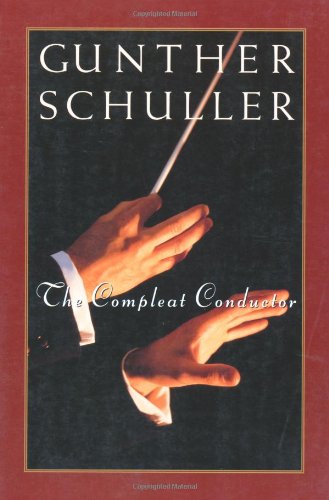
4. The Compleat Conductor
by Gunther Schuller
Paperback: 592 Pages (1998-12-10)
list price: US$32.50 -- used & new: US$15.09
(price subject to change: see help)
Asin: 0195126610
Average Customer Review: 4.0 out of 5 stars
Canada | United Kingdom | Germany | France | Japan
Editorial Review

Amazon.com
What makes for a "compleat" conductor? According to Gunther Schuller, it is a combination of fidelity to the score and going "for the grand line ... the clarification of the inherent structure(s)." Schuller, himself a conductor, has written The Compleat Conductor as a kind of report card on many of this century's foremost practitioners of the art. Using scores from Beethoven, Brahms, Schumann, Tchaikovsky, Strauss, and Ravel as his final exam, Schuller measures the work of the world's great conductors--everyone from Toscanini to John Eliot Gardiner--against what's printed on the page, and he finds most wanting in comparison.

The Compleat Conductor is partly an indictment of the failings of other conductors, partly Schuller's reflections on music, performance, and the authority of the score versus the authority of the conductor. Many of Schuller's pronouncements are sure to arouse controversy, but even for music lovers who disagree with his grading system, there's plenty of food for thought in The Compleat Conductor.Book Description
A world-renowned conductor and composer who has lead most of the major orchestras in North America and Europe, a talented musician who has played under the batons of such luminaries as Toscanini and Walter, and an esteemed arranger, scholar, author, and educator, Gunther Schuller is without doubt a major figure in the music world. Now, in The Compleat Conductor, Schuller has penned a highly provocative critique of modern conducting, one that is certain to stir controversy. Indeed, in these pages he castigates many of this century's most venerated conductors for using the podium to indulge their own interpretive idiosyncrasies rather than devote themselves to reproducing the composer's statedand often painstakingly detailed intentions. Contrary to the average concert-goer's notion (all too often shared by the musicians as well) that conducting is an easily learned skill, Schuller argues here that conducting is "the most demanding, musically all embracing, and complex" task in the field of music performance. Conducting demands profound musical sense, agonizing hours of study, and unbending integrity. Most important, a conductor's overriding concern must be to present a composer's work faithfully and accurately, scrupulously following the scoreincluding especially dynamics and tempo markingswith utmost respect and care. Alas, Schuller finds, rare is the conductor who faithfully adheres to a composer's wishes. To document this, Schuller painstakingly compares hundreds of performances and recordings with the original scores of eight major compositions: Beethoven's fifth and seventh symphonies, Schumann's second (last movement only), Brahms's first and fourth, Tchaikovsky's sixth, Strauss's "Till Eulenspiegel" and Ravel's "Daphnis et Chloe, Second Suite." Illustrating his points with numerous musical examples, Schuller reveals exactly where conductors have done well and where they have mangled the composer's work. As he does so, he also illuminates the interpretive styles of many of our most celebrated conductors, offering pithy observations that range from blistering criticism of Leonard Bernstein ("one of the world's most histrionic and exhibitionist conductors") to effusive praise of Carlos Kleiber (who "is so unique, so remarkable, so outstanding that one can only describe him as a phenomenon"). Along the way, he debunks many of the music world's most enduring myths (such as the notion that most of Beethoven's metronome markings were "wrong" or "unplayable," or that Schumann was a poor orchestrator) and takes on the "cultish clan" of period instrument performers, observing that many of their claims are "totally spurious and chimeric." In his epilogue, Schuller sets forth clear guidelines for conductors that he believes will help steer them away from self indulgence towards the correct realization of great art. Courageous, eloquent, and brilliantly insightful, The Compleat Conductor throws down the gauntlet to conductors worldwide. It is a controversial book that the music world will be debating for many years to come. ... Read more

Customer Reviews (9)

2-0 out of 5 stars doesn't see the wood for the trees.
This book often inspires a fresh take on the standard repertoire,more alive than the average analysis book.It's easy to understand why Schuller has carved a reputation as a composition teacher-Bainbridge,Weir and Knussen from the UK alone!

Alas,the central thrust of 'The Compleat Conductor'-that conductors often deviate from the letter of the score(shock,horror!)....becomes weary and pedantic in the end.Schuller really doesn't see the wood for the trees and his arguments aren't as watertight as you might think as some of the other reviewers have shown.

5-0 out of 5 stars A wonderful resource...I'm listening with new ears
This book was recommended to me during a conducting workshop.The teacher, an extremely knowledgeable musician and gifted and hardworking conductor, hated this book upon FIRST reading, and as he explored the concepts and analyses further found more enlightenment and wisdom.You can tell the folks who didn't like this book are writing off the cuff.

In The Compleat Conductor, Gunther Schuller gives us his philosophy and a short history of conducting, and then goes into some real detail analyzing eight great classical works and how even the greatest maestros can fail the composer's wishes and ideals.Schuller is VERY straightforward and covers all of his bases well, and defends his points and decisions and pickiness.A quote:"The secret of great artistry and true integrity of interpretation lies in the ability to bring to life the score for the listener (and the orchestra) through the fullest knowledge of the score, so that the conductor's personality expresses itself WITHIN the parameters of the score."Schuller maintains that composers like Beethoven and Brahms were very explicit in their desires, and that their music doesn't need all of the extra bells and whistles conductors use to manipulate an audience, and in fact a good number of conductors in the process ignore the finer points of the music.
Quote again:"...all those deviations from the score do not necessarily make the performance 'more natural,''more human.' They may create that illusion--or delusion; they may fool the unknowing, unwary listener into thinking that it was 'exciting,''moving,''authentic,' when in reality the excitement was superficial and the work was grossly misrepresented."

There are points in the book where Schuller then recommends changing this and that in various scores.But in these sections he more than backs up his reasons--perhaps there is conflict between the manuscript and printed scores, or maybe there is truly a problem in balance due to the power of different instruments, etc.

I am now listening to recordings with a new critical ear, and approaching my orchestral work with a refreshed perspective.

5-0 out of 5 stars A wonderful resource...I'm listening with new ears
This book was recommended to me during a conducting workshop. The teacher, an extremely knowledgeable musician and gifted and hardworking conductor, hated this book upon FIRST reading, and as he explored the concepts and analyses further found more enlightenment and wisdom. You can tell the folks who didn't like this book are writing off the cuff.

In The Compleat Conductor, Gunther Schuller gives us his philosophy and a short history of conducting, and then goes into some real detail analyzing eight great classical works and how even the greatest maestros can fail the composer's wishes and ideals. Schuller is VERY straightforward and covers all of his bases well, and defends his points and decisions and pickiness. A quote: "The secret of great artistry and true integrity of interpretation lies in the ability to bring to life the score for the listener (and the orchestra) through the fullest knowledge of the score, so that the conductor's personality expresses itself WITHIN the parameters of the score." Schuller maintains that composers like Beethoven and Brahms were very explicit in their desires, and that their music doesn't need all of the extra bells and whistles conductors use to manipulate an audience, and in fact a good number of conductors in the process ignore the finer points of the music.
Quote again: "...all those deviations from the score do not necessarily make the performance 'more natural,''more human.' They may create that illusion--or delusion; they may fool the unknowing, unwary listener into thinking that it was 'exciting,''moving,''authentic,' when in reality the excitement was superficial and the work was grossly misrepresented."

There are points in the book where Schuller recommends changing this and that in various scores, which would seem to directly contradict everything he built up in the first two sections of the book. But in these sections he more than backs up his reasons--there may be a conflict between the manuscript and printed scores, maybe there is truly a problem in balance due to the power of different instruments, or else there may be problems in the publishing.His point being that you have to make informed, intelligent decisions when you bring music to life with an ensemble.Every single nitpick Schuller has with the world's greatest conductors is backed up by examples in the score and historical musical analysis.I have to admit it is a little bit fun to read some of the barbs he throws at the "great maestroes", and to know that they are fallible and not necessarily automatically superior interpreters of every work.A conductor can get a sound thrashing for certain points of his interpretation of a piece, but then on the next page be commended as being the ultimate purveyor of good taste in another passage over all others.So each conductor is only judged on their actions within the music and get equal consideration (with the exception of Bernstein who gets a poke or two for his ego and podium gyrations).

As a violinist in a couple of local symphonies and someone who has studied to a small degree the art of conducting, I have to agree with Schuller that most musicians have no idea what actually goes on within a score and that that is a real disservice to the music.Most musicians, I have discovered, also have no idea what makes the difference between a great conductor and teacher and someone who can go through the motions and look really good--without actually transferring much meaning into the music for the musicians to work with.This is why The Compleat Conductor is important for musicians to read.And if you are simply a classical music lover this could get a little bit pedantic at times, but if you also like to follow scores can be an eye-opener when you go back to listen again with your favorite recording.

By the way, Schuller does make exceptions for the different sound qualities of recordings of different time periods and does note those places where he couldn't be sure of problems because of those difficulties.There are also a couple of unfortunate editing errors, but they are small considerations within the large scope of this work.

1-0 out of 5 stars Beethoven and Toscanini make way, Schuller knows best!
This is a very bizarre book indeed. Schuller's ideals are laudable in themselves: don't tamper with scores and don't let your ego get in the way of what the composer is saying. But his attempts to prove his point are flawed in almost every way, mainly because he constantly breaks the rules that he set out himself to start with. He obsessively analyses recordings of a number of famous great works with the score in hand, and points out the innumerable sins, blunders and stupidities that in his view virtually every conductor allows himself in virtually every bar. For some reason the author presumes he is just about the only one who knows how it should be done, or cares about doing it well, or even more amazingly: knows what the composer actually meant. E.g.: Changing anything in a score is a mortal sin, because the composer knows best - only Schuller knows better, pointing out where the composer 'forgot' something or is 'obviously' wrong, and changing instrumentation, tempo or dynamics accordingly. For some unspecified reason (a personal hotline to the hereafter maybe?) the author is the only conductor allowed to make such decisions; be sure he will hurl accusations of incompetence or arrogance at others who do the same thing! These inconsistencies are an inevitable result from the assumption that scores are fairly unambiguous and composers well nigh infallible. Of course, they aren't and they aren't.
Schuller claims objectivity, but his methods wouldn't hold their own against even the mildest scientific criteria. How can one realistically compare recordings from the '30s to state of the art CD-sound from the '90s? Can one really, objectively and consistently, judge the difference between pp and ppp? And if Schuller can't hear a particular detail, is that proof of an inadequate performance - or does it say something about differences in recording techniques, about the (unspecified) playback equipment Schuller used, or even about his hearing? Worse, Schuller's reasoning is rarely other than subjective: 'Any intelligent reading of the score will make it obvious...', and arguments like that. Also he will point out how 'natural', 'thrilling' or 'perfect'something will sound if done the right (i.e., Schuller's) way, forgetting that these are all matters of taste. Where he really gives himself away is in his vitriolic attack on the authenticists, which is so poorly argued and random that I find it hard to understand without wondering about personal motives (Schuller pulls all the stops here, and enjoys adding a footnote in which he points out that in a supposedly 'expert' booklet note on an authentic Beethoven recording the term 'mezza voce' is misspelled as 'mesa voce'. This turns out unexpectedly funny seeing that Schuller himself also misspells the term, as 'messa voce'!).
Maybe for some this book invites a new look at some scores, but it also turns music-making into a scholastic exercise at the risk of draining all feeling out of it. The useful points that are made could have been made in under 50 pages; the rest is just obsessive repetition. It might have warranted 2 stars, maybe, but I felt the overenthusiastic average rating needed some reduction towards a more realistic level.

5-0 out of 5 stars A Must Read for Every Musician
Gunther Schuller is, in my view, the most knowledgeable living
musician. What this book provides is a factual awareness of hoaxes perpetrated by so-called 'name' conductors over the years.
Every symphony orchestra player will benefit from the information provided in this masterpiece. ... Read more


5. Musings: The Musical Worlds of Gunther Schuller
by Gunther Schuller
 Paperback: Pages (1989)

Asin: B00120BUHY
Canada | United Kingdom | Germany | France | Japan

6. Horn Technique
by Gunther Schuller
Paperback: 152 Pages (1992-04-02)
list price: US$50.50 -- used & new: US$38.65
(price subject to change: see help)
Asin: 0198162774
Average Customer Review: 4.0 out of 5 stars
Canada | United Kingdom | Germany | France | Japan
Editorial Review

Book Description
The first edition of this book was published in 1962 and quickly established itself as the classic guide to all aspects of horn-playing, with chapters on tone-production, exercises, legato and staccato playing, and the art of practising.For this new edition the author has greatly enlarged the Repertoire List, which gives details of over 1,000 pieces from the solo, chamber, and orchestral repertoires which include one or more horns.The author draws attention to key works in each genre.There are also a number of corrections and up-datings throughout the text and a new preface outlining recent developments in the horn world. ... Read more

Customer Reviews (1)

4-0 out of 5 stars Review of Horn Technique
This is an excellent handbook and supplementary guide to the Farkas book. I recommend this book to horn players of any level. Like the Farkas book, this reviews technique and tips to make good horn players even better. Thisalong with the Farkas Book, are absolute musts in the horn players library. ... Read more


7. Early Jazz: Its Roots & Musical Development
by Gunther Schuller
 Hardcover: Pages (1968)

Asin: B000QB8U4G
Canada | United Kingdom | Germany | France | Japan

8. Gunther Schuller: A Bio-Bibliography (Bio-Bibliographies in Music)
by Norbert Carnovale
Hardcover: 350 Pages (1987-05-15)
list price: US$95.00 -- used & new: US$95.00
(price subject to change: see help)
Asin: 0313250847
Canada | United Kingdom | Germany | France | Japan

9. Annual Review of Jazz Studies 1: Features King Oliver, Gunther Schuller, Fats Waller, Black College Bands (Annual Review of Jazz Studies)
 Paperback: 192 Pages (1982-06)
list price: US$18.50 -- used & new: US$15.95
(price subject to change: see help)
Asin: 0878558969
Canada | United Kingdom | Germany | France | Japan

10. Biography - Schuller, Gunther (1925-): An article from: Contemporary Authors
by Gale Reference Team
Digital: 8 Pages (2002-01-01)
list price: US$9.95 -- used & new: US$9.95
(price subject to change: see help)
Asin: B0007SF4FG
Canada | United Kingdom | Germany | France | Japan
Editorial Review

Book Description
This digital document, covering the life and work of Gunther Schuller, is an entry from Contemporary Authors, a reference volume published by Thompson Gale. The length of the entry is 2306 words. The page length listed above is based on a typical 300-word page. Although the exact content of each entry from this volume can vary, typical entries include the following information:

  • Place and date of birth and death (if deceased)
  • Family members
  • Education
  • Professional associations and honors
  • Employment
  • Writings, including books and periodicals
  • A description of the author's work
  • References to further readings about the author
... Read more

11. Musings: the musical worlds of gunther schuller
by Gunther Schuller
 Paperback: Pages (0002)

Asin: B000P0UX9S
Canada | United Kingdom | Germany | France | Japan

12. Early Jazz : its roots and musical developement
by Gunther Schuller
 Hardcover: Pages (1968)

Asin: B000NE3BC2
Canada | United Kingdom | Germany | France | Japan

13. THE SWING ERA: THE DEVELOPMENT OF JAZZ 1930-1945
by Gunther Schuller
Hardcover: 919 Pages (1989)
-- used & new: US$110.00
(price subject to change: see help)
Asin: B000REI4N4
Canada | United Kingdom | Germany | France | Japan
Editorial Review

Product Description
Twenty years after the publication of Early Jazz , French hornist, conductor, composer, educator and broadcaster Schuller brings forth this 900-page second volume in his monumental "History of Jazz." He is perhaps better equipped to analyze style and technique than anyone else who has written about this music. No previous critic has delineated in as great detail how the various styles developed and coalesced. Schuller devotes 40 pages to Louis Armstrong, 110 pages and 62 musical examples to Duke Ellington. He identifies the unique characteristics of each of the big bandsamong them, Count Basie, Benny Carter, Lionel Hampton, Coleman Hawkins, Fletcher and Horace Henderson, Earl Hines, Jimmie Lunceford and Chick Webb; of arrangers Mel Powell, Don Redman and Eddie Sauter; of such soloists as Bunny Berigan, Charlie Christian, Roy Eldridge, Billie Holiday, Art Tatum, Jack Teagarden, Ben Webster and Teddy Wilson; of the small groups of Nate Cole, John Kirby, Red Nichols and Rex Stewart; even of the "territory bands" of the Middle West. He also explicates the contributions of the big white bands of Charlie Barnet, Bob Crosby, Tommy Dorsey, Benny Goodman, Woody Herman, Harry James, Gene Krupa, Glenn Miller and Claude Thornhill, who, by codifying and expanding upon the innovations of their black counterparts, played as crucial a role and brought jazz to millions who otherwise would never have heard any jazz at all. Schuller's evaluations are original, trenchant and even-handed: He discusses shortcomingsstylistic stultification, topheavy sound, exuberant vulgarity, for exampleas well as achievements. And he demonstrates the gradual atrophying of swing by repetition, formularization, the reduction of improvisation and loss of spontaneity. More brilliantly than anyone before him, Schuller has explained a glorious period in the history of American music. ... Read more


14. BIG BAND JAZZ FROM THE BEGINNINGS TO THE FIFTIES
by GUNTHER: WILLIAMS, MARTIN SCHULLER
 Paperback: Pages (1983)

Asin: B000J2MRJG
Canada | United Kingdom | Germany | France | Japan

15. Journey Into Jazz: Full Score
 Paperback: 80 Pages (1986-11-01)
list price: US$25.00 -- used & new: US$17.18
(price subject to change: see help)
Asin: 0793513596
Canada | United Kingdom | Germany | France | Japan
Editorial Review

Book Description
For narrator, jazz ensemble and small orchestra. ... Read more


16. Duo Sonata
by Gunther Schuller
Paperback: 16 Pages (1986-11)
list price: US$15.00 -- used & new: US$10.71
(price subject to change: see help)
Asin: 0634013890
Canada | United Kingdom | Germany | France | Japan
Editorial Review

Book Description
For clarinet and bass clarinet. Includes set of parts for each player. ... Read more


17. BIG BAND JAZZ
by Gunther Schuller
 Paperback: Pages (1983)

Asin: B000N3552M
Canada | United Kingdom | Germany | France | Japan

18. Bessie Smith: Empress of the Blues
by Chris Albertson, Gunther Schuller
 Hardcover: Pages (1975-06)
list price: US$12.95
Isbn: 0028700201
Canada | United Kingdom | Germany | France | Japan

19. Early Jazz: Its Roots and Musical Development
by Gunther Schuller
 Paperback: Pages (1968)

Asin: B000OKC1H6
Canada | United Kingdom | Germany | France | Japan

20. Concerto No. 3 for Orchestra: Farbenspiel: Full Score
 Paperback: 80 Pages (1994-03-01)
list price: US$40.00 -- used & new: US$30.39
(price subject to change: see help)
Asin: 0793529603
Canada | United Kingdom | Germany | France | Japan
Editorial Review

Book Description
Concerto No. 3 for Orchestra: Farbenspiel is the third concerto for orchestra by Gunther Schuller.The first was composed for the Chicago Symphony in 1966. ... Read more


  1-20 of 67 | Next 20
A  B  C  D  E  F  G  H  I  J  K  L  M  N  O  P  Q  R  S  T  U  V  W  X  Y  Z  

Prices listed on this site are subject to change without notice.
Questions on ordering or shipping? click here for help.

site stats