e99 Online Shopping Mall

Geometry.Net - the online learning center Help  
Home  - Composers - Schoenberg Arnold (Books)

  1-20 of 100 | Next 20
A  B  C  D  E  F  G  H  I  J  K  L  M  N  O  P  Q  R  S  T  U  V  W  X  Y  Z  

click price to see details     click image to enlarge     click link to go to the store

$14.90
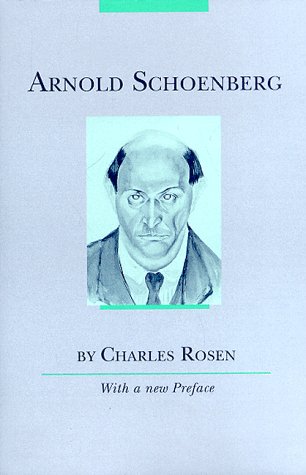
1. Arnold Schoenberg
$23.99
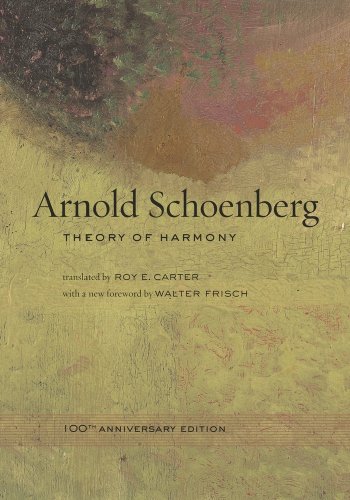
2. Theory of Harmony (California
 
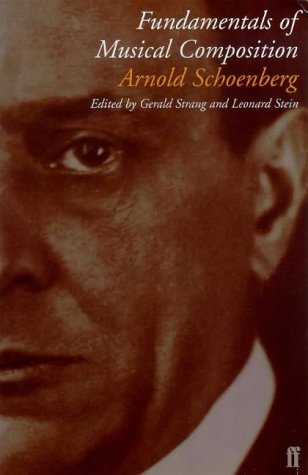
3. Fundamentals of Musical Composition
 
4. Structural functions of harmony
$19.39
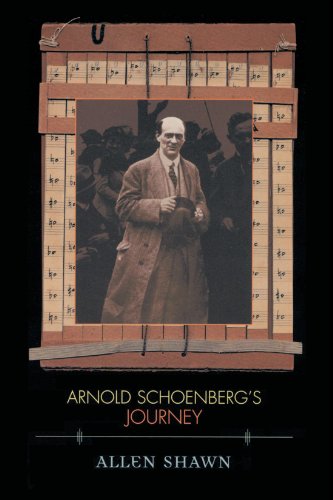
5. Arnold Schoenberg's Journey
$21.58
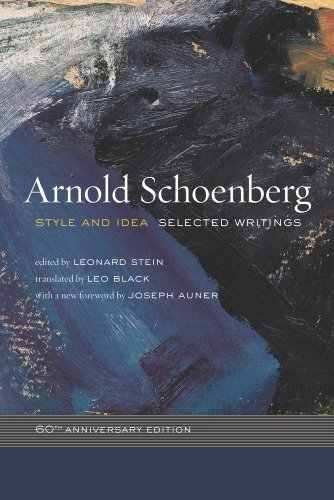
6. Style and Idea: Selected Writings
$11.76
7. Style and Idea
$80.40
8. Schoenberg's Musical Imagination
$50.40
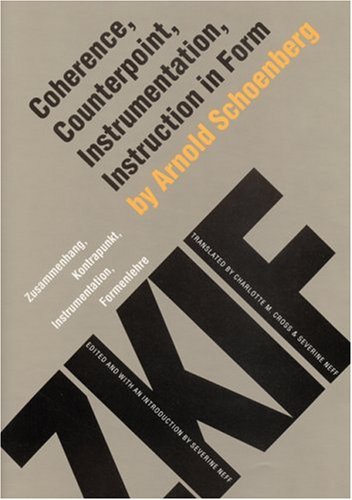
9. Coherence, Counterpoint, Instrumentation,
$20.00
10. The Early Works of Arnold Schoenberg,
$99.95
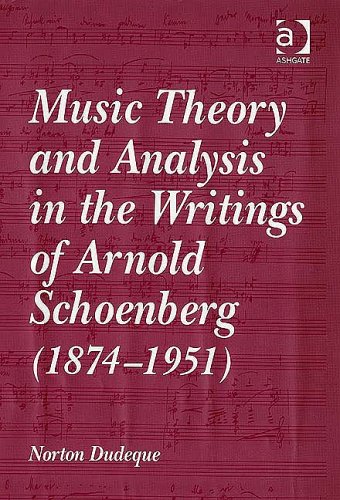
11. Music Theory And Analysis in the
 
12. Preliminary Exercises in Counterpoint
 
13. Arnold Schoenberg / Wassily Kandinsky:
 
14. Arnold Schoenberg's Vienna
$2.84
15. Five Orchestral Pieces (Dover
$29.75
16. The Atonal Music of Arnold Schoenberg,
$35.80
17. Schoenberg and the New Music:
$12.13
18. Five Orchestral Pieces and Pelleas
 
19. Arnold Schoenberg: Fundamentals
 
20. Schoenberg and His School: The

1. Arnold Schoenberg
by Charles Rosen
Paperback: 128 Pages (1996-09-01)
list price: US$15.00 -- used & new: US$14.90
(price subject to change: see help)
Asin: 0226726436
Average Customer Review: 5.0 out of 5 stars
Canada | United Kingdom | Germany | France | Japan
Editorial Review

Book Description

In this lucid, revealing book, award-winning pianist and scholar Charles Rosen sheds light on the elusive music of Arnold Schoenberg and his challenge to conventional musical forms. Rosen argues that Schoenberg's music, with its atonality and dissonance, possesses a rare balance of form and emotion, making it, according to Rosen, "the most expressive music ever written." Concise and accessible, this book will appeal to fans, non-fans, and scholars of Schoenberg, and to those who have yet to be introduced to the works of one of the greatest composers of the twentieth century.

"Arnold Schoenberg is one of the most brilliant monographs ever to be published on any composer, let alone the most difficult master of the present age. . . . Indispensable to anyone seeking to understand the crucial musical ideas of the first three decades."—Robert Craft, New York Review of Books

"What Mr. Rosen does far better than one could reasonably expect in so concise a book is not only elucidate Schoenberg's composing techniques and artistic philosophy but to place them in history."—Donal Henahan, New York Times Book Review

"For the novice and the knowledgeable, Mr. Rosen's book is very important reading, either as an introduction to the master or as a stimulus to rethinking our opinions of him. Mr. Rosen's accomplishment is enviable."—Joel Sachs, Musical Quarterly
... Read more

Customer Reviews (6)

5-0 out of 5 stars a useful hanbook to one of the milestones of 20th century music
Sometimes it's the simplest of observations which make the most long lasting impression.I've always been struck by Rosen's assertion that in 'pierrot lunaire' (or any number of his pieces)it wouldn't make make a huge amount of difference if the instrumental parts were transposed in such a way that the vertical relationships would be altered.Rosen notes that it would be more detrimental if the dynamic markings were altered, affecting the delicate interplay of textures.

5-0 out of 5 stars A short, satisfying read!
Every book I've ever read by Charles Rosen and has deeply affected my view of the topic, and this little book is no exception.There isn't much biography in this book, it is strictly music criticism, focusing on the 'victory' of Schoenberg as well as his two students Webern and Berg.
This book went a long way in helping me to understand the aesthetics of serialism.I don't think a nonmusician would find much use in it, but I think anyone who is a musician at all and has experienced Schoenberg's music will be able to get a lot out of it.

5-0 out of 5 stars excellent mix of bio and musicology
seeing that this is such a small book (barely 100 pages of text), i was surprised at the depth of this book. as one reviewer wrote, it does not get into specifics about his life ('journeys' by allen shawn is good for that), but it gets into enough. i was especially pleased with the musical analysis of schoenberg's music that was presented here, which those who understand music can appreciate; such is left out of many musical biographies that i have read, and that is why i appreciate it here. it does lend a tremendous assistance in understanding his music, and his working philosophy. (that said, though, it might mean that this isnt the book for you if you dont want to get into theory; again, shawn's book is an excellent alternative then.)in fact, after reading this, i started to read schoenberg's writings on music theory, which ifound enlightening.

5-0 out of 5 stars Best starting and ending point for Schoenberg
Robert Craft was on the money in his description of this monograph as "one of the most brilliant ever to be published on any composer, letalone the most difficult master of the present age." Stripping awayany unnecessary biographical details, Mr. Rosen gives a surprisingly deepand insightful chronicle (for so short a book) of both the music ofSchoenberg and that of his contemporaries. Whatever path serialism was tofollow after Schoenberg, his own personal reasons for creating it areelucidated here more clearly and with greater historical insight thananywhere else that I am aware of. It has been popular of late to denigrateSerialism,implicating Schoenberg in some of the excesses of hisfollowers. This has always seemed to stem from some fundamentalmisunderstandings about just what it was Schoenberg was setting out to dowhen he created his twelve-tone system. This work should be mandatoryreading for those revanchist musicians and neo-tonalists who practice asort of musical revisionism in their assessments of Schoenberg'swork--indeed, for anyone who is interested in gaining insight into acomposer of unquestionable genius.

5-0 out of 5 stars Best starting and ending point for Schoenberg
Robert Craft was on the money in his description of this monograph as "one of the most brilliant ever to be published on any composer, letalone the most difficult master of the present age." Stripping awayany unnecessary biographical details, Mr. Rosen gives a surprisingly deepand insightful chronicle (for so short a book) of both the music ofSchoenberg and that of his contemporaries. Whatever path serialism was tofollow after Schoenberg, his own personal reasons for creating it areelucidated here more clearly and with greater historical insight thananywhere else that I am aware of. It has been popular of late to denigrateSerialism,implicating Schoenberg in some of the excesses of hisfollowers. This has always seemed to stem from some fundamentalmisunderstandings about just what it was Schoenberg was setting out to dowhen he created his twelve-tone system. This work should be mandatoryreading for those revanchist musicians and neo-tonalists who practice asort of musical revisionism in their assessments of Schoenberg'swork--indeed, for anyone who is interested in gaining insight into acomposer of unquestionable genius. ... Read more


2. Theory of Harmony (California Library Reprint Series)
by Arnold Schoenberg
Paperback: Pages (1983-02-16)
list price: US$32.50 -- used & new: US$23.99
(price subject to change: see help)
Asin: 0520049446
Average Customer Review: 4.0 out of 5 stars
Canada | United Kingdom | Germany | France | Japan

Customer Reviews (21)

5-0 out of 5 stars Very good, but know what you are getting into
A very good book indeed, making many interesting points not just about the theory of harmony, but also on music in general, and on art in general.
The author inserted quite a few quite large digressions, so if you want a book that really sticks to the subject of harmony, you should probably buy another book.
If you want to learn about harmony as well as about the larger context, this is probably the book to buy.

5-0 out of 5 stars An artful course in harmony
I have read most reviews below...and I find most of them incomprehensible. Someone compares Shoenberg's Treatise to the Treatise by Rameau,for example. A rather irrelevant comparison,because both books have their area of undeniable expertise. How do you compare a book about building a Ferrari and one about building an aeroplane? They both talk about aerodynamics,but there are differencies,I think!

Then there is the person that finds the book very hard to grasp. Well,I doubt this is Mr. Shoenberg's fault!
This is a books about CLASSICAL harmony!It seems that nowadays people playing popular pop or doing songwriting or jazz-rock fusion guitarists (nothing wrong with any of this ) think,for some strange reason, that Shoenberg's book is actually a whatever course of harmony and because he was so open-minded and wide ranging,that actually anyone after learning a Beatles song just starts on Shoenberg? Or that in the book the technique of 'atonality' is taught ?
No,no....there is some very real confusion here. Not many people know that Shoenberg practiced and learned the traditionaltechniques in an amazingly diligent and through way for years....incredibly hard work. On his own! The 'serialism' part it's entirely his own quirk and style,and it is not the main point in this book...it's only people that see it this way. It is basicly an assumption.

So basicly,if you want to fly,learn to run properly on your own ground first. That is the philosophy,and this is exactly what he does in the book: he starts and progress VERY logically. Some people may be puzzled ,but again,if you dont understand,well,read it 'till youdo. Do not forget that Shoenberg had unsurpassed experience in teaching ,and that he started teaching in universisites WITHOUT the help of titles or master degree's but ONLY because of his SKILL.

And that has to be kept in mind too,so,if they appear ramblings,I am sorry,it's only laziness on the part of the student. Sure it's not easy to keep pace,but if you do,you will be rewarded.


If anyone actually STUDIED seriously even part of the book,he would realize that ,in fact,this is exactly whatShoenberg says:

''I bolt the door against the bravado which would like to burst in absolute disregard for the rules. I bolt the door by developing his sense of form,according to the rigorous old rules.''

The people that say that 'it's not a textbook' ,dont know what they are talking about. This is a course in harmony prepared by a real artist,a real composer,not by an historian,not by a teacher in a university,master's degree or otherwise. You make out of this whatever you want. Of course I am not saying that the other people are bad ,or good. I am only saying that this book was written by a real composer,not by a theorist. He just happened to study most major harmony texts and compose in his mind for 14 instruments while going for morning walks!

People who think of his book as having a place as a theorist treatise did not really know the book in question.This book was written for people that want to learn about harmony. Very simply. But not to the extent that a guitarists may really study it on guitar! Otherwise,as some reviewer mentioned ,it will not be understood why Shoenberg calls a first inversion chord a 'sixth' chord. This is classical method,Rameau for example calls it the same way. It is simple: because the bass ,being in first inversion,forms a sixth with the root above it.
It cannot be studied by a guitarist if that guitarist does not know the difference between a root and a bass note. In popular music it's just the bass,but not in classical.

I am about halfway the book,and no,I did not read it,I am STUDYING it.That is an ENORMOUS difference. Some people said that they read it...or worse,studied 'a couple of chapters,and then read the rest'. I STRONGLY doubt that you will get much from that book in this way. That is just superficiality and laziness,let's be very clear about this. Again,this is hardly Mr. Shoenberg' fault.You will better off by not even starting on it.

To me he is a unique teacher ,musician and artist. I am learning A LOT from his book,and I am grateful he took so much time and patience to write it down. I really like his book,even going so far as being very honoured that I actually study a book written by such an intelligent artist ,musician and teacher. Someone mentioned that he calls the student of the book 'pupil' as if it's a strange,unnecessary thing....I fail to understand why,I would not really be interested in knowing why either,since the book is a complete course in harmony,if not ,infact, a much better one than even theuniversity one. I feel honoured that he calls the person that decides to study the book, 'pupil',and I only hope I will workeven much harder than I do.


It's no-one business if Shoenberg viewed harmony in his own way,he does not have to excuse himself for lack of superficiality or laziness or personal idea.
If you want the book that teaches you modulation in a couple of ways only,then, by all means 'Theory Of Harmony' was definitely not written for you. By all means buy another book.

But ,if you want to became an EXPERT about modulation,then start eating it! It's up to you. Shoenberg it's not making it simplistic for you. But it does not ,ever ,makes it difficult or superficial.

You do not care about the roman empire,fine,but just so you know,Shoenberg was a very cultured person,and he really cared about self-education,musical independence andindependence of thought. He knew people like Strauss,Mahler,Brahms,Goethe. He had amazing musical and pedagogy skills. He was a famous and controversial composer from Vienna,and,quite frankly,I doubt that anybody here has even a right about saying what's best or not about him,and I refer even to master's degrees owners here,simply because you cannot be taught such independence inin any school;as Bruce Lee said 'All real knowledge it's ultimately SELF knowledge'. You will not be taught that in any music course,Shoenberg is a real master because his wish in his books is not to create students or historians or theorists,his hope instead is to create creators.

Someone here even said that 'it's not a textbook' ; 'it's a supplement'. I do not think those people understood much about the book. Those are just pretentious assumptions of people who just box the book into a narrow category,and the job's done.

It's funny,but I do not find Shoenberg's book difficult. I have bought it because I wanted to teach myself CLASSICAL harmony. And believe it or not, I learn more from it than going to a music college. Yes,I say that without any doubts because I actually went to a college,and as I was studying BOTH the book and at the college,I found I was really MUCH better off with the book.

I must say that at the very beginning,I too did think the book was hard and complex andhad 'too much philosophy' in it,although I did think highly of it from the start,and never actually went as far as defining Shoenberg's thoughts 'ramblings'...it may appear so only tosuperficial and green attidudes. Someone with a penchant for doing things quickly rather than throughly,maybe?

There are other misundertandings,I think,about the book,for example the fact that most people do not really know that this book is about TRADITIONAL harmony ,not a manual that makes of a total ignoramus a 'serialist' in a couple of months.

It's your choice...but one last thing I will say; I have seen concepts such as modulation and many other treated with such amazing detail ONLY in this books. I have bought many others,including Rameau,C.p.e Bach,Piston,Kitson,Lovelock and others,but I will stay with this one because it teaches in such detailed way.

I recommend it highly,very highly,but only to people that really want to create ,not to historians or 'theorists'. I respect all of them ,but to me Shoenberg is no mere historian.
So,if you have courage and true dedication,buy this amazing book and go slowly,but actually start it and make sure you keep going. I think it is amazing just as the other books by the same Shoenberg....they are all keepers as far as I am concerned.

4-0 out of 5 stars Very interesting and important treatise by a very important composer - NOT a textbook
From where we stand in history, it is not possible to grasp how important and how influential Arnold Schoenberg was during the first seventy years of the twentieth century.The post war generation of academic composers were almost all spiritual and technical disciples of Schoenberg, Berg, and Webern.He is most remembered for his 12 tone method of composition, which too many people associate with atonality.It is not chaotic music and can have tonal gestures, even if it studiously avoids actual tonal methods.What is not often remembered are his lush and highly chromatic but very tonal compositions that he wrote prior to his development of his serial compositional techniques.He was a master of late Romantic chromaticism (late - late - late Romatic).

This book is not a text for teaching theory, although he meant it to be used for study by students.It is more of a philosophical treatise.There are no examples from the literature, but many musical abstractions by Schoenberg to provide schematics of his views.There are also no assignments or exercises (although he provides these in another book).However, this is an important work by a titan of 20th century music.

3-0 out of 5 stars Somewhat dissapointing
I am not particularly fond of this book.If you're interested in reading Schonberg's view on the pedagogical aspects of music, then you'll love this book. I, however, did not find it that appealing.It is a very philosophical, thought-provoking book; but, it is NOT your typical music theory book.There is a good bit of information, but it is often presented in a very cumbersome manner, and difficult to understand.This is partly due to Schonberg's aptness to go on philosophical tirades after intoducing every new concept.

5-0 out of 5 stars A Masterpiece for every musician
This book is a must for a musician.

It is not a textbook. You need another standard one for this purpose. But it is essential as a companion, if you want to UNDERSTAND the reasons behind the rules. And you better read it in parallel with a standard textbook.

Schoenberg starts from the most ancient sources to the most modern and EXPLAINS everything! You are his pupil because this book was written for his real pupils. (And btw a 6th chord is a 6th chord for every classical harmony manual...).

I agree that sometimes some digressions may be questionable and some "rules" are introduced and then eliminated in a questionable way, but he is undoubtely an artist, and this book reflects it.The way he explains, for instance, the minor mode is unsurpassed.

You can't break harmony rules if you don't know what's behind them.

AMM ... Read more


3. Fundamentals of Musical Composition
by Arnold Schoenberg, Leonard Stein
 Paperback: 240 Pages (1982-01-01)
list price: US$21.95
Isbn: 0571092764
Average Customer Review: 4.0 out of 5 stars
Canada | United Kingdom | Germany | France | Japan

Customer Reviews (4)

4-0 out of 5 stars I think Schoenberg might be part Vulcan...
I don't particularly like Schoenberg's music, but I think he does quite well in this book, which primarily covers musical form ranging from the tiniest motif to the complete sonata. He goes into detail about how each part of a piece is structured from ever smaller elements down to the phrase and the motifs within it. Over all, it really does cover the fundamentals of musical composition well.

The book covers a number of common musical forms in classical music, including minuets, scherzos, theme-and-variation, and the sonata-allegro form. I was somewhat dissappointed to see that important forms like the concerto and the tone poem were not covered, and it should be noted that Schoenberg focuses mainly on form in this book rather than harmony.

However, the approach presented in the book strikes me as somewhat contrived and mechanical and I find it hard to believe that Beethoven thought to himself "hmm, maybe I should invert the motif in measure 2 and repeat it at a different interval in measure 3". Other than that, though, it is mostly quite useful, though certainly not light reading.

4-0 out of 5 stars Designed as a text for student composers wanting to learn the basics of musical form
Schoenberg worked on this text as part of his work with students at UCLA.He worked on it until his death in 1951 and had revised it several times.It is meant for students of composition rather than general music students studying form.The terminology is often Schoenberg's own and he, of course, has many interesting and strongly held views and approaches.It is not a text on twelve-tone composition, but of traditional and classic forms.

It was written in English rather than Shoenberg's native German, but he had the help of this volume's editor, Gerald Strang.In this edition, many of Schoenberg's specially composed examples were replaced by examples from the literature and the proprietary examples moved to the volume "Structural Functions of Harmony".This is meant to serve as a very fundamental discussion of these matters for students who are thinking about becoming composers.

4-0 out of 5 stars One of the best works on musical forms
Arnold Schoemberg clearly demonstrates, through examples taken frombaroque, classical and romantical pieces, the stuctural aspect of music;its small units, such as subjects, themes and phrases are explained in richdetail; the musical forms, like the minuet, rondo and sonata are also shownin full detail, allowing every music student to make contact with basic andadvanced composition techniques. However, this is not for begginers, sinceadvanced theory and harmony is required for full understanding. LikeSchoemberg's"Theory of Harmony", this book doesn't containmaterial on twelve-tone composition and its specific forms, unfortunately.

4-0 out of 5 stars Excellent introductory material about musical form.
This is an excellent book for musicians interested in dabbling in composition. It defines the basic terminology frequently used in composition and discusses the common forms: scherzo, theme and variations, rondo, and sonata-allegro. One of the most important things about this book is probably that it does not focus upon the theoretical aspect of music at all. Experience in harmonic structure is not necessary to read this book, although ability to read music is. Most examples are excerpts from common pre-20th century composers such as Bach, Haydn, Mozart, Beethoven, Brahms, etc. This book is an essential to any musician's library. Even performers can benefit by understanding the forms common in standard repertoire. However, for someone specifically looking for information about harmonic theory, this book provides very little useful information. ... Read more


4. Structural functions of harmony
by Arnold Schoenberg
 Unknown Binding: 203 Pages (1969)

Isbn: 0510359108
Average Customer Review: 4.5 out of 5 stars
Canada | United Kingdom | Germany | France | Japan

Customer Reviews (7)

5-0 out of 5 stars New Revelations of Old Forms
Schoenberg writes from a traditional harmonic standpoint.But he is aware of the fact that the primary systems of analysis are very limited to these traditional sounds and harmonies.Therefore Schoenberg sets out to put into work a new system for harmonic analysis which will work fine on traditional harmonies as well as on newer, more outside progressions.He achieves all of this through his idea of regions within music, a specific idea with a broad goal.By leaving the intricacies of traditional harmonic analysis and widening his scope, Schoenberg presents a system we may all need to take a second look at.

5-0 out of 5 stars not for beginners
Well it looks like naj "jak" here is almost as clueless as he thinks the book is. He should know that Theory of Harmony is not a book to LEARN harmony, its a book that teaches you in detail the purposes and most advanced properties of such. If you're looking to begin music, do not buy this book. If you are a musician looking for a (in my opinion) genius's perspective on one of the most fundamental elements of music...then thats the book for you.

4-0 out of 5 stars Important book, but make sure you have a solid background before you take this on.
This is an important book because it is a document written by Arnold Schoenberg.He wrote it from the way he taught his students harmony.If you know Schoenberg's tonal music you know how highly chromatic it is.It moves from tonal center to tonal center almost without the listener understanding how far they are traveling.This book uses his concept of region and that is not something taught in your freshman - sophomore theory courses.

If you want to read this book, make SURE you have a strong grounding in traditional theory first.Then ground yourself in Schoenberg's treatise on harmony.Then take on this little book.Otherwise it will be opaque to you.

However, just because you can't understand what the composer wrote, don't suppose that it is nonsense or dismiss it because of your own lack of comprehension.Schoenberg was a very important composer and understood the methods of composition very well.He certainly had his own views, however idiosyncratic they may be.It is simply that when you are Schoenberg you can do things lesser musicians cannot.

1-0 out of 5 stars pure nonsense
From the very start this book did not do a good job of clarifying its title or it vocabulary used in its analyses.I think that he thoughtby using the word function that it would add some esteem or he fancied himself a mathematian. The writer schonberg atthe begining of the book first page after the title page the uses word triad a ,three note chord, which I never understood and I think involves a lot acoustic science that mr. schonberg never had or b.s.ed that he had. Succesion, progression,tonal all vague or historically obscure. The entire book has sheet music in it and parts from scores whichs seems to me he could have simplified and condensed his thinking. I think anyone who read/reviewed this book and liked it is putting on the airs because it is in style or the hip thing to like schonberg and it would be uncool amongst intellectuals not to like schonberg. Time to search for alternative ways of understanding music for anyone really is interested in bringing music out of the educational stone age because it has been neglected for to long and has been everyones side project.Fractal science shows progress.

5-0 out of 5 stars Master Class
If you are a musician and want to know more about harmony, Schoenberg's thoughts should be at least considered. You might not necessarily agree with him, but keep in mind that Schoenberg always taught from a traditionalist standpoint. Despite his "revolutionary" logo, Schoenberg never cared much for music before Bach. Even Schoenberg's idol and so-called reactionary, Brahms, thought highly of Josquin DesPres. And while there are probably better teaching books around, considering Schoenberg's music will be played 200 years from now (at the very least, Verlarkte Nacht) and yours probably won't (unless it's used on TV ad or played on an oldies station), you might want to get some idea of what makes this guy so utterly fascinating. ... Read more


5. Arnold Schoenberg's Journey
by Allen Shawn
Paperback: 368 Pages (2003-05-30)
list price: US$20.50 -- used & new: US$19.39
(price subject to change: see help)
Asin: 0674011015
Average Customer Review: 5.0 out of 5 stars
Canada | United Kingdom | Germany | France | Japan
Editorial Review

Book Description
Proposing that Arnold Schoenberg has been more discussed than heard, more tolerated than loved, Allen Shawn puts aside ultimate judgments about Schoenberg's place in music history to explore the composer's fascinating world in a series of linked essays--"soundings"--that are both searching and wonderfully suggestive. Approaching Schoenberg primarily from the listener's point of view, Shawn plunges into the details of some of Schoenberg's works while at the same time providing a broad overview of his involvements in music, painting, and the history through which he lived. ... Read more

Customer Reviews (5)

5-0 out of 5 stars i like this book
This marvellous book evoked the sense of excitement/bemusement at encountering Schoenberg's music for the first time but also prompted me to investigate works which in the past i'd not given sufficent attention.
Here's a few scattered quotes of what he has to say about 'Die Gluckliche Hand':
'that the representation of the unattainable is embodied in music that is itself dense and tangled is no accident.Although it is beautifully imagined and so headlong in its progress that it seems shorter than it is......yet it is precise in its intricacy,and the orchestration is lush and full of colour' pg.158

The moments of analyis are always free of technical jargon and i like the attention given to Schoenberg's painting as a means of illumination.Altogether a compelling read and well illustrated.

The possible drawbacks are minor:
for my liking,there are too many references to Robert Craft, and i don't understand what Shawn means when he describes Wagner as being earthbound in comparison with early Schoenberg(the prelude to Parsifal being one of the most weightless pieces of music i know).Also,i have a special affection for that most ravishing of choral works 'Friede auf Erden' op.13 so was sad to find no reference to this little gem.

But please,go out and buy this book.It's got just the right tone of voice.Supplement with Rosen's more dense but equally thoughtful book.

4-0 out of 5 stars An attempt at a more "superficial treatment" of Schoenberg...
Schoenberg's music gets treated at times like no more than a necessary intellectual evil: "Ok! Ok! Tonal centers aren't the only musical expressive form! We get it! Now can we please get back to beautiful life-affirming melodies and harmonies?!?!" The music often gets treated from only a theoretical viewpoint, and many people read about Schoenberg, or worse, read opinions about his music, before really experiencing the music itself. In this sense the music doesn't get a chance to live and breathe on its own without an angorra-thick layer of theory and sometimes obscure and opaque musicology heaped over it. The author of this book states this idea very eloquently in the introduction: "...it is not entirely in a spirit of facetiousness that I have said to friends that I feel perhaps Schoenberg's work deserves a more superficial treatment than it has hitherto received." This theme runs throughout the book, and the reader actually has a chance to get to know Schoenberg's biography and how that biography potentially related to his music without being subjected to stifling theory.

The book as a whole is made up of short chapters some of which contain mostly biography and others of which contain mostly descriptions and reflections on some of Schoenberg's major works (there are chapters completely dedicated to the following works: Verklärte Nacht, Gurre-Lieder, Brettl-Lieder (from Schoenberg's suprising tenure with Berlin cabarets in 1901-1902), Five Pieces For Orchestra, Erwartung, Pierrot Lunaire, Die glückliche Hand, Moses Und Aron, and the String Trio). This book doesn't just cover his music, though. One chapter gets devoted to his very literary treatise on harmony, "Harmonielehre". Another chapter discusses Schoenberg's paintings (some of which Gustave Mahler purchased to help support his financially struggling colleague). Two interesting later chapters deal with his propensity to create games and practical inventions, and even a reflection on being short (a trait that the author confesses to share; Schoenberg himself was under 5'4" which ranks him heightwise beneath Napolean).

Some of the most fascinating biographical episodes involve the audience and critical reactions to Schoenberg's works (at a performance of Pierrot Lunaire an audience member supposedly pointed at Schoenberg and yelled "Shoot him! Shoot him!" other concerts prompted his friends to shield him from projectiles thrown by the audience, or to evacuate him from the theater, and many performances were literally shouted down - the vocalist at the premiere of his Second String Quartet apparently left the stage in tears). An entire chapter also gets dedicated to Schoenberg's twelve-tone technique (often derogatorily subsumed as "overly intellectualist"); a technique he followed in his later works (most notably in "Music for a Film Scene", Op. 34, and the famous Piano Concerto, Op. 42).

Schoenberg also lived through major world events: World War I (in which he took a part) and World War II (which forced him to flee Germany and Austria in the rising tide of 1930s Anti-Semitism; "Ode To Napolean Bonaparte", Op. 41, stands as Schoenberg's musical lashing out at Hitler's tyranny). He also tried to help Jews in europe during Hitler's rise; he took anti-semitism as a given (one could arguably make the depressingly bizarre claim that anti-semitism was almost "fashionable" in the early part of the twentieth-century) and advocated a Jewish homeland.

Schoenberg's skills as a teacher (his most reliable source of income throughout his life) receives notice here, too. His pedogogical style apparently didn't encourage devoteeism. Some of his most famous students included Alban Berg, Anton Webern, and John Cage. All followed their own distinct directions following Schoenberg's instruction.

This book brings Schoenberg to life for those who know little about him. Those who have not heard any of Schoenberg's music should seek it out before reading this book. After all, the message of this book relates to finding meaning through active listening to, not intellectualizing about, the music of Schoenberg. Some passages might get a little thick for those with no musical background. And some contain actual musical notation. Nonetheless, a music theory background is not required to read or even to enjoy this book (though admittedly it would be helpful). The book overall opens up the expressive possibilities of Schoenberg's music to those whose spines curl at the mere mention of his name.

5-0 out of 5 stars a wonderful, sympathetic view
Allen Shawn's book is clearly a labor of love.This is remarkable, given that Schoenberg is notoriously difficult to love!I strongly recommend the book to anyone interested in one of the most influential composers of all time.Shawn is a composer, and presents careful treatments of several major compositions, complete with excerpts from the scores.He includes some fascinating biographical information, but the focus is the music.Schoenberg pioneered "atonal" music in the years right around 1910 parallel to Kandinsky's pioneering abstract painting, and in fact the two were friends and collaborators.Here is an amazing quote from Schoenberg:

"It has never been the purpose and effect of new art to suppress the old, its predecessor, certainly not to destroy it....The appearance of the new can far better be compared with the flowering of a tree:it is the natural growth of the tree of life.But if there were trees that had an interest in preventing the flowering, then they would surely call it revolution.And conservatives of winter would fight against each spring. ... Short memory and meager insight suffice to confuse growth with overthrow." (p. 141)

5-0 out of 5 stars Great Composer, Great Book
I don't understand musical notation, but when Mr. Shawn goes into detail, his inspiration is transmitted to me, and I want to go hear the work.

Schoenberg is tough, true. But I hope people will read this book and see he was human and passionate.

It's really silly that I haven't had the opportunity to hear one of the greatest composer's music in concert. Will that change?

With more advocates such as Mr. Shawn, I can hope so.

5-0 out of 5 stars A great book
Thank you, Allen Shawn, for putting Arnold Schoenberg in the light that he deserves to be viewed in. ... Read more


6. Style and Idea: Selected Writings
by Arnold Schoenberg
Paperback: 560 Pages (1984-11-09)
list price: US$22.95 -- used & new: US$21.58
(price subject to change: see help)
Asin: 0520052943
Average Customer Review: 5.0 out of 5 stars
Canada | United Kingdom | Germany | France | Japan
Editorial Review

Book Description
One of the most influential collections of music ever published, Style and Idea includes Schoenberg's writings about himself and his music as well as studies of many other composers and reflections on art and society.
... Read more

Customer Reviews (2)

5-0 out of 5 stars The Work of a Genius
Arnold Schoenberg is one of the most brilliant minds of the twentieth century, not just in the field of music. This is not only an excellent reference of some of his seminal writings, but it's also a great read for anyone who would like a better understanding of the musical landscape of the early 20th century through the eyes of a genius. His scholarship is just as beneficial to us as his compositions.

5-0 out of 5 stars one-of-a-kind
This book is nothing short of an institution in attidude,insight and understanding toward art.
Shoenberg was an amazing teacher,artist and musician. That book is definitely a keeper,and I have bought A LOT of textbooks about harmony,counterpoint,you name it.

But that one is really unique. It's like he's there sitting in front of you and REALLY dwelling into the profoundest thoughts about music,art,life.

His thoughts,ideas,reasonings,are always very,very insightful. Like no-one else.

He is always talking very seriously,but ,like a real master,what he talks about is always full of content and meaning. Always personal yet impersonal,and very ,very intelligent (the word 'very intelligent' hardly does him justice,really .).

At times his focused sarcasm makes me laugh too,I love his clear and truly remarkable reasoning.

For the ones that would not buy this book ONLY because they do not like his music,it is a prejudice that will prevent them to discover the causes of ignorance and will also miss the opportunity to achieve clarity onto subjects that very few,if any,would confront in the way that Arnold Shoenberg does.

Amazing and beautiful.
... Read more


7. Style and Idea
by Arnold Schoenberg
Paperback: 236 Pages (1950-01-01)
list price: US$16.00 -- used & new: US$11.76
(price subject to change: see help)
Asin: 0806530952
Canada | United Kingdom | Germany | France | Japan

8. Schoenberg's Musical Imagination (Music in the Twentieth Century)
by Michael Cherlin
Hardcover: 414 Pages (2007-06-25)
list price: US$96.00 -- used & new: US$80.40
(price subject to change: see help)
Asin: 0521851661
Canada | United Kingdom | Germany | France | Japan
Editorial Review

Book Description
No composer was more responsible for changes in the landscape of twentieth century music than Arnold Schoenberg (1874-1951), and no other composer's music inspired a commensurate quantity and quality of technical description. Yet there is still little understanding of the correlations between Schoenberg's musical thought and larger questions of cultural significance in and since his time: the formalistic descriptions of music theory do not generally engage larger questions in the history of ideas and scholars without an understanding of the formidable musical technique are ill-equipped to understand the music. Schoenberg's Musical Imagination is intended to connect Schoenberg's music and critical writings to a larger world of ideas. While most technical studies of Schoenberg's music are limited to a single compositional period, this book traces changes in his attitudes as a composer, and their impact on his ever-changing compositional style over the course of his remarkable career. ... Read more


9. Coherence, Counterpoint, Instrumentation, Instruction in Form (Zusammenhang, Kontrapunkt, Instrumentation, Formenlehre)
by Arnold Schoenberg
Hardcover: 135 Pages (1993-06-01)
list price: US$55.00 -- used & new: US$50.40
(price subject to change: see help)
Asin: 0803242301
Canada | United Kingdom | Germany | France | Japan
Editorial Review

Book Description

Only Stravinsky can claim as much credit as Schoenberg for the most dramatic innovations in twentieth-century music. Inventor of the twelve-tone row, explorer of atonality and the hexachord, composer of tone poems, songs, and chamber music, and chief spokesman for the Vienna Circle, Schoenberg has become ever more influential as his successors have come to understand him.
Fuller understanding has been delayed because many of his writings have not yet been edited or published. This volume collects four short works, each concentrated on a key issue in composition. Written in 1917, but altered and augmented many times in later years, the manuscripts edited and translated in this volume have never been published before.
Their importance can permit no further delay since they present Schoenberg's thinking well after the publication in 1911 of Harmonielehre, his revolutionary theoretical book. The later texts provide numerous prospects for enhancing the study and appreciation of Schoenberg's compositions and theories.
Also a painter, Schoenberg enjoyed the friendship of Kandinsky and the Berlin expressionists. This volume includes a frontispiece reproducing one of Schoenberg's paintings.
... Read more

10. The Early Works of Arnold Schoenberg, 1893-1908
by Walter Frisch
Paperback: 350 Pages (1997-11-17)
list price: US$24.95 -- used & new: US$20.00
(price subject to change: see help)
Asin: 0520212185
Canada | United Kingdom | Germany | France | Japan
Editorial Review

Book Description
Here is the first full-scale account of Schoenberg's early tonal works, a rich repertory that music historians have tended to neglect or view as transitional to a mature atonal style.
Between 1893 and 1908, Schoenberg created many genuine masterworks in the genres of Lieder, chamber music, and symphonic music. This book includes detailed critical analyses of such widely admired and performed compositions as Verklärte Nacht, Gurrelieder, and the First Chamber Symphony, as well as discussions of little-known but important songs and instrumental works from the earlier years.
Drawing on original manuscript sources, on Schoenberg's musical environment, on a range of analytical methods, and on Schoenberg's own theories, Frisch traces the development of technique and aesthetic across this critical fifteen-year period of the composer's career. ... Read more


11. Music Theory And Analysis in the Writings of Arnold Schoenberg (1874ÃÂ1951)
by Norton Dudeque
Hardcover: 274 Pages (2006-01)
list price: US$99.95 -- used & new: US$99.95
(price subject to change: see help)
Asin: 0754641392
Canada | United Kingdom | Germany | France | Japan

12. Preliminary Exercises in Counterpoint
by Arnold Schoenberg
 Paperback: 246 Pages (1988-11)
list price: US$12.95
Isbn: 0571092756
Average Customer Review: 4.5 out of 5 stars
Canada | United Kingdom | Germany | France | Japan

Customer Reviews (3)

4-0 out of 5 stars A serious pedagogical use of counterpoint to teach music through the late romantic period
I have always believed that studying counterpoint is an important aspect of a musical education and leads to a greater understanding of how serious music works than will the study of harmony.While harmonic awareness is quite useful and effective, it is counterpoint that provides the bedrock of great music for the past eight hundred years.Great musical works need the kind of horizontal structure that great voice leading provides.

That being said, species counterpoint is not a compositional process any more than slapping Roman numerals under vertical structures is.It is a pedagogical tool to provide the beginner with important insights about the materials they use in the works.And don't mistake Schoenberg for Fux or Zarlino or even Jeppesen.He uses the structure of species counterpoint to present his method, but has his own adaptations and extensions.Schoenberg is a teacher of modern students learning to compose music in the twentieth century.This is a contemporary method rather than a look back to, say, Palestrina as Jeppesen's book does (as great as that book is).

I like Schoenberg's use of all the C-cleffs to encourage students to develop the ability to read musical scores and transposing instruments.His demonstrations of counterpoint in composition and counterpoint without a cantus firmus are also very interesting and useful for students integrating the idea of counterpoint into real compositions.

Why this book isn't in print is beyond me.Here is a major work by one of the twentieth century's most important composers.Get it back in print and keep it available for serious students.

5-0 out of 5 stars A must havefor serious study in species counterpoint
In this book Schoenberghas u write out all the possibilities for each cantus firmus and then analyze them, which i feel is a very good approach so u can learn whats good,bad or acceptable when new problems are encountered . Also its in the major and minor format as opposed to the modal approach of Fux, Jeppensen etc. and, includes his concept of "monotonality" like in structural functions and theory of harmony. I found the modulations and neutralization very relevant because i also use that approach for harmonic progressions, modulations etc. which are in his harmony books. This book is a must have for any serious species counterpoint student as well as those who have strucural functions or theory of harmony and are interested in a new approach to species counterpoint.

5-0 out of 5 stars Traditional counterpoint theory
This book is for practice traditional counterpiont. It contains "neuralization" concept that are not appear in other text. Sheonberg suggest systemic practice method that isefficient. ... Read more


13. Arnold Schoenberg / Wassily Kandinsky: Letters, Pictures and Documents
 Paperback: 221 Pages (1984-04)
list price: US$15.95
Isbn: 0571131948
Canada | United Kingdom | Germany | France | Japan

14. Arnold Schoenberg's Vienna
by Jane Kallir
 Paperback: 120 Pages (1985-09-15)
list price: US$19.95
Isbn: 0847805808
Canada | United Kingdom | Germany | France | Japan

15. Five Orchestral Pieces (Dover Miniature Scores)
by Arnold Schoenberg
Paperback: 64 Pages (1999-01-26)
list price: US$5.95 -- used & new: US$2.84
(price subject to change: see help)
Asin: 0486406423
Canada | United Kingdom | Germany | France | Japan
Editorial Review

Book Description

Possessing a soloistic texture and variations in instrumental color defined by Grove's as "chamber music for full orchestra," this 1909 work demonstrates the composer's daring explorations in music that renounces motivic connections and tonality. Includes bar-numbered movements and ample margins at the bottom of each page for notes and analysis.
... Read more

16. The Atonal Music of Arnold Schoenberg, 1908-1923
by Bryan R. Simms
Hardcover: 286 Pages (2000-11-16)
list price: US$98.00 -- used & new: US$29.75
(price subject to change: see help)
Asin: 0195128265
Average Customer Review: 5.0 out of 5 stars
Canada | United Kingdom | Germany | France | Japan
Editorial Review

Book Description
Between 1908 and 1923, Arnold Schoenberg began writing music that went against many of the accepted concepts and practices of this art. Largely following his intuition during these years, he composed some of the masterpieces of the modern repertoire--including Pierrot lunaire and Erwartung--works that have since provoked a large, though fragmented, body of critical and analytical writing. In this book, Bryan Simms combines a historical study with a close analytical reading of the music to give us a new and richer understanding of Schoenberg's seminal work during this period. ... Read more

Customer Reviews (1)

5-0 out of 5 stars Come out in paperback, .....!
Certainly the most serious, scholarly, and musicological study of Schoenberg's early, atonal work.For those interested in less of an introduction and more in depth analysis, this book is the key for its subject area.Lucidly written, the ideal first step beyond so many biographical-introductions to this great composer. ... Read more


17. Schoenberg and the New Music: Essays by Carl Dahlhaus
by Carl Dahlhaus
Paperback: 320 Pages (1989-01-27)
list price: US$45.00 -- used & new: US$35.80
(price subject to change: see help)
Asin: 0521337836
Average Customer Review: 5.0 out of 5 stars
Canada | United Kingdom | Germany | France | Japan
Editorial Review

Book Description
This collection of essays examines the works of composer Arnold Schoenberg, one of the most influential and controversial composers of the twentieth century, in the context of the "New Music" that was the historical and cultural movement of his time. In these essays, Schoenberg's work is subjected to historical, technical and theoretical analysis. Studies of other "New Music" composers such as Webern, Schreker and Scriabin are also provided. The collection includes essays of broader cultural-historical and sociological import that should interest those involved with twentieth-century music and theory. ... Read more

Customer Reviews (1)

5-0 out of 5 stars Essential reading for those with an interest in the 20th century avant garde
My familiarity with Dahlhaus primarily comes from reading his "Esthetics of Music," a book I highly recommend to anyone with an interest in the philosophy of music. I was hoping for more of the same, this time dealing with my favorite musical era - the so-called "new music" of Schoenberg and the second Viennese school.

The essays are not limited to Schoenberg, but cover Webern, Berg, and some larger and more theoretical issues. Some sections are straightforward theoretical analysis, while others feel something like a response to Adorno's "Philosophy of New Music," not in the sense of a counterpoint or a confirmation, but as a different angle. Where Adorno's book is polemical, Dahlhaus seems to be much less confrontational. He isn't saddled with the responsibility of defending the music and can thus spend his time examining it historically and theoretically. Dahlhaus does not feel the need to defend its existence as Adorno did years earlier.

The translation is quite readable. Derrick Puffett and Alfred Clayton successfully translate Dahlhaus's dense prose into decent English that is elegant, but never flashy or overly obscure as one sometimes finds with translations of German.

I'm not exactly sure why the book is so expensive. In early 2008, the price has held steady for well over a year at $43. It's not inordinately thick or anything. Cambridge U.P. paperbacks aren't usually this pricey. It may pertain to the most recent reprint occurring back in 1990. Regardless, the price should not dissuade you from picking it up - the essays within are worth it, provided you're interested in 20th century Western art music. The range of topics and the variety of approaches (historical, theoretical, philosophical) make this a excellent text on a very interesting period in Western music. I highly recommend "Schoenberg and the New Music". ... Read more


18. Five Orchestral Pieces and Pelleas und Melisande in Full Score
by Arnold Schoenberg
Paperback: 192 Pages (1994-08-09)
list price: US$18.95 -- used & new: US$12.13
(price subject to change: see help)
Asin: 0486281205
Average Customer Review: 5.0 out of 5 stars
Canada | United Kingdom | Germany | France | Japan
Editorial Review

Book Description

Two works richly displaying use of the whole-tone scale and a continuously evolving melodic line without thematic reference.
... Read more

Customer Reviews (1)

5-0 out of 5 stars Outstanding republication of seminal Schönberg pieces!
Of the two pieces reprinted from Universal and Peters respectively in this volume, it's the former - the tone poem "Pelléas und Mélisande" (Op.5), using the same subject matter as Debussy's opera - that's the more accessible.It follows logically upon "Verklärte Nacht" (Op.4) and "Gurrelieder" (no opus number) both in terms of Schönberg's evolution as a composer from his home-base of Late-Romanticism to Expressionism (a sort of intensified Romanticism) and also in terms of his gradual departure from tonality.This departure didn't happen overnight (though it still was quick! - from "Verklärte Nacht", which is still quite tonal although it modulates a lot, to the "Songs of the Book of the Hanging-Gardens", where complete atonality is achieved, it took only 7 years!).However, once it happened, he never (with one exception - that of a piece commissioned by a school orchestra in the USA) returned to any true sort of tonality.

This earlier piece is still tonal, but it already is more dissonant and less key-anchored compared to the other two works mentioned already, notably Part 1 of "Gurrelieder" (excluding the Song of the Wood-Dove) as well as "Verklärte Nacht".There are fewer traditional cadential-type passages - even at the ending one has no true "V-I" progression of any sort to establish the final d-minor key.Those that remain are ever-more overlaid with (chromatically-linked) dissonance and less pre-cadential preparation so as to make key-establishment less and less definitive (let alone secure!).[Even in the first two pages of the score one can't say that the tonality of d-minor is truly established at all!]

Apparently it was this element that excited Schönberg just as much as inverting the whole idea of music to emphasise dissonance over consonance:whereas the traditional idea is to resolve dissonances into consonances, atonality utterly reverses that flow (with Schönberg, even minor dissonances eventually resolve into stronger discords)!It is this very idea of in essence turning the entire concept of music upside-down that is the essence of such works as virtually everything after Opus 14.So it is with the Three Piano-Pieces of Opus 11, the "Songs of the Book of the Hanging-Gardens" (Opus 15), and - in our case - the Five Orchestral Pieces of Opus 16.Here not only any sort of consonance and tonality is utterly abrogated:the music becomes virtually athematic to boot...

[As a curiosity (if I recall correctly):when Opus 16 was published initially, it was suggested to Schönberg that the individual movements have titles bestowed on them (not given in this publication).The result are the following "non-titles":1) Vorgefühle (Premonition);2) Vergangenes (What's Past);3) Sommerfarben (Summer-Colours);4) Peripetie (Perpetual-Motion?);5) das Obligate Rezitative (The Obligato Recitative).]

In all events, there's positively no better bargain in getting to know these pieces than to have this score, which reproduces the definitive editions of both pieces, in hand!!Most unreservedly recommended!!! ... Read more


19. Arnold Schoenberg: Fundamentals of Musical Composition
by Gerald; Stein, Leonard (editors) Strang
 Hardcover: Pages (1967)

Asin: B000LDX1DY
Canada | United Kingdom | Germany | France | Japan

20. Schoenberg and His School: The Contemporary Stage of the Language of Music (Da Capo Paperback)
by Rene Leibowitz
 Paperback: 305 Pages (1975-09)
list price: US$5.95
Isbn: 0306800209
Average Customer Review: 5.0 out of 5 stars
Canada | United Kingdom | Germany | France | Japan

Customer Reviews (1)

5-0 out of 5 stars The best book I've ever read on the subject!
This is the most thorough book I have ever read on Schoenberg and the Second Viennese School.It very clearly leads the reader through the progression from tonal music to the twelve-tone system and demonstrates howthis progression is a logical extension of the music that came before. There is also a great deal of analysis of almost all the works ofSchoenberg, Berg & Webern. ... Read more


  1-20 of 100 | Next 20
A  B  C  D  E  F  G  H  I  J  K  L  M  N  O  P  Q  R  S  T  U  V  W  X  Y  Z  

Prices listed on this site are subject to change without notice.
Questions on ordering or shipping? click here for help.

site stats