e99 Online Shopping Mall

Geometry.Net - the online learning center Help  
Home  - Composers - Ives Charles (Books)

  1-20 of 100 | Next 20
A  B  C  D  E  F  G  H  I  J  K  L  M  N  O  P  Q  R  S  T  U  V  W  X  Y  Z  

click price to see details     click image to enlarge     click link to go to the store

$12.06
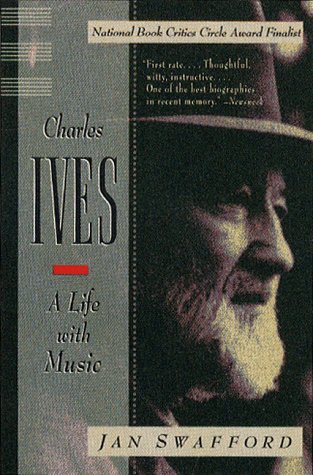
1. Charles Ives: A Life With Music
 
$34.39
2. Selected Correspondence of Charles
$7.75
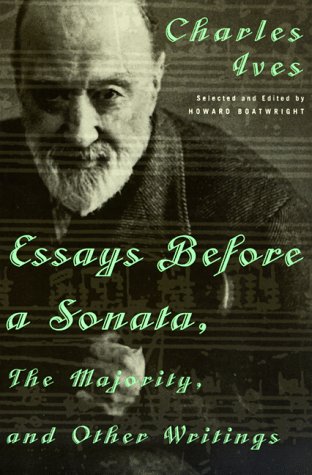
3. Essays Before a Sonata: The Majority
$8.33
4. Charles E. Ives: Memos
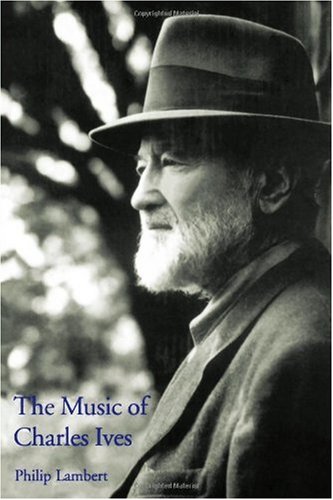
5. The Music of Charles Ives (Composers
$24.11
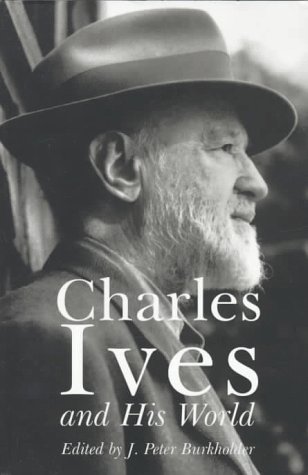
6. Charles Ives and His World
 
7. Ives Celebration (Music in American
$18.50
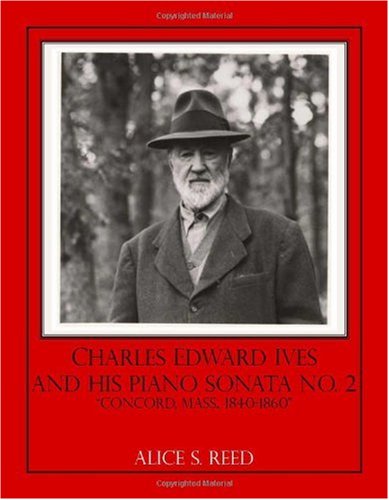
8. Charles Edward Ives and His Piano
$18.80
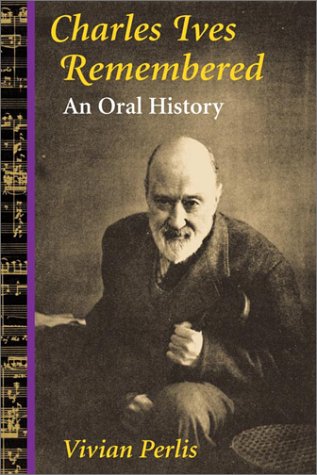
9. Charles Ives Remembered: AN ORAL
$53.52
10. Charles Ives: "My Father`s Song":
$35.00
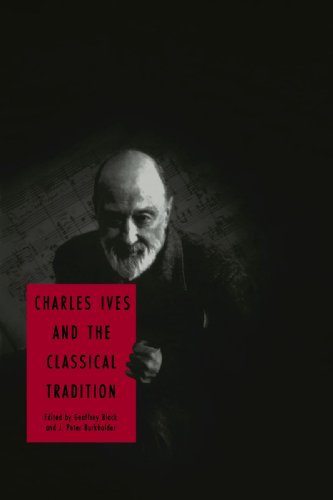
11. Charles Ives and the Classical
$14.90
12. Charles Ives and Aaron Copland
 
$250.00
13. Charles Ives: 129 Songs (Music
$52.57
14. Ives Studies
 
15. Charles Ives and His Music,
$23.10
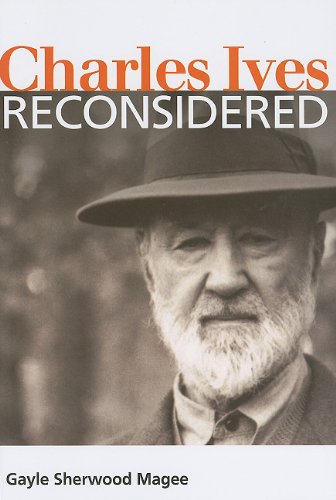
16. Charles Ives Reconsidered (Music
$65.50
17. A Descriptive Catalogue of the
 
$39.95
18. 114 Songs by Charles Ives
 
19. CHARLES IVES AND HIS MUSIC
$40.96
20. Baseball and the Music of Charles

1. Charles Ives: A Life With Music
by Jan Swafford
Paperback: 544 Pages (1998-01)
list price: US$18.95 -- used & new: US$12.06
(price subject to change: see help)
Asin: 0393317196
Average Customer Review: 5.0 out of 5 stars
Canada | United Kingdom | Germany | France | Japan
Editorial Review

Amazon.com
This is a scholarly assessment of the American composer Charles Ives, whose life and work have remained enigmatic since his death in 1954. A successful insurance executive in Hartford, Connecticut, Ives used a considerable part of his tidy income to promote serious modern music, and despite his day job maintained a prolific output of scores himself. He was a robustly opinionated and confident individual who eschewed easy listening; his atonal works were considered almost un-American. Yet he also sought recognition that just eluded him in his lifetime. Ives is increasingly known around the world. Jan Swafford, himself a composer, should help win even more interest with this sympathetic biography.Book Description
An illuminating portrait of a man whose innovative works profoundly influenced the course of twentieth-century American classical music. Jan Swafford's colorful biography first unfolds in Ives's Connecticut hometown of Danbury, then follows Ives to Yale and on to his years in New York, where he began his double career as composer and insurance executive. The Charles Ives that emerges from Swafford's story is a precocious, well-trained musician, a brilliant if mercurial thinker about art and life, and an experimenter in the spirit of Edison and the Wright brothers. A National Book Critics Circle nominee and a New York Times Notable Book. ... Read more

Customer Reviews (5)

5-0 out of 5 stars A Great American Composer Brought to Life
Charles Ives (1874-1954)was the first, and still probably the greatest, composer of a distinctly American art ("classical") music.His relationship to American music seems to me roughly parallel to Walt Whitman's relationship to American poetry and to Charles Peirce's relationship to American philosophy. Like Peirce, Ives was little-known during his lifetime.Furthermore, while many people may be aware of Peirce and of Ives, a much smaller number have much acquaintance with their works.

Ives was born in Danbury, Connecticut and remained throughout his life attached to his vision of thepost-Civil War small-town New England of his childhood.His father, George Ives, was a bandmaster and the greatest influence on Ives's life.Ives was a musical prodigy who began composing at an early age, quickly picking up experimental styles. He showed great proficiency at the piano and organ. (Through young manhood, we worked Sundays as a church organist.)He studied music at Yale where his teacher was Horatio Parker, a then famous American who was trained in the music of German Romanticism.As a college student, Ives wrote music played for the inaugaration of President William McKinley.

After graduation from Yale, Ives became a millionare in the insurance industry where he pioneered many marketing techniques.He also became increasingly Progessive and politically active and actually proposed a constitutional amendment which would increase the power of the democracy in government decision-making.At the age of 32, he married Harmony Twitchell who, after his father, was the greatest influence on his life.

Ives wrote music in the midst of an extraordinarily busy life.Most people think of Ives as a trailblazer and iconoclast.He was indeed, but may of his earlier works, such as the Second and the Third Symphonies are easily accessible and have a feel of America about them similar to the feelings Aaron Copland evoked some three decades later.

Jan Swafford's biography movingly and eloquently describes the life of Charles Ives. This is a reflective, thoughtful discussion of Ives, his America, his music, and its reception. In addition to a thorough treatment of Ives' life and works, Swafford has three chapters which he titles "Entra'acets" which consist of broad-based reflections on Ives's music and its significance.Swafford's entire book is full of ideas which are intriguing in themselves.Of Ives's work, Swafford gives his most extended treatment to the Fourth Symphony (he sees Ives as essentially a symphonist) and to the Concord piano Sonata.But many works are discussed in detail which will be accessible to the non-musician.The book has copious and highly substantive footnotes and an extensive bibliography.

Ives's Americanness, humor, romanticism, modernism, optimism, and generosity ( Ives gave large amounts of money to his family and to musicians and music publications. He also paid for the publication of several of his important works when commercial publishers showed no interest in them.) come through well.Swafford sees Ives as the last American transcendentalist in the tradition of Emerson.At the conclusion of his book, Swafford writes of Ives (p. 434)

" [I]n his music and his life he embodied a genuine pluralism, a wholeness beneath diversity, that in itself is a beacon for democracy and its art.Aesthetically he is an alternative to Modernism, an exploratory road without the darkness and despair of the twentieth century.In spirit he handed us a baton and calls on us to carry it further.He suggests a way out of despair, but leaves it to us to find the route for ourselves.If we are alone with ourselves today, Ives speaks incomparably to that condition."

This book made me want to learn more about and to hear the music of Charles Ives.In its own right, it is a joy and an inspiration to read.

5-0 out of 5 stars Ives, the Bucky Fuller of American music!
Charlie Ives was a visionary, an idealist, and apparently a manic-depressive.Swafford tells his story in a compulsively readable fashion, and wins you over to the side of the irascible composer.Ives never made any money from his music, in fact he subsidized it with the fortune he made in the insurance industry.But he was generous in supporting the work of other sympathetic composers as well, including Henry Cowell.Ives was rare in that he was a genius not only in music, but in business.Ives made a fortune in developing the modern, mass-market life insurance industry.He wrote a tremendously influential pamphlet in 1910, "The Amount to Carry," which pioneered estate planning.Ives was an idealist and an altruist even as he became wealthy -- he convinced himself that insurance was socially progressive, and motivated his sales staff with his lofty vision of cooperation.Later in life, he developed this into a plan for a People's World Union!

Ives' great successes all came together, early in life, following his marriage.He composed on the side as he built his company, burning the candle at both ends.Swafford speculates that Ives was literally manic during those heroic years of the Teens, and that he subsequently crashed, enduring more depression than mania for the rest of his life.Interestingly, the Great War was such a blow to his idealism, he reacted physically, compounding his collapse.Ives retired very young, but rather than turn to composing, he found that he was unable.The rest of his life was devoted to trying to find an audience for the works of his glory years.I found the book most interesting here, in situating Ives in relation to the more well-known Modernists of his time -- Schoenberg, Stravinsky, Varese and the others.The irony is that while Ives' music came about independently, it was "popularized," only through association with the European revolutionaries, and so he was widely perceived as an imitator.The world was only ready for Charlie's music after the ground had been broken!The story of Cowell, Slonimsky, Carter, Gilman and Bernstein, who championed Ives over many years until he was finally recognized, is fascinating.

This is supremely enjoyable reading.Jan Swafford clearly loves Ives, and I found his account irresistable.

5-0 out of 5 stars A high-water mark in musical biographies.
Quite recently, I had the privilege of reading a copy of this book that was the personal copy of a musician who had been involved, in a rather unique way, in the centennial observation of Charlie Ives's birthday back in 1974. For reasons of geography, then musical interest, he "got to know" Charlie quite well, even if only 20 years after Charlie's death. I immediately ordered my own copy, while continuing to read the heavily-annotated copy of my musician friend. (It was rather vicarious pleasure, "looking over the shoulder" of this musician, to see what it was about the music, life and times of Charlie that fascinated him.)

In his early years, Ives was a one-man dynamo. Learning much of his music theory and practice from his father George Ives, who had been a very young (perhaps the youngest) Civil War band leader, and then from Horatio Parker at Yale University, he had more than a "thorough grounding" in the basics. However, unlike most American composers, particularly those of his and the following generation, he did not go to Europe for a post-grad internship with any known European composer, but simply set out on his own after matriculating from Yale. He went to New York City, employed as an insurance clerk for one full-time job, wrote music constantly for another full-time job, and had yet another career, had he wanted it, as organist and choir director for the Central Presbyterian Church in New York. During this period - leading up to his marriage in 1908 - he literally burned the candle at both ends. (Swafford goes on, later in the book, to posit why Charlie had this incredible burst of energy for the first 15 or 20 years of his adult life, but it's best that his reasons for this - and for Ives's shortened composing career - be left to you, the potential reader.)

Most anyone who knows anything about Ives knows that he became comfortably wealthy in the insurance industry, that during his active composing days little of his music was played by anyone, and that he was - literally and figuratively - burned out by the time he was only 40. For the remaining half of his life, much of it was spent editing, publishing and promoting his music and the music of others, including many friends, using the proceeds from his insurance success to underwrite projects for many composers who would have gone unnoted had it not been for him. Musical success - unlike business success - came too late in life for him to truly enjoy at least its artistic, if not financial, rewards. He was in his last years when Leonard Bernstein premiered his Second Symphony, and never lived to hear his masterpiece - his Fourth Symphony - premiered by Leopold Stokowski in 1965. Despite this, he was far from an unhappy man in his later years; philosophically resigned yet optimistic that his day might yet come would be the more accurate description.

Swafford's writing is simply wonderful. It tells the story of a true American iconoclast; an "original." The narrative flows beautifully without omitting anything of significance in Ives's life or about his music. (The book contains nearly 80 pages of endnotes, in which the musical marginalia are explained in exhaustive, but emminently readable, detail, to preserve the flow of the main narrative.) In parts, it is incredibly moving. I particularly enjoyed the extended "mating dance" of his courting of Harmony Twichell, who was to become his life-long helpmate (and who did live long enough to attend the Stokowski premiere of his masterpiece, as the guest of honor). Ives, ever the Victorian man if something else as a composer, would always refer to her, to third parties, as "Mrs. Ives." Yet their fifty years together could be a model for today's dysfunctional families. A beautiful chapter; one of the best in the book.

There's a curiously cryptic endnote that suggests a "what might have been." It is a fact that very little of Ives's music saw public performance before the early 30's, when Nicholas Slonimsky championed Ives and other "moderns." Yet another two decades were to pass until Bernstein premiered the Second Symphony. Yet, in 1910, while shopping in a music store in preparation for his final return to Vienna, where he would die in less than a year's time, Gustav Mahler purchased a fair copy - one of only two or three in existence - of Ives's Third Symphony. Swafford doesn't make that big a deal about this, but I do. I've always thought that Ives and Mahler, aside from being near-contemporaries, had more in common than they did in opposition. It is just conjecture - but truly fascinating conjecture - to think what might have happened had Mahler premiered Ives's Third Symphony at a time in the life of Ives when it really might have made a difference.

Just what was Ives, as a composer? Bernstein did him no favors by calling him "a primitive; a Grandma Moses of music" while at the same time championing his music. Back in those days, there were no labels like "atonalist," "serialist," "avant-gardist," "post-modernist," what-have-you, that we tend to use today to compartmentalize a composer. To me, Ives was, well... an iconoclast, an "original," and, if a label must be applied, our first "pre-post-modern." He was never imitated, at least not successfully, not only because he didn't have his own students as did other composers, but because by the time his music enjoyed sufficient - if not plentiful - performances, composers' agendas were different.

Fortunately audiences think differently, and do enjoy Charlie's music. And you will enjoy this book.

Bob Zeidler

5-0 out of 5 stars Accessible tale of a musical maverick with a business head
Well written and accessible, the book describes the life of America's preeminent composer in the European tradition.A man who successfully forged a truly personal musical vocabulary on strong and deep American musical rootstock.Yet his only commercial success came through his equally great (though far less consequential) business talents.A continuing cautionary parable about the creative arts in the United States.I wish there were more score excerpts included.

5-0 out of 5 stars Great combination of erudition and accessibility
Not being a music professional, I was pleasantly surprised to find this book not only made Ives come to life but explained the music in a way that neither addressed the lowest common denominator nor spoke exclusively to the ivory tower crowd. The love letters between Ives and his wife Harmony (yes, that really is her name) are incredibly moving for an insurance exec. Saw a good review in Newsweek; agree with its assessment: "one of the best biographies in recent years.&quot ... Read more


2. Selected Correspondence of Charles Ives
by Charles Ives
 Hardcover: 410 Pages (2007-06-14)
list price: US$45.00 -- used & new: US$34.39
(price subject to change: see help)
Asin: 0520246063
Canada | United Kingdom | Germany | France | Japan
Editorial Review

Book Description
This authoritative volume of 453 letters written by and to composer Charles Ives (1874-1954) provides unparalleled insight into one of the most extraordinary and paradoxical careers in American music history. The most comprehensive collection of Ives's correspondence in print, this book opens a direct window on Ives's complex personality and his creative process. Though Ives spent much of his career out of the mainstream of professional music-making, he corresponded with a surprisingly large group of musicians and critics, including John J. Becker, Henry Bellamann, Leonard Bernstein, John Cage, Aaron Copland, Henry Cowell, Ingolf Dahl, Walter Damrosch, Lehman Engel, Clifton J. Furness, Lou Harrison, Bernard Herrmann, John Kirkpatrick, Serge Koussevitzky, John Lomax, Francesco Malipiero, Radiana Pazmor, Paul Rosenfeld, Carl Ruggles, E. Robert Schmitz, Nicolas Slonimsky, and Peter Yates. ... Read more


3. Essays Before a Sonata: The Majority and Other Writings
by Charles Ives
Paperback: 284 Pages (1999-01)
list price: US$13.00 -- used & new: US$7.75
(price subject to change: see help)
Asin: 0393318303
Average Customer Review: 5.0 out of 5 stars
Canada | United Kingdom | Germany | France | Japan
Editorial Review

Book Description
Ives's second piano sonata, Concord, Mass., 1845, standsamong the masterpieces of American music. The Essays Before a Sonata wasconceived by Ives as a preface of sorts to the composition. Ives'smusings also explore the nature of music, discuss the source of acomposer's impulses and inspiration, and offer some biting comments oncelebrated masters. The writings in this collection-now featuring acomprehensive index-allow readers entry into the brilliant mind thatproduced some of America's most innovative musical works. ... Read more

Customer Reviews (1)

5-0 out of 5 stars A highly original writer
A highly original writer, Ives can be a tough read. He follows his asides & digressions in prose much the same way as he does in music. But he dragged Transcendentalism (moaning & groaning) into the 20th Century,wrote a philosophy of insurance salesthat is still consulted today, &was not afraid to call for a national referendum prior to the United Statescommitting to war. His ideas about creativity remain, at the core,uncomfortably radical for most of his admirers.Bob Rixon, WFMU-FM ... Read more


4. Charles E. Ives: Memos
Paperback: 358 Pages (1991-05)
list price: US$13.95 -- used & new: US$8.33
(price subject to change: see help)
Asin: 0393307565
Average Customer Review: 4.5 out of 5 stars
Canada | United Kingdom | Germany | France | Japan

Customer Reviews (2)

4-0 out of 5 stars Charles Ives' MEMOS
I am finding the book a poignant look at the life and times of one of America's most original creative forces.These notes from Ives' sketchbook illuminate his mind and thought process towards his composition, as well as his personal outlook towards life.This book shows just how intelligent the man was, especially in his comments about other music and critics of his time.To any true music lover, MEMOS can't help but be an eye opener to how Charles Ives worked, thought and assimilated musical ideas during his creative periods.Original, thought provoking book.D. R. Safley, Fresno, CA

5-0 out of 5 stars A classic American text.
Like Miles Davis, Duke Ellington and Charles Mingus'respecive autobiographies, Ives' "Memos" is a fascinating look at the inner workings of one of America's greatest gifts to international music. Like Mingus espescially, Ives was a very opinionated and . . . well, masculine presence. In fact, my favorite quote, which could have easily been Mingus as well is "Stand up and face the full force of a dissonance like a man." Yikes! This collection of essays - he decided against calling the project an autobiography because, in his mind, anyone who found himself important enough to deserve one probably didn't - deals with family, friends, but focusses primarily on music aesthetics. There are several stories of awful performances, justifications for experimentalism, and run-ins with his hilarious nemesis "Rollo". Highly recommended reading for anyone interested in experimental music, masculinity, Americana, as well as Ives' history. Hey, it's all straight from the horses mouth. A primary source like this is invaluable! We're lucky this stuff wasn't lost for good. ... Read more


5. The Music of Charles Ives (Composers of the Twentieth Century Serie)
by Philip Lambert
Hardcover: 256 Pages (1997-07-25)
list price: US$45.00
Isbn: 0300065221
Canada | United Kingdom | Germany | France | Japan
Editorial Review

Book Description
With this innovative analysis of the music of Charles Ives, Philip Lambert fills a significant gap in the literature on one of America`s most important composers. Lambert portrays Ives as a composer of great diversity and complexity who nevertheless held to a single artistic vision. ... Read more


6. Charles Ives and His World
Paperback: 464 Pages (1996-08-05)
list price: US$26.95 -- used & new: US$24.11
(price subject to change: see help)
Asin: 069101163X
Average Customer Review: 5.0 out of 5 stars
Canada | United Kingdom | Germany | France | Japan
Editorial Review

Book Description

This volume shows Charles Ives in the context of his world in a number of revealing ways. Five new essays examine Ives's relationships to European music and to American music, politics, business, and landscape. J. Peter Burkholder shows Ives as a composer well versed in four distinctive musical traditions who blended them in his mature music. Leon Botstein explores the paradox of how, in the works of Ives and Mahler, musical modernism emerges from profoundly antimodern sensibilities. David Michael Hertz reveals unsuspected parallels between one of Ives's most famous pieces, the Concord Piano Sonata, and the piano sonatas of Liszt and Scriabin. Michael Broyles sheds new light on Ives's political orientation and on his career in the insurance business, and Mark Tucker shows the importance for Ives of his vacations in the Adirondacks and the representation of that landscape in his music.

The remainder of the book presents documents that illuminate Ives's personal life. A selection of some sixty letters to and from Ives and his family, edited and annotated by Tom C. Owens, is the first substantial collection of Ives correspondence to be published. Two sections of reviews and longer profiles published during his lifetime highlight the important stages in the reception of Ives's music, from his early works through the premieres of his most important compositions to his elevation as an almost mythic figure with a reputation among some critics as America's greatest composer.

... Read more

Customer Reviews (2)

5-0 out of 5 stars "[...] only an inventor knows how to borrow."
Beginning in 1990, Bard College (Annandale-on-Hudson, NY) has held an annual music festival celebrating the music and related cultural/aesthetic background of composers, with the festival "proceedings" published as a Festschrift volume. The consideration for a composer being celebrated would seem to be that the composer's works represent a measurable break with "the past," in terms of musical aesthetic. Only one of these composers has been American. It is fitting that this American should be Charles Ives. This volume is from the 1996 festival for the music and life of Ives. It nicely summarizes why it is that Ives was important to the development of a uniquely American musical aesthetic, and how that aesthetic was closely tied with the man's life in other respects.

The volume is in four unequal parts: Part I, ESSAYS (five in-depth pieces covering key aspects of Ives the composer, philospher and businessman and ethicist, filling nearly half the book), and briefer Parts II, III and IV, providing, respectively, LETTERS (to and from Ives), REVIEWS (of music and performances), and PROFILES (of Ives during his lifetime).

The essays cover distinct aspects but have some overarching themes:

[1.] Consistently (and persistently), Ives composed in four styles: American popular music, Protestant church music, "art" music in the European classical sense, and experimental music, frequently combining two or more of these styles in a work. Ives did not "progress" from the simple to the complex (as had earlier been put forth, before musicologists and critics could achieve perspective on his output), but always had each of these in his "composers' toolbox"; even at the end of his composing career, he remained grounded in European "art" music, and continued to call upon the vernacular music of his childhood while at the same time his music grew in depth and profundity of expression.

[2.] Ives's use of vernacular music, as nostalgia and as "writing music about music," and his creating a naturalistic sound stage by adding aural perspective to his scoring, were unique for their time, although they found application in the contemporaneous works of Gustav Mahler, quite by accident.

[3.] We cannot separate the composer from the philospher and/or the businessman without risk of arriving at an incomplete picture and failing to understand the music that is the principal surviving entity of his life's work. The fullest, most accurate picture emerges only when it becomes clear by what route his philosophical leanings reached their fullest flower, affecting both his musical and business lives, and how the fullest flower didn't really arrive until he redirected his business efforts and ethics, and married, with his wife providing the "quiet space" and the gentle encouragement for this fulfillment.

[4.] Ives developed a new musical aesthetic that was revolutionary in its break from the past, as represented by the example of Beethoven. It was his connection with the philosophy of Emerson, and resonances with Emerson's writings, that led him to this aesthetic, which reached its zenith in his monumental Concord Sonata.

Another theme, not an essay but clear from a complete read of the book, is that Ives - because he was a "private, spare-time" composer - was significantly ahead of his time and not really "discovered" and understood until years after his composing ceased. Most of his works were substantially completed prior to 1915, but performances and recognition were to wait another fifteen years or more, until the rest of the music world caught up to him, and early assessments of his works were badly flawed.

There is no better example of the initial misunderstanding of Ives's music and the time lag "until appreciation" than his Concord Sonata for solo piano, now properly considered one of the greatest 20th century keyboard works and the topic of both a major essay and a large portion of the critical reviews in this bood. A few paragraphs about the breadth and depth of commentary on this work can serve to represent the overall quality of the book.

Completed in 1915, the Concord didn't receive its premiere until a quarter-century later, in a landmark 1939 Town Hall/NY performance. In the meantime (in 1920), Ives self-published the sonata, as well as a companion volume, "Essays Before a Sonata," rationalizing his aesthetic for the work.

David Michael Hertz's essay ("Ives's Concord Sonata and the Texture of Music") makes clear that this was a revolutionary - and difficult - work because of the new ground it broke. Despite "borrowing" identifiable themes from Beethoven and vernacular music, and stylistic devices from Liszt, Chopin, Scriabin and Debussy (leading to my review title), the Concord represented a departure from the past not because it used and subsumed these materials but because of how the materials are organized and developed from the fragmentary to the complete (an aesthetic that Hertz calls "cumulative form"): it is only at the end of each movement of the work that a full statement of the thematic materials emerges, a reversal of the ordinary course of events in composing.

The reviews covering the period from Ives's publication of the Concord up to the work's premiere, performed by John Kirkpatrick, are almost universally dismissive; the score was incomprehensible to critics and fellow composers). It was only with Kirkpatrick's successful premiere of the Concord (an effort that took twelve years of study on his part) that composers and critics began to accept this work for the masterpiece that it is.

The rest of the volume is "of a piece" with this Concord Sonata example. This is a splendid critical overview of Ives, a fresh view, if you like, of "Ives reconsidered, after the dust has settled."

Those interested in a more "linear" biographical account of the life and works of Ives are recommended to read Jan Swafford's splendid "Charles Ives: A Life with Music" (also 1996).

Bob Zeidler

5-0 out of 5 stars A "must read"
For anyone interested in the life of Ives, in addition to his music, this book is a "must read." It is enlightening in it's approach to his personal life - which is so obvious in his music. There is an equitableblend of personal and musical background information by many notablecomposers, friends and business associates. The book has just enoughphotography to support context, not that Ives was a camera hog.

I had theopportunity and priveledge to attend the Bard Music Festival forperformances of some of my favorite Ives pieces. It was fantastic.

Ihighly recommend this book to anyone interested in the Ives legacy andespecially to any student of composition. ... Read more


7. Ives Celebration (Music in American life)
by Vivian Perlis, H.Wiley Hitchcock
 Hardcover: 252 Pages (1978-02-23)

Isbn: 0252006194
Average Customer Review: 5.0 out of 5 stars
Canada | United Kingdom | Germany | France | Japan

Customer Reviews (1)

5-0 out of 5 stars Charles Ives, evaluated on his centennial anniversary.
How better to observe the month of the 50th anniversary of Charles Ives's death (May 19, 1954) than with some comments on a 30-year-old book that celebrated the 100th anniversary of his birth? Well, I can't think of a better way for this special month.

The year 1974 saw a flurry of Ivesian activity, in performances and recordings of Ives's music, and in symposia and publications. This book-"An Ives Celebration"-while not published until 1977, captures a series of symposia and concerts held during the Charles Ives Centennial Festival-Conference of 17 - 21 October, 1974. It is, to my way of thinking, the best Ives centennial book, and as such is a true collector's item. (In stark contrast, unquestionably the *worst* book to come out of the Ives centennial year was David Wooldridge's "From the Steeples and Mountains," a work I previously reviewed in some depth at its Amazon.com product page.)

While this book is edited by H. Wiley Hitchcock and Vivian Perlis, two Ives scholars who are still very much with us today, I think that they would forgive me for saying that the book-and the Festival-Conference as well-might never have happened had it not been for the two decades' worth of groundbreaking scholarly work that John Kirkpatrick did, beginning at Ives's death. It was during these two fertile decades of scholarly work that much of the "unknown Ives"-who had been not much more than a curious footnote to musical history at the time of his death-became the "known Ives." And, in large measure, "by this book, ye shall know Ives."

The proceedings (papers and panel discussions) are divided into five main sections. In addition, there are three appendices, one of which lists all of the concert performances, with fully-detailed programs, that were held in conjunction with the Festival-Conference. These performances are literally a "Who's Who" of Ivesians of that time: Kirkpatrick, William Masselos, Gregg Smith, the Orpheus Chamber Ensemble, James Sinclair, Jonathan Elkus, Robert Shaw, John Mauceri, Helen Boatwright and Phyllis Curtin, to mention just some of the artists. It is a shame that no recordings of those concerts appear to have survived.

The first section, "Ives and American Culture," endeavors, in three presentations, to put Ives into a proper social context and cultural milieu. It is, in my estimation, the portion that has worn the least well over the years. Robert M. Crunden endeavors to include Ives among the great progressivists of the era, including Teddy Roosevelt, Woodrow Wilson and John Dewey, inter alia. Frank R. Rossiter-the first Ives scholar to submit Ives's life and works to psychological analysis-argues (largely) that Ives's self-imposed isolation, the narrowness of his cultural experiences, his emphasis on "masculinity" and his absolutist moral positions were largely the outgrowth of his upbringing, the early death of his father (whom he clearlyboth idolized and idealized), and the failure of America and the world to conform to his ideals (particularly in the years following the end of WW I). Neely Bruce compares Ives to his earlier American predecessors, including the "Second New England School" that included Horatio Parker, his Yale mentor, but, to my way of thinking, with too much emphasis on Stephen Foster as an "Ivesian precursor/paradigm." Much of this "1974 thinking" represents, in retrospect, examples of blind men endeavoring to explain the elephant. A far better and much more complete picture of the complexities of Ives emerges in Jan Swafford's "Charles Ives: A Life With Music."

The real meat of these proceedings, and the reason why this book is especially worth tracking down, lies in the latter three sections. "On Editing Ives" (Section III) illuminates the challenges scholars have had to deal with, in coming to grips with a lifetime's worth of stored manuscripts exceeding 700 works, and the range of creative solutions they have devised for realizing many of these works. "On Conducting and Performing Ives" (Section IV) relates the conductorial experiences of Lehman Engel, John Mauceri, Gunther Schuller, Nicolas Slonimsky, Gregg Smith and others in dealing with the technical difficulties inherent in Ives's orchestral and choral compositions. Much closer to home, on a personal note, is a splendid symposium by Nancy and Alan Mandel in performing Ives's violin sonatas, vastly underappreciated works now more dear to me than ever with the recent gift of the scores for these from a friend.

The concluding section ("Ives and Present-Day Musical Thought") contains two of the best presentations of the Festival-Conference. "Spatial Form in Ives," by Robert P. Morgan (who was to write, four years later, "Ives and Mahler: Mutual Responses at the End of an Era," a seminal essay that ties together large areas of compositional-aesthetics common ground between these otherwise dramatically different composers), sets out in splendid detail the highly-specific dynamic and spatial indications that Ives wrote into many of his works, how such demands were unique (owing largely to Ives's commitment to "write for himself rather than for performance"), and how observance of these indications results in music that continues to sound so fresh a century later. And Allen Forte, a leading expert on atonality theory and its description in terms of "sets" (of notes), in "Ives and Atonality," provides a rather exhaustive analysis of the atonality found in Ives's works, comparing aspects of atonality in Ives's compositions in depth to those of Schoenberg, Stravinsky and Berg that were written years later.

As noted earlier, Ives has been the elephant to more than a few blind men. It seems to me-perhaps as a consequence of totally immersing myself in the widest possible range of his music-that he is best appreciated and understood by embracing him in his Whitmanesque totality. This collector's item of a book goes a long way toward a fuller, richer understanding of his uniqueness. Highly-even urgently-recommended to every Ivesian.

Bob Zeidler ... Read more


8. Charles Edward Ives and His Piano Sonata No. 2: "Concord, Mass., 1840-1860"
by Alice S. Reed
Paperback: 182 Pages (2006-07-06)
list price: US$18.50 -- used & new: US$18.50
(price subject to change: see help)
Asin: 141204474X
Canada | United Kingdom | Germany | France | Japan
Editorial Review

Product Description
The book chronicles the life and work of Charles Edward Ives, concentrating specifically on the good and misfortune that he experienced on his way to being known as the Father of American Music. ... Read more


9. Charles Ives Remembered: AN ORAL HISTORY (Music in American Life)
by Vivian Perlis
Paperback: 264 Pages (2002-07-24)
list price: US$18.95 -- used & new: US$18.80
(price subject to change: see help)
Asin: 025207078X
Average Customer Review: 5.0 out of 5 stars
Canada | United Kingdom | Germany | France | Japan

Customer Reviews (2)

5-0 out of 5 stars I can't overestimate the value of this priceless collection.
I have my days when I feel as if I've known Charlie Ives all my life. Of course, this is physically impossible: when Charlie died, in 1954, I was only fifteen, and I didn't hear any of his music at least until a few years later, in college. And even then, there wasn't all that much of it available on LP. But, over a period now approaching a half-century, my knowledge of, and admiration for, the man and his music grew steadily, if at first slowly.

With this steady accumulation of knowledge now at the point where I feel at ease ("comfortable in my skin," one might say) with providing some informed commentary, I suggest to readers interested in learning about Charlie, and his life and music, two recommendations. The first recommendation is that they read Jan Swafford's "Charles Ives: A Life with Music," one of the most superb books of its kind, totally sympathetic to the man but at the same time not close-minded to his "warts" and their possible causes.

The second is of course this book by Vivian Perlis, one of the most remarkable of its kind. It is one of the most frequently quoted resources by Ives scholars and writers, and obviously so.

The reason for its very existence is almost as fascinating as its contents. Perlis, in 1968, had been working with the Ives Collection, and, to quote her (in the Preface), "I became aware that there were [...] people still living who had known and worked with [Ives], and that an effort [...] be made to [...] preserve their memories of him."

Ives died in 1954, in his eighthieth year. At the time of the start of Perlis's project, then, those of his contemporaries still alive who knew him were already well in their nineties. Mrs. Ives (Harmony Twichel Ives) was still alive, but too ill to be interviewed. (She died on Good Friday, April 4, 1969.) Ives's business partner, Julian Myrick, was able to be interviewed, but he passed on in the course of the project. Charlie's piano tuner died on the day he was to be scheduled to be intereviewed. There were only three Yale classmates who survived long enough to be interviewd. Facts such as these explain the need on Perlis's part to "work against time" in her plan to capture as many direct recollections as possible in putting together this oral history.

Perlis's subjects included, of course, family members, as well as friends and neighbors, most of them from succeeding generations. (Charlie's brother, Moss Ives, had six children [five nephews of Charlie and Harmony, and one niece]; three of the nephews provide some of the best recollections. Sadly, Charlie's niece, Sarane [Sally], as well as his own daughter, Edith [Edie], died in 1956, only two years after him.) Perlis even interviewed Charlie's personal secretary, his barber, and the architect who was responsible for remodeling his West Redding, CT home. Each provides his or her glimpse of the man. That these glimpses are often reminiscent of blind men describing an elephant speaks to the complexities of an outwardly simple-appearing man.

A large portion of the book covers recollections of musicians who knew and worked with Charlie. While all were of the succeeding younger generation, they can lay claim to being the closest to Charles Ives the composer and musician. The list reads like a "Who's Who" of mid-20th century American music: Elliott Carter, Aaron Copland, Lehman Engel, Lou Harrison, Bernard Herrmann, John Kirkpatrick, Goddard Lieberson, Carl Ruggles and Nicolas Slonimsky among others.

Each of these musical friends achieved fame for his own contributions to the art. Each remembered Charlie in the greatest of detail and anecdote, often in terms that bordered on "reverential" and with individual insights which added substantially to a better understanding of his musical psyche.

With one exception: Elliott Carter. Carter, still alive and kicking (and composing) at age 94, was one of the very earliest beneficiaries of Charlie's intellectual and personal largesse. As a teen-age high schooler, he was often invited to Charlie's W. 74th Street townhouse, a comfortably short distance from Carnegie Hall, where they would take in concerts and then talk about what they heard. Given that these were Carter's "formative years," one might think (and some do) that Carter was the logical successor to Charlie. In my judgement, he wasn't; there are simply too many differences between the two, in terms of compositional aesthetic, for the relationship to be valid. And, of all the musical associates interviewed, only Carter, in what I feel to be mean-spirited commentary, was negative about Charlie's contributions to American music. (It is more than a little interesting that Perlis, in her Preface, found it necessary to state that of all the interviews, only Carter's, as published, differed substantially from the raw interview material. One can only wonder at just what was expurgated!)

I am indebted to J Scott Morrison, fellow music lover and Amazon.com reviewer, for bringing to my attention that, in addition to Elliott Carter, there is one other survivor to this day who can claim direct contact with Charlie. That other person is Paul Moor, who interviewed Charlie for the September 1948 edition of Harper's. Moor (now in his late 70s) was in Europe between about 1953 and 1979, and therefore "out of reach" (and likely off the radar screen) of Perlis. It is too bad that this understandable omission is nonetheless an omisson. Perhaps Moor's judgement would offset Carter's; perhaps not.

In searching for a comparable book about another composer, the closest I can come to Perlis's unquestioned masterpiece is Elizabeth Wilson's "Shostakovich: A Life Remembered." But, whereas reading first-hand accounts about Shostakovich's life can often be an exercise in pain, given the circumstances of that life, reading about Charlie's life only seems to bring me joy. I hope it does for you as well.

Bob Zeidler

5-0 out of 5 stars The Place To Start
This is the first book I read about Charles Ives, and I'm happy that it's still in print.If you are new to Charles Ives, I would suggest that you start here.If you have the funds, I also recommend you pick up Jan Swafford's excellant biography.
Why is this book the best place to start?The book is a compilation of thoughtful and revealing rememberances from Mr.Ives's close friends and his family, all personally interviewed by the author.We even get to hear what Mr.Ives's barber had to say about him!Perhaps most moving is the interview with Brewster, Mr.Ives's nephew.
This book is also chock full of photos and pictures of Mr.Ives's original manuscripts. ... Read more


10. Charles Ives: "My Father`s Song": A Psychoanalytic Biography
by Stuart Feder
Hardcover: 368 Pages (1992-06-24)
list price: US$60.00 -- used & new: US$53.52
(price subject to change: see help)
Asin: 0300054815
Average Customer Review: 2.0 out of 5 stars
Canada | United Kingdom | Germany | France | Japan

Customer Reviews (1)

2-0 out of 5 stars Attempting to explain- away Ives
This biography of Ives neglects the most important thing that makes Charles Edward Ives someone worth reading about; brushing his music aside, Feder contiues on to show us exactly why we should be indifferent at bestto this all but crazy composer.

While his anyalisis of the music isinteresting, it is shallow at best, picking and choosing songs and otherworks to support his claims about Ives. He delves deeply into a man, andlooses the reason Ives is someone we care about-- the music he wrote.

Ives certianly had an unusual, and perhaps unhealthy, relationship withhis father, but Feder exagerates this and turns it into something unlikewhat Ives himself said it was.Feder uses this to explain Ives'eccentricites and moodiness in his later life, ignoring the fact that Ivessuffered from adult onset diabetes, which was a likely cause of that, aswell as a possible cause of George Ives' premature death.

At its best,this book is a penetrating look at Charles Ives the man.At its worst, itdisenegrates into Freudan goobledey-gook of which it is difficult to makeheads or tails. ... Read more


11. Charles Ives and the Classical Tradition
Paperback: 200 Pages (1996-05-11)
list price: US$35.00 -- used & new: US$35.00
(price subject to change: see help)
Asin: 0300105274
Average Customer Review: 5.0 out of 5 stars
Canada | United Kingdom | Germany | France | Japan
Editorial Review

Book Description
Although Charles Ives has long been viewed as the quintessential American composer, he was also closely linked to the European classical tradition, say the Ives scholars in this book. Contributors explore the influences on Ives of his musical predecessors and the parallels between Ives and his European contemporaries, revealing him as culturally unique and yet reliant on the classical tradition for aesthetic philosophy and musical techniques."A stimulating and important contribution to Ives scholarship and to the understanding of twentieth-century music."-Larry Starr, University of Washington"A valuable addition to Ives scholarship."-Library Journal"Illuminates Ive's music by comparing it with that of other composers in Europe and the U.S. Begins with essays that examine the influences of his musical predecessors, and concludes with essays that find parallels between Ives and European contemporaries including Mahler, Schoenberg, Berg, and Stravinsky."-Reference & Research Book News"Each of the essays in Charles Ives is provided with copious and detailed notes. A general index covers the entire book. This work is essential reading for scholars interested in Ives and his music."-Kathryn Bumpass, Notes ... Read more

Customer Reviews (1)

5-0 out of 5 stars Charles Ives: The Great Anticipator.
Igor Stravinsky, late in life, and in an unusually rare moment of candor for him, conceded that Charles Ives had been "The Great Anticipator." Unfortunately for Ives, this bout of candor came eight years after he died. And, upon Arnold Schoenberg's death In 1953 (six months before Ives did), his widowcame upon a remarkable statement by her husband, written nearly a decade earlier: [quote]

There is a great Man living in this Country - a composer.
He has solved the problem of how to preserve one's self-esteem.
He responds to negligence by contempt.
He is not forced to accept praise or blame.
His name is Ives. [unquote]

That these two composers, contemporaries of Ives, took so long to pay proper tribute is as much a result of Ives having chosen to be a "private" composer over the two important decades of his composing life (1902 - 1922) as it was their own agendas and efforts. Before 1922, nothing of significance that Ives had written saw public performance subsequent to his 1902 cantata, "The Celestial Country." And nothing of significance came from his pen after those two decades; he spent the balance of his life editing his works and supporting the efforts of other American composers.

However, beginning in the 1930s, Ives's works slowly began to see public performance, and the pace of performance did pick up in the years remaining to him. And what concert-goers, and fellow composers, began to hear was a bewildering variety of musics, at least some of which reminded them of works not only by Schoenberg and Stravinsky but by Debussy, Bartók, Scriabin, Copland and a host of other "moderns." And on his death in 1954, at which time Harmony Ives placed his works in public trust, with John Kirkpatrick as the executor, the floodgates began to open on what it was that Ives had accomplished, not least of which was to anticipate virtually every significant stylistic movement in 20th-century music.

With the 50th anniversary of Ives's death just days away (May 19, 2004) as I write this, we now have a much better picture of "Ives the anticipator." And, as well, "Ives the protean American extender of the classical tradition." And this book, edited by two of the most knowledgeable Ives scholars, is as fine an effort as I've seen at putting Ives in proper historical perspective. It is the benchmark for the comparative study of Ives's compositional aesthetic, and I don't expect that it will be soon surpassed in this respect.

The book is in two unequal parts (following an introduction by J. Peter Burkholder). The first third of the book, entitled "Predecessors," describes Ives's early musical education, by both his father and Horatio Parker. The three essays in this section cover his background in, and familiarity with, the music of Bach, Beethoven, Brahms, Franck, Dvorak, Tchaikovsky and Reger, as well as those who, like Parker, made up the preceding "New England School": George Chadwick, Frederick Shepherd Converse, Daniel Gregory Mason and John Knowles Paine. Sandwiched between the European and New England School essays is a superb one by Geoffrey Block (co-editor along with Burkholder) entitled "The 'Sounds That Beethoven Didn't Have'," showing how Ives both borrowed from and built upon Beethoven in writing his culminating keyboard masterpiece, the "Concord" Sonata. This essay cannot but help those who are befuddled by this thorny work.

The balance of the book is given over to comparisons of Ives with his European contemporaries. The first is a reprint of Robert P. Morgan's groundbreaking 1978 essay, "Ives and Mahler: Mutual Responses at the End of an Era." While this essay is available on the internet in Adobe pdf form, its inclusion here is most welcome and appropriate. There is so much commonality in the compositional aesthetics of these two (incorporation of "vernacular" music, use of polyrhythms, providing for "near" and "far" sound fields) that it is surprising that matters took as long as they did to reach this stage (although Elliott Carter, some years earlier, had pointed the way, seemingly the first to do so).

"Ives, Schoenberg, and the Musical Ideal" sets out not only the similarities between Ives's usage of the terms "manner and substance" and Schoenberg's of "style and idea" (and their commonality in philosophical thought traceable back to Kant), but also their shared admiration of Brahms. That Ives wrote atonally and experimented with tone rows in advance of Schoenberg is an interesting aside, but the "substance" (or "idea"), if you will, is that both developed new aesthetics of some similarity in expression and much commonality in background.

"Ives and Stravinsky: Two Angles on 'the German Stem'" is, for me, the most fascinating essay in the book. Ives wrote in bitonality some years before "Petroushka" and had been accused of "borrowing" ideas from "The Rite of Spring" well before the true facts emerged. But ultimately more interesting are the parallels between the two in terms of their musical educations and usage of source materials, and their inveterate editing of existing works. Of course, their motivations for doing so differed: While Ives was editing largely to achieve performance, Stravinsky was forever "scrubbing his works clean" of earlier influences.

When study began on Ives's manuscripts (now complete, thanks to James Sinclair's "A Descriptive Catalog of the Music of Charles Ives"), a treasure trove of "anticipations" - atonality, tone rows, bitonality, polyrhythms, collage, impressionism, minimalism, aleatorism and virtually every other "ism" - was found. While this book does not cover everything, the essays on Ives and Schoenberg and Ives and Stravinsky are worth the price of admission. But I do wish that the editors had included contributions on Ives and Debussy and Ives and Bartók (despite Burkholder's apology for not having done so in the Introduction). A very minor cavil for an otherwise remarkable collection of essays.

Bob Zeidler ... Read more


12. Charles Ives and Aaron Copland - A Listener's Guide: Parallel Lives Series, No. 1 Their Lives and Their Music (Parallel Lives)
by Daniel Felsenfeld
Paperback: 224 Pages (2004-11-01)
list price: US$22.95 -- used & new: US$14.90
(price subject to change: see help)
Asin: 1574670980
Average Customer Review: 5.0 out of 5 stars
Canada | United Kingdom | Germany | France | Japan
Editorial Review

Amazon.com
The title of this book is a misnomer: there are no parallels between these two composers' lives except that both were Americans and musical innovators. They were as different as they could be. Copland was an open-hearted, open-minded cosmopolitan New Yorker, who, actively engaged in human and social affairs, wrote mainly accessible music and books for the people. Ives was an embittered, idealistic, secretive recluse who wrote mainly inaccessible music and books for himself while selling insurance for a living. Yet, as Daniel Felsenfeld shows in this thoughtful, enlightening book, each in his own way laid the foundation for what came to be defined as the "American" sound and spirit in music. Convinced that a composer's work is inseparable from his life and personality, Felsenfeld divides his book into three inventively organized sections. Beginning with a brief biography and ending with a discussion of some of his subjects' striking characteristics, he shows how their training and experiences influenced their work and careers and then devotes the central part to analyzing their music. Guidance for listening and understanding is aided by a CD of their most familiar compositions in excellent performances.

Copland, son of Jewish Polish-Lithuanian immigrants, studied with Nadja Boulanger, but being surrounded by French music and culture only strengthened his resolve to become an "American" composer. Despite a brief flirtation with serialism, he was determined to close the gap between composer and audience, and he succeeded admirably: his colorful scores, often suffused with folk and jazz idioms, speak to everyone; he became not only one of the most popular, but most respected composers of his time.Ives, whose musician father opened his ears to unheard-of musical combinations, was born into a New England family steeped in transcendental philosophy. His music, eccentric and deliberately perverse, is an acquired taste. Any composer who feels impelled to write a long, linguistically and philosophically impenetrable essay explaining his "magnum opus" can hardly expect to capture a large audience. Felsenfeld makes the best possible case for it, but one senses admiration rather than love.The author's style is not always felicitous (Copland's teacher "feared that Ives' influence might improperly influence the talented young man"), but having obviously read all of Copland's popular and Ives' indigestible writings, he was perhaps improperly influenced himself.--Edith EislerBook Description
This book explains-in vivid picturesque detail-why we still listen with admiration to the work of these men, and how their personalities and the era in which they lived affected their music. The accompanying CD includes a sampling of their music from masterworks such as Appalachian Spring and The Unanswered Question to less common gems and includes guided listenings of exactly how the pieces work. ... Read more

Customer Reviews (2)

5-0 out of 5 stars What's on the CD you ask...
Since a third of the book is dedicated to the discussion and dissection of Charles Ives' and Aaron Copland's compositions, here is a listing of the music on the accompanying BMG CD: 1) Copland: Concerto for Clarinet and String Orchestra with Harp and Piano; 2) Copland: Appalachian Spring; 3) Copland: El Salon Mexico; 4) Ives: The Unanswered Question; 5) Ives: "Memories"; 6) Ives: "General William Booth Enters Into Heaven"; and 7) Ives: Three Places in New England - II. "Putnam's Camp". The recording is dominated by Michael Tilson Thomas who appears as both conductor of the London and San Francisco Symphonies and as pianist on "Memories."Also on the disc are Eugene Ormandy conducting the Philadelphia Orchestra (Appalachian Spring) and Eduardo Mata conducting the Dallas Symphony Orchestra (El Salon Mexico).

5-0 out of 5 stars introduction to the music with a CD
Brief biographies of the two premier American composers are followed by tutorials on their music focusing on better-known, widely-aclaimed pieces. The guide succeeds in making the music accessible without dumbing it down at all or trying to popularize it. Felsenfeld is himself a composer and a music writer bringing to the task not only compatibility with Ives and Copland, but also an educator's understanding of the reader's position in wanting to learn more about them and enhance appreciation of their music. With the book is the treat of a CD offering ample samplings of music, including Copland's complete "Appalachian Spring" and four pieces of Ives', who wrote shorter, intense works.
... Read more


13. Charles Ives: 129 Songs (Music of the United States of America)
 Paperback: 526 Pages (2004-07-30)
list price: US$250.00 -- used & new: US$250.00
(price subject to change: see help)
Asin: 0895795248
Canada | United Kingdom | Germany | France | Japan

14. Ives Studies
Paperback: 312 Pages (2006-11-02)
list price: US$55.00 -- used & new: US$52.57
(price subject to change: see help)
Asin: 052102837X
Canada | United Kingdom | Germany | France | Japan
Editorial Review

Book Description
The essays in Ives Studies are concerned with Charles Ives (1874SH1954), an American composer of symphonic, choral, and chamber music who was an early pioneer of twentieth-century musical modernism. Ten leading scholars address issues that have been at the forefront of a recent surge in Ives scholarship, including the hotly debated chronology of his work, the nature of his compositional philosophy and style, and his place in music history. ... Read more


15. Charles Ives and His Music,
by Henry, Cowell
 Paperback: Pages (1969-08)
list price: US$3.95
Isbn: 0195007808
Canada | United Kingdom | Germany | France | Japan

16. Charles Ives Reconsidered (Music in American Life)
by Gayle Sherwood Magee
Hardcover: 216 Pages (2008-07-18)
list price: US$35.00 -- used & new: US$23.10
(price subject to change: see help)
Asin: 0252033264
Canada | United Kingdom | Germany | France | Japan
Editorial Review

Book Description

Charles Ives Reconsidered reexamines a number of critical assumptions about the life and works of this significant American composer, drawing on many new sources to explore Ives's creative activities within broader historical, social, cultural, and musical perspectives. Gayle Sherwood Magee portrays Ives's life, career and posthumous legacy against the backdrop of his musical and social environments from the Gilded Age to the present. The book includes contemporary portraits of the composer, his peers, and his teachers, as seen through archival materials, published reviews, and both historical and modern critical assessments. Magee offers the first large-scale rethinking of Ives's musical development based on the controversial revised chronology of his music. Using Ives's own dictum that "the fabric of existence weaves itself whole" as a guide, Charles Ives Reconsidered offers several new paths to understanding all of Ives's music as the integrated and cohesive work of a controversial composer who was very much a product of his time and place.
... Read more

17. A Descriptive Catalogue of the Music of Charles Ives
by James B. Sinclair
Hardcover: 784 Pages (1999-08-11)
list price: US$100.00 -- used & new: US$65.50
(price subject to change: see help)
Asin: 0300076010
Canada | United Kingdom | Germany | France | Japan
Editorial Review

Book Description
This monumental catalogue of the music of Charles Ives contains 728 entries that cover all of the prolific composer`s works. With new information produced by recent Ives scholarship and generous commentary on each of Ives`s compositions, this all-inclusive book is not only an important source for music writers and performers but also an essential volume for scholars of American music. ... Read more


18. 114 Songs by Charles Ives
by Charles Ives
 Paperback: 263 Pages (1933-10-01)
list price: US$39.95 -- used & new: US$39.95
(price subject to change: see help)
Asin: 0934009872
Canada | United Kingdom | Germany | France | Japan

19. CHARLES IVES AND HIS MUSIC
by Henry and Sidney Cowell
 Hardcover: 256 Pages (1955)

Isbn: 019500518X
Canada | United Kingdom | Germany | France | Japan

20. Baseball and the Music of Charles Ives: A Proving Ground
by Timothy A. Johnson
Paperback: 216 Pages (2004-07-28)
list price: US$44.95 -- used & new: US$40.96
(price subject to change: see help)
Asin: 0810849992
Canada | United Kingdom | Germany | France | Japan
Editorial Review

Book Description
Baseball and the Music of Charles Ivesoffers readers an exceptionally rich understanding of Charles Ives. Through intelligent discussion of Ives's musical compositions combined with solid research on the composer's lifelong love of the American pastime, Ives's pioneering spirit and unique creativity are highlighted most clearly in this fascinating work. ... Read more


  1-20 of 100 | Next 20
A  B  C  D  E  F  G  H  I  J  K  L  M  N  O  P  Q  R  S  T  U  V  W  X  Y  Z  

Prices listed on this site are subject to change without notice.
Questions on ordering or shipping? click here for help.

site stats