e99 Online Shopping Mall

Geometry.Net - the online learning center Help  
Home  - Composers - Feldman Morton (Books)

  1-20 of 24 | Next 20
A  B  C  D  E  F  G  H  I  J  K  L  M  N  O  P  Q  R  S  T  U  V  W  X  Y  Z  

click price to see details     click image to enlarge     click link to go to the store

$29.98
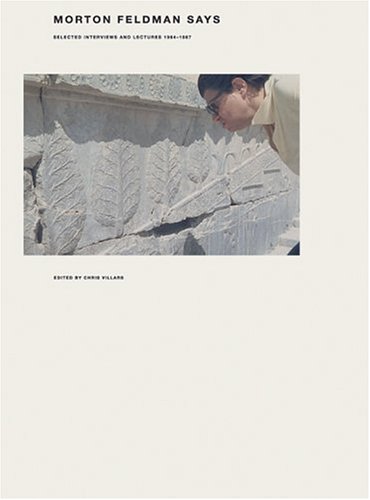
1. Morton Feldman Says: Selected
$9.83
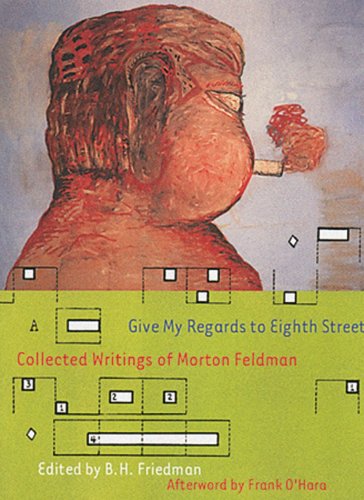
2. Give My Regards to Eighth Street:
$93.95
3. The Music of Morton Feldman (Contributions
$15.00
4. Peter Michael Hamel: Morton Feldman
 
5. Essays
$467.09
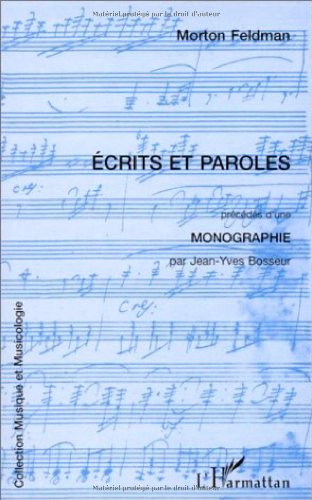
6. Ecrits et paroles (Collection
7. Morton Feldman (Musik-Konzepte)
$130.94
8. Neither: Die Musik Morton Feldmans
 
9. Circumscribing the Open Universe:
 
10. Morton Feldman Says
 
11. Feldman,Morton:Only Works for
 
12. Between categories: Studien zum
 
13. Conversation with Morton Feldman
 
14. Morton Feldman: For Franz Kline,
 
15. On hearing Morton Feldman's new
 
16. The King of Denmark: Percussion
 
17. Crippled symmetry
 
18. Sound, noise, Varese, Boulez
 
19. Chorus and instruments (Edition
 
20. THE VIOLA IN MY LIFE (IV).

1. Morton Feldman Says: Selected Interviews and Lectures 1964-1987 (New Series)
Paperback: 304 Pages (2006-05-01)
list price: US$50.00 -- used & new: US$29.98
(price subject to change: see help)
Asin: 0907259316
Average Customer Review: 4.5 out of 5 stars
Canada | United Kingdom | Germany | France | Japan
Editorial Review

Book Description
Alongside John Cage and Edgar Varese, Morton Feldman is regarded by many as one of the foremost American composers of the twentieth century. Evidence of his lifelong passion for music can be found in the numerous interviews and lectures he gave about his life and work. But despite his reputation and creative output, very little has been published on this charismatic figure. In Morton Feldman Says, editor Chris Villars has collected two decades of interviews, many available here for the first time, illustrating Feldman's creative process and his wide range of cultural interests and references, especially to visual art. Morton Feldman Says contains the first English translation of Sebastian Claren's biographical notes as well as conversations with Gavin Bryars, Kevin Volans, and Walter Zimmermann, as well as transcriptions of two of Feldman's lectures, held in Toronto (1982) and Johannesburg (1983). ... Read more

Customer Reviews (2)

4-0 out of 5 stars A wonderful collection, if a bit pricey
I've spent a fair amount of time with "Morton Feldman Says" and I've decided it's an excellent collection, but not necessarily worth it's price. While in Scarecrow saw fit to offer an interpretation of Feldman in his review, I'm content to leave that task to the reader. I will, however, offer a few comments on the book itself.

The selection of interviews, lectures, and writings are fairly diverse. For those who enjoyed "Give My Regards to Eighth Street", there is plenty of new material here. Where "8th Street" is mostly Feldman's essays, notes, and fragments, "Feldman Says" feels more complete. The books fill different needs and thus work well together. "Feldman Says" also has a number of black-and-white photos from Feldman's life. One of the most interesting features of the book is a collection of reproductions of Feldman scores. For those who do not have access to Feldman's scores, this will be of great interest.

The only thing that keeps me from giving this title five stars is that I feel it is significantly overpriced. Although Amazon currently offers it well below the $50 list price, I feel this is simply too much for a paperback of this type. Especially so when you consider the superb "Give My Regards to Eighth Street" is closer to $15. Both titles offer a great view into Feldman's world - his life, his ideas, his compositional technique - but aside from some photographs in "Feldman Says", I can't see a major difference.

I don't mean to sound cheap. I just mean to warn you that for the price, you may expect more than you'll receive. Most of the time when a book crosses the $50 threshold, it's either a beautiful hardcover, some sort of limited edition, or large and comprehensive. This is none of the above. Ultimately though, this is a fine collection of interviews and writings. Add to that some interesting reproductions of Feldman's scores and a timeline, this is a great book for both Feldman fans and anyone interested in 20th century American art music.

5-0 out of 5 stars good essays,explicatories
The late Morton Feldman was an articulate speaker. Not that some days he was "off" where he came to repeat himself and get bogged down in one single work explications. His last Darmstadt lectures for example (with Ferneyhough and Rihm in attendance) is an example. He spoke about his historically long piece for Flute and Piano and percussion. He speaks in timbre, think of the flute he would say, "I don't think of the flute, as a flute" (to paraphrase).He thinks of his music as transitory, always to something else.

Feldman honed his ideology hanging out with painters,the Abstract Expressionists at the Cedar Bar in New York. But he also was invited to studios (Guston, Kline, de Kooning) to view new works and think about what they mean not philosophic but the technical. He always found fascinating concepts to bring to his music and thinking about the process of writing music. Very late in life he re-discovered the inherent mysteries in minimal aesthetic, an aesthetic very different than what you may think you know of rhytmic patternings music. Incredibly Feldman didn't discover this odyssey for the minimal earlier, although in many respects you can argue that he always had a fascination for un-repetition of the same stasis.In retropsect you can see where his music has much more elements of longevity than the "Star" minimalists whose work today has is now a mere caricature of what it may have been,co-opted, homogenized down to its lowest forms.
Feldman has written some of the most beautiful music claiming a place that the vigours of modernity need not lead to "alienation" schemes practiced so well by his brethren, the post-war European creators as well as closer friends, Cage and Brown.Feldman it seems always thought something else need to happen while modernity simply goes on toward its own demise. Well here you get to experience his thoughts into pathways into how he composes, although much of these materials are already available on the web if you know where to look.
Feldman delves into memory of concepts from Henri Bergson. Memory is a realm quite a problematic when you consider the question how does one listen to a six hour piece of music as Feldman's "Second String Quartet", or the seminal(granite-like) now last piano works, "for Bunita Marcus,"and "Triadic Memories". He became interested in the process of rug making and how patterns become distributed over a defined space. Do we listen in a striaght line or in para-memory means, where are listening is similar to a Moebius strip where we continue to return to events, fragments, particles of timbre we had previously experienced. Feldman then suggests ways of thinking about important elements of maodernity as density, shape, space, texture and timbre. Ultimatly it was timbre itself that he most contributed, the love of timbre I think compells us as composer, the composer to continue to write. Meaning then becomes something you can ponder after creativity. This is something Feldman would advise the young composer, write and write and write,ponder and think later or during.

This is a wonderful job of Villars attempting to fill the void left by the interviews with Walter Zimmermann now a collectors item to purvey. ... Read more


2. Give My Regards to Eighth Street: Collected Writings of Morton Feldman
by Morton Feldman, Frank O'Hara
Paperback: 256 Pages (2001-01-26)
list price: US$15.95 -- used & new: US$9.83
(price subject to change: see help)
Asin: 1878972316
Average Customer Review: 4.5 out of 5 stars
Canada | United Kingdom | Germany | France | Japan
Editorial Review

Book Description
Morton Feldman (1926-1987) is among the most influential American composers of the 20th century. While his music is known for its extreme quiet and delicate beauty, Feldman himself was famously large and loud. His writings are both funny and illuminating, not only about his own music but about the entire New York School of painters, poets, and composers that coalesced in the 1950s, including his friends Jackson Pollock, Philip Guston, Mark Rothko, Robert Rauschenberg, Frank O'Hara, and John Cage. Give My Regards to Eighth Street is an authoritative collection of Feldman's writings, culled from published articles, program notes, LP liners, lectures, interviews, and unpublished writings. ... Read more

Customer Reviews (3)

5-0 out of 5 stars The Ever-Lasting Yes
Morton Feldman's essays and liner notes are every bit as challenging as his music.In fact, I would like to turn one of Morty's quotable lines on its ear and say that "Feldman couldn't write a note unless it was literary."Of course, I'm inserting Feldman's name for the orginal Ives (see page 165 of this book), but I have to say that this composer provides in these pages the "narrative dark matter and coherent strange attractors" for his--in the main--disjunctive sounds.With this book Feldman positions himself in the same great tradition of writer-musicians as Berlioz, while all the while disparaging that very tradition!In fact, I would say that of all the recent experimentalists--Cage included--Feldman had to have been the most literary.

What a fine mind, and what a great loss to have only one side of Feldman's legendary conversational powers in this book, but, until everyone in the world has sense enough to stop what they're doing and applaud Morton Feldman's brilliance and the END of TIME COMES and Feldman himself descends from on high seated on a golden bar stool, ready to take on all comers, they will have to be content with this written fossil.And of course the music...but that's another story.

This book includes an appreciation of Morty and his work by Frank O'Hara, another person I wish I'd met.

4-0 out of 5 stars Essential reading for Feldman fans
This book, collecting all of Morton Feldman's published writings--along with four miscellaneous pieces--is an expanded version of a book originally published in a bilingual German/English edition in 1985, edited by Walter Zimmermann. To the original book, the editor, B. H. Friedman has added his own introduction, a postface by the poet Frank O'Hara, a late friend of Feldman's, and various other writings not collected in the original book.

There is much to enjoy here, from Feldman's reminiscences of his New York School colleagues, his admiration for Varese, his not uncritical appreciation of Webern and Stockhausen and his dislike for Boulez and Schoenberg. Equally, there is much interesting material on the visual arts as well: Feldman's passions for Mondrian, Pollock, Guston and Rothko are intimately related to his music and this book illuminates this strongly. Feldman's understanding of the need for a specifically US artistic and musical tradition--and how this tradition came about--is particularly illuminating, as is his writing about his colleague and friend John Cage.

Feldman's writing style is clear and conversational--if it occasionally lacks in depth this is a minor sin in comparison to the wilfully obfuscatory writings of the young Boulez, for example. Because of its own nature as a collection of unrelated pieces, this book tends to contain a little too much repetition and some very slight pieces (often notes from recordings or performances). I would have liked a little more writing on Feldman's own music--the rare occasions where he explains his techniques are highly interesting--but even with these flaws anyone interested in Feldman's music or the New York School in general will find this book very interesting.

5-0 out of 5 stars a primary document of the American avant-garde
" The day Jackson Pollock died I called a certain man I knew- a very great painter-and told him the news. After a long pause he said, in a voice so low it was barely a whisper,' That son of a b---he did it'. . . .With this supreme gesture Pollock had wrapped up an era and walked away from it." Feldman was very much part of that era, the Fifties when American art was becoming the most important post-war art there was its unique expressions. Sure Europeans tried to copy us but only became more academic about as Boulez and his excursions into chance/aleatoric gesturing. This collection of essays very clearly reveals how important American expeimentalism was to music. Feldman's forever endeavor to merely create, create at a high intensity working like a Dutch diamond cutter,or lens grinder,toying with creative means as his use of indelible ink, this he said makes you think about what your writing than how you are writing, puts the creative process back into the head.Or composing at the piano, which slows you down so you need to think more. He followed the intellectual currents, anything that brought a sense of richness and other dimension to his art, he knew for instance Henri Bergson's concept of memory and time,how that might affect his music,and painterly means was second nature to him hanging out at the Cedar Bar in New York talking for hours on Light,texture,perception,shape,design,concept, facility,gesture,timbre,tone,chiarscuro, there is ample historical data here as well, almost like a subtext of these ,like an unwritten history of the avant-garde, a "Conversation with Stravinsky"(not really),his first meeting with John Cage(after a performance of Webern), Earle Brown, Christian Wolff, also his travels to Berlin, and England and experiencing the avant-garde through Cornelius Cardew, and British experimentalism.His last years was devoted to long durational compositions, and he merely said he had more time to compose in these years,but Feldman here is filled with marvelous quotes,things,items,shapes for the mind"I knew I was going to be a professional the day I first became practical.Practicality took the form of copying out my music neatly,keeping my desk tidy and organized-all the unimportant things that seem unrelated to the work,yet somehow do affect it.". He also knows how to look from greater heights from mountains, tothe substance of modernity, those who stopped creating and became more interested in themselves as Stockhausen were "Modernists"; for Feldman allowing your materials,the shape,structures of your music tell you the secrets of creativity was most important and became a cause. ... Read more


3. The Music of Morton Feldman (Contributions to the Study of Music and Dance)
by Thomas DeLio
Hardcover: 260 Pages (1996-03-30)
list price: US$93.95 -- used & new: US$93.95
(price subject to change: see help)
Asin: 0313298033
Average Customer Review: 5.0 out of 5 stars
Canada | United Kingdom | Germany | France | Japan
Editorial Review

Book Description
Morton Feldman (1926-1987) is today widely regarded as one of America's foremost experimental composers. His unique body of compositions, as well as his numerous writings and interviews, provide a vast amount of source material for scholarly research. This book begins with a brief work by John Cage written in honor of Morton Feldman. It is followed by a series of essays that challenge some views of Feldman's music and clarify many others. The collection concludes with a selection of essays written by the composer himself; these essays reveal as much about Feldman's own work and attitudes as they do about the work and thought of the many composers and artists about whom he wrote. The volume concludes with a list of Feldman's compositions, a bibliography, and a discography. This study, the first of a series of "Profiles of American Composers," will be invaluable to musicologists and all involved with the music of the 20th century. ... Read more

Customer Reviews (1)

5-0 out of 5 stars Good compendium of things missed
Since his death in 1988, there has been no shortage of interest in Morton Feldman. While alive there was a small but devoted following. The Brits loved the utter beauty, and simplicity of his work, Composers HowardSkempton, Cornelius Cardew, even the improv ensemble AMM speak deeply ofFeldman's influence. With this collection of analytical investigations therigours of academia as well now are making,staking a claim. And that'silluminating because the Feldman aesthetic is the direct opposite ofsomeonethe demeanor of Elliot Carter. But herein all the creative periodsin Feldman's life are exposed with ample analytical tools of graphicrenderings. Here John Welsh discusses 'Projection 1' a modest cello solonotated on graph paper, considered at the time of writing 1950, anexperimental piece and something gleaned from John Cage I suspect. Feldmanto my mind never had that kind of aesthetic voice for innovation. Hisconcern was always in the aesthetic object, its attenuation, shape, itsdesign and process, as opposed to Cage where the aesthtic object was aby=product of a larger process, hence it fell or stood,depending on thegifts and vision of the performers. Venturing forward, an importantcontribution to piano literature is discussed by Paula Kopstick Ames, awork modestly titled 'Piano" from 1977, a 20 minute work where webegin to see Feldman's interest in large scale durational values . And ifsomething is missing here it is an appraisal of these massivly long workslike the String Quartet, that Kronos had premiered, or 'TriadicMemories',or 'Cryppled Symmetry', or 'For Christian Wolff' a four hour workfor flute and piano. For John Cage(1982) is well rendered with structuraldefinitions and charts which mark its divisions. When you see thesedivisions its odd how simple it is, you always think an analysis willpreserve the complexity we hear, or didn't hear or discover a complexity toexhibit the visual side of analysis, for let's face, this kind of academiawork is an end in itself. I know of no performers of this music who consultanalyses prior to their performative work, Like wise Elliot Carter. Theultimate highlight here is the inclusion of three essays by Mr. Feldmanhimself. He was a gifted orator, and verbal communicator. He had a gift forinterdiscipline- like approach, where he interjects concepts fromMondrian,Tolstoi, Henri Bergmann, something now we take for granted. 'TheAnxiety of Art', is an essay and position statement, on that the AmericanRevolution, in art that is, the Pollock, Abstract Expressionist Revolutionwhich rendered New York the art world center was devoid of bloodshed, henceno banners, and the word of subversion is only now coming through. Thisbook is one example of that revolution. ... Read more


4. Peter Michael Hamel: Morton Feldman In My Life
by Peter Michael Hamel
Sheet music: 20 Pages (2006-01-01)
list price: US$15.00 -- used & new: US$15.00
(price subject to change: see help)
Asin: 0700252207
Canada | United Kingdom | Germany | France | Japan

5. Essays
by Morton Feldman
 Paperback: 244 Pages (1985)

Isbn: 3980051617
Average Customer Review: 5.0 out of 5 stars
Canada | United Kingdom | Germany | France | Japan

Customer Reviews (1)

5-0 out of 5 stars reveals more of the lifeworld than just music.
Shame these essays and interviews are no longer available or difficult to obtain.
Feldman has, or had many interests verging converging in all directions but all of it seems to have served, to have nurtured his music, and his thinking about the various nefarious processes that music allows one,memory, timbre, texture, register,and finally long durational lengths and rhythm. All this wasthe lifeworld that challenges the work ethic,sitting down everyday at a table, with pen, to organize oneself is perhaps just as important as what one writes, for we learn the process itself determines the results. Feldmansaid that one day he would write, and if it went well, the next day he would copy theone page of many yet to write in final form in some indelible ink.
Feldman has much to say about working, that for instance he wrote at the piano to try things out, this it turns out slowed him down, you needed to think before you wrote. Also he utilized indelible inks that simply one could not erase easily, unless the page of score was cut with a pen-razor knife.

Walter Zimmermann had interviewed Feldman, this was a time(the early Eighties) when Zimmermann himself was evaluating his own work in composition, what musical language one may might adopt.

Feldman studied composition with Stefan Wolpe yet was schooled within the mileau of the Abstract Expressionists in New York, where they hung out at the Cedar Bar in New York City speaking about all things commonplace, as density, texture, shape and design of abstraction, also working and process, how does one learn again and again when something is already learned (as for instance drip painting or field colours, largeness and scale, what now does one do to further the process along. Feldman would often accompany painters to other studios to see new creations/directions art was(or did) take. Usually friend painter Philp Guston said when examining a work, ". . . . yes overall it doesn't work, but this moment here (gesturing to the lower right quadrant of the painting) is pure genius."

Feldman had challenged himself constantly with new forms new musical shapes in genre, he simply titled his work , :Durations: or:Music for, , , or named it after a friend, or simply :piano piece", then simplified still "piano". But he did break this with more dramatic titles as "The King of Denmark", a wonderful graphic piece (in numbers) piece for solo percussionist who must play the instruments his/er choice with knuckles and fingers only.

These interviews are well-endowed with selected pages from Feldman's music yet they stop prior to the large scale works the last ten years of his life as the String Quartet, the 6-Hour work, and "For Christian Wolff", the 4 Hour flute and Piano work.I find this late period rather dismal and not thought through enough, enamored over theso-called rhythmic discoveries of Phil Glass. Feldman had a wider pallette to manipulate and survey, he had a deeper understanding of "what works" in timbre in density in register. He had no feel for the market and the cash box as Glass surely did with his repetitive rhythmic harmonic formulaic dribble.
Feldman also speaks here of how memory works and Henri Bergson, how the mind retains "data", or music, what happens to a musical idea before and after it is transformed and within the context of what surrounds it and itself., during as well, and how all this affects the "composition" of how we remember music, their/its events and gestures. Although Fedlamn did not think of his music as gesture, simply relationships of timbres and intervals where they reside for how long what comes before and after. He sought real unadorned beauty of the aesthetic object, something that set him quite apart from his indeterminate innovative brethren as John Cage, Earle Brown and Christian Wolff, unofficialy referred to as the Cage School. Well Cage had the drive, Feldman tells us he knew how to organize and event send out :mailers:, and postcards, schedule rehearsals and the performance space. Coordinate the logistics of what is needed, as say four pianos, or simply a string quartet. ... Read more


6. Ecrits et paroles (Collection Musique et musicologie)
by Morton Feldman
Unknown Binding: 378 Pages (1998)
-- used & new: US$467.09
(price subject to change: see help)
Asin: 2738471579
Canada | United Kingdom | Germany | France | Japan

7. Morton Feldman (Musik-Konzepte)
Perfect Paperback: 186 Pages (1986)

Isbn: 3883772305
Canada | United Kingdom | Germany | France | Japan

8. Neither: Die Musik Morton Feldmans
by Sebastian Claren
Turtleback: 634 Pages (2000)
-- used & new: US$130.94
(price subject to change: see help)
Asin: 3923997906
Canada | United Kingdom | Germany | France | Japan

9. Circumscribing the Open Universe: Essays on John Cage, Morton Feldman, Christian Wolff, Robert Ashley, Alvin Lucier
by Thomas Delio
 Hardcover: 120 Pages (1984-04)
list price: US$44.50
Isbn: 0819137472
Canada | United Kingdom | Germany | France | Japan
Editorial Review

Book Description
Explores the concept of open structure as it has evolved in the music of the American avant-garde throughout the 1960s and 1970s. The works of five composers are examined in detail: John Cage, Morton Feldman, Christian Wolff, Robert Ashley and Alvin Lucier. ... Read more


10. Morton Feldman Says
by Chris Villars
 Paperback: Pages (1980)

Asin: B000N6CS1A
Canada | United Kingdom | Germany | France | Japan

11. Feldman,Morton:Only Works for Voice A
by San Francisco Contem Cdkhi Nar085
 Audio CD: Pages (2004-12-31)
list price: US$15.98
Isbn: 6308464937
Canada | United Kingdom | Germany | France | Japan

12. Between categories: Studien zum Komponieren Morton Feldmans von 1951 bis 1977
by Marion Saxer
 Paperback: 270 Pages (1998)

Isbn: 3897270269
Canada | United Kingdom | Germany | France | Japan

13. Conversation with Morton Feldman
by John Cage
 Unknown Binding: Pages (1983)

Asin: B00073ABEA
Canada | United Kingdom | Germany | France | Japan

14. Morton Feldman: For Franz Kline, For Frank O'Hara, De Kooning, Piano Piece to Philip Guston
by Unknown
 Audio CD: Pages (1996)

Asin: B000K7J0NQ
Canada | United Kingdom | Germany | France | Japan

15. On hearing Morton Feldman's new recording ;: A lecture on something
by John Cage
 Unknown Binding: Pages (1959)

Asin: B0007I5898
Canada | United Kingdom | Germany | France | Japan

16. The King of Denmark: Percussion (Edition Peters)
by Morton Feldman
 Unknown Binding: 3 Pages (1965)

Asin: B0007H946W
Average Customer Review: 5.0 out of 5 stars
Canada | United Kingdom | Germany | France | Japan

Customer Reviews (1)

5-0 out of 5 stars beauty in the thuds, clucks, pams, slaps ticks
This is one of Feldman's number graph pieces for a solo percussionist. You get to select your own instruments, decide the range/register of the the three regions High, Middle and Low, once you decide you need to keep the same instruments ,but I doubt if anyone would mind if you changed in midstream, the piece is a good 10 minutes, a durational length Feldman came to believe was a good frame for American avant-garde music, 20 minutes would be the the primary obtimum durational length fora musical work more serious in dimensions. The fascinating aspect of the King here is the percussionists cannot utilize sticks, only his/her fingers to tap,scrap,ping,hit thump the instruments, so the beauty is furthered I think in a magical, way, it also reduces the overall dynamic level down,so this piece is like listening to timbre under a microscope, you attention is drawn in on small particles, and fragments of timbre.The numbers situated within the three regions are the number of times the player strikes the instrument(s) depending on the ground rules you select, there is a metronome marking that should be strictly followed. (Feldman also had similar pieces for piano solo, the "Intersections", and a few chamber works to be realized in sound.So the overall effect/affect of this work is quite interesting. I know percussionist Eddie Prevost in particular of AMM who utilizes his knuckles, with tape on them for the repeated practice of the work can take its told on delicate fingers.The title is acutally arbitrary, it has no realtion to any King, at least to me anyways the title detracts from the overall beauty of the work, unless Feldman in some rush of false elitism considered himself an aristocrat as Chopin who he had discussed in that vein, But I don't think so.The title is pretencious. Simply listen to the results! ... Read more


17. Crippled symmetry
by Morton Feldman
 Unknown Binding: Pages (1981)

Asin: B00073ABF4
Canada | United Kingdom | Germany | France | Japan

18. Sound, noise, Varese, Boulez
by Morton Feldman
 Unknown Binding: Pages (1958)

Asin: B0007I589I
Canada | United Kingdom | Germany | France | Japan

19. Chorus and instruments (Edition Peters [6933])
by Morton Feldman
 Unknown Binding: 16 Pages (1963)

Asin: B0007DPU96
Canada | United Kingdom | Germany | France | Japan

20. THE VIOLA IN MY LIFE (IV).
by Morton. Feldman
 Hardcover: Pages (1973)

Asin: B000N744YI
Canada | United Kingdom | Germany | France | Japan

  1-20 of 24 | Next 20
A  B  C  D  E  F  G  H  I  J  K  L  M  N  O  P  Q  R  S  T  U  V  W  X  Y  Z  

Prices listed on this site are subject to change without notice.
Questions on ordering or shipping? click here for help.

site stats