e99 Online Shopping Mall

Geometry.Net - the online learning center Help  
Home  - Composers - Carter Elliott (Books)

  Back | 21-40 of 98 | Next 20
A  B  C  D  E  F  G  H  I  J  K  L  M  N  O  P  Q  R  S  T  U  V  W  X  Y  Z  

click price to see details     click image to enlarge     click link to go to the store

$13.95
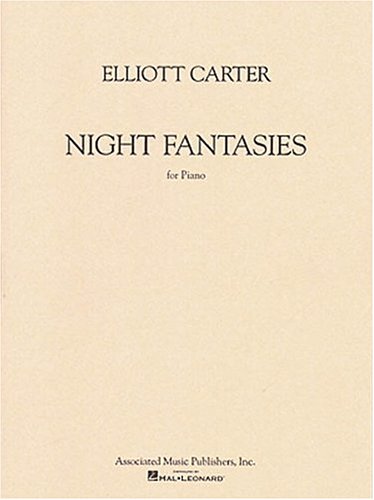
21. Night Fantasies: Piano Solo
 
$37.39
22. A Mirror on Which to Dwell: Full
 
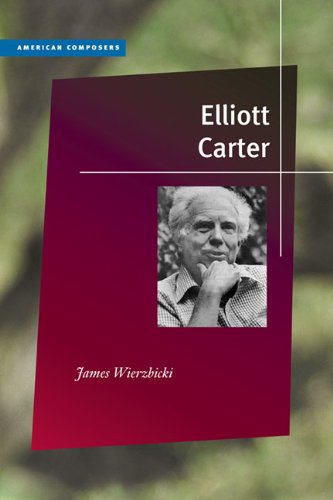
23. Carter (Biblioteca di cultura
$7.94
24. Hiyoku: for Two Clarinets
 
$15.76
25. Sonata (1948): Cello and Piano
$7.94
26. Retracing: for Solo Bassoon
 
$38.98
27. Double Concerto (1961): Full Score
 
$29.70
28. Piano Concerto: Full Score
 
$30.39
29. Duo: Violin and Piano
 
$7.81
30. Three Poems of Robert Frost: Voice
$7.94
31. Retrouvailles: for Solo Piano
$7.94
32. Figment No. 2: Remembering Mr.
 
$5.95
33. Varied clinical presentations
$13.74
34. String Quartet No. 3 (1971): Study
35. Von heute auf morgen. / What next?
 
$17.18
36. Woodwind Quintet, 1948: Score
 
37. New Worlds of Edgard Varese: Papers
 
38. The obstacle course: A guide to
$7.94
39. Steep Steps: for Bass Clarinet
$7.94
40. Au Quai

21. Night Fantasies: Piano Solo
Paperback: 52 Pages (1996-02-01)
list price: US$25.00 -- used & new: US$13.95
(price subject to change: see help)
Asin: 0793552559
Average Customer Review: 5.0 out of 5 stars
Canada | United Kingdom | Germany | France | Japan

Customer Reviews (1)

5-0 out of 5 stars golden fruits of maturity
this is Carter's most interesting piano solo,written late;a quadruple commission; it seems most of his piano repertoire,his thinking excursis for the keyboard has been skewed toward chamber settings(The Double Concerto),the Wind and String Quintets(also late bloomer works) and the massive penumbral "Piano Concerto", that which has equally more interesting orchestrations than the content for what is played on the piano. The earlier Brahmsian/Copland-esque "Piano Sonata" from the Forties, has its points of interests,rolling rotund resonant timbres,bombastic declamations but that is an earlier Carter,formative times and a different set of creative paradigms at work actually, prior to the maturity and interest that set in after the "First String Quartet". . .The golden fruits of maturity has seen many works even an opera of mixed quality,and predictable-ness some of the solos and duets,dedications as "Espirit rude" are quite glib materials,tossed off. Here however the "Night Fantasies" is an interesting piece of music,certainly one that has entered the modern piano literature, a modern nocturne of darkness for dark times which never seem to recede,simply differing gradations of it. This work has entered the mainstream and academia naturally and you can see it played on piano competitions,although difficult to perform in that all the suggestive timbral layers Carter employs/deploys need continuous clarity.He sets a large pallette of piano attacks,mixed with an equal distributions of dynamics sustained moments mixed with more percussive effects,staccato with sustained, cloistered-like chorals deployed.If this agenda for "layering" is abandoned well the work will cohere-melt into one quite boring unadorned glob of timbre, suggestive of Schumann or Brahms having lived through World War 2.Ursula Oppens and Charles Rosen have exhibited the most interesting readings I think,and quite recently Pierre Laurent Aimard,in a nice recording with his own commnetary thrown in.I would like to hear Frederic Rzewski play this work, with his overriding dynamic approach and technical clarity he can summon to his fingers and perhaps glean the overbearing romantic-nesses from the work, making it leaner and more articulated.That is always the problem with modernity of this kind,it always tempts the interpreter into a more facile reading,more direct, more bound to the aesthetic of the romantic as Solti playing Schoenberg as Brahms or as he had done with Carter's "Variations for Orchestra" he had takened on tour.. If you bring direct unencumbered musicianship to Carter the music will reward you, and if you acknowledge its intellectual agendas you will be twice blessed.
Jon Link has done excellent work on mapping the poly-rhythmic distributions of this work,and David Schiff's excellent book to a less exhaustive degree and Yes! some can hear all of it,the poly-rhythms, layered textures if you have a map inside your head, and have some pre-requisite home study of the score prior to a listening experience, but short of that the work still harbors a neo-romanticism with an affinity for modernity, the wonderful fast furioso filigree displays, "fugitive" lines wanting to escape from the work's structural tyranny has a kind of other wordly quality. ... Read more


22. A Mirror on Which to Dwell: Full Score
by Elizabeth Bishop
 Paperback: 100 Pages (1986-11-01)
list price: US$60.00 -- used & new: US$37.39
(price subject to change: see help)
Asin: 0634038109
Canada | United Kingdom | Germany | France | Japan
Editorial Review

Book Description
For Soprano and Chamber Orchestra. Six poems by Elizabeth Bishop. ... Read more


23. Carter (Biblioteca di cultura musicale)
by Elliott Carter
 Unknown Binding: 318 Pages (1989)

Isbn: 887063051X
Canada | United Kingdom | Germany | France | Japan

24. Hiyoku: for Two Clarinets
Paperback: 4 Pages (2006-01-01)
list price: US$9.95 -- used & new: US$7.94
(price subject to change: see help)
Asin: 1423410351
Canada | United Kingdom | Germany | France | Japan
Editorial Review

Book Description
First performed in 2001 in Amsterdam by Charles Neidich and Ayako Oshima, and recorded by them on Bridge Records. "Hiyoku" is a poetic word, originally used by the ancient Chinese poet, Bai Juyi, later adopted by Japanese authors. It means two birds flying together with the connotation of eternal love. ... Read more


25. Sonata (1948): Cello and Piano
 Paperback: 48 Pages (1986-11-01)
list price: US$22.95 -- used & new: US$15.76
(price subject to change: see help)
Asin: 0793517435
Canada | United Kingdom | Germany | France | Japan
Editorial Review

Book Description
For flute, oboe, cello and harpsichord. ... Read more


26. Retracing: for Solo Bassoon
Paperback: 4 Pages (2006-01-01)
list price: US$9.95 -- used & new: US$7.94
(price subject to change: see help)
Asin: 142341036X
Canada | United Kingdom | Germany | France | Japan
Editorial Review

Book Description
Retracing is excerpted from Asko Concerto (2000). First performed by Peter Kolkay at Weill Recital Hall, New York, in 2002. Duration: 3 minutes. ... Read more


27. Double Concerto (1961): Full Score
 Paperback: 180 Pages (1986-11-01)
list price: US$40.00 -- used & new: US$38.98
(price subject to change: see help)
Asin: 0793534151
Average Customer Review: 5.0 out of 5 stars
Canada | United Kingdom | Germany | France | Japan
Editorial Review

Book Description
Elliot Carter is considered one of the most significant composers of the 20th century whose works are usually quite involved and intellectual. This full score includes extensive notes on seating for the players, types of instruments used, performance suggestions and program notes. Instrumentation: Piano, Harpsichord and 2 chamber ensembles. Parts available on rental. ... Read more

Customer Reviews (1)

5-0 out of 5 stars great water mark of modernity
this is again a high point for Carter's newly found aesthetic,neo this or neo that, I simply listen these days,but he had fashioned a musical language of continuation, intervallic mosaics,rhythmical structures employed over large swabs of time with the combustible emotive freedoms of here two keyboard soloists,,,the agenda here was to associate certain chamber timbres with either the harpsichord or the piano, like a timbral dialogue,latterly developed in his "Penthode"/ / / Here the "Double Concerto" it begins quite mysteriously with fragments and shards,tinkles,thuds,and chunks of percussive sounds, lightly tapped tom-toms and suspended cymbals/ / /I heard performances where the percussion cadre came to dominate the timbral space given,too loud! no the two keyboard instruments should reign supreme here with their own cadre of chamber orchestras to help them convey their content. The Harpsichord which can be amplified is first in exposition of materials,you hardly know the piano exists,lighly trying to penetrate the discussion,like some marginal prophet trying to find where it belongs, with lightly sprinkled finger cymbals and idle taps on a metal plate, there is not much sustaining power here unless you find these overwhelming arpeggiations in the harpsichord which Carter does employ, each orchestra has their own materials, their own intervallic language,timbres,rhythms to establish who they are in Cartesian formation, like a "clash of civilizations"to a degree promuligated now for greater divisions of greed and wealth, so to within the realms of the aesthetic these metaphors have some substance,The piano then comes to dominate the latter half of the piece,within its more rotund timbres to help convey its persona, trombones and lower strings and winds help this tyranny along, and lower tom-toms, these timbres do interestingly enough cross in diagonals between chamber borders, and if all these expressive emotive minutae are not sorted out you have a real quagmire on your hands/ / / if you have strong persuasive musician soloists as Ursula Oppens, the piece ceases the "double concerto" narrative. The work is compact, classic in shape and agenda,quite difficult to perform in that much happens of intervallic configurations,although Carter kept his orchestrations quite lean,and understared, at least that is my take on how to read the work, yet there are layering devices to distinguish mere accompaniment from primary material.This was Carter's first primary work subsequent to the associative achievements of context of the First and Second String Quartets/ / /there has not been yet another modern concerto of this modest magnitude, unpretencious, yet proclaiming a territory nonetheless.Too bad this work is not perfomred more often than it is by primary venues,usually student orchestras take up the cause,and as relavant as that enterprising course is, it is far from the trajectory where masterworks of modernity should reside. ... Read more


28. Piano Concerto: Full Score
 Spiral-bound: 201 Pages (1986-11-01)
list price: US$45.00 -- used & new: US$29.70
(price subject to change: see help)
Asin: 0793511305
Average Customer Review: 5.0 out of 5 stars
Canada | United Kingdom | Germany | France | Japan

Customer Reviews (1)

5-0 out of 5 stars deeply compact, another water sign of the "anarchic"
if I recall Carter had written much of this while in West Berlin teaching some students, it follows the ;Double Concerto;(then subsequent equally powerful "Concerto for Orchestra") in some respects yet now projecting an unencumbered, an un- burdened free soloist. Carter said he merely wanted to write music he thought was interesting in the Sixties and so he could under the neo-liberal order.
This is a dark,thorny,fully impassioned work yet it allows "sunshine",reflection(s) inside the texture of things in density and timbre,and in complexity to come through.
The piano solo and the orchestra begin their arguments,their probings as equals, very democratic,very exciting,the incessant assymetrical rhythms and poly-rhythms between the soloist and the winds/ / /,the orcehstration is interesting for the pianoseems to mimic or stay within identical registers to whomever else in the orcehstra is uttering a declamation or idle intervallic thought/ / / no shifting of emphasis and function, of tossing and relaying music materials between, in fact the orchestra comes to "freeze" itself, in contracting itself in compacted clusters,cecoming less free as the work progresses,this while the piano tries to find an expressive way out of this cul de sac and never really does, even resorting to now full brutal dialogue( in the ;second movement;), the piano comes to ask questions, while maintaining its full virtuoso flair and expressive demeanor never succombing to the torrent of timbre in the orchestral forces.High register winds, snarling brass come to help cadences of moments, and the piano plunges right in to help disrrupt anything that claimed to be "unifying".At times as well the piano shares particular register to augment/further an argument as the "basso" regions with low tom-toms and tympani; The work is incredibly compact/impacted within two movements (of 10 minutes and 12 and one half minutes) respectively.This structure seems to work much better than the more fragmented "Concerto for Orchestra" which seems to meander and finds itself without purpose as it progresses,at least to this listener. On paper,in score I suspect all Carter makes clarity an art of shape and tone of rhythmic dimensions.In the "Piano Concerto" however Carter allows interestingly enough the full basso timbres of the piano to come through,single tones,like revealing yet another aspect of a persona, another side to a facial contour never seen prior in time. This can and does halt the rhythmic momentum,going forward,it does and does not at times, the rather dense convoluted textures which he allows are present as a given, and Gielen and Oppens(in their recording) are incredible in the clarity they bring to this complex score by anyones definition.There is a timbral beauty in Carter if you know where to look.His music looks forward by looking backwards;this gives his music a real powerful agenda,in that we come to re-experience, the quasi-romantic/expressionist charms and arrogant expressions.
Arnold Hauser in one of his "histories" on the visual arts says someplace that the entire "romantic" constitution comes from the"anarchic", the exposed,the abandoned premise, the unencumbered, of a new class fettered no more and finding new freedoms in merchant capitalism within the 19th Century. Well Carter is a traditional/modernist but one whose affinity resorts to these romantic dimensions of expressions in that his creative pallette did not venture to far afield,the center of his creativity remains within a predictable consciousness. His music will never surprise you,or take you unawares of some dimension of what modernity can do, or should do.I think that this is part of its wide appeal, that within the the alienation schemes practiced within the modernist language in music, Carter's music is knowable, one can come to follow it without too much arduous exchange within one's psychology.
There are exposed solo lines as well in the winds and a solo violin a la Richard Strauss primarily in the ;second movement; the flute, and the "new" timbre (for its time) the Bass Clarinet;nice round tones allowed to pass the tyrannical gaze of the piano. The work as it progresses wants to end itself, it becomes somewhat neurotic in not discovering a resolution for itself.It works nonetheless much better than the "Concerto for Orcehstra". ... Read more


29. Duo: Violin and Piano
 Paperback: 56 Pages (1986-11-01)
list price: US$40.00 -- used & new: US$30.39
(price subject to change: see help)
Asin: 0793520622
Average Customer Review: 5.0 out of 5 stars
Canada | United Kingdom | Germany | France | Japan
Editorial Review

Book Description
Composed in 1974 and commissioned by the McKim Fund in the Library of Congress, Duo was first performed by Paul Zukofsky and Gilbert Kalish on March 21, 1975. It reflects the contrast between the sounds made by stroking the violin with the bow and those made by striking the piano. ... Read more

Customer Reviews (1)

5-0 out of 5 stars another genre givingborn again illumination
this dates from Carter's Middle period; the works after the massive "Concerto for Orchestra"and the upcoming :Third String Quartet:; this "Duo" for Violin and Piano reveals that you need to locate a new context if you want the genre itself to speak to you, otherwise you resort to nefarious predictable approaches as engaging the styles of Neo this or Neo that, and when you think of the countless Violin modern Sonatas that have been written,idly boring stuff. I would think you would want the genre not to be a deadend, and it has certainly the Beo-Romantic literature pummeled the Sonata genre into the ground,with Hindemith,Poulenc,Milhaud,Rorem.
Carter here directly wants a situation where he is dealing with timbre,timbre exposed in and by-itself rather than utilizing the already given expressive shapes of this genre,andto manipulate and explore the unique characteristics of the two instruments and set up a situation where the two can be developed along fairly interesting lines of complexity, opacity and communication if possible. He allows only certain intervals to appear in each part,as a way of fixing the field of play, giving the instruments like a shape of unique colour; for example the Violin is dominated,saturated with the intervals m2,M3,tritones,P5,M6 and m7th fairly resonant producing materials,with double stops; the piano is burdened with M2,m3,P4,also tritone,m6 and M7th, there is also a Fixed Octave scheme established in the first 83 measures of the work, the tones(beginning on the g below Middle C),g,a,c,d,eb,f,ab,b,c3,e,f#,g,a,c,d,eb,f,ab,b. The rhythmic utilizations as well plays a role in defining the characteristics of the instrument, so the Violin has more a soloistic demeanor,anarchic, free with tied over the bar tones, more asymmetrical units displayed, against the sometimes more predictable percussive piano.The piano is utilized very much as in the earlier :Sonata for Violoncello and Piano:,like a time keeper/retainer, a walking bass or Baroque Trio basso continuo. You really cannot say there is accompaniment here merely another part. Carter also morvelously utilizes differign arrays of articulations in the piano, something you will find later in his "Night Fantasies", and "90+" for piano solo.
The genre of the Violin and Piano is a well trodden, well reserfed for serious discourse in some respects, with Arnold Schoenberg's "Fantasy for Violin and Piano, one of the last works he wrote in the early Fifties.Also Milton Babbitt's "Joy of Sextetts", and "More Joy".The solo Violin genre as we travel past these times has not faired much better with Boulez's disappointing "Anthemes" utilzing antiphonal dimensions with very little to exploit or reveal or say, and Nono's weakest work of his innovative late period, the "Lontano. . . for two violins with also antiphonal handlings. ... Read more


30. Three Poems of Robert Frost: Voice and Piano
 Paperback: 12 Pages (1987-04-01)
list price: US$10.95 -- used & new: US$7.81
(price subject to change: see help)
Asin: 079351326X
Canada | United Kingdom | Germany | France | Japan
Editorial Review

Book Description
Three settings of titles from The Collected Poems of Robert Frost, composed by Carter in 1942. Titles include: Dust of Snow * The Rose Family * The Line-Gang. Also available in a version orchestrated for 12 players (performance material on rental). ... Read more


31. Retrouvailles: for Solo Piano
Paperback: 4 Pages (2006-01-01)
list price: US$9.95 -- used & new: US$7.94
(price subject to change: see help)
Asin: 1423410327
Canada | United Kingdom | Germany | France | Japan

32. Figment No. 2: Remembering Mr. Ives
Paperback: 8 Pages (2006-01-01)
list price: US$9.95 -- used & new: US$7.94
(price subject to change: see help)
Asin: 1423410343
Canada | United Kingdom | Germany | France | Japan
Editorial Review

Book Description
Composed for and first performed by Fred Sherry at Alice Tully Hall, New York, in 2001, and recorded by him on Bridge Records. 5 minutes. The music recalls fragments of Charles Ives' Concord Sonata and Hallowe'en. ... Read more


33. Varied clinical presentations of Vibrio vulnificus infections: a report of four unusual cases and review of the literature.(Review Article): An article from: Southern Medical Journal
by Ozlem Ulusarac, Elliott Carter
 Digital: 15 Pages (2004-02-01)
list price: US$5.95 -- used & new: US$5.95
(price subject to change: see help)
Asin: B00081UZUG
Canada | United Kingdom | Germany | France | Japan
Editorial Review

Book Description
This digital document is an article from Southern Medical Journal, published by Southern Medical Association on February 1, 2004. The length of the article is 4232 words. The page length shown above is based on a typical 300-word page. The article is delivered in HTML format and is available in your Amazon.com Digital Locker immediately after purchase. You can view it with any web browser.

Citation Details
Title: Varied clinical presentations of Vibrio vulnificus infections: a report of four unusual cases and review of the literature.(Review Article)
Author: Ozlem Ulusarac
Publication: Southern Medical Journal (Refereed)
Date: February 1, 2004
Publisher: Southern Medical Association
Volume: 97Issue: 2Page: 163(6)

Distributed by Thomson Gale ... Read more


34. String Quartet No. 3 (1971): Study Score
Paperback: 100 Pages (1986-11-01)
list price: US$20.00 -- used & new: US$13.74
(price subject to change: see help)
Asin: 0634002538
Average Customer Review: 5.0 out of 5 stars
Canada | United Kingdom | Germany | France | Japan

Customer Reviews (1)

5-0 out of 5 stars extemely intense music after a long gestation
a long arduous gestation period some 20 years, separates the evocative, relatively gentle Second Quartet of brevity and classic shape to the more intensely extreme dimensions of the Third Quartet of 1971, I cannot help but think that the uncertainty of world events had been an integral formative part of this period,and fines its way into the strings herein/the deeply stated penumbral "Piano Concerto" was behind Carter's creativity now,I always like to think that pieces, a composer's oeuvre influences the burden of future works, that things, the working out of the music becomes more arduous, and filled with irresolution as time passes, what will come, and in this light this Third Quartet has that dimension. Of course you can also say that this work is an intense celebration, a fullfillment of strong brutal ideas for their own sake, not for anyone,unadorned,unencumbered by any narrative,relishing in deeply virtuosic timbres, revealing a content of extroversion,one not afraid(within the aesthetic) of anything anymore. This Quartets dimensions it seems knows no boundary markers with its duel forces pitted against each other, like a palace rebellion strictly of aristocrats had occurred without the outside populace knowing about it. So here the DUO I is Violin and Cello,cloistered together where pitches and tone configuration seem to be boundless,more rhapsodic in playing (as Carter advises in his notes "quasi rubato") to the more imprisoned DUO II, Violin and Viola,(stricter rhythm(s) throughout) taking on here more an accompanimental role,equally with Carter's affinity for the sustained string sound, this un-freedom functions nonetheless and makes the music stop,halts the flow of itself and/or create a magnificent tension so the work wants to proceed,but cannot, wants to fulfill itself it does so with a large array of durational indication, expanding and contracted in surface in register,very liberal utilizations of double stops as well, as if one single voice along never quite fits the emotive agenda here there is also a :dialectic:( a bad word) of emotive content at work with often times contradictory indications between the two DUO, as the opening exhibits simultaneously "Maestoso" in DUO II, and "Furioso" (quasi rubato,)in DUO I,this suggested hostility continues quite to the end.
The modern British painter Francis Bacon had said that longevity within this language, (meaning expressionisms of sorts,equal to Carter's musical substance)that tension remains forever in art where it may exist,as even the private pastoral tensions in the continuous tonal movements of trees and mountain surfaces in Poussin's massive landscapes,geometrically pure,but unknown at dirst So to Carter I beleive in some array of poly-rhythmic durational scheme takes this work's strength from under its rhythmic surface passive perhaps on the surface, but look closer for the tension. Here passive acceptance in Carter is by degrees,and within his affinity for establishing characters within the genres,resolution simply goes away forgotten as unimportant.
In Carter's introductory notes, he advises that the :sustained sound:, and the fast tones will tend to get "covered by notes of medium speed", so an interpretive problem exists in the clarity of this duel of virtuosity, of dodecaphonic remorse. The work has a dryness to me, never seductive, or in a way suggestive of Lucien Freud's work, equally dry yet not devoid of emotion, below the surface. Here the surface brutality usually foments, throws our listening into the work, deeply engaging without an agenda.The work has no resolution,or it implodes upon itself really and as it progresses it deeply exposes its content, what it has been about,that the violence sought after in the beginning becomes tamer to a degree in its totality beaming,projecting itself in fragements,like incomplete thoughts, "fugitives"(as Pierre Aimard might say) where it becomes like a flame-furioso, given less oxygen for its existence snuffed out, stepped on for a time. ... Read more


35. Von heute auf morgen. / What next? Zwei Einakter. Ein Opernführer.
by Arnold Schönberg, Elliott Carter
Paperback: Pages (1999-10-01)

Isbn: 345834604X
Canada | United Kingdom | Germany | France | Japan

36. Woodwind Quintet, 1948: Score
by E. Carter, Elliott Carter
 Paperback: 24 Pages (1988-06)
list price: US$15.00 -- used & new: US$17.18
(price subject to change: see help)
Asin: 0793515726
Canada | United Kingdom | Germany | France | Japan

37. New Worlds of Edgard Varese: Papers and Discussion from a VareseSymposium at the City University of New York (I.S.a.M. Monographs, No. 11.)
 Paperback: 90 Pages (1979-02)
list price: US$10.00
Isbn: 0914678116
Canada | United Kingdom | Germany | France | Japan

38. The obstacle course: A guide to vocational recovery
by Elliott E Carter
 Unknown Binding: 111 Pages (1978)

Asin: B0006XMC6Q
Canada | United Kingdom | Germany | France | Japan

39. Steep Steps: for Bass Clarinet
Paperback: 5 Pages (2006-01-01)
list price: US$9.95 -- used & new: US$7.94
(price subject to change: see help)
Asin: 1423410378
Canada | United Kingdom | Germany | France | Japan
Editorial Review

Book Description
Premiered in 2000 at Weill Recital Hall, New York, by Virgil Blackwell, and recorded by him on Bridge Records. The piece was composed for Blackwell. The composer states: "Its title comes from the fact that, unlike the other woodwind instruments, the clarinet overblows at the twelfth, a large interval that forms the basis of much of this composition." 3 minutes. ... Read more


40. Au Quai
Paperback: 5 Pages (2006-01-01)
list price: US$9.95 -- used & new: US$7.94
(price subject to change: see help)
Asin: 1423410335
Canada | United Kingdom | Germany | France | Japan
Editorial Review

Book Description
Written for the London Sinfonietta for Oliver Knussen's 50th birthday, and first performed by members of that ensemble in 2000 at Queen Elizabeth Hall, London. Recorded by Peter Kolkay, bassoon, and Maureen Gallagher, viola, on Bridge Records. The composer states: "The title of this piece was suggested by Arnold Schoenberg's short story 'To the Wharfs' in which he describes the mounting anxiety of the members of a French fishing village as the boats and the sea-bound fisherman failed to appear after a storm and several days' absence. When they were suddenly sighted all shouted 'to the wharfs, aux quais, O.K.'" 3 minutes. ... Read more


  Back | 21-40 of 98 | Next 20
A  B  C  D  E  F  G  H  I  J  K  L  M  N  O  P  Q  R  S  T  U  V  W  X  Y  Z  

Prices listed on this site are subject to change without notice.
Questions on ordering or shipping? click here for help.

site stats