e99 Online Shopping Mall

Geometry.Net - the online learning center Help  
Home  - Composers - Cage John (Books)

  1-20 of 100 | Next 20
A  B  C  D  E  F  G  H  I  J  K  L  M  N  O  P  Q  R  S  T  U  V  W  X  Y  Z  

click price to see details     click image to enlarge     click link to go to the store

$14.61
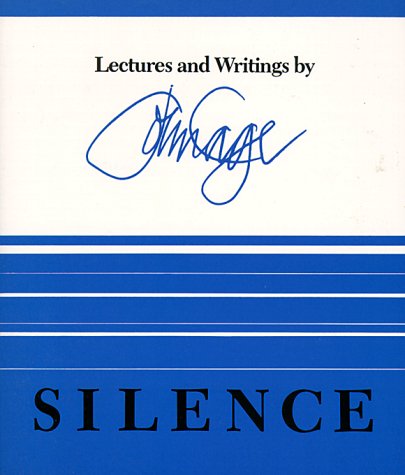
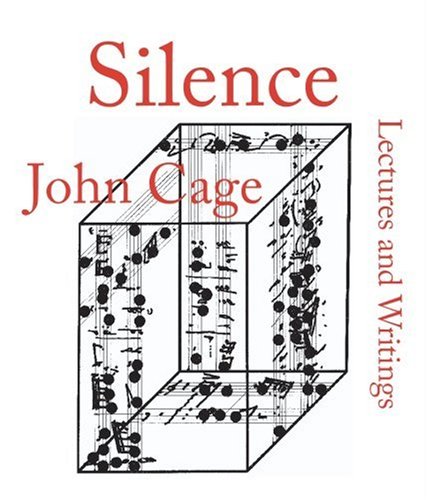
1. Silence: Lectures and Writings
$35.50
2. The Music of John Cage (Music
$13.95
3. The Roaring Silence: John Cage:
$13.79
4. John Cage: Composed in America
5. Cage - Cunningham - Johns: Dancers
 
6. Silence: Lectures and Writings
 
$27.73
7. M
$14.65
8. Anarchy
$42.00
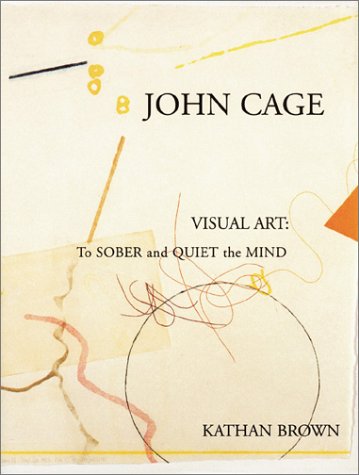
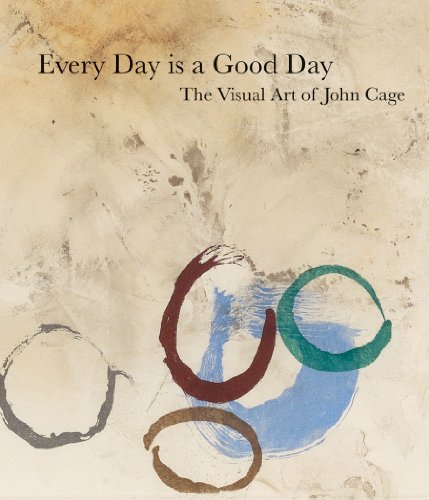
9. John Cage Visual Art: To Sober
 
10. Diary: How to Improve the World
 
11. Themes and Variations
 
12. I-VI / John Cage
$29.71
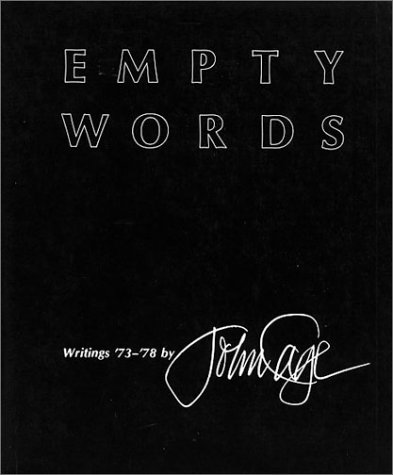
13. Empty Words
$23.95
14. Extended Play: Sounding Off from
$25.95
15. John Cage (American Composers)
 
$26.68
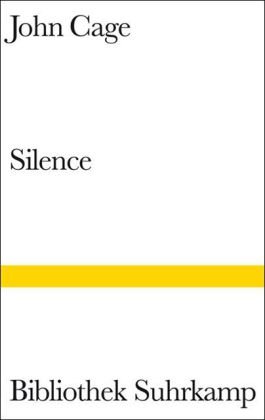
16. Silence.
 
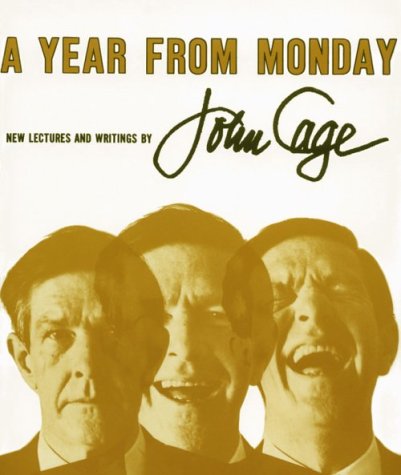
17. A year from Monday;: New lectures
18. John Cage: An Anthology (Da Capo
 
19. Notations
$115.00
20. John Cage: Music, Philosophy,

1. Silence: Lectures and Writings
by John Cage
Paperback: 288 Pages (1961-06-15)
list price: US$22.95 -- used & new: US$14.61
(price subject to change: see help)
Asin: 0819560286
Average Customer Review: 4.5 out of 5 stars
Canada | United Kingdom | Germany | France | Japan
Editorial Review

Book Description
Silence, A Year from Monday, M, Empty Words and X (in this order) form the five parts of a series of books in which Cage tries, as he says,"to find a way of writing which comes from ideas, is not about them, but which produces them." Often these writings include mesostics and essays created by subjecting the work of other writers to chance procedures using the I Ching (what Cage called "writing through"). ... Read more

Customer Reviews (8)

4-0 out of 5 stars Very Interesting!!
This book is a work of art in itself. John Cage takes so many of his theories and applies them to his writing style, formatting, and type style.I suggest knowing a little about him before reading this book as it is a little easy to get lost in translation (figuratively speaking). Overall, it is definitely worth reading, and it is fairly affordable...a good addition to any collection.

5-0 out of 5 stars Essential
Not just for musicians, but for anybody who is interested in music or philosophy.Cage's ideas presented in the work are fascinating in and of themselves, but even the manner in which he physically notates his thoughts on paper is amazing to see.

There's a common argument that his ideas (and this book) are overrated.I find this difficult to digest, especially when one considers the enormous impact Cage's writings and compositions have had on countless composers (basically anyone composing after 1950 has most likely taken a thing or two from the ideas in this book).

Sometimes he can be a little tough to follow in the book, as properly constructed sentences are not high up on Cage's list of priorities.However, this book has so much to offer that it is worth wading through the occasional slow spot.

So give it a whirl.Even if you don't like Cage's music, reading this book will give you insights into what he did that may change your mind or at least instill a newfound respect.At its best, this is inspiration of the highest sort.

5-0 out of 5 stars Quintessential Cage
I keep readingit year after year and I keep finding sections of it I've never seen before.magic.A the same time, I read the same part overs and over again years later and they just get better.

It's just a remarkable text.

You have to get it.

4-0 out of 5 stars This book is slightly overrated, actually
There is no denying the importance of John Cage as a composer as well as a writer. But even though this book is a necessary provocation for anyone who thinks they know what music is and should be, he is not a philosopher, and his ideas are often contradictory, naive and even romantic.

Romantic? Yes, I would say that for instance his idea of "sounds in themselves" and "nature" are romantic. Can we really eliminate all cultural impact and distortion just by refusing intention? I think not. Sounds are always inflected by history.

Still, I would not want a world without the challenge of his extreme stance.

5-0 out of 5 stars Nothing Has Been The Same
It's always a strange sensation for me to go into a record store, or even see what's available here, and find so many John Cage recordings in print.As the most essential and avant-garde composer of the century, that'sgratifying to me [a composer] but also unnerving that anyone soexperimental and uncompromising in the arts would enjoy suchpopularity.

This book goes a long way towards explaining that.And inmany ways, this book stands apart from his music, and can be enjoyedwithout ever hearing or knowing of Cage's music pieces.Because the musicwas almost by accident - Schoenberg told Cage that he was an inventor, nota composer, and this book demonstrates that, and goes further to show Cagewas a philosopher.Music just happened to be the medium where he bestexpressed his philosophy, but it could have been painting or film,depending on his path.The book defines a way of living and thinking andseeing, and of course hearing, the world.That's what it's about.Andit's beautiful and gentle quality capture the essence of Cage, a true quietrevolutionary.His revolution was profound, and best expressed in hispiano piece 4'33", where the pianist does not make a sound at theinstrument.The revolution of that event was the most profound anddestabilizing in the history of music, and yet it was entirely silent. Such is the power of Cage's ideas that he has no need to really 'lecture'about them, he merely presents them and let's their own strength do therest. ... Read more


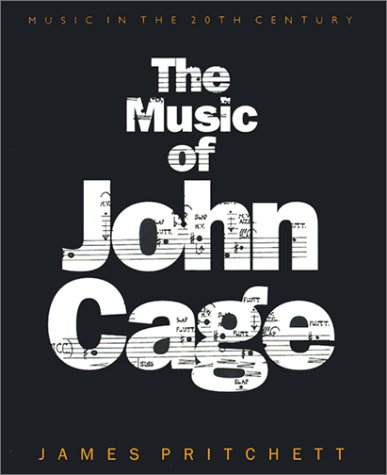
2. The Music of John Cage (Music in the Twentieth Century)
by James Pritchett
Paperback: 237 Pages (1996-04-26)
list price: US$43.00 -- used & new: US$35.50
(price subject to change: see help)
Asin: 0521565448
Canada | United Kingdom | Germany | France | Japan
Editorial Review

Book Description
Although John Cage has been almost universally recognised as the leading figure of the post-war musical avant-garde, this is the first book to present a complete and coherent picture of Cage the composer. Providing a historical account of Cage's musical concerns and changing style, James Pritchett describes just what it was Cage did and why and how he did it. The book is centred around extensive descriptions of the most important works and compositional techniques, including in-depth explanations of the role of chance and indeterminacy in Cage's music. Dr Pritchett also considers the relationship of Cage's musical thought to his interests in such diverse subjects as Eastern philosophy and religion, Marshall McLuhan, and anarchism (among many others). This book thus makes the essential introduction to Cage's musical world. ... Read more


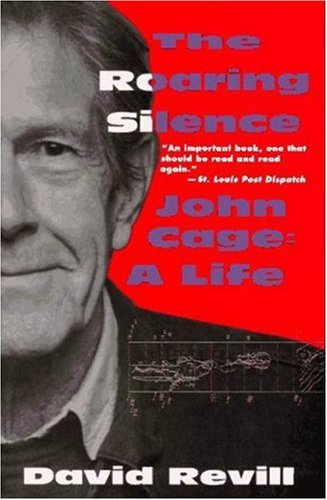
3. The Roaring Silence: John Cage: A Life
by David Revill
Paperback: 375 Pages (1993-11-05)
list price: US$14.45 -- used & new: US$13.95
(price subject to change: see help)
Asin: 1559702206
Average Customer Review: 3.5 out of 5 stars
Canada | United Kingdom | Germany | France | Japan

Customer Reviews (2)

3-0 out of 5 stars John Cage : "Perhaps You Would Understand It If You Did It"
The Roaring Silence by David Revill includes all of this information and much, much more. This biography gives a very personal account of the life of John Cage, and Revill makes it clear to the reader all too often that he knew Cage personally. It seemed as if this personal relationship interfered with the account of Cage's life and made it confusing. This confusion was caused by explanation and not enough placement of where the author was in Cage's life (even though the chapters are labeled by a span of a few years each). This makes it difficult to figure exactly when Cage did some things and makes the reader guess all too often. Perhaps this non-straight forwardness should be applauded in getting into tremendous detail about some things that another author might skim over, but I only found it discouraging. Name-dropping and over-quoting were another consequence of this personal approach, which I also felt was inappropriate.
Adding to this narrative confusion, Cage's life is extraordinarily complex in and of itself. To try to explain what Cage attempted in his work, along with giving concise descriptions of it would be quite a feat. Though it was nice that The Roaring Silence encapsulated all of his work, be it painting, music, or prose, it may have benefited both the author and the audience if it was clearer about what was what. In the very same chapter that discussed an integral and complex piece of music, Revill would quickly run-down what his art looked like at the time, then return to talking about the music composition. This also sparked some confusion.
In terms of biographical information, The Roaring Silence seems extremely thorough. Aside from the abundance of contextual information regarding his works in the text, there is an extensive Chronology of Works among the last pages of the book. A Bibliography and Source Notes accompany the text with many other sources of information about Cage. A full sixteen pages wedged between chapters contains some black-and-white photos of his life along with some images of his artwork and compositions on staff paper. However, there is nearly no background information given about his family, or even the young Cage's life. The beginning of the book skims over Cage's life through high school in about the time that Revill would later focus on only two years of the older Cage. I contend that because Revill did not know Cage at a young age, he did not bother to research these years and thusly skimmed over it so that he could emphasize the point that he knew John before anything significant happened. Though this is yet another foreseeable weak point of the book, it does not mean that the book is all that bad.
The ways in which this book are effective can be clearly overtaken by the plethora of confusion in The Roaring Silence. However, this should not be taken to mean that Revill's work should be taken for granted. In the biography, he effectively compiles as much information about John Cage's composing life that anyone could dig up. Throughout the progress of the book, he consistently refers to actual letters Cage sent or received along with transcripts of speeches or dialogues Cage was actively involved in. There is a highly objective sense in the book though it is clear that Revill has some personal biases based on his knowing Cage. Revill never comments on any of Cage's pieces or editorializes on why this piece of art is more profound than that one. Personally, for such a confusing composer such as Cage, I treasure the omission of unnecessary opinion when already having difficulty sorting out what it is that Cage actually accomplished in his life. However, I can also see why some may want the author to comment more than he does in trying to understand some people's active opinions of Cage during his life.
In reviews of the biography found elsewhere, the most positive comment I could find was that The Roaring Silence is, at best, a "fine" companion to Cage's autobiographical work Silence. Though I have not read Cage's autobiography, I believe that I am more strongly encouraged to go and read a copy. Perhaps having read the biography first, I might have gotten a fuller picture of his life. Perhaps this would only create more confusion. With all of the quotes straight from Cage's mouth or from Silence encapsulated in this work, I am inclined to imagine that the holes that remain here are also found in the autobiography.
Cage's influence is apparent throughout the pages of the book. Revill draws connections with other composers directly affected by Cage's work. In Cage's constant defense, Revill also continually argues that he is possibly the most important composer of our time. He spares no time at all in delving into the heart and mind of Cage, brushing off any of the negative criticism he received continually throughout his life. The way in which Revill constructs the biography extends Cage's influence into the realms of poetry, video art, printmaking, painting and dance.
Revill's The Roaring Silence is the first of its type, a complete biography (non-autobiographical) of John Cage. It is clear that throughout the early writing process, Revill worked closely with Cage in constructing the most authentic biography possible. In doing so, it captures much more that just a synopsis of Cage's external life. In many chapters, he discusses philosophical and aesthetic ideals that Cage held dear. In doing so, he relates periods of Cage's work to his state of mind of the time. Just as confusing as some of Cage's pieces were, so were his beliefs. Ever changing, non-committal and fervent were his ideas, sometimes all at once. The skepticism, however, that was typical of Cage's personality was evident throughout his life in both his music and his beliefs. As a media scholar myself, I find of particular interest the close intellectual bond that he shared with the ideas of Marshall McLuhan. These were both people who were out to prove the world wrong and to change it and challenge it in ways never before thought possible. The idea of the world as a 'global village' fascinated Cage greatly, and he constantly went back to McLuhan's ideas for inspiration that are evident in his own poetry, paintings and other composition. It has been said that Cage was not of this world, he was merely living in it and I strongly believe that this is a just description of the man.
Cage's innovations also do not go unnoticed in this book. His prepared piano is still commonly referred to and used by many musicians today. In his time, this avant-garde instrument was looked down upon and today is commonplace among many post-modern composers. Cage also pioneered the idea of indeterminate notation in which instructions on staff paper are very loosely based and much is left largely to the performer. This focus on the performer is something that many composers tended to ignore before Cage. Now, there is a clear interest in many classical performers and the composers who write for them. Finally, Cage's use of aleatoric music and chance methods of composition such as the I Ching were extremely huge innovations for his time. Again, today, there remains a large influenced group of post-modern composers who utilize aleatoric music in nearly every composition. These sorts of influences are used by Revill in determining and emphasizing Cage's importance in the realm of classical music. In doing so, he focuses on more than just Cage's quirkiness and bizarreness and cuts through to a key element of his compositional life.
As stated previously, this book also spans many years and many phases of Cage's life. Not only does Revill illuminate the composer that Cage was, he also delves into the more brushed-over aspects of his life: the performer, the printmaker, the watercolorist, the expert amateur mycologist, the game show celebrity, the political anarchist, and the social activist. His influence in all of these areas is noted doubly by Revill. I am told today by my fashion-designer girlfriend that even the 2007 color for winter is named J. Cage. The cult phenomenon known as John Cage clearly found his way into nearly everyone's life he touched in some way.
It is clear that Cage's influence, not only as a composer, is evident in The Roaring Silence. This, I believe, is the strongest element of Revill's work. The personal flares that he adds in sometimes enhance the reading experience, and sometimes distract from the overall cohesiveness of the work. I can honestly say that I wish that I had read Cage's own Silence before reading this. As a companion to Silence, I am sure that this biography only enhances the reader's understanding. However, not all is wrong with The Roaring Silence. An overall fascinating read cover to cover, it was a joy to experience the mystery that was John Cage.

4-0 out of 5 stars Read this to hear differently
An essential book for anyone interested in John Cage's music or post-war classical music. It gives a comprehensive view of Cage's entire life as well as his thoughts on music, covering his time both before and afterdiscovering Zen. David Revill writes in a matter of fact, straightforwardmanner, without infusing the book with his personal opinions, although hispercussion background comes through when he describes the rhythmic detailsof Cage's compositions. Overall a fine introduction to Cage's thought, butbe sure to hear his music as well. ... Read more


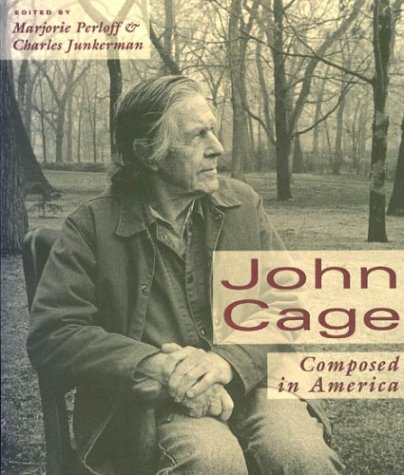
4. John Cage: Composed in America
Paperback: 296 Pages (1994-08-01)
list price: US$18.00 -- used & new: US$13.79
(price subject to change: see help)
Asin: 0226660575
Average Customer Review: 5.0 out of 5 stars
Canada | United Kingdom | Germany | France | Japan
Editorial Review

Book Description

When the great avant-gardist John Cage died, just short of his eightieth birthday in 1992, he was already the subject of dozens of interviews, memoirs, and discussions of his contribution to music, music theory, and performance practice. But Cage never thought of himself as only (or even primarily) a composer; he was a poet, a visual artist, a philosophical thinker, and an important cultural critic.

John Cage: Composed in America is the first book-length work to address the "other" John Cage, a revisionist treatment of the way Cage himself has composed and been "composed" in America. Cage, as these original essays testify, is a contradictory figure. A disciple of Duchamp and Schoenberg, Satie and Joyce, he created compositions that undercut some of these artists' central principles and then attributed his own compositional theories to their "tradition." An American in the Emerson-Thoreau mold, he paradoxically won his biggest audience in Europe. A freewheeling, Californian artist, Cage was committed to a severe work ethic and a firm discipline, especially the discipline of Zen Buddhism.

Following the text of Cage's lecture-poem "Overpopulation and Art," delivered at Stanford shortly before his death and published here for the first time, ten critics respond to the challenge of the complexity and contradiction exhibited in his varied work. In keeping with Cage's own interdisciplinarity, the critics approach that work from a variety of disciplines: philosophy (Daniel Herwitz, Gerald L. Bruns), biography and cultural history (Thomas S. Hines), game and chaos theory (N. Katherine Hayles), music culture (Jann Pasler), opera history (Herbert Lindenberger), literary and art criticism (Marjorie Perloff), cultural poetics (Gordana P. Crnkovic, Charles Junkerman), and poetic practice (Joan Retallack). But such labels are themselves confining: each of the essays sets up boundaries only to cross them at key points. The book thus represents, to use Cage's own phrase, a much needed "beginning with ideas."
... Read more

Customer Reviews (3)

5-0 out of 5 stars Cage (realy) explained
This book of essays marks the begginig of a new era on John Cage studies. Less romantic, more scientific, less partisan, more academical. Everybody who wants to learn about Cage have to read this book.

5-0 out of 5 stars Forget the Zen--This is a Great Read
This book explores John Cage from all aspects of his life and work. In my opinion, the most valuable essay is Thomas S. Hines' biographical study of the young Cage as he begins to grope towards a definition of himself that includes artist and inventor as well as his role as a gay man in straight society.We see that Cage's experimental roots were clearly evident in his relationship with his gifted, albeit wayward, father, and his rather mysterious mother.Everything was in place well before Cage's dramatic encounter with Suzuki's version of Zen, and it could be argued that Cage would have been Cage even without it.There's lots to read and think about in this volume and I continue to return to it to understand this great American gadfly of the 20th century.

5-0 out of 5 stars vigorous essays on a Zen interdisciplinarian
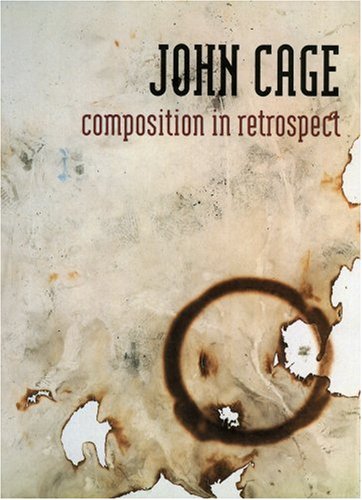
These are a collection of marvelous essays Marjorie Perloff has edited. The scope of Cage is seemingly immense, the implications of his work has touched varigated corners and crevices,abandoned places: the music world,the world of poetry,conceptual art, performance art, mushroomenthusiasts,opera, and other synergistic art forms we have no label foryet. Perloff herself chooses the influence of Duchamp to discuss, the endsof things of the Western canon was a frightening yet fascinating point inthe last century. And Cage always had done everything,like Duchamp with anelement of the lighthearted at work. There are analysis here as well asseasoned music essayist Jann Pasler's discussion on Cage's"Composition in Retrospect" a 1981 mesostic text. Pasler helpsexplain what this figuritivly complex yet disarmingly word play compositionmeans. Cage wrote many of his most important works in this structural form.And his own "Overpopulation and Art" is included here, asa aguiding means of response to these participants. This is as close as Cagegets to social and political/environmental reflection, you will notrecognize Cage here.Herbert Lindenberger is a well known writer in thecloistered world of Opera and he admirably reflects on Cage's one and onlyOpera "Europeras" and the Aesthics that may emit itself from thatvarigated and multidimensional work. Although aesthtics in itstraditionally bound demeanor was always and remained a by-product of theCage edifice, here in this opera he lets other impart their aesthticdesires by allowing singers to choose their own arias to perform. Also Cagescholar Joan Retallack(who has also an impressive series of interviews withCage) speaks here on "Poetics of a Complex Realism", and thisrefers to the American dimension of Cage, a topic seldom discussed. Thisrefers to the Trancendentalists tradition of social rebellion althoughquite passive in retrospect. Writers like Thoreau were important to Cage.Cage activism points in mysterious and undramatic ways. The making ofmeaning through performance and collaboration was what Cage had valued andhe contributed that legacy to the last century. Artifacts of art needcontinuous nurturing,scholarly explication, regular performance and triedand tested aesthetic canons to be attenuated. Rather within this insecureworld, Cage's hope was to nurture a tradition of performers,ofcommunicators equipped with a conceptual fredom of expressive means througha varied and interdisciplinary world which didn't seem to depend on any oneparticular discipline or technique, as the rigours of composition or,playing the violin, or writing symmetrical verse. ... Read more


5. Cage - Cunningham - Johns: Dancers on a Plane
by Susan Sontag
Hardcover: 166 Pages (1990-11-12)
list price: US$50.00
Isbn: 0394588479
Average Customer Review: 5.0 out of 5 stars
Canada | United Kingdom | Germany | France | Japan

Customer Reviews (1)

5-0 out of 5 stars Good stuff
A very good book. I used it for a research paper on the New York School and Abstract Expressionism. I focused on Cage, so I didn't read the whole book, but if it is as good as the section on Cage, I'd say it's a very good book. ... Read more


6. Silence: Lectures and Writings By John Cage
by John Cage
 Paperback: Pages (1069)

Asin: B000NOYR1Q
Canada | United Kingdom | Germany | France | Japan

7. M
by John Cage
 Paperback: 217 Pages (1976-12-09)
list price: US$31.40 -- used & new: US$27.73
(price subject to change: see help)
Asin: 0714511358
Average Customer Review: 5.0 out of 5 stars
Canada | United Kingdom | Germany | France | Japan
Editorial Review

Book Description
Mainly mesostics inspired by music, mushrooms, Marcel Duchamp, Merce Cunningham, Marshall McCluhan, etc. and includes "Mureau"-composed from the writings of Henry David Thoreau. ... Read more

Customer Reviews (1)

5-0 out of 5 stars M by John Cage
I read this book many years ago and do not know if it is even still in print. I saw that no-one had reviewed it and felt duty bound to add my little bit in the hope it might persuade someone else to go to the troubleof seeking out this book. It is one of THOSE books, a true giant of a thing- not just for the ideas and insights it contains but for the wonderful waythat it is written. Cage's music was years ahead of its time (still isprobably), the book is the same. Brilliant, challenging, rambling,inspirational and utterly engrossing; it's the nearest any of us will everget to being inside the mind of a genius. I can not recommend this bookhighly enough, but it is especially good if you are feeling like doingsomething new in your life and haven't quite got the nerve. This guy hadguts! ... Read more


8. Anarchy
by John Cage
Hardcover: 91 Pages (2001-06-01)
list price: US$25.00 -- used & new: US$14.65
(price subject to change: see help)
Asin: B0009YARHS
Average Customer Review: 2.5 out of 5 stars
Canada | United Kingdom | Germany | France | Japan
Editorial Review

Book Description
"That government is best which governs not at all; and when men are prepared for it, that will be the kind of government which they will have."This quote from Henry David Thoreau's Essay on Civil Disobedience is one of thirty quotations from which John Cage created Anarchy, a book-length lecture comprising twenty mesostic poems. Composed with the aid of a computer program to simulate the coin toss of the I Ching, Anarchy draws on the writings of many serious anarchists including Emma Goldman, Peter Kropotkin, and Mario Malatesta, not so much making arguments for anarchism as "brushing information against information," giving the very words new combinations that de-familiarize and re-energize them. Now widely available of the first time, Anarchy marks the culmination of Cage's work as a poet, composer and as a thinker about contemporary society. ... Read more

Customer Reviews (2)

2-0 out of 5 stars An unnecessary enterprise
This book is, I regret to say, more or less an attempt by Wesleyan University Press to artificially expand their catalog of Cage's works. The observant among you will notice that this same text has already been printed once before, in Bucknell Press's _John Cage at 75_Wesleyan has played an incredibly important role in promoting Cage's writing for forty years now, but unfortunately this addition was just plain unnecessary.

Also note that the text is littered with typographical errors that were not in the original. The layout and overall book design are beautiful however.

3-0 out of 5 stars anarchic seems every bit more escapist, self-indulgent
John Cage was never an activist,at least not one that had tangible results toward change. His work remains amongst/ within the safe,complaisant corridors of escapist realms. He encouraged throughout his life,gently, cadre's of creators, all brilliant,provocative, interesting, and thought provoking, with a utopian flair to change the world.But to change what? Yet there is a grotesquely large gulf between these realms, opaque boundless chasms of artistic creations, notebooks, concepetual art, performance art, all spawned from the Cage Zen inspired pacifist anarchy.Yet what has this work changed as fascinanting as it remains???
It has been well known that the great anarchist thinkers that Cage utilizes here as Mikail Bakunin, Petr Kroputkin, and Murray Bookhin in the 20th Century hardly proved to mountpathways worth pursuing.They indulged in corrupt opportunists politics as those they criticized, as Kroputkin's affair with double dealings.And Bakunin spent most of his life in the Czar prisons. When he was released this rendered him a humble repenting pacifist inwardly. All their work simply remains as Cage's as fascinating, interesting, arresting probes,improvisations into history the 19th and 20 Centuries as a conceptual canvas, with an unreality for the utopian mind.
But the world still needs reform and correction,and change,there still is poverty, and malnutrition, and genocide, and corruption, and now more than ever with the turn within world politics after September 11 to Rightward magnetic attractions,with the reoccuring collapse of national currencies,(as Argentina, Brazil, South Korea)tied as a tyranny tied to the American Dollar$$ add to that the new face of corporate corruptions, as Enron which are coming more to the surface for the populace in the face of ever more speculative global capital greed within the financial world. In this light the plight and pursuit of anarchy seems infantile, accelerated to even more escapist self-indulgent, realms as Cage encourages.

There are some facinating moments in Cage's "Anarchy" here the very process of "reading" "interpreting" his mesostics, is a sense of the humanly performative, something we haven't lost the capacity for. Yet this is a self-absorbed endeavor, self-referential and need I say deeply masterbatory, hardly emancipatory in content.
We've lived admirably attentively through the revolution of the aesthetic,the conceptual, the Duchamp universe wrought with the carnage of the First World War,the Surrealists and made more transgressive,andirrational with the Second.

The Cage conceptual creative edifice was never one to gaze outward at this negative,odious impalletable world, Cage's creative magnetic fields were always one of a distant opaque, unexplainable future, made ever more distant and unreachable with each new work, further setting the light at the end of the tunnel ever further out of reach of humanity. ... Read more


9. John Cage Visual Art: To Sober and Quiet the Mind
by Kathan Brown
Hardcover: 144 Pages (2001-03-30)
list price: US$42.00 -- used & new: US$42.00
(price subject to change: see help)
Asin: 1891300164
Average Customer Review: 5.0 out of 5 stars
Canada | United Kingdom | Germany | France | Japan
Editorial Review

Book Description
“What I'm proposing to myself and to other people, is what I often call the tourist attitude—that you act as though you've never been there before. So that you're not supposed to know anything about it. If you really get down to brass tacks, we have never been anywhere before.” -John Cage, 1992

John Cage advocated paying attention to the world around us, and “to the life that we are so excellently living.” He is mainly known as a composer who affected the course of music in our time, but he also lectured, wrote commentary and poetry, and made prints, watercolors, and drawings. He died in 1992, but his work continues to affect people conscious of shaping their own lives.Cage worked at Crown Point Press, publisher of fine art prints, every year from 1978 until his death. During that period he produced 27 groups of prints, mostly etchings, totalling 667 individually composed works of art.Kathan Brown worked with Cage on these prints that make up the largest and most sustained aspect of his visual art. In this book, she speaks from her own experience about how he worked. The many illustrations make it easy to see what she is talking about, and she often uses Cage's own words to describe particular works or reflect upon the nature of his art. ... Read more

Customer Reviews (1)

5-0 out of 5 stars A masterful overview of Cage's visual art.
This is a very beautiful book, with the focus on Cage's print works.One will also find examples of Cage's drawings and watercolors, but they are included here more as a referance point to the print works.The works focussed on in this book are a wonderful selection of his prints, all done at the print studio of Kathyn Brown.The layout of the book, and the detail of description of Cage's working methods, are all topnotch.The quality of the printing and binding of the book is excellent also.Any fan of Cage, and of contemporary print editions, will definitely want to have this beautiful volume in their library. ... Read more


10. Diary: How to Improve the World (You Will Only Make Matters Worse) Continued. Part Three (1967).
by John Cage
 Paperback: Pages (1967)

Asin: B000KTFZG0
Canada | United Kingdom | Germany | France | Japan

11. Themes and Variations
by John Cage
 Paperback: 108 Pages (1982-06)
list price: US$9.95
Isbn: 0930794230
Canada | United Kingdom | Germany | France | Japan

12. I-VI / John Cage
by John Cage
 Hardcover: Pages (1990)

Asin: B000VZWU5W
Canada | United Kingdom | Germany | France | Japan

13. Empty Words
by John Cage
Hardcover: 187 Pages (1980-01-01)
list price: US$29.71 -- used & new: US$29.71
(price subject to change: see help)
Asin: 0714527041
Average Customer Review: 5.0 out of 5 stars
Canada | United Kingdom | Germany | France | Japan
Editorial Review

Book Description
Writings through James Joyce's Finnegan's Wake, Norman O. Brown, and "The Future of Music." ... Read more

Customer Reviews (1)

5-0 out of 5 stars The Great mind of John Cage!
If you are familiar with John Cage's thinking you will enjoy and understand this book as well as his other numerous writings, and fantastic music. If you are new to Cage's work, well, be patient and try to follow. Perhaps some previous reading of his poetry and writings will guide you more towards this book. I am a fan and admirer of Cage's work, so I loved it. ... Read more


14. Extended Play: Sounding Off from John Cage to Dr. Funkenstein
by John Corbett, John Corbett
Paperback: 360 Pages (1994-12)
list price: US$23.95 -- used & new: US$23.95
(price subject to change: see help)
Asin: 0822314738
Average Customer Review: 5.0 out of 5 stars
Canada | United Kingdom | Germany | France | Japan
Editorial Review

Book Description
In Extended Play, one of the country's most innovative music writers conducts a wide-ranging tour through the outer limits of contemporary music. Over the course of more than twenty-five portraits, interviews, and essays, John Corbett engages artists from lands as distant as Sweden, Siberia, and Saturn. With a special emphasis on African American and European improvisers, the book explores the famous and the little known, from John Cage and George Clinton to Anthony Braxton and Sun Ra. Employing approaches as diverse as the music he celebrates, Corbett illuminates the sound and theory of funk and rap, blues and jazz, contemporary classical, free improvisation, rock, and reggae.
Using cultural critique and textual theory, Corbett addresses a broad spectrum of issues, such as the status of recorded music in postmodern culture, the politics of self-censorship, experimentation, and alternativism in the music industry, and the use of metaphors of space and madness in the work of African American musicians. He follows these more theoretically oriented essays with a series of extensive profiles and in-depth interviews that offer contrasting and complementary perspectives on some of the world’s most creative musicians and their work. Included here are more than twenty original photographs as well as a meticulously annotated discography. The result is one of the most thoughtful, and most entertaining, investigations of contemporary music available today.
... Read more

Customer Reviews (2)

5-0 out of 5 stars imaginative scintillations
"The sententious critic puts me to sleep.I would prefer a critic of imaginative scintillations.He would not be sovereign, nor dressed in red.He would bear the lightning flashes of possible storms."--Michel Foucault

Corbett seems to operate according to Foucault's injunction, and bears quite a few lightning flashes, due to his playful imagination and the imagination of the cutting edge artists he covers."Extended Play" puts Cage and Clinton in the title, but actually focuses on free jazz/improvisation, not composition or funk.Corbett presents marvelous interviews with European free improvisers, including saxophonists Evan Parker and Peter Brotzmann, guitarist Derek Bailey, and drummer Han Bennink, as well as Americans Sun Ra (composer and bandleader),and Anthony Braxton (composer and reed player).He profiles fellow Chicagoans Hal Russell, Fred Anderson, Von Freeman, and EdwardWilkerson Jr. (the latter three all tenor players), English bassist and bandleader Barry Guy, and Sainkho Namtchylak, the only female Siberian Tuva singer in the ranks of European free improv.He does interview John Cage, which I found uninteresting, and George Clinton, which is tremendous.

Whether despite or because of his poststructuralist leanings (I'm with Evan Parker, who, according to Corbett, "...knows I'm a Continental-philosophy kinda guy, which is something he's certain that he isn't."), Corbett takes a stance clearly on the side of "optimism concerning the possibility of resistance," resistance in the realm of popular music against the capitalist status quo.

Presently overseeing the Unheard Music series for Atavistic Records in Chicago -- free jazz/improv tapes buried in the vaults until now -- John Corbett is doing his part to keep ALL the signifiers free!

5-0 out of 5 stars Ushering in a new era of popular culture criticism?
Like Greil Marcus and Robert Palmer, Corbett looks at (popular?) culture as both a product of and a determinant of culture at large.As a postmodernist, he delves into genres that are largely devoid of quality criticism as few are up to the task.Actually he's probably more of a Nat Hantoff or Frank Kofsky of our time in that he's quick to support what may commonly be refered to as music that tries its listeners patience and willingness to explore. I used this book as a reference for my thesis and have recommended it to several people. ... Read more


15. John Cage (American Composers)
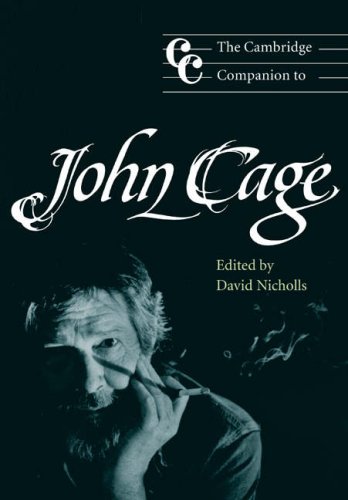
by David Nicholls
Hardcover: 160 Pages (2007-11-26)
list price: US$35.00 -- used & new: US$25.95
(price subject to change: see help)
Asin: 0252032152
Canada | United Kingdom | Germany | France | Japan
Editorial Review

Book Description

John Cage was a giant of American experimental music--composer, writer, and artist. He is most widely known for his 1952 composition 4'33, whose three movements continue to challenge the definition of music by being performed without playing a single note. In questioning fundamental tenets of Western music, Cage was often at the center of controversy, and is regarded as an important contributor to many facets of American culture.

To enable readers to understand what makes Cage such an extraordinary figure, David Nicholls masterfully places his striking body of prose and poetry, over 300 music compositions, and prominent performance career into historical, environmental, intellectual, philosophical, and aesthetic contexts. Nicholls’ intimate study of John Cage’s personal and professional life confirms the legacy of this major figure in twentieth-century American culture.
... Read more

16. Silence.
by John Cage
 Hardcover: 159 Pages (1995-05-01)
-- used & new: US$26.68
(price subject to change: see help)
Asin: 3518221930
Canada | United Kingdom | Germany | France | Japan

17. A year from Monday;: New lectures and writings
by John Cage
 Unknown Binding: 167 Pages (1967)

Asin: B0006D62K8
Average Customer Review: 4.5 out of 5 stars
Canada | United Kingdom | Germany | France | Japan
Editorial Review

Book Description
Includes lectures, essays, diaries and other writings, including "How to Improve the World (You Will Only Make Matters Worse)" and "Juilliard Lecture." ... Read more

Customer Reviews (2)

4-0 out of 5 stars Very Interesting
I find his book very interesting and informative in many ways. Most of it is very difficult to read because 1. John Cage is extremely intellectual, and 2. He is very avan garde, so some of the formats in which he writes in can be very complicated. I enjoy it being complicated though because there is something you can always figure out about it or just look into very closely. My favorite subject of this book are his journal/diary entries. They include entries of him away at master classes and the things that he talks about are humorous, great to know, and interesting to think about. I recommend this selection of John Cage highly.

5-0 out of 5 stars or: today(?)
Yes.

The second collection of John Cage's writings to appear (after Silence), A year From Monday is indispensable to anyone wishing to have more than a passing understanding of Cage's work and thought.In usual Cage fashion, the lectures, essays, "diaries," anecdotes, and assorted miscellanea jump off the page - utilizing an increasingly diverse array of typefaces and sizes, the writings contained here blaze the trail that leads to the mesostics and other verbal experiments that characterize the remainder of Cage's literary work beginning with M: Writings '67-'72.

Including, amongst numerous other gems, the "Two Statements on Ives," "26 Statements re Duchamp," "Jasper Johns: Stories and Ideas," the "Julliard Lecture," "Lecture on Commitment," and a collection of personal reminiscences/Zen riddles entitled "How to Pass, Kick, Fall, and Run," A Year From Monday contains an overflow of priceless Cageisms.

Beginning with an unforgettable cover (three slightly-overlapping photos of Cage's face, the first serious, the second beginning to open up, the third in full cackle) and never slowing down, the collection demonstrates perfectly Cage's relevance to musicians firstly, and thinkers finally.From one of the most significant and influential composers of the 20th century, A year From Monday demonstrates the originality, openness, and precision of thought that make Cage relevant to a much broader audience than simply the avante-garde musician. ... Read more


18. John Cage: An Anthology (Da Capo Paperback)
Paperback: 237 Pages (1991-04)
list price: US$14.95
Isbn: 0306804352
Average Customer Review: 5.0 out of 5 stars
Canada | United Kingdom | Germany | France | Japan

Customer Reviews (1)

5-0 out of 5 stars The place to start with Cage
This is THE place to begin with John Cage, easily one of the more intriguing creative minds of the 20th century.

Kostelanetz assembles a free-ranging portrait of the man - mostly varied essays and theories of composition and performance, but along the way Cage's more arcane influences also surface:his Buddhism, and fascination with chance, which was embodied in his fixation with the "I Ching," which became both a point of departure for theoretical meditations, and a most unusual compositional tool.

Cage was the quintessential modernist, and even when his music was daunting and intrepid, his ideas were never, ever stupid, ill-informed or socially disconnected.And Kostelanetz' anthology is great, affectionate, engaged and fascinating - it will turn you into an admirer.

-David Alston ... Read more


19. Notations
by John Cage
 Unknown Binding: Pages (1969)

Asin: B0000CTXNM
Canada | United Kingdom | Germany | France | Japan

20. John Cage: Music, Philosophy, and Intention, 1933-1950 (Studies in Contemporary Music Andculture)
Hardcover: 288 Pages (2001-12-21)
list price: US$115.00 -- used & new: US$115.00
(price subject to change: see help)
Asin: 0815329954
Canada | United Kingdom | Germany | France | Japan
Editorial Review

Book Description
John Cage seeks to explore the early part of the composer's life and career, concentrating on the "pre-chance" period between 1933 and 1950 that is crucial to understanding his later work. The essays consider Cage's influences, his evolving aesthetic, and his movement toward ideology that would later shape his work. ... Read more


  1-20 of 100 | Next 20
A  B  C  D  E  F  G  H  I  J  K  L  M  N  O  P  Q  R  S  T  U  V  W  X  Y  Z  

Prices listed on this site are subject to change without notice.
Questions on ordering or shipping? click here for help.

site stats