
|
Help |
| Home - Basic O - Objectivism Philosophy (Books) | |
e99 Online Shopping Mall
|
|
Help |
| Home - Basic O - Objectivism Philosophy (Books) | |
| Back | 21-40 of 99 | Next 20 |
click price to see details click image to enlarge click link to go to the store
| 21. Scientific theismOrganic scientific philosophy by Francis Ellingwood Abbot | |
 | Kindle Edition:
Pages
(2009-08-19)
list price: US$0.99 Asin: B002M78P88 Canada | United Kingdom | Germany | France | Japan |
| 22. Outlines of Cosmic Philosophy: Based on the Doctrine of Evolution (With Criticisms on the Positive Philosophy) by John Fiske | |
| Hardcover:
Pages
(1902-01-01)
Asin: B000873C8M Canada | United Kingdom | Germany | France | Japan | |
|
Editorial Review Product Description | |
| 23. Objectivism Today 1994 by David Kelley, Kenneth Livingston, Stephen Moses, Kirsti Minsaas | |
 | Audio Cassette:
Pages
(1994-12-01)
list price: US$54.95 -- used & new: US$54.95 (price subject to change: see help) Asin: 157724009X Canada | United Kingdom | Germany | France | Japan |
|
Editorial Review Product Description | |
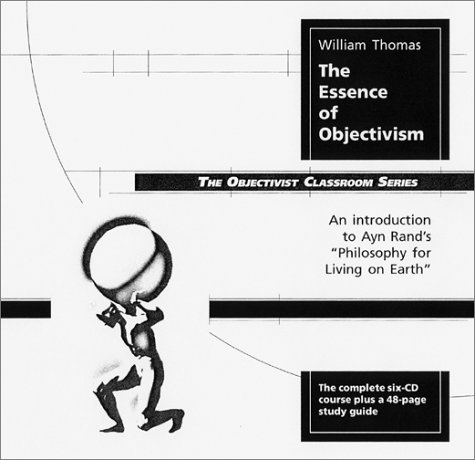
| 24. The Essence of Objectivism by William Thomas | |
 | Audio CD:
Pages
(2002-03-22)
list price: US$85.00 Isbn: 157724060X Canada | United Kingdom | Germany | France | Japan |
|
Editorial Review Product Description Lectures include: ”Objectivism: Who Needs It?”; “Reason: Man’s Only Absolute”; “Living On Earth”; “Happiness: The Moral Purpose of Life”; “Productive Achievement: The Noblest Activity”; and “Capitalism as a Moral Ideal.” The course is accompanied by 48-page study guide, which outlines each lecture in detail with numerous visual aids and suggests topics for discussion and materials for further study. | |
| 25. The Ayn Rand Lexicon: Objectivism from A to Z (Meridian) by Ayn Rand | |
| Paperback: 535
Pages
(1988-01-01)
list price: US$9.95 Isbn: 0452008727 Average Customer Review: 
Canada | United Kingdom | Germany | France | Japan | |
|
Editorial Review Product Description Customer Reviews (27)
| |
| 26. Objectivism: The Philosophy of Ayn Rand by Ayn Rand | |
| Paperback:
Pages
(1993)
Asin: B003QFVL18 Canada | United Kingdom | Germany | France | Japan | |
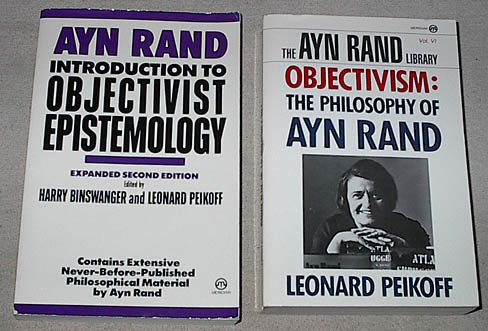
| 27. Ayn Rand Objectivism two book set: Introduction to Objectivist Epistemology & Objectivism: The Philosophy of Ayn Rand (the Ayn Rand library, Vol. VI) by Ayn Rand, Leonard Peikoff | |
 | Paperback:
Pages
(1100)
Asin: B0034V0ZCA Canada | United Kingdom | Germany | France | Japan |
| 28. The role of philosophy in psychotherapy by Edith Packer | |
| Unknown Binding: 18
Pages
(1987)
Asin: B00072MZG8 Canada | United Kingdom | Germany | France | Japan | |
|
Editorial Review Product Description | |
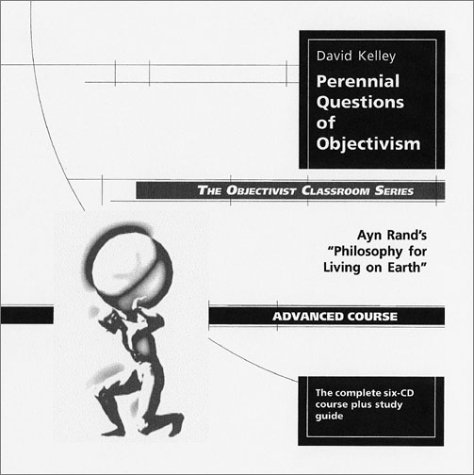
| 29. Perennial Questions of Objectivism by David Kelley | |
 | Audio CD:
Pages
(2002-09-01)
list price: US$85.00 Isbn: 1577240642 Canada | United Kingdom | Germany | France | Japan |
|
Editorial Review Product Description Perennial Questions of Objectivism is an advanced 6-CD course which examines five of these seminal questions. In each lecture, the issue is formulated, the arguments for each side put forward, and the strengths of the standard responses from Objectivist literature are considered and evaluated. Each session concludes with lessons on philosophical methodology that affect the discussion. The final lecture is reserved for a brief review integrating course material, followed by audience questions. This ia an advanced course, presupposing a solid understanding of Rand's philosophical writings and the secondary literature on Objectivism. The course is accompanied by a study guide, which outlines each lecture in detail and suggests materials for further study. Lectures include: "Reason and Emotion," "Virtue and Self-Interest," "Survival vs. Flourishing," "Government vs. Anarchy," "Free Will vs. Determinism," and "Concluding Thoughts and Questions." | |
| 30. The Future of Objectivism by Robert James Bidinotto, Nathaniel Branden, David Kelley Robert Poole | |
 | Audio Cassette:
Pages
(2001-05-01)
list price: US$18.95 Isbn: 1577240553 Canada | United Kingdom | Germany | France | Japan |
|
Editorial Review Product Description | |
| 31. METAETHICS: An entry from Gale's <i>Encyclopedia of Philosophy</i> by Thomas Carson | |
| Digital: 11
Pages
(2006)
list price: US$10.90 Asin: B001SCJTI8 Canada | United Kingdom | Germany | France | Japan | |
|
Editorial Review Product Description | |
| 32. Objectivism, Subjectivism, and Relativism in Ethics: Volume 25, Part 1 (Social Philosophy and Policy) (v. 25) | |
 | Paperback: 416
Pages
(2008-01-28)
list price: US$38.99 -- used & new: US$20.98 (price subject to change: see help) Asin: 0521719631 Canada | United Kingdom | Germany | France | Japan |
|
Editorial Review Product Description | |
| 33. Moral Philosophy Through The Ages by James Fieser | |
 | Paperback: 294
Pages
(2000-09-01)
-- used & new: US$85.88 (price subject to change: see help) Asin: 0767412982 Canada | United Kingdom | Germany | France | Japan |
|
Editorial Review Product Description | |
| 34. Q METHODOLOGY AS PROCESS AND CONTEXT IN INTERPRETIVISM, COMMUNICATION, AND PSYCHOANALYTIC PSYCHOTHERAPY RESEARCH.: An article from: The Psychological Record by Irvin Goldman | |
| Digital: 24
Pages
(1999-09-22)
list price: US$5.95 -- used & new: US$5.95 (price subject to change: see help) Asin: B00099LFVK Canada | United Kingdom | Germany | France | Japan | |
|
Editorial Review Product Description | |
| 35. Ayn Rand's Life: Highlights and Sidelights | |
| Audio Cassette:
Pages
(1994)
Isbn: 1561142999 Canada | United Kingdom | Germany | France | Japan | |
|
Editorial Review Product Description | |
| 36. The Fountainhead by Ayn Rand | |
 | Paperback: 694
Pages
(1952)
-- used & new: US$4.99 (price subject to change: see help) Asin: B001L0ZMJM Average Customer Review: 
Canada | United Kingdom | Germany | France | Japan |
|
Editorial Review Product Description Customer Reviews (1052)
| |
| 37. Beyond Objectivism and Relativism: Science, Hermeneutics, and Praxis by Richard J. Bernstein | |
 | Paperback: 320
Pages
(1983-11-01)
list price: US$26.50 -- used & new: US$16.00 (price subject to change: see help) Asin: 0812211650 Average Customer Review:
Canada | United Kingdom | Germany | France | Japan |
|
Editorial Review Product Description Customer Reviews (5)
As a book report, it gets 3 stars. As a book with an idea, it gets one. His essays, in other books,seem to suffer from the same fault.
| |
| 38. Objectivism and the Corruption of Rationality: A Critique of Ayn Rand's Epistemology by Scott Ryan | |
 | Paperback: 432
Pages
(2003-01-27)
list price: US$22.95 -- used & new: US$20.65 (price subject to change: see help) Asin: 0595267335 Average Customer Review:
Canada | United Kingdom | Germany | France | Japan |
|
Editorial Review Product Description Customer Reviews (11)
No wonder, either. Mr Ryan has delivered a powerhouse philosophical critqique of Objectivism in this work. I'm not at all surprised that Rand's followers are having trouble refuting it (in part because it's written well over their heads; Ryan is considerably more expert in real philosophy than Rand was, let alone her acolytes). Ryan demonstrates consistently, time after time, that Rand's explicit philosophy depended implicitly on unacknowledged premises that were at odds with it. In summary, and with an irony not at all lost on Ryan, Objectivism itself is a huge "stolen concept." Ryan is not Rand's enemy; on the contrary, he expressly states that he enjoys much of her fiction and agrees broadly with her political philosophy. He just doesn't think she was much of an epistemologist. Any unbiased reader of this book will come to agree, after watching Ryan deconstruct and decimate her theories on page after page of careful exposition and analysis. There aren't very many competent philosophical critiques of Objectivism in print. This is one of the best. Its detractors either don't know what they're talking about, or just don't want you to read it, or (most likely) both. Don't let them turn you away.
-Ray ... Read more | |
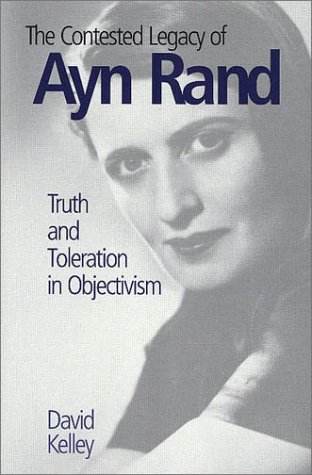
| 39. The Contested Legacy of Ayn Rand by David Kelley | |
 | Hardcover: 128
Pages
(2000-12-05)
list price: US$34.95 -- used & new: US$23.95 (price subject to change: see help) Asin: 0765800608 Average Customer Review: 
Canada | United Kingdom | Germany | France | Japan |
|
Editorial Review Product Description Customer Reviews (12)
This is NOT to say that Kelley doesn't put forth a noble effort. In fact, for those that admire Objectivism, this is really a great book and you should read it. In it, Kelley's main target is objectivism's assertion that as all ideas are moral to some degree, we as right thinking people should always - ALWAYS - condem those who hold "immoral" views - whether it be Kant, Marx, your co-workers, or your college professor. Kelley tries very hard to draw a distinction between when it is appropriate to morally condemn and write off, and when it is not. Unfortunately, his argument is pure rhetoric and fails to do much except, as another reviewer nobley said, belabor the obvious. The problem, as that same reviewer said, is that intolerance is simply built into the system of objectivism. So as to explain only enough not to bore the reader, there is an odd and unresolved tension in Kelley's simultaneous view that (a) "there is no dichotomy between fact and value" and (b) his dislike of the belief that things have intrinsic values discovered through Reason (natural law and the like). He correctly notes that it is a hard line to keep straight, but fails to mention that he doesn't ever actually draw the line. When one believes that values are a form of fact and that those facts can only be discovered through reason, one is - no matter how one sells it - a believer in the very intrinsicism one is preaching against. Secondly, Kelley talks of toleration as, to a decent degree good, because 'there is a difference between error and evil.' We tolerate others because they (he never says 'we') have a right ot err. That is not tolerance that anyone wants; it is rather like a heterosexist tolerating her flaming gay cousin or someone tolerating a buzzing fly. That is not tolerance; it is condescension in 'tolerance's' clothing. (And if objectivism isn't supposed to be Leonard Peikoff's religion anymore, then why does Kelley still capitalize the "O"?) What Kelley, I think, doesn't realize is that, as Greg Nyquist below writes, the moment one suggests that there is no dichotomy between fact and value - between is and ought - the tendency will always be to suggest that "since I'm right and you're not, you should go my way; or I could just tolerate you by silent condescension." Read the book. See if it makes sense to you. I cannot tell you what to do (as I have given up those Randian pretensions). But for my money, Kelley is running against a current that is so fast and strong that while he might feel he is making good speed, he will still do nothing but lose ground.
If you want to understand Objectivism, read Ayn Rand's books. If you want to learn about Kelleyism, read Kelley's books. But do not confuse the two.
| |
| 40. The New Ayn Rand Companion, Revised and Expanded Edition by Mimi Reisel Gladstein | |
 | Hardcover: 176
Pages
(1999-08-30)
list price: US$69.95 -- used & new: US$62.95 (price subject to change: see help) Asin: 0313303215 Average Customer Review:
Canada | United Kingdom | Germany | France | Japan |
|
Editorial Review Product Description Customer Reviews (3)
What's covered here? Let Gladstein answer: "Theorganization of this Companion follows a logical heuristic: Who? What? andSo what? 'Who is Ayn Rand?' is the question answered partly by the briefbiographical chapter. The main body of this book, however, responds to thequestion, 'What has she written?' That is covered in the chapters on herfiction, her nonfiction, and in the compendium of characters. 'So what?' isthe question that calls for critical reaction and that is provided in thechapter on criticism." The author also provides a comprehensivebibliography of works by and about Rand. Even such obscure pieces as DavidM. Brown's hitherto unheralded survey of "The Critics of BarbaraBranden" (published in the May 1988 issue of Liberty magazine) areincluded. Gladstein has much that is both positive and on-point to sayabout Rand's character, her fiction, her nonfiction, and the variouscritical assessments of her work. She doesn't shy away from negativejudgments when such are appropriate, either. On Rand Herself:"Regardless of what pressures were brought to bear, regardless of howmany of those in power told her that she must change her style, regardlessof what obstacles she found to 'doing it her way,' Rand remained true toher purposes in writing." "Intellectually, she could best anyonein argument.... Bennett Cerf concurred, 'You can't argue with Ayn Rand.She's so clever at it, she makes a fool out of you.' " Rand's personalshortcomings are mentioned, as well as the troubling circumstances thatsurrounded the Objectivist Crackup in 1968; but Gladstein does not dwell onsuch matters. Of course the works cited, the most important of which is ThePassion of Ayn Rand, tell the whole story of Ayn Rand's often triumphant,sometimes tragic life. On Rand's Fiction: "Rand's major literaryworks follow similar plot patterns. In each, an exceptionally able andindividualistic protagonist battles the forces of collectivism andmediocrity that are threatening or have destroyed the nation or theworld." "Rand's heroes are tall, straight and strong. As withtheir feminine counterparts, defiance is a keystone to theircharacters." "The major theme of Rand's fiction is the primacy ofthe individual. The unique and precious individual human life is thestandard by which good is judged." Mention is also made of suchleitmotifs as "recurring whip imagery" and "romanticizedrapes" that are "symbolic of the head-on clash of two strongpersonalities." (Gladstein is quick to add that readers of"raised consciousness about the nature of rape might find thissymbolism unpalatable," but neglects to state clearly that thevigorous sexual encounters in Rand's fiction cannot be taken as actualrape-not if the text itself is to be admitted in evidence.) Gladstein'ssummaries of Rand's stories are uniformly excellent. On Rand'sNonfiction: "Montaigne, author of the book Essais which created thegenre of the essay, defined the essay as 'an attempt,' a brief discussionas opposed to a thesis or dissertation. [The essays of The Virtue ofSelfishness] are just that-compressed discussions, forays into theirsubjects. As such, they are appealing to interested nonacademic ornonspecialist readers as well as to the more serious student ofObjectivism." "Rand says capitalism is the only moralpolitico-economic system in history, a system that has been a great boon tohumankind [TDO thinks Gladstein means "mankind" here].... Herpurpose [in Capitalism: the Unknown Ideal] is to clearly identify thebenefits of capitalism while also exposing the nature of its arch enemy,altruism." "One of Rand's greatest gifts is her ability to cut tothe heart of a contemporary event or issue and analyze its philosophicalimplications." "The specific referencts of [The ObjectivistNewsletter] were events of the early sixties. What makes themintellectually satisfying today is that the basic premises Rand uses tocriticize government, education, or literature apply now as they didthen." The chapter on "Criticism of Rand's Works"includes a summary of every work about Rand that has been published, andmentions a great many of the critical articles. As you can imagine, thecriticism is a very mixed bag, as assessments of Rand run the gamut in toneand objectivity. To her great credit, Gladstein's sensibility incriticizing the criticism is almost infallible. Any palpable blunders inThe New Ayn Rand Companion? One or two.In the introduction the authorstates that Rand "presented herself as representative of her fictionalideal: rational, objective, uncompromising, unswerving. Her followers canfind no imperfections. This tends to create a situation in which all whoare not fully in accord with Rand are seen as part of the opposition."The gist of the observation is correct, but some qualification should havebeen made. Elsewhere in the book Gladstein herself documents the growth ofmore tolerant wings of the Objectivist movement, including the birth of TheInstitute for Objectivist Studies (now The Objectivist Center) and thepublication of David Kelley's Truth and Toleration. (Alas, the Companionwent to press just around the time The Daily Objectivist was being founded,so TDO's rapid ascendancy as the premier arbiter of non-orthodoxObjectivist thought, displacing Kelley's organization, is not mentioned atall. Hopefully this omission will be rectified in the thirdedition.) Another little glitch we could mention appears in thedescription of Hank Rearden. "Although [Rearden's] feelings forFrancisco d'Anconia are strained by Francisco's superficial public image,their friendship grows until Rearden finds out that Francisco had beenDagny's lover." But in fact the great breach in the friendship occursearlier in the novel, when Rearden realizes that Francisco had had themeans to prevent a disaster from befalling Rearden Steel but chose not toprevent it. The discovery of Francisco and Dagny's past romance onlyincreases but does not inaugurate the tension between the two men when theyfinally next encounter each other in Dagny's apartment. Anyone who has readAtlas Shrugged a million times cover to cover would be familiar with thissequence of events. However, these points are trivia. Ninety nine pointnine nine percent of the time Gladstein is completely accurate, not tomention astonishingly concise given the wealth of information she presents.She acknowledges the assistance of a number of major figures in theObjectivist movement, including Chris Matthew Sciabarra, Nathaniel Brandenand Barbara Branden, Peter Saint Andre, Michelle Marder Kamhi and LouTorres. Anyone with any serious interest in the work of Ayn Rand and itsgrowing influence on our culture should own a copy of The New Ayn RandCompanion.--David M. Brown, Editor, The Daily Objectivist(www.dailyobjectivist.com) ... Read more | |
| Back | 21-40 of 99 | Next 20 |
 Not perfectly comprehensive, but a great resource
 not a good starting place
 Why is the religious right pushing this book???