e99 Online Shopping Mall

Geometry.Net - the online learning center Help  
Home  - Basic O - Objectivism Philosophy (Books)

  1-20 of 98 | Next 20
A  B  C  D  E  F  G  H  I  J  K  L  M  N  O  P  Q  R  S  T  U  V  W  X  Y  Z  

click price to see details     click image to enlarge     click link to go to the store

$5.67
1. Objectivism: The Philosophy of
 
2. A Study Guide to Leonard Peikoff's
 
3. Answer to Ayn Rand: [a critique
 
$25.17
4. Objectivism: The Philosophy of
$13.99
5. The Hijacking of a Philosophy:
 
$80.64
6. Objectivism: The Philosophy of
 
7. Objectivism: The Philosophy of
 
8. The Philosophy of Objectivism:
$18.95
9. Objectivism : The Philosophy and
$0.02
10. Speech and Political Practice:
$7.35
11. Stance of Atlas: An Communication
$54.95
12. Objectivism Today 1994
 
$67.51
13. Ayn Rand, Objectivists, and the
$24.20
14. The Contested Legacy of Ayn Rand:
 
15. With Charity Toward None: An Analysis
 
$5.50
16. Introduction to Objectivist Epistemology:
 
$4.81
17. The Ayn Rand Lexicon: Objectivism
$21.13
18. Atlas Shrugged (Centennial Ed.
 
19. Objectivism: The Philosophy of
20. The Essence of Objectivism

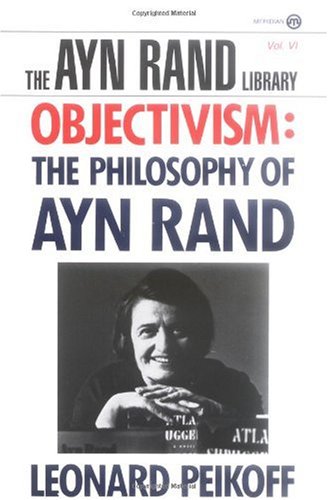
1. Objectivism: The Philosophy of Ayn Rand (The Ayn Rand Library, Volume 6)
by Leonard Peikoff
Paperback: 512 Pages (1993-12-01)
list price: US$20.00 -- used & new: US$5.67
(price subject to change: see help)
Asin: 0452011019
Average Customer Review: 4.0 out of 5 stars
Canada | United Kingdom | Germany | France | Japan

Customer Reviews (76)

5-0 out of 5 stars Objectivism: The Philosophy of Ann Rand
A superb grounding in Objective philosophy expanding on Ayn Rand's "Introduction to Objectivist Epistemology".This book at least equals in quality an earlier book by Leonard Peikoff, "The Ominous Parallels" ,in explaining this Philosophy to a layman like myself.

1-0 out of 5 stars boring
- YES, I am an advocate of the Rand "philosophy" and have read most of her books repeatedly.

- NO, I do not need someone else to come along and tell me in 50 pages what she managed to say in one page.

An heir is meant to look after the inheritance, NOT turn it into gobbledygook. Ms. Rand did really well without you Mr. Peikoff - would you just reimburse me the money I have spent purchasing your long and convoluted book please?

5-0 out of 5 stars A Philosophy for Living On Earth
Dr Peikoff worked closely with Ayn Rand for thirty years and was designated by her as her intellectual heir. Therefore, it is not surprising that, after having read a number of books explaining this philosophy, Peikoffs' presentation ofObjectivism turns out to be the best. Every time I reread this book, I find new and useful ways of applying this original and exciting "philosophy for living on earth".

5-0 out of 5 stars Finally, a Philosophy One Can Understand
For people who have read Ayn Rand's novels and want to learn more about her ideas, Objectivism: The Philosophy of Ayn Rand is the book to read. For people who have not read Ayn Rand's novels, this is still the book to read.One unique feature of Ayn Rand's novels We the Living, TheFountainhead, and Atlas Shrugged is that they help to express her very original philosophical ideas, which she later called Objectivism.But from these novels, it is difficult to understand the logical structure of Rand's philosophy.Some people might get the impression that Ayn Rand was primarily concerned with politics, but in fact, she wrote on all branches of philosophy, from metaphysics to epistemology to esthetics.Leonard Peikoff is very knowledgeable about Objectivism because he knew Ayn Rand and studied her philosophy for most of his life.His purpose in writing this book is to put her philosophical ideas together in one text starting with the foundation of metaphysics and epistemology, and then showing how these fundamental ideas logically led to Rand's views on ethics, politics, and esthetics.Even though Peikoff takes on some very abstract subjects, he never fails to write in a very clear style, using several concrete examples to help in understanding.One doesn't need a degree in philosophy to understand this well-written book.

5-0 out of 5 stars One of the Greatest Books Ever Written.
One could improve the book and philosophy by subsuming Objectivism under materialism while retaining almost all of its conclusions.Even Peikoff admits that if one argued consistently from materialist premises he'd conclude the same things as one does if he invents the falsehoods that consciousness is immaterial and a "prime mover," as Objectivists do.There are other errors, but a reader would improve himself so much by reading this that the book more than deserves five stars despite them.If it doesn't deserve five stars despite its errors, only a few books in the world do, and they contain their own errors.Moreover, the book trains people well enough in some cases that they can correct the book, so sometimes the end result is as if the book were perfect. ... Read more


2. A Study Guide to Leonard Peikoff's Objectivism: The Philosophy of Ayn Rand
 Paperback: Pages (1995)

Isbn: 1561142514
Canada | United Kingdom | Germany | France | Japan

3. Answer to Ayn Rand: [a critique of the philosophy of objectivism]
by John W Robbins
 Unknown Binding: 147 Pages (1974)

Asin: B0006CEEUE
Canada | United Kingdom | Germany | France | Japan

4. Objectivism: The Philosophy of Ayn Rand
by Leonard Peikoff
 CD-ROM: Pages (2007-08-01)
list price: US$39.95 -- used & new: US$25.17
(price subject to change: see help)
Asin: 0786188677
Canada | United Kingdom | Germany | France | Japan
Editorial Review

Product Description
This brilliantly conceived and well-organized book is based on a lecture course given by Dr. Leonard Peikoff in 1976, prepared with the help of Ayn Rand and entitled "The Philosophy of Objectivism." Ayn Rand said of these lectures: "Until or unless I write a comprehensive treatise on my philosophy, Dr. Peikoff's course is the only authorized presentation of the entire theoretical structure of objectivism--that is, the only one that I know to be fully accurate."

As Rand's designated heir and foremost interpreter, Peikoff here reveals both the abstract fundamentals of objectivism and its practical applications, covering topics from certainty to money, from logic to art. With much new material that Rand offered only in private conversations with Peikoff, these clear, cogent chapters illuminate objectivism and its creator with startling clarity. ... Read more


5. The Hijacking of a Philosophy: Homosexuals vs. Ayn Rand's Objectivism
by Reginald Firehammer
Paperback: 146 Pages (2004-03-09)
list price: US$13.99 -- used & new: US$13.99
(price subject to change: see help)
Asin: 1594572755
Average Customer Review: 1.0 out of 5 stars
Canada | United Kingdom | Germany | France | Japan
Editorial Review

Product Description
Here is an objective analysis of the growing movement to normalize homosexaulity within the context of Ayn Rand's philosophy of Objectism. It is that movement, as epitomized in Dr. Chris Sciabarra's autograph, Ayn Rand, Homosexuality, and Human Liberation, that is examined, detailing each issue, from the normality and morality of homosexuality itself, to the proper Objectivists approach toward questions of sexuality. ... Read more

Customer Reviews (3)

1-0 out of 5 stars Mindless
This guy is a cranky old cultural conservative and a social Darwinist dressed in Objectivist clothing.

1-0 out of 5 stars Homophobia Run Amok!
This is a hateful little book, a vile diatribe, virulently anti-gay, and homophobia run amok.It is, I believe, arrogant, pretentious, presumptious, and highly judgmental.

Firehammer, at various points, calls homosexuality evil, false, harmful, disgusting, irrational, abnormal, and immoral.He states that homosexuality is both physiologically and psychologically self-destructive, and that homosexuals are "pursuing whim, which will ultimately preclude their ever achieving full human happiness".It is his belief that homosexuals are "addicted to a self-destructive life style" and "act contrary to the requirements of their own nature".

Firehammer doesn't belief in the concept of sexual orientation, and states that "the invention of this idea of sexual orientation is just another attempt to excuse bad choices".He also dismisses the concept of homophobia as nonsense.

Firehammer further states that "the freedom of homosexuality is being out of control...Every homosexual pleasure they enjoy is a source of guilt, a value unearned and a pleasure undeserved".

For the record, I am a 60 year old heterosexual married man, and a practicing clinical psychologist for over 30 years.In addition, I was a serious "student of Objectivism" in the late 1960's, have read all of Ayn Rand's writings, and am quite knowledgable about her philosophy of Objectivism.

Dear potential readers - save your money and buy a different book!

1-0 out of 5 stars Pathetic Reasoning
Reading this work was an exercise in forcing myself to keep reading.The holes in the reasoning are immense.I'm all for people expressing their views and I'm all for reasoned discussion-- but you won't find it here.Try another work. ... Read more


6. Objectivism: The Philosophy of Ayn Rand
by Leonard Peikoff
 Audio CD: Pages (2007-08-01)
list price: US$120.00 -- used & new: US$80.64
(price subject to change: see help)
Asin: 078619099X
Canada | United Kingdom | Germany | France | Japan
Editorial Review

Product Description
This brilliantly conceived and well-organized book is based on a lecture course given by Dr. Leonard Peikoff in 1976, prepared with the help of Ayn Rand and entitled "The Philosophy of Objectivism." Ayn Rand said of these lectures: "Until or unless I write a comprehensive treatise on my philosophy, Dr. Peikoff's course is the only authorized presentation of the entire theoretical structure of objectivism--that is, the only one that I know to be fully accurate."

As Rand's designated heir and foremost interpreter, Peikoff here reveals both the abstract fundamentals of objectivism and its practical applications, covering topics from certainty to money, from logic to art. With much new material that Rand offered only in private conversations with Peikoff, these clear, cogent chapters illuminate objectivism and its creator with startling clarity. ... Read more


7. Objectivism: The Philosophy of Ayn Rand (Unabridged)
by Leonard Peikoff
 Audio Download: Pages
list price: US$49.95
Asin: B0006IU47K
Canada | United Kingdom | Germany | France | Japan

8. The Philosophy of Objectivism: a Brief Summary
by Leonard Peikoff
 Paperback: Pages (1982)

Asin: B000JSXL6S
Canada | United Kingdom | Germany | France | Japan

9. Objectivism : The Philosophy and the Movement
by David Kelley
Audio Cassette: Pages (1996-10-01)
list price: US$18.95 -- used & new: US$18.95
(price subject to change: see help)
Asin: 1577240014
Canada | United Kingdom | Germany | France | Japan
Editorial Review

Book Description
The lecture that innaugurated the Institute for Objectivist Studies, now known as The Objectivist Center. In this talk, David Kelley explains how a spirit of independent thought, open inquiry, rational discussion, and debate is necessary for Objectivism to capitalize on the promise of Ayn Rand's ideas. ... Read more


10. Speech and Political Practice: Recovering the Place of Human Responsibility (Suny Series in the Philosophy of the Social Sciences)
by Murray Jardine
Paperback: 207 Pages (1998-04)
list price: US$22.95 -- used & new: US$0.02
(price subject to change: see help)
Asin: 0791436861
Canada | United Kingdom | Germany | France | Japan
Editorial Review

Book Description
Recently, political theorists, philosophers, and theologians have given considerable attention to the role of narrative both in the formation and maintenance of political communities and in moral reasoning. Speech and Political Practice examines a central question for narrative-based theories of community and ethics: How can we tell a good story from a bad one? That is, how can narrative models of community escape moral relativism? It argues that a good, or morally acceptable, narrative provides the members of the community derived from it with a sense of place that can allow individuals to understand their own identity and its relation to others. Such a sense of place can establish limits on individual action and on what a community may demand of individuals, as well as on a community's action toward other communities.

Speech and Political Practice develops a dynamic and egalitarian conception of place based on the human capacity for speech. It argues that places of responsibility can be derived from the structures of various types of speech act, and that such places of responsibility can establish limits on individual and collective action without abandoning legitimate modern achievements such as democracy and science. Drawing upon recent philosophy of language and science and upon anthropological studies of oral, literate, and electronic-image cultures, Jardine concludes that practical development of speech-based places will require that we reorient ourselves from visual modes of experience toward oral/aural experience. He discusses what this would imply for a revival of public life. ... Read more


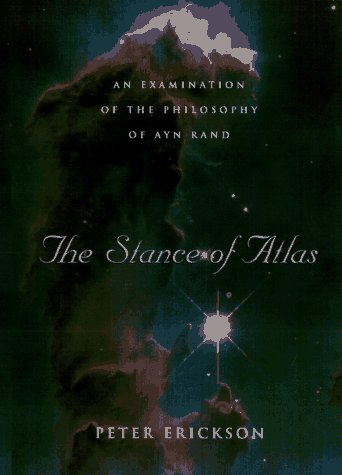
11. Stance of Atlas: An Communication of the Philosophy of Ayn Rand
by Peter F. Erickson
Paperback: 364 Pages (1997-06)
list price: US$19.95 -- used & new: US$7.35
(price subject to change: see help)
Asin: 0965418308
Average Customer Review: 2.5 out of 5 stars
Canada | United Kingdom | Germany | France | Japan
Editorial Review

Book Description
Ayn Rand was one the most influential writers of the 20th century.According to the a poll conducted in 1991 under the auspices of the Library of Congress, her Atlas Shrugged is second only to the Bible in general influence in this country.It was she who more than any other writer in history championed capitalism not just as the most practical economic system--but as the only one consistent with reason and ethics. She called her philosophy, "Objectivism."

At the present time, the market place is more highly esteemed by more Americans than is government; this may soon be the case with a majority of the literate in other countries as well.Increasingly government is now viewed as a burden, rather than as a benefit.Yet, a political- economic system cannot continue to exist simply on the basis of a current success. Moreover, the present order is a mixture of capitalism and controls. Sooner or later, problems will develop, as they did in the nineteen thirties--and then people will have to consider what was at fault. Should there be a depression or some other huge social contagion, the lack of true answers may mean more war--perhaps right here in the United States.

Mr. Erickson's book, The Stance Of Atlas, contains an examination of Ayn Rand's philosophy of Objectivism. More than that, it provides answers to some of the problems in philosophy which she had attempted to solve, but unsuccessfully.

It contains 361 pages, including index--softbound. ... Read more

Customer Reviews (3)

2-0 out of 5 stars Critical mistakes make for dull book
Although Erickson makes some good points along the way, the book on the whole is a disappointment.Erickson committed three cardinal mistakes in writing it.To begin with, he unwisely adopts a dialogue form ofpresentation.The trouble with this is that philosophical dialoguesconstitute the most difficult form of philosophical writing.In order tofor a dialogue to be effective, the characters participating in it must bepresented as real human beings, not just cardboard puppetsventriloquistically manipulated by the author.Erickson is clearly out ofhis depth in the whole business.His characters have no personality atall.They do not fight for their ideas, like real human beings would, butcalmly accept all the arguments presented by the character Philosophus, whorepresents Erickson himself. Erickson would have been better off writingthe work in the traditional style of the essay.Philosophical dialoguesshould only be written by those equipped with the necessary literary anddramatic genius to bring them off. A second mistake involves Erickson'sdecision to focus primarily on abstruse technical questions.Too much ofhis book is preoccupied with an analysis of vague philosophical terms. Terms like absolute, apprehension, contextual, free will, identity,necessity, reason, unit, and value are tossed around as if they meantsomething definite.Most of Erickson's critique reduces itself merely to apurely verbal analysis of the meanings of these vague terms, out of whichobscure technical problems are deduced and endlessly quibbled over. Erickson would have been better off focusing the lion's share of hisattention on the factual shortcomings of some of Rand's more controversialphilosophical contentions.It is on the empirical side that Objectivism ismost vulnerable.Toward the end of the book, we find one of Erickson'spuppet-characters declaring: "I think we now have a sufficientunderstanding of the strengths and weaknesses of ObjectivismŠ"Thisimplies that Erickson believes his discussion of Rand's philosophy iscomprehensive.Here he commits his third mistake: for his book is notcomprehensive.It ommits a discussion of two of Rand's most important andcharacteristic doctrines: her theory of human nature and her theory ofhistory.You would think a doctrine as critical to the Objectivist ideology as this one would warrent a word ortwo from Erickson's cast of puppets, but they are strangely silent on thewhole issue. What could possibly be the reason for this?I suspect themajor reason is that Erickson more or less sympathizes with Rand's view ofhistory and thus sees no reason to animadvert against it.He prefers toquibble over such inconsequential issues as time and space and the problemsraised by discussing perception in terms of vague philosophical concepts. It is primarily for the above stated reasons that I cannot give Erickson'sbook a rating higher than two stars.While he does, as I stated above,make a few good points along the way, the book on the whole isoverly-technical, prolix, destitute of empirical rigor and, worst of all,dull.

4-0 out of 5 stars Excellent book.
This book is excellent for readers who agreed with many of Rand's views but were upset by her atheism.It removes a basic contradiction:If belief in God causes the "evil" in Atlas shrugged, why does the Catholic faith argue against the same evil.Simple, Rand was wrong.

The book attacks Objectivism, but does not argue against Rand's true genius -- her ability to get inside the head of New Age man and describe and explain this evil being.

The book does answer the question on universals.The observations on memory are brilliant.

Examples of the new philosophy of Factivism include:"Name a nonexistant fact"answer the Past.

The only reason for the four stars is that the book is hard to read.I have read it four times and have mastered only about 50%.Definitely geared to philosophy buffs.Another similar book is "Raselas"(spelling)

2-0 out of 5 stars Fair but foolish, Erickson fails as debater and philosopher.
Erickson's critique of Objectivism is highlydefective.While he brings a sincerity to his discussion which other of Rand's commentators have not possessed, his arguments are generally poorand his reports of Rand's claims confused.Thebook is also badly planned and edited and suffersgrievously under the dead weight of its dialogueform.Erickson's misapprehensions reach their deepest when he discusses technical issues in theObjectivist epistemology.Rand and her followers introduce the notion 'perceptual form' to indicate the *means* by which something is *directly*observed by a knowing subject.Erickson fails to grasp the difference between Objectivism's uniquevariant of direct realism and the flawed butpopular theory of perception wherein the knowingsubject apprehends, not something external toherself, but internal *representations* of theexternal.Because of this confusion, Ericksontreats Objectivism as reifying form into the objectof perception itself, and in attacking this idea argues against a theory which Objectivismopposes.His error is based on a misunderstanding of what it is to perceive something in-a-form.He believes that Rand wishes to argue that weperceive things in a *different* form; different, presumably, from the one which they possess ontheir own.But since form is the means by which we perceive a thing, there is no form which athing is in other than the one in which it isperceived.Erickson performs a similar reification of thenotion 'unit', which is again simply the external object of awareness under a certain perspective.After about the middle of the book, Erickson'sprose becomes very garbled and the quality ofargument - already dubious - suffers.He movesinto various technical issues in the sciences and economics which are inappropriate to a book onphilosophy.He argues against the Einsteinianview of the relativistic nature of space and time on purely *a priori* grounds, hardly the way toapproach empirical questions.Even so, his arguments are not successful.The book's coveradvertises a solution to the problem ofuniversals, but I must confess I could not findit.He introduces God into his speculations withno more attempt at proof than the claim that"Atheism is getting to be out-of-date" (p. 219) The philosophy which he attempts to present underthe name "Factivity" lacks an analysis of, amongother things, facts.The book has two virtues.The first is itsgeneral fair-mindedness.Erickson is willing to adopt ideas from Rand and seems to have nopsychological axe to grind; he even intervenes on her behalf early in the book, making decentarguments for her position which she never herself made.The second is his comparison between Rand and the Marxist tradition, especially Lenin. While Erickson is not the first to make thiscomparison, he provides new and intriguingreferences and points of similarity. ... Read more


12. Objectivism Today 1994
by David Kelley, Kenneth Livingston, Stephen Moses, Kirsti Minsaas
Audio Cassette: Pages (1994-12-01)
list price: US$54.95 -- used & new: US$54.95
(price subject to change: see help)
Asin: 157724009X
Canada | United Kingdom | Germany | France | Japan
Editorial Review

Book Description
At the Objectivist Center's 1994 conference "Objectivism Today," four lecturers discussed different aspects of Objectivism, its progress, and its effects on our culture: "The Politics of Virtue" by David Kelley, Ph.D.; "Raising Good Kids" by Kenneth Livingston, Ph.D.; Structure and Meaning in Ayn Rand's Novels" by Kirsti Minsaas, Ph.D.; and "Rolling Back the Welfare State," by Stephen Moses. ... Read more


13. Ayn Rand, Objectivists, and the History of Philosophy
by Fred Seddon
 Hardcover: 206 Pages (2003-05-20)
list price: US$71.50 -- used & new: US$67.51
(price subject to change: see help)
Asin: 0761823085
Average Customer Review: 4.0 out of 5 stars
Canada | United Kingdom | Germany | France | Japan
Editorial Review

Book Description
n this book, Fred Seddon critically examines the views of Ayn Rand and some of her fellow Objectivists on several of the major figures in the history of philosophy, viz., Plato, Augustine, Hume, Kant and Nietzsche. There is also a chapter dealing with Rand's aesthetics, as well as three appendixes, two on Plato and one detailing the philosophy of Ayn Rand. ... Read more

Customer Reviews (2)

5-0 out of 5 stars Valuable critique
I have read all ofAyn Rand's fiction and some of the non-fiction many years ago. I would not describe myself as an Objectivist but her description of philosophies and philosophers with whom she disagreed, I tended to take at face value.Plato was an evil mystic, Hume an Attila of the spirit, Kant "the most evil man in mankind's history".Of course, it is a tendency of revolutionaries ( and Rand was certainly one) to demonize those with whom they disagree. Professor Seddon shows, on the whole successfully,that Ayn Rand misinterpreted or distorted the views ofmany of these philosophers and this practice continues to some extent with her intellectual heirs.
I think he makes his point most clearly in the chapters on Kant's ethics and Hume.The quotations from Hume's works and the author's cogentanalysis show that Hume is so much a defender ofcapitalism and reason in the affairs of society that he should be regarded as at least an ally of objectivists.Rand's criticism of Kant's ethics he shows to be so off base as to be embarrassing.
It was difficult for me to follow the arguments in the section on Plato maybe because, as Professor Seddonsays, the dialogues have to be read more as plays or myths than as arguments for a position in the modern sense.Appendices A and B also added little to my understanding of the section on Plato.
Appendix C on the other hand,is an excellent 8 page summary ofRand's philosophy.It might have made a good introduction to the book.
Professor Seddon writes with and engaging and fluid style but I found the habit of referring to the works of the philosophers by abbreviations hard to follow, particularly in the section on Nietzsche.
Anyone who is interested in the philosophy of Objectivism would profit from reading this book.

3-0 out of 5 stars Disappointing
Say what you want about Ayn Rand, but she wasn't an expert in the history of philosophy. It's widely conceded - even by many Objectivists - that her views on other philosophers weren't always accurate, to say the least. Her simplistic and often fanciful creation of what the leading philosophers taught has been continued by some of her followers. Nonetheless, I'm not aware of a systematic analysis of Rand's thought in this area.

This book contains seven chapters and three appendices. The chapters are on Plato, Augustine, Hume, Kant (2), Nietzsche, and Rand's view of art. Sometimes the chapter focuses on how Rand interpreted a given thinker, other times it focuses on what an Official Objectivist (such as Ridpath or Gotthelf) stated.

I'm disappointed with this work. As Prof. Seddon says in the introduction, many of the chapters in the book were published as separate articles. There's nothing wrong with that, but the book doesn't provide an overview of Rand's view of the history of philosophy. There are also 2 appendices (totaling 35 pages) which merely catalog Aristotle's references to Plato and his dialogues. That's interesting, but there is no discussion about how these citations help the reader understand Rand better. And, speaking of Aristotle, one of the book's glaring omissions is that there is no chapter on Aristotle. Rand asserted that her only philosophical debt was to Aristotle, so a discussion of whether she understood Aristotle well would be an essential part of any discussion. The chapters of the various thinkers are interesting as far as they go (particularly the one on Augustine) but there is no attempt to present them as an integrated whole.

This work was just recently published, so Mr. Seddon had the benefit of two recent works on Rand: Chris Sciabarra's AYN RAND: THE RUSSIAN RADICAL and Scott Ryan's critique of Rand's epistemology. Both works (particularly the first) are quite relevant to any critique of Rand's view of the history of philosophy. Unfortunately, neither is mentioned.

Considering the price of this book, I'm also disappointed about how poorly set it is and the large number of typos and related problems. For example, there is a reference in a footnote to a work "Lennox (2001)." Yet the bibliography contains no reference to a work by Lennox. ... Read more


14. The Contested Legacy of Ayn Rand: Truth and Toleration in Objectivism
by David Kelley
Hardcover: 128 Pages (2000-12-05)
list price: US$34.95 -- used & new: US$24.20
(price subject to change: see help)
Asin: 0765800608
Average Customer Review: 3.0 out of 5 stars
Canada | United Kingdom | Germany | France | Japan
Editorial Review

Book Description
In The Contested Legacy of Ayn Rand, philosopher David Kelley analyzes the conflicts that led him to break ranks with orthodox Objectivists and create an independent branch of the movement.Originally published in 1990 as the manifesto Truth and Toleration, this new and expanded edition is an engaging introduction to the Objectivist movement, its core ideas, and its central fissures. ... Read more

Customer Reviews (12)

5-0 out of 5 stars Ayn Rand for the rational - and tolerant!
A number of the reviewers here of Kelley's book are water-carriers for the ARI and their curious claim that NOBODY (except them, of course!) can speak for Objectivism and the legacy of Ayn Rand. Echoing Leonard Peikoff, they claim that Objectivism is a "closed system" that is perfect, complete, above criticism, and comprises ONLY the writings of Ayn Rand or those she endorsed (although ARI tries to ignore the Brandens' pre-1968 writings that Ayn Rand herself, endorsed). Ironically, this means that not only is Peikoff's own book on Objectivism excluded from the "canon" (as Peikoff admits in his Preface), BUT SO ALSO IS EVERYTHING ELSE THAT HAS BEEN WRITTEN ABOUT OBJECTIVISM, PRO OR CON, SINCE RAND'S DEATH! So even the Ayn Rand Institute's authors cannot claim that their writings are "Objectivist."

However, this attempt to stifle or disqualify any critical commentary on Ayn Rand's remarkable contributions to philosophy is doomed to failure, as has been repeatedly demonstrated in the history of ideological movements. The early followers of Saint-Simon, Auguste Comte, Karl Marx, and Sigmund Freud (to name a few examples) all tried to limit or disqualify any criticism or revision of their founders, but to no avail. In fact, such attempts inevitably lead to even more criticism, more revisions and additions, and the proliferation of schools of thought, all claiming that only they have found the "true" interpretation of what the original philosopher "really" meant.

Sadly, the ARI people just don't get it. I guess we will just have to let history teach them. For everyone else who has read Ayn Rand and are looking for a deeper understanding of her ideas and their implications, I suggest that they read this revealing book by David Kelley (-AND Nathaniel and Barbara Branden, AND the Objectivist Center/Atlas Society authors, AND Leonard Peikoff and other ARI authors, among others) and then, judge for yourself as to who is more true to Ayn Rand's vision of reason and individualism.

2-0 out of 5 stars You can't lose for trying...but....
I first read this work when it came out in 2000. At the time, I had been quite a believer in objectivism but completely irked by the Peikoff-style iron fisted approach to philosophy (that Rand was indubitably a part of). Objectivism was not much better, it seemed, than the very religous dogma it rebelled so much against. Then I read Kelley and decided that one could actually have a more tolerant and open objectivism. Unfortunately, as objectivists say, A is A - Objectivism is Objectivism (still with a capital "O") and my new found optimism only lasted about another six months. The "movement" will never change; it never could; the intolerance Kelley wants is built into the fiber of Rand's philosophy. Despite Kelley's efforts, I decided to quit.

This is NOT to say that Kelley doesn't put forth a noble effort. In fact, for those that admire Objectivism, this is really a great book and you should read it. In it, Kelley's main target is objectivism's assertion that as all ideas are moral to some degree, we as right thinking people should always - ALWAYS - condem those who hold "immoral" views - whether it be Kant, Marx, your co-workers, or your college professor.

Kelley tries very hard to draw a distinction between when it is appropriate to morally condemn and write off, and when it is not. Unfortunately, his argument is pure rhetoric and fails to do much except, as another reviewer nobley said, belabor the obvious. The problem, as that same reviewer said, is that intolerance is simply built into the system of objectivism.

So as to explain only enough not to bore the reader, there is an odd and unresolved tension in Kelley's simultaneous view that (a) "there is no dichotomy between fact and value" and (b) his dislike of the belief that things have intrinsic values discovered through Reason (natural law and the like). He correctly notes that it is a hard line to keep straight, but fails to mention that he doesn't ever actually draw the line. When one believes that values are a form of fact and that those facts can only be discovered through reason, one is - no matter how one sells it - a believer in the very intrinsicism one is preaching against.

Secondly, Kelley talks of toleration as, to a decent degree good, because 'there is a difference between error and evil.' We tolerate others because they (he never says 'we') have a right ot err. That is not tolerance that anyone wants; it is rather like a heterosexist tolerating her flaming gay cousin or someone tolerating a buzzing fly. That is not tolerance; it is condescension in 'tolerance's' clothing.

(And if objectivism isn't supposed to be Leonard Peikoff's religion anymore, then why does Kelley still capitalize the "O"?)

What Kelley, I think, doesn't realize is that, as Greg Nyquist below writes, the moment one suggests that there is no dichotomy between fact and value - between is and ought - the tendency will always be to suggest that "since I'm right and you're not, you should go my way; or I could just tolerate you by silent condescension."

Read the book. See if it makes sense to you. I cannot tell you what to do (as I have given up those Randian pretensions). But for my money, Kelley is running against a current that is so fast and strong that while he might feel he is making good speed, he will still do nothing but lose ground.

1-0 out of 5 stars Wide Open Mind
Kelley endorses a concept of "tolerance" that includes the "toleration" of the comprehensive dishonesty of Nathaniel and Barbara Branden. A "Big-L" Libertarian is almost by definition one who uncritically embraces the Brandens or Rothbard in their dishonest slams on Ayn Rand, just as Kelley has now embraced the Brandens.
Politically, the valid concept is "rights." Morally, the concept of "tolerance" is meaningless. Debating, discussing or working with someone depends on having an honest colleague or rival to do it with, whatever you agree or disagree about. Nothing positive can come from cooperating with the dishonest. "Tolerating" the dishonest, in any non-political sense, means endorsing it -- voluntarily giving it the very credibility it does not deserve. Would Kelley debate flat-earth advocates or those who deny the Holocaust, if he found in a particular case, he wasn't totally sure whether the advocate was evading or not...?

1-0 out of 5 stars Why is this so hard to understand?
Objectivism is the name that Ayn Rand gave HER philosophy. If you change it's fundamentals around, it's no longer Objectivism. If I want to change Objectivism so it includes religion, or astrology or faith, that new philosophy I created is no longer Objectivism. Kelley wants to do just that. Change fundamentals, but still get away with calling it Objectivism. That's about as dishonest as you can get.

If you want to understand Objectivism, read Ayn Rand's books.

If you want to learn about Kelleyism, read Kelley's books.

But do not confuse the two.

1-0 out of 5 stars Rand is Not for the Morally Squeamish
Immoral conduct has something to do with what used to be called "bad character." Rand knew that beneath it all, our habits, emotions, and characteristic attitudes are largely the result of our thinking or failure to think. If Rand was right -- if thinking is a volitional choice -- then, of course, EVERY idea one believes is either honest or dishonest (taking into account the context of available knowledge, of course.) EVERY belief is, therefore, moral or immoral -- no matter how difficult this may be to determine in a particular case. Dishonest thinking is morally bad even BEFORE it is acted on, precisely because it helps shape behavior. ... Rand believed that intellectual dishonesty of this kind is the result of volitional choices and that intellectual dishonesty of this kind is causally related to bad behavior. It is, all by itself, a bad thing. One might even say that the simple-minded confusion between political "tolerance" and moral "tolerance" by smart people is likely to be dishonest. It also shows just how much damage the Popper-Hayek crowd has inflicted on the libertarian capacity to think. Another bad result of bad thinking, hmmm ... ... Read more


15. With Charity Toward None: An Analysis of Ayn Rand's Philosophy
by William F. O'Neill
 Paperback: 233 Pages (1977-06)
list price: US$7.95
Isbn: 0822601796
Average Customer Review: 3.5 out of 5 stars
Canada | United Kingdom | Germany | France | Japan

Customer Reviews (6)

3-0 out of 5 stars Dated
In 1971, professor of philosophy William O'Neill published the first book-length critique of Ayn Rand's philosophy, known as Objectivism.(Albert Ellis's 1968, IS OBJECTIVISM A RELIGION?, was a discussion of Rand and psychology, from what I recall.)This book isn't bad, but it has been superseded as a critique of Objectivism by Robbins's work (ANSWER TO AYN RAND, which has been updated as WITHOUT A PRAYER) and Scott Ryan's recently released OBJECTIVISM AND THE CORRUPTION OF RATIONALITY.

O'Neill's discussion of Rand's thought is informative and more or less accurate.On the other hand, he doesn't make enough of an effort to integrate Rand's thought into a coherent whole (granted, this isn't easy to do).So I don't think that someone new to Ayn Rand would understand why Rand has influenced so many people.Yet O'Neill does do a good job at bringing to light of some of the contradictions in Rand's work.For example, Rand preached that compromise was evil; yet she supported candidates for president who were anything but Objectivists.However, some of the alleged contradictions Prof. O'Neill finds would disappear if he had used a bit more "charity" in interpreting Rand.

If you want to read a sympathetic integration of Rand's thought, I recommend Chris Sciabarra's AYN RAND: THE RUSSIAN RADICAL.

5-0 out of 5 stars A balanced, well-researched, well-organized analysis
O'Neill delivered a concise academic and philosophical critique of Objectivism and Ayn Rand's work.

His work was informed by an exhaustive survey of objectivist literature. He left no stone unturned either in giving Rand the benefit of the doubt or in pinning down the definitions Rand herself or other Objectivists gave to the terms they used.

He makes no extreme claims about objectivism. The book is an analysis, not a polemic.

Albert Ellis' book, _Is Objectivism a Religion?_ is a good companion to this book. Both books have ramifications for libertarianism and even for the somewhat reified and theological capitalism that dominates America politically. This is because the same inconsistencies and factual errors that the objectivists are guilty of permeate libertarianism and the debunked but still influential economic theories like supply-side or Austrian economics that have political power long after working economists despaired of finding any practical use for them.

1-0 out of 5 stars Sigh...
I am beginning to wonder of ANY of these people have read a single Objectivist book. I cannot vouch for Rand as the most sane person (I would think she was most likely a mild schizophreniac), but her philosophy is farfrom mad. Another thing, there is no such thing as selfishness harmingothers--harming people is not good for anyone, even you people know what,and is most certainly not selfish.

2-0 out of 5 stars Well-meaning, but dull, critique of Rand's philosophistry
Professor O'Neill's book was the first philosophical critique of Rand's doctrines ever published (Ellis' "Is Objectivism a Religion" is not really a philosophical critique). As such, it can be regarded as a sort of pioneering effort. When it was originally published in 1970, the very idea of taking Rand seriously enough to criticize her was something of a novelty. In those days, almost all respectable people regarded Rand as a crazy person. Some even thought she was dangerous. Today, we know better. Rand was not a crazy person; she was simply ignorant and confused. Nor was she dangerous. The utopia her books offered will never appeal to a wide audience. Most human beings need either belief in God or belief in society to get by. By rejecting both these beliefs, Rand divided herself forever from the hearts and minds of the overwhelming majority of the human race.

O'Neill's critique suffers from the usual flaws of a pioneering effort. He is unable to grasp precisely what Rand is all about, and consequently ends up critiquing distortions of her philosophy rather than the actual doctrines Rand propagated. This defect is not helped by Mr. O'Neill's dryasdust style, which makes "Charity Toward None" a very difficult read. Dullness is the number one defect of academic philosophy. If philosophy is to make any difference in the world, it cannot be written as if it were meant to be a soporific.

During Rand's life, her admirers could boast that no one had yet been able to refute the philosophy of their idol. The publication of Professor O'Neill's book did little to change this state of affairs. While he makes a few good points along the way, O'Neill's inability to understand the terms Rand uses to express her ideas renders his critique largely verbal and semantic. Unable, for instance, to fathom what Rand means by the term "objective," our intrepid Professor ends up going off on all kinds of irrelevant tangents, demolishing in systematic effusion a number of arguments which Rand herself would never have been caught dead advocating. Those who wish to refute Rand should avoid trying to get at her through verbal analysis. No one cares whether Rand's use of philosophical terms corresponds to the way academic philosophers use those same terms. What is important is whether Rand's views correspond to empirical reality. It is on the empirical side that Rand is most vulnerable. If you want to demolish Rand's system, simply compare her philosophy to the facts. It will not compare favorably.

5-0 out of 5 stars Minor corrections
William O'Neill's _With Charity Toward None_ was published in 1971; John Robbins's _Answer To Ayn Rand_ was published in 1974. This fine volume by O'Neill was indeed the first full-blown critique of Objectivism from an academic-philosophical point of view, but it wasn't alone for all _that_"many" years. Nor was it the first "critical and broadreview of Rand's work by someone who disagreed with her ideas to a greatextent." That honor goes to Albert Ellis's _Is Objectivism AReligion?_, published in 1968 -- admittedly not a _philosophical_ critique, but a critical review all the same. ... Read more


16. Introduction to Objectivist Epistemology: Expanded Second Edition
by Ayn Rand
 Paperback: 320 Pages (1990-04-26)
list price: US$20.00 -- used & new: US$5.50
(price subject to change: see help)
Asin: 0452010306
Average Customer Review: 3.5 out of 5 stars
Canada | United Kingdom | Germany | France | Japan

Customer Reviews (46)

5-0 out of 5 stars Best book on epistemology
This is the clearest exposition of the most important problem in epistemology: the problem of universals.Most philosophers have believed that the meaning of concepts are not derived from sense perception.The Platonists and religious philosophers such as Augustine believe that concepts come from pre-existing forms, which are revelations from the highest form God.The Sophists, nominalists, and other secular philosophers such as Kant believe concepts are inventions of the mind and do not correspond to reality. Rand argues persuasively that a concept (or universal) is not synonymous with its definition, but an organization of an entire class of existents, our defintion of it changing as we learn more about the similarities of this class.For instance, the concept of "atom" has changed a lot from the Ancient Greeks through Dalton to the present day; but this change in defintion was not arbitrary.The scientists were responding to their observations, and the more they learned about atoms, the more they were obliged to change the definition of atom in accordance with their new understanding.Rand recognizes her debt to Aristotle in epistemology, but also points out flaws in Aristotle's theory of universals, and how these flaws were relentlessly exposed by philosophers eager to attack reason and promote faith, brute feeling, and other forms of irrationality.Most philosophy in the modern period is very abstruse, obscure, and incoherent;this book, by contrast, presents the issue very clearly.

4-0 out of 5 stars Quine and knowledge
A reviewer wrote:

For example, Peikoff's piece on the analytic-synthetic distinction shows that he is completely unaware of contemporary philosophy: he begins by saying that the analytic-synthetic distinction "is accepted, in some form, by virtually every influential contemporary philosopher". But this is clearly false. The most cited paper in 20th century philosophy is Quine's "Two Dogmas of Empiricism" (1953, available in From A Logical Point of View) which famously (and, I think, quite effectively-much more effectively than Peikoff) attacks the distinction. Though there have been many criticisms of the paper and defenses of the distinction, many agree with Quine and he is one of the most famous philosophers of the 20th century, especially within Anglo-American philosophy.


Really, I am just curious as to the evidence behind the claim that Quine's article is the 'most cited' paper in 20th century philosophy. Furthermore, I have no clue into the amount of comprehension that reivewer has of Quine's argument in the paper at hand. As far as the outcome of the debate he has raised -- it is far from over. In fact, it is very much alive. A J Ayer, for example, has written several intersting essays discussing the nature of not only Quine's objections, but Alonzo Church as well.

5-0 out of 5 stars Read these reviews carefully
So many of these reviews complain that 'Ms. Rand claims that she has solved the problem of universals, but universals are a problem
of metaphysics, not epistimology'

Imagine a group of doctors standing around a patient, trying to figure out what is wrong with the patients nose, because he has complained that he has a problem breathing.They've examined his nose, looked up inside it, probed it, tested it, but none of them can solve the problem.

Then some competent young doctor happens by the scene, observes the activity, and declares, 'This man has a problem with his lungs, which can be treated by a particular operation I know.'

The doctor performs the operation, and the patient says, 'Thank You!! I can breathe properly now!', to which the group of doctors replies, 'He didn't really solve anything.It was a problem of the nose.'

5-0 out of 5 stars Excellent and Incredible
At last the the seemingly un-tractable problem of the Universals was solved by Ayn Rand.Here in this book it was brilliantly elucidated how the concepts can be based on the observed facts or how the observed facts can be explained through concepts without any ambiguity.Concepts can be formed realistically i.e., with reference to ACTUAL referents and without any recourse to either mystical realm or the 'unknowble' trash .Ayn Rand with her monumental Philosophy of Objectivism performed a much needed and an expert psycho-therapy to Philosophy, in general, which is otherwise went out of contact with reality by basing its foundationsin 'Unknowables','Subjectivism','Mysticism'. Ayn Rand forever will be accredited with making philosophy relevant to the life of a Man that is ONLY possible ' here on this earth'.Truly Objectivism is a philosophy for living on earth.Objectivism is aGreat ,Brilliant,Incredible and Lasting breakthrough in the sphere of Philosophy.

2-0 out of 5 stars David Hume's Treatise on Human Nature an Antedote
I'll not cover the topics others have speculated in great detail. And that's the point; Rand is an armchair speculative, grounding the support of her arguments from an Aristotlean, a priori-type logic that can "prove" just about anything. The greatest Aristotlean of them all, Thomas Aquinas, could prove or disprove just about anything and everything from the same logical method, and come up with all sorts of differing conclusions. Aquinas wrote his "Summa Theologica" using nothing but deductive logic, and upon close scrutiny, one ultimately has to ask: Is this really a reasonable (cf, rational) enterprise after all?

Using deductive logic, which Rand extols, can be helpful, but rarely leads to any "facts." It's merely speculation, and after a while, one has to ask if this whole methodology has any merit to it at all. Those committed to "strong reasons" will always speculate why their dogmas are superior to another's. But after a while, one begins to see that such a priori speculations are just that: An over-reliance on deductive logic to create a preference for one myth over another. The problem is that they are all myths, or false dogmas, or irrational conclusions based on spurious premises (even though the conclusions may be "valid," they aren't "sound").

For those tired of reading endless rational speculations based on nothing more than armchair a priori deductions, and becoming confused rather than enlightened about human affairs, a good antedote to all these mythologizers is reading 18th-century empiricist philosopher David Hume's "Treatise on Human Nature." First, he proves that there are no a apriori foundations for genuine knowledge (opinion or belief).All knowledge is a posteriori, that is inferred inductively from sense experience and the imagination's inferential patterns of resemblance, contiguity, and causality. Second, he shows that sensations and emotions are empirical, not a priori, and that they contribute just as much to our "knowledge" as does verification and non-falsibility. Lastly, he demonstrates that morals and the knowledge of them are based not on some pie-in-the-sky theory, but on the basic human inclination (shall we dare say "instinct") to maximize pleasure and avoid pain. For those who are tired of endless speculative metaphysical and highly rational (in the sense of overly a priori premises and conclusions) dogmas and myths, Hume is a great antedote.

Since Rand is no different from her progenitors Aristotle and Aquinas, whether you "choose" to buy into her armchair epistemology will depend on whether or not you've had enough of overly-deductive reason, outdated metaphysics, and irrational dogmas and myths. If you think she has the "answers," try out Hume's antedote to see that she might be just another in a long list of mythologizers. ... Read more


17. The Ayn Rand Lexicon: Objectivism from A to Z (Ayn Rand Library)
by Ayn Rand
 Paperback: 560 Pages (1988-01-01)
list price: US$25.00 -- used & new: US$4.81
(price subject to change: see help)
Asin: 0452010519
Average Customer Review: 3.5 out of 5 stars
Canada | United Kingdom | Germany | France | Japan

Customer Reviews (19)

5-0 out of 5 stars An excellent look into the mind of an original thinker
Ayn Rand held so many unconventional views it is hard to remember them all.There are times when you hear some politician or college professor speaking or read some writer who is writing on a subject as if there can be no other valid point of view, and it will occur to you to wonder what Ayn Rand had to say on the subject.By no means is this a reference to all of her works, but it does contain the some of the topics which she wrote on with insight and with passion.Reason, pride, love and sex are there as are sacrifice, abortion, socialism and religion.The thing that makes reading her thoughts so valuable is that she is so clear in her explanation of _why_ she believes what she does and her views are often exactly opposite what everyone in the mainstream is saying and writing.One good insight gleaned from this book is worth more than the purchase price--and I have personally gained much by referring to it.

5-0 out of 5 stars Great for the student of Objectivism
Ayn Rand had comments on a vast array of topics of interest to all of us.For the student of Objectivism or the student of philosophy studying Objectivism you can find answers to her positions on this myriad of subjects along with what is more important her reasons as well as references to the source texts where you can garner broader understanding.No significant topic is overlooked.

5-0 out of 5 stars A healthy supply of ... rope.
On writing in general and reviews in particular, my High School English teacher always told her students, once begun half done.
Half done.
Part II.
How it is possible to give less than 6 stars to a Professional Objectivist is beyond me, but let me try.
For Dr. Harry B's Book, The Ayn Rand Lexicon I give:
1 STAR for taking on the task in the first place,
1 STAR for providing me with a really quick reference for refreshing my understanding of a particular Ayn Rand argument (something I periodically need--especially after reading the daily newspaper),
1 STAR for Harry B being Harry B (that is, for being one of the good guys),
1 STAR for NOT using clichés--e.g, "give `em enough rope and they'll hang themselves" and
1 STAR for providing a healthy supply of rope for Ayn Rand's critics to do you know what with.
In my arithmetic that's 1+1+1+1+1 which equals 5 which is less than 6.
There, I did it.
My English teacher was correct.
All done.

5-0 out of 5 stars Convenient reference to Objectivist Thought

Ayn Rand was one of the most original thinkers of the 20th century and a magnificent defender of freedom and capitalism. She was also a prescient critic of a consensus that has since proved harmful and been discarded. This encyclopaedic work provides easy reference to all the key ideas in her extensive writings and the vast range of issues that she dealt with. Approximately 400 entries are arranged alphabetically, making it easy to access her thoughts on many topics of enduring importance.

The lexicon draws on the books Atlas Shrugged, Capitalism: The Unknown Ideal, Introduction To Objectivist Epistemology, The New Left, Philosophy: Who Needs It?, The Romantic Manifesto, The Virtue Of Selfishness, We The Living, and The Ominous Parallels by Leonard Peikoff. Other material comes from journals like The Ayn Rand Letter, The Objectivist, The Objectivist Forum and The Objectivist Newsletter.

There is an introduction by Leonard Peikoff and preface by the editor Harry Bingswanger. A Conceptual Index classifies the topics under the headings Philosophy, Psychology, Economics and General. Philosophy is further subdivided into Metaphysics, Epistemology, Ethics, Politics and Aesthetics.

All the relevant matters from the objectivist corpus in the above disciplines and in intellectual history are covered here. The text includes some work by other authors like Peikoff only where it was specifically endorsed by Rand. The entries, from Abortion to Zero, are meticulously cross-referenced.

The Ayn Rand Lexicon is a treasure trove of original thought and information on this most radical of all philosophies devoted to reason, freedom and capitalism. It is a valuable reference work and compelling compendium of Rand's contribution to literature and philosophy.

3-0 out of 5 stars An Objectivist Lexicon
THE AYN RAND LEXICON is an alphabetically organized collection of excerpts from the writings of Ayn Rand and other Objectivists.A concept or topic is listed, and excerpts from Objectivist writings follow.For example, the entry "Renaissance" contains three paragraphs from Ayn Rand, one from Leonard Peikoff, and a multiple paragraph entry from an article in "The Objectivist" by Mary Ann Sures.

According to the editor, Harry Binswanger, Rand approved of the idea for the LEXICON and was consulted during the early stages of production.(Rand died in 1982 and this work came out in 1986.)Needless to say, one's opinion of this work will in large part depend on one's view of Rand and Objectivism.

On the positive side, this is a useful way to look up what Rand believed on a variety of topics.Her writing was crisp and at times insightful, and at other times simplistic and ill informed.Take the above section on "Renaissance."Rand thought the Renaissance represented the rebirth of reason and Aristotelianism, but there is no indication that Rand studied this period of history.These excerpts (and her writings in general) show no understanding that the Renaissance represented the rebirth of Platonism.In fact, I'm not aware of a single Renaissance figure that Rand ever discussed in any detail.

As I stated, THE AYN RAND LEXICON contains excerpts from Rand and her associates.Following Rand, the most entries are Peikoff's with a smattering of others.I'd say Rand makes up about 80% to 85% of the book.Most of the additional entries are those that were published under Rand's auspices, so I assume they represent "official Objectivism."On other hand, when Rand broke with the Brandens in 1968, she said that their writings published prior to the break were consistent with Objectivism.Why have none of these writings been included?

A good compliment to this work is THE AYN RAND READER, published in 1999.The excerpts are much lengthier and contain no writings from second-handers.If you want to know what a "second-hander" is, check the LEXICON and "check the premises" of the Official Objectivist movement. ... Read more


18. Atlas Shrugged (Centennial Ed. HC)
by Ayn Rand
Hardcover: 1192 Pages (2005-04-21)
list price: US$39.95 -- used & new: US$21.13
(price subject to change: see help)
Asin: 0525948929
Average Customer Review: 5.0 out of 5 stars
Canada | United Kingdom | Germany | France | Japan
Editorial Review

Book Description
The year 2005 marks Ayn Rand’s Centennial Year.

The astounding story of a man that said that he would stop the motor of the world—and did. Tremendous in scope, breathtaking in its suspense, Atlas Shrugged is unlike any other book you have ever read.

“A writer of great power. She has a subtle and ingenious mind and the capacity of writing brilliantly, beautifully, bitterly.”
—The New York Times ... Read more

Customer Reviews (28)

5-0 out of 5 stars Required Reading for the Sane
This must rate as one of the literary classics of the 20th century for Rand's philosophical insights and facility for cinematicly descriptive writing, an amazing feat for a Russian-born author writing in her second language.The application of Randian philosophy to current events, politics, and cultural climate leads one to the conclusion that Rand was more right than we'd like to admit.

The rating is for the ideas; the novel that is wrapped around them would rate just a little lower, knocked down by too many long monologues to express those ideas, especially a 50-page one at the crucial climax of the book that should have involved dialogue, action, and crises.

Still, this book packs such a vast array of (I think its safe to say) dangerous ideas that it can't be ignored.In fact, 50 years later, the ideas that have been ignored are glaringly obvious in current economic, political, and cultural loose thinking and the rotten fruits that have arisen from it.I felt as though I was watching Rand script some of the wrong-headed events I've witnessed in working around government projects the last several years.

Obviously, as a Christian, I can't agree with Rand's core idea that morality is only a result of rational or internal values (objectivism, as this philosophy has become known).God is the creator and source of all morality.

I do think that Rand is close to the truth in saying that the fall, the eating of the fruit of the tree of good and evil, made man his own moral compass.Rand believes that that event made man an Objectivist.I believe that event made us fallen sinners, because seeing good and evil, we are unable to always choose the good, thus we are inherently sinful and in need of God's miraculous salvation.Rand does not believe in the possibility of miracles or the need for salvation.

This should be required reading for politicians who want to enhance the "public welfare" or raise taxes so that government can "invest" in charity and other good deeds, and for those of any stripe who believe that they can act in the "public interest" by forcibly expropriating private property.

Rand's ideas have attained "cult" status; in fact, check my review of Jeff Walker's book "The Ayn Rand cult", as I plan to read his book next, whose back-cover blurbs promise to expose Objectivism as "a classic cult."

5-0 out of 5 stars Atlas Shrugged
Atlas Shrugged is a timeless classic about an industrialist with the weight of the world on her shoulders. After completing the book, I began to reflect on the interdependance of each member of society and the duty we have to one another. Ayn Rand changed the way I think about capitalism and economics. Interesting sub plots.

5-0 out of 5 stars What a book
This book has influenced my life and the way I view the world and events.The second most influencial book in my life (the Bible being the first) I have read this book over and over.I can see why she would have a cult following.I would highly recommend reading this book for everyone.

3-0 out of 5 stars Good book hampered by bad editing
Let me start off by stating that this is a book worth reading. In it, Ayn Rand propounds her philosophy of Objectivism (politically similar to Libertarianism) which, as she states, has the following core principles:

"My philosophy, in essence, is the concept of man as a heroic being, with his own happiness as the moral purpose of his life, with productive achievement as his noblest activity, and reason as his only absolute."
--Ayn Rand

There's not much to fault in those principles; and, it's easy to envision the benefit that could accrue from espousing them. Even the story itself has appeal: it takes place within an extremely socialistic society whose economy is foundering because all of its great industrialists are disappearing.

My problem with the book, and what made it, at times, almost torture to get through, is that the action of the story happens between a seemingly interminable series of long repetitive speeches expounding Rand's philosophy. For example, toward the end of the book, a character gives an uninterrupted speech of almost 70 pages; and, even more exasperating than the sheer length of the speech is the fact that it's essentially just a reiteration of points made earlier in the book by other characters -- and earlier in the speech by the character himself. This book would've been made considerably better if several hundred pages of tedious pontifications had been culled from it.

5-0 out of 5 stars A celebration of human normalcy
It is difficult to find a book of fiction that has caused so much controversy as this one, and its critics have a degree of zeal that is matched by its defenders. It is a gigantic philosophical tome, with characters that many have scoffed at as being larger than life, as representing a sterile view of the human psyche, and as being naïve and sophomoric in its world view. Hated in general by both conservatives and liberals, those who love the book envy those who are approaching it for the first time. It is a book for optimists; a book for those who love and celebrate life. But above all it is a book for normal people, because in the final analysis, even though its author may have viewed its characters as representing statistical outliers, as rare and distinctive visionaries who epitomize high intelligence and creativity, it represents what it means for a human to be normal.

It is abnormal and an aberration for humans to want to organize themselves in a socialist state with no personal rights and no freedom to make their own way. It is abnormal and an aberration for humans to wage war and destruction against themselves and others. It is abnormal and an aberration for humans to avoid responsibility for their actions and blame others for their failures. It is abnormal and an aberration for humans to hypothesize an imaginary deity and prostrate themselves in contemplation of it. It is abnormal and an aberration for humans to serve others without question and with no mutual respect. It is abnormal and an aberration for humans to sit still, to lose their kinetic energy, both physical and mental, and not overcome seemingly insurmountable odds.

Humans are in a state of normalcy when they create, build, think, and prosper, and unashamed when they are doing so. This novel, now appearing in print for fifty years, asks the reader to contemplate what would happen if the most creative and industrious of humans were to withdraw from society and leave it to those who took on the grotesqueness of inaction, envy, and sterile diatribes of socialist thought. It asks the reader to contemplate what it takes to have a productive, healthy, comfortable, technological society. Whose intelligence and entrepreneurial alertness are in full operation in such a society and what are the consequences if these are extinguished by the voluntary withdrawal of those who possess them?

The philosophical dialog one can find in this book has drawn the ire of many an academic philosopher and politician. The reviews of the book when it was first published fifty years were probably the most vituperative of all in print. But vehemence towards the book has not extinguished its relevance or its power to instigate critical reflection. It is an alternative view of ethics, one that dignifies human individuality and self-interest. It is an ethic that abhors the initiation of force and worships human ingenuity. The philosophical dialog inked on its pages is a testament to the center of human optimism, and it is a perfect reflection and celebration of human normalcy. ... Read more


19. Objectivism: The Philosophy of Ayn Rand 0003195542
by Leonard Peikoff
 Paperback: Pages (1993)

Asin: B000J4LWDG
Canada | United Kingdom | Germany | France | Japan

20. The Essence of Objectivism
by William Thomas
Audio CD: Pages (2002-03-22)
list price: US$85.00
Isbn: 157724060X
Canada | United Kingdom | Germany | France | Japan
Editorial Review

Book Description
The Essence of Objectivism is a six-lecture course, which provides a structured introduction to the key ideas of Objectivism -- the philosophy originated by the novelist/philosopher Ayn Rand. This course is intended for those who are new to Ayn Rand's work or have enjoyed her novels but are not deeply familiar with her philosophy. Here you will see how Rand's ideas fit together, how her philosophy is illustrated both in her fiction and in real life, and how Objectivism contrasts with philosophic and religious views that pervade our culture today.

Lectures include: ”Objectivism: Who Needs It?”; “Reason: Man's Only Absolute”; “Living On Earth”; “Happiness: The Moral Purpose of Life”; “Productive Achievement: The Noblest Activity”; and “Capitalism as a Moral Ideal.” The course is accompanied by 48-page study guide, which outlines each lecture in detail with numerous visual aids and suggests topics for discussion and materials for further study. ... Read more


  1-20 of 98 | Next 20
A  B  C  D  E  F  G  H  I  J  K  L  M  N  O  P  Q  R  S  T  U  V  W  X  Y  Z  

Prices listed on this site are subject to change without notice.
Questions on ordering or shipping? click here for help.

site stats