e99 Online Shopping Mall

Geometry.Net - the online learning center Help  
Home  - Basic O - Object-oriented Programming (Books)

  Back | 21-40 of 100 | Next 20
A  B  C  D  E  F  G  H  I  J  K  L  M  N  O  P  Q  R  S  T  U  V  W  X  Y  Z  

click price to see details     click image to enlarge     click link to go to the store

$11.98
21. Object-Oriented Programming Using
$79.99
22. Object-Oriented Programming in
$9.00
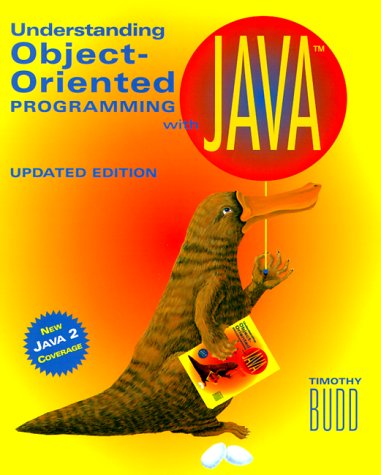
23. Object-Oriented Programming with
$19.45
24. Object-Oriented Programming with
$31.69
25. Object-Oriented Programming Languages:
$70.53
26. A First Course in Computational
$100.65
27. An Information Systems Approach
$24.95
28. Object-Oriented Programming in
$28.06
29. Foundations of Object-Oriented
$28.97
30. Object-Oriented Programming in
31. Object-Oriented Programming: An
 
32. Object-oriented Programming with
$20.00
33. Karel++: A Gentle Introduction
$33.16
34. Object Oriented Programming Using
$30.00
35. A Comprehensive Introduction to
 
36. An Introduction to Programming
$11.00
37. ActionScript 3.0 Design Patterns:
$22.40
38. The Essence of Object-Oriented
$49.95
39. Advanced Object Oriented Programming
$29.69
40. Visual Basic .Net: A Complete

21. Object-Oriented Programming Using C++ (2nd Edition) (The Addison-Wesley Object Technology Series)
by Ira Pohl
Paperback: 576 Pages (1996-12-26)
list price: US$49.99 -- used & new: US$11.98
(price subject to change: see help)
Asin: 0201895501
Average Customer Review: 3.0 out of 5 stars
Canada | United Kingdom | Germany | France | Japan

Customer Reviews (16)

4-0 out of 5 stars Not flashy, but has the essentials
This book assumes prior knowledge of programming; preferably in C or some C++. Not for beginners. Has the merit of not being too verbose. It deals mainly with the syntax of C++. And, yes, while it certainly covers OOP, this may be why some other reviewers say it is not a good OOP book. The thing is, if you have start explaining the language at the lowest level, syntax, then this necessarily takes up space in the book.

What some may notice is the lack of diagrams, whether UML or flowcharts or whatever. There is relatively little coverage of higher level design, from an OOP standpoint or any other, for that matter.

Plus, unlike some more recent programming books, which use multicolours on the text pages to draw the reader's attention, this is very much a traditional text, in plain black and white. Nothing wrong with that, but some of you expecting a more "popular" style should look elsewhere. But if you knuckle down and read this text, you can benefit.

5-0 out of 5 stars Great book! Discard reviews saying it does not cover OOP
This is a great book, however this is not for beginners. I only started reading this after 2 years of intensive study of the language. I learned the most about OOP from this book. The person who wrote that this is not about OOP only based on the chapter titles obviously did not read the book and has no clue what OOP programming is about, otherwise he/she would have realized that each chapter covers a different aspect of OOP.

2-0 out of 5 stars Not an OOP book by any means
I would give this book 5 Stars if its title is changed to "Programming Using C++". Read on to find out why.

Short Summary: The title of this book is way off on what the text covers; you will NOT learn any OOP from this book. If you are looking to learn about OOP than look elsewhere. If you already know some C++ (or know very well some other language) and want to learn C++, you will find this book very promising.

Long Summary: I don't know why this book was given such a title -- there is nothing about OOP in the text (except for one chapter). However, it does a VERY good job on teaching C++ programming. There are 12 chapters in the book and 5 appendixes (517 pages in all). They are: 1) Why OOP in C++?, 2) Native Types and Statements, 3) Functions and Pointers, 4) Implementing ADTs in the Base Language, 5) Data Hiding and Member Functions, 6) Object Creation and Destruction, 7) Ad Hoc Polymorphism, 8) Visitation: Iterators and Containers, 9) Templates, Generic Programming, and STL, 10) Inheritance, 11 Exceptions, 12) OOP Using C++, A) ASCII Character Codes, B) Operator Precedence and Associativity, C) Language Guide, D) Input/Output, E) STL and String Libraries.

Well, as you can see from the title of the chapters, ONLY chapter 12 talks about OOP and it is only 17 pages longs. Every other chapter is about the C++ language and they NEVER cover OOP by any means. So don't get this book in the hope of learning OOP, but get it if you want to learn C++ and I found it very healthy in covering C++.

Finally, for those reviewers who are claiming that this is an OOP book, I see them as mixing C++ and OOP as being equal -- it is not.You can learn about OOP with (almost) any language -- OOP has nothing to do with C++ and this book does NOT teach you OOP.

1-0 out of 5 stars Look elsewhere
This book is one of the most poorly contstructed quasi-textbooks I have seen.I had to buy it for a C++ class, and have found the following:
1) The text does a bad job of explaining topics fully.
2) The end-of-chapter questions are written so poorly that they are not able to be done without finding out their hidden meaning.
3) The appendices are incomplete.

If you need a real C++ or C book see Deitel and Deitel and leave this waste of trees alone.I find myself constantly having to refer to "C++ How To Program" to figure out my programming projects, and it comes through every time.

5-0 out of 5 stars Book not for beginners
If you already know some C++ this is one of the best books available. ... Read more


22. Object-Oriented Programming in Python
by Michael H Goldwasser, David Letscher
Paperback: 688 Pages (2007-11-08)
list price: US$102.00 -- used & new: US$79.99
(price subject to change: see help)
Asin: 0136150314
Average Customer Review: 5.0 out of 5 stars
Canada | United Kingdom | Germany | France | Japan
Editorial Review

Book Description
This book presents a balanced and flexible approach to the incorporation of object-oriented principles in introductory courses using Python. Familiarizes readers with the terminology of object-oriented programming, the concept of an object's underlying state information, and its menu of available behaviors. Includes an exclusive, easy-to-use custom graphics library that helps readers grasp both basic and more advanced concepts. Lays the groundwork for transition to other languages such as Java and C++. For those interested in learning more about object-oriented programming using Python. ... Read more

Customer Reviews (1)

5-0 out of 5 stars Best Python Book but
There are only some problems have the answer (less than 5% of the total).This was not a problem because David Letscher, one of the author, was my professor, since he rarely used problem from the book for the tests and the final.

There is also a small problem with the graphic library, cs1graphics.py which people need to use for some covered topics, is not completed.

However, Of all learning Python books I've read, this book is the best.It covers basic to advanced topics in a very well-organized way with clear explanations.
... Read more


23. Object-Oriented Programming with Visual Basic.NET
by Michael McMillan
Paperback: 316 Pages (2004-06-21)
list price: US$37.99 -- used & new: US$9.00
(price subject to change: see help)
Asin: 0521539838
Average Customer Review: 4.0 out of 5 stars
Canada | United Kingdom | Germany | France | Japan
Editorial Review

Book Description
After an introduction to abstract data types and their initial implementation using structures, Michael McMillan analyzes standard OOP topics, including class design, inheritance, access modifiers and scoping issues, abstract classes, design and implementation of interfaces and design patterns, and refactoring in VB.NET.More advanced OOP topics are covered as well (reflection, object persistence, and serialization.) Finally, he demonstrates OOP techniques for standard Windows applications; for database applications using ADO.NET; for Web-based applications using ASP.NET; and for Windows service applications. ... Read more

Customer Reviews (4)

2-0 out of 5 stars Very Basic
After the previous glowing reviews of this book I bought it hoping to get some special insite in OO. If you have any experience with VB.NET this is just a review. I have gleened much deeper conceptual understaning of OO from fellow programmers.If you are brand new to VB.NET this might be an OK book.I was dissappointed in the lack of depth.

5-0 out of 5 stars Great platform to learn Object Oriented Programming
This is the first technical book that I've finished cover to cover, from a list of many that I've purchased. Mike McMillan explains the basics of Object Oriented programming in a .NET environment in a concise manner that is easy to understand and follow. At the end of each chapter there's exercises to complete, giving you the chance to practice hands-on, the material covered.
This book provides a great platform for those wanting to move from a procedural based style of programming to one that is object based. I highly recommend it.

5-0 out of 5 stars A Great Book: Concise and Informative!
I had the privalege of studying under Mr. McMillan when he was preparing for this book. Each one of the concepts and topics in the book were covered in class. Mr. McMillan is an excellent teacher and communicator--two essential qualities for a programming book. Whether you are a VB rookie or have a background in pre-OO Vb, this book is a quick, competant and very readable guide on how to learn and best mould VB.NET to your demands.

4-0 out of 5 stars Great start with the basics
Not being a programmer by profession this book offers the best place to start with programming-- organization. Although OOP offers other benefits, organization of thought and process is one of the more important aspects given by OOP. Very clearly written and for the most part "just the facts". ... Read more


24. Object-Oriented Programming with Visual Basic .NET
by J.P. Hamilton
Paperback: 308 Pages (2002-10)
list price: US$34.95 -- used & new: US$19.45
(price subject to change: see help)
Asin: 0596001460
Average Customer Review: 4.0 out of 5 stars
Canada | United Kingdom | Germany | France | Japan
Editorial Review

Book Description
One of the most significant features of Visual Basic .NET is the full support of object-oriented programming.For years, developers have been asking for it, but you may not be quite sure how it can help to create and maintain scalable .NET applications.VB.NET is a language that facilitates object-oriented programming, but does not guarantee good object-oriented code.That's where Object-Oriented Programming with Visual Basic .NET comes in.It will show you how to think about similarities in your application logic and how to design and create objects that maximize the benefit and power the .NET Framework enables.The concept of separating the interface from the implementation has been around for years, but with Object-Oriented Programming with Visual Basic .NET you'll put it all into practice and you'll never willingly go back to those old ways.With chapters on object fundamentals and class anatomy, you'll lay a foundation that will prepare you to think and apply code reuse principles.Following that, you'll be ready to dive deep into code and the dynamic ecology that it interacts with. Inheritance, containment, polymorphism, overloading, and overriding are just the beginning of this adventure.From there, you'll discover exception handling, reflection, serialization, and I/O. Packed with examples that will guide you through every step, Object-Oriented Programming with Visual Basic .NET is a guide for those with some programming experience.This book is for those who know Visual Basic 6.0 and are ready or have started the process of developing with Visual Basic .NET.It is an essential tool that will build your skills, as you become a master of Visual Basic .NET.It is one thing to know how to write object-oriented code. Knowing the when and the why is what makes good programmers. That's exactly what you'll know after reading this book. ... Read more

Customer Reviews (1)

4-0 out of 5 stars TRULY OBJECT-ORIENTED
As the name indicates, the contents of this book are truly object-oriented.
It has all the lessons that learners would need in order to comprehend the various options and applications that Visual Basic .NET offers. This book provided exemplary guides, which would encourage learners to endure some self-tests. It anticipates problems and helps provide solutions that programmers can count on. Almost everything about it is positive.
However, its information are not as detailed as some experts would like them to be. Again, anybody who has poor knowledge of Visual Basic 6.0 will not find this book easy. Its writer assumed that its readers are already familiar with VB 6.0. ... Read more


25. Object-Oriented Programming Languages: Interpretation (Undergraduate Topics in Computer Science)
by Iain D. Craig
Paperback: 256 Pages (2007-03-28)
list price: US$39.95 -- used & new: US$31.69
(price subject to change: see help)
Asin: 1846287731
Canada | United Kingdom | Germany | France | Japan
Editorial Review

Book Description

This comprehensive examination of the main approaches to object-oriented language explains the key features of the languages in use today. Class-based, prototypes and Actor languages are all looked at and compared in terms of their semantic concepts. In providing such a wide-ranging comparison, this book provides a unique overview of the main approaches to object-oriented languages.

Exercises of varying length, some of which can be extended into mini-projects are included at the end of each chapter. This book can be used as part of courses on Comparative Programming Languages or Programming Language Semantics at Second or Third Year Undergraduate Level. Some understanding of programming language concepts is required.

... Read more

26. A First Course in Computational Physics and Object-Oriented Programming with C++
by David Yevick
Hardcover: 418 Pages (2005-04-25)
list price: US$85.00 -- used & new: US$70.53
(price subject to change: see help)
Asin: 0521827787
Average Customer Review: 4.5 out of 5 stars
Canada | United Kingdom | Germany | France | Japan
Editorial Review

Book Description
C++ is rapidly becoming the programming language of choice for science and engineering applications because of its rich object-oriented features. Intended for beginning and intermediate programmers, this book surveys the application of C++ to technical problems. Modern object-oriented software engineering tools are employed to simplify the presentation and all aspects of modern C++ programming practices of relevance to scientific programming are surveyed. ... Read more

Customer Reviews (3)

5-0 out of 5 stars the best
This is a very good book, the codes are clear and
written from a computational point of view. It is easy
to set up the software. I agree with the authors self
remraks except that he should wirte up some harder examples
in the end. But still, the best.

5-0 out of 5 stars From the Author:
This book was developed during many years of teaching scientific programming to engineers and scientists in both electrical engineering and physics courses.About 1/3 of the text is accessible to beginning programmers even at a high-school level, while the last part of the book can serve as a second-term undergraduate scientific programming course or as a reference text.While the title indicates that a major focus of the text is computational physics, the book contains problems and examples from numerous scientific and engineering disciplines and can be employed across a wide variety of course offerings.

Because of the practical difficulties faced by beginning students, a first course in scientific programming generally requires very significant personal intervention by the instructor or laboratory assistant.This book effectively removes this issue by providing a common base of free Windows software on CD-ROM that is meticulously documented in the text (the software is also available for Linux).The reader is introduced to programming through numerous assignments containing real-world technical problems.The assignments at first contain nearly the entire program to be developed; as the book develops, however, fewer code sections are provided.This method allows the user to absorb proper program structure while avoiding frustrating and confusing stylistic traps.A solution manual is made available to instructors through Cambridge University Press (see their website for errata) while the CD-ROM also contains copies of all programs presented in the text.

This book presents a compact but completely unified picture of modern programming practice as it applies to scientific programming.The fundamental, underlying principles of the C++ language and scientific programming are stressed in order to simplify retention of complex C++ syntax and of the mathematical and physical content.More involved topics in numerical analysis, scientific programming methods and C++ are presented in an intuitive and easily-understood manner.Examples of the subjects covered are: software engineering principles (UML), numerical analysis, scientific graphics programming, the Standard Template Library (STL), Monte-Carlo methods including the Metropolis and multicanonical techniques, partial differential equation solvers, calling Fortran from C++, C++ program optimization.

4-0 out of 5 stars not as abstract as a pure physics text
This book can serve several audiences. It teaches both computational physics and the use of C++ in writing object oriented code. Clearly, if you are already know one of these topics, but not the other, then the book is a natural fit. You can concentrate on what is essentially half the book.

The more challenging task is if you are unfamiliar with both. Well, it is reasonable to assume that you know some physics, say at the first year undergraduate level. And perhaps you have done some programming, in a procedural language like Fortran or Basic.

The amount of abstractions, or rather the level of difficulty in this, is less than in a typical physics text that is explaining Maxwell's Equations or Einstein's Special Relativity. The physics in the book revolves around trying to compute certain numbers in an efficient manner.

While from a programming standpoint, computational physics examples are given as an important use case, to help the student grasp the OO concepts. ... Read more


27. An Information Systems Approach to Object-Oriented Programming Using Microsoft Visual C# .NET
by Kyle Lutes, Alka Harriger, Jack Purdum
Paperback: 608 Pages (2005-04-06)
list price: US$105.95 -- used & new: US$100.65
(price subject to change: see help)
Asin: 0619217359
Average Customer Review: 5.0 out of 5 stars
Canada | United Kingdom | Germany | France | Japan
Editorial Review

Book Description
While there are many books used to teach introduction to programming, very few books combine the elements of 1) teaching computer programming from an application developer perspective, 2) teaching Object-Oriented Programming (OOP) by integrating it throughout the text, and 3) using C# as the programming language to teach concepts and techniques.C# has quickly become the fastest growing programming language in the industry today.Therefore, An Information Systems Approach to Object-Oriented Programming Using Microsoft Visual C# .NET has been designed to fill the need for a book that teaches the object-oriented approach to programming as well as the C# programming language to beginning programmers in the CIS market.This book will empower readers to explain OOP concepts and develop practical/useful programs written in C#. ... Read more

Customer Reviews (1)

5-0 out of 5 stars An outstanding textbook for Visual C#.NET
An excellent introduction of VS.Net and explanation of IDE development vs stand-alone development, and a thorough coverage of analysis and design phases of the development process.Also excellent worked out examples in each chapter. There are a good number of objective questions and several programming exercises at the end of each chapter, which is very helpful help for the teacher using this textbook.Writing style is extremely clear and very effective.Complex topics, including the ones listed below have been explained in a manner that every student can easily understand them:

data validation in response to a question:" What should you do when input values are incorrect, Existence Check, Data Type Check, Range Check, Reasonableness Check, Code Check, Cross-Field Check, manipulation of numbers using arithmetical operators, manipulation of strings using operators like concatenation, substring, parsing, methods for changing to upper case etc., date-time manipulation, exceptions and exception handling, call stack, application exception, execution call stack, stack trace property, pass by reference, pass by value, instance method, overloading, shared method, static method, top of stack, recursive methods, theoretical concepts of "arrays," and "good use of arrays," use of proper encapsulation by making the operations visible and the data and the implementation of the operations hidden in the objects, common formats for saving information in sequential data files using plain text: (1) Fixed-width text files, (2) CSV (Comma-separated values) files, and (3) Tab-delimited file, Inheritance and Polymorphism -- two important important components of Object Oriented Programming etc. )

I have seen other books where authors create confusion in reader's mind when they try explaining complex topics in a confusing way.I found everything in this book very easy to understand.

After looking at the table of contents, I admire the strategy of the authors - they are presenting the "more technical things earlier" and "more management issues a "bit later."Also they have separated some programming conventions into appendix B (because the conventions may differ at some software houses).I like the authors separating such material from the chapters of the textbook.

Writing style is indeed very clear and very effective, and it reflects the pedagogical skills of the authors. The authors skillfully and successfully explain many difficult issues in programming, like, hash table, stacks, queues, etc.I fully expect to use this book when I teach C# at my university. ... Read more


28. Object-Oriented Programming in Java (Mitchell Waite Signature Series)
by Stephen Gilbert, Bill McCarty
Hardcover: 953 Pages (1997-09-10)
list price: US$59.99 -- used & new: US$24.95
(price subject to change: see help)
Asin: 1571690867
Average Customer Review: 3.5 out of 5 stars
Canada | United Kingdom | Germany | France | Japan
Editorial Review

Book Description
Designed for those new to programming, Object-Oriented Programming in Java provides step-by-step lessons that cover OOP (object-oriented programming) and the Java language comprehensively with clear examples, code and figures. You'll use Java's built-in-objects to create applets. Design your own classes and assemble them into sophisticated, complete programs that run inside an HTML browser or as stand-alone applications. Create objects using the simple ideas of sequence, selection and iteration. You'll delve into Java's Abstract Window Toolkit (AWT) to create full-color, multimedia Java applets, components and containers. Explore Java's versatile input/output streams and utility classes. ... Read more

Customer Reviews (19)

1-0 out of 5 stars Stay away from this book
Too much junk and the way this book is organized makes it not easy to understand. I agree with a previous reviewer that this books it too wordy and boring.
For a book on java, I'd recommend "Java in 21 days" and "Thinking in Java".

1-0 out of 5 stars Wordy and Boring!
I agree with one of the reviewers who wrote that the book is wordy and it does not worth over [money].Only one-third of the book is educational, the rest is junk. The author wants to be funny and all that does is to make me irritated at all the jokes and the pizza and the elephant stories. If I want to learn how to do something, I'll look to the instructions in a manual, not some "comic book want-to-be". I would not recommend this book to anyone.

4-0 out of 5 stars The BEST Book to Start JAVA
I realized that readers form their personal opinion about a book based on how well it met their expectation. That is quite unfair to the book itself because it may never start out to meet everybody's needs.

OOP in Java certainly did not set out to do that. It claims to be a book for those without any prior programming experience and teaches OOP from the ground up. If we solely rate this book based on what it promises, then it not only lives up to it, but far surpasses its claims. It teaches you Java programming not by dumping a lot of facts, figures and explanation but in using generous amount of examples.

Before you see another keyword or concept, you would have already mastered the necessary ones to get you ahead. Unlike the other programming books, this goes down to your level (occasionally, it goes too low). But the BEST is that it follows the maxim that programmers are first human and second programmers. Thus teaching you programming not in a vacuum, but relating the whole learning experience to a simulated business company wishing to set up a store. Therefore, you'll not only understand how a concept is, but WHY it is being used in this manner.

The only short-coming of this book is that it contains many "real-world" situation that you need to read through before being introduced to the programming, something which I find a little irritating.

But if you are new to programming and want to get stated with Java. THIS IS THE BOOK FOR YOU.

5-0 out of 5 stars BUY THIS BOOK; TRASH ALL OTHERS.
Let's set the stage: I have read "Java in 21 Days". Results: shouldn't have spent 21 minutes. And: "Java and Object-Orientation, (John Hunt); Results, It's nothing but Jargon, "another worthless Academic. It reminds me of the time that Ben Barber (The Whalt Whitman Chair at Rutgers University in New Jersey) said to me on day after class that he was too busy to talk to me because he had a call from the (Clinton) WhiteHouse. Yea, right Ben You Liar. I Have read Eckels Stuff, too, it's Junk. BUT......This book is the book that will allow you to throw those bloated academics in the trash and get to understanding and writting some great Java code. I suggest that you buy any book that has the namesStephen Gilbert and Bill McCarty in the Author'e credits. Actually, I think I will form a foundation that demands that these two authors write for us--future programmers-- the next instalment of "Advanced Java" by Gilbert and McCarty

3-0 out of 5 stars A good conceptual start
The book is a good conceptual start for Java 1.1. It is also a good bookon OOD. However, since no revision of the book is being done, it is losingvalue. In fact with passage of time, the usefulness of this book (or anyother programming language book) is bound to depreciate.

The concept ofdesign patterns is not discussed in this book, which simply cannot beavoided in any book dealing with OOD (except such references as 'accessor'or 'mutator').

Reference to a modeling language (preferably, UML) wouldappreciate the usefulness, which is my personal opinion.

I wish a groupof person take this book as an ongoing project and do the necessary thingsthat would bring it to 6*! ... Read more


29. Foundations of Object-Oriented Programming Using .NET 2.0 Patterns (Foundations)
by Christian Gross
Paperback: 376 Pages (2005-10-13)
list price: US$44.99 -- used & new: US$28.06
(price subject to change: see help)
Asin: 1590595408
Average Customer Review: 3.0 out of 5 stars
Canada | United Kingdom | Germany | France | Japan
Editorial Review

Book Description

Foundations of Object-Oriented Programming Using .NET 2.0 Patterns solves the object-oriented and pattern-programming problem by mixing the two&emdash;the book teaches object-oriented concepts using patterns, or a solutions-based approach. The book's material is organized around tasks and patterns, and illustrated through development problems and solutions that include persistence, code efficiency, and good design.

This book is of special interest to those who want to learn how to use .NET 2.0 Generics in conjunction with patterns. This unique book is based on the author's lectures, and the information unfolds in a practical manner.

... Read more

Customer Reviews (11)

1-0 out of 5 stars The book needed an Editor
I purchased this book "used" - received it in the mail today.I payed a fraction of the published price - however, I have to say, I am having a huge reaction of repulsion to this book - regardless of the price.

I have a few years of .Net Coding, and decades of programming experience. I know enough to realize that there are some really beginning things in this book, and some concepts that are just a bit past a beginner.I find the writing style irratic and irritating.

It could be that part of the problem is that the publisher did not put the authors paragraphs through an Editorial team and make the author keep his style clear and simple. (A technical reviewer would not do that) The Editorial team would make sure that the English states a theme and stays on topic to a point of clarity that really seems to be missing in what I have seen so far. If there was an Editorial team, they missed the boat - a book should never have gone to print this bad.

Only one other technical book has ever created such a strong repulsion before and that was over 10 years ago. That older book sounded like they were too full of themselves - I cannot point to that in this - at least so far it just seems to be extremely irratic in its presentation to the point that I find it terribly annoying.

I am not even sure that the hoped for "Pattern's"(e.g Gang of Four) will be fully developed in what I have seen so far. My reaction to the writing was enough to want to post a review to warn others. The book so far is really a dissapointment.

I am having a hard time trying to read this for any value due to my reaction to the writing style. Clarity and simplicity of style are not in what I have seen so far. Simply awful.


1-0 out of 5 stars Source code organization is a joke
I consider myself an intermediate.None of the concepts I've read in this book so far are foreign but I'm sick and tired of books like this being thrown together.I haven't gotten through the book yet but I will not give this or any other book a better rating until there is at least documentation of how to source is thrown together.Having said that, could I sit here and figure everything out.Sure I could but that's not the point.I bought the book to learn and get a different perspective.For me, looking and stepping through examples is how I learn.The author admits the source is horribly organized.What just baffles me is here's the text in the changelog.txt:

"Initial release where source code is functional, but not organized.To get
an understanding of what the source code is doing look at the book:
Foundations of Object Oriented Programming using .NET 2.0 Patterns published
by Apress.In the future I will work on making the source code more
organized.It also depends on the demands of the readers and clients."

With VS 2005 there simply is no excuse for any author not to be able to package a fully functioning solution or solutions to where the user extracts it and it builds.Well there is one excuse and it's laziness.

The txt file above only confirms whoever put this together is lazy.come on it's not organized great but if people complain maybe we'll do better.Pitiful.

Having said that the content of the book could be good but for me I paid the fee for the book to read and learn through examples not figure out somebody elses mess.

For those who can comprehend code without ever wanting or needing to put it in the IDE and step through, look at variable states etc, then this probably won't apply to you.

I for one demand apress or this author at least extend the courtesy to their customers to at least post documentation as to how to set up the code to where it will at least compile without us trying to weave through the authors tangled mess.

3-0 out of 5 stars This is a "Foundation" book
I was hoping for more C# tips then just plain OO methodologies. This is simply a book to teach you object oriented programming, and the code they use in their examples is C#. If you are just learning OO and wanted to do it in C# then this book would be fine.

3-0 out of 5 stars Code samples are not orgnized at all, need help ???????????
This book is good, however its code samples are not orgnized. Many of my classmates do not know how get the code run by chapter.
We hope the book author be helpfull on this issue, at least post some guidence.
??????????????????????????????????????????????

5-0 out of 5 stars Well Written
I totally disagree with 'E. Makepeace "Ewan"'. But there's always at least one hater in the group, who hates just to hate.

I've been searching for a book like this for a long time; one that is C# flavor that not only defines patterns, but explains how and why to use them. My schooling focused on OOP concepts but never touched on patterns. The author supplies many good examples and explains concepts in an easy to understand manner. Highly recommended... ... Read more


30. Object-Oriented Programming in Common Lisp: A Programmer's Guide to CLOS
by Sonya E. Keene
Paperback: 288 Pages (1989-01-11)
list price: US$39.99 -- used & new: US$28.97
(price subject to change: see help)
Asin: 0201175894
Average Customer Review: 4.5 out of 5 stars
Canada | United Kingdom | Germany | France | Japan

Customer Reviews (5)

5-0 out of 5 stars Really great book on CLOS
This is a great book. It shows everything about CLOS (except the metaobject protocol, which is just mentioned but not explained in detail). The explanations are very clear and the author does every possible thing to make you understand all details (a bit too much for me, but that's a matter of taste).

For anyone interested in OO programming in Common Lisp, this is an essential book.
Even if you are interested in OO programming in general, this book covers a different approach, so it is nice for a comparison (in CLOS, methods do not belong to classes, and there are lots of interesting tricks that you can do that are not possible in other languages).

4-0 out of 5 stars Concise, clear and readable, an excellent introduction
Lisp is kinda hot again, Perl 6 will have multiple dispatch, Ruby's getting before and after methods, and Aspect Oriented Programming is still bubbling under in Java, so what better time to revisit the Common Lisp Object System and this slim volume from 1989? Unsurprisingly, objects in Lisp are implemented differently to the well-known object systems, even Smalltalk, so if you're into OO (and in particular AOP), check out CLOS.

And this book is an excellent way to get acquainted with the features of CLOS. While the introduction suggests non-Lispniks can benefit from reading this book, I would strongly suggest you can read Lisp to make sure you understand what's going on. It's a quick read (about 220 pages, excluding the appendices), the language is unfussy and clear, and the concepts are simply explained.

The hoary old shape example is used briefly (perhaps it wasn't as tired in 1989), but the two main examples used in the book is a simple locking mechanism for concurrency, and multiple inheritance based disk and tape stream classes. Both example do the job well of highlighting the unique flavour of CLOS. The metaobject protocol is touched upon only briefly, but there's more than enough of the standard object protocol described for you to be getting your money's worth.

Other introductory books do cover CLOS (Practical Common Lisp has a good chapter), but this is a very nice standalone volume devoted to CLOS only. Well worth reading, object (and Lisp) fans.

4-0 out of 5 stars A good way to understand "why CLOS?"
This is a nice "tutorial style" walk through much of the functionality of CLOS.

It doesn't get into examples that are of _spectacular_ complexity, either in size or in difficulty of concept, but that strikes me as being just fine.The dialect of CLOS in use predates the final version that was released, so a few examples require a little modification to work with modern Lisp releases.

If you're looking to get into the sophistication of redefining your own metaobject protocols, the MOP book is surely more suitable.But for most of us who just need to figure out what CLOS is good for, this book provides a very nice presentation of that.

5-0 out of 5 stars The cover says it all
You are going to get precisely what is advertised: a good guide to object-oriented programming in Common Lisp, no less, no more.

5-0 out of 5 stars A worthwhile reference
Keene covers CLOS thoroughly and clearly. A classic. Can't say much else.If you care about your LISP programming craft, buy this book. ... Read more


31. Object-Oriented Programming: An Evolutionary Approach
by Brad J. Cox, Andrew J. Novobilski
Paperback: 320 Pages (1991-05)
list price: US$44.95
Isbn: 0201548348
Average Customer Review: 4.5 out of 5 stars
Canada | United Kingdom | Germany | France | Japan

Customer Reviews (4)

4-0 out of 5 stars The original reference work on Objective-C
The original reference work on Objective-C; the second edition was published May of 1991.So don't expect anything about OS X or Cocoa.But it's still a good book.If you want to read about the language itself, its history, the motivations behind its design, and its relationship to other languages, this is the book for you.If you want an introduction to the concept of object-oriented programming that is not mucked up by the foulness of C++ or Java, but rather gets you started down the One True Path of Cocoa right off the bat, this would also be a good place to start.I learned Objective-C from this book, and it is still handy as a reference work.Kind of the Kernighan & Ritchie of Objective-C. Four stars instead of five because it has less and less relevance for the typical Obj-C programmer nowadays, who is almost certainly coding for Cocoa on OS X.

5-0 out of 5 stars This book is awesome.. it explains alot.
The book is kind of small.. but its packed w/ info onobjective-c. It gives complete info on how to use the objective-c OOPextension as well the objective-c internals.

4-0 out of 5 stars The main reference on Objective-C.
The first three chapters are conceptual, and compare various approaches to object-oriented programming.Chapters 4 until 8 are highly technical and give detailed information on the Objective-C runtime and class libraries.I find the chapter on user interfaces a bit sloppy. Interesting, on the other hand, is the final chapter with projects for extensions.

5-0 out of 5 stars One of the best books on Object Oriented Programming
This book is a must read for anybody working in Objective-C (NextStep/Rhapsody). It basically describes Objective-C, how it works, and future directions for the language. It also has a good comparison of other OO languages. Overall, it's a great book ... Read more


32. Object-oriented Programming with C++
by E Balagurusamy
 Paperback: Pages (1997)

Isbn: 007462038X
Canada | United Kingdom | Germany | France | Japan

33. Karel++: A Gentle Introduction to the Art of Object-Oriented Programming
by Joseph Bergin, Mark Stehlik, Jim Roberts, Richard E. Pattis
Paperback: 208 Pages (1996-10-02)
list price: US$38.95 -- used & new: US$20.00
(price subject to change: see help)
Asin: 0471138096
Average Customer Review: 3.5 out of 5 stars
Canada | United Kingdom | Germany | France | Japan
Editorial Review

Book Description
This creative approach to learning C++ programming introduces readers to Karel the Robot and then shows them how to design programs that instruct Karel to perform complex tasks. Karel's world is essentially a practice field on which readers learn valuable lessons about creating and debugging program. The programs instruct the robot to move and manipulate its environment using object orientation. ... Read more

Customer Reviews (6)

1-0 out of 5 stars I'd rather cross the Saraha without sunscreen
This book was the text for one of my intro to programming courses.I had no choice.You do.Run while you can.

4-0 out of 5 stars Good Start for Younger Readers
This book reminds me of the older LOGO programming language.You have a small "robot" that explores his world.You tell him how to move and what to do.The only reason this is good is that it helps you think of object oriented programming.(The robot is considered an object).There are also special editions of the book in case you want to specifically move to C++ or Java later.Basically, the book is a good start.If you have any programming experience - skip it.Otherwise, it will get you in the rate frame of mind to move toward OOP.

1-0 out of 5 stars Not worth your time
I had to read this book for an introductory programming class and didn't find it at all helpful when going on to Java.It wasn't worth the time I spent working with it.You'd be better off just beginning the object-oriented language you're interested in.If you want my advice, try Beginning Java Objects by Jacquie Barker instead.

4-0 out of 5 stars A Decent but very basic intro to C++
This book is meant for the earliest of beginning programmers.If you have any programming experience whatsoever, even with macros, the information in this book will seem extrememly remedial.Also, some of the terms usedaren't even real C++ code, so you'll have to adjust your thinking just alittle when you move on.Finally, the price is pretty steep for the amountof information you get.I would probably only recommend this book forsomeone needing a very, very, VERY gentle intro to programming.

5-0 out of 5 stars Quickly learn the Concepts and Theories behind C++ and Java
With the use of this book and associated software, one can master the C++ or Java language in no time at all! It uses the analagy of a Robot, and the simple classes that operate it. Due to the fact that it has simple classes,time is not wasted trying to remember the many classes and their functions,and the reader immediatly begins programming the Robot. The Karel++language has the Syntax of C++, and is Object Oriented (just like Java andC++). This is a must buy for anyone getting into programming, or justlearning OOP (Object Oriented Programming)! ... Read more


34. Object Oriented Programming Using C++, Second Edition
by B. Chandra
Hardcover: 480 Pages (2005-02)
list price: US$59.95 -- used & new: US$33.16
(price subject to change: see help)
Asin: 1842652478
Average Customer Review: 4.0 out of 5 stars
Canada | United Kingdom | Germany | France | Japan
Editorial Review

Book Description
Discusses all aspects of OOP like Classes, Polymorphism, Inheritance,Virtual Functions and Friend Functions apart from fundamental concepts.Extensive coverage has been given to illustrate standard templates likeVectors, Queues, Stacks, List and Maps. ... Read more

Customer Reviews (1)

4-0 out of 5 stars check out the STL
Chandra takes you on an extensive and comprehensive tour of C++. Object oriented programming is taught with many code examples to illustrate the ideas.

The book is suitable as the main text of a one term introductory course in C++. I say introductory because it does not assume any prior knowledge of the language or of OOP, and so has to spend some time going over the elementary syntax.

Once you have mastered the latter, consider reading carefully the chapter on the Standard Template Library. This gives you access to a lot of code that has proved to be very useful to many C++ programmers. A wonderful timesaver, that frees you to concentrate on original work. ... Read more


35. A Comprehensive Introduction to Object-Oriented Programming with Java
by C. Thomas Wu (Otani)
Paperback: 1189 Pages (2007-02-13)
list price: US$102.50 -- used & new: US$30.00
(price subject to change: see help)
Asin: 007331708X
Canada | United Kingdom | Germany | France | Japan
Editorial Review

Book Description
A Comprehensive Introduction to Object-Oriented Programming with Java provides an accessible and technically thorough introduction to the basics of programming using java. The text takes a truly object-oriented approach. Objects are used early so that students think in objects right from the beginning. The text focuses on showing students a consistent problem solving approach. ... Read more


36. An Introduction to Programming and Object-oriented Design Using Java (Wiley Plus Products)
by Jaime Nino, Frederick A. Hosch
 Paperback: Pages (2008-03-03)

Isbn: 0470132191
Average Customer Review: 3.5 out of 5 stars
Canada | United Kingdom | Germany | France | Japan
Editorial Review

Book Description
The emphasis throughout this book is on problem modeling using fundamental software engineering principles and concepts. Although Java is introduced and used throughout the text, this is not a text about Java. Rather, Java is used as a tool to present the concepts.

The UML is used, very informally, for denoting objects, object relationships, and system dynamics.< ... Read more

Customer Reviews (7)

4-0 out of 5 stars Java, UML and algorithms all in one
This is an ideal book for those that want to learn Java with a college textbook. Starting with the basics each chapter is well written and illustrated and has a series of questions at the end to help you test your knowledge of what you have just learned. UML is used throughout as the illustration language. Later chapters deal with algorithms (e.g. storage, sorting, searching, etc.)

All of the features of the Java language are covered. Swing is used to teach the basics of UI. There is nothing on web application work. Collections are taught using the new generics features of Tiger.

A good book for those looking to learn how to program, and who want to start with the Java language and object-oriented design.

5-0 out of 5 stars A Great Introductory Book for Beginning Programmers
This book, in my opinion, is probably one of the few better introduction books that should be widely used in many intro computer courses.I have programmed for many years, and I have learned that I have made the same mistake in the past that I know many others have done, when they first started programming.The problem I am talking about is when some people program, they just go up to the keyboard and screen and just type, which I have learned from this book that it is very wrong to do.I have learned from this book that when one programs, he/she has to have some kind of design implementation (UML) set and ready before going to turn the designs to code.As an introductory book, this will teach beginner programmers the correct way to program, without the sloppy coding techniques.
The first two chapters are a good explanation to how computers process code and the meaning of object-orientation.The next couple of chapters gives a brief overview of what Java is and how Java ties in with object-oriented design.If one already has Java experience, I think he/she can just skip these chapters, because it may get repetitive to the eyes.For beginner Java-ers, the book gives excellent pure examples in Java, without any confusing documentation or coding.
Then comes Chapter 10 and on...These chapters covered are for Java programmers who have already passed the Beginner's stage, but feel they need to 'dip their feet' in Java water a little more before declaring themselves as proficient Java-ers.These chapters cover excellent computer terminology and basic computer aspects (lists, sorts, searches, abstractions) and classic algorithmic ideas.The last couple of chapters deal with introduction to Exceptions (Java) and GUI Applets, after dealing with TUI most of the book.
So in closing, a good book for introduction, but if you do have experience in Java, then you still would find the book useful, with a handful of excellent defined computer programming terminology and examples.Also, I took the class with one of the authors (Dr. Jaime Nino) and he is truly an exceptional professor at heart who loves his programming.

5-0 out of 5 stars Excellent Book...
I've been a designer/multimedia developer for the past 10 years (using Director/Lingo and Dreamweaver/HTML and After Effects).Until recently, I'd been sorely underdeveloped in the areas of scripting and application customization (not to mention application development) since I had only a very basic understanding of programming concepts and tended to use "black box" code off the web, which I'd modify to suit my purposes.I'd studied Java at Career Centers (a NYC-based training facility) but although I had learned the syntax and general usage, I was missing a foundation in the underlying programming concepts...

A month ago I decided to buckle down and learn core programming techniques.I found this book, and it has served me WELL.(Paid $40 for a used copy).

I'm not sure how frustrating this book would be to someone who had never seen Java before, or had little knowledge of the scope of the language.However, if you're a "scrip kiddie" or a developer with a "working knowledge" of programming tools, but no thorough understanding of core techniques -- this book is for you!

5-0 out of 5 stars Learn Software Design From Two Legendary Masters
For nearly two decades, the computer science department at the University of New Orleans has had the outstanding reputation of possessing one of the finest academic programs in software engineering in the south.A huge part of this reputation can be attributed to the presence of two legendary software designers at the department, Professor Fred Hosch and Professor Jaime Nino.Now, for the benefit of those who are unable to experience the expertise of these two professors first-hand, John Wiley & Sons, Inc. proudly presents An Introduction to Software Construction with Java, the very first textual authority ever to be written by Professors Hosch and Nino.Although no substitution for the professors themselves, this paperback mentor will teach you how to program and program well.

Unlike any other textual teaching tools on the subject of software construction today, such as Java In a Nutshell by David Flanagan, Hosch and Nino's text is geared towards the novice programmer, that is, an introductory-level student who does not even know the meaning of the phrase "computer science."In this textbook, the authors first define what it means to be a software engineer.Then, they will take you by the hand and teach you the basic syntax and grammar of the Java language.You will learn how to define variables and construct objects.You will know what the concept of "object-oriented designing" means.

Next, these authors will teach you what no other books on software that I have read thus far will teach you: how to design a good software system.These authors will teach you how to construct interaction diagrams and how to use them so that you can implement well-organized relationships between clients and servers.You will fully understand and appreciate the extremely important, yet often overlooked, concept of designing a good programming by contract relationship between objects.Often, I see textbooks presenting as examples to students implementations that Hosch and Nino would refer to as a "house of cards."In other words, the relationships between the objects in such examples are so unnecessarily complex that any minute modifications to these poor implementations will cause the collapse of their entire software structure.

A programmer, by definition, is one who can implement software systems that execute properly.What, then, is the definition of a good programmer?A good programmer is one who knows how to implement software so that it can solve a problem within the least amount of time possible.How do you gauge the time complexity of a software system?Hosch and Nino will present you with a classical tool for measuring software speed that is guaranteed to increase the efficiency of your designs in no time.

Other topics covered in this book include: constructing lists, guidelines to writing better comments and documentations, techniques for building maintainable and adaptive software that completely encapsulates a single notion, techniques for optimizing your software's interface via the principle of information hiding, handling exceptions and failures, developing graphical user interfaces that adhere to the model-view-controller pattern, constructing advanced containers, such as dynamic arrays, linked lists, stacks, dictionaries, queues, and hash tables, and, finally, learning how to develop your very own software library.

So, if you are a software developer or are just remotely interested in the craft of software engineering, I urge you to buy this book and let Hosch and Nino, two legendary professors from the University of New Orleans, teach you the proper marksmanship of legendary programming.

2-0 out of 5 stars An ambitious attempt, but falters badly
My business card says "software engineer" but I code very little. This book is the text for an introductory computer science course I am taking. While I admire the authors' attempt at putting Objects First in the curriculum, they have only succeeded in confusing and alienating a number of my classmates with little programming experience. The most glaring weaknesses are the the relatively few, undistinguished examples, and the lack of rigor in teaching Java syntax and semantics. The authors' freely admit that they do not attempt to teach Java itself, but this ultimately leaves students stranded as they peruse the hundreds of Java titles at the local bookstore, looking for a decent language reference. Lastly, they mix a lot of software engineering practice in with the actual computer science. While topics such as programming by contract and software quality are important, I am not convinced that this material is suited for students at the beginning level. ... Read more


37. ActionScript 3.0 Design Patterns: Object Oriented Programming Techniques (Adobe Developer Library)
by William Sanders, Chandima Cumaranatunge
Paperback: 530 Pages (2007-07-16)
list price: US$44.99 -- used & new: US$11.00
(price subject to change: see help)
Asin: 0596528469
Average Customer Review: 4.0 out of 5 stars
Canada | United Kingdom | Germany | France | Japan
Editorial Review

Book Description
Now that ActionScript is reengineered from top to bottom as a true object-oriented programming (OOP) language, reusable design patterns are an ideal way to solve common problems in Flash and Flex applications. If you're an experienced Flash or Flex developer ready to tackle sophisticated programming techniques with ActionScript 3.0, this hands-on introduction to design patterns is the book you need.

ActionScript 3.0 Design Patterns takes you step by step through the process, first by explaining how design patterns provide a clear road map for structuring code that actually makes OOP languages easier to learn and use. You then learn about various types of design patterns and construct small abstract examples before trying your hand at building full-fledged working applications outlined in the book. Topics in ActionScript 3.0 Design Patterns include:

  • Key features of ActionScript 3.0 and why it became an OOP language
  • OOP characteristics, such as classes, abstraction, inheritance, and polymorphism
  • The benefits of using design patterns
  • Creational patterns, including Factory and Singleton patterns
  • Structural patterns, including Decorator, Adapter, and Composite patterns
  • Behavioral patterns, including Command, Observer, Strategy, and State patterns
  • Multiple design patterns, including Model-View-Controller and Symmetric Proxy designs
During the course of the book, you'll work with examples of increasing complexity, such as an e-business application with service options that users can select, an interface for selecting a class of products and individual products in each class, an action game application, a video record and playback application, and many more. Whether you're coming to Flash and Flex from Java or C++, or have experience with ActionScript 2.0, ActionScript 3.0 Design Patterns will have you constructing truly elegant solutions for your Flash and Flex applications in no time. ... Read more

Customer Reviews (9)

5-0 out of 5 stars Great detailed book
I bought this book when I wanted to pick up on Design Patterns in AS3 (I had little to no experience with DP in AS2), and after I read "Essential ActionScript 3.0".I bought it without reading any reviews because I like O'reilly books, but after I placed the order, I looked at the reviews, and noticed that people were favoring "Advanced ActionScript 3 with Design Patterns" (by Joey Lott and Danny Patterson) -- so I went to the closest B&N and picked it up a day before the O'reilly one arrived, so I was able to compare.I must say that I liked the O'reilly book by FAR over the other one, mostly because of the detailed and extensive examples, descriptive copy and easy-to-follow real-life samples (even though the author referred to Gnarls Barkley as a person at one point.. haha).

So - for someone like me, who knew AS3 (the books assumes you do), but wanted to get into OOP with Design Patters, this was an excellent choice. I would highly recommend it.

2-0 out of 5 stars Workarounds for where ActionScript can't be Java
ActionScript 3.0 has more in common with Java than any previous ECMAScript, so it lends itself to a reimplementation of the classic Design Patterns originally espoused by the "Gang of Four" in "Design Patterns: Elements of Reusable Object-Oriented Software". "ActionScript 3.0 Design Patterns" essentially does just this.

Unfortunately, ActionScript 3.0 does have some differences (no abstract classes, no private constructors) that make it impossible to implement the patterns in exactly the same way as the canonical Java solutions. Even with the workarounds Sanders and Cumaranatunge explain to get back on track, I can't help but think that there might be better solutions using the full range of ActionScript's capabilities, instead of sticking obstinately to the new Java-like syntax.

4-0 out of 5 stars Impressive resource on Design Patterns for ActionScript 3.0
I've been reading through O'Reilly's "ActionScript 3.0 Design Patterns: Object Oriented Programming Techniques" by William Sanders and Chandima Cumaranatunge for the last few weeks and have to say its an incredibly useful resource.

The interesting thing is that this book approaches design patterns in the more traditional sense, not dumbing down on the object-oriented terminology. In that sense it is very approachable to those coming from a Java or C background and are looking for ActionScript 3.0 implementations of specific patterns.

Full review at: [...]

5-0 out of 5 stars A pick for any advanced programmer's library.
College-level and specialty computer libraries covering web development will find William Sanders & Chandima Cumaranatunge's ActionScript 3.0 Design Patterns an excellent acquisition, covering common problems in Flash and Flex applications and providing developers with the tools necessary to adopt superior design patterns. From key components of ActionScript 3.0 and its characteristics to the benefits of developing both structural and behavioral patterns, ACTIONSCRIPT 3.0 is a pick for any advanced programmer's library.

4-0 out of 5 stars Excellent
Great book! The concepts shown are useful not only to action script but to any language at the enterprise development level. ... Read more


38. The Essence of Object-Oriented Programming with Java(TM) and UML
by Bruce E. Wampler
Paperback: 320 Pages (2002-01-05)
list price: US$44.99 -- used & new: US$22.40
(price subject to change: see help)
Asin: 0201734109
Average Customer Review: 4.0 out of 5 stars
Canada | United Kingdom | Germany | France | Japan

Customer Reviews (6)

4-0 out of 5 stars An excellent book to grasp the essence of OO, JAVA and UML
I have gone through your book entitled "The essence of
object-oriented programming with java and UML" and I
must say that you wrote a very fine book.

To explain my point and let you know what is good
about it from my own perspective, I find it not quite
advanced in its treatment of the JAVA language but at
the same time it gives you a sense of knowing right
from the beginning the very essence of the language.
In addition,introducing in parallel the UML
methodology helps a lot to understand the software
"production" requirements.

I have gone through several books for the last 5
months. Each pretending to explain once and for all
JAVA or UML. But your book is the only one I found so
complete in its treatment of both OO, JAVA and UML
(even though it is only 290 pages long !).

Again, thanks for such a fine book and my best wishes
for all your future endeavors.

4-0 out of 5 stars The emphasis is on object-oriented principles, not Java
The world of programming is changing, and in my opinion, the change is welcome. The Unified Modeling Language or UML used to be reserved for advanced programmers in large projects. However, the basics of the UML are easy to understand and provides an excellent way to represent classes and their interactions. Therefore, more authors of introductory programming texts are using the UML in their books. This is a welcome addition, and I am now puzzled when I see a book where it is not used. I do not understand why anyone would use the standard bubble tree diagram to describe inheritance when a UML diagram could be used.
The next question to settle then becomes how well the UML is used and integrated into the presentation of the principles of object-oriented programming. My response to that question is also an affirmative. Wampler uses the combination of UML and Java to explain the fundamentals of object-oriented programming in a way that anyone with programming experience can follow. He also does not commit the error of using too much code in the book. Code is used only when necessary and only enough to make the crucial point. If there is a flaw, it is that there is not enough code in the book. There are times when I thought that an extra example would have been beneficial. However, that is a debatable point and not a serious flaw.
If I were teaching an introductory course in object-oriented programming, this is the text I would use. The emphasis in such courses should be on the principles of object-oriented programming and not the features of a language. In my experience, students quickly learn the syntax of a language, but the organizational strategies used to make programs comes much more slowly. Wampler takes the right approach and I recommend this book to anyone who wants to learn object-oriented programming.

4-0 out of 5 stars The emphasis is on object-oriented principles, not Java
The world of programming is changing, and in my opinion, the change is welcome. The Unified Modeling Language or UML used to be reserved for advanced programmers in large projects. However, the basics of the UML are easy to understand and provides an excellent way to represent classes and their interactions. Therefore, more authors of introductory programming texts are using the UML in their books. This is a welcome addition, and I am now puzzled when I see a book where it is not used. I do not understand why anyone would use the standard bubble tree diagram to describe inheritance when a UML diagram could be used.
The next question to settle then becomes how well the UML is used and integrated into the presentation of the principles of object-oriented programming. My response to that question is also an affirmative. Wampler uses the combination of UML and Java to explain the fundamentals of object-oriented programming in a way that anyone with programming experience can follow. He also does not commit the error of using too much code in the book. Code is used only when necessary and only enough to make the crucial point. If there is a flaw, it is that there is not enough code in the book. There are times when I thought that an extra example would have been beneficial. However, that is a debatable point and not a serious flaw.
If I were teaching an introductory course in object-oriented programming, this is the text I would use. The emphasis in such courses should be on the principles of object-oriented programming and not the features of a language. In my experience, students quickly learn the syntax of a language, but the organizational strategies used to make programs comes much more slowly. Wampler takes the right approach and I recommend this book to anyone who wants to learn object-oriented programming.

4-0 out of 5 stars Useful for Flash MX Developers
Learn the basics of MVC and UML in a movie catalog application. Clear representation of fundamentals of OOP.

4-0 out of 5 stars Good Introduction
I really enjoyed this book. It was a fairly swift read and a good introduction to object-oriented programming and methodologies. It could have been better, imo. I recommend it, in spite of the criticisms below :).

I wish the author had spent more time explaining how the example programs integrate with the MVC framework which he provided. Unfortunately he doesn't even provide that information with UML diagrams, much less discuss it in the text. It would also have been nice to have some discussion of how to extend the framework.

In chapter 6, it was a bit confusing when he used the class MovieModel to model not a movie but rather an application to catalog movies.

The included CD-ROM was missing the source code file for Listing 5.10, so I had to type in in by hand. Unfortunately the listing in the book has a couple of mistakes. The author's web site does not have the code available.Here's the corrected code:

I apologise for the lack of formatting. Space constraints.

/*
* WmvcChkMenuItemCtl - implements JCheckBoxMenuItem controller
* (c) 2001, Bruce E. Wampler
*/
import java.awt.*;import java.awt.event.*;
import javax.swing.*;import javax.swing.event.*;
public class WmvcChkMenuItemCtl extends WmvcController {
private JMenu myMenu; private JCheckBoxMenuItem checkBoxItem;
// Constructor for JMenu item: JCheckBoxMenuItem
//public WmvcController( JMenu menu,
public WmvcChkMenuItemCtl(JMenu menu,String text,String icon,
char mnemonic,String accel,boolean checked,WmvcExecutor wExec )
{super((JComponent)new JCheckBoxMenuItem(), null, wExec); myMenu = menu;
//checkBoxMenuItem = (JCheckBoxMenuItem)myComponent;
checkBoxItem = (JCheckBoxMenuItem)myComponent;
if (text != null)checkBoxItem.setText(text);
if (mnemonic != ' ' && mnemonic != 0)checkBoxItem.setMnemonic(mnemonic);
if (accel != null){KeyStroke ks = KeyStroke.getKeyStroke(accel);
checkBoxItem.setAccelerator(ks);}
if (icon != null){Icon theIcon = new ImageIcon(icon);
checkBoxItem.setIcon(theIcon);}
checkBoxItem.setState(checked); checkBoxItem.addActionListener(this);
checkBoxItem.addItemListener(this); myMenu.add(checkBoxItem);}
public boolean getState(){return checkBoxItem.getState();}
public void setState(boolean checked){checkBoxItem.setState(checked);}
public void setEnabled(boolean enable){checkBoxItem.setEnabled(enable);}
public JMenu getJMenu(){return myMenu;}
public JCheckBoxMenuItem getJCheckBoxMenuItem(){return checkBoxItem;}} ... Read more


39. Advanced Object Oriented Programming with Visual FoxPro 6.0
by Markus Egger
Paperback: 414 Pages (1999-04)
list price: US$49.95 -- used & new: US$49.95
(price subject to change: see help)
Asin: 0965509389
Average Customer Review: 5.0 out of 5 stars
Canada | United Kingdom | Germany | France | Japan
Editorial Review

Book Description

This book combines OOP theory and real-world practical wisdom, all from the Visual FoxPro point of view. Covered are multi-tiered architecture; OO design patterns; object metrics; and OO requirements, modeling, and design, including the UML.
... Read more

Customer Reviews (15)

3-0 out of 5 stars But, I don't have Rational Rose...
Overall pretty good book, I pretty much read it cover-to-cover over a two day period.However, my expectations were a bit high after reading all the other reviews on this site.First of all, his description of the Component Gallery totally lost me.More importantly, from chapter 12 on, the author elects to assume that everyone has access to a ... piece of software called Rational Rose to design an OOP app.This disappointed me, I would have preferred to have things explained in a way that I could follow along with the tools I have as a VFP developer.

5-0 out of 5 stars If there's one book to buy this is it!
When was the last time you picked up a book and couldn't put it down? Markus Egger's "Advanced Object Oriented Programming with Visual FoxPro 6.0" is such a book. He covered everything I needed to know. He covered the fundamentals (a short review of terms), given clear explanations to everyday problems and demonstrated how objects are used in real world designs.

My favorite chapter was "Using Shrink-Wrapped Classes". Until now I have avoided using the available classes distributed with Visual FoxPro because there was a lack of documentation in the original manuals and didn't have the time to open each class and explore. Now that I have read this chapter I ask myself why was I pushing a square wheel up a hill all these years when I could have used these classes immediately and start building on them. Another favorite was needing to know how to hide properties and methods in classes and never being able to figure out how to make these classes work properly. Now I know!

I read this book in two evenings and now I am going back over my classes to re-configure them.

Hentzenwerke Publishing has done a phenomenal job with all it's titles. Not one has been a disappointment. Unlike IDG Books "Bible" series which has been nothing more than fluff and someone wanting to show-off their code.

5-0 out of 5 stars Absolutely the best book for cutting your teeth in OOP/VFP6!
This is probably the best book that I have ever purchased for learning the real nuts and bolts on Visual FoxPro's OOP capabilities and the tools available in it.I encourage both new and seasoned programmers in Visual FoxPro to BUY THIS BOOK!!.I don't think you'll find a better one out there.The way Markus covers the FFCs and other advanced topics is great!!!It is hard to describe in 100 words or less how valuable this book is.

5-0 out of 5 stars Excellent
Almost reads like a novel.I couldn't put the book down.It was immediately relevant, and I can see it being so for years to come.It has permanently changed the way I write code in VFP.

5-0 out of 5 stars A Book for Power Developers using VFP's powerful OOP...
In order to benefit the Power of VFP, a developer should understand the power of OOP in software development. This book tells and guides you how OOP is applied in application development using VFP. The explanation ofOOP tells it loud and clear that Object Orientation is very importantaspect in today's software development. Markus and his associates reallydeserves commendation of doing it well. ... Read more


40. Visual Basic .Net: A Complete Object-Oriented Programming Course Including Unified Modelling Language Uml
by Phil Jones
Paperback: 702 Pages (2003-10)
list price: US$44.99 -- used & new: US$29.69
(price subject to change: see help)
Asin: 1844800989
Average Customer Review: 5.0 out of 5 stars
Canada | United Kingdom |