
|
Help |
| Home - Basic M - Macedonia Culture (Books) | |
e99 Online Shopping Mall
|
|
Help |
| Home - Basic M - Macedonia Culture (Books) | |
| 1-20 of 24 | Next 20 |
click price to see details click image to enlarge click link to go to the store
| 1. Macedonia (Cultures of the World) by Marylee Knowlton | |
 | Library Binding: 144
Pages
(2005-04)
list price: US$42.79 -- used & new: US$19.49 (price subject to change: see help) Asin: 0761418547 Average Customer Review: 
Canada | United Kingdom | Germany | France | Japan |
Customer Reviews (1)
| |
| 2. Macedonia: The Politics of Identity and Difference (Anthropology, Culture and Society) by Jane K. Cowan | |
 | Hardcover: 192
Pages
(2000-12-01)
list price: US$89.00 -- used & new: US$51.45 (price subject to change: see help) Asin: 0745315941 Canada | United Kingdom | Germany | France | Japan |
|
Editorial Review Product Description | |
| 3. Women and Monarchy in Macedonia (Oklahoma Series in Classical Culture) by Elizabeth Donnelly Carney | |
 | Hardcover: 369
Pages
(2000-06)
list price: US$55.00 -- used & new: US$50.59 (price subject to change: see help) Asin: 0806132124 Average Customer Review: 
Canada | United Kingdom | Germany | France | Japan |
Customer Reviews (2)
| |
| 4. Patterns and Corporeality: Neolithic Visual Culture from the Republic of Macedonia Bar S1910 by Goce Naumov | |
| Paperback: 145
Pages
(2009-12-31)
list price: US$85.00 -- used & new: US$85.00 (price subject to change: see help) Asin: 1407303937 Canada | United Kingdom | Germany | France | Japan | |
|
Editorial Review Product Description | |
| 5. A History of Macedonia (Hellenistic Culture and Society) by R. Malcolm Errington | |
| Hardcover: 325
Pages
(1990-08-27)
list price: US$55.00 -- used & new: US$30.00 (price subject to change: see help) Asin: 0520063198 Average Customer Review: 
Canada | United Kingdom | Germany | France | Japan | |
|
Editorial Review Product Description Customer Reviews (7)
Dr. Nick Papanikolaou
This book is very well written and, I believe, will always be a great source of historical info. for myself and my daughter. Mr. Errington's research and conclusions as to the ethnic makeup of the ancient Macedonians are not only correct they appear to be necessary in light of today's wave of self-serving history revisionism. QUESTION #1: WHAT WAS THE LANGUAGE OF THE ANCIENT MACEDONIANS? Here's what a couple of ancient (and obviously unbiased) sources say: The Roman writer Titus Livius says : (from "The Foundation of the City", Paragraph 31) "The Aitolians, the Akarnanians, the Macedonians, men of the same language, are united or disunited by trivial causes that arise from time to time; with aliens, with barbarians, all Greeks wage and will wage eternal war; for they are enemies by the will of nature, which is eternal, and not from reasons that change from day to day." Didorus of Sicily (17.67.1) says: (...) And the rest of the Greeks? Pausanias writes in his book "Description of Greece" (10.3.3): "The Phocians were deprived of their share in the Delphic sanctuary and in the Greek assembly, and their votes were given by the Amphictyons to the Macedonians." and also in his book "Phokis" (8,2 & 4): "They say that these were the tribes collected by Amphiktyon himself in the Hellenic Assembly: [...] the Macedonians joined and the entire Phocian race [...] In my day there were thirty members: six from each of Nikopolis, Macedonia and Thessaly [...] " Aeschines (On the Embassy 2.32) gives evidence of the Macedonian king Amyntas taking part at the congress of the Lacedaemonian allies and the other Greeks: "For at a congress of the Lacedaemonian allies and the other Greeks, in which Amyntas, the father of Philip, being entitled to a seat, was represented by a delegate whose vote was absolutely under his control, he joined the other Greeks in voting to help Athens to recover possession of Amphipolis. As proof of this I presented from the public records the resolution of the Greek congress and the names of those who voted". Isocratis, one of the most impotant orators of ancient Greece says in his speach "To Philip" addressed to King Philip II of Macedonia (Paragaraph 127): (...) The Sicilian historian Diodoros says in his history about King Philip of Macedonia (Diodoros, Historical Library 16.95.1-2) "Such was the end of Philip, who had made himself the greatest of the kings in Europe in his time, and because of the extent of his kingdom had made himself a throned companion of the twelve gods. He had ruled twenty-four years. He is known to fame as one who with but the slenderest resources to support his claim to a throne won for himself the greatest empire in the Greek world, while the growth of his position was not due so much to his prowess in arms as to his adroitness and cordiality in diplomacy. It is clear to see why special interest groups 'need' to separate ancient Macedonians from the rest of Greece. The new Slav Republic of "Macedonia" (FYROM), needs to establish some sort of link to the age of antiquity, in order to justify their self-proclaimed ethnic identity. It must be difficult to prove that you have some ancient local roots when your ancestors (Slavic tribes) descended on the Balkans about 800 years after the death of Alexander. Books such as the Erringtons' are clearly needed in order to establish historical and cultural truth. Readers can simply judge for themselves. Start with this book. ... Read more | |
| 6. MACEDONIA: An entry from Macmillan Reference USA's <i>Countries and Their Cultures</i> by VICTOR A. FRIEDMAN | |
| Digital: 8
Pages
(2001)
list price: US$3.90 -- used & new: US$3.90 (price subject to change: see help) Asin: B001QHZN3U Canada | United Kingdom | Germany | France | Japan | |
|
Editorial Review Product Description | |
| 7. Skopje: Seven Monuments of Art and Architecture | |
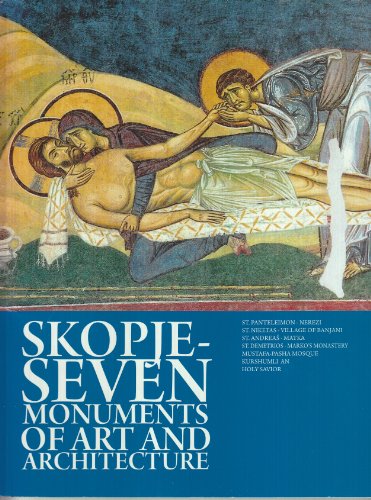 | Paperback:
Pages
(2010)
Asin: B003V4HMIA Canada | United Kingdom | Germany | France | Japan |
| 8. Modern and contemporary Macedonia: History, economy, society, culture | |
| Unknown Binding:
Pages
(1993)
Isbn: 9602607246 Canada | United Kingdom | Germany | France | Japan | |
| 9. Modern and contemporary Macedonia: History, economy, society, culture | |
| Unknown Binding:
Pages
(1993)
Isbn: 9602607254 Canada | United Kingdom | Germany | France | Japan | |
| 10. Treasures of Ancient Macedonia: [catalogue of the exhibition organized by the] Ministry of Culture and Science, General Direction of Antiquities and Restoration [at the] Archaeological Museum of Thess by Greece | |
| Unknown Binding:
Pages
(1978)
Asin: B0046KU3KM Canada | United Kingdom | Germany | France | Japan | |
| 11. A HISTORY OF MACEDONIA. Volume V in Hellenistic Culture and Society. by R. Malcolm. Translated by Catherine Errington. ERRINGTON | |
| Hardcover:
Pages
(1990)
Asin: B0012KM032 Canada | United Kingdom | Germany | France | Japan | |
| 12. The Macedonian national culture in the Pirin part of Macedonia (Macedonian heritage collection) by Pero Korobar | |
| Unknown Binding: 97
Pages
(1987)
Asin: B0000EBHQG Canada | United Kingdom | Germany | France | Japan | |
| 13. Hegemony to Empire: The Development of the Roman Imperium in the East from 148 to 62 b.c (Hellenistic Culture and Society) by Robert Kallet-Marx | |
 | Hardcover: 428
Pages
(1996-04-01)
list price: US$65.00 -- used & new: US$649.67 (price subject to change: see help) Asin: 0520080750 Canada | United Kingdom | Germany | France | Japan |
|
Editorial Review Product Description | |
| 14. Athens and Macedon: Attic Letter-Cutters of 300 to 229 B.C. (Hellenistic Culture and Society) by Stephen V. Tracy | |
 | Hardcover: 232
Pages
(2003-08-04)
list price: US$75.00 -- used & new: US$35.00 (price subject to change: see help) Asin: 0520233336 Canada | United Kingdom | Germany | France | Japan |
|
Editorial Review Product Description | |
| 15. Bright Balkan Morning: Romani Lives and the Power of Music in Greek Macedonia by Charles Keil, Angeliki Vellou Keil | |
 | Paperback: 352
Pages
(2002-12-09)
list price: US$39.95 -- used & new: US$21.00 (price subject to change: see help) Asin: 0819564885 Average Customer Review:
Canada | United Kingdom | Germany | France | Japan |
|
Editorial Review Product Description Customer Reviews (5)
What is especially interesting to me is the authors' view of how multi-ethnic society works in Greek Macedonia as compared to Bulgaria or Former Yugoslavia, and how the strategy of Roma musicians is different in these different countries. In Greek Macedonia the musicians play the music of all ethnic groups in order to maximize their flexibility and income. During multi-ethnic celebrations the musicians follow a strict policy of playing everyone's requests in the order requested, so that no one feels that they have priority. There is a fascinating description of an ethnically mixed wedding where the families have to adjust their various wedding traditions to accommodate each other, making it up as they go along to some extent. The authors compare and contrast this with the approach taken by Roma musicians in other areas of the Balkans. In Kosovo in the 1980s the Roma musicians are said to have purposely selected music from traditions from other than Serbian and Albanian in order to avoid conflicts. In Bulgaria the wedding band tradition is described as leading to a new pan-Balkan "fusion" style which borrows from many cultures but still feels Bulgarian. Ultimately the motivation behind each strategy is the need of musicians to make a living. The book is interesting reading from a North American perspective as well.Keil contrasts the multi-ethnic consciousness of Greeks, where the same person may have several types of ethnic and national identities simultaneously, with the concept of "multiculturalism" which he describes as slices of a pizza in which there are lots of ethnicities but everyone is either one thing or another. This raise the question of what is really going on in such immigrant nations as Canada and the United States. The accompanying CD is a potpourri of sounds, including music of various types, and there is a section of the book describing the contents of the CD. Some of the track titles are Market Day in Jumaya, Afternoon at a Mahala Café, At Home in the Mahala, New Year's Party in Serres, Taverna Party at Nikisiani.The combination of the text, the many high quality black and white photos and the soundscape are successful in putting you into the experience, as much as this is possible. There was also a nice balance between Angeliki Keil's straight-forward and very readable reporting of the lives of the musicians and Charles Keil's more theoretical musings about ethnicity, the music and the role of the musicians. My only complaint about the book is its weight - it's printed on very heavy, glossy stock, no doubt adding to the quality of photographic reproductions, but it is so big and heavy that you pretty well have to read it sitting up.An alternate title could be, "Your Big Fat Roma Music Book."
That in itself is a rich and satisfying experience.But don't stop there.Read the text! It tells of Roma (aka Gypsy) musicians who have cornered the market on live music in polyglot Greek Macedonia.While they are at the bottom of the social order, anyone who wishes a proper wedding, festival, or party of any kind hires these musicians. The musicians generally perform in trios, one playing a bass drum while the other two play the zurna - a double-reed woodwind found throughout Eurasia and Africa. Their repertoire is drawn from the peoples who live in the area, or passed through at one time, and is sometimes more Oriental, sometimes more European - whatever the customer wants. Keil and Keil give detailed accounts of several performances - a baptism, a wedding, and a saint's day festival - tell the life stories of a dozen or so musicians & family, and recount the broad history of the Roma in the Mediterranean as well as presenting a more focused account of their sojourn in Greek Macedonia.Blau's photographs range from intimate portraits, to dancers in full party whirl, through street scenes jumbled or measured, to serene landscapes.Some of his shots are so strikingly composed - the cover image, for example - that the effect is both subjective (Blau's aesthetic) and objective (we're looking at things, out there, in the world).Steven Feld's soundscapes give us the living flow of sound. Not only do we hear the twin zurnas flying through drum rhythms, but dancing feet, shouts of joy and exertion, motors churning, sheep braying, and Stevie Wonder piped in through a tinny sound system. Bright Balkan Morning is a milestone.See it, hear it, read it.Take pleasure in it.
I urge you to buy this book.I say so as someone who almost never reads anything published by an academic press.I am definitely not an anthropologist or a social scientist of any kind.What I know about the raw and the cooked doesn't get very far beyond my kitchen, but I couldn't put BRIGHT BALKAN MORNING down.This book ought to be that rare thing:an academic book with popular appeal. The easiest way into the riches of BRIGHT BALKAN MORNING are Blau's black-and-white photographs of the Romani playing their instruments for weddings, wrestling matches, and the little parades that apparently form wherever they go.When the dances started up, I have a feeling that Blau joined in, for these pictures just pulled me along.I could smell the perfume in the grandmother's handkerchief as she held it out to Blau and, through him, to me, as we all danced together.I could see the textures of the road when I took my place in the wedding parade; I could almost hear the sound of the zurna (a kind of outdoor oboe) being played in my ear. Of course Steven Feld's CD brings the actual sounds to life.The CD begins oh so slyly by introducing Romani music emerging from the ambient sounds of twentieth-century Macedonia.The Romani are, if nothing else, great survivors of history's cultural wars, and you can hear so many diverse musical strains-from the Muslim to the techno pop.Eerily enough, the rhythm of the dauli (a two-headed bass drum) being played sounds exactly like the bass-drum pounding at a high-school football pep rally. I wasn't as happy with the book's writing style, but then the authors seem to be wrestling with shaping this heartfelt information of theirs into all the requirements of academic publishing, and that struggle oddly mirrors the lives of the Romani.This sometimes awkward prose becomes just one more instance of the dance the Romani inspire everywhere they go as they blend in and out of the moment's culture. --R. M. Ryan | |
| 16. Studies in Macedonian Language, Literature and Culture: Proceedings of the First North American-Macedonian Cstudies Ann Arbor, 1991 (Michigan Slavic Materials) by North American-Macedonian Conference on Macedonian Studies 1991 Ann a, Benjamin A. Stolz | |
| Paperback: 276
Pages
(1995-09)
list price: US$22.00 Isbn: 093004276X Canada | United Kingdom | Germany | France | Japan | |
| 17. Your Woman in Skopje: Letters from Macedonia, 1995-1999 by Dianna M. Porter | |
 | Hardcover: 216
Pages
(2001-05)
list price: US$31.99 -- used & new: US$26.82 (price subject to change: see help) Asin: 0738865737 Canada | United Kingdom | Germany | France | Japan |
| 18. Byzantine Museums in Macedonia (Greece): White Tower of Thessaloniki, Museum of Byzantine Culture, Byzantine Museum of Komotini | |
 | Paperback: 20
Pages
(2010-09-15)
list price: US$14.14 -- used & new: US$14.13 (price subject to change: see help) Asin: 1158926448 Canada | United Kingdom | Germany | France | Japan |
|
Editorial Review Product Description | |
| 19. Treasures of Ancient Macedonia: [catalogue of the exhibition organized by the] Ministry of Culture and Science, General Direction of Antiquities and Restoration ... Archaeological Museum of Thessalonike [1978] by Greece | |
| Unknown Binding: 62
Pages
(1978)
Asin: B0000E9W69 Canada | United Kingdom | Germany | France | Japan | |
| 20. Man from Macedonia: my life of service, struggle, faith, and hope by Rev. Aaron Johnson with Deb Cleveland | |
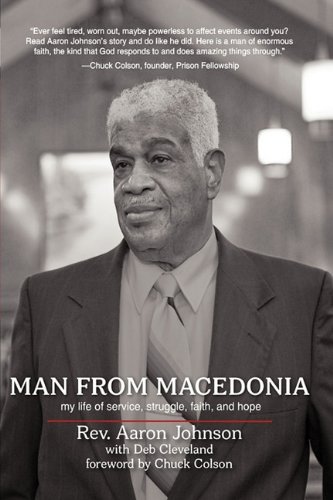 | Hardcover: 272
Pages
(2010-02-08)
list price: US$35.95 -- used & new: US$23.44 (price subject to change: see help) Asin: 1449700306 Average Customer Review:
Canada | United Kingdom | Germany | France | Japan |
|
Editorial Review Product Description Customer Reviews (5)
| |
| 1-20 of 24 | Next 20 |