e99 Online Shopping Mall

Geometry.Net - the online learning center Help  
Home  - Basic J - Japanese Mythology (Books)

  Back | 21-40 of 100 | Next 20
A  B  C  D  E  F  G  H  I  J  K  L  M  N  O  P  Q  R  S  T  U  V  W  X  Y  Z  

click price to see details     click image to enlarge     click link to go to the store

 
$75.00
21. Japanese Historians and the National
$70.00
22. The Emergence of Japanese Kingship
 
23. Tales of the Supernatural in Early
 
$13.96
24. The Japanese Psyche: Major Motifs
 
25. The sacred scriptures of the Japanese,:
 
$49.00
26. The Wisdom of American Indian
 
27. Even Monkeys Fall from Trees and
 
28. Rethinking Sorrow: Revelatory
 
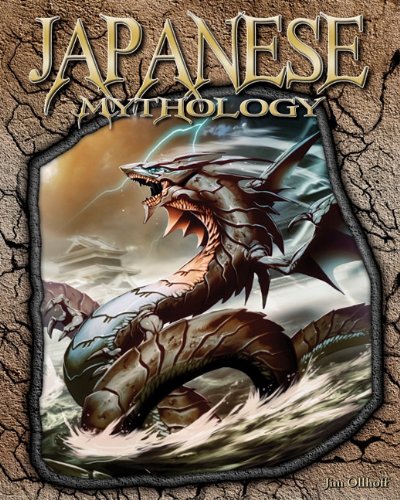
29. Japanese Mythology
 
30. Chinese [mythology] Japanese [mythology]
 
31. Smithsonian Report - 1891; National
 
32. Japanese Mythology
 
33. Japanese Mythology
 
34. Japanese Mythology
 
35. Chinese mythology, (Mythology
 
36. The old Japanese myths and traditions
 
37. The language, mythology, and geographical
 
38. Mythological Japan or the Symbolisms
 
39. The Yanagita Kunio Guide to the
 
40. Murder in Japan: Japanese Stories

21. Japanese Historians and the National Myths, 1600-1945: The Age of the Gods and Emperor Jinmu
by John S. Brownlee
 Hardcover: 256 Pages (1998-01)
list price: US$75.00 -- used & new: US$75.00
(price subject to change: see help)
Asin: 0774806443
Canada | United Kingdom | Germany | France | Japan

22. The Emergence of Japanese Kingship
by Joan Piggott
Hardcover: 436 Pages (1997-08-01)
list price: US$70.00 -- used & new: US$70.00
(price subject to change: see help)
Asin: 0804728321
Average Customer Review: 5.0 out of 5 stars
Canada | United Kingdom | Germany | France | Japan
Editorial Review

Book Description

This is the first comprehensive study of the sources and nature of classical Japanese kingship and state formation. To draw new insights from the rich body of extant documents and artifacts from early Japan, the author employs the analytical tools of recent Western historiography and anthropology, constructing an “archeology of kingship” that begins by exposing the roots of Japanese monarchy in third-century chieftaincy.

The book then traces sovereignty and polity through a series of temporal cross sections, analogous to an archaeologist’s trenches, to reveal artifacts from seven historical epochs, including an array of chieftains, kings, and sovereigns variously styled as Son of Heaven, Polestar Monarch, and Heavenly Sovereign. These sacral and increasingly courtly rulers (both men and women) first presided over confederate chieftaincies, then expansive coalescent polities, and eventually the archipelago’s earliest state formation, Nihon.

The book culminates in an account of the reign of the mid-eighth-century monarch Shomu, who represented the zenith of classical Japanese kingship and was supported by a bureaucracy of more than 7,000 people. Shomu’s opulent Chinese-style palace and the unprecedented, monumental Temple of the Great Buddha at Todaiji were replicated in smaller scale by provincial headquarters and temples, all of which functioned as ritual stages for articulating Shomu’s cultural hegemony. Although the forms of classical Japanese kingship—court, fisc, dynasty, and realm—continued to develop in subsequent centuries, all assumed their basic form in the age of Shomu.

The author has sought to counter the ahistoricity that characterizes much scholarship concerning early Japanese kingship and to broaden the geographical and disciplinary contexts within which Japanese kingship has been examined. As long as evidence was limited to certain myth-histories compiled in the eighth century, which traced the rule of Heavenly Sovereigns and their realm of Nihon back to prehistory, ahistoricity was inevitable. The author suggests that only when such narratives are reread in the light of evidence from archaeology, continental history, and comparative ethnohistorical research can new scenarios be formulated to trace the emergence of paramount rule.

... Read more

Customer Reviews (2)

5-0 out of 5 stars Excellent work on earliest royal history
Joan Piggots' scholarship is excellent. Pulling from a wide array of sources, covering everything from shipping tags attached to merchandise delivered in payment of tribute to the quasi-legendary early chronicles, to written works of law, literature, and religion, archaelogical artefacts and tomb burials, as well as previous works of historical scholarship, she presents an exhaustive and authoritative analysis of a frequently overlooked period in Japanese history, the 3rd through 8th centuries.

Piggott's work focuses on the emergence of the nascent Japanese nation-state, from its indigenous roots with a tennou ('sovereign' ) who was a chief among clans to its period of heavy Chinese borrowing and transformation into a 'modern' (for the era) nation headed up by a Chinese-style Emperor. Adopting a metaphor of archaeological trenches, she describes and analyzes seven major periods of development, discusses the various problems associated with research in that particular period, the known information, and conflicting points of view, while cogently and persuasively arguing her own viewpoint.

Her historical scholarship is impeccable and her writing style is clear and readable -- a great boon to anyone who has wrestled with some of the more obscure writings on the same topic. In short, she makes a significant addition to body of knowledge in the English language regarding a little known era of Japanese history.

5-0 out of 5 stars Excellent
It is rare to find a work that is both good history and well written; Piggot's examination of the emergence of kingship in a country where 'the gods have not yet died' is an important expansion of our understanding of archaic Japan in particular and sacral kingship in general. ... Read more


23. Tales of the Supernatural in Early Modern Japan: Kaidan, Akinari, Ugetsu Monogatari (Japanese Studies, 16)
by Noriko T. Reider
 Hardcover: 204 Pages (2002-08)
list price: US$99.95
Isbn: 0773470956
Canada | United Kingdom | Germany | France | Japan

24. The Japanese Psyche: Major Motifs in the Fairy Tales of Japan
by Hayao Kawai
 Paperback: 234 Pages (1996-11)
list price: US$22.00 -- used & new: US$13.96
(price subject to change: see help)
Asin: 0882143689
Average Customer Review: 5.0 out of 5 stars
Canada | United Kingdom | Germany | France | Japan
Editorial Review

Book Description
This book examines the haunting, sad, and lovely depths of the Japanese soul by studying their idiosyncratic figures: terrible women who eat people, obscene escapes from the Oni monsters, brother-sister bonds, undersea dragon palaces, movements between "worlds". We learn why so few tales end in a "happily-ever-after" marriage, and why the female figure best represents the culture's ego and possible future.

Prof. Kawai, the first Jungian analyst in Japan, has received many honors including distinguished literary prizes for this book. He now holds a most senior position in the Ministry of Culture. ... Read more

Customer Reviews (2)

5-0 out of 5 stars Exploring the Japanese people through Fairy Tales
Much of a culture's beliefs and character are expressed in its fairy tales.They are the stories everyone learns from childhood, and the motifs teach children society's moral code in easily understandable and enjoyable parables.We can all remember the legends, the handsome princes and beautiful princess, the monsters and heroes.

For most Westerners, Japan's fairy tales, called mukashibanashi or "Tales of Long Ago", are entirely perplexing.They don't end the way we think they should, the morals are not easy to understand, and the characters behave in a bizarre fashion.Often, the moral of the story seems to be "don't look in the box".In fact, "don't look in the box" is the first theme discussed in Hayao Kawai's "The Japanese Psyche: Major Motifs in the Fairy Tales from Japan".

All in all there are nine individual themes in Japanese fairy tales identified by Kawai.For each one, she discusses the ramifications of the theme, and presents several stories that exemplify the theme.The themes are along the lines of "The Laughter of an Oni" and "The Woman of Endurance", using exploring an archetypal and reoccurring character of myth.

She often compares them with Western fairy tales, especially the rarity of a Japanese fairy tale ending with a wedding, as so many Western tales do.It is also interesting how the majority of major characters in Japanese fairy tales are women, with men playing a smaller role.This is a great contrast to Japanese society itself, and is an interesting topic of discussion.

This is a serious academic study, including graphs and charts, and isn't really a good book if you just want to read some cool fairy tales.It is an excellent resource, however, for thoselooking to explore Japanese fairy tales on a deeper level.I am very happy that this book was translated.

5-0 out of 5 stars Intelligent, thoughtful critique of Japanese fairy tale archetypes
This translation, introduced by poet Gary Snyder, offers fantastic insights into Japanese culture as informed by Japanese myth and fairy tale. Ferociously intelligent, Hayao Kawai discusses the impact of ancient religion and the female-centered nature of many Japanese tales - figures such as the disappearing woman, the changeling wife, and the self-sacrificing older sister - will intrigue anyone who has wished to understand the phenomenon of strong female-centric anime or Manga, for instance, in a culture that has often been described as opressively patriarchal by those outside looking in. Also includes several translated versions of hard-to-find Japanese fairy tales. ... Read more


25. The sacred scriptures of the Japanese,: With all authoritative variants, chronologically arranged, setting forth the narrative of the creation of the cosmos, ... the rule of the world unto ages eternal
by Post Wheeler
 Unknown Binding: 562 Pages (1952)

Asin: B0007DUP5K
Average Customer Review: 5.0 out of 5 stars
Canada | United Kingdom | Germany | France | Japan

Customer Reviews (1)

5-0 out of 5 stars A very conscientious author
This work constitutes, by and large, the only complete and critical presentation of the sacred myths of the Shinto. In this book, Dr. Post Wheeler gives an accurate and complete translation of the two basic religious texts of the Japanese, the Kojiki and the Nihongi. This tremendous task was not only one of collection and translation - but of weaving all existing fragments together so that they could constitute a coherent Narrative, and as far as possible a chronological one. The Narrative is the whole story without adaptation or expurgation.
In plain and simple language, supplementary to the Narrative, Dr. Wheeler traces the projection into modern times of the claim of the "Heavenly Descent"; offers a condensed discussion of the various manuscripts that make up the Scriptures; an outline Argument of the complete myth-story whose various scenes alternate between the Sky, the Earth and the Under-World; a "Kami-list" of all Deities and Personages that figure in the story, with page references that link them to their proper episodes; and a detailed Analysis of the Narrative. 562pp. ... Read more


26. The Wisdom of American Indian Mythology
by John J. Ollivier
 Paperback: 272 Pages (1995-05)
list price: US$17.95 -- used & new: US$49.00
(price subject to change: see help)
Asin: 1560870494
Average Customer Review: 5.0 out of 5 stars
Canada | United Kingdom | Germany | France | Japan

Customer Reviews (1)

5-0 out of 5 stars superb
Finally, a book about Indian myths that I can understand!!! ... Read more


27. Even Monkeys Fall from Trees and Other Japanese Proverbs
 Hardcover: 226 Pages (1987-06)
list price: US$11.95
Isbn: 0804815267
Average Customer Review: 4.0 out of 5 stars
Canada | United Kingdom | Germany | France | Japan

Customer Reviews (4)

2-0 out of 5 stars not useful
I live in Japan and I am here to tell you that these proverbs are rarer than an uncooked steak. 80% of the proverbs my Japanese friends have never heard of, and the rest they are not sure what the proverbs actual mean. My advice is master the easier Japanese first!

5-0 out of 5 stars Another Opinion
I just finished going through this book, and I enjoyed it very much. Today I read the other reviews, and I can understand their opinions, but think another perspective should be added. I'm sure my Japanese is not nearly as good as the other reviewer, and I don't live in Japan. Still, here is my opinion.

Translations are difficult in any language. Working on some very simple translations I found them most challenging. For example, the word Kobunboku I translated as Plum Blossom. If you translate the Kanji singularly and literally it would be Nice Prefered Wood. But if you understand the symbolic compounds it reads "The famous tree of Chinese literature" the flower of peace, the plum blossom. Most Japanese people would not recognize this literary compound. In reality no translation is perfect. In the version of one of these proverbs I have: "Fallen blossoms don't return to the branch. . ." It includes: "There is no sense in crying over spilt milk."

As far as testing them on Japanese friends, and average Japanese people having not heard them. . .would this be less common with English idioms? The South has many idioms people in the North have never heard. "He's drunker than Cooter Brown" "Penny wise, Pound foolish" I never heard till I was 40.

I would add I don't think it is a good idea to try and use these proverbs to impress Japanese speakers. Contrivance is rarely respected.

I greatly appreciated the author including the Kanji, Romanji, Hiragana, and English, and I think the book is helpful and a lot of fun to read with some nice thoughts to reflect on their wisdom.

PS: The title "IS" Even Monkeys Fall From Trees :)

3-0 out of 5 stars Not sure about this one...
I'd like to point out before I get into the meat of this review that I am not out to give the writer, sorry "compiler" a damn good ragging, but I am not at all sure this book is as good as you may have been led to believe by the reviewer before me. OK, first, the positive points. There are many well known proverbs in this book that will be useful to anyone who is interested and each proverb is illustrated by a cartoon. So far, so good.However, I have found that a couple of these proverbs are unknown to my Japanese collegues who doubt their authenticity. For example, one of the proverbs that I liked when I first saw it is "Ke bukai mono wa iro bukai". The translation being "A hairy thing is a sexy thing". Well, if you know anything about Japanese culture and attitudes and believe me, I do! I work and live in Japan and I speak Japanese and know a lot of Japanese people, then you will know that body hair is considered to be dirty and repulsive. So how can there be a proverb like that? It stands to reason! Another example of an "unknown" proverb is "He o hitte shiri tsubome" which is supposedly a Japanese version of "It's no use closing the stable doors after the horse has bolted". The Japanese version translates as "It's no use scrunching up you buttocks after you have farted". This is more or less how it is translated in the book. It is an appropriate image, however no one has heard of that either! It is a proverb I like to use from time tio time in English but when I tested out the Japanese equivalent amongst friends, they just thought I was being rude. In fact the word "he" is a coarse word to use in Japanese. "Onara" is more aceptable, well, about as acceptable as talking about farts can be!!! When I have to explain a Japanese proverb to a Japanese person, I can only conclude that the proverb is erroneous to start with. I don't think this is a reliable book. If you get it then check out which proverbs are authentic with a native speaker so you don't end up looking stupid or intentionally rude.

5-0 out of 5 stars Domo arigato, David-san.
An uncle of mine passed away when I was only about ten. We were very close- even today, my mother and my aunts and uncles tell me how much I remind them of him. Two things immediately pop into mind when I remember my Uncle John- first, he was something of an oddball. And second, he had a passion for languages. Uncle John could speak just about any language you could name. He was particularly fond of Japanese, and I remember him reading to me from "Even Monkeys Fall From Trees." When he passed away, I inherited his copy, and it is to this day my most treasured possession.

What of the book, then? It is really quite simple- it is a collection of 100 Japanese sayings, written both in phonetic Japanese and with an English equivalent (Example- moshi wa moshiya- "for rice cakes, go to the rice cake maker"). Opposite each proverb is a full-page illustration, with the proverb written in Japanese calligraphy. A short preface by the author is included on the significance of the proverbs in Japanese culture, and a short appendix is also included which attempts to find an equivalent adage from our culture for each proverb.

This book is a rich source of inspiration, and I have continually found new meaning in the sayings contained within. The simplicity of its design affords a certain elegance, as it presents the proverbs in a manner which stimulates the reader to find his own wisdom in them. The illustrations are clever and appropriate, and yet do not force a specific interpretation.

This book would make a fine gift for anybody, especially a child, as it is the rare sort of book that one does not merely read, but rather grows with, like a close friend. Whether you're looking for an interesting way to learn some new Japanese, or merely searching for insight, BUY THIS BOOK. ... Read more


28. Rethinking Sorrow: Revelatory Tales of Late Medieval Japan (Michigan Monograph Series in Japanese Studies)
by Margaret Helen Childs
 Hardcover: 181 Pages (1991-10)
list price: US$27.95
Isbn: 0939512424
Canada | United Kingdom | Germany | France | Japan

29. Japanese Mythology
 Hardcover: Pages (1998-11-20)

Isbn: 7215975622
Canada | United Kingdom | Germany | France | Japan

30. Chinese [mythology] Japanese [mythology] (The Mythology of all races)
by John Calvin Ferguson
 Unknown Binding: 416 Pages (1964)

Asin: B0006AYUPA
Average Customer Review: 5.0 out of 5 stars
Canada | United Kingdom | Germany | France | Japan

Customer Reviews (1)

5-0 out of 5 stars An amazing collection of mythology
I suppose that some of the work in this book, one of a 13 volume set written between 1916 and 1932 (reprinted in the 1960s), has been changed by more recent scholarship, but there is still nothing to equal this fantastic achievement. The set includes not only the more familiar myths such as Greek and Roman, but pretty well succeeds in its goal to include all of humanity. The text is extremely detailed but very readable; none of the turgid prose so often associated with academia. The volumes contain numerous illustrations, both in the text and as plates (mostly black & white.)

One of the most useful parts of the set is the final volume, an extremely detailed index, which allows the reader to pursue a theme, or even a topic as specific as the significance of belts, across all the volumes.The individual volumes do not have their own indices, but the tables of contents are fairly detailed.The books appear to have been issued without dust jackets.

The 1964 reprint, and I suppose the older printing of this volume, has 61 text illustrations, 54 plate illustrations (3 in color), a map and an index of Chinese terms.

In the interest of fairness, I want to reveal that I am selling some volumes, but only because I got the extremely rare opportunity to buy a complete set, making these redundant

... Read more


31. Smithsonian Report - 1891; National Museum, Kilimanjaro, Shintoism, Japanese Mythology, Japan,
 Hardcover: Pages (1892)

Asin: B000H98NGM
Canada | United Kingdom | Germany | France | Japan

32. Japanese Mythology
by Proinsias Mac Cana
 Hardcover: Pages (1988-06)
list price: US$14.98
Isbn: 9993702455
Average Customer Review: 5.0 out of 5 stars
Canada | United Kingdom | Germany | France | Japan

Customer Reviews (1)

5-0 out of 5 stars Japanese Mythologyand Archaeology
I am Japanese Archaeologist living in London. I need a help from someone who give me a advice and guide line how to publish in US my book(or article)about relationship between japanese mythology and archaeology. It means how to get a proof of certain japanese mythology(mostly shinto related) through archaeological excavation hard evidence. Please contact me if you think that you can help me in this matter. Kazuomy e-mail isSarEngland7@aol.com ... Read more


33. Japanese Mythology
by Juliet Piggott
 Hardcover: Pages (1975)

Asin: B000TZI74C
Canada | United Kingdom | Germany | France | Japan

34. Japanese Mythology
by Julie Piggott
 Hardcover: Pages (1984)

Asin: B000UCYPLI
Canada | United Kingdom | Germany | France | Japan

35. Chinese mythology, (Mythology of all races)
by John Calvin Ferguson
 Unknown Binding: 416 Pages (1937)

Asin: B0008CB2XE
Average Customer Review: 5.0 out of 5 stars
Canada | United Kingdom | Germany | France | Japan

Customer Reviews (1)

5-0 out of 5 stars An amazing collection of mythology
I suppose that some of the work in this book, one of a 13 volume set written between 1916 and 1932 (reprinted in the 1960s), has been changed by more recent scholarship, but there is still nothing to equal this fantastic achievement. The set includes not only the more familiar myths such as Greek and Roman, but pretty well succeeds in its goal to include all of humanity. The text is extremely detailed but very readable; none of the turgid prose so often associated with academia. The volumes contain numerous illustrations, both in the text and as plates (mostly black & white.)

One of the most useful parts of the set is the final volume, an extremely detailed index, which allows the reader to pursue a theme, or even a topic as specific as the significance of belts, across all the volumes.The individual volumes do not have their own indices, but the tables of contents are fairly detailed.The books appear to have been issued without dust jackets.

The 1964 reprint, and I suppose the older printing of this volume, has 61 text illustrations, 54 plate illustrations (3 in color), a map and an index of Chinese terms.

In the interest of fairness, I want to reveal that I am selling some volumes, but only because I got the extremely rare opportunity to buy a complete set, making these redundant

... Read more


36. The old Japanese myths and traditions
by Kōchi Doi
 Unknown Binding: Pages (1938)

Asin: B000885RRA
Canada | United Kingdom | Germany | France | Japan

37. The language, mythology, and geographical nomenclature of Japan viewed in the light of Aino studies: Including "An Ainu grammar" (Memoirs of the Literature College, Imperial University of Japan)
by Basil Hall Chamberlain
 Unknown Binding: 174 Pages (1887)

Asin: B000881L5M
Canada | United Kingdom | Germany | France | Japan

38. Mythological Japan or the Symbolisms of Mythology in Relation to Japanese Art. With Illistrations, Drawn in Japan By Native Artists .
by Alexander F.; Holbrook, Theodore S. Otto
 Hardcover: Pages (1902)

Asin: B000UPNPES
Canada | United Kingdom | Germany | France | Japan

39. The Yanagita Kunio Guide to the Japanese Folk Tale
 Hardcover: 363 Pages (1986-05)
list price: US$31.50
Isbn: 025336812X
Canada | United Kingdom | Germany | France | Japan

40. Murder in Japan: Japanese Stories of Crime and Detection
by John L. Apostolou
 Hardcover: 224 Pages (1987-06)
list price: US$15.95
Isbn: 0934878870
Canada | United Kingdom | Germany | France | Japan

  Back | 21-40 of 100 | Next 20
A  B  C  D  E  F  G  H  I  J  K  L  M  N  O  P  Q  R  S  T  U  V  W  X  Y  Z  

Prices listed on this site are subject to change without notice.
Questions on ordering or shipping? click here for help.

site stats