e99 Online Shopping Mall

Geometry.Net - the online learning center Help  
Home  - Basic E - Economic History (Books)

  1-20 of 100 | Next 20
A  B  C  D  E  F  G  H  I  J  K  L  M  N  O  P  Q  R  S  T  U  V  W  X  Y  Z  

click price to see details     click image to enlarge     click link to go to the store

$44.30
1. A New Economic View of American
$72.04
2. American Economic History (7th
$64.98
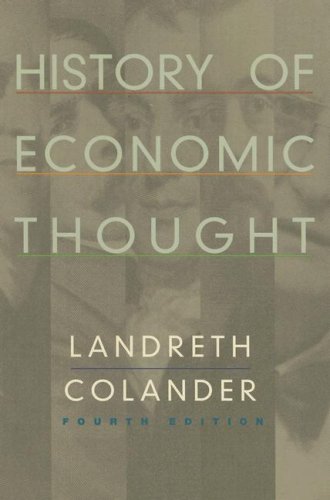
3. History Of Economic Thought
$13.23
4. The Secret History of the American
$27.15
5. The Economic History of Latin
$53.36
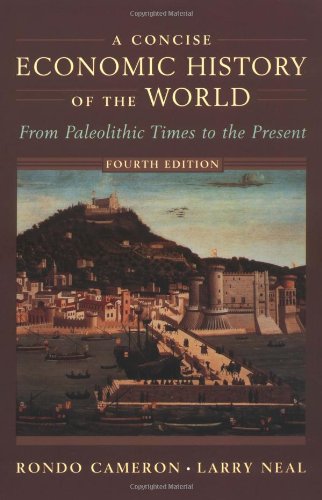
6. A Concise Economic History of
$15.00
7. Structure and Change in Economic
$34.95
8. General Economic History
$17.00
9. Economics and World History: Myths
$49.50
10. An Austrian Perspective on the
$33.00
11. A Companion to the History of
$29.15
12. The Economics of World War II
$19.97
13. An Economic History of the United
$18.43
14. A Farewell to Alms: A Brief Economic
$19.14
15. Castles, Battles, and Bombs: How
$28.00
16. A Brief History of Economics:
$34.50
17. An Economic and Social History
 
18. The Cambridge Economic History
$46.96
19. Ireland: A New Economic History,
$65.00
20. A History of Economic Theory and

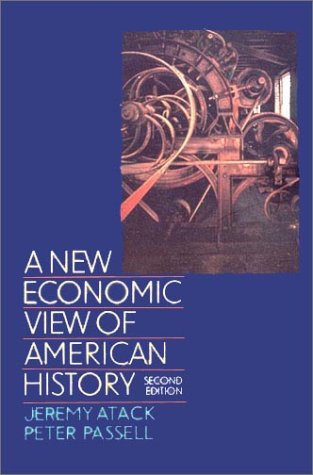
1. A New Economic View of American History: From Colonial Times to 1940
by Jeremy Atack, Peter Passell, Susan Lee
Paperback: 714 Pages (1994-10)
list price: US$52.90 -- used & new: US$44.30
(price subject to change: see help)
Asin: 0393963152
Average Customer Review: 5.0 out of 5 stars
Canada | United Kingdom | Germany | France | Japan

Customer Reviews (3)

5-0 out of 5 stars American History through an Economic Filter!
If you ever wanted to understand U.S. history on an economic basis, this is the book to read.

It's beautifully written with extensive economic analysis of various aspects and subjects covering U.S. history from the profitability of slavery to continous increasing of the standards of living.

The authors make some striking discoveries (for example, half of all farms in the south had no slaves at all, and yet managed to be as efficient as many which did have slaves) about productivity in the U.S. as new technologies and, in essence, a new economy evolved. The impact improvements in roads had on the economic development of the country is wonderfully detailed.

The author includes multiple tables and detailed explanations as to how they reached their conclusions.

All in all, an excellent book on U.S. history for economic professionals and/or buffs!

5-0 out of 5 stars If You're Choosing Only One ...
Let me speak here in law teacher mode: if you wanted to read just one book as background for law school, I think perhaps this should be the one. It's a model in terms both of substance and of presentation. In substance, the authors have done an admirable job of summing up the best available knowledge about the economy and how it came to be. In presentation, what they've done is to take an array of technical or specialized studies and to make them accessible to the determined non-specialist.

I remember it in terms of so many wonderful anecdotes. There are the farm girls from Vermont who staffed the mills in Massachusetts until the great Irish immigration drove them back to the farm. There are the restless young men from the prairies who rode the rafts down river to New Orleans, and then set off to see the world. There are the canals that lost all their capital value with the coming of the railroads - but then kept operating anyway, because it was more worthwhile to use them than to tear them up.

This is not, of course, precisely a law book. But it is a book about issues for the law: about slavery, about public land policy, about the structure of industry and finance. The chapters on the Great Depression alone would make a sufficient background for any course in constitutional or administrative law.For the authors, only two words: new edition.

5-0 out of 5 stars Exceptional!
This is an incredible introduction to economic history.It is clearly written, and it is easy for the non-economist to read and enjoy.If you have any interest in economic history, then this is a must read. ... Read more


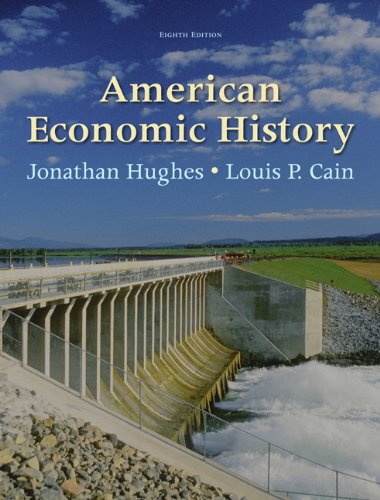
2. American Economic History (7th Edition) (Addison-Wesley Series in Economics)
by Jonathan Hughes, Louis P. Cain
Hardcover: 688 Pages (2006-07-08)
list price: US$145.33 -- used & new: US$72.04
(price subject to change: see help)
Asin: 0321278895
Average Customer Review: 4.5 out of 5 stars
Canada | United Kingdom | Germany | France | Japan

Customer Reviews (2)

5-0 out of 5 stars Among the best you can get in economic history
This is a wonderful textbook for anyone looking to teach a course on economic history of the United States. For just general reading I would recommend Gordon's An Empire of Wealth but for others looking to teach or do an independent study this is a must. It clearly lays out all the developments in our economy very carefully and does a wonderful job of discussing current and relevant literature so you can specialize in the areas that you wish to look at further.

4-0 out of 5 stars Explorations inAmerican Economic History
American Economic History is a challenging, extensive, and complete economic history of the United States from the establishment of the Jamestown settlement to modern economic issues and trends.Hughes and Cain give an overview appropriate to the college upper classman or graduate student.The book does a particularly fine job of discussing and analyzing the slavery question that, for the most part, led to the Civil War and the various causes, such as the Stock Market Crash of 1929, that led to the Great Depression. The authors survey the various strains of thought on most of the central economic issues in American History: sometimes giving the most logical view(s) as based on the emperical evidence available to the economist-historian. In addition, to being, generally, well written and accurate, the text lends itself to a short or moderate length essay as a means of evaluation. ... Read more


3. History Of Economic Thought
by Harry Landreth, David C. Colander
Paperback: 511 Pages (2001-10-18)
list price: US$136.36 -- used & new: US$64.98
(price subject to change: see help)
Asin: 0618133941
Average Customer Review: 4.0 out of 5 stars
Canada | United Kingdom | Germany | France | Japan
Editorial Review

Book Description

An upper-level text, History of Economic Thought continues to offer a lively, accessible discussion of ideas that have shaped modern economics. The Fourth Edition has been thoroughly revised to reflect recent scholarship and research, as well as a more pointed focus on modern economic thought. The text remains a highly understandable and opinionated—but fair—presentation of the history of economic thought.

... Read more

Customer Reviews (4)

3-0 out of 5 stars Interesting but not for people new to economics
I am an engineering student with interest in economy, and thought such a book can give me a good introduction to the topic. However I would say this book is more for people comfortable with economics already. I have read almost a quarter of the book so far. I like the introduction where the authors are honest about their method and assumptions.
However I do not like that the authors are very free in expressing their personal opinion on things. I know history cannot be totally objective, but I still prefer authors to try to be so.
Another issue is that I think the language formulation is a bit complicated, the sentenes are long and seem confusing at times.
For beginners in economics, I would more recommend the book "Development of Economic Analysis" by Ingrid Hahne Rima; It gives more space for explaining various concepts, and I love the inclusion of parts of original works at the end of each section. Landreth's book can be a second stage, to get an insight into the reason for such economic development, rather than to learn about economics.

4-0 out of 5 stars Economics a Discipline of Many Theories
This text surveys the main streams of thought in economic theory.The survey provides an overview of the preclassical schools,i.e.: scholastics, mercantilists, and physiocrats.The scholastics and mercantilists called for govermental intervention in the growing market economy. The mercantilists, in England, went so far as to call for the regulation of trade. Albeit, the physiocrats in France held that the government should leave the market alone.Therefore, the physiocrates influenced and set the tone for Smith and many classical economists to come.
Modern classical economics considers Adam Smith as its father. Smith, a product of the U.K.'s traditions, examines economics in the context of the middle to late 1700s.In his seminal thesis ... The Wealth of Nations, professor Smith believed laissez faire, or nongovernmental intervention, would allow a competitive market to best promote the economic growth needed to meet the consumers' needs.
Landreth and Colander, further, discuss the classical economic theories of Thomas Malthus, David Ricardo, and John Stuart Mill. The former reverend,Malthus held population growth would outstrip the food supply. He failed to account for improvements in technology. Mr. Ricardo developed pure, or noncontextual, theories such as scarcity and diminishing returns. One note, Ricardo favored free trade while Malthus suggested tariffs could be beneficial to a nation. Mill, at one time a member of parliament, believed there were injustices inherent in a capitalist economy.
Also coveredby this text are the ideas of Karl Marx.Marx rejected the orthodox classical theories of capitalistic economies. He purported that "dialectical materialism", a theory of history, should be applied to analysis of the capitalist's economy.Moreover, Dr. Marx predicted a collapse of capitalism caused by class conflict.However, this generally has not occured.Paradoxically, for the scribbler most often associated with communism: Marx mainly discussed and analyzed capitalism.
The text goes into some detail about the neoclassical school as formulated by Menger, Jevons, Walras, and Marshall.Yet, the role of much neoclassical economics is overstated in the second edition of this work. Nevertheless, professor Alfred Marshall demonstrated the importance of both supply and demand in achieving dynamic equilibrium. Professor Marshall also warns against the excessive use of mathematics in economic calculus. He suggested to his students that economic models need to be practical so as to reflect reality.History of Economic Theory covers both the development of modern microeconomics and macroeconomics.As for the development of macroeconomics; John Maynard Keynes' theories are introduced quite methodically. In his 1936 book, The General Theory ..., Sir Keynes felt the unstable market needed governmental assistance to achieve full employment equilibrium. Keynes' ideas were used by President F.D. Roosevelt to help the United States out of its depression. Critical of Keynesian theory were the Monetarists led by Milton Friedman. Professor Friedman held the money supply plays a central role in the economy. In fact, Friedman said inflation is a monetary phenomenon. Finally, heterodoxical economists are covered.
Students who enjoy The Worldly Philosophers and New Ideas from Dead Economists will surely find this work useful and enlightening - - if only for the introduction on the history of economics as a profession!

5-0 out of 5 stars What everyone should know about economics
As a former student of Dr. Harry Landreth, I had the honor of learning economic theory under his expert tutelage.This book helps you appreciate and understand the theories and thinking that helped shape our world.A must for any serious student of economics; this book is hailed by academics as THE book on this subject, and I do not disagree.

5-0 out of 5 stars Excellent Text!
An excellent overview of the history of economic thought.I used this text in my course on the history of economic thought.I highly recommend it!The authors cover, in great detail, such critical items as thepreclassical areas of thought, mercantillism, Malthus, Marx, Ricardo, andthe transition to Neoclassicaleconomics.The discussion of the modernMicroeconomic Theory is also a must for any fan of economics. ... Read more


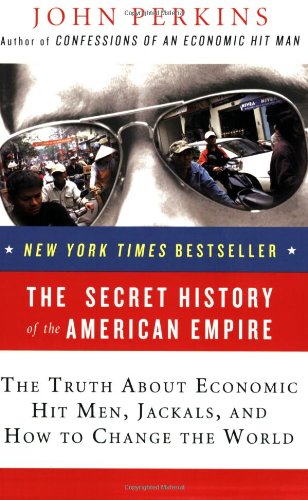
4. The Secret History of the American Empire: Economic Hit Men, Jackals, and the Truth about Global Corruption
by John Perkins
Hardcover: 384 Pages (2007-06-05)
list price: US$25.95 -- used & new: US$13.23
(price subject to change: see help)
Asin: 052595015X
Average Customer Review: 4.0 out of 5 stars
Canada | United Kingdom | Germany | France | Japan
Editorial Review

Book Description
A riveting exposé of international corruption—and what we can do about it, from the author of Confessions of an Economic Hit Man, which spent over a year on the New York Times bestseller list.

In his stunning memoir, Confessions of an Economic Hit Man, John Perkins detailed his former role as an “economic hit man” in the international corporate skullduggery of a de facto American Empire. This riveting, behind-the-scenes exposé unfolded like a cinematic blockbuster told through the eyes of a man who once helped shape that empire. Now, in The Secret History of the American Empire, Perkins zeroes in on hot spots around the world and, drawing on interviews with other hit men, jackals, reporters, and activists, examines the current geopolitical crisis. Instability is the norm: It’s clear that the world we’ve created is dangerous and no longer sustainable. How did we get here? Who’s responsible? What good have we done and at what cost? And what can we do to change things for the next generations? Addressing these questions and more, Perkins reveals the secret history behind the events that have created the American Empire, including:

• The current Latin-American revolution and its lessons for democracy
• How the “defeats” in Vietnam and Iraq benefited big business
• The role of Israel as “Fortress America” in the Middle East
• Tragic repercussions of the IMF’s “Asian Economic Collapse”
• U.S. blunders in Tibet, Congo, Lebanon, and Venezuela
• Jackal (CIA operatives) forays to assassinate democratic presidents

From the U.S. military in Iraq to infrastructure development in Indonesia, from Peace Corps volunteers in Africa to jackals in Venezuela, Perkins exposes a conspiracy of corruption that has fueled instability and anti-Americanism around the globe. Alarming yet hopeful, this book provides a compassionate plan to reimagine our world. ... Read more

Customer Reviews (44)

5-0 out of 5 stars SECRET HISTORY OF AMERICAN EMPIRE.CONFESSION OF ECONOMIC HITMAN
THIS IS A MUST READ FOR ALL.I RECOMMEND THIS BOOK TO ANYONE WHO WANTS A TRUE PICTURE OF AMERICAS INFLUENCE AROUND THE WORLD.

5-0 out of 5 stars What Every American Should Read
A REVEALING book that will stay with you long after you have finished reading it.Do NOT read this book unless you have read the author's first book, "Confessions of an Economic Hit Man."It is well-written in a personalized style which makes the content fully believeable.Every American should read this book.It will not make you comfortable and it may even stir you to ACTION.
Well, it should.

2-0 out of 5 stars An annoying read
The author shares some interesting anecdotes and has some interesting perspectives, gained from an unusual perch.However, the prose is very bulky and difficult to get through and the writer's voice is annoying, filled with over-generalizations and self-aggrandizement. The author credits himself with having been much more plugged into the power structure than he could possibly have been and credits himself with having more insight into the world than he likely has.

4-0 out of 5 stars Very interesting book raises a lot of questions
I found this book to be very enlightening, much like Perkins' previous book (which wasdownright shocking) and raises a lot of questions in my mind. How are they (the corporatocracy) able to keep the public in the dark so effectively? How do you keep the politicians in line? How do you orchestrate something like the invasion of Iraq, and keep dissent off the airwaves? Did any of you see "Donahue" before the war started, and how it was yanked from the airwaves? The excuse was "poor ratings" and "a difficult public face for NBC in the time of war", but it was the highest rated show on MSNBC. There is another a more "threatening" possibility also. I've always thought that the main purpose of the USA "Patriot Act" was NOT fighting terrorism (that's secondary), but rather giving the government the legal ability to keep massive amounts of information on every citizen (remember, it was basically the intelligence agencies' Xmas wish list, rewritten in the middle of the night before the vote, so no one voting on it had time to actually READ it.). And what info they can't legally obtain, they outsource to companies like Choicepoint. Remember J Edgar Hoover, what was the secret to his longevity? My educated guess is: dossiers. So many dossiers that no politician dared to cross him. Who would you guess to be his modern equivalent?
So this book raised a lot of questions (especially chapter 23), questions that the corporate media won't even touch, because they want to keep their jobs (and their lives, too). So, call me crazy if you want to, let's just keep talking about this book, some people (if the book is even halfway true) want this book to quietly fade away...

2-0 out of 5 stars Not so good
I read confessions. It was out there, but plausible. This one is off the wall. Some of the things he says don't add up.

He claims he was drinking sake at a Chinese restauran in Indonesia. The Chinese don't drink sake. I believe it is 'jiu'. He says he went to Egypt and visited the pyramids at 'Gaza'. Gaza doesn't have pyramids, it has a bunch of Palestinians crammed together by Israeli fences.

He has vivid recollections of conversation which took place decades ago. He writes as though it were a fictional novel (sci-fi maybe). He claims that he is speaking in Spanish, or broken English, yet the characters deftly employ strangely American idioms in their speech.

I just don't find it credible that people are so overt. "We have to exploit these people for corporate profits". That may happen, but people don't walk around talking about it in that fashion.

He writes, the wealthy are bad, the poor are good... in every case. He is a victim of what Nietzsche called "resentiment" (resentment). The ideology where the poor and diposessed create a morality which puts the wealthy as the evil, and the poor as the good. It is monolithic, and in terms of analyzing the world, completely useless.

After reading this book (which one should do) read the State Department refutation of the book. ... Read more


5. The Economic History of Latin America since Independence (Cambridge Latin American Studies)
by Victor Bulmer-Thomas
Paperback: 506 Pages (2003-08-04)
list price: US$32.99 -- used & new: US$27.15
(price subject to change: see help)
Asin: 0521532744
Average Customer Review: 5.0 out of 5 stars
Canada | United Kingdom | Germany | France | Japan
Editorial Review

Book Description
This book covers the economic history of Latin America from independence in the 1820s to the present.It stresses the differences between Latin American countries while recognizing the similar external influences to which the region has been subject.Victor Bulmer-Thomas notes the failure of the region to close the gap in living standards between it and the United States and explores the reasons. He also examines the new paradigm taking shape in Latin America since the debt crisis of the 1980s and asks whether this new economic model will be able to bring the growth and equity that the region desperately needs.First Edition Hb (1995): 0-521-36329-2First Edition Pb (1995): 0-521-36872-3 ... Read more

Customer Reviews (2)

5-0 out of 5 stars Definitely 5 Stars
I confirm the five star reviews of this book.This is economic history at its best: lucid and highly informative with well constructed and convincing arguments. Bulmer-Thomas is able to cover two hundred years of the economic history of the entire region, which is no small task.This work cuts no corners; Bulmer-Thomas commands the subject.Any student of Latin America or economic history should read this book.

5-0 out of 5 stars The Economic History of Latin America Since Independence
Not a single Latin American republic has achieved the status of developed nation after nearly two hundred years from colonial rule. The vast abundance of land, labor and natural resources has not delivered the long-awaited fruits of economic growth and economic development. Victor Bulmer-Thomas provides in this book an excepcionally detailled and balanced account of the factors that affect economic progress until the initial period of implementation of market-oriented reforms. It is in summary, an incomparable source of economic history information for those in love with the Latin American region. For a complete understanding of all the materials contained in the book, certain economic background is advisable. ... Read more


6. A Concise Economic History of the World: From Paleolithic Times to the Present
by Rondo Cameron, Larry Neal
Paperback: 480 Pages (2002-05-30)
list price: US$59.95 -- used & new: US$53.36
(price subject to change: see help)
Asin: 0195127056
Average Customer Review: 4.0 out of 5 stars
Canada | United Kingdom | Germany | France | Japan
Editorial Review

Book Description
This classic book offers a broad sweep of economic history from prehistoric times to the present and explores the disparity of wealth among nations. Now in its fourth edition, A Concise Economic History of the World has been updated to reflect the stunning changes in the world economy since 1989. Truly a definitive history of globalization, the new edition has been expanded to include coverage of the most recent developments in the European Union, East Asia, and, in general, transition economies. Comprehensive and global in scope, this concise text features ample illustrations and a fully updated annotated bibliography that guides readers to the relevant scholarly literature. Now available in eleven languages, including Spanish (second edition), French, German (two volumes), Polish, and Chinese, this unique work remains an invaluable, lively, and accessible text for both undergraduate and graduate students of European economic history, the history of globalization, and world development. ... Read more

Customer Reviews (7)

2-0 out of 5 stars Simple history lacking theory
This book is too elementary, in terms of economic history, for even an intro level book on the subject. For a better introduction see Braudel's "Wheels of Commerce". In addition, it lacks any discussion of theory(ies) or presentations thereof as to what drives growth and why it has occured in some areas and not others. After all, is this not the purpose of studying history?

2-0 out of 5 stars Adequate but roundly lacking work
If one looks to today's world he overarching political and economic structure is that of westernized globalization.It seems that most political movements are either for globalization who to varying degrees either against or promoting the slowing of its effects.How does this relate to the world we have seen previously in the world?

Cameron and Neal hope to give a complete history of the trends and stages of the world economy from the first humans to today's world (circa 2001) and cram it into fewer than 500 pages.In this fourth edition of their 1989 original, they have produced an adequate work.They take surprising stands on certain issues, like the Industrial Revolution while not accounting for some recent scholarship on effects of neo-liberal globalization.

Their thesis of the logistic (the S shaped growth curve of biology) to help explain periods of European growth may help to enlighten some trends in world economic history. The first logistic happens in the early fourteenth century; while the second takes place in the seventeenth century.After the logistic the "life for ordinary men and women were becoming increasingly difficult in the decelerating phases" (p. 17).Cameron and Neal place the third logistic in the first part of the nineteenth century.

As the nineteenth century is considered the beginning of "modern industry," the effects of the "industrial revolution" have become a major determinant of modern growth.Yet, Cameron and Neal call this a misnomer.The growth of population and agricultural efficiency in the period can help to explain the third logistic.Therefore for Cameron and Neal the Industrial Revolution was no revolution.One can look to Marx' description of what we think of as revolution: it is only the big bang at the end of real social revolution.Is it not possible that the industrial revolution was a revolution; just due to a dearth of ready capital there was no big bang but a steady growth of investment into the world of iron and coal?

The spend time discussing the revolutions of 1989 as the prelude to the more modern era of both economics and politics.The year 2001 is declared a watershed, as we will view the successes and failures of globalization.Here they follow neo-liberal party line.Let's quote Adam Smith about growth but ignore his portions of the Wealth of Nations regarding equality.

At no point in the work do I recall the terms "equality," "inequality," "Gini coefficient," or "Lorenz Curve;" and, none of these terms appear in the index.(Stolper-Samuelson and Hecksher-Ohlin are equally shirked). The fact is they turn blinders to the growing inequality found at stages of globalization of the economy, neither mentioning the scholarship nor even attempting to excuse the matter.

While the actual trends of inequality in today's globalization may not have been readily available in 2001, there were those who had not drank the neo-liberal Kool Aid and were already challenging some of the assumptions.Jefferey Williamson's 1997 paper "Globalization and Inequality, Past and Present" shows that while there was overall growth in the world economy's first major globalization from 1890-1914, the fruits were seldom shared by the working class.This is the dirty little secret of globalization, which is invariably ignored by Cameron and Neal.Perhaps they can use the excuse they only had 500 pages to tell the history of the economic world.

I am going to give this book two stars.I see no reason to read it if it were not assigned for a class.Yet, if it assigned it will be one of the easier economic textbooks to read which you'll ever be assigned.

5-0 out of 5 stars Excellent Work
This is one of the best works by Neal.While yes it is heavy on Europe, the explanations of Egypt and China are exceptional.

A sure buy is you want to study the topic better.

4-0 out of 5 stars Not Bad
The title of this book should read "An Economic History of Europe," because 90% of the material focuses on the economic development of Europe.This is understandable considering that the industrial revolution first occured in Europe, and pulsated outwards.However, the amount of time given towards explaining the economies of the middle east, Asia, Oceania, Australasia, Africa, Latin America, and even the USA are so minute that the title is decieving and for all intensive purposes incorrect.

Nevertheless, the book is quite interesting, as it progresses from the dawn of human civilization with very concise and brief summaries well in to the twentieth century becoming more desciptive and detailed.If you are interested in how the world economy arrived to its current level, then I would suggest that this book is a good read and worth your while.Since this edition was published in 1997, it is excusable for the author to omit the economic consequences of the Euro, the rise of China and the rest of Asia, and the economic implications of Septemer 11.The author also refuses to offer his speculative view on the future of the world economies, thereby leaving the reader to do his or her on guess work.Although the introduction of the book, on the current inequality of world economies, is quite interesting, it is not elaborated upon towards the end of the book, and causes a lack of continuity.If you wish to understand better the world economy, you would be better off reading the encyclopedia, Lonely Planet travel guides, or perhaps even better, (what I have done) which is to travel and see these countries for yourself with your own eyes.

5-0 out of 5 stars The total economic history of the world in laymans words
Rondo Cameron certainly explains the hold economic history of the world. Rondo takes you from the ages before Christ to the twenthieth century. Why did the Roman Empire went down?, Why Spain was not able to achievehigherlevels of economical well-being despite their big colonies overseas?:Questions like these are answered in Rondo's excellent book. If a man wantsto forsee the future, he has to go back and learn where he comes from.Economics and History were successfully married in the book, so historians,economists and financiers will find it helpfull. ... Read more


7. Structure and Change in Economic History
by Douglass C. North
Paperback: 240 Pages (1981-06)
list price: US$19.55 -- used & new: US$15.00
(price subject to change: see help)
Asin: 039395241X
Average Customer Review: 4.5 out of 5 stars
Canada | United Kingdom | Germany | France | Japan

Customer Reviews (7)

4-0 out of 5 stars A basic tool for development economics
Together with his more recent Institutions, Institutional Change and Economic Performance (1990), D.C.North provides here an indispensable framework to reflect on the problems of social transformation that underlie economic growth and development. He proffers no magic wand, but he describes the long processes implied in institution building which no development theoretician or practitioner should ever ignore.

4-0 out of 5 stars pls read this for better understanding of the world as it exists now
Do you want to know why the USA are rich and powerful and why Russia, for example, can't copy its way ? Why is export of formal institutions impossible in this world without considering ideology, mental structures and so on..
And don't even try to force others to be like you, to eat hamburgers and drive fords. We are different! and it lies beneath - in history.
It's the only positive and constructive idea that appears in ones mind when reading North. Let his theory be week and not scientific enough, let him mix neoclassics with institutional economics and history - this eclectics will do good for you as a killer of brain limits.
peace!

5-0 out of 5 stars Structure and Change in Economic History
This book aims to explain the structure and evolution of institutions.The author, Nobel laureate Douglass North, concludes that the tension between gains from specialization and attendant costs is "the basic source of structure and change in economic history."Institutions arise to exploit the gains from division of labor or to reduce transaction costs.This theory appears to offer considerable economy and power of explanation.

North asserts that, in the prehistoric era, human population increase would lead to declining labor productivity as resources were exhausted.New technologies could increase productivity but, if property rights were nonexclusive, as they must have been in a nomadic hunter-gatherer society, new technologies would simply accelerate resource depletion.Only if a tribe or band could exclude rivals from exploiting the resource, as they could in a settled agricultural society, would the productivity gains from new technology be sustained.The advantage that agriculture offered, then, was the opportunity to establish exclusive communal property rights.This produced what North calls the first economic revolution.

The first economic revolution, occasioned by the rise of agriculture, produced the state, "the most fundamental achievement of the ancient world."The state specialized in providing security, keeping order within societies and protecting them from outside threats, while the complex demands of an agricultural economy(compared to those of a hunter-gatherer economy) required increased specialization throughout the rest of society as well.Over time, new military technologies led to larger states and more representative forms of government as rulers were forced to make concessions to their constituents to compete militarily with other rulers.

The industrial revolution, which North refers to as the second economic revolution, was largely a result of better specified and enforced property rights that raised the private returns to invention and led to an invention "industry."The industrial revolution brought tremendous gains in the standard of living but required new institutions to achieve gains from specialization without losing them to attendant transaction costs.

North notes that transaction costs would be prohibitive without a normative system that encourages compliance with contractual obligations.Accordingly, concurrent with the industrial revolution, we see a concerted effort by elites to inculcate the values of hard work, thrift, and sobriety among the working classes.In fact, North has reflected deeply on the role of ideology in an industrial society.Changes in knowledge and technology affect relative prices and thus affect perceptions of fairness.Differences in occupation or geographic location also give rise to different perceptions of how output should be distributed."Ideological entrepreneurs" capitalize on these different perceptions.Successful ideologies must provide an explanation of history that plausibly accounts for current conditions.Ideologies must be flexible so that they can attract new adherents and accommodate changed conditions.Most importantly, to effect change, successful ideologies must overcome the free rider problem.Their ability to do so will be inversely related to the legitimacy of existing institutions.

An interesting question asked early on in the book is, why do states persistently fail to establish property rights that would permit high rates of economic growth?He explains that states first maximize returns for the ruler and then, subject to this constraint, try to reduce transaction costs throughout the economy.Where the ruler is an individual or the representative of a small elite group, the interests of rulers will not normally coincide with those of society as a whole.

Structure and Change in Economic History offers considerable insight into fundamental historical forces.It will come as no surprise to those who have read this work that North won the Nobel Prize for Economics in 1993 for his use of economic theory and quantitative methods to explain economic and institutional change.

3-0 out of 5 stars Institutions as Panacea
In this book North modifies the rationality assumption of neoclassical theory and puts individuals into a more complex framework of decision-making.According to my reading, this new model is characterized by an emphasis on incentive constrains (structures/institutions) and a dynamic process of learning (both individual and collective).

But here North runs into a problem with the infamous structure/agency dichotomy.That is, he means to rise above methodological individualism by incorporating a broad, deterministic social "structure" into his analysis -- "by structure I mean those characteristics of a society which we believe to be the basic determinants of performance" (3).However, he also seems to chalk a great deal of explanatory power up to individual leadership, calculation and rationality:the state specifying rules of the game to maximize rents (24) and also:"throughout history, individuals given a choice between a state-however exploitative it might be-and anarchy, have decided for the former" (24).But if there's such a powerful structure, then can individuals really "choose" their fate?How much leeway is there for strategic calculation?On page 32 he seems to say that the masses have no power to choose:"institutional innovation will always come from rulers rather than constituents since the latter would always face the free rider problem".Is North's structure (and institutions) merely an aggregation of the choices of masses of agents, or is it the strategic choices of a few ruling principals and their agents, or is it the evolution of an impersonal body of culture, ideas, law, etc., or is it all three?And if it's all three, then is he trying to incorporate too much into the concept of "institutions", until they become tautological?What CANNOT be an institution under his definition, and if everything is an institution, then how can we formulate testable, falsifiable hypotheses about social change?

North defines institutions as "the humanly devised constrains that construct human interaction" (p. 344); or, the rules of the game in a society.Thus, it is clear that North is trying to provide an explanation of the dynamic interaction among many factors, which is always a difficult task.But he is to be commended for modifying neoclassical thought in this provocative new way, potentially opening a path for a whole new research agenda in the social sciences.

4-0 out of 5 stars theory covering eight millenia of economic history
Professor North's work is divided into two parts. The first briefly outlines a theory of structural change of institutions through time. North argues that the most interesting aspects of economic history involve assumptions that standard, neoclassical economic theory holds contant. In particular, North argues that "The physiography and resources of the regions together with the state of military technology played decisive roles in determining the size and characteristics of the state and in shaping the forms of economic organization" (pg. 64), and that those forms overcome shirking, known as the Free Rider Problem, through the elaboration of a dominant ideology. It is just such considerations that neoclassical theory cannot account for in its model of the utilitarian actor and yet which are so vital in understanding the essential elements of economic history (rather than economics) - structure and change.

The second part applies the ideas of the first to a few thousand years of human history. At least that is the aim. It is actually little more than a brief recounting of major events in world, particularly Western history. North starts with the so-called First Economic Revolution; that is, mankind's switch from a primarily hunter/gatherer existence to one based mostly on agriculture. He then moves through the decline of the ancient world, spending most all of his time on the fall of the Roman Empire. From there he covers the rise of western Europe and then the American economy at the turn of the last century.

It is this second part that is the book's weakest link. North should either have spent more time discussing how his theory relates to the event he surveys or let the reader apply the theory on her own and left the historical essays out entirely. As they stand, they are little more than brief reviews in "benchmark" and tired historical events. It would have been interesting, for instance, to see how Roman economic institutions and its ideology of stoicism compared with the Ch'in dynasty and confucianism, or of the role that "physiography" - a word used but never discussed - played in the differing development of each. Here North seems much less willing to speculate.

His theory also leaves a little to be desired. By explaining innovation merely as a result of the development of communal, and then personal property rights, he can make the scientist and historian of science shudder. He argues for the central role of structure in forging economic systems and the dominant order, but seems merely to assume that no structure existed in early hunter/gatherer bands - that they were models of egalitarianism. Such ideas run counter to a lot of accumulating evidence that man, like all social mammals, has a basic social structure "hardwired" in us. It is not clear how such knowledge would effect the formation of early "states" as North describes them.

But all criticisms aside, the book is well-written and the discussions, if they cannot lay all controversy to rest, certainly give the reader an excellent introduction to the economic history of man. Given the spate of less-than-rigorous books on the subject that have been published of late, this one is a welcome breath of fresh air. ... Read more


8. General Economic History
by Max Weber
Hardcover: 428 Pages (2007-11-01)
list price: US$34.95 -- used & new: US$34.95
(price subject to change: see help)
Asin: 1602069727
Canada | United Kingdom | Germany | France | Japan
Editorial Review

Book Description
Considered one of the founders of modern sociology, German sociologist and historian MAX WEBER (1864-1920) long studied the impact of religion on culture-is most famous work is 1905's The Protestant Ethic and the Spirit of Capitalism-but he was also renowned as a thinker on economic issues. Here, in this classic collection of lectures first published in English in 1927 and translated by American economist Frank Hyneman Knight (1885-1972), Weber brings his keen and lively sociological eye to the history of commerce, money, and industrial endeavor, discussing:. agricultural organization and the problem of agrarian communism . the house community and the clan . the evolution of the family as conditioned by economic factors . the condition of the peasants before the entrance of capitalism . capitalistic development of the manor . stages in the development of industry and mining . the origin of the European guilds . the factory and its forerunners . forms of organization of transportation and commerce . money and monetary history . the meaning of modern capitalism . the first great speculative crisis . citizenship as an economic concept . the evolution of the capitalistic spirit . and much more. ... Read more


9. Economics and World History: Myths and Paradoxes
by Paul Bairoch
Paperback: 200 Pages (1995-09-01)
list price: US$17.00 -- used & new: US$17.00
(price subject to change: see help)
Asin: 0226034631
Average Customer Review: 4.5 out of 5 stars
Canada | United Kingdom | Germany | France | Japan
Editorial Review

Book Description

Paul Bairoch sets the record straight on twenty commonly held myths about economic history. Among these are that free trade and population growth have historically led to periods of economic growth; that a move away from free trade caused the Great Depression; and that colonial powers in the nineteenth and early twentieth centuries became rich through the exploitation of the Third World. Bairoch argues that these beliefs are based on insufficient knowledge and misguided interpretations of the economic history of the United States, Europe, and the Third World.

"A challenging and readable introduction to some major controversial themes in modern international economic history."—Peter J. Cain, International History Review

"Paul Bairoch sheds fascinating light on many of the accepted truths of modern economic history: an intriguing account, well executed."—Alfred L. Malabre, Jr., Economics Editor, Wall Street Journal
... Read more

Customer Reviews (2)

4-0 out of 5 stars Useful overview of economic history
Paul Bairoch's "Economics and World History" aims to dispel many common myths about, well, economics and history. Although he addresses a multitude of different specific subjects and examples (like sugar trade and coal vs. oil), he focuses mainly on a few important issues that he impresses on the reader:

- Free trade is historically the exception, not the norm;
- Free trade does not lead to more growth for most nations;
- The 19th century had a much slower growth rate than the 20th, overall;
- Agricultural production in the Third World is more costly than in the First; and
- European colonialism was largely not profitable.

Bairoch does not pay much attention to showing whether these things really are common myths or not, but even if they aren't, it is still useful to have an overview of historical evidence regarding these subjects, especially considering the political consequences of some. And this he does very well: though the discussion of some more controversial claims is really too short to be entirely convincing, he clearly has done a great amount of research on the economic history of mainly the 19th and 18th centuries, and his discussion of the literature is clear and concise.

Overall he seems to prove his case in most, if not all, cases and particularly case for protectionism in underdeveloped nations, which he clearly supports. A good addition to economic and historical bookshelves.

5-0 out of 5 stars Crisp and Incisive
Bairoch's book is a classic and despite its fairly technical subject easy to read. ... Read more


10. An Austrian Perspective on the History of Economic Thought (2 Vol. Set)
by Murray Rothbard
Hardcover: 1084 Pages (2006-02-01)
list price: US$50.00 -- used & new: US$49.50
(price subject to change: see help)
Asin: 094546648X
Average Customer Review: 5.0 out of 5 stars
Canada | United Kingdom | Germany | France | Japan
Editorial Review

Product Description
The appearance of the famous (and massive) volumes of Rothbard's History of Economic Thought in a new edition is cause for great celebration. They have been out of print for many years, and were previously only available at a price exceeding $200 for the set. They are at last accessible again, in beautiful hardcover, and at an affordable price.

In Economic Thought Before Adam Smith, Murray Rothbard traces economic ideas from ancient sources to show that laissez-faire liberalism and economic thought itself began with the scholastics and early Roman, Greek, and canon law. He celebrates Aristotle and Democritus, for example, but loathes Plato and Diogenes. He is kind toward Taoism and Stoicism. He is no fan of Tertullian but very much likes St. Jerome, who defended the merchant class. Now, that takes us only to page 33, just the beginning of a wild ride through the middle ages and renaissance and modern times through 1870.

Rothbard read deeply in thinkers dating back hundreds and thousands of years, and spotted every promising line of thought — and every unfortunate one. He knew when an idea would lead to prosperity, and when it would lead to calamity. He could spot a proto-Keynesian or proto-Marxist idea in the middle ages, just as he could find free-market lines of thought in ancient manuscripts.

Many scholars believe this was his most important work. The irony is that it is not the work it was supposed to be, and thank goodness. He was asked to do a short overview of the modern era. He ended up writing more than 1,000 pages of original ideas that remade the whole of intellectual history up through the late 19th century.

Once Rothbard got into the project, he found that most all historians have made the same error: they have believed that the history of thought was a long history of progress. He found that sound ideas ebb and flow in history. So he set out to rescue the great ideas from the past and compare them with the bad ideas of the "new economics."

His demolition of Karl Marx is more complete and in depth than any other ever published. His reconstruction of 19th-century banking debates has provided enough new ideas for a dozen dissertations, and contemporary real-money reform. His surprising evisceration of John Stuart Mill is cause to rethink the whole history of classical liberalism.

Most famously, Rothbard demonstrated that Adam Smith's economic theories were, in many ways, a comedown from his predecessors in France and Spain. For example, Smith puzzled over the source of value and finally tagged labor as the source (a mistake Marx built on). But for centuries prior, the earliest economists knew that value came from within the human mind. It was a human estimation, not an objective construct.

Rothbard was a pioneer in incorporating the sociology of religion into the history of economic ideas. He saw that the advent of Christianity had a huge impact on the theory of the state. He observed the rise of absolutism and theory of nationalism that came with the reformation. He traced the changes in the Western view toward lending and interest payments over the course of a thousand years.

This set is a monument to Rothbard's genius, a resource that will be valuable to intellectuals for generations, and a great read too! ... Read more

Customer Reviews (2)

5-0 out of 5 stars Pre-Austrian Economic History from an Austrian Perspective
This work is a tour de force of economic thought, spanning a thousand pages and nearly two millennia.

The books thesis rests on Thomas Kuhn's theory of paradigm shifts of scientific intellectuals in "The Structure of Scientific Revolutions."In these two volumes, Rothbard grinds his axe against what he would refer to as the "Whig theory of history" or the idea that history of ideas is always a progression forward.

In light of this thesis, Rothbard carefully works in progression from ancient Greek thought of Plato, Aristotle, and Xenophobe to the late 19th century works of J.S. Mill, Marx, Bastiat and Pareto.What is truly amazing is amount of time in Volume I he devotes to smaller unknown scholastics (who revived much of the work of Aristotle after finding preserved by the Arabs) overlooked by works like Lionel Robbins lectures on Economic thought and much of Hayek's contributions, which were dominated by the Scottish Enlightenment.Insomuch, Rothbard credits - like Schumpeter did - many lesser individuals which prefigured Smith, like Turgot, Cantillon and the French tradition; or the School of Salamanca and the Scholastic's who debunked the idea of a just price - based in a theoretical corpus of Natural Law (like Rothbard himself).

There are some who have taken the whole book out of context by reading only his treatment of Adam Smith - mostly because this is the most controversial section. Without context, Rothbard chapter on Smith seems to be harsh for those who consider him a great defender of liberty and lassie faire.Yet, to me, he sufficiently backs his libertarian case against Smith - as those who have actually looked into the Wealth of Nations can attest (the contradiction in Book 1 and 5 is most apparent in his description of the division of labor on one hand and alienation on the other).In fact, he continues Joseph Schumpeter's famous assessment of `das AdamSmith' problem (Schumpeter argues that Smith, in the Wealth of Nations is just carrying on a physiocrat position in `Economic Doctrine and Method'); which has plagued economic thought by misplacing an emphasis on one man as the intellectual godfather while belittling outstanding prefigures like Turgot and Cantillon, the Scholastics and post-figures such as Senior, Bastiat and Say.

It is not that Rothbard means to tear Smith's whole doctrine asunder.Rothbard admits freely that Smith was important up to a point, yet was bereft in his defense of liberty.Hence Smith doesn't measure up to his `hardcore' liberal French counterparts - for instance Turgot or Say.Rothbard illustrates this in the American tradition by quoting Thomas Jefferson as having admiration and preference for De Tracy and J.S. Say instead of Adam Smith.

A mild warning - although the book is an exhilarating history of ideas, some of the finer points may be difficult or perhaps too technical for a layman.Rothbard has particular detailed points on theoretical economic issues.(Which makes me question the familiar charge about Rothbard retreating from Economics during the 1970's - as this book was written in the 1980's) He spends some space analyzing the differences in the theory of price (between Mill, Ricardo, Smith and the French School), interest and other lengthy sections (roughly 3 chapters of the second book) on monetary theory.

In light of the 20th century textbook analysis dominated by the neo-classical tradition in the micro sphere and Keynesianism in the macro sphere, Rothbard seeks to carve out and correct misunderstanding and misrepresentation of the classics and its development into the strains of these modern ideas - evaluating them by his own Austrian standard (see Rothbard's Man, Economy and State and Human Action by L. von Mises).Yet, Rothbard is not intentionally setting up historical economists as straw men, but to show that they were pioneers - some with clearer insight than others.In effect, he shows that some economics has gotten better while other have gotten worse.

Although this book is aimed at understanding economics, these two volumes also show the depth of Rothbard as an intellectual, religious and political historian as well.Again, this work ought to be disquieting to those scholars who continually discounted Rothbard.It is this painstaking argumentation which feeds directly into his thesis and makes the work sparkle; providing relevance to the questions which still persist today and will be here tomorrow.

5-0 out of 5 stars Brilliant work
I borrowed this work from my local university library and read it through TWICE! I am now about to order this new affordable set published by the Mises Institute so that I can not only read it through again but have as a constant source of reference. A brilliant work! ... Read more


11. A Companion to the History of Economic Thought (Blackwell Companions to Contemporary Economics)
Paperback: 736 Pages (2006-12-05)
list price: US$49.95 -- used & new: US$33.00
(price subject to change: see help)
Asin: 1405134593
Canada | United Kingdom | Germany | France | Japan
Editorial Review

Book Description

Assembling contributions from top thinkers in the field, this companion offers a comprehensive and sophisticated exploration of the history of economic thought. The volume has a threefold focus: the history of economic thought, the history of economics as a discipline, and the historiography of economic thought.


  • Provides sophisticated introductions to a vast array of topics.
  • Focuses on a unique range of topics, including the history of economic thought, the history of the discipline of economics, and the historiography of economic thought.
... Read more

12. The Economics of World War II : Six Great Powers in International Comparison (Studies in Macroeconomic History)
Paperback: 332 Pages (2000-06-26)
list price: US$34.99 -- used & new: US$29.15
(price subject to change: see help)
Asin: 0521785030
Average Customer Review: 4.0 out of 5 stars
Canada | United Kingdom | Germany | France | Japan
Editorial Review

Book Description
This book, the result of an international collaborative project, provides a new quantitative view of the wartime economic experiences of six great powers: the UK, the United States, Germany, Italy, Japan and the USSR. A chapter is devoted to each country, while the introductory chapter presents a comparative overview. It aims to provide a text of statistical reference for those interested in international and comparative economic history, the history of World War II, the history of economic policy, and comparative economic systems. ... Read more

Customer Reviews (1)

4-0 out of 5 stars macroeconomic overview of major combatants
This book is a very learned overview of the macro-economic factors affecting the WWII war economies of major combatants. A certain degree of acquaintance with economic monetary theory is advisable. The fact that itincludes all the major players is valuable (any article on Italy's warefforts is always welcome!), but the emphasis some of the articles give toeconometric treatment is, frankly, irrelevant to understanding most of thewar effort, especially when one is talking of survival. The book also triesto analyse how wartime experience helped shape the post war economy, afield in which it it quite successful. It is worth noting, by the way, thatgenerally speaking all the authors seem to agree that wartime investment incapital formation and technical training schemes paid off for thevanquished, whilst in the case of the USSR, the amount of war destructionand the political predominance of the "industrial-militarycomplex" led, ultimately, to economic stagnation.

Advisable foranyone with a serious interest in wartime economics. ... Read more


13. An Economic History of the United States: From 1607 to the Present
by Ronald E. Seavoy
Paperback: 368 Pages (2006-09-07)
list price: US$35.00 -- used & new: US$19.97
(price subject to change: see help)
Asin: 0415979811
Canada | United Kingdom | Germany | France | Japan
Editorial Review

Book Description
An Economic History of the United States is an accessible and informative survey designed for undergraduate courses on American economic history.The book spans from 1607 to the modern age and presents a documented history of how the American economy has propelled the nation into a position of world leadership.Noted economic historian Ronald E. Seavoy covers nearly 400 years of economic history, beginning with the commercialization of agriculture in the pre-colonial era, through the development of banks and industrialization in the nineteenth century, up to the globalization of the business economy in the present day. ... Read more


14. A Farewell to Alms: A Brief Economic History of the World (Princeton Economic History of the Western World)
by Gregory Clark
Hardcover: 440 Pages (2007-07-24)
list price: US$29.95 -- used & new: US$18.43
(price subject to change: see help)
Asin: 0691121354
Average Customer Review: 4.0 out of 5 stars
Canada | United Kingdom | Germany | France | Japan
Editorial Review

Book Description

Why are some parts of the world so rich and others so poor? Why did the Industrial Revolution--and the unprecedented economic growth that came with it--occur in eighteenth-century England, and not at some other time, or in some other place? Why didn't industrialization make the whole world rich--and why did it make large parts of the world even poorer? In A Farewell to Alms, Gregory Clark tackles these profound questions and suggests a new and provocative way in which culture--not exploitation, geography, or resources--explains the wealth, and the poverty, of nations.

Countering the prevailing theory that the Industrial Revolution was sparked by the sudden development of stable political, legal, and economic institutions in seventeenth-century Europe, Clark shows that such institutions existed long before industrialization. He argues instead that these institutions gradually led to deep cultural changes by encouraging people to abandon hunter-gatherer instincts-violence, impatience, and economy of effort-and adopt economic habits-hard work, rationality, and education.

The problem, Clark says, is that only societies that have long histories of settlement and security seem to develop the cultural characteristics and effective workforces that enable economic growth. For the many societies that have not enjoyed long periods of stability, industrialization has not been a blessing. Clark also dissects the notion, championed by Jared Diamond in Guns, Germs, and Steel, that natural endowments such as geography account for differences in the wealth of nations.

A brilliant and sobering challenge to the idea that poor societies can be economically developed through outside intervention, A Farewell to Alms may change the way global economic history is understood.

... Read more

Customer Reviews (27)

5-0 out of 5 stars Economic history in a nutshell
Gregory Clark's A Farewell to Alms is the most informative book about economic history that I know. On about 380 pages and with nearly 200 illustrations, Clark describes the dynamics of the Malthusian economy that prevailed worldwide up to the time of the industrial revolution, and the industrial revolution itself. It is smoothly written, focuses on the important issues in economic history, and is immensely informative. This combination makes it suitable both for the historically interested non-specialist and the expert. Above all, I recommend it as a textbook for undergraduate courses in economics and history.
However, the author goes beyond the traditional stock-in-trade of the field. He emphasizes that the industrial revolution in England was preceded by behavioral changes whose consequences he sees manifested in declining homicide rates and declining interest rates, both indicative of a population that became less impulsive and more focused on long-term goals than had been the case in earlier times. He might as well have added the unprecedented proliferation of ideas and innovations in the arts, sciences and philosophy that characterized Europe throughout the centuries from the Italian Renaissance to the French Enlightenment. This trend shows rising intellectual sophistication not only in England, but in most or all parts of Europe.
In particular, he shows that in preindustrial England there was differential reproduction on a massive scale: Generation after generation, rich men had nearly twice as many surrviving children as poor men. This meant not only downward social mobility, which was certainly deplorable. It also implied that both the cultural values and the genes of economically successful people penetrated throughout the society. Today's Europeans are, by and large, descended from the upper social classes in medieval and early modern times. Clark is one of the first economic historians to realize the importance of Darwinian mechanisms in cultural and economic advance, even on a time scale of only some hundreds of years.
I recommend this book for its clarity, the wealth of data that the author uses to illustrate the points he is making, and especially the focus on the important issues: How did the Malthusian economy work? What were the determinants of fertility, mortality and wealth during pre-industrial times? Why was pre-industrial Europe more prosperous than pre-industrial China and India? What trigered the industrial revolution in England? When did efficiency gains outpace population growth? Why did large wealth differentials between countries develop since the mid-19th century?

4-0 out of 5 stars Cultural learnings of upper classes for make benefit glorious nation of Britannia
As if the book's subtitle weren't a dead giveaway, Gregory Clark confesses in the first paragraph to another unabashed attempt at a sweeping world history.Clark yearns to know "How did we get here? Why did it take so long? Why are some rich and some poor?"He claims that no one can be truly intellectually alive unless they've had a little go at these big mysteries.

The main title is less obvious.It summarises Clark's belief that "fanciful" economic notions drive the World Bank and International Monetary Fund in their global alms-race to rescue the poor nations.The Scottish-raised University of California economist gives plenty of cheek to his own profession.

Although I concede this "simple set of ideas" is accessible to non-economists, you have to raise a sweat in the economics gym.The exercise machines are the Malthusian Trap, Industrial Revolution and Great Divergence.The machinery is lubricated by a happy scholarly coincidence.England, home of the Revolution, offers a "uniquely well documented wage and price history" going back to the early 1200s.

The Malthusian Trap "ensured that short-term gains in income through technological advances were inevitably lost through population growth.Thus the average person in the world of 1800 was no better off than the average person of 100,000 BC." Average means average, not the idle rich."Better off" means relative to stuff that economists can measure - diet, health, work hours, and life expectancy.

The "Trap" assumes that each society had a "customary" birth rate that rose with living standards, a death rate that fell as living standards went up, and living standards that went down (or up) as population grew (or fell).So the 14th-century Black Death was an unexpected fillip for the lifestyle of survivors.

Despite these medieval fluctuations, Clark contends that average Englishpersons of the year 1800 hadn't gained much, compared with those of 1200.Their real wages were about par.They still produced fewer "food calories per worker-hour" than some forager societies and they weren't living long lives.

What really matters to Clark are the underlying shifts in English family and wealth over 1200-1800.He infers that the rich could readily become poor - and the poor get rich.But the richest individuals were leaving twice as many surviving children as the poorest. The surviving sons of the rich tended to die rich too.That held true even if son had to share father's initial bequest with many siblings.So, reasons Clark, the successful fathers must have been passing on the cultural learning or even inborn attributes for further economic and family success.The nerdish (some would say pious) virtues of hard work and deferred gratification were becoming the inside run for reproductive advantage, rather than the forager's supposed strategy of whacking the opposition. The author deduces that the gradual population buildup of these cultural virtues must have induced the Industrial Revolution.

"Well, what else did you think it could be?" a duffer might say.But we ordinary folk are not Clark's problem.His main target is the "priestly cast" of economists that influences aid policy.It perceives a Revolution that was institutionally not culturally inspired.Yet the institutional levers - low taxes and spending, security of property and person, liberal markets for goods and capital - had apparently been around for ages.Medieval England, the author asserts, would outscore any modern high-income economy on the IMF criteria for economic incentive.It, not us, would tick the boxes for low taxes and low debt.

For Clark the actual timing of the Industrial Revolution remains "the enduring puzzle of human history". Conventional explanations for this timing fail his tests of reasonableness.The Revolution, arriving thousands of years after various "institutionally stable economies" rose and fell, must hinge on the gradual development of useful cultural adaptations.That is, your above-mentioned toil and patience.

With the revolution finally springing the Trap, English real income could rise yet population could grow at the same time."Population rose from 6 million in the 1740s, no more than its medieval maximum, to 20 million in the 1860s."

Ironically, the deathly medieval "filthiness" of the English hadn't held them back compared with the fastidious Chinese and Japanese.But why didn't these developed eastern economies also take off around 1800?Maybe, Clark speculates, they'd leant too much on physical "advantages" like boosting their croplands or yields.Maybe the rich weren't "spreading constantly downward through the ranks" as in England.The morbid English, meanwhile, were forced into useful intangibles like better education and lower interest rates.

In Clark's long view, a modicum of education goes a long way.He figures that unskilled wages have gained on skilled wages ever since the Industrial Revolution.Nevertheless, modern economies still prize "regular and meticulous completion of work tasks".

The approach to the labour question is significant.Clark says that 19th-century communication and transport breakthroughs gave "every hope" poor countries would join the industrial club.But many didn't.Again, the author discounts the conventional accounts for this.Relying heavily on Indian subcontinent data sets, his take is that poor countries just couldn't get their workers to use new technologies effectively.In economist-speak, "extra workers per machine [lent no] corresponding gain in output per unit of capital".

The result today is that Western Europe, North America, and Oceania remain well ahead of other regions in terms of output (income) per person.Borrowing another book's title, this is the "Great Divergence".

Clark is not linking the Divergence to general intelligence, more to acquired cultural attitudes and behaviours.He pleads ignorance as to the underlying causes of peculiar differences over time in the national quality of labour."[Developed] economies seem, to us, to alternate more or less randomly between relatively energetic phases and periods of somnolence". So, Ireland surges as New Zealand falters.

Our interpreter cheerfully concludes that his profession has never been worse at predicting changes in income and wealth across time and space.It follows that he declines to make global prognoses of his own.He just says rich nations should liberalise immigration - because the "complicated economic surgery" offers scant local relief to poor nations.And, small consolation, all that cash barely keeps the rich nerds happy.

What about the Green Revolution?Overpopulation?Africa?Environmental degradation?Global warming?Hardly a word on these as the canny author ducks the rope.Leaving a great contribution, with the inherent difficulties in the data comparisons offering wriggle room for enthusiastic scholars to return fire.

(Canberra Times December 2007)

3-0 out of 5 stars The Great Divergence
Economists are rushing to answer the most urgent question of our time: Why is the 21st Century the time when both the richest and the poorest people have ever lived? Gregory Clark, a professor of economics at the University of California, Davis, tackles this issue in a book whose title is misleading, as he scarcely addresses "alms" or aid at all. A better title would be "The Great Divergence" (already used by another author), as he assesses ideas that economists have been accumulating on the reasons for the vast disparity of wealth on the order of 50:1 between rich and poor today. Not only are the rich getting richer than ever, but Clark claims that the poor are worse off today than our Stone Age ancestors.

Briefly, Clark finds that the Great Divergence began in 1800 with the Industrial Revolution. Prior to that, economics was easy to understand and the person who described it best in those days was Robert Malthus. Malthusian economics was based on agriculture, and with a fixed amount of land, the size of population determined average income. In that era, wars and plagues actually raised living standards for survivors as they reduced the population. On the other hand, an increase in population lowered living standards. Technological innovations had little effect on living standards because of the slow rate at which they were introduced. Thus, Clark estimates that living standards remained fairly static from the dawn of history to 1800. In that period the greatest disparity between rich and poor was only on the order of 4:1.

From 1800 onward, the rate of technological innovation increased so dramatically that population could finally increase together with income for the first time in history. Once the Malthusian dynamics changed, and agriculture was no longer the determining factor in economics, the Great Divergence began. Because of western dominance around the globe, new technology flowed freely to all parts of the world, yet this did not cause incomes to rise uniformly. Instead, some parts of the world became richer and others poorer.

In the final analysis, Clark admits that the Great Divergence is an acute conundrum for economists. In fact, many of the remedies prescribed amount only to "bloodletting" through ignorance, as in programs of the International Monetary Fund and World Bank. Clark has only three possible explanations for the Great Divergence: differences in social energy in various societies, modern medicine, and sophisticated technology requiring ever more efficient labor forces. Modern medicine has driven down the level of income needed to survive, so that the poorest people today live with lower standards than their prehistoric ancestors.

The only remedy that Clark offers to close the wealth gap in the world is to open up national borders to allow poor immigrants to enter the wealthier nations freely. That is the only proven way for the poor to enter into the rewards that rich countries enjoy. However, Clark cautions that rising wealth has not increased happiness as people expected it would.

In the end, this book is disappointing in not living up to the expectations one might have from reading the title, but at least it provides some much-needed honesty about what modern economic theory can actually deliver.

3-0 out of 5 stars Anglo-centric
"History of the World" texts have been quite the vogue the last 150 years.Starting with Kapital by Karl Marx, then Toynbee's "Rhythms of History" and culminating with Diamond's Pulitzer Prize winner "Guns, Germs and Steel", a whole slew of social scientists have taken a stab at explaining how human civilization has arrived at its present state.This book puts forth the idea that the variation in family size and fertility rates as a function of personal wealth differs from one nation to another, and this is what leads different nations to either get rich, or stay poor.The author argues this point by examining demographic data for England over the past 1000 years, and comparing it to available data for China, Japan, India, and other Western European nations when available.Comparable data for Eastern European nations, the Arab world, Latin America and Africa is rarely presented.This might be due to lack of information; the author does not fully explain.

In the process of putting forth its point, the author makes references to many other texts in the same subject matter; and numerous classical economics texts also, such as Smith's "Wealth of Nations".This is a plus as it is always good to reference works in the same field.

The book focuses its arguments on the divergence of living standards since 1800, or approximately the beginning of the Industrial Revolution.The book surmises that the changes of the Industrial Revolution actually began in England during the early 1700's, something I agree with.However, the author's explanation of other countries' lack of progress in the 1800s and 1900s is somewhat lacking.Specifically, the author correctly surmises that the Industrial Revolution in England and the US was an mineral-intensive process of economic change.Coal, iron, aluminum, and eventually oil became important commodities.These needs drove political changes in both countries, which in turn drove foreign policies built around the control of natural resources, both within national borders, and overseas.Hence the colonial policies of both countries in Africa and the Middle East; policies that have generated poverty and thwarted any attempts at an Industrial Revolution in those countries.It is this last point that is wholly ignored by this book; hence my rating of only three stars for an otherwise great book.

5-0 out of 5 stars An Excellent Introduction to American Economic History
This book is an excellent text for both the undergraduate student of economic history and the informed amateur.This is most definitely not "a cocktail table book."Economic theory is employed to assay the economic causes and consequences of events. However, the authors manage to show the interrelationships between political social, cultural and economic forces as the they shaped American history.In most chapters,the impact of economic forces on historical events is clearly explained by setting forth and the elucidating an appropriate theory or model.I found the extentensive treatment of the colonial economy and the economic problems generated by Great Britain's Mercantilism especially interesting.

This book only takes the reader as far as 1985 - but that's about the threshold beyond which history stops and current events begin.

I recommend this book as both an informative text and a good read!! ... Read more


15. Castles, Battles, and Bombs: How Economics Explains Military History
by Jurgen Brauer, Hubert van Tuyll
Hardcover: 432 Pages (2008-05-15)
list price: US$29.00 -- used & new: US$19.14
(price subject to change: see help)
Asin: 0226071634
Canada | United Kingdom | Germany | France | Japan

16. A Brief History of Economics: Artful Approaches to the Dismal Science
by E. Ray Canterbery
Paperback: 481 Pages (2001-07-15)
list price: US$28.00 -- used & new: US$28.00
(price subject to change: see help)
Asin: 9810238495
Canada | United Kingdom | Germany | France | Japan
Editorial Review

Book Description
A history of the discipline and practice of economics, illustrating howthe ideas of great economists influenced societies and helped shapecultures. Links works of literature and historical figures and events toeconomic ideas and events. Written in a humorous style. Softcover,hardcover also available. ... Read more


17. An Economic and Social History of the Ottoman Empire (Economic & Social History of the Ottoman Empire)
by Suraiya Faroqhi, Bruce McGowan, Donald Quataert, Sevket Pamuk
Paperback: 643 Pages (1997-04-28)
list price: US$43.00 -- used & new: US$34.50
(price subject to change: see help)
Asin: 0521574552
Average Customer Review: 2.0 out of 5 stars
Canada | United Kingdom | Germany | France | Japan
Editorial Review

Book Description
This major contribution to Ottoman history is now published in paperback in two volumes: the original single hardback volume (1995) has been widely acclaimed as a landmark in the study of one of the most enduring and influential empires of modern times. The authors provide a richly detailed account of the social and economic history of the Ottoman region, from the origins of the Empire around 1300 to the eve of its destruction during World War One. The breadth of range and the fullness of coverage make these two volumes essential for an understanding of contemporary developments in both the Middle East and the post-Soviet Balkan world. ... Read more

Customer Reviews (1)

2-0 out of 5 stars Misleading advertising for this book.
I have yet to read the book but was extremely disappointed to find it was only one part of a two part item. It was (is) misleading not to have this information in the 'ad'. I guess I will now have to find the other volume. ... Read more


18. The Cambridge Economic History Of India Volume 1 C. 1200-C. 1750
by Irfan Raychaudhuri Tapan; Habib
 Paperback: Pages (1984)

Asin: B000O8MHUY