e99 Online Shopping Mall

Geometry.Net - the online learning center Help  
Home  - Basic B - Balkans History (Books)

  1-20 of 100 | Next 20
A  B  C  D  E  F  G  H  I  J  K  L  M  N  O  P  Q  R  S  T  U  V  W  X  Y  Z  

click price to see details     click image to enlarge     click link to go to the store

$7.86
1. The Balkans: A Short History (Modern
$6.98
2. Balkan Ghosts: A Journey Through
$10.00
3. History of the Balkans, Vol. 2:
$13.99
4. The Balkans: A History Of Bulgaria--Serbia--Greece--Rumania--Tu
$19.95
5. The Balkans in World History
 
$38.00
6. History of the Balkans, Vol. 1:
$23.95
7. The Establishment of the Balkan
 
8. Remembering Yugoslavia: A Short
$143.39
9. A History of the Balkans 1804-1945
$24.52
10. History in Exile: Memory and Identity
$125.00
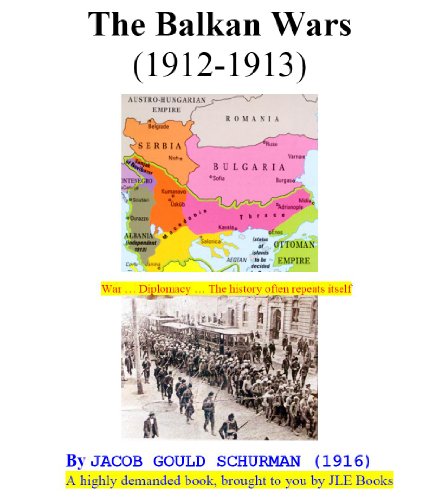
11. Balkan Wars 1912-1913: Prelude
12. Yugoslavia as History: Twice there
 
$40.95
13. The History of the Balkan Peninsula:
 
$4.98
14. History of the Balkans: From the
 
15. A concise history of the Balkan
 
16. The Balkans a Laboratory of History
 
$54.95
17. Balkan Economic History, 1550-1950:
 
$30.00
18. The Turkish State and History:
$105.00
19. Religious Quest and National Identity
$35.00
20. The Balkans: A Post-Communist

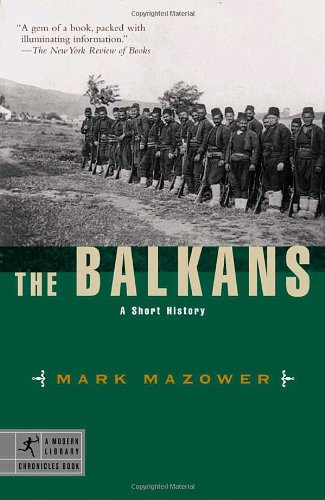
1. The Balkans: A Short History (Modern Library Chronicles)
by Mark Mazower
Paperback: 240 Pages (2002-08-06)
list price: US$13.95 -- used & new: US$7.86
(price subject to change: see help)
Asin: 081296621X
Average Customer Review: 3.5 out of 5 stars
Canada | United Kingdom | Germany | France | Japan
Editorial Review

Book Description
Throughout history, the Balkans have been a crossroads, a zone of endless military, cultural, and economic mixing and clashing between Europe and Asia, Christianity and Islam, Catholicism and Orthodoxy. In this highly acclaimed short history, Mark Mazower sheds light on what has been called the tinderbox of Europe, whose troubles have ignited wider wars for hundreds of years. Focusing on events from the emergence of the nation-state onward, The Balkans reveals with piercing clarity the historical roots of current conflicts and gives a landmark reassessment of the region’s history, from the world wars and the Cold War to the collapse of communism, the disintegration of Yugoslavia, and the continuing search for stability in southeastern Europe. ... Read more

Customer Reviews (19)

4-0 out of 5 stars Great introduction
A concise and elegant overview of Balkan history. Mazower shows not just the name 'Balkans' but also a lot of western perceptions on the Balkans are of recent date. On top of that, the book makes for pleasant afternoon reading.

1-0 out of 5 stars Confusion
If you are looking for a chronological history of the Balkans, this isn't it.The book skips back and forth between the centuries in a confusing and disorganized manner.

4-0 out of 5 stars Good introduction but most suitable for people with basic knowledge of Balkan history
I chose this book as I had wanted an introduction to the history of the region. The strength of this book is that it's concise and it doesn't bog down the reader (assuming that he/she is already interested in Balkan history). As another reviewer pointed out, the book is a neat package of the author's thesis/view that the Balkans is not synonymous with ethnic or religious strife as some Western historians often conclude. As such, the book is not so much a descriptive work of the region's history, but uses facts and travellers' observations to bolster Mazower's thesis. Some sections do indeed give off the sense that the reader should have a certain understanding of the history of the region. Unfortunately, I know of no book that gives a concise description of Balkan history. Jelavich's two-volume work is the only one that comes to mind, but it seems to be much more involved.

At any rate, recommended, and an interesting way of countering conventional views on Balkan history (but for me not to the degree of political correctness as someone else had commented here.)

4-0 out of 5 stars Solid and concise introduction to the region
The region known as the Balkans is the proverbial red-headed step-child of Europe. It has been looked upon as backwards, violent, and primitive by many in the Western world for some time. In recent years, the region has earned a reputation of violence, ethnic cleansing, and nationalistic strife. This compact little book set out to discern fact from myth concerning the history and people of the Balkans. It also outlines the crucial role the region has played not only in European, but in world history. One example of this is the region's role in the First World War. Not only was the war started in the Balkans-with the assasination of ArchDuke Ferdinand-it was also virtually ended there also-with the Bulgarian collapse of September 1918.

The author debunks the myth that ethnic and religious differences alone are to blame for the current chaos in the region by pointing out that for hundreds of years, the many religions and ethnic groups of the region lived side by side in relative harmony. The now fragmented Balkans were once part of the Roman and Ottoman empires, and until relatively recent times, enjoyed a semblance of stability. It wasn't until the last century when nationalistic and ethnic ambitions surfaced,(with the encouragement of the Great Powers) that things turned ugly.

In the epilogue, the author (somewhat repetitively) argues against the view of the Balkans as being inherently violent and chaotic. While his point is well-taken, this chapter comes across as more of an exercise in political correctness than anything else. Nevertheless, this is a solid overview of the the Balkans that I would definitely recommend as a starting point.

4-0 out of 5 stars Balkan Confusion
Mark Mazower has managed to clarify the history of the Balkans somewhat, but his subject is far too difficult. He certainly would not have been able to exhaust the subject in such a short history. Still, most of the world hasn't a clue as to the present day struggles of the Balkan region. Because of war in Bosnia and Kosovo as well as Milosevic and other war criminals in the news, the world's interest has been spiked. The problem is that nobody really seems to be able to get a grip on the problems facing Southeast Europe. For those with an interest but little understanding, this book will certainly help clarify many things. The strength of the book is that it takes the historical confusion of the Balkans and uses it to explain present day problems. We should all learn from the past. Hopefully, the people of the Balkans will learn from their past and lean toward a brighter future. ... Read more


2. Balkan Ghosts: A Journey Through History
by Robert D. Kaplan
Paperback: 368 Pages (2005-05-01)
list price: US$15.00 -- used & new: US$6.98
(price subject to change: see help)
Asin: 0312424930
Average Customer Review: 3.5 out of 5 stars
Canada | United Kingdom | Germany | France | Japan
Editorial Review

Amazon.com
From the assassination that triggered World War I to the ethnic warfare now sweeping Serbia, Bosnia, and Croatia, the Balkans have been the crucible of the twentieth century, the place where terrorism and genocide first became tools of policy.

This enthralling and often chilling political travelogue fully deciphers the Balkans' ancient passions and intractable hatreds for outsiders.For as Kaplan travels among the vibrantly-adorned churches and soul-destroying slums of the former Yugoslavia, Albania, Romania, Bulgaria, and Greece, he allows us to see the region's history as a time warp in which Slobodan Milosevic becomes the reincarnation of a fourteenth-century Serbian martyr; Nicolae Ceaucescu is called "Drac," or "the Devil"; and the one-time Soviet Union turns out to be a continuation of the Ottoman Empire.Book Description
This new edition includes six opinion pieces written by Robert Kaplan about the Balkans between l996 and 2000 beginning just after the implementation of the Dayton Peace Accords and ending after the conclusion of the Kosovo war, with the removal of Slobodan Milosevic from power ... Read more

Customer Reviews (116)

5-0 out of 5 stars A (GOOD) BOOK WHICH BROUGHT BACK (BAD) MEMORIES.
Wow ! Robert D. Kaplan brought me back to the Romania I left ages ago: personality cult, the "Iron Guard," fear of your neighbor, food and other shortages, "Securitate" caused paranoia,political corruption and graft, Transnistria and local Holocausts, competent and incompetent kings, submissive and non-submissive queens, pro-Nazi and pro-Communist dictatorships etc., etc.

Even long forgotten geographical locations and Romanian expressions came back in a jiffy.

Thank you "Robby." When things seem to go bad here in our U.S. of A., a therapeutic trip to the past helps to better appreciate the present.

4-0 out of 5 stars Good intro to a complicated region
Before reading Balkan Ghosts, I knew very little about the Balkans.With so many small countries, so many ethnic enclaves, so many religious sects, it has always been an extremely perplexing area for me.

However, this book helped me understand this part of the world much more clearly.Just knowing who lives where and believes what is a huge piece of the puzzle, so I really enjoyed broadening my knowledge while reading this book.

My favorite parts of the book were about how the Balkans influenced Russian history and, later on, how the Soviet Union influenced Balkan history.Very interesting cycle that continues today.

Tough subject buy enjoyable reading.I recommend it.

4-0 out of 5 stars Journalist's version of Balkan history
I'm not really sure why this book is called "Balkan Ghosts" when it talks primarily about only four of the Balkan states: Yugoslavia, Romania, Bulgaria, and Greece. However, since I'm mostly interested in Romanian history, it was a good book for me (but someone who expects to read about the other Balkan states outside the group of 4 might be disappointed). In defense of the author, I guess he did slide Croatia, Albania, and Macedonia into the Yugoslavia chapter.

But, don't get the wrong idea. This was still a good book (even if a bit skimpy on its Balkan coverage). It's an eye-witness account of things that journalist Robert Kaplan personally experienced while he lived in the Balkans. And that "personal touch" makes the book well worth the read.

It was well-written and as easy to read as a good newspaper or magazine article. The only problem I found was that because journalists are always working against a deadline, they often don't have the time to fully research their topics. On the other hand, like all good reporters, Kaplan relied on interviews with real people. And their stories made this book a valuable addition to my collection.

3-0 out of 5 stars "Ghosts" Flawed but Interesting at Times
I found Balkan Ghosts mildly enjoyable, and it accurately describes many of the unfolding trends that exploded in the 1990s in the region.

Stylistically, there are reasons for pause. It is somewhat schizophrenic, darting between history and travelogue. Others may be more fond of this hybrid history / travel genre, but to me it seemed forced.

I also found the book overly fanciful and stereotypical at times. Kaplan finds much of what he sees alien, but to the extent that this is a travel book, Kaplan is entitled (and expected) to convey his Western sensibilities to his Western audience.

Overall, I suspect there are better choices for many readers.

4-0 out of 5 stars Interesting and entertaining introduction
Though slightly dated now, this work is an interesting and entertaining introduction to the complex political movements in the Balkans. This is not in depth on any one of the myriad of questions needing answers in the Balkans but is simply a quick overview in the form of a travelogue that gives you a feel for travelling through this fascinating part of the world where Ottoman and European cultures met and mingled. ... Read more


3. History of the Balkans, Vol. 2: Twentieth Century (The Joint Committee on Eastern Europe Publication Series, No. 12)
by Barbara Jelavich
Paperback: 476 Pages (1983-08-31)
list price: US$55.00 -- used & new: US$10.00
(price subject to change: see help)
Asin: 0521274591
Average Customer Review: 4.5 out of 5 stars
Canada | United Kingdom | Germany | France | Japan
Editorial Review

Book Description
This volume concentrates on the Balkan wars and World War II, which both had their origins in the desire of nationalist circles to complete the territorial unification of their states. A substantial part of this book deals with the wartime experience, the establishment of the postwar regimes and their internal development to 1980 and the divergent paths followed by the five states (Bulgaria, Greece, Montenegro, Romania and Serbia) since 1945. ... Read more

Customer Reviews (3)

5-0 out of 5 stars Dated at places, otherwise excellent
The scope of Jelavich's second volume of her "History of the Balkans" actually covers the last several decades of the nineteenth century and ends with the early 1980s, when it was published. No updated editions were ever published. This unfortunately makes an otherwise exemplary historiographical work somewhat dated. Jelavich's analysis of events and developments in the communist Romania, Albania and Bulgaria, as well as Greece is, however, a good summary of the history of these countries from 1945 to the early 1980s. Where the book is obviously dated is in its coverage of the former Yugoslavia: in her conclusions, the author implies a generally positive course for this country based on its relative successes until then in economic and overall social development. Nonetheless, her examination of socialist Yugoslavia does provide a view into the country's flaws, which would eventually lead to its violent collapse in 1991. Jelavich's treatment of the late 19th century, the two World Wars and the interwar is comprehensive and very informative; the author's vast knowledge of numerous primary sources and the extensive secondary literature on this region comes to the fore here. Although Jelavich's strength is her knowledge of political and diplomatic history, she provides a strong analysis of the region's underlying economic problems (which in all countries considered is the relative technological backwardness). The only weakness of this volume is the short-shrift given to cultural/social issues - thus, very little is said about literary and artistic activity, or the effects of the vast social change in Western Europe and the U.S. on the various Balkan countries. Her overall conclusion is obviously a bit dated since all of the communist regimes have since fallen. Nevertheless, this is an excellent integrated history which is broken down into logical chronological and geopolitical sections, making it also useful as a reference work.

4-0 out of 5 stars A weighty, serious tome for serious readers
This text is now a bit dated: it does not cover the tumultuous events ofthe 90s.This book, nevertheless, covers what took place earlier in the20th century with great depth and balance.Jelavich's book is for anyperson who wants a serious look into the history of the Balkans.Suchknowledge is a must and a primer for a true understanding of the"balkanization" of the Balkans in the 1990s.If you want a quick, lightread, this book in NOT for you.This book is at times heavy and hard, butis worth the effort.

4-0 out of 5 stars Biography or some more about Author
cao! I would like to found more about Author sbiography Thanks advance Boban Barbare ... Read more


4. The Balkans: A History Of Bulgaria--Serbia--Greece--Rumania--Tu
by Nevill Forbes
Paperback: 294 Pages (2007-02-22)
list price: US$13.99 -- used & new: US$13.99
(price subject to change: see help)
Asin: 1426455895
Canada | United Kingdom | Germany | France | Japan
Editorial Review

Product Description
We hope we have dealt fairly with all these peoples. Mediaeval history is mostly a record of bloodshedding and cruelty and the Middle Age has been prolonged to our own time in most parts of the Balkans and is not yet over in some parts. ... Read more


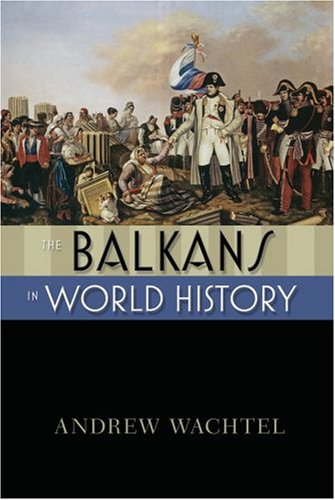
5. The Balkans in World History
by Andrew Wachtel
Paperback: 176 Pages (2008-10-01)
list price: US$19.95 -- used & new: US$19.95
(price subject to change: see help)
Asin: 0195338014
Canada | United Kingdom | Germany | France | Japan
Editorial Review

Book Description
In the historical and literary imagination, the Balkans loom large as a somewhat frightening and ill-defined space, often seen negatively as a region of small and spiteful peoples, racked by racial and ethnic hatred, always ready to burst into violent conflict. The Balkans in World History re-defines this space in positive terms, taking as a starting point the cultural, historical, and social threads that allow us to see this region as a coherent if complex whole. Eminent historian Andrew Wachtel here depicts the Balkans as that borderland geographical space in which four of the world's greatest civilizations have overlapped in a sustained and meaningful way to produce a complex, dynamic, sometimes combustible, multi-layered local civilization. It is the space in which the cultures of ancient Greece and Rome, of Byzantium, of Ottoman Turkey, and of Roman Catholic Europe met, clashed and sometimes combined. The history of the Balkans is thus a history of creative borrowing by local people of the various civilizations that have nominally conquered the region. Encompassing Bulgaria, Croatia, Bosnia and Herzegovina, Serbia, Montenegro, Albania, Macedonia, Greece, and European Turkey, the Balkans have absorbed many voices and traditions, resulting in one of the most complex and interesting regions on earth. ... Read more


6. History of the Balkans, Vol. 1: Eighteenth and Nineteenth Centuries (The Joint Committee on Eastern Europe Publication Series, No. 12)
by Barbara Jelavich
 Paperback: 400 Pages (1983-07-29)
list price: US$65.00 -- used & new: US$38.00
(price subject to change: see help)
Asin: 0521274583
Average Customer Review: 4.5 out of 5 stars
Canada | United Kingdom | Germany | France | Japan
Editorial Review

Book Description
Volume I discusses the history of the major Balkan nationalities.It describes the differing conditions experienced under Ottoman and Habsburg rule,but the main emphasis is on the national movements, their successes and failures to 1900, and the place of events in the Balkans in the international relations of the day. ... Read more

Customer Reviews (2)

4-0 out of 5 stars Good material, but dry and dated
Jelavich clearly knows her stuff, and this (and its successor volume) serve as an excellent general study. However, the writing style is very dry and can be difficult and a little boring to read. Further, the work is a bit dated, neglecting all of the extraordinary events after the mid-80s. The bibliography is very good, though keep in mind obviously no recent works are there. Citations are a bit sparse, making it difficult to pursue a line of thought further.

This is overall a good book, but readers interested in first learning this subject absolutely should start with Stavrianos' "The Balkans since 1453." It's even more dated, but is unbeatable as a general study on the region up to about 1950.

5-0 out of 5 stars Comprehensive introduction to Balkan history
Although published in the late 1980s with no updated editions in later years, Jelavich's masterful "History of the Balkans" is still by far the best introduction to contemporary Balkan history. This first volume traces the developments among the various Balkan peoples as they moved into modernity and formed independent nation states. Jelavich begins with a short and very informative introduction to Balkan history up to the end of the 17th century, i.e. the time when Ottoman power in the region seriously began to wane and the role of the Habsburg Monarchy and Russia (and later all of the major European powers) in the region became crucial. The author focuses mostly on the Ottoman Empire and the Balkan nationalities under Ottoman rule, the Bulgarians, Greeks, Romanians and Serbs, and the Albanians to a lesser extent, as it was among these people that the first revolts occurred and the first nation states were formed in the Balkans. Even so, Jelavich provides excellent analysis of the main currents in the Habsburg Monarchy's Balkan possessions, mainly the Croatian lands but also Vojvodina and Transylvania with their large Serbian and Romanian populations. Perhaps the main thing that comes out of this volume is that Ottoman rule in the Balkans was not as oppressive as it was often later portrayed (i.e. the notorious "Turkish yoke" of national(ist) historiography in the Balkans). It was in fact this empire's decentralized governing institutions, tolerance of non-Islamic religious communities, and general inefficiency that made possible a great deal of local autonomy among the Balkan peoples and proved conducive to the nationalist uprisings of the 19th century. Also important is Jelavich's repeated emphasis on the region's general poverty. Throughout the period this book covers, the vast majority of the Balkan people were peasants who often lived at subsistence levels. This factor was crucial in shaping the region's history. This book contains both detailed accounts of the major events in Balkan history during the period it covers as well as strong analysis of the underlying social and political processes. It therefore provides a strong basis for understanding Balkan history, and greatly helps in comprehending current events in the region. ... Read more


7. The Establishment of the Balkan National States, 1804-1920 (History of East Central Europe)
by Charles Jelavich, Barbara Jelavich
Paperback: 374 Pages (1987-10)
list price: US$27.50 -- used & new: US$23.95
(price subject to change: see help)
Asin: 0295964138
Canada | United Kingdom | Germany | France | Japan

8. Remembering Yugoslavia: A Short history of Serbia, Yugoslavia, and the Balkan people
by Anna Nevenic
 Paperback: 162 Pages (2002)

Asin: B0006S9642
Canada | United Kingdom | Germany | France | Japan

9. A History of the Balkans 1804-1945
by Stevan K. Pavlowitch
Paperback: 384 Pages (1999-04-13)
list price: US$50.60 -- used & new: US$143.39
(price subject to change: see help)
Asin: 0582045843
Canada | United Kingdom | Germany | France | Japan

10. History in Exile: Memory and Identity at the Borders of the Balkans
by Pamela Ballinger
Paperback: 368 Pages (2002-12-01)
list price: US$26.95 -- used & new: US$24.52
(price subject to change: see help)
Asin: 0691086974
Canada | United Kingdom | Germany | France | Japan
Editorial Review

Book Description

In the decade after World War II, up to 350,000 ethnic Italians were displaced from the border zone between Italy and Yugoslavia known as the Julian March. History in Exile reveals the subtle yet fascinating contemporary repercussions of this often overlooked yet contentious episode of European history. Pamela Ballinger asks: What happens to historical memory and cultural identity when state borders undergo radical transformation? She explores displacement from both the viewpoints of the exiles and those who stayed behind. Yugoslavia's breakup and Italy's political transformation in the early 1990s, she writes, allowed these people to bring their histories to the public eye after nearly half a century.

Examining the political and cultural contexts in which this understanding of historical consciousness has been formed, Ballinger undertakes the most extensive fieldwork ever done on this subject--not only around Trieste, where most of the exiles settled, but on the Istrian Peninsula (Croatia and Slovenia), where those who stayed behind still live. Complementing this with meticulous archival research, she examines two sharply contrasting models of historical identity yielded by the "Istrian exodus": those who left typically envision Istria as a "pure" Italian land stolen by the Slavs, whereas those who remained view it as ethnically and linguistically "hybrid." We learn, for example, how members of the same family, living a short distance apart and speaking the same language, came to develop a radically different understanding of their group identities. Setting her analysis in engaging, jargon-free prose, Ballinger concludes that these ostensibly very different identities in fact share a startling degree of conceptual logic.

... Read more

11. Balkan Wars 1912-1913: Prelude to the First World War (Warfare and History)
by Richard C. Hall
Library Binding: 176 Pages (2000-10-19)
list price: US$125.00 -- used & new: US$125.00
(price subject to change: see help)
Asin: 0415229464
Average Customer Review: 4.0 out of 5 stars
Canada | United Kingdom | Germany | France | Japan
Editorial Review

Book Description
Richard Hall examines the origins, the enactment and the resolution of the Balkan Wars, during which the Ottoman Empire fought a Balkan coalition of Bulgaria, Greece, Montenegro and Serbia, that collapsed in 1913. Based on archival as well as published diplomatic and military sources, this book provides the first comprehensive perspective on the diplomatic and military aspects of the Balkan Wars. It demonstrates that, because of the diplomatic problems raised and the military strategies and tactics pursued to resolve those problems, the Balkan Wars were the first phase of the greater and wider conflict of the First World War. ... Read more

Customer Reviews (4)

5-0 out of 5 stars the best book in English on the subject
I've just finished writing a book about the Ottoman Army's participation in the Balkan Wars. Consequently, I've read (or scanned) almost every book ever written in English, German, Turkish, and French about the Balkan Wars.
Dr. Hall's book is the only book written in English which lays out the flow of events in an understandable format that links the various theaters together. Nobody in the past eighty years has ever done a better job in explaining the military side of this war. If you only read a single book on this subject - this is it.
The challenge of writing a balanced book on this subject is extremely difficult due to the problem of access to available sources and the problem of fluency in multiple (and uncommon) languages. Dr. Hall has done a creditable job in crafting a capstone book that captures the overall strategic picture of the Balkans in 1912/1913. While some readers may find criticisms (maps, editing, use of mainly Bulgarian sources, etc.) this should not obscure what the author has achieved.
I enjoyed the book and I refered to it frequently while writing my own book when I neeeded to fall back on a meaningful context and framework of understanding. Finally, "The Balkan Wars 1912-1913" will leave you hungry for more information about this important war. I hope that it will stimulate interest in a long neglected subject. It's worth the money!

3-0 out of 5 stars Good but flawed synthesis
This is a readable brief account of a series of conflicts about which far too little has been written in English, which should serve non-Balkan specialists well.But it falls considerably short of what one would like, even for a book of 176 pages.There are an embarrassing number of editing lapses (e.g., repetition of the sentence beginning "Negotiations..." on p. 69) and typos, for which the publisher bears some responsibility.Forms of proper names are mostly Bulgarian (with inconsistencies), with no cross-reference to, say, the usual Yugoslav spelling of "Pashich" and rendering of Turkish names, when they are given at all, without dotless i's, etc. Previous reviewers have commented on the grossly inadequate maps; the photo on the cover of the paperback edition whets my appetite for more illustrations, which are completely lacking.Anyone with access to a large public or university library should look for old literature on the war, such as Hermenegild Wagner's _With the Victorious Bulgarians_ (1913), which has very good maps of the Thracian theater.

Hall depends heavily on Slavic sources on the wars, especially Bulgarian ones, which he has thorough control of, but the results are some quite idiosyncratic casualty figures. (The Turkish General Staff's official history of the war, _Balkan harbi_, is cited nowhere, presumably because the author doesn't read Turkish.) The Serbian army's casualties seem far too small, considering that they took every Turkish position by direct assault (e.g., less than 4,000 Serb casualties for the battle of Kumanovo, as opposed to 12,000 Turkish losses).If the Turks had simply retreated instantly, the low casualties would seem understandable, but the Ottoman casualties given for the Macedonian theater are quite high, so one might conclude either that Serbian casualties were greatly underplayed or that the progress of the battle is totally misrepresented.The Turkish casualty figure of 100,000 for both theaters seems incredibly high (though Edward Erickson's _Ordered to Die_ , by an author who knows Turkish sources, gives a far more astounding figure, 250,000.)

Hall is addicted to military and diplomatic second-guessing, which grows tiresome by the end of the book.Though he puts his finger on the more consequential faux pas (the inability of the Russian government to arbitrate Balkan League conflicts, the confusion in Sofia at the opening of the 2nd Balkan War), I would prefer analysis of why errors were made to shoulda-coulda.I would also question Hall's understanding of cholera (which rivaled combat as a source of death); it was most likely not spread by armies, but by soldiers' repeated use of untreated water-hence its reoccurrence in eastern Thrace.

Above all, even for a short book, one would like more on the human rather than strictly political consequences of the war.Virtually nothing is said of the fate of the millions of ethnic Turks and Slavic-speaking Muslims trapped in non-Muslim states as a result of the Balkan Wars.Maybe Hall himself will someday write a more complete book on the wars (and, I hope, get better editorial support).

4-0 out of 5 stars Fills a gap in 20th Century European History
Most students of modern Europe will have learned something of the Balkan Wars, those two localized conflicts involving Turkey which occurred on the eve of, and were among the causes of, World War I.But few studies of 20th century Europe, or even of the Great War and its causes, provide more than mere mention of these obscure wars.Richard Hall goes far towards remedying the problem in this concise (143 pp., 165 pp. with endnotes and bibliography) study.

Hall covers much of the basic ground:why the wars occurred; who was allied with whom and why; the size, training, armaments and disposition of the competing forces; the strategy and tactics of the campaigns; and, a succinct explanation of the results.Hall also appears well-equipped to analyze these wars.In addition to relying on contemporaneous accounts by French, German, British and American observers, Hall also cites numerous works in Serbo-Croation and Bulgarian. Perhaps one reason why there has never appeared a good summary of the Balkan Wars is that a command of several languages is needed in order to write a reliable one.Except for Greek and Turkish sources, Hall seems to have examined the available primary sources.

Only two criticisms can be fairly lodged against this study.First, while readers will recognize that this work was intended to be rather short ( it forms a part of the Warfare and History series under the general editorship of Jeremy Black), Hall might have spent a little more time integrating the Balkan Wars into the larger picture of instability which characterized early 20th century Europe.How did the Balkan Wars affect the attitudes, if not the alignments, of the Great Powers?Did the Balkan Wars really bring the Great Powers closer to European War?Could a remedy to the competing interests of the countries involved have been fashioned in such a way as to defuse the Balkan powder keg?Hall's study might have dealt with these larger questions more thoroughly.

Of less importance, the text is marred by numerous editing errors and by inadequate maps.I always read history with historical atlases by my side; but none that I own provide good maps of these wars.The publishers missed a real opportunity to remedy this problem with Hall's book; more detailed and well-developed maps would have greatly enhanced the text.

Still, this book goes far towards filling in a significant gap in modern European history and is recommended for students of modern Europe and particularly for those interested in the Balkans or in the origins of the First World War.

3-0 out of 5 stars "Some damned silly thing in the Balkans"
As Bismarck is attributed as saying in 1898, "If there ever is another war in Europe, it will come out of some damned silly thing in the Balkans."

This book is a diplomatic and military history of the First and Second Balkan wars.It's rather amazing that these local conflicts were not the "damn silly thing" and did not erupt into a wider conflict.It would take Princip's shots at Sarajevo to spread the flames of war to the Great Powers.

Much of the belligerent nations' subsequent diplomatic decisions can be attributed to the events and results of the Balkan Wars.Bulgaria's alliances with Germany in the subsequent two world wars are clearly rooted in the Balkan Wars.Serbia's actions and the Austrian reactions to them were first choreographed during the Balkan Wars - with disastrous consequences in July of 1914.

The book provides excellent background on the early 20th century conflicts which incubated today's controversies regarding Macedonia, Kosovo, and other lingering Balkan animosities.

The author makes the point that in the Balkans, there was almost no pause between these wars and thebeginning of the Great War.Many of the belligerents were engaged from 1912 until the Armistice of 1918.

Because of the short time between the end of the Balkan Wars and the beginning of the Great War, the author argues that the military lessons of the Balkan Wars regarding machine guns, quick firing artillery, and aircraft reconnaissance could not be properly absorbed by the military tacticians of the day.

Of particular interest to military historians is the book's description of the Gallipoli campaign during the First Balkan War in which the Turks conducted an amphibious assault against the defending Bulgarians.The Turks were able to make good their lessons learned from their attack when they were in the reverse role of defending against the British and ANZACs in 1915.

The Great Power conferences which finalized the results of the two Balkan wars were like the last symphonies in the Concert of Europe.The Balkan belligerents had to maintain one eye on their patrons among the Great Powers as they pursued their territorial goals.Never again would Great Power diplomatic pressure alone be successful in redrawing the borders of Europe.For example, the birth of the Albanian state as a result of Austrian and Italian interests against those of Serbia and Greece was a major outcome of the First Balkan War.

I could only give this book three stars due to some shortcomings.The maps are simple line drawings and do not provide enough detail to adequately support the text.The author has a habit of "giving away" the results of a battle before his description of the entire event is complete.For example, indicating that control of a road would be critical to an army's eventual retreat before describing the actual battle.Finally, the author has a predilection towards perfect hindsight judgments regarding the belligerents' ways and means.

Overall, a nice and short read on a little documented prelude to the Great War. ... Read more


12. Yugoslavia as History: Twice there was a Country
by John R. Lampe
Hardcover: 441 Pages (1996-10-13)
list price: US$59.95
Isbn: 0521461227
Average Customer Review: 4.0 out of 5 stars
Canada | United Kingdom | Germany | France | Japan
Editorial Review

Book Description
Yugoslavia as History is the first book to trace the bloody demise of the former Yugoslavia through its history and its earliest roots. A Yugoslav idea had already emerged before the First World War, and it led to two states called Yugoslavia, between 1918 and 1941, and from 1945 until 1991. This book examines the origins of that idea among the related but separate peoples who have populated the region over the last 1,000 years, drawing out the connections this story has with the violent end of Tito's Yugoslavia in 1991. The author follows these peoples, their institutions and ideas from their earliest interaction, into the two World Wars and the states which resulted from them, detailing the tortuous search for political and economic viability which characterised Yugoslavian statehood. Accessible and authoritative, this book provides a unique insight into the origins of the tragedy that has overtaken the region.Download Description
Yugoslavia as History is the first book to examine the bloody demise of the former Yugoslavia in the full light of its history. This new edition of John Lampe's accessible and authoritative history devotes a full new chapter to the tragic ethnic wars that have followed the dissolution of Yugoslavia, first in Croatia and Bosnia, and most recently in Kosovo. John Lampe concentrates on the connection, real and imagined, between these conflicts and the experience of the successor states, the two Yugoslavias and their predecessors. ... Read more

Customer Reviews (4)

4-0 out of 5 stars An economic historian's perspective
Although this is a general history of Yugoslavia, from ancient times up to 1992, the analysis reflects the fact that Lampe is first and foremost an economic historian.

4-0 out of 5 stars A commendable survey
Lampe's "Yugoslavia as History" is probably the first book that deals with the entire history of Yugoslavia from its inception in 1918 to its collapse in 1991. While discussing pre-1918 developments and (very summarily) post-1991 events, he focuses his discussion on Yugoslavia as it actually existed, doing a commendable job of viewing past events on their own terms rather than through the prism of present-day events (the primary flaw of many recent historical works written both by former Yugoslav and outside scholars, commentators, etc.). Lampe's primary expertise is economic history, and this is evident in his strong analysis of Yugoslavia's frequent economic problems, which would be a crucial factor in the country's eventual downfall. However, this means he often gives short shrift to the cultural, social and intellectual antagonisms which gave expression to the country's underlying problems. Also, while socialist Yugoslavia's decentralized political structure did foment the development of separate economic, social and intellectual cultures, there were also many factors that bound Yugoslav citizens and did create a some sense of community (he only touches on sports and film, but almost completely ignores literature and pop music). Indeed, this appearance of a rudimentary common culture was what made Yugoslavia's violent breakdown so shocking to people in the county itself and to outside experts. Even so, "Yugoslavia as History" is a very strong survey of the country's troubled history and a very useful resource for students and others - it is much, much better and more informative than the many "instant histories" (a term I think Lampe himself used in a journal article) which appeared in droves once Yugoslavia did break up and the war started. The book is also, by the way, a very good reflection and summary of the main streams of American historiography on the former Yugoslavia.

3-0 out of 5 stars weak in some areas
while john r. lampe's book is accurate and very readable, Iwould still like to point out some problems. the main one is, that theauthor deals with slovenians and macedonians very briefly, more like an afterthought. as a slovenian, I may feel a bit strongly about it, but I would like to give two examples: there is no mention of the isonzo front (first world war, between italy and austro-hungary), which went on for twelve battles and has its own novel (and film) - farwell to arms. also, the ossimo accords, which finalized the border between yugoslavia (now slovenia) and italy are not mentioned -and they are important, since italy used them to present all sorts of obstacles to slovenia after 1991.the book is still very much worth reading, but keep in mind that the slovenians (and I imagine the macedonians) are not given the adequate space. read something else as well!

5-0 out of 5 stars reliable, beautifully written - a true diamond
It happens so rarely that one gets so completely excited by a history book, especially if, as is the case with Lampe's work, it covers such a broad time-period in such a relatively small and, with the sad exception ofthe last ten years, un-known country. Lampe has succeeded in what manyscholars of the region of the former Yugoslavia have failed: to provide anauthoritative, well-argumented, and clear case for the bloody demise of thecountry. He is one of the few who doesn't fall into the trap of playing theprejudicial and rascist songs about Balkans being the cradle of terrorismand bloodshed - rather, he traces the demise of the country through almostone hundred years of its existence, showing when and why Yugoslavia was tothe benefits of the nations living there, and when its existence rancontrary to the wishes of its founding fathers. Lampe has a sharp eye of anobserver who has witnessed a tragedy with his heart and yet knows how tolook for answers and explanations using his head. I can only warmlyrecommend this book to anyone who really wants to get a taste of thisunhappy region, to all students of the Balkans, or people merely interestedin "what it was all about". This is a real diamond in a decadewhich has seen a wave of books dealing with the former Yugoslavia, most ofwhich have left me flabbergasted and stupified by their style and myopic(to say the least) ideas they promoted. ... Read more


13. The History of the Balkan Peninsula: From the Earliest Times to the Present (Eastern Europe Collection)
by Ferdinand Schevill
 Hardcover: 558 Pages (1970-06)
list price: US$40.95 -- used & new: US$40.95
(price subject to change: see help)
Asin: 0405027745
Average Customer Review: 4.5 out of 5 stars
Canada | United Kingdom | Germany | France | Japan

Customer Reviews (2)

5-0 out of 5 stars Excellent history without the influence of recent events
I read this book as after reading "Short History of Byzantium" and "Ottoman Centuries." My biggest concern in choosing from the available material was finding a subjective history that wasn't influenced by the events of the past decade or even, if possible, the cold war. The market has been flooded in recent years with books attempting to "explain" current events in Serbia, et al.

I found what I was looking for in this book. Published ~1920, the author's language can come across archaic at times, but is not difficult to read. He has a dry wit and insight which shines through, making it quite enjoyable.

Although he pays passing tribute to the Greeks, the primary focus on the region's history begins with the Byzantine empire, followed by Ottoman, which was still in the process of finding it's present day role in the world as the Republic of Turkey at the time this book was published.

High marks go to Schevill for his ability to interweave European politics and their impact on the region (Russia's desire for control of the Balkans from the time of Peter the Great forward;Napoleon's brief alliance with Russia for the same purpose; Austria's on-going alliance with Hungary)

This is history at its finest - a must read for anyone with more that a passing interest in the subject.

4-0 out of 5 stars A course in Balkan History
This is a very informative book on the history of the Balkan countries, including Greece, Bulgaria, the Ottoman Empire, Rumania, Hungary, Yugoslavia, and Albania.The book reads like a college course in History: I even took notes on it so that I could remain organized.If you arelooking for a book that reads easily, and will be informative as well asfun, this is probably not the book for you.However, if your goal is tolearn about this diverse and troubled region of the world, and you have thepatience and thirst for knowledge of a scholar, this would be right up youralley. ... Read more


14. History of the Balkans: From the Earliest Times to the Present Day
by Ferdinand Schevill
 Hardcover: 562 Pages (1991-07)
list price: US$9.95 -- used & new: US$4.98
(price subject to change: see help)
Asin: 0880296976
Average Customer Review: 5.0 out of 5 stars
Canada | United Kingdom | Germany | France | Japan

Customer Reviews (1)

5-0 out of 5 stars Excellent and informative book
As a non-historian interested in Balkan problems I found this book filled with historic details and descriptions that helped me elucidate reasons behind today's underlying conflicts. It reads like a novel occassionally with awry ironic tone and yet seems fair and unbiased. It will remain on my shelf to be re-read and referred to. ... Read more


15. A concise history of the Balkan Wars, 1912-1913
 Unknown Binding: 385 Pages (1998)

Isbn: 9607897072
Canada | United Kingdom | Germany | France | Japan

16. The Balkans a Laboratory of History
by William M. Sloane
 Hardcover: 322 Pages (1914)

Asin: B000ILS5LM
Canada | United Kingdom | Germany | France | Japan
Editorial Review

Product Description
History of late 19th and early 20th century conflict in the Balkans, in the years just before World War I. ... Read more


17. Balkan Economic History, 1550-1950: From Imperial Borderlands to Developing Nations (Theories of Contemporary Culture)
by John R. Lampe, Marvin R. Jackson
 Hardcover: 728 Pages (1982-04)
list price: US$54.95 -- used & new: US$54.95
(price subject to change: see help)
Asin: 0253303680
Canada | United Kingdom | Germany | France | Japan

18. The Turkish State and History: Clio Meets the Grey Wolf (Institute for Balkan Studies)
by Speros, Jr. Vryonis
 Hardcover: 131 Pages (1992-09)
list price: US$30.00 -- used & new: US$30.00
(price subject to change: see help)
Asin: 0892415320
Average Customer Review: 4.0 out of 5 stars
Canada | United Kingdom | Germany | France | Japan

Customer Reviews (5)

5-0 out of 5 stars Turkification of Gobineau
The most remarkable information in this book--and there is a great deal of remarkable information here--is the revelation that Kemalism established the "Turkification of Gobineau's theory of the racial, and therefore civilizational, superiority of the Aryans."

Ataturk established the Turkish Historical Thesis (Turk Tarih Tezi) and the Sun Theory of Languages (Gunes Dil Teorisi). The former holds that the history of Turkeyas known today doesn't consist merely of Ottoman history, but is much older and in fact dispersed culture to all nations, including the Greek classical nation, the Hittites, the Chinese, the Romans and all European nations. The latter holds that Turkish was the first language ever spoken by humans, and is the foundation for all other languages, be they classical Greek and Latin, Romance languages or even Anglo-Saxon tongues.

By way of these theories, the Turkish educational system still, today, teaches that Turkish society is supremacist, and that it is from Turkish history and language that all other culture and languages flow. One can according to these theories allow that there was, for example, a beautiful Greek civilization, but at the same time, one holds that this was not independent, but a derivative of the Turkish culture and history.

What is even more astounding is that there are those historians, including Bernard Lewis, who make apology for this supremacist line.

Since the European Union is now considering whether Turkey should join its ranks, it would be highly beneficial for all European citizens--but especially European officials--to read this short but powerful book. To the extent that the racist teachings exposed herein are still taught today in Turkey, and are still regarded as truth by the mass of educated Turks, this book is a warning against Turkish admission to the EU.

--Alyssa A. Lappen

4-0 out of 5 stars Very informative
This book addresses the way the modern Turkish state deals with history.
Its first part focuses on a book by a former prime minister of Turkey (T. Ozal) titled "Turkey in Europe". This part of Vryonis's book is the one I'm most skeptical about. The purpose of "Turkey in Europe" was to survey the history of the Turkish people from about 7000 BCE to today and from that to deduce that Turkey has a historic claim to EU membership. As expected, a book dealing with such a large period cannot be possibly
documented and researched in a scientific way, even if written by a professional historian (not the case with Ozal). Indeed, "Turkey in Europe" has never been treated in this way.
One then wonders about the importance and relevance of a detailed analysis of its errors by a historian of Vryonis' stature. A more interesting approach would have been to view the book in the context of modern geopolitical confrontations rather than that of intellectual debates.
Fortunately, this is the approach in the remaining two part of the book. The second part studies two theories that have played an important role in the emergence of modern national Turkish conscience (one anthropological and the other linguistic). Again Vryonis spends more time on the content of these two theories than they deserve. However, that's more relevant than the analysis of Ozal's book because these are theories that are broadly spread in the Turkish society.
The strongest (and surprisingly timely) part of the book is, in my opinion, the third one dealing with the attempts of the Turkish government to manipulate US scholarship and, more generally, the US public opinion. The historical background of these attempts is described and documented painstakingly, the degree to which they have been successful is assessed and the role of third parties is analyzed (people prominent in the last
events in Iraq figure here, even though the book was written in 1991).
The book is very well written and the prose often passionate (something natural when the topic is genocide denial, justice on crimes against humanity etc.) and the documentation and argumentation is compelling.

5-0 out of 5 stars The Turkish state promoting fraudulent theories
This book is a review by Prof. Vryonis of a book that was authored in French by the late prime minister of Turkey, Turgut Ozal. The apparent aim of the book is to make propaganda about Turkey, Turkish history, the language etc. that is so incredible that it could not possibly be believed by anyone even passingly familiar with history. Vryonis does a great job deflating this incompetent job of chauvinism and bungled attempt at historical revisionsim. Ozal goes down as just another Turkish politician who gave his people a bad name. A must read for all those interested in learning the dark side of modern Turkey.

1-0 out of 5 stars A strident and profoundly biased view of complex questions.
In this book, Mr. Vryonis speaks for an institute whose avowed purpose is to propogate a particular version of history, a version which demonizes all things Turkish. In short, it's an unhelpful contribution to a complex--even Balkan--set of problems and an oversimplification of aquite complicatedhistorical legacy.Look for more objective books if you need background onthese questions:this one is a rant.

5-0 out of 5 stars How the Turkish State Victimizes History
The author, a well known scholar, provides an excellent analysis of how the modern Turkish state, ever since its founding in 1923, has worked intensively, though incompetently, on distorting history.

This is doneby reviewing a recent book written in French by the assistants of the latepresident Ozal of Turkey, in order to convince the Europeans that Turkeyshould be allowed to enter the European Union.

Mr. Ozal, turnedhistorian, attempts to persuade the readers of his book of such things as:all Greek history is in fact Turkish history; all history stems from theTurks and could not be possible without the contribution of the Turks; alllanguage stems from Turkish etc.

In the second part of the book, Dr.Vryonis examines how the Turkish state is buying influence in the UnitedStates by bankrolling the work of corrupt American scholars to parrot such"theories" as those in Mr. Ozal's book and by endowing chairs ofTurkish Studies in American universities.

The chief characteristic ofTurkish civilization when it comes into contact with other civilizations isthat an orgy of taking and usurpation develops -- that is the Turks takingfrom the other civilization. The current book -- superbly documented withTurkish as well as international sources -- shows that this culturaltendency to usurp and appropriate extends not just to material wealth andto the genes of theforcibly Turkified populations, but -- beyond that --to the history of the peoples the Turks come into contact with.

In ourtimes this tendency is manifested by the Turkish state denying the identityof 20% of its population which is Kurdish and by its insistence to refer tothem as "mountain Turks" while prohibiting public speech orpublications in Kurdish.

The book should be read by all, but especiallyby those who believe that Turkey is a Western nation. Distortion of historyand manipulation of national identity is not a particularly western value. ... Read more


19. Religious Quest and National Identity in the Balkans (Studies in Russian & Eastern European History)
Hardcover: 270 Pages (2001-12-07)
list price: US$105.00 -- used & new: US$105.00
(price subject to change: see help)
Asin: 0333778103
Canada | United Kingdom | Germany | France | Japan
Editorial Review

Book Description
This book offers rare insights into the cultural traditions that have shaped the Balkan region--from pagan times, through folk culture, the medieval Christian churches, the encounter between Christianity and Islam, up to the religious and national mythologies that have proved so destructive in the present day. With the Balkans a central focus of European concern at the beginning of the 21st Century, this volume is a timely reminder of the complex cultural processes that continue to affect the modern world. ... Read more


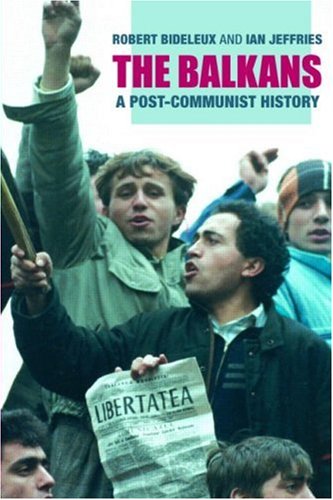
20. The Balkans: A Post-Communist History
by Bideleux/Jeffri
Paperback: 620 Pages (2006-12-04)
list price: US$44.95 -- used & new: US$35.00
(price subject to change: see help)
Asin: 0415229634
Canada | United Kingdom | Germany | France | Japan
Editorial Review

Book Description
Balkans: A Contemporary History is a state-by-state, successor-state-by-successor-state run through of the Balkans in the twentieth century, including study of the Balkans in earlier context too. States covered are:
* Greece
* Romania
* Albania
* Bulgaria
* Serbia and Yugoslavia
* Croatia
* Slovenia
* Montenegro
* Macedonia
* Bosmia-Hercegovina
* Kosovo
An excellent companion volume to the successful A History of Eastern Europe, this is a highly topical study for students of Eastern European history. ... Read more


  1-20 of 100 | Next 20
A  B  C  D  E  F  G  H  I  J  K  L  M  N  O  P  Q  R  S  T  U  V  W  X  Y  Z  

Prices listed on this site are subject to change without notice.
Questions on ordering or shipping? click here for help.

site stats