e99 Online Shopping Mall

Geometry.Net - the online learning center Help  
Home  - Basic B - Baboons Primates (Books)

  Back | 21-37 of 37
A  B  C  D  E  F  G  H  I  J  K  L  M  N  O  P  Q  R  S  T  U  V  W  X  Y  Z  

click price to see details     click image to enlarge     click link to go to the store

 
21. Behavioral observations of feral
 
22. Behavioral observations of feral
 
23. Behavior of captive baboons (Papio
 
24. Infectious diseases (bacterial,
 
25. Behavioral observations of feral
$17.23
26. Baboon Metaphysics: The Evolution
$115.00
27. The Sociobiology of Infant and
$4.15
28. In Quest of the Sacred Baboon
 
$46.50
29. Beach Troop of the Gombe (The
$39.99
30. Foraging for Survival: Yearling
 
$39.47
31. Foraging for Survival: Yearling
 
$18.00
32. A Belizean Rain Forest: The Community
 
33. The seed-eaters: A new model of
 
34. The menstrual cycle of the primates
$7.28
35. Soon, Baboon, Soon
 
36. Primates (Publications, Science
 
37. Behavior of captive marmosets

21. Behavioral observations of feral and free-ranging baboons (Papio and Theropithecus): A bibliography, 1980-1988
by Jean Balch Williams
 Unknown Binding: 18 Pages (1988)

Asin: B00071GFS8
Canada | United Kingdom | Germany | France | Japan

22. Behavioral observations of feral and free-ranging baboons (Papio): A bibliography, 1940-1979
by Jean Balch Williams
 Unknown Binding: 21 Pages (1982)

Asin: B00070TXI8
Canada | United Kingdom | Germany | France | Japan

23. Behavior of captive baboons (Papio and Theropithecus): A bibliography, 1965-1987
by Jean Balch Williams
 Unknown Binding: 15 Pages (1987)

Asin: B00070Z4N6
Canada | United Kingdom | Germany | France | Japan

24. Infectious diseases (bacterial, viral, mycotic and endoparasitic) of feral macaques (Macaca) and baboons (Papio): A bibliography, 1972-1988
by Jackie Lee Pritchard
 Unknown Binding: 15 Pages (1988)

Asin: B00071GHLI
Canada | United Kingdom | Germany | France | Japan

25. Behavioral observations of feral and free-ranging baboons (Papio): A bibliography
by Jean Balch Williams
 Unknown Binding: 21 Pages (1981)

Asin: B0006Y9PHO
Canada | United Kingdom | Germany | France | Japan

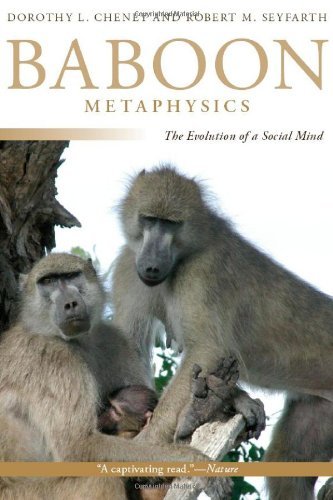
26. Baboon Metaphysics: The Evolution of a Social Mind
by Dorothy L. Cheney, Robert M. Seyfarth
Hardcover: 358 Pages (2007-05-15)
list price: US$27.50 -- used & new: US$17.23
(price subject to change: see help)
Asin: 0226102432
Average Customer Review: 5.0 out of 5 stars
Canada | United Kingdom | Germany | France | Japan
Editorial Review

Book Description

In 1838 Charles Darwin jotted in a notebook, “He who understands baboon would do more towards metaphysics than Locke.” Fifteen years ago, following the extraordinary success of their How Monkeys See the World, Dorothy Cheney and Robert Seyfarth set out to take up Darwin’s challenge. Baboon Metaphysics is their fascinating response.

Cheney and Seyfarth set up camp in Botswana’s Okavango Delta, where they could intimately observe baboons and their social world. Baboons are a perfect model for such a study because they live in groups of up to 150, including a handful of males and eight or nine matrilineal families of females. Such numbers force baboons to form a complicated mix of short-term bonds for mating and longer-term friendships based on careful calculations of status and individual need. The result is enough interpersonal drama to rival Jane Austen, as the baboons make and break alliances and try to anticipate the actions of their friends and rivals, all while avoiding frequent attacks by predators.

But Baboon Metaphysics is concerned with much more than just baboons’ social organization—Cheney and Seyfarth aim to fully comprehend the intelligence that underlies it. How do baboons actually conceive of the world and their place in it? Using innovative field experiments, the authors test whether baboons understand kinship relations, how they make use of vocal communication, and how they manage the stress and dangers of life in the wild. They learn that for baboons, just as for humans, family and friends hold the key to mitigating the ill effects of grief, stress, and anxiety.

Written with a scientist’s precision and a nature-lover’s eye, Baboon Metaphysics gives us an unprecedented and compelling glimpse into the mind of another species.
... Read more

Customer Reviews (9)

5-0 out of 5 stars Thought provoking analysis of baboons
The team of Dorothy Cheney and Robert Seyfarth has collaborated on numerous publications, including a fine book, "How Monkeys See the World."This represents an ambitious addition to their body of work. A takeoff point is a quotation from Charles Darwin's notebooks, from 1838 (Page 1): "Origin of man now proved--Metaphysic must flourish--He who understands baboon would do more toward metaphysics than Locke." The authors use the Cambridge English Dictionary to define metaphysics (Page 2): "the part of philosophy that is about understanding existence and knowledge."

The authors have been studying baboons for many years.This book summarizes much of their work and indicates the ingenious experiments that they have devised to assess baboons' thought processes and to explore if they possess something like a "theory of mind."They consider, in the process, the extent of "social intelligence" in baboons.At the outset, they propose two general points that guide their analysis of "baboon metaphysics": (1) natural selection leads to a brain for any species that are specialized for the relevant survival needs; (2) baboons have great expertise in navigating social life, since they live in relatively complex social systems.

Key chapters in this volume:

Chapter 3: The dangerous world in which baboons live is well portrayed.Predators pose a danger.Another unfortunate factor of baboon life is infanticide.If a new male enters a troop and becomes dominant, for instance, he may try to kill all young baboons.In this manner, the new male is in a position to begin reproducing very soon with female baboons who lost their infants; he is able, as a result, to increase the amount of his genetic material in the troop through siring his own infants.

Chapters 4 and 5 are critical, as they lay out the very different social worlds of male and female baboons.In either sex, dominance hierarchies are central.Males strive to attain the alpha ranking, that is, being the most dominant male in the troop. Male hierarchies are unstable, leading to considerable social stress.Females' hierarchies are more complex and more stable.Among females, their lineage is important.Each lineage has its own ranking, so one is either born into a top ranking, middle ranking, or low ranking family.Successfully managing to thrive in this social order calls for a high level of social skills.

Baboons, as Chapter 6 emphasizes, have quite good "social knowledge."The understanding of how baboon society works is based on (Pages 118-119) ". . .an innate predisposition to recognize other individuals' ranks and social relationships." Chapter 7 builds on this with a discussion of the social intelligence of baboons, with the authors emphasizing the criticality of baboons' understanding of how to navigate complex social life in a way that facilitates their survival and successful reproduction.The chapter concludes with an interesting discussion of how baboons' social intelligence differs from that of other species, as a result of the evolutionary demands on baboons.

Chapter 8 focuses on the extent to which baboons have a "theory of mind," that is, understanding of the mental states of other baboons.The authors conclude that there might be (page 197) "vague intuition about other animals' intentions," but that there is nothing like a well formed ability among these animals to understand intentions and motivations of others.

The volume concludes in Chapter 12 with a summary discussion of "baboon metaphysics" and with speculation about the relevance of their research for understanding humans. With respect to the former, they conclude that baboons demonstrate that some animals can live in complex societies with a theory of mind and without language--if their mental abilities allow for "making sense" of how to navigate their complex social world. The latter discussion notes what differences could lead to humans having a theory of mind that baboons do not possess.

All in all, a remarkable book.It has value in helping us to understand baboons in their own terms; it helps think about the position of humans in nature and why we are unique (as all species are unique); it provokes reflection on the ability to reflect on oneself and others and try to understand why we behave as we do.Nice touches abound, as illustrated by a charming reference to characters from Jane Austen's novels to make points about individual baboons' behavior.

This is an ambitious work, and there will be questions.The authorsseem to overreach when exploring a theory of mind.It's almost as if they are using a human orientation to study baboons rather than focusing on baboons themselves. In some ways, I'm not sure that the theory of baboons' minds is so crucial as the authors do.The social intelligence part of the picture seems to me more important. Finally, using the philosophical term metaphysics in a baboon context may represent another reach too far.

Nonetheless, these are relatively minor points.The bottom line?A terrific book. . . .

4-0 out of 5 stars Uneven
Chapter 3 is as good nature writing as I have ever read; it is not to be missed even if you do not read the rest of the book.The last chapter is nicely written, and a good summary of the author's views.

Most of the book is very uneven.Much of it reads like a Ph.D. thesis.It is often repetitive and unnecessarily hard to follow.At the same time, it is easy to reach false conclusions, and the authors try to be very careful, relaxing only when providing their more general speculative theses, such as that social requirements are the impetus for primate cognitive evolution, and that social concepts provide the basis for language and even grammar (for another view, see Jerome A. Feldman's "From Molecule to Metaphor").The point they make about animal's much greater capacity for understanding language vs. producing language is well substantiated in the book, and it is a good way to think about much animal behavior such as that of dog.

Evenreaders like myself, who have read previous books about animal cognitive abilities and also child development (animals are frequently compared to young children of various ages),will learn things if they wade through all the book's pages.The authors point out that humans have different cognitive systems, so that people who are blind due to problems in the cortex, may be able to see even if they cannot consciously report on what they have seen, as proved by experiments.Well it turns out that the well known experiments showing the age at which children are first aware that others may have different beliefs than theirs, so that others may not know where something has been moved while the children were watching and they were not, is not the whole story.At younger ages, using different, evolutionary older cognitive systems, there is some awareness of other's beliefs, even if not conscious.

For whatever reason, the authors maintain a view that chimpanzees are not cognitively superior to monkeys, except for tool use.They do not even have as a reference any books by Franz de Waal, one of the leading authorities on chimpanzee mental abilities, and director of the "Center for the Advanced Study of Ape and Human Evolution".A good book by him is "Good Natured: The Origins of Right and Wrong in Humans and Other Animals."There is also a terrible "typo".On p. 40, it is stated that infanticide accounted for "at least 53% of all infant deaths".On p. 57 it is stated that "53% of all infants born during our study" died as a result of infanticide.The latter is a much stronger statement, since if 200 infants were born, 100 died, and 53 were victims of infanticide, the first statement would be true, but the 2nd would not.

5-0 out of 5 stars Baboons and the Social Mind
This is a scholarly book which is simultaneously entirely suitable for the general reader. None of Baboons, psychology, or metaphysics are my fields but I was utterly fascinated by the authors' research and their contribution to the concept of the social mind as important in the evolution of the human species.READ THIS!

5-0 out of 5 stars Thought-provoking
This is a work of scientific rigor and intuitive leaps.It clearly describes the social order of baboon society and draws fascinating inferences about the possibility of baboon cognition.The parallels to the evolution of cognition in early hominids are inescapable.

5-0 out of 5 stars Party Animals?
Charles Darwin once wrote of his belief that if we would learn something very important if we could but understand the behavior of baboon.

The authors of this enthralling book are widely known for their studies of primate behavior in the Okavango in Botswana, and set out to do just that: understand how behavior baboons live and organize their lives.

Baboons live in groups of up to 150 individuals, which include a few males and eight or nine matrilineal families of females. The account of the daily life of the group reads like the script of Survivor!

There is a complicated mix of personal relationships ranging from short-term bonds for mating to long-term friendships that lead to cooperative rearing of the young. There are intrigues that may involve alliances of two or three individuals all the way up to battles that involve three or four extended families.

What this tells us is that the survival of an individual baboon and his or her family depends on an ability to predict the behavior of others and arrange to form the most advantageous relationships. So are these just reflexive behaviors, or do baboons form models of the world and their place in it? In such a fluid social environment, to what extent can they deduce the motives of other baboons?

This book sets out to discover the intelligence that underlies this social organization. In the process we learn a lot about ourselves.

The book is divided into twelve chapters:
1. The Evolution of Mind
2. The Primate Mind in Myth and Legend
3. Habitat, Infanticide, and Predation
4. Males: Competition, Infanticide, and Friendship
5. Females: Kinship, Rank, Competition, and Cooperation
6. Social Knowledge
7. The Social Intelligence Hypothesis
8. Theory of Mind
9. Self-Awareness and Consciousness
10. Communication
11. Precursors to Language
12. Baboon Metaphysics

These are followed by an appendix, references and a good Index.

The social lives of baboons are fluid and highly complex, and that reflects a complex and adaptable social intelligence. This will not surprise most people who live with animals: Many of them have quite elaborate social systems, sophisticated emotions and quite well developed concepts of social propriety and even of right and wrong.

The authors write very well indeed. They share their enthusiasm and the implications of their work.

This is a terrific book that deserves a very wide readership, not least because it helps put to bed the notion that humans are the only species with a complex social life.

Humans may be different, but we are not that different.

Highly recommended.


Richard G. Petty, MD, author of Healing, Meaning and Purpose: The Magical Power of the Emerging Laws of Life ... Read more


27. The Sociobiology of Infant and Adult Male Baboons: (Monographs on Infancy)
by David Martin Stein
Hardcover: 256 Pages (1984-01-01)
list price: US$115.00 -- used & new: US$115.00
(price subject to change: see help)
Asin: 0893912654
Canada | United Kingdom | Germany | France | Japan
Editorial Review

Book Description
This volume analyzes the behaviorl interactions between infant and adult male baboons. The result is the first quantitative description of infant-adult male relations for any higher primate, including humans. The idea that emerges is that infant-adult male relations are far more complex than the mere paternal caretaking or exploitation that has previously been assumed, and these relations are specific, long-term, reciprocal, and beneficial to both infants and the adult males. The book also deals with many current topics of interest, including parental investment, kidnapping, altruism, food sharing, agonistic buffering, adoption, and infanticide. ... Read more


28. In Quest of the Sacred Baboon
by Hans Kummer
Paperback: 364 Pages (1997-12-22)
list price: US$29.95 -- used & new: US$4.15
(price subject to change: see help)
Asin: 069104838X
Average Customer Review: 5.0 out of 5 stars
Canada | United Kingdom | Germany | France | Japan
Editorial Review

Book Description

In a tale that begins at a zoo in Zurich and takes us across the deserts of Ethiopia to the Asir Mountains in Saudi Arabia, Hans Kummer recreates the adventure and intellectual thrill of the early days of field research on primates. Just as Jane Goodall and Dian Fossey introduced readers to the fascinating lives of chimpanzees and gorillas, Kummer brings us face to face with the Hamadryas baboon.

With their furry white mantles and gleaming red hindquarters, the Hamadryas appear frequently in the art of the ancient Egyptians--who may have interpreted the baboons' early morning grooming rituals as sun-worshiping rites. Back then, Hamadryas were thought to be incarnates of Thoth, the god of wisdom; today they are considered to have one of the most highly structured social systems among primates, very close, in some respects, to that of humans. In the 1960s, Kummer, after conflicts with nomadic warriors, managed to track down these elusive baboons near the Danakil Desert, and then followed them from dawn to dusk on their treks from one feeding place to another. His scientific account of this period reads like a travel memoir as he describes his encounters with the Hamadryas and the people with whom they share the desert.

Winding his way through cliffs and stubble, Kummer records the baboons' social life, from the development of pair relationships to the way an entire group decides where to march each day. Much like the human nomads who cope with the harsh demands of the desert environment, the Hamadryas maintain a society that is strict and patriarchal in its details but multilayered and flexible in its largest units. We learn, for example, of the Hamadryas' respect for possession that protects family structure and of the cohesion among family leaders that lessens the threat of battle. At the same time, clear-cut personalities emerge from Kummer's account, drawing us into the life stories and power struggles of individual baboons. Whereas this rich detail holds many implications for natural scientists, the colorful way it comes to life makes for a compelling book bound to entertain and educate all readers.

... Read more

Customer Reviews (1)

5-0 out of 5 stars Science writing at its best
This is popular science writing at its best.Hans Kummer summarizes a lifetime's work with one of the most fascinating primate species there is.He is an eloquent writer and a superb scientist who really knows his subject.I assign this book to my primatology classes because he explains difficult concepts well and because he clearly outlines his thought processes as his research program unfolded in a way that helps students learn how to think scientifically.Hans Kummer is one of very few scientists who has used experimental approaches to analyze social dynamics in the field, and his experiments are eye-openers.His accounts of life in the field nicely supplement his detailed accounts of the animals' lives.Anyone interested in the nuts and bolts of social relationships will love this book.It is a must read for all primatologists, but it should be of interest to anyone who is interested in social relationships or the evolution of social behavior.The writing is definitely engaging enough to hold the attention of non-professionals. ... Read more


29. Beach Troop of the Gombe (The Primates)
by Timothy W. Ransom
 Hardcover: 319 Pages (1981-02)
list price: US$46.50 -- used & new: US$46.50
(price subject to change: see help)
Asin: 0838717047
Canada | United Kingdom | Germany | France | Japan

30. Foraging for Survival: Yearling Baboons in Africa
by Stuart A. Altmann
Paperback: 617 Pages (2000-04-15)
list price: US$47.50 -- used & new: US$39.99
(price subject to change: see help)
Asin: 0226015963
Canada | United Kingdom | Germany | France | Japan
Editorial Review

Book Description

Stuart A. Altmann presents the results of one of the most intensive investigations ever carried out on foraging behavior and its consequences for survival and reproduction.

"This book is destined to become a classic in primate feeding behavior. It is exhaustive and a pleasure to read, and it sets the standard for amalgamation of modeling theory and ecological observation."—Joanna E. Lambert, American Scientist

"The gold standard for research on naturalistic behavior and ecology of primates."—Peter S. Rodman, American Journal of Primatology

... Read more

31. Foraging for Survival: Yearling Baboons in Africa
by Stuart A. Altmann
 Hardcover: 617 Pages (1998-08-15)
list price: US$85.00 -- used & new: US$39.47
(price subject to change: see help)
Asin: 0226015955
Average Customer Review: 5.0 out of 5 stars
Canada | United Kingdom | Germany | France | Japan
Editorial Review

Book Description

Stuart A. Altmann presents the results of one of the most intensive investigations ever carried out on foraging behavior and its consequences for survival and reproduction.

"This book is destined to become a classic in primate feeding behavior. It is exhaustive and a pleasure to read, and it sets the standard for amalgamation of modeling theory and ecological observation."—Joanna E. Lambert, American Scientist

"The gold standard for research on naturalistic behavior and ecology of primates."—Peter S. Rodman, American Journal of Primatology

... Read more

Customer Reviews (2)

5-0 out of 5 stars This is a great book intended to ecology specialists
A review of this book has been published in the following journal:

Houle, A. (1999). Book-Review: Foraging for survival: Yearling baboons in Africa. Behavioural Processes. (in press)

5-0 out of 5 stars This book is destined to become a classic in primatology.
This is a story of how eleven juvenile baboons feed themselves.The setting: Amboseli National Park, Kenya.This is, however, much more than a simple story.Throughout, Altmann engages the reader with his elegantanalysis - rich with ecological detail - of the costs and benefits primatesmust negotiate in their daily pursuit of requisite nutrients and energy. Baboons are exemplary eclectic omnivores;still, as Altmann quotes, "thereis no such thing as a free lunch."Bearing this in mind, he sets out toevaluate the balancing act baboons must achieve in maximizing nutrientintake, while at the same time minimizing toxic accumulation of plantsecondary metabolites.

At the outset, Altmann describes what thebaboons ate, how they ate it, and what foods they avoided altogether duringthe study period (1975-1976).He then identifies what baboons should eat. A foraging strategy is an ultimate endpoint, achieved via an array ofpotential tactical routes.Altmann evaluates both the feeding tactics andthe eclectic foraging strategy of his young baboons by identifying thedegree to which they deviate from an optimum model of adaptive feedingtraits. The baboons' actual dietary intake is compared to thespecifications of adequate and optimal diets; this is done for both anaverage yearling's diet, as well as on individual variance from thepredicted diets.

Deviations from the optimum are viewed as indicatorsof potential differences in reproductive fitness.Although the feedingdata stem from research undertaken in the mid-1970s, Altmann takesadvantage of the two succeeding decades to relate differences in juvenilediets to longevity and fitness outcomes later in life.This historicaldepth is particularly valuable because it tests the model by evaluatingwhether those baboons that come closer to the optimum as juveniles havehigher fitness as adults.

Altmann expands on the extreme selectivityexhibited by baboons, providing details on the toxic load, protein,carbohydrate, water content, and load of various plant species and themanner in which baboons maximize (or minimize) their intake of these foodcomponents.Finally, he assesses the anatomical and behavioral attributesthat may contribute to making baboons one of the most successful andbroadly distributed primate species.To complement the main body of thetext, Altmann includes a series of appendices and tables in which heevaluates various methodological and definitional issues relating tocalculating feeding bouts and dietary intake.Here, he presents additionaldetail on diet composition and the nutritional and toxic attributes ofplant foods.

The work's emphasis on juvenile feeding behavior is anunusual yet valuable feature.This developmental stage is often overlookedin studies of non-human primate behavior and ecology, despite the fact thatthis period, and the transition from a milk diet to an adult diet, areundoubtedly critical to our understanding of adult fitness and life historypatterns.

However, some caution is warranted: This book was not intendedfor the casual student of animal feeding behavior, nor for those new tooptimal foraging theory.Altmann's models, food intake calculations, andfeeding bout formulae are exacting, and quite abstracted from theexperience of observing feeding behavior.Before embarking into thisvolume, non-modelers will have to review the technical terminology thatnecessarily accompanies Optimization Theory.In addition, I do not viewthe generalizations (outlined in Chapter Two) based on the relationshipsamong body size, patch size, and dietary selectivity to be particularlyilluminating.Too many exceptions to his proposed relationships can befound for such generalizations to be of much explanatory utility.

Nonetheless, this book is destined to become a classic in primatefeeding behavior.It is exhaustive in its breadth, a pleasure to read, andsets the standard for amalgamation of modeling theory and ecologicalobservation. ... Read more


32. A Belizean Rain Forest: The Community Baboon Sanctuary
by Robert H. Horwich, John Lyon
 Paperback: 420 Pages (1990-08)
list price: US$18.00 -- used & new: US$18.00
(price subject to change: see help)
Asin: 0963798200
Canada | United Kingdom | Germany | France | Japan
Editorial Review

Book Description
A tropical rain forest primer for Belize and nearby countries, this authoritative and entertaining book is a must for travelers, students, teachers and conservationists.Written by internationally renowned zoologist Dr. Robert Horwich and ecologist Dr. Jon Lyon, and now in its third printing, A Belizean Rain Forest offers detailed yet easy to read descriptions of the flora, fauna natural history and people of the Community Baboon Sanctuary. Conveniently arranged by topic, this book allows the reader to quickly look up in-depth information on subjects of interest.It gives a thorough understanding of the importance of the rain forest and also presents a community-based method of rain forest conservation. ... Read more


33. The seed-eaters: A new model of hominid differentiation based on a baboon analogy (Warner modular publication)
by Clifford J Jolly
 Unknown Binding: 22 Pages (1973)

Asin: B00072MLIK
Canada | United Kingdom | Germany | France | Japan

34. The menstrual cycle of the primates (Proceedings of the Zoological Society of London)
by Solly Zuckerman Zuckerman
 Unknown Binding: Pages (1932)

Asin: B0008COZB0
Canada | United Kingdom | Germany | France | Japan

35. Soon, Baboon, Soon
Hardcover: 32 Pages (2005-03-17)
list price: US$14.99 -- used & new: US$7.28
(price subject to change: see help)
Asin: 0399242686
Average Customer Review: 4.0 out of 5 stars
Canada | United Kingdom | Germany | France | Japan
Editorial Review

Book Description
Here comes a drummer. Here comes another.
Hey, it's time for The Percussion of the Apes!
All the primates have a part: monkeys play bongos, chimpanzees playtympani, orangutans bang everythang, gorilla's got a gong!
But when will it be Baboon's turn?
And will he be ready when it comes?
Newcomer Dave Horowitz brings electrifying rhythmic energy to a cast of musically inclined primates and proves in his inimitable way that patience is a virtue. ... Read more

Customer Reviews (1)

4-0 out of 5 stars captivating and fun
the colors were brilliant and each page was more vivd than the one before.the enticing world of the colors made you want to pick up the book. i read it and instantly fell in love with the story as well.

i cant wait to get the book and share it with my children and their school...

good luck to the author/illustrator...an amazingly talented childrens writer...how refreshing !!

... Read more


36. Primates (Publications, Science & Mathematics Texts)
by W.C.Osman Hill
 Hardcover: 750 Pages (1984-01-01)

Isbn: 0852240368
Canada | United Kingdom | Germany | France | Japan

37. Behavior of captive marmosets and tamarins (Callitrichidae): A bibliography, 1975-1987
by Jean Balch Williams
 Unknown Binding: 19 Pages (1987)

Asin: B00070Z4NG
Canada | United Kingdom | Germany | France | Japan

  Back | 21-37 of 37
A  B  C  D  E  F  G  H  I  J  K  L  M  N  O  P  Q  R  S  T  U  V  W  X  Y  Z  

Prices listed on this site are subject to change without notice.
Questions on ordering or shipping? click here for help.

site stats