e99 Online Shopping Mall

Geometry.Net - the online learning center Help  
Home  - Authors - Tacitus (Books)

  Back | 21-40 of 100 | Next 20
A  B  C  D  E  F  G  H  I  J  K  L  M  N  O  P  Q  R  S  T  U  V  W  X  Y  Z  

click price to see details     click image to enlarge     click link to go to the store

 
$11.59
21. The Annals and The Histories By
 
22. Tacitus. Volume II.
 
$52.78
23. Tacitus: Histories Book I (Cambridge
$74.50
24. The Annals of Tacitus: Book 3
$153.73
25. Germania (Clarendon Ancient History
$22.67
26. Two Centuries of Roman Prose:
$7.45
27. Agricola and Germany (Oxford World's
 
28. Ten Studies in Tacitus
 
29. The Complete Works of Tacitus
$19.96
30. Tacitus: Annals I (Bristol Latin
$17.18
31. Tacitus (Ancients in Action) (Ancients
$61.75
32. The Annals of Tacitus: Volume
$35.95
33. Tacitus
 
$13.99
34. Great Books of the Western World;
$4.36
35. The Madness of Nero (Penguin Epics)
$78.33
36. Tacitus: 2 volumes (Oxford University
$26.99
37. Tacitus: Dialogus (Tacitus)
$13.95
38. The Reign of Tiberius, Out of
$30.57
39. The Annals Of Tacitus, Books 1-4:
 
40. The Annals of Tacitus

21. The Annals and The Histories By P. Cornelius Tacitus. Great Books of the Western World 15
by Robert M., Tacitus Hutchins
 Hardcover: Pages (1952)
-- used & new: US$11.59
(price subject to change: see help)
Asin: B000N8O1G8
Canada | United Kingdom | Germany | France | Japan

22. Tacitus. Volume II.
by Sir Ronald. TACITUS. SYME
 Hardcover: Pages (1967)

Asin: B000JNI4LU
Canada | United Kingdom | Germany | France | Japan

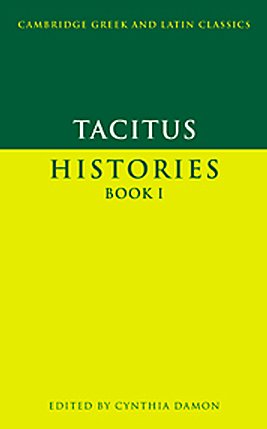
23. Tacitus: Histories Book I (Cambridge Greek and Latin Classics)
by Tacitus
 Hardcover: 338 Pages (2003-01-27)
list price: US$90.00 -- used & new: US$52.78
(price subject to change: see help)
Asin: 0521570727
Average Customer Review: 4.0 out of 5 stars
Canada | United Kingdom | Germany | France | Japan
Editorial Review

Book Description
As the first historical work by Rome's greatest historian, the Histories hold a crucial place in the study of Latin literature. Book I covers the beginning of the infamous "Year of the Four Emperors" (69 c.e.), which brought imperial Rome to the brink of destruction after the demise of the Julio-Claudian dynasty. Its account of the ensuing power struggles is unmatched for detail and interest. This edition includes the Latin text and provides a complete commentary accessible to students of intermediate level as well as an extensive introduction discussing historical, literary and stylistic issues. ... Read more

Customer Reviews (1)

4-0 out of 5 stars Great commentary, poor copy editing.
Tacitus was a brilliant writer who I imagine would have felt at ease in a round table with Toynbee, Mommsen, Hegel, or any of the other historiography giants. If I could score him separately he would undoubtedly receive 5 stars. Jump anywhere into either the Historiae or the Annales and you can immediately recognize his unparalleled command of Latin prose. His relentless attention to word choice and construction bespeaks a continuous and boundless energy which leaves the reader with no desire to pause. The speeches are near-Thucydidean in rhetorical richness. Well-calculated ambiguities, sly moral insinuation, and a modern comprehension of multi-linear storytelling coalesce into a largely logical framework and a very reliable masterpiece of history. Lastly, Thomas Jefferson admired him as being "the first modern author" and that's gotta count for something.

Damon does very well in fleshing out omitted material where Tacitus' style becomes terse and she has done wonderful comparative work with Suetonius, Cassius Dio, Plutarch, and a few others. She does not often seem as interested in the linguistic aesthetic as I would have liked and I missed this after having had more insights when reading the Annales. Nevertheless, her perceptive observation shines when pointing out Tacitus' subtle verbal manipulation to create dramatic irony between seemingly disparate excerpts in the Historiae.

The only major drawback to this edition of Hist. Liber I is the copy editing. Every single page of the text contained at least one typo, be it a missed space, added space, or letters mistakenly added/dropped. Usually this did not affect comprehension (but I vividly remember when an "e" should have been an "et"!) and having Damon's commentary more than makes up for the egregious publication flaws. The typographical inaccuracies herein are more frequent and glaring than in any professionally published book I have yet encountered, and I suspect that Damon has given a few people at Cambridge an earful of well-deserved complaint.

Do buy this edition. Damon is highly intellectually stimulating if you like Tacitus. If you're doing research her inferences from other classical historians will be tremendously helpful. ... Read more


24. The Annals of Tacitus: Book 3 (Cambridge Classical Texts and Commentaries)
by Tacitus
Paperback: 534 Pages (2004-08-26)
list price: US$90.00 -- used & new: US$74.50
(price subject to change: see help)
Asin: 0521609461
Average Customer Review: 5.0 out of 5 stars
Canada | United Kingdom | Germany | France | Japan
Editorial Review

Book Description
The Annals of Tacitus, which chronicle the years AD 14-68, are arguably the greatest work of the greatest Roman historian. Book 3 of The Annals covers the years AD 20-22, a period including the trial of Calpurnius Piso for treason and the alleged murder of Germanicus. The editors are the first to compare a recently discovered record of this trial with Tacitus' narrative of the same events. Throughout the volume attention is paid to literary matters, and textual. linguistic and historical issues are treated fully. ... Read more

Customer Reviews (1)

5-0 out of 5 stars Definitive Primary Source On the History OfImperial Roman
I read this book for a graduate course in Roman history.It is an indispensable primary source for students of Roman history.

On the first page of his Annals of Imperial Rome, Tacitus wrote that Octavian "seduced the army with bonuses, and his cheap food policy was successful bait for civilians."Tacitus' description of Augustus' transformation of Rome from a republic into an empire is most illuminating as well."Upper-class survivors found that slavish obedience was the way to succeed, both politically and financially.They had profited from the revolution, and so now they liked the security of the existing arrangement better than the dangerous uncertainties of the old regime."

Sir Ronald Syme relied heavily on the work of Tacitus for his cogent narrative of Octavian's rise to power as Augustus.Syme's in-depth study of Tacitus' life and work was published in 1958.Tacitus' historical accuracy was doubted for centuries and Syme made a project of re-evaluating the accuracy of his historical writings.Syme believed that Tacitus was in a unique position to write about the birth and early political history of the Imperial period in Rome due to his very active political life.Tacitus had served as a senator, consul, and proconsul of Asia.In addition, he was known to be an excellent orator in his day.In his writings, Syme believed that Tacitus provided excellent accounts of Augustus' rise to power and his career as Rome's first Emperor.

Tacitus delved into the machinery of the new government, including Augustus' use of patronage as well as his many thwarted attempts at planning for his own succession.What Syme found was a man that grew very adept politically and whose political maturity rapidly developed at an early age.At eighteen, he was named as heir to Julius Caesar.He grew into the greatest Roman princeps spanning fifty-six years until his death.Augustus knew that to retain power he had to maintain the general consent of the governed.He astutely maintained order not by following the constitution or past precedent, but by using the tremendous resources at his disposal.Augustus kept the plebeians in check making sure they were fed, kept them amused with games, and constantly reminded them that he was protecting them from the oppression of the nobiles.

Augustus became the "leader of a large and well organized political party as the source and fount of patronage and advancement."

Recommended reading for those interested in Roman history, military history.
... Read more


25. Germania (Clarendon Ancient History Series)
by Tacitus
Hardcover: 360 Pages (1999-11-29)
list price: US$248.00 -- used & new: US$153.73
(price subject to change: see help)
Asin: 0198150504
Average Customer Review: 4.5 out of 5 stars
Canada | United Kingdom | Germany | France | Japan
Editorial Review

Book Description
The Germania of Tacitus is the most extensive account of the ancient Germans written during the Roman period, but has been relatively neglected in the scholarship of the English-speaking world: the last commentary appeared in 1938, and only a handful of studies have appeared since that time. In recent decades, however, there have been important scholarly developments that significantly affect our understanding of it.Ongoing archaeological work in western and central Europe has greatly increased our knowledge of the iron-age cultures in those regions, while new anthropological and literary approaches have called into question some of the traditional assumptions that shaped the use of this text as a historical source.This new commentary, together with the extensive introduction, provides a current and comprehensive guide to the relevant textual and archaeological evidence and also examines the methodological issues involved in the interpretation of this important work. ... Read more

Customer Reviews (3)

4-0 out of 5 stars A reliable source of ancient history
The treatise Germania was written by the Roman historian Publis (or Gaius, his first name is uncertain) Cornelius Tacitus, who was born around 55 CE and is thought to have died circa 117 CE.A prominent citizen during the rule of the Emperor Trajan, Tacitus published Germania sometime around 98 CE, which was intended to provide crucial information about the warrior-barbarians inhabiting Rome's northern hinterlands.It is our only surviving source of information about the early Germans, thus providing data for which we would have no other resource.

Tacitus is considered one of antiquity's greatest historians, and his most prominent works (the Annals and the Histories) were primarily about the Roman Empire in the first century.He also penned three less ambitious works: the Agricola (a laudatory biography of his father-in-law), the Dialogus (a discussion of oratory in the style of Cicero), and Germania.Beyond his written works, little is known for certain about his life.A born aristocrat, his father was a commander of the Roman army garrisoned in Britain.Tacitus himself rose to prominence as a Roman senator while cultivating a well-deserved reputation as an eloquent orator and an effective lawyer (he successfully prosecuted Marius Priscus - proconsul of Africa - for corruption).Later appointed substitute consul under Nerva in 97 CE, he subsequently became proconsul of Asia (the western part of modern Turkey) around 112-113 CE.It is not known whether he fathered any children.

Germania is an ethnographic account of the cultures comprising the northern European tribes, who thus far had successfully resisted conquest by Rome.The essay - along with an earlier account in 58 BCE by Julius Caesar entitled De Bello Gallico - comprises the only surviving report on the domestic lives, habits, and beliefs of these second century Teutonic barbarians who lived in what today comprises Germany and Eastern Europe.Sprinkled liberally among various facts about the region, Tacitus simultaneously compares the "decadence" of Rome with German virility, strict monogamy, and self-reliance by idealistically portraying the various Germanic tribes as rugged and noble in sharp contrast to his characterization of Rome as corrupt and immoral.In this comparison, Tacitus makes use of facts, myths, and half-truths to idealize many facets of the German society.In addition to his analysis of the history and varied social structures among the German tribes, Tacitus also provides a detailed description of the geography and climate of their territory.

Each of Germania's passages deals with a particular area of German civilization.The first half of the account consists of a generalized description of the inhabitant's origin and the lands, laws and customs of the region.Tacitus then spends the second half presenting a geographical account of the locations of the main German tribes - beginning with those who live closest to Roman territory and ending on the shores of the Baltic with a description of the savage Fenni living a life mired in stone-age poverty.An interesting note: Among the Baltic coast tribes listed by Tacitus were the Anglii who, four hundred years later, invaded Britain and successfully conquered the Romanized Celts while renaming the island Angla-land (England).

Although taking notice of their habitual drunkenness, laziness, and barbarism, his purpose in writing the book appears to be primarily moralistic, extolling the virtues of Germanic simplicity, bravery, honor, and fidelity while simultaneously warning of the havoc that could ensue should these "noble savages" ever cease fighting amongst themselves and turn their attention south toward Italy ("May the Gods continue to perpetuate amongst these nations, if not any love for us, yet by all means this their animosity and hate towards each other, since whilst the destiny of the Empire thus urges it,fortune cannot more signally befriend us, than in sowing strife amongst our foes.").Though replete with sociological opinions, the book serves primarily as a concise, factual treatise on the culture and geography of the German region.

Though displaying a pro-German bias and unapologetic admiration in his observations of their culture, Tacitus wishes to improve - not replace - Roman society with the "nobler" aspects of German society. The work is clearly moralistic in its structure, as Tacitus' descriptions of German habits, customs, and family life are compared favorably with "old fashioned" Roman Republican ideals.Tacitus longs for the Republic's idealized Roman virtues, bemoaning the Roman Empire's degeneration.

He portrays the Germans as a people who have maintained their freedom and their pride, both highly valued universally, while uncompromisingly maintaining their individual cultures in the shadow of the great Roman Empire.They are illiterate and live in huts while farming and hunting for sustenance.But they thrive, and Tacitus seems to believe that freedom, even in poverty, is preferable to wealth and modernity in captivity.The work, however, is not objective; it is a picture of the "simple Germans" glorified by comparison with the corruption and luxurious immorality of the Romans.The moral purpose and severe criticism of contemporary Rome, fallen from the virtuous vigor of the old republic, is a common theme.

Mention is made in several sections of mythological occurrences, with both Hercules and Ulysses prominently featured.The author also occasionally mentions traditional folklore as a source of information.Considering the personal danger a Roman citizen could expect while wandering around these foreign and barbaric surroundings, it is reasonable to assume that Tacitus made liberal use of oral and written second-hand accounts, historical lore and legends in the compilation of his book. It must be remembered, though, that Roman military excursions into this territory had been commonplace for two hundred years, so one can assume that Tacitus had the means of obtaining accurate information on the character and history of the Germans.His account of German customs and institutions can therefore be assumed to be reliable.

The treatise is a concise and instructive document produced by one of the preeminent philosophical historians of the ancient world.The intrinsic credibility of the author makes it a reliable source of ancient historical and geographical information.Furthermore, the political maxims and moral sentiments interwoven for the sake of instruction are merely incidental and in no way detract from the abundant factual and methodically presented documentation.As the only detailed account of German culture in the ancient world, Tacitus' rich and instructive Germania provides us with an invaluable glimpse of life beyond Rome's influence in Eastern Europe

5-0 out of 5 stars Ausgezeichnet
The book suggests it is for scholars and post-graduate researchers.I admire the thought of being a scholar, but this is book for anyone with an interest in the structure of the ancient Germanic world.Every phrase is dissected.Alternative interpretations of text, possible errors, conflicting theories on every facet of the text of Tacitus's monumental work fill page after page.In the process, onesees beyond Tacitus into minute details of the Germanic past, the very nature of their existence.References to other scholarly works is vast!Critique is refined, balanced, meticulous.Who knows, maybe even a Frenchman would like this book.Now.I said it.

5-0 out of 5 stars More than another translation
In this Clarendon Ancient History Series edition, James Rives has given usmuch more than another translation. Enough background materials andcommentary are provided to give a reader all that is needed for an informedunderstanding of this important historical text.

Conflicting theories aretreated in an even-handed manner and the author's conclusions are wellreasoned. The actual text is an easy to read, yet pleasingly accurateversion of the original Latin in which the surviving copies of the Germaniawere written.

A hefty price for a paperback, but in this instance it isone justified by the wealth of information the book contains. ... Read more


26. Two Centuries of Roman Prose: Extracts from Cicero, Nepos, Sallust, Livy, Petronius, Seneca, Pliny and Tacitus
by Eberhard Christoper Kennedy
Paperback: 281 Pages (2002-01-28)
list price: US$23.50 -- used & new: US$22.67
(price subject to change: see help)
Asin: 1853994952
Canada | United Kingdom | Germany | France | Japan
Editorial Review

Product Description
Extracts from Cicero, Nepos, Sallust, Livy, Petronius, Seneca, Pliny and TacitusIn Latin with notes and introductory material in English. ... Read more


27. Agricola and Germany (Oxford World's Classics)
by Tacitus
Paperback: 224 Pages (1999-09-23)
list price: US$13.95 -- used & new: US$7.45
(price subject to change: see help)
Asin: 0192833006
Average Customer Review: 5.0 out of 5 stars
Canada | United Kingdom | Germany | France | Japan
Editorial Review

Book Description
`Long may the barbarians continue, I pray, if not to love us, at least to hate one another.' Cornelius Tacitus, Rome's greatest historian and the last great writer of classical Latin prose, produced his first two books in AD 98.He was inspired to take up his pen when the assassination of Domitian ended `fifteen years of enforced silence'.The first products were brief: the biography of his late father-in-law Julius Agricola and an account of Rome's most dangerous enemies, the Germans.Since Agricola's claim to fame was that as governor for seven years he had completed the conquest of Britain, begun four decades earlier, much of the first work is devoted to Britain and its people. The second is the only surviving specimen from the ancient world of an ethnographic study.Each in its way has had immense influence on our perception of Rome and the northern `barbarians'.This edition reflects recent research in Roman-British and Roman-German history and includes newly discovered evidence on Tacitus' early career. ... Read more

Customer Reviews (4)

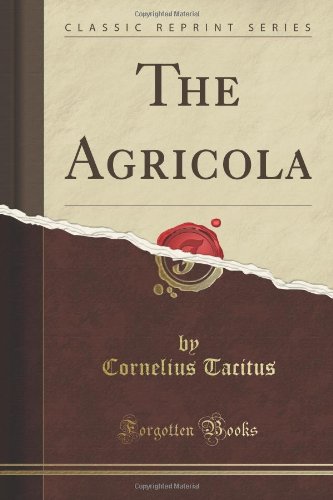
5-0 out of 5 stars A review of A. R. Birleyýs translation of Tacitusý Agricola
Finally after 91 years of"scholarly" and mediocre translations of The Agricola by self appointed "learned academics"A. R. Birley has produced a work that demonstrates why Tacitus has been regarded as among the best historians and rhetoricians of antiquity.The beauty and the elegance of the original is apparent in this translation, that has been lacking since the translation of W. H. Fyfe in 1908.The love and the sense of loss that Tacitus had for his father in law is still apparent to us, who live two thousand years after them.

To illustrate the superiority of this translation a few examples follow:

The first example is the translation of the term "divus"as in "divus Augustus" or "divus Claudius".Fyfe translated this term as sainted, and Birley as deified.Both of these seem to be adequate renditions of the term. However the Leob Classical Library's translation, by M. Hutton, translates the term as "of happy memory."Thisis curious because in their edition they compare the original Latin on the left with the English on the right. One would think that one of Leob's editors would have just looked at the Latin to see if it at least resembled the English.But this is even preferable to the Penguin translation, by H. Mattingly revised by S. A. Handford, wherein they just dropped the term altogether.Apparently Messrs. Mattingly, Handford, and Hutton felt that we the reading public wouldn't understand roman titles of respect and sought to protect us from this pagan ritualism.

A second example occurs near the end of the third chapter when Tacitus laments the passage of fifteen years due to the tyranny of Domitian.Birley's(and Fyfe's was similar)translation reads; "So many years have been stolen from the middle of our lives, years in which those of us who were youths have become old men and the old men have reached almost the end of their allotted span - in silence." The Penguin translation reads;"since so many of our best years have been taken from us - years in which men in their prime have aged and old men have reached the extreme limit of mortality, without ever uttering a word."The Leob translation has, "for out of our prime have been blotted fifteen years, during which young men reached old age and old men the very bounds almost of decrepitude, and all without opening their lips."Apparently the Leob and Penguin translators wanted us (the reading public) to understand that the young are now old and the old almost dead,but in their haste to "dumb-down" the original they sacrificed the beauty, the brevity and the profound nature of Tacitus.Furthermore the Leob and Penguin translators apparently didn't realize that it was "us" that had aged and not other "young men" who had aged.

The final example is from the last paragraph of the Agricola. Birley's translation reads; "Many of the men of old will be buried in oblivion, inglorious and unknown.Agricola's story has been told for posterity and he will survive." The Penguin translation is close and reads; "With many it will be as with men who had no name or fame: they will be buried in oblivion.But Agricola's story is set on record for posterity, and he will live."But the Leob translation gives us; "Many of the ancients will forgetfulness engulf as though neither fame nor name were theirs. Agricola, whose story here is told, will outlive death, to be our children's heritage."The remarkable thing about the Leob translation is that it doesn't even resemble the Latin original with spurious details about children's heritage and engulfing forgetfulness.That is bad but Penguin is worse because the editors added a note that this last passage is "strange".They didn't realize that Tacitus had lifted a line from Horace.One must wonder why these "scholars" learned Latin in the first place if theyweren't going read and study the classics.Maybe Penguin's editors simply thought we, the public, would be oblivious to other classical writers and would learn to hate the Romans as they so obviously do.

There are many other examples in both the Agricola and the Germania that I could quote however; that would serve no purpose. In conclusion this translation of the Agricola reminds me of why I admire and respect the writers of antiquity.Perhaps the reason that the ancients are no longer esteemed isn't because they are no longer relevant to our age but because of the miserable quality of recent translations.

5-0 out of 5 stars Agricola and Germania
This book contains a pair of early works by the great Roman historian Tacitus. Agricola is an homage to the historian's father-in-law, a Roman governor in Britain during the 1st century A.D. Germania describes the German people and their culture during the same period.

The author's admiration for his late father-in-law is manifest in Agricola. Sometimes his admiration comes across as tender, sometimes as fawning. Tacitus writes near the crest of Roman world-domination (Americans take note). He frequently adopts the tone of a tourist in a third-world country -- sometimes looking down his nose at local customs, sometimes in fascination at a primitive culture that compares favorably to a Roman empire suffering decay and corruption. He is a loyal Roman and an educated man. As such, he can glorify Rome and, in the same breath, criticize Rome's tyranny and empathize with the empire's victims. Tacitus lends an eloquent voice to Rome's enemies and those facing enslavement. The speech (probably apocryphal) of Caledonian warlord Calgacus before the climactic battle of the Graupian mountain may be the best section of either book. Backed up to the northern tip of modern Scotland, Calgacus tries to rally his men before battle. "Now there is no people beyond us," he says, "nothing but tides and rocks and, more deadly than these, the Romans ... They have pillaged the world ... They plunder, they butcher, they ravage, and call it by the lying name of empire. They make a desert and call it peace."

Tacitus has no personal connection to any person in the second book, Germania. His writing is more sterile here, but he provides a captivating description that seems part based on observation and part on rumor.

Tacitus is a pithy writer, given to understatement and the wry aside. The translator does a tremendous job of carrying these qualities across in English. Important books both, Agricola and Germania provide some of our only glimpses of the early ancestors of the English people, the Anglo-Saxons and the Britons.

5-0 out of 5 stars Beautiful writing.Fascinating. A very `readable' Classic.
Tacitus' opens up a lost world before the Christians in what was, for many of us, our mother countries - Britian and Germany.The book is divided in two; the first piece `Agricola' (farmer)is named after the father-in-law ofTacitus.Tacitus gives us part biography and part eulogy in order toconfer immortality on Agricola's memory at the edge of Empire among thebarbarians. Agricola was loved and honoured by Tacitus, and Tacitus givesan account of his military and political triumphs before being called toRome. For anyone interested in early British history, warfare or paganthemes observed first hand, this is a must have.

The second part is anamazing series of geograpgical, religious, and general culturalobservations among the Germans. In this age of political correctness,Tacitus' observations are a delicious treat of unfettered notation ofracial difference and character that still ring guiltily true about theGermans (good and bad), especially in the first half of the last century. "Their holy places are the woods and groves, and they call by the nameof god that hidden presence which is seen only by the eye ofreverence." ... "They count, not like us, by days, but bynights." ... "No form of approval can carry more honour thanpraise expressed by arms."

Great stuff.Short, entertaining andinformative of another time and place.

5-0 out of 5 stars Anyone interested in Rome needs to read Tacitus
This is a good edition of two of Tacitus' works, the Agricola, which is a short biography of his father-in-law, and the Germania, a look at the Roman view of the Germans (timely at the moment in view of the opening scenes ofRidley Scott's film "Gladiator"). I am especially fond of theAgricola, in particular the last few pages, where Tacitus is finished withthe biography and can speak about Agricola like a son. His love andadmiration for his father-in-law still reaches us, almost 2000 years later.Anyone interested in Rome owes it to themselves to read the sourcedocuments, and this is a good start. ... Read more


28. Ten Studies in Tacitus
by Ronald Syme
 Hardcover: 160 Pages (1970-06-25)

Isbn: 0198143583
Canada | United Kingdom | Germany | France | Japan

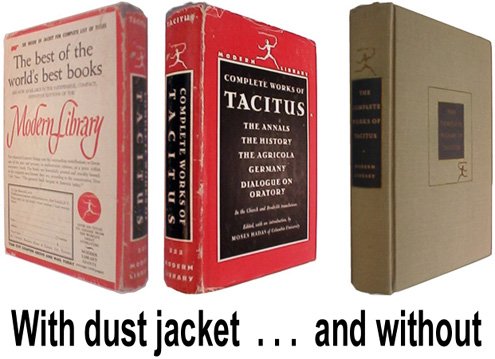
29. The Complete Works of Tacitus (Modern Library, 222.1)
 Hardcover: Pages (1942)

Asin: B000E62GAM
Canada | United Kingdom | Germany | France | Japan

30. Tacitus: Annals I (Bristol Latin Texts Series)
Paperback: 272 Pages (2002-09-18)
list price: US$23.50 -- used & new: US$19.96
(price subject to change: see help)
Asin: 1853993581
Average Customer Review: 5.0 out of 5 stars
Canada | United Kingdom | Germany | France | Japan

Customer Reviews (1)

5-0 out of 5 stars Definitive Primary Source On the History OfImperial Roman
I read this book for a graduate course in Roman history.It is an indispensable primary source for students of Roman history.

On the first page of his Annals of Imperial Rome, Tacitus wrote that Octavian "seduced the army with bonuses, and his cheap food policy was successful bait for civilians."Tacitus' description of Augustus' transformation of Rome from a republic into an empire is most illuminating as well."Upper-class survivors found that slavish obedience was the way to succeed, both politically and financially.They had profited from the revolution, and so now they liked the security of the existing arrangement better than the dangerous uncertainties of the old regime."

Sir Ronald Syme relied heavily on the work of Tacitus for his cogent narrative of Octavian's rise to power as Augustus.Syme's in-depth study of Tacitus' life and work was published in 1958.Tacitus' historical accuracy was doubted for centuries and Syme made a project of re-evaluating the accuracy of his historical writings.Syme believed that Tacitus was in a unique position to write about the birth and early political history of the Imperial period in Rome due to his very active political life.Tacitus had served as a senator, consul, and proconsul of Asia.In addition, he was known to be an excellent orator in his day.In his writings, Syme believed that Tacitus provided excellent accounts of Augustus' rise to power and his career as Rome's first Emperor.

Tacitus delved into the machinery of the new government, including Augustus' use of patronage as well as his many thwarted attempts at planning for his own succession.What Syme found was a man that grew very adept politically and whose political maturity rapidly developed at an early age.At eighteen, he was named as heir to Julius Caesar.He grew into the greatest Roman princeps spanning fifty-six years until his death.Augustus knew that to retain power he had to maintain the general consent of the governed.He astutely maintained order not by following the constitution or past precedent, but by using the tremendous resources at his disposal.Augustus kept the plebeians in check making sure they were fed, kept them amused with games, and constantly reminded them that he was protecting them from the oppression of the nobiles.

Augustus became the "leader of a large and well organized political party as the source and fount of patronage and advancement."

Recommended reading for those interested in Roman history, military history.
... Read more


31. Tacitus (Ancients in Action) (Ancients in Action)
by Rhiannon Ash
Paperback: 144 Pages (2006-10-13)
list price: US$20.00 -- used & new: US$17.18
(price subject to change: see help)
Asin: 1853996874
Canada | United Kingdom | Germany | France | Japan
Editorial Review

Product Description
Tacitus is arguably the most significant writer of the Roman imperial period. His biting creativity is best known to us through his historical narratives. The Histories ruthlessly depicts the disastrous civil wars which exploded in AD 68-9, while the Annals chillingly documents the murky principles of the Julio-Claudian emperors from Tiberius to Nero. Tacitus is driven throughout by a desire to reveal escalating corruption and selfish ambitions and to demonstrate how and why such a debased world evolved after the death of Augustus. This book sets Tacitus clearly in context, surveying all his works and clarifying the traditions of ancient writing that informed and shaped his narratives. It also traces how his works have been used and abused in subsequent eras. ... Read more


32. The Annals of Tacitus: Volume 2, Annals 1.55-81 and Annals 2 (Cambridge Classical Texts and Commentaries)
by Tacitus
Paperback: 498 Pages (2004-05-20)
list price: US$65.00 -- used & new: US$61.75
(price subject to change: see help)
Asin: 0521604338
Average Customer Review: 5.0 out of 5 stars
Canada | United Kingdom | Germany | France | Japan
Editorial Review

Book Description
This book is the second volume of one of Professor Goodyear's greatest works of Latin literature and one of the most important sources for the history of the Roman Empire. His edition is accompanied by a major commentary which deals fully with textual, linguistic, literary, and historical matters. Every question is examined afresh. The discussion ranges widely, but not loosely. It is the editor's aim to explain Tacitus as a whole, not just particular features of his writing. The task he has undertaken is very large for there is a vast amount which needs explanation in the subject-matter and in its presentation. The results should benefit students of Latin literature and Roman history equally. ... Read more

Customer Reviews (1)

5-0 out of 5 stars Definitive Primary Source On the History OfImperial Roman
I read this book for a graduate course in Roman history.It is an indispensable primary source for students of Roman history.

On the first page of his Annals of Imperial Rome, Tacitus wrote that Octavian "seduced the army with bonuses, and his cheap food policy was successful bait for civilians."Tacitus' description of Augustus' transformation of Rome from a republic into an empire is most illuminating as well."Upper-class survivors found that slavish obedience was the way to succeed, both politically and financially.They had profited from the revolution, and so now they liked the security of the existing arrangement better than the dangerous uncertainties of the old regime."

Sir Ronald Syme relied heavily on the work of Tacitus for his cogent narrative of Octavian's rise to power as Augustus.Syme's in-depth study of Tacitus' life and work was published in 1958.Tacitus' historical accuracy was doubted for centuries and Syme made a project of re-evaluating the accuracy of his historical writings.Syme believed that Tacitus was in a unique position to write about the birth and early political history of the Imperial period in Rome due to his very active political life.Tacitus had served as a senator, consul, and proconsul of Asia.In addition, he was known to be an excellent orator in his day.In his writings, Syme believed that Tacitus provided excellent accounts of Augustus' rise to power and his career as Rome's first Emperor.

Tacitus delved into the machinery of the new government, including Augustus' use of patronage as well as his many thwarted attempts at planning for his own succession.What Syme found was a man that grew very adept politically and whose political maturity rapidly developed at an early age.At eighteen, he was named as heir to Julius Caesar.He grew into the greatest Roman princeps spanning fifty-six years until his death.Augustus knew that to retain power he had to maintain the general consent of the governed.He astutely maintained order not by following the constitution or past precedent, but by using the tremendous resources at his disposal.Augustus kept the plebeians in check making sure they were fed, kept them amused with games, and constantly reminded them that he was protecting them from the oppression of the nobiles.

Augustus became the "leader of a large and well organized political party as the source and fount of patronage and advancement."

Recommended reading for those interested in Roman history, military history.
... Read more


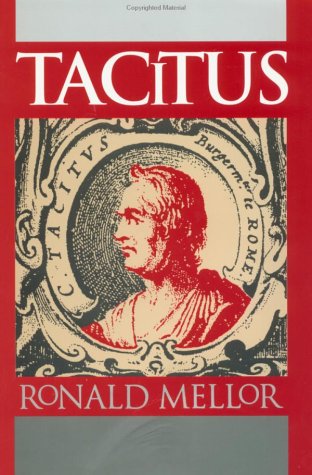
33. Tacitus
by Ronald Mellor
Paperback: 200 Pages (1994-11-02)
list price: US$35.95 -- used & new: US$35.95
(price subject to change: see help)
Asin: 0415910021
Canada | United Kingdom | Germany | France | Japan
Editorial Review

Book Description
The histories of Roman senator Cornelius Tacitus constitute the most influential examination of tyranny, political behavior and public morality from the classical age. For centuries these portraits of courageous martyrs to freedom, of paranoid tyrants, and of sycophantic flatteres and informers shaped modern political attitudes. Ronald Mellor provides a compelling analysis of the ideas of the greatest historian of evil in the western intellectual tradition.

In Tacitus, Ronald Mellor passionately argues for reclaiming this ironic genius whose cynical world view is particularly well-suited to an analysis of the tyranny and brutality in our own century.

Tacitus is presented as a moralist, psychologist, political analyst and literary artist. Tacitus' greatest impact has never been on historians. Rather, his political vision and dramatic images left their mark on painters, poets and thinkers. ... Read more


34. Great Books of the Western World; Volume 15; the Annals and the Histories By P. Cornelius Tacitus
by P Cornelius; Hutchins, Robert Maynard (Editor in Chief); Mortimer J. Adler, Assoc. Editor; Translated By Alfred John Church and William Jackson Brodribb Tacitus
 Hardcover: Pages (1952)
-- used & new: US$13.99
(price subject to change: see help)
Asin: B000CRFVXM
Canada | United Kingdom | Germany | France | Japan

35. The Madness of Nero (Penguin Epics)
by Tacitus
Paperback: 144 Pages (2006-12-26)
list price: US$8.95 -- used & new: US$4.36
(price subject to change: see help)
Asin: 0141026863
Canada | United Kingdom | Germany | France | Japan

36. Tacitus: 2 volumes (Oxford University Press Academic Monograph Reprints)
by Ronald Syme
Hardcover: 872 Pages (1980-06-05)
list price: US$145.00 -- used & new: US$78.33
(price subject to change: see help)
Asin: 0198143273
Average Customer Review: 4.5 out of 5 stars
Canada | United Kingdom | Germany | France | Japan
Editorial Review

Book Description
This now-classic work seeks to place Tacitus in his social and political context.Syme not only analyzes in detail Tacitus's writings, their development and style, but also his political career, using his progress through government to illustrate the process that brought new men from the
western provinces to success and primacy at Rome. ... Read more

Customer Reviews (2)

5-0 out of 5 stars Definitive Exploration On Imperial Rome's Great Historian
I read this book for a graduate course in Roman history.It is an indispensable primary source for students of Roman history.

On the first page of his Annals of Imperial Rome, Tacitus wrote that Octavian "seduced the army with bonuses, and his cheap food policy was successful bait for civilians."Tacitus' description of Augustus' transformation of Rome from a republic into an empire is most illuminating as well."Upper-class survivors found that slavish obedience was the way to succeed, both politically and financially.They had profited from the revolution, and so now they liked the security of the existing arrangement better than the dangerous uncertainties of the old regime."

Sir Ronald Syme relied heavily on the work of Tacitus for his cogent narrative of Octavian's rise to power as Augustus.Syme's in-depth study of Tacitus' life and work was published in 1958.Tacitus' historical accuracy was doubted for centuries and Syme made a project of re-evaluating the accuracy of his historical writings.Syme believed that Tacitus was in a unique position to write about the birth and early political history of the Imperial period in Rome due to his very active political life.Tacitus had served as a senator, consul, and proconsul of Asia.In addition, he was known to be an excellent orator in his day.In his writings, Syme believed that Tacitus provided excellent accounts of Augustus' rise to power and his career as Rome's first Emperor.

Tacitus delved into the machinery of the new government, including Augustus' use of patronage as well as his many thwarted attempts at planning for his own succession.What Syme found was a man that grew very adept politically and whose political maturity rapidly developed at an early age.At eighteen, he was named as heir to Julius Caesar.He grew into the greatest Roman princeps spanning fifty-six years until his death.Augustus knew that to retain power he had to maintain the general consent of the governed.He astutely maintained order not by following the constitution or past precedent, but by using the tremendous resources at his disposal.Augustus kept the plebeians in check making sure they were fed, kept them amused with games, and constantly reminded them that he was protecting them from the oppression of the nobiles.

Augustus became the "leader of a large and well organized political party as the source and fount of patronage and advancement."

Recommended reading for those interested in Roman history, military history.

4-0 out of 5 stars More Genius from Syme
This book is not for the faint of heart -- and I hesitated for some time over how to rate this book. One does require a working knowledge of Tacitus' life and of Roman history and traditions. The book was written in the late 1950's when, annoyingly, certain classicists felt that it was beneath them to translate their citations from the original latin. Today we often regard this practice as having the patina of snobbishness and elitism. Again and again one encounters paragraphs where the key thought is embodied (entombed is more like it!)in one of Tactitus' remarks -- but in Latin!

This however, is a quibble. There is enough of this book that is readable to render it a vastly worthwhile undertaking. But be prepared! Have a good translation of Tacitus to hand -- together with a classical dictionary, a latin dictionary and Barrington's recently published Atlas of the Ancient World (which, by the way, was one of the most wondrous things to be published in the last few decades).

If you are prepared to put the work in, Syme, and Tacitus, will reward you. Victor Davis Hanson referred to The Roman Revolution, Syme's more accessible work, as a work of "Tacitean brilliance". And there is no question that Tacitus style and wit have rubbed off on Syme.

Here is Syme, encapsulating Cicero, on the writing of history:

"Now the fundamental laws of history, as all men know and concede, are veracity and honesty. But history calls for style and composition. It is not enough to record the events, they must be interpreted and judged, with movement and eloquence in keeping. The orator will supply what is needed."

And on the Roman view of the afterlife:

"The shadowy hope of a shadowy existence did not convince the traditional Roman of the governing order. The sole and solid propect of survival lay in good deeds, with good repute thereafter to posterity. Hence the preoccupation with fame -- sharp, insistent, and dominant. Even philosophers, who impugned the validity of the opinion, could not deny or repel the tempations of glory."

Let there be no mistake about it, Syme was one of the most thought-provoking and influential scholars of the last century. His death was a terrible loss. Syme's Tacitus is an excellent study (for it is not a biography)of Tactius, his work and his times. But the road to this book lies through The Roman Revolution -- read that first. If it is to your taste, drive on! ... Read more


37. Tacitus: Dialogus (Tacitus)
Paperback: 222 Pages (1997-07-09)
list price: US$27.00 -- used & new: US$26.99
(price subject to change: see help)
Asin: 1853995193
Canada | United Kingdom | Germany | France | Japan
Editorial Review

Book Description
This book remains the standard edition of the "Dialogus", providing a comprehensive treatment of the problems of authorship, date, form and style. This volume is intended to meet the needs of students and scholars increasingly working on ancient rhetoric, as the "Dialogus" constitutes an important link between the rhetorical works of Cicero on the one hand and Quintilian's "Institutio Oratoriae" on the other. ... Read more


38. The Reign of Tiberius, Out of the First Six Annals of Tacitus; With His Account of Germany, and Life of Agricola
by Caius Cornelius Tacitus
Paperback: 182 Pages (2006-11-03)
list price: US$13.95 -- used & new: US$13.95
(price subject to change: see help)
Asin: 1406938327
Canada | United Kingdom | Germany | France | Japan

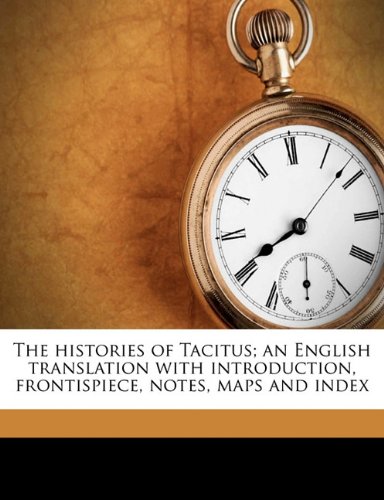
39. The Annals Of Tacitus, Books 1-4: An English Translation, With Introduction, Notes And Maps (1904)
by George Gilbert Ramsay
Paperback: 532 Pages (2007-11-03)
list price: US$40.95 -- used & new: US$30.57
(price subject to change: see help)
Asin: 0548724709
Canada | United Kingdom | Germany | France | Japan

40. The Annals of Tacitus
 Mass Market Paperback: Pages (1966)

Asin: B000IE8UMS
Canada | United Kingdom | Germany | France | Japan

  Back | 21-40 of 100 | Next 20
A  B  C  D  E  F  G  H  I  J  K  L  M  N  O  P  Q  R  S  T  U  V  W  X  Y  Z  

Prices listed on this site are subject to change without notice.
Questions on ordering or shipping? click here for help.

site stats