e99 Online Shopping Mall

Geometry.Net - the online learning center Help  
Home  - Authors - Simenon Georges (Books)

  Back | 21-40 of 100 | Next 20
A  B  C  D  E  F  G  H  I  J  K  L  M  N  O  P  Q  R  S  T  U  V  W  X  Y  Z  

click price to see details     click image to enlarge     click link to go to the store

$6.47
21. The Hotel Majestic (Penguin Mysteries)
$18.24
22. The Rules of the Game
$6.95
23. Monsieur Monde Vanishes (New York
$7.00
24. The Engagement (New York Review
$44.99
25. Maigret Bides His Time
$22.22
26. Inspector Maigret's Case Files
$49.00
27. Tout Simenon
$7.49
28. The Man Who Watched Trains Go
$9.43
29. Three Crimes (Modern Voices)
$42.87
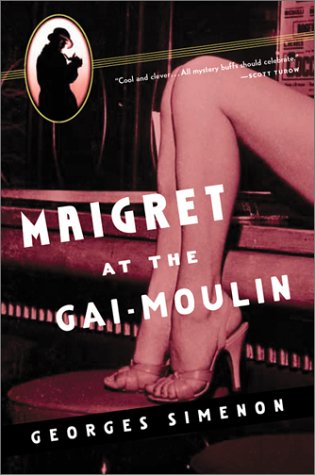
30. Maigret at the Gai-Moulin
$79.95
31. Tout Simenon Vol 1: La Fenetre
$7.00
32. Simenon: A Biography
$3.23
33. Tropic Moon (New York Review Books
$7.24
34. Three Bedrooms in Manhattan (New
$15.99
35. Georges Simenon:'Maigrets' and
$4.94
36. Maigret's Christmas
$5.25
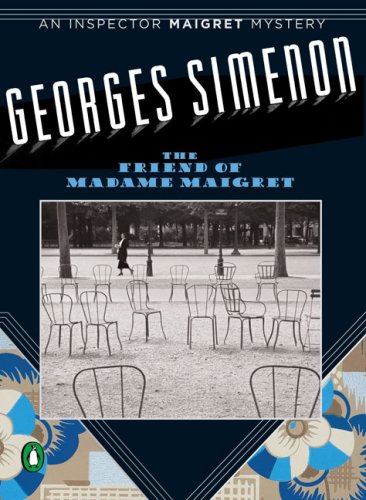
37. Friend of Madame Maigret (Inspector
$29.98
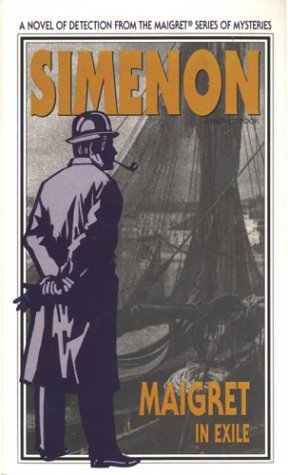
38. Maigret in Exile (Maigret Series
 
$26.95
39. Maigret and the Minister
$34.99
40. Inspector Maigret and the Strangled

21. The Hotel Majestic (Penguin Mysteries)
by Georges Simenon
Paperback: 176 Pages (2006-12-26)
list price: US$12.00 -- used & new: US$6.47
(price subject to change: see help)
Asin: 0143038451
Average Customer Review: 4.0 out of 5 stars
Canada | United Kingdom | Germany | France | Japan
Editorial Review

Book Description
Penguin delivers two more vintage Inspector Maigret novels by the legendary mystery author

In The Hotel Majestic, Maigret investigates the murder of Mrs. Clark, the wife of a wealthy American industrialist, whose strangled body is found in the basement of an upscale hotel near the Champs-Élysées. Maigret’s inquiries take him from the endless corridors of the Hotel Majestic to the countryside of the Bois de Boulogne and sun-drenched Cannes, into a world of prostitution, drug addiction, and blackmail. ... Read more

Customer Reviews (1)

4-0 out of 5 stars Welcome to the Hotel Majestic
Georges Simenon was the author of over 100 Inspector Maigret mystery stories. They were immensely popular in the 1930s through the 1960s. Inspector Maigret stories also appeared in film and TV version. Simenon also authored dozens of books described as "romans durs", `hard stories' that had a darker tone than his Maigret novels.Simenon seems to have fallen under the radar in recent decades but in recent years he seems to have been rediscovered by a new generation of mystery/detective story fans. Penguin Books has begun to reissue some of those Maigret mysteries and the New York Review of Books Press has reissued some of his `hard stories', dark novels that did not feature Inspector Maigret. Penguin's latest Inspector Maigret Mystery reissue, "The Hotel Majestic" is as good a place to start for anyone wishing to discover (or re-discover) Simenon.

As with most police procedurals, the Hotel Majestic begins with a dead body.Mrs. Clark, a guest traveling with her wealthy American husband, their child and a governess, has been found murdered and stuffed into an empty locker in the basement of the Hotel Majestic.Maigret arrives to begin the investigation. His investigation quickly draws him into two parallel words: the world upstairs of champagne and caviar and the world downstairs filled with hotel employees eking out a living.Maigret's investigation begins with an examination into how and why these two different worlds collided in this brief but deadly incident.From there he proceeds to interview everyone and anyone who might have information about the crime of the victim.Maigret is no Sherlock Holmes.For Maigret, crimes are to be solved by a process of accumulating as much information as possible and then analyzing that information based on his past experience.Maigret plays hunches to be sure but Maigret's chief weapon is perseverance and determination.Consequently, the reader is presented with information about the crime and the protagonists in real time along with Maigret.As I read these stories I find myself absorbing these bits of information and trying to weigh them against the information previously disclosed.This served to keep me engaged throughout the book and caused me to keep turning page after page until the `final curtain'.

Simenon has a keen ear for dialogue and character development.Maigret is not a character that is revealed to the reader immediately. Simenon doesn't set about to provide you with a character map to Maigret's personality in any one book. Rather, he grows on you over time. He has an innate disdain for higher authority that is appealing. Simenon's settings and other characters also add a dash to his Maigret mysteries. These are not parlor room mysteries where the reader has to determine which upper-class member of the gentry (or the butler) committed murder most foul in the library. Simenon's stories have the feel of grit and the demimonde about them that adds a bit of spice to the `formula'.In Hotel Majestic, Simenon's description of the hard-streets and dark bars of Paris and the people that inhabit them all seem quite fully realized to me.

All in all, I find Simenon's Maigret mysteries to be consistently entertaining.They may not be as dark or foreboding as the novels released by New York Review of Books - but it you like well-written, taut, police procedurals you will like Georges Simenon's Hotel Majestic.Recommended. L. Fleisig
... Read more


22. The Rules of the Game
by Georges Simenon
Hardcover: 154 Pages (1988-11)
list price: US$18.95 -- used & new: US$18.24
(price subject to change: see help)
Asin: 0151694753
Average Customer Review: 4.0 out of 5 stars
Canada | United Kingdom | Germany | France | Japan

Customer Reviews (1)

4-0 out of 5 stars Discreet Harm to the Bourgeoisie
Georges Simenon was nothing if not prolific in both his literary and public life. Born in Belgium in 1903, Simenon turned out hundreds of novels. Simenon's obsession with writing caused him to break off an affair (he was prolific in this area of his life as well) with the celebrated Josephine Baker in Paris when he could only write twelve novels in the twelve month period in which they were involved.Simenon's novels were immensely popular in the 1930s through the 1970s and many of his novels (particularly the Inspector Maigret stories) appeared in film and TV versions. Simenon also authored dozens of books that he described as "romans durs", roughly translated as`hard stories' that had a darker tone than his Maigret novels. Simenon seems to have fallen under the radar in recent decades but in recent years he seems to have been rediscovered by a new generation of mystery/detective story fans. Penguin Books has begun to reissue some of those Maigret mysteries and the New York Review of Books Press has reissued some of his `hard stories'.However, my appetite for Simenon has caused me to look beyond the recent reissues. A recent trip to my public library brought me to "The Rules of the Game".

"The Rules of the Game" was written in 1955 and translated and published in the United States in 1988.It is set in suburban Connecticut.(After World War II, for reasons related to accusations that he was sympathetic to the occupying forces and the Vichy Regime, Simenon moved to the United States and spent a few years in Connecticut.) Walter Higgins is a supermarket manager.He is a stolid, predictable, married father of four living in a house that stretches his economic resources to the fullest.He is also enormously (and understandably) proud of the fact that he has lifted himself through diligence and hard work from a less than happy and economically depressed childhood.He plays by the rules. He goes to church and volunteers in any number of community organizations.He seeks affirmation of his status by applying for membership in the local country club. He is told his membership is a sure-thing and is devastated when he is told that he has been blackballed, denied entry by means of a secret vote of the club's membership committee.Each member of that committee was known to Higgins and he thought of each as a friend and colleague in the community.The rejection turns Higgins's life upside down and the rest of the story takes us on the journey Higgins takes as the trauma of rejection hits him.

"Rules of the Game" provides a fascinating, contemporary look at life in the U.S. of the 1950s.Since it was written in 1955, Simenon's examination of the hidden cracks in the life-style of suburban America in the age of Ozzie and Harriet seems a bit ahead of its time.In a way, Simenon's look at the unraveling of Higgins life after the jolt of rejection is mildly reminiscent to the unraveling of Willy Loman's life in Miller's "Death of a Salesman".Higgins' reaction to `failure' (in his eyes) is not nearly as dramatic as Loman's but it does provide some warning that the American Dream does have cracks that even the most stolid members of its society can fall through.

"Rules of the Game" is a good example of the craft of Simenon.It is certainly worth reading if you can find a copy online or in your local library. My library has a nice collection of out-of-print Simenon's and I'll be back there soon for another Simenon.L. Fleisig
... Read more


23. Monsieur Monde Vanishes (New York Review Books Classics)
by Georges Simenon
Paperback: 192 Pages (2004-07-31)
list price: US$12.95 -- used & new: US$6.95
(price subject to change: see help)
Asin: 1590170962
Average Customer Review: 4.0 out of 5 stars
Canada | United Kingdom | Germany | France | Japan
Editorial Review

Book Description
Monsieur Monde is a successful middle-aged businessman in Paris. One morning he walks out on his life, leaving his wife asleep in bed, leaving everything. Not long after, he surfaces on the Riviera, keeping company with drunks, whores and pimps, with thieves and their marks. A whole new world, where he feels surprisingly at home—at least for a while.

Georges Simenon knew how obsession, buried for years, can come to life, and about the wreckage it leaves behind. He had a remarkable understanding of how bizarrely unaccountable people can be. And he had an almost uncanny ability to capture the look and feel of a given place and time. Monsieur Monde Vanishes is a subtle and profoundly disturbing triumph by the most popular of the twentieth century's great writers. ... Read more

Customer Reviews (5)

5-0 out of 5 stars Psycological novel
This is a great book but one would never read it if one merely read the back cover copy which is totally inaccurate -- so inaccurate that one suspects the writer of the copy has never read the book.I have read M. Monde Vanishes many times in French (La Fuite de M. Monde) and given dozens copies of this excellent English translation to friends and acquaintances.M. Monde learns, in the course of his adventures after he flees his unhappy existence, that true freedom comes from inside -- one does not have to tear one's life apart, one can to change one's perspective.In Simenon's usual concise, brilliant style.

4-0 out of 5 stars "Let's take a boat to Bermuda
Let's take a plane to Saint Paul.
Let's take a kayak to Quincy or Nyack,
Let's get away from it all."

I have to admit that Frank Sinatra version of "Let's Get Away From it All" kept entering my consciousness as I read George Simenon's "Monsieur Monde Vanishes".The upbeat nature of the song is not remotely like the dark, reflective tone of Simenon's story but if you have ever sat in your office on a dreary day or sat in your home on a humdrum evening and just wondered what it would be like to just walk away from your life and start fresh somewhere else then you will have some understanding and, perhaps, sympathy for a man who wakes up one morning and decides to get away from it all.

Simenon was nothing if not prolific in both his literary and public life. Born in Belgium in 1903, Simenon turned out hundreds of novels. Simenon's obsession with writing caused him to break off an affair (he was prolific in this area of his life as well) with the celebrated Josephine Baker in Paris when he could only write twelve novels in the twelve month period in which they were involved. Although perhaps best known for his Inspector Maigret detective novels, Simenon also wrote over a hundred novels that he referred to as `romans durs' (literally "hard novels"). As with many of his contemporaries such as Chandler and Hammett, Simenon's books were marketed and sold as popular, almost pulp fiction. Also like Chandler and Hammett, Simenon's books have stood up well over time. The New York Review of Books publishing division has reissued much of Simenon's books. They are well worth reading and "Monsieur Monde Vanishes" is an excellent place to start.

As with virtually all his protagonists in these hard stories, Monde is a stolid, middle-class member of the establishment.Based in Paris, Monde runs the family export/import business. His is a life of regular habits, from the time he wakes up, through his work day and then through the evening.He is married (a second wife) and has children.Beneath this surface regularity lies a yearning to get away, to just leave everything behind and as the book opens Monde does just that. The rest of the novel explores Monde's journey, his new identity, the places he goes (the French coast) and the people he meets.He sheds his stolid identity like someone sheds their clothing at night and finds himself in a world entirely different from the one he leaves behind.The reader witnesses this transformation in what can be best described as something of a voyeuristic fashion.

Simenon's hard novels are often referred to as psychological novels but I find that term a bit misleading. Simenon does not analyze. He does not delve deep into his protagonists' minds. He presents the reader with a slice of the human condition and lets the reader deal with the implications, the psychoanalysis if you like. They do offer glimpses into his protagonists' lives even though (or perhaps because) he does not fill in the blanks for you. His character's actions speak for themselves and what they have to say is not always pleasant. In "Monsieur Monde" we are not presented with an explanation for Monde's acts. They are simply provided to the reader.It is up to us to judge them or analyze them if we so choose.In a world of fiction filled with happiness and redemption and the ultimate triumph of good against evil, Simenon is a breath of fresh (if pessimistic) air. "Monsieur Monde" does break away from this mold a bit as I found there was a bit more `closure' (a hackneyed word to be sure but it seems suitable for use here) in "Monsieur Monde" than in some of his other works.Unlike some of his other books we see someone reclaim some of the responsibility he walked away from.However, the question that Simenon poses is a critical one, is the Monde that reenters the world left behind the same man?

"Let's take a trip in a trailer
No need to come back at all.
Let's take a powder to Boston for chowder,
Let's get away from it all."

"Monsieur Monde Vanishes" was an enjoyable book to read. Highly recommended.L. Fleisig

4-0 out of 5 stars Businessman's Vacation
One of the values of Amazon's recommendation software is that you are directed to authors with whose work you may not be familiar and who are not carried on the shelves of most bookstores.This is how I found Monsieur Monde Vanishes.It is an economical and very visual book even though the visuals are of mostly unremarkable venues: cheap hotel rooms, the back office of a nightclub, train stations, etc.The narrative value, however, lies partly in bringing such sites to life.

The largely passive Monde exits his successful life in Paris to allow another life in Nice to happen to him.In the end, this change enables him to return to his prior existence possessed of enhanced stature with his business, his wife and his son.The breaking of his life pattern, even though he is compelled to return to it, seems to give Monde additional power over his environment.

Read this book and get swept up in the rhythm of an unspectacular life that is likely different than your own in detail but not in method.

4-0 out of 5 stars A Wonderful Imaginary Diversion
A good friend of mine recommended Simenon books to me. This story is about a successful, middle-aged man who, obsessed with pursuing another life, one day decides to remove himself from everything that he has called his own. Leaving no trace of himself, he uproots himself and heads off in no particular direction. As he continues on his adventure, he encounters a number of enemies and companions all of whom help him realize a new self-awareness. But in the midst of this new comfort, his old life invades. He must then decide not only which life to embrace, but which self he will be.

Though this is the only book I've read so far from Georges Simenon, I'm certain it will not be the last. I appreciated his ability to write with a great economy of words and yet penetrate deep into my imagination. His style is simple, his story is believable, and the questions he raises are not easy to answer. All around, a good, challenging book.

For a full review go to my blog in my screen name and click on the Readings category

4-0 out of 5 stars Beautifully understated, impressively human
Norbert Monde, a fourth-generation bourgeois Parisian businessman, "comes to his senses" on the afternoon of his forty-eighth birthday, withdraws 300,000 francs from his bank account, and promptly vanishes, abandoning his second wife, gay son, and money-grubbing daughter to their own devices.He surfaces in Marseilles where he is quickly drawn into a domestic crisis at a hotel and winds up living a new life among gamblers, drunks and prostitutes in Nice.He's happy, for a while, in realizing his lifelong ambition to be nobody other than a man in the street.But when his work at a nightclub brings his first wife, Therese, into his orbit, Monsieur Monde finds himself drawn back into the world of moral responsibility.Beautifully understated and impressively human, Simenon's take on the familiar "walking out on your life" tale is one of the better examples.In its empathy for the desperation of middle-class life, and for a man whose childhood values have fed into a lifetime of limited scope, it reminded me of that slim European classic, Patrick Suskind's novella "The Pigeon". ... Read more


24. The Engagement (New York Review Books Classics)
by Georges Simenon
Paperback: 160 Pages (2007-03-06)
list price: US$12.95 -- used & new: US$7.00
(price subject to change: see help)
Asin: 1590172280
Average Customer Review: 4.5 out of 5 stars
Canada | United Kingdom | Germany | France | Japan
Editorial Review

Book Description
On the outskirts of Paris, a prostitute is found murdered in a vacant lot. In a seedy apartment house nearby lives pasty, fat Mr. Hire. Mr. Hire, who earns his living through a petty postal scam, is a convicted pornographer, a peeping Tom, and, once a week, the unlikely star of a Parisian bowling club, where people think he works for the police. He is a faceless man of regular habits who keeps to himself and gives his neighbors the creeps. After the murder, Mr. Hire’s concierge points a finger at him: he was out late the night of the crime. The police have the suspect under 24-hour surveillance. They are only waiting for him to make the inevitable mistake and give himself away.

Except that creepy Mr. Hire is in fact an innocent man, whose only mistake is to have fallen head-over-heels in love with the wrong girl.

One of the most chilling and compassionate of Simenon’s extraordinary psychological novels, The Engagement explores the mystery of a blameless heart in a compromised soul. ... Read more

Customer Reviews (5)

5-0 out of 5 stars Simenonic genius
Georges Simeon was the ultimate spy.He perched on the edge of everyone's lives and wrote down in novel form exactly what he saw.The characters in his novels are more real than the characters in real life. All of the action takes place in a field that can only be described as the color gray-the rain cloud field in which our human tragedies and redemptions occur.

I don't know why in lists of great writers of the twentieth century Simenon is not listed - up there with the likes of Kafka, Joyce, Proust, Lovecraft, Chesterton, Djuna Barnes, and all of the other players.Simenon was born for the twentieth century - it finds its most major representation in no other writer.

5-0 out of 5 stars "Even from Mr. Hire's room, the goose bumps on her skin were visible."
No question that for Simenon, less is more, as this enormously talented writer in "The Engagement" sketches out the essential lines of his protagonists and their rather drab and robotic lives with such skill that he engages us at every turn. What's real to Simenon is desire, greed, and death. There's little room here for sentiment, and if you're looking for a sweet confection, you've definitely entered the wrong door.

Simenon has created a "modern" twentieth-century man, Mr. Hire, who really has no spiritual or moral center. He simply is a collection of habits and fears, spiced with perverse self-flagellating pleasures and one great but rather ridiculous skill. His alienation from society, which itself is presented as crude and hard and bordering on a violent mob, is sad and almost understandable, considering his dysfunctionality may have a basis in the gross nature of those who surround him. Yet his one soft spot is the highly sexual dairy maid, Alice, who lives directly across from him. Her little piece of paradise is so close that he can see right into her windows.

So goes this Hitchcockian plot as Mr. Hire's robotic life is disrupted by this seductress and by the police. Underlying this plot is Simenon's writing machinery, which carries with it a valueless worldview. The author is really telling us we all amount to very little in the end: a collection of habits, enactments of our desires, and vain hopes for a better life. Why we are who we are is not of any significance to what we do while we are here in this life.

I found this work to be extraordinary in its philosophical and psychological implications. Simenon was way ahead of his time as a writer and thinker. Not only that, his selection of detail and his ability to draw up whole scenes through the skillful use of the five senses could teach many a writer how to make the page come alive.

4-0 out of 5 stars When the Internal and External Collide
When a prostitute is murdered in an abandoned lot, all eyes look towards Mr. Hire as the suspect.The reader can certainly understand why.Hire makes his income in a petty postal scam and his main hobby is peeping on the woman across the courtyard as she undresses.His past is no better, with a conviction for petty sex offenses and some time in prison.No wonder the guy is in the crosshairs.

Yet THE ENGAGEMENT is one of Simenon's roman durs (hard novels) with more of a noir edge to them.Hire is innocent of the crime but, as is true for the roman durs, hardly innocent in any other application of the term.Hire's apparently empty internal world collides with the external as Hire realizes that some others, specifically the police, do not consider him to be as inconsequential as he thought.The scene in which Hire discovers at the train station that he is being watched and followed was among the most simple yet powerful scenes I have encountered of a character's horror at having his comfortable little world disturbed through no fault of one's own.

Despite his initial shock, Hire soon comes to enjoy being the center of someone's attention and starts showing off for the detectives on his tail.This excitement is heightened when the girl on whom Hire peeps starts showing some romantic interest.But in a morally vacuous world, it is all a ruse.Hire is being played for the sap.Even if the police knew of Hire's innocence, it is questionable whether they would care.They show the same apathy towards the lives of others as everyone else and seem less concerned with nabbing the real murderer than they are in getting the case behind them.They are just playing a different role in the game.

In his roman durs, Simenon shows no concern for issues of right and wrong.The amorality of the world simply is a given in which people are thrust and left to their own devices.It is an interesting world to visit while hoping we never find ourselves as its tenants.

4-0 out of 5 stars "You shall become engaged to a woman
but another man shall lie with her." Deuteronomy 28:30

Georges Simenon was nothing if not prolific in both his literary and public life. Born in Belgium in 1903, Simenon turned out hundreds of novels. Simenon's obsession with writing caused him to break off an affair (he was prolific in this area of his life as well) with the celebrated Josephine Baker in Paris when he could only write twelve novels in the twelve month period in which they were involved. Although perhaps best known for his Inspector Maigret detective novels, Simenon also wrote over a hundred novels that he referred to as `romans durs' (literally "hard novels").These hard stories typically involve a person's descent from normality (or a life that seems to bear the appearance of normality) into nihilism and despair.Usually there is a triggering event, a murder, a bankruptcy, or simply too much to drink on a road trip.The publishing arm of `"The New York Review" NYRB Books is reissuing Simenon's hard novels."The Engagement" is one of Simenon's earliest hard novels and it was hard to put down. The story line is rather a simple one.

Mr. Hire is a quiet man. But he isn't quiet in the way that he blends into the background. He's quiet in the way that his neighbors find him odd and more than a bit scary.Odd in such a way that children are pulled into their parent's apartment when he is heard walking around in his Paris apartment.And, critically for "The Engagement", odd in such a way that when a neighborhood prostitute is found murdered, the concierge in his apartment tells the police Hire is the culprit."The Engagement" is a study in contrasts.It gives us Mr. Hire, going about his daily business and gives us the police (with the helpful assistance of Hire's neighbors) going about their business and slowly obtaining enough information to arrest him for murder.

The storyline may not sound unique but the devil is always in the details. Simenon's prose may be direct and to the point but he manages to paint a compelling picture of his protagonists.Mr. Hire, the concierge, and the young girl across the street with whom Mr. Hire shares a voyeuristic relationship that holds the key to the story line, are all wonderfully drawn.Hire is not an attractive person yet this reader could not help but feel no small amount of empathy toward.It is hard to give examples without divulging too much of the plot. Suffice it to say that Simenon knows how to craft sentences that keep the reader turning page after page after page.

Simenon's hard novels are often referred to as psychological novels but I find that term a bit misleading.Simenon does not analyze. He does not delve deep into his protagonists' minds.He presents a story stripped of moralizing or analysis. He presents the reader with a slice of the human condition, usually an unpleasant slice, and lets the reader deal with the implications, the psychoanalysis if you like.They do offer glimpses into his protagonists' lives even though (or perhaps because) he does not fill in the blanks for you.His character's actions speak for themselves and what they have to say is not always pleasant.In a world of fiction filled with happiness and redemption and the ultimate triumph of good against evil, Simenon is a breath of fresh (if pessimistic) air. I recommend highly all of Simenon's romans durs and The Engagement is no exception.L. Fleisig

5-0 out of 5 stars NYRB brings out another of simenon's great psychological novels
Originally published in 1933, this slim volume already showcases Simenon's unique brand of realism, which eschews easy humanism in favor of a punishingly bleak moral universe.The story centers on Mr. Hire, the middle-aged son of working class immigrant parents.When a prostitute is murdered in his neighborhood, Hire's asocial habits, petty criminal record and ethically dubious profession leads the police to his door.Fed by the suspicions of vindictive neighbors, detectives tail him relentlessly, waiting for Hire to slip up and yield any evidence linking him to the crime.Readers of Simenon's so called 'romans durs' will find The Engagement to be an excellent early example of its type.Furthermore, the brief afterword by John Gray provides informative context for the novel as well as evidence of a rare instance of autobiographical sourcing. ... Read more


25. Maigret Bides His Time
by Georges Simenon
Paperback: 160 Pages (1992-09)
list price: US$3.95 -- used & new: US$44.99
(price subject to change: see help)
Asin: 0156551519
Average Customer Review: 5.0 out of 5 stars
Canada | United Kingdom | Germany | France | Japan
Editorial Review

Book Description
Maigret's longest-running case involves two decades of jewelry heists, a generation of conspiracy, and the revelation of a long-buried secret from World War II. “[Simenon could] turn the simplest of romans policiers into a moving and memorable form of art.” — The Times (London) “[Maigret's investigation] is a bittersweet elegy for the glory days of both thief and cop.” — Chicago Sun-Times ... Read more

Customer Reviews (2)

5-0 out of 5 stars A Twenty Year Mystery is Solved.
The setting is Paris in the early 1960's.The venerable Inspector Maigret is nearing retirement age and growing increasingly stout.Paris is hit once again by a series of jewell heists.Maigret has known for twenty years that the Corsican crime boss Manuel Palmari has been behind the crimes.Over the years, Maigret has developed respect and even professional admiration for Palmari.During the middle of the latest crime spree, the wheelchair bound Palmari is found murdered in his apartment.This is Maigret's opportunity to unravel a mystery that has been bothering him for 20 years.This story has all the classic elements that Jules Maigret fans love.

5-0 out of 5 stars A detective plagued by jewelry store heists ý in daylight
Georges Simenon's Maigret Bides His Time provides an unabridged Jules Maigret mystery telling of a detective plagued by jewelry store heists - in the daylight. The Parisian inspector has his hands full, and Clifford Norgate's background in Shakespearean drama brings the underlying drama to life in this mystery. ... Read more


26. Inspector Maigret's Case Files Murder: Murder a LA Carte
by Georges Simenon
Hardcover: Pages (1992-09)
list price: US$9.98 -- used & new: US$22.22
(price subject to change: see help)
Asin: 0883658100
Canada | United Kingdom | Germany | France | Japan

27. Tout Simenon
by Georges Simenon
Paperback: Pages (2003-01)
list price: US$49.95 -- used & new: US$49.00
(price subject to change: see help)
Asin: 2258060427
Canada | United Kingdom | Germany | France | Japan

28. The Man Who Watched Trains Go By (New York Review Books Classics)
by Georges Simenon
Paperback: 224 Pages (2005-06-10)
list price: US$12.95 -- used & new: US$7.49
(price subject to change: see help)
Asin: 1590171497
Average Customer Review: 4.5 out of 5 stars
Canada | United Kingdom | Germany | France | Japan
Editorial Review

Book Description
Kees Popinga is a solid Dutch burgher whose idea of a night on the town is a game of chess at his club. Or so it has always appeared. But one night this model husband and devoted father discovers his boss is bankrupt and that his own carefully tended life is in ruins. Before, he had looked on impassively as the trains to the outside world swept by; now he catches the first train he can to Amsterdam. Not long after that, he commits murder.

Kees Popinga is tired of being Kees Popinga. He's going to turn over a new leaf—though there will be hell to pay. ... Read more

Customer Reviews (3)

4-0 out of 5 stars Nihilism is not only despair and negation
but above all the desire to despair and to negate.Camus.

Despair and negation predominate in Georges Simenon's "The Man Who Watched Trains Go By", a book that I considered to be darker than noir.

Simenon was nothing if not prolific in both his literary and public life.Born in Belgium in 1903, Simenon turned out hundreds of novels.Simenon's obsession with writing caused him to break off an affair (he was prolific in this area of his life as well) with the celebrated Josephine Baker in Paris when he could only write twelve novels in the twelve month period in which they were involved.Although perhaps best known for his Inspector Maigret detective novels, Simenon also wrote over a hundred novels that he referred to as `romans durs' (literally "hard novels").As with many of his contemporaries such as Chandler and Hammett, Simenon's books were marketed and sold as popular, pulp fiction. Also like Chandler and Hammett, Simenon's books have stood up well over time. The New York Review of Books publishing division has reissued much of Simenon's books.They are well worth reading and "The Man Who Watch Trains Go By" is an excellent place to start.

The story's protagonist and narrator is Kees Poppinga.As the book opens Kees is seen and sees himself as a stolidly middle-class Dutch citizen living a life of relative comfort in the coastal town of Groningen.He is secure in his job as the manager of a ship's supply company.His sense of security is reflected in an attitude best described as smug and more than a bit conceited. On the surface, Kees' life seems well insulated from the harsher side of life.But Simenon shows us quickly that this appearance of security was really a thin veneer that could be washed away at a moment's notice.One night, Kees discovers that his company's owner has driven the company into bankruptcy.Kees will soon be out of the job and will likely lose everything he holds dear.

The rest of the book focuses on Kees' decent from smug satisfaction to nihilism and despair.Stripped of his middle-class sense of security Kees finds that he is also stripped of all those societal restraints that most civilized members of society have.Kees embarks on a journey of death, deceit, and madness.The only character trait that remains is one of conceit and superiority as he travel to Paris and falls in with the Parisian underworld.

The reader experience this journey through the narration of Kees and Simenon does an excellent job of allowing the reader to look out at the world through the eyes of a madman.It is something of an uncomfortable feeling but it made for compelling reason.I have already compared Simenon to Chandler and Hammett because they wrote in a similar genre and were contemporaries.As far as contemporary writers are concerned, the French-writer Michel Houellebecq (Elementary Particles) seems remarkably similar in both tone and style.

I have now read two of Simenon's romans durs and three of his Inspector Maigret mysteries.They have all been worth reading and if you are interested in either the detective genre or the type of dark psychological novel described here, Simenon is well worth discovering. L. Fleisig

5-0 out of 5 stars Captured by the author
Simenon in aslow but progressive manner has the ability to draw the reader into the life of the protaganist no matter how heinous the situation. This iswell manifest in this typical Simenon psychological thriller. Ifyou like this type of ouevre The Man Who WatchedTrains will fit the bill.

4-0 out of 5 stars Simenon's Existential Man
This book stands as evidence of the literary crime that has been perpetrated against the legacy of Georges Simenon over the last century.Written in 1938, 'The Man Who Watched Trains Go By' predates Camus' 'l'etranger' by eight years.Simenon's work is the study of what happens when a once uber-respectable bastion of bourgeois values watches as the very foundations of his existence crumble before his eyes.The pace at which the novel's central figure degenerates from an upstanding business leader obsessed with managing appearances to a bestial creature succumbing to every whim and fancy--all the while meticulously recording each step of his progress in his little red notebook--is dizzying.The questions raised by Simenon regarding man's confrontation with the ephemeral nature of meaning in existence are addressed at least as skillfully as Camus would nearly a decade later.This work--and many of Simenon's other romans durs--remain an essential link in the chain of existential novels ranging from Dostoevsky to Camus and Sartre.The fact that Simenon's works are not celebrated as such represents a significant injustice. ... Read more


29. Three Crimes (Modern Voices)
by Georges Simenon
Paperback: 200 Pages (2007-03-01)
list price: US$15.95 -- used & new: US$9.43
(price subject to change: see help)
Asin: 1843914212
Canada | United Kingdom | Germany | France | Japan
Editorial Review

Book Description

Based on his own experiences, Georges Simenon tells of a period in his youth when he was befriended by three men. Unbeknownst to him, these three would go on to commit a series of wholly reprehensible crimes. Yet it was only by chance that these travesties inspired Simenon to become a crime writer, rather than tread the path of evil himself. One of the 20th century's most prolific and widely read authors, Georges Simenon (1903–1989) is widely recognized as one of the most skillful and literate writers of detective fiction, famed for his Commissaire Maigret novels.
... Read more

30. Maigret at the Gai-Moulin
by Georges Simenon
Paperback: 176 Pages (2003-04-21)
list price: US$8.00 -- used & new: US$42.87
(price subject to change: see help)
Asin: 015602845X
Average Customer Review: 4.0 out of 5 stars
Canada | United Kingdom | Germany | France | Japan
Editorial Review

Book Description

It's closing time at the Gai Moulin, and Jean Chabot and René Delfrosse are planning to rob the till to pay of their debts. To their surprise, they stumble upon a dead body. What at first seems to the police an open and shut case proves more complicated when the body turns up next at the zoo, stuffed into a wicker basket. Into the puzzlement steps Maigret, who makes one of the most dramatic and colorful entrances of his career as he sorts out the tangled web of deceit.

Maigret is a registered trademark of the Estate of Georges Simenon.
... Read more

Customer Reviews (4)

4-0 out of 5 stars "Like many rich people, he is bored; and, like many bored people, he craves excitement."
Long neglected and at the bottom of the barrel in sales here on Amazon, this gem takes place in Liege, Belgium presumably in 1931, the year it was written. Two teenaged boys, anxious to dip into the till of the Gai-Moulin nightclub where they waste away their time, hide in the basement until the place empties out. After working up their courage to commit their first criminal act, they creep upstairs, light a match to see where they're going, and find a dead body sprawled across the floor. They panic and run off. From this intriguing beginning, the story unwinds with a typical cast of Simenon characters and seeming contradictions.

I first quibbled with the translator, Geoffrey Sainsbury, as I thought the writing lacked the usual pop I've grown accustomed to. Word choice for a translator is key to either adding life to the prose or making the story flat. But this translation is the only one out there, and eventually the prose and pace picked up and drew me in thoroughly. Another slight difficulty for me was the non-appearance of Maigret until well past the middle of the book. We find out later that he's been there all along, hiding not just from the police, but from us too. Without Maigret, this work is merely good and gives us delicious European flavor and atmosphere as well as those ever-interesting characters.

From what I've read of Simenon thus far, his view of pre-WWII European social class structure comes across loud and clear: upper class folks are bored, corrupt, and blundering. They are contrasted to salt of the earth types, hard-working people scraping together a living, and the middle class, all of whom are knocked around by the elite. Maigret (Simenon) is the master weaver in these stories who understands the common threads with which European society is sewn and, standing apart, can analyze people's motives, morality, and lives. He himself seems to be of the middle class, as this brief description of his life at his apartment on Boulevard Richard-Lenoir reveals: "...Maigret was looking through his mail. 'Anything interesting?' asked Madame Maigret as she vigorously shook a rug out the window." Simenon plants all kinds of characters and events in the "rug" he weaves, and then vigorously shakes them out, cleaning his concoction nicely for us. All very entertaining.

Highly recommended for a literary evening by the fire.

5-0 out of 5 stars A different Maigret
Atmosphere is stranger than in others Maigret's novels. But it's also very good novel. If you have read "Pedigree" (Simenon's childhood autobiography) you can make interesting parallels between one of the two young boys and Simenon himself. It seems to say to us that the line between criminals and the other humans isn't very large ...

4-0 out of 5 stars A Younger Inspector Maigret
You can compare my review to the other one on this book.OUr views are not the same.

I found this book, which I read in French while living in California, to be a delight.It takes place in Liege, in the country of Simenon's birth, long before most of the novels.And part of the suspense(for it is a suspense murder mystery) is waiting for Maigret toappear.

Eventually the large figure in his dark winter overcoat entersthe story, well supplied with his pipe(s) and tobacco, his mind racing overpossibilities.And we are not disappointed, even after reading countlesslater stories.Not only does Simenon give us a satisfactory ending, but wehave a splendid picture of an almost "old world" Liege and thekind of people who lived and worked in it.

No, definitely not just a"holiday book", this.Rather, a book for all seasons.Give it atry and you will agree.

3-0 out of 5 stars OK
I read this book while I was on my vacation and I think it is exactly that sort of book :a vacation one. It is ok. ... Read more


31. Tout Simenon Vol 1: La Fenetre des Rouet / La Fuite de Monsieur Monde / Trois Chambres a Manhattan / Au Bout du Rouleau / La Pipe de Maigret / Maigret ... / Lettre a Mon Juge / Les Destin de Malou
by Georges Simenon
Paperback: Pages (1999-01-11)
list price: US$79.95 -- used & new: US$79.95
(price subject to change: see help)
Asin: 0685116131
Canada | United Kingdom | Germany | France | Japan

32. Simenon: A Biography
by Pierre Assouline
Hardcover: 447 Pages (1997-06-10)
list price: US$32.50 -- used & new: US$7.00
(price subject to change: see help)
Asin: 0679402853
Average Customer Review: 4.0 out of 5 stars
Canada | United Kingdom | Germany | France | Japan
Editorial Review

Amazon.com
The Belgian-born author, whose many novels include the mega-selling Inspector Maigret books,doesn't come across as a terribly nice man in this coolly detached biography by French editor Assouline.Simenon (1903-89) womanized flagrantly, promoted himself unabashedly, and, late in life, penned a seriesof controversial memoirs that unsparingly delineated his tortuous relations with his parents, wives, andchildren. He was also a dedicated writer as committed to growing artistically as to piling up royalties, andhis complex personality--perceptively analyzed by Assouline--makes for engrossing reading.Book Description
An enthralling biography of a man whose life was the stuff of fiction. Numbering more than 400 in all, including the beloved Inspector Maigret stories, Georges Simenon's novels have been translated into 50 languages, with sales exceeding 500 million worldwide. Now, drawing on unprecedented access to Simenon's papers, family and friends, Pierre Assouline gives readers the utterly absorbing story of this tormented and egomaniacal genius of literary mass production. 16-page photo insert. ... Read more

Customer Reviews (1)

4-0 out of 5 stars A remarkable writer.
Every once and a while, a treasure awaits among the dusty remaindered volumes that sit neglected outside bookstores. Who could imagine that $2.99 could yield so many hours of pleasure?This excellent book follows the remarkable life of one the 20th century's most prodigious writers, Georges Simenon -- author of almost 400 novels.His office was a "factory" -- where he would often produce a novel within two weeks.One day for thinking and taking notes.Then he would obsessively sharpen a box of pencils, fill up a series of pipes (so as to waste no time)and sit down each day and write one chapter -- spending one final day for corrections and proofreading.But what is most remarkable about Simonon was a jewel-like qualities of each book, filled with brooding atmosphere, perfect characterizations, and authentic dialogues that were impossible to imitate.Simenon is often remembered for his detective stories featuring Jules Maigret, but his many other excellent books show a scope of range and topic that made the Belgian writer one of the most widely translated authors of the French language.Even more interesting than his books was Simenon himself -- a tireless self-promoter who once signed a contract (never executed) to write a two-week novel in a glass box on the Champs Elysees -- each page handed to a messenger so that it could be instantly translated into newsprint for his hungry audience.He almost married the legendary black dancer from America, Josephine Baker -- was close friends with Henry Miller, Coulette and Charlie Chaplain-- and boasted that he had made love to thousands of women.He traveled widely but his neighbors were often horrified to find their own private lives incorporated into the novels that churned out of his relentless typewriter.It was inevitable that he would suffer personal torment to generate such a vast body of work, but no matter -- it was worth it.If you have any doubts, take a few hours to read what was arguably his finest book -- "The Little Saint."-- JD ... Read more


33. Tropic Moon (New York Review Books Classics)
by Georges Simenon, Marc Romano, Norman Rush
Paperback: 152 Pages (2005-09-01)
list price: US$12.95 -- used & new: US$3.23
(price subject to change: see help)
Asin: 159017111X
Average Customer Review: 4.0 out of 5 stars
Canada | United Kingdom | Germany | France | Japan
Editorial Review

Book Description
Newly translated for this edition.

A young Frenchman, Joseph Timar, travels to Gabon carrying a letter of introduction from an influential uncle. He wants work experience; he wants to see the world. But in the oppressive heat and glare of the equator, Timar doesn't know what to do with himself, and no one seems inclined to help except Adèle, the hotel owner's wife, who takes him to bed one day and rebuffs him the next, leaving him sick with desire. But then, in the course of a single night, Adèle's husband dies and a black servant is shot, and Timar is sure that Adèle is involved. He'll cover for the crime if she'll do what he wants. The fix is in. But Timar can't even begin to imagine how deep.

In Tropic Moon, Simenon, the master of the psychological novel, offers an incomparable picture of degeneracy and corruption in a colonial outpost. ... Read more

Customer Reviews (1)

4-0 out of 5 stars Dark as the African Continent Itself
The prolific Georges Simenon wrote a number of roman durs, or hard novels, which have more of a noir edge to them than his traditional mysteries.TROPIC MOON is a good introduction to them as we follow young Joseph Timar to Africa.In search of job experience and maybe a bit of adventure, he quickly finds himself in way too deep.He almost immediately sleeps with the hotel owner's wife, the morally ambiguous Adele, and quickly thereafter finds himself in the middle of a murder investigation in which everyone else seems to know what is going on while leaving him in the blank.

TROPIC MOON, however, is more than just a crime novel.It is a raw depiction of conflict.After learning, in a rather cold and even humiliating way, that Adele has slept with almost every male character in the book, Timar becomes more and more obsessed with her, especially driven as she appears to be somehow implicated in the murder.Adele walks the tightrope of trying to draw Timar closer personally while seeming to protect him from the dark underbelly of the conspiracy.

This drama is set against the larger picture of colonial Africa, in which whites and blacks live in two different realities.It is a world of moral confusion and comes to the foreground as the details of Adele's involvement become more and more focused.The ending, although a bit weak, leaves Timar in the same state of confusion as the African continent on which the action unfolds.TROPIC MOONis a quick and worthwhile read. ... Read more


34. Three Bedrooms in Manhattan (New York Review Books Classics)
by Georges Simenon
Paperback: 176 Pages (2003-10-31)
list price: US$12.95 -- used & new: US$7.24
(price subject to change: see help)
Asin: 159017044X
Average Customer Review: 4.5 out of 5 stars
Canada | United Kingdom | Germany | France | Japan
Editorial Review

Book Description
An actor, recently divorced, at loose ends in New York; a woman, no less lonely, perhaps even more desperate than the man: they meet by chance in an all-night diner and are drawn to each other on the spot. Roaming the city streets, hitting its late-night dives, dropping another coin into yet another jukebox, these two lost souls struggle to understand what it is that has brought them, almost in spite of themselves, together. They are driven—from moment to moment, from bedroom to bedroom—to improvise the most unexpected of love stories, a tale of suspense where risk alone offers salvation.

Georges Simenon was the most popular and prolific of the twentieth century's great novelists. Three Bedrooms in Manhattan—closely based on the story of his own meeting with his second wife—is his most passionate and revealing work. ... Read more

Customer Reviews (2)

4-0 out of 5 stars Set Your Dogs And Wolves On Me
Though neither a crime nor a detective novel, Georges Simenon's Three Bedrooms in Manhattan (1946) nonetheless takes place in the lonely, desperate, claustrophobic, and paranoid world of most of the author's other books--of which there are hundreds. The story of a recently divorced French actor, Francios, who takes up solitary residence in Manhattan until he encounters and becomes dependent upon an unattached woman who is also of foreign birth, Three Rooms In Manhattan is a dark examination of a crippled human psyche. Simenon had few peers when it came to writing psychological fiction, and despite a hopeful if slightly improbable ending, the novel is gripping and seductive. Simenon also excelled at recording the vicissitudes of human emotion under stress, and his earnest depiction of Francios, who is crippled by jealousy, delusion, and rage, is superb.

Early in the novel, Simenon shrewdly depicts Kay, the object of Francios's obsession, as a listless, calculating mythomaniac, so much so that during the book's first 50 pages, Kay seems like one of the permanently wounded, misplaced female protagonists found in Jean Rhys' five novels. But readers are seeing Kay through Francios's blighted eyes, and Kay eventually manifests on the page in quite a different fashion. Nonetheless, Three Rooms In Manhattan revels in the grim, the sordid, and the violent, and an ugly fog of sadomasochism continually hangs in the air. Few 20th Century writers, with the exception of Denis De Rougemont, Jean Genet, and Vita Sackville-West, in her diaries, have had the courage to depict the cruelty and desire for domination and submission that lies just beneath the surface of passionate love.

Appropriately, the book takes place in mid-autumn, when the New York City weather routinely shifts between the transcendent and the unpleasant. The novel's first half revolves around a sometimes nightmarish schedule of endless, compulsive, and directionless walks which the couple takes through the city. Stopping only to drink and smoke in bars, and occasionally to eat, Francios and Kay are two lost souls seeking solace in one another, and both incapable of being apart and unable to be alone, except for the briefest of intervals. All the while, unspoken suspicions, recriminations, and phantoms from the past hang in the air.

Modern readers may find Francios misogynist in the extreme, as he spends a great amount of psychic energy spewing volleys of hatred towards Kay in his imagination, even while he walks calmly beside her through the haunted city streets. The idea of taking active revenge against all of the women who have wounded him--especially against his ex-wife, who has left him for a much younger man--through Kay is never far from his consciousness. But Simenon superbly reveals how it is the ostensibly subservient and masochistic Kay, and not Francios, who is the stronger of the two. Accepting even physical abuse, Kay manages to remain perceptive, objective, and resilient, while her lover repeatedly collapses in bouts of tears, humiliation, and self hatred. For Francios, passion and deep anxiety are synonymous; unable to live independently, he discovers that love is a stifling, suffocating trap too.

The mood of fatalism that suffuses Three Rooms In Manhattan was somewhat prescient; Simenon, upon whom Francios was based, eventually married Denyse Ouimet, the woman who inspired the character of Kay. But Ouimet later "lapsed by degrees into psychosis," and the child of their union, Marie-Jo, committed suicide.

Most of Simenon's non-detective fiction has been long out of print in America; New York Review Books is to be commended for bringing this and several other classic Simenon novels back into circulation.

5-0 out of 5 stars classic
one of the best true to life love stor ... Read more


35. Georges Simenon:'Maigrets' and the 'roman durs' (Life & Times S.) (H Books)
by Lucille F. Becker
Hardcover: 192 Pages (2006-11-02)
list price: US$24.95 -- used & new: US$15.99
(price subject to change: see help)
Asin: 1904950345
Canada | United Kingdom | Germany | France | Japan
Editorial Review

Product Description
Georges (Joseph Chrétien) Simenon (1903-1989) was a renowned Belgian-French novelist. Obsessed by writing, Simenon may well be one of the most prolific writers of the 20th century: he wrote more than 400 novels, half of them using 20 different pseudonyms. His first novel under his own name was The Case of Peter the Lett (1931), in which he introduced one of the best-known characters in detective fiction, the pipe-smoking Parisian police detective Inspector Maigret. He wrote some 80 more Maigret novels, as well as 130 psychological novels, numerous short stories, and autobiographical works. The central theme running through his fiction is the isolated existence of the neurotic, abnormal individual. The renowned French literature expert Lucille Becker dives behind the mountain of writing and finds new insights into how much of Simenon's life influenced his writing. ... Read more


36. Maigret's Christmas
by Georges Simenon
Paperback: 336 Pages (2003-11-03)
list price: US$14.00 -- used & new: US$4.94
(price subject to change: see help)
Asin: 0156028530
Average Customer Review: 5.0 out of 5 stars
Canada | United Kingdom | Germany | France | Japan
Editorial Review

Book Description

Nine short stories make up this delightful holiday-themed collection, each featuring Georges Simenon's famous
detective, Jules Maigret. Christmas mysteries abound: an otherwise sensible little girl insists that she has seen Father Christmas, a statement alarming to her neighbors, Monsieur and Madame Maigret. Then, a choirboy helps the inspector solve a crime while he lies in bed with a cold; another boy, pursued by a criminal, ingeniously leaves a trail to help Maigret track him. Many of these stories feature observant and resourceful children, frightened yet resolute, who bring out a paternal streak in the childless Maigret. The rapport between the inspector and these youthful heroes imparts a delightful freshness to this holiday collection-
a cornucopia for fans of Maigret and mysteries.

... Read more

Customer Reviews (3)

5-0 out of 5 stars A nice holiday treat
for any Simenon fans.As always- Simenon is economical in expression- but still giving a full picture of the scene.I love this book because it allows- in one of the short stories- a closer look at Madame Maigret- and her personality.She is a shadowy character in the series, but always present.
The Holiday themed cover that is curently being used, makes it a nice Holiday gift as well.I also like that it is a bit longer than the usual Maigret- maning that it makes a good gift for someone about to go on a long train/plane or automobile trip!

5-0 out of 5 stars A Double Expresso of Maigret
Typically, a Maigret novel is easy reading.Four or five hours of light reading is all it takes to read a very good crime story.This lightness allows one to go on a Maigret binge where in the course of a week, two or three novels can polished off.

Miagret's Christmas is a collection of nine short stories.Some of the short stories are not so short, they are more like novellas.At 320 pages of small print, this book is by no means light reading.It took me a couple of weeks to finish the book.

Of the nine stories, I found four of them to be classic Georges Simenon.They were world class in their cleverness.The other five were good but not great.However, Georges Simenon's good is most writers very best.All and all a great book but a bit of slog.

5-0 out of 5 stars Well-written, thoughtful, and cleverly plotted
These stories are excellent.All nine pose intriguing puzzles for Maigret and his colleagues to solve.What makes them special is the quality of the writing (just enough words to convey the image and no more) and the subtlety of the author who always seems to add a little bit more to the reader's perception of Maigret.There are great scenes between Maigret and his wife, Madame Maigret.Anyone married for any length of time will enjoy these little domestic battles.There are also some well drawn child characters whose interaction with Maigret is skillfully depicted.The reader always ends up admiring Maigret for his thoughtfulness and his persistance.He asks great questions of the witnesses to draw out the story.This collection of stories is outstanding. ... Read more


37. Friend of Madame Maigret (Inspector Maigret Mysteries)
by Georges Simenon
Paperback: 192 Pages (2007-06-05)
list price: US$12.00 -- used & new: US$5.25
(price subject to change: see help)
Asin: 0143038931
Average Customer Review: 4.0 out of 5 stars
Canada | United Kingdom | Germany | France | Japan
Editorial Review

Book Description
In The Friend of Madame Maigret, Simenon’s economic prose brilliantly portrays the Marais quarter of Paris and those who haunt its narrow streets as Inspector Maigret attempts to prove that a murder has actually been committed without a corpse anywhere to be found. As the investigation becomes increasingly complex, seemingly unconnected characters are drawn into the case, and Maigret begins to wonder if his wife’s earlier strange encounter with a woman and her baby may be the missing link. ... Read more

Customer Reviews (1)

4-0 out of 5 stars beware of duplication
The book is good, but it was published years ago as "Madame Maigret's Own Case."So beware of duplication. ... Read more


38. Maigret in Exile (Maigret Series of Mystery Novels)
by Georges Simenon
Paperback: 162 Pages (1994-04)
list price: US$5.95 -- used & new: US$29.98
(price subject to change: see help)
Asin: 0156551365
Average Customer Review: 5.0 out of 5 stars
Canada | United Kingdom | Germany | France | Japan

Customer Reviews (1)

5-0 out of 5 stars Out of favor with the Paris administration, Maigret is demoted to divisional superintendent in Lucon
Maigret in Exile is decidedly among my favorites.The copyright is 1942, a time when France was under German occupation. In Georges Simenon's fictional world of his Chief Superintendent Maigret, there is no direct mention of the war. However, Maigret has fallen into disfavor and has been reassigned from Paris to the post of divisional superintendent in remote Lucon. No one - including his wife - knows why. His new routine activities do indirectly suggest that something is amiss in France: he is concerned with a group of Poles that needed watching, the failure of some unspecified individuals to produce identity cards, and contraventions of restricted travel orders, etc.

The situation changes quickly when a sixty-four year old woman, Adine Hulot, specifically asks for Maigret; she reports that for two days a corpse has been lying on the bedroom floor in the adjacent villa, the home of Judge Forlacroix, formerly a magistrate at Versailles.The corpse is clearly visible from atop a ladder leaning against an apple tree. Adine and her husband have kept watch for two days. They believe that the judge will dispose of the body when the tide comes in tonight. And so begins a classic Maigret mystery.

Chief Inspector Maigret's home locale is Paris, but occasionally Maigret ventures elsewhere. His excursions into rural, provincial France are particularly fascinating. If you enjoy Maigret in Exile, I recommend the two following stories.

Maigret Goes Home (published in 1932, first published in English in 1940) is among the best stories by Simenon that I have encountered. It takes place in 1928, early in Maigret's career, and involves a unique visit to Maigret's childhood home, the village of Saint-Fiacre. Maigret Goes Home is a compelling story, one in which the mystery puzzle, the characters themselves, their psychology, and the intriguing locale all share front stage.

Maigret Goes to School (December, 1953) is another of my favorites. On an early, dazzling spring day Maigret accepts a plea to help a schoolmaster accused of murder in the small coastal community of Saint-Andre-sur-Mer. Maigret recognizes that his decision was perhaps less influenced by the claimant's plea and more by his own memories of white wine and fresh oysters characteristic of the Charentes region. ... Read more


39. Maigret and the Minister
by Georges Simenon
 Audio CD: Pages (2004-04)
list price: US$39.95 -- used & new: US$26.95
(price subject to change: see help)
Asin: 0563524049
Canada | United Kingdom | Germany | France | Japan

40. Inspector Maigret and the Strangled Stripper (Inspector Maigret Mysteries)
by Georges Simenon
Audio Cassette: Pages (2001-08)
list price: US$17.95 -- used & new: US$34.99
(price subject to change: see help)
Asin: 0736657258
Canada | United Kingdom | Germany | France | Japan
Editorial Review

Book Description
A dancer in a Montmartre bar hears two men planning to murder a countess. After work she takes her story to the police. Later she retracts it. Nevertheless, both she and the countess are soon dead.

Enter Jules Maigret. His famous method is based primarily on intuitive imagination. Maigret immerses himself in the ambience of the crime.

"Well-characterized...adroitly handled." (The New York Times) ... Read more


  Back | 21-40 of 100 | Next 20
A  B  C  D  E  F  G  H  I  J  K  L  M  N  O  P  Q  R  S  T  U  V  W  X  Y  Z  

Prices listed on this site are subject to change without notice.
Questions on ordering or shipping? click here for help.

site stats