e99 Online Shopping Mall

Geometry.Net - the online learning center Help  
Home  - Authors - Simenon Georges (Books)

  1-20 of 100 | Next 20
A  B  C  D  E  F  G  H  I  J  K  L  M  N  O  P  Q  R  S  T  U  V  W  X  Y  Z  

click price to see details     click image to enlarge     click link to go to the store

$6.69
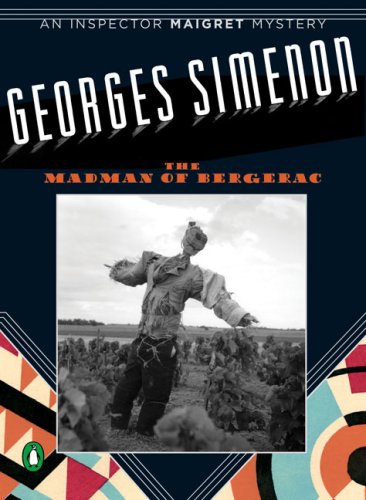
1. The Madman of Bergerac
$7.35
2. My Friend Maigret (Inspector Maigret
$6.67
3. The Bar on the Seine (Penguin
 
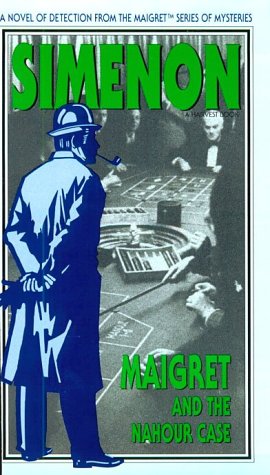
4. Maigret and the Toy Village (Harvest
$8.13
5. The Strangers in the House (New
$10.36
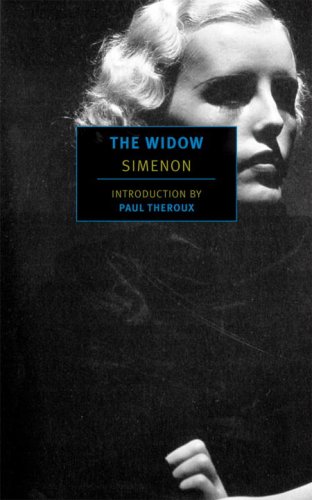
6. The Widow
$7.34
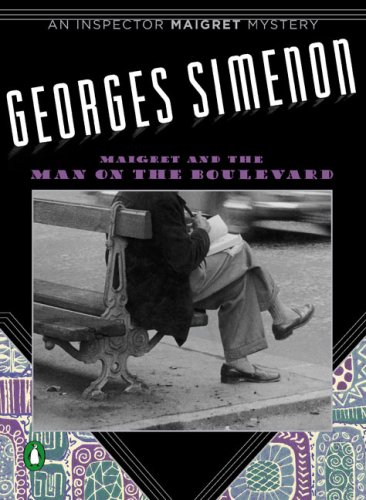
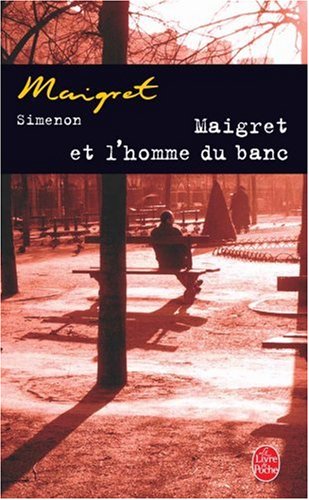
7. Maigret and the Man on the Boulevard
$6.00
8. Maigret and the Killer (Maigret
 
9. Blind Alley a Novel
$3.92
10. Georges Simenon (Pocket Essential
$7.34
11. Inspector Cadaver (Inspector Maigret
 
12. Maigret and the Headless Corpse
 
13. Les Fiancailles De M. Hire (Presses-Pocket)
 
$11.51
14. The Mystery of Georges Simenon
 
15. Maigret and the madwoman
$8.25
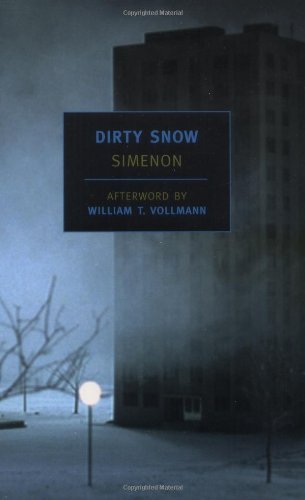
16. Dirty Snow (New York Review Books
$7.88
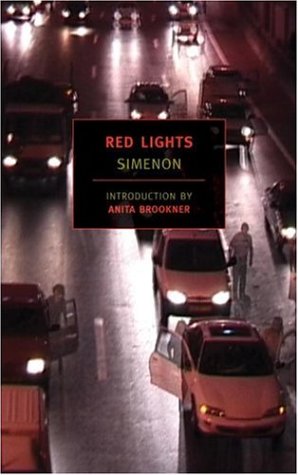
17. Red Lights (New York Review Books
$6.83
18. Maigret Sets A Trap (Maigret Mystery
$7.27
19. Lock 14 (Inspector Maigret Mysteries)
$18.95
20. Mon Ami Maigret

1. The Madman of Bergerac
by Georges Simenon
Paperback: 176 Pages (2007-06-05)
list price: US$12.00 -- used & new: US$6.69
(price subject to change: see help)
Asin: 0143111965
Average Customer Review: 4.0 out of 5 stars
Canada | United Kingdom | Germany | France | Japan
Editorial Review

Book Description
One of the world’s most successful crime writers, Georges Simenon has thrilled mystery lovers around the world since 1931 with his matchless creation Inspector Maigret. In The Madman of Bergerac, Maigret gets caught up in an investigation in a provincial French town terrorized by a maniacal murderer—only after being shot following a man who has mysteriously jumped off a moving train. The Madman of Bergerac captures the obsessive snobbery and hypocrisy of small-town bourgeoisie. ... Read more

Customer Reviews (2)

4-0 out of 5 stars Bed-bound sleuthing
Reading Simenon is like eating pistachios--it soon becomes compulsive because the item consumed is so tasty. In "The Madman," Inspector Maigret is laid up in a provincial French town after being wounded by a man he was tracking (for his own, not police, reasons). Intrigued by rumors of a "madman" on the loose in this town, Simenon begins his own bedside investigation into the crime. Without benefit of even a wheelchair to survey much of the town's layout (a lá Jimmy Stewart in "Rear Window," which this novel predates by several decades), Maigret's insight into human nature is such that, within the confines of 150 or so pages, he pieces together what is happening, unraveling a host of small-town hypocricies along the way. My only complaint about the Maigret novels (and what keeps me holding back the fifth of five stars from my review) is that, unlike Simenon's "dark" novels, they have "happy endings"; i.e., the bad guy is caught. Reality often veers away from our desires for "closure," yet even with the Maigret novels, Simenon lays bare the thin skrim that separates civility from ruthlessness.

4-0 out of 5 stars There is only one difference between a madman and me
I am not mad.Salvador Dali.

That premise, so aptly stated by Salvador Dali, forms the philosophy that guides Inspector Maigret in his search for the person the inhabitants of the quaint French town of Dordogne consider to be a maniacal killer. The fact that this premise deeply offends the bourgeoisie sensibilities of the townsfolk of Dordogne seems not to matter overly much to Maigret although it certainly added to the enjoyment of reading Georges Simenon's "The Madman of Bergerac".

Georges Simenon was the author of over 100 Inspector Maigret mystery stories. They were immensely popular in the 1930s through the 1960s. Inspector Maigret stories also appeared in film and TV versions. Simenon also authored dozens of books that he described as "romans durs", roughly translated as`hard stories' that had a darker tone than his Maigret novels. Simenon seems to have fallen under the radar in recent decades but in recent years he seems to have been rediscovered by a new generation of mystery/detective story fans. Penguin Books has begun to reissue some of those Maigret mysteries and the New York Review of Books Press has reissued some of his `hard stories'. Penguin's latest Inspector Maigret Mystery reissue, "The Madman of Bergerac" is a fine example of the Simenon's craft and a fine example of Simenon's craftsmanship.

In the absence of a book description I think it appropriate to set out the basic plot of the book.Set in 1932, it is a warm, sunny March in Paris and since Inspector Maigret is not particularly busy and his wife is out of town he decides to take up the open invitation to visit is his retired former colleague Inspector Leduc.Leduc has a cottage near Dordogne in south-west France.Unable to sleep on the overnight train ride because of the disturbing noises made by the fellow in the upper berth, Maigret follows his berth-mate into the corridor to get some air.He is so astonished to see the man jump off the train as it slows down around a curve in the tracks on its approach to a station that he jumps off the train in pursuit.The man immediately shoots Maigret.Maigret is found and taken to hospital where he is accused by the police of being "the madman of Bergerac", a killer who has already killed two local girls. Once he is identified as a police inspector from Paris, Maigret sets out to solve the crimes.However, due to his wounds Simenon is confined to his bed.He sends for his wife to assist him and quickly begins and completes the investigation while confined to bed-rest.

As implied at the beginning of the review, Maigret insists that the killer is very likely a local who appears to one and all to be perfectly sane - apart from the fact that he every now and again commits a brutal murder.This theory is considered insulting by the townsfolk but Maigret is not deterred and the investigation continues.

Simenon's Inspector Maigret mysteries are often compared to Christie's Hercule Poirot mysteries. There are many resemblances to be sure. There are some major differences however worth noting. The chief differences seem to me to be Simenon's darker touch and his rather cynical feelings toward the more `respectable' members of French society.This is very evident in the "Madman of Bergerac" but it is not so intrusive that it gets in the way of the story and telling the story always seems to be Simenon's main focus.Simenon treats words with respect and doesn't use more than seems necessary to advance the story.

Finally, for me, the centerpiece of any detective story of this type is the character of the detective. In the case of Maigret, the more I read of him the more I enjoy his character.This was a fast-paced well written story that can be read in one or two sittings. Recommended. L. Fleisig
... Read more


2. My Friend Maigret (Inspector Maigret Mysteries)
by Georges Simenon
Paperback: 208 Pages (2007-12-18)
list price: US$13.00 -- used & new: US$7.35
(price subject to change: see help)
Asin: 0143112848
Average Customer Review: 4.0 out of 5 stars
Canada | United Kingdom | Germany | France | Japan
Editorial Review

Book Description
Three vintage Maigret novels by legendary mystery author Georges Simenon

One of the world ’s most successful crime writers, Georges Simenon has thrilled mystery lovers since 1931 with his matchless creation Inspector Maigret. In My Friend Maigret, Inspector Maigret investigates the murder of a small-time crook on a Mediterranean island. Told in Simenon’s spare, unsentimental prose, Inspector Cadaver is a haunting exploration of provincial hypocrisy and snobbery, in which Maigret encounters a rival sleuth from his past. In Maigret and the Man on the Boulevard, Simenon’s tenacious detective pieces together the life of a man who for three years lived a secret life—until he is found stabbed to death in an alleyway. ... Read more

Customer Reviews (2)

5-0 out of 5 stars A classic in a great series
An inspector from Scotland Yard comes to France to observe the police methods of the great detective Maigret as he investigates a crime.As the stoic British policeman follows Maigret around, both men feel awkward because Maigret has no methods, other than his characteristic investigative technique of immersing himself in the atmosphere of the place and in the lives of the persons involved until he knows them so well that he understands how the crime must have happened.This is a classic Maigret.

3-0 out of 5 stars Maigret and the Observer Effect
As I understand it the term "observer effect" stands for the proposition that the act of observing changes the act of the person or thing being observed.In Georges Simenon's "My Friend Maigret" we get a story in which "observer effect" is fully in play.The result is another good Simenon "Maigret" mystery.

"My Friend Maigret" open with the good Inspector Maigret going about his normal routine in Paris.Much to Maigret's chagrin he finds himself in the company of one Inspector Pyke of Scotland Yard who accepted an invitation from the chief of the Paris police to come to Paris to see the great Maigret at work.As luck would have it Maigret is advised that a murder has been committed inPorquerolles, an island of the coast of Provence in the south of France.This would normally not be of interest to the Paris police but on the night of the murder the victim (a small-time career criminal) had been heard bragging about his good friend Inspector Maigret.So Maigret finds himself getting on a train and ferry, with Inspector Pyke in tow, to the warm and sunny island to conduct an investigation.

The investigation/plot is pretty standard fare for detective mysteries. There is a murder and a small set of potential killers from a wide variety of backgrounds.What sets "My Friend Maigret" apart from the run of the mill story is the exotic location, Simenon's spare but arch writing, and Maigret's ongoing self-consciousness derived from being observed constantly by the quiet British observer.

All in all this was a pretty good story but far from being one of Simenon's best Maigret mysteries.Nonetheless, average Simenon remains a cut above the average for this genre.Fans of Simenon and Maigret should enjoy "My Friend Maigret".However, as someone who gladly prmotes Maigret at every opportunity, I don't think this would be a good introduction for a reader new to the Maigret mysteries.I think Lock 14 (Inspector Maigret Mysteries), Maigret and the Man on the Boulevard (Inspector Maigret), or Inspector Cadaver (Inspector Maigret Mysteries)would make for a better starting point for anyone interested in Maigret.Once Maigret has a chance to grow on you, "My Friend Maigret" will make for an enjoyable read.L.Fleisig
... Read more


3. The Bar on the Seine (Penguin Mysteries)
by Georges Simenon
Paperback: 160 Pages (2006-12-26)
list price: US$12.00 -- used & new: US$6.67
(price subject to change: see help)
Asin: 0143038311
Average Customer Review: 4.0 out of 5 stars
Canada | United Kingdom | Germany | France | Japan
Editorial Review

Book Description
One of the world’s most successful crime writers, Georges Simenon has thrilled mystery lovers around the world since 1931 with his matchless creation Inspector Maigret. In The Bar on the Seine, Maigret must visit a prisoner he arrested and bear the news that his reprieve has been refused and he will be executed at dawn. But when the condemned man tells Maigret a story, his investigations lead him to the Guinguette à Deux Sous, a bar by the River Seine, and into the seamy underside of bourgeois Parisian life. ... Read more

Customer Reviews (5)

5-0 out of 5 stars mystery novel as high art
The mystery novel becomes, in the hands of Simenon, not only a stage for characters to develop and respond to one another, but a form of social commentery as well.Magritte is a member of the working class, not living in poverty, but also not able to share in the wealth he sees others squandering.He acts with dignity, and his determined effort to solve crimes becomes inseparable from his effort to keep focused on how one should keep one's dignity, even in a corrupt society.

4-0 out of 5 stars "Waiter, where are those Pernods?"
Penguin has reissued Inspector Maigret mysteries in a winning new format which invites the reader to cozy up to a neat little page that is easy on the eyes. The trim size of these series permits you to pack these books easily into your pocket. They are lightweight and the type size is generous and airy. Distinctive covers, consisting of grainy black and white photos vaguely reflecting the general feel of the books' plot, and Georges Simenon's name, tipped to the left in dropout white on a black background, give all the books a branded look which marks them clearly for the potential Simenon fan.

As has already been articulated in other reviews, Simenon is a master reporter of human behavior. He makes no value judgments, nor does he provide elaborate details. He simply furnishes the facts, as gruesome or sordid as they may be. Here, middle-class fun seekers on holiday are busy committing adultery, being blackmailed, and killing people. Yet the Pernod keeps on being poured and the laughter and jolly times keep rolling. Inspector Maigret is the ballast on this cruise and keeps his eye ever focused on the mystery at hand. That mystery is revealed in the very first chapter as a condemned man archly hints at another murder which has gone unpunished. Maigret commits himself to collaring the culprits, and so the plot unwinds as Simenon the journalist succinctly and colorfully reports the action for us.

I read this book while on a business trip in India. My outrageous jet lag and sleepless nights provided ample time to finish this work and move on to others. I must admit, however, that I wasn't much in the mood for it, but then again, I spent much of my time trying to get some rest and being unable to. Probably the only book I would have wanted to read would have been a treatise on insomnia. Not Simenon's fault.

4-0 out of 5 stars Good But Short
This is a light and an enjoyable read which I managed to digest easily in an evening sitting. I enjoyed the book and would recommend it. The book is either 4 or 5 stars. In any case, it is highly entertaining, light, perhaps what one would call beach reading.

As most know, Simenon was one of the best know mystery writers of the twentieth century, having written close to 200 novels, over 150 novellas, plus several autobiographical works. He had over 500 million books in print. He started off as a city reporter as a teenager first in Liege, then later moving to Paris. He started writing in Liege at a young age. In later years he lived and worked in Canada and in America. The Paris based Inspector Maigret is his best know series with over 100 works between 1931 and 1972. Inspector Maigret has become synonymous with great Parisian detective stories. His trademark visits to smoky Parisian bars for a few drinks are part and parcel of the reading experiences.

Without revealing the plot details in this particular mystery story, the novel "The Bar of the Seine" manages to combine crime, detective work, Paris city life, and the charm of the French countryside all in one quick and enjoyable read. It has a cast of very entertaining characters, including a wealthy coal merchant and his wife, along with his mistress and others.

The story involves a confession which leads to a trip to the countryside and then the unraveling of a complex murder mystery. The setting is far from the city. The story is set in a slightly decaying house or bar on the river among weekend guests and French recreational boaters.

Recommend: 4 stars.

4-0 out of 5 stars "There shall be read the woe
That he doth work with his adulterate money on the Seine."Dante. The Divine Comedy

"The Bar of the Seine" begins with a curious conversation between Inspector Maigret and a prisoner, Lenoir, sitting in a cell on death-row in a Parisian jail.Lenoir's execution has been set for dawn on the next day and for Maigret, the person responsible for the capture and conviction of the prisoner, this visit is something of a courtesy call.During their conversation Lenoir tells Maigret about an unsolved murder.The only real information he provides is that some unidentified bar on the River Seine would lead Maigret in the right direction.As Maigret takes his leave of Lenoir he does not take the train to meet his wife at their summer vacation spot. Instead, he defers his vacation and sets out to investigate.

Maigret finds the bar in short order and walks into a world where a slice of the Parisian middle-class comes for its rather tawdry summer weekends.Drinking, cards, boating on the Seine and indiscriminate bed-hopping are the order of the day. There has also been a murder and, as befits a story planted so firmly in the detective genre, Maigret brushes aside all distractions to solve the mystery handed to him by a condemned man.

Georges Simenon was the author of over 100 Inspector Maigret mystery stories. They were immensely popular in the 1930s through the 1960s. Inspector Maigret stories also appeared in film and TV version.Penguin Books has begun to reissue a set of Maigret mysteries."The Bar on the Seine", one of Simenon's earlier Maigret stories, is a good place to start.

Simenon's writing is sparse and to the point.This is a short book, 154 rather small pages, and can be read in one or two sittings.But despite its brevity this reader felt engaged not only by the characters (Maigret in particular) but the settings.Simenon doesn't tell you what to think of any particular character nor does he engage in lengthy discussions on his protagonists' morality or character. He simply paints a very evocative picture and leaves the analysis for the reader.

Simenon's Maigret stories, although faithful to the detective story formula of his time, manages to hold up better over time for me than others. I think that what sets Simenon's Maigret stories apart from those of his contemporaries is the character of Maigret and down to earth settings of the stories. Maigret is not a character that is revealed to the reader immediately. Simenon doesn't set about to provide you with a character map to Maigret's personality in any one book. Rather, he grows on you over time. He has an innate disdain for higher authority that is appealing. Simenon's settings and other characters also add a dash to his Maigret mysteries. These are not parlor room mysteries where the reader has to determine which upper-class member of the gentry (or the butler) committed murder most foul in the library.

Anyone interested in a good story, simply told should enjoy Bar on the Seine. L. Fleisig

4-0 out of 5 stars A satisfying, psychologically involving, early Maigret
The Bar on the Seine is translated by David Watson from a 1931 book called La Guingette a Deux Sous. It has previously been translated in 1940 by Geoffrey Sainsbury, and published variously in English as Guingette by the Seine, A Spot by the Seine, and Maigret and the Tavern by the Seine.

Maigret visits a gangster who is about to be executed, and the man hints that he knew of a murderer, from 6 years before, who frequented a bar called La Guingette a Deux Sous. Maigret has little luck finding this, until he stumbles across a man who mentions his plan to visit this tavern -- a man who, Maigret learns, is also arranging as assignation with his mistress. Maigret finds his way to the tavern, where he finds the man (a successful coal merchant) with his wife, and also the man's mistress and her husband, a struggling haberdasher, and a varied cast of characters, including a talkative heavy-drinking Englishman, and several more folks. It seems the mistress is a rackety woman who has had affairs with several of the regulars at this tavern -- and that her husband has used this knowledge to blackmail some of her lovers. So it is perhaps not a surprise when the sorry blackmailer is shot -- and when his wife's latest lover, the coal merchant, is found with a gun.

The man escapes, and Maigret tries to track him down. Meanwhile the Englishman strikes up a relationship of sorts with Maigret, while at the same time all but flaunting his attempts to help the escaped coal merchant. And Maigret learns some of the details of the haberdasher's arrangements, including his involvement with a moneylender who disappeared, significantly, six years before -- just when the gangster Maigret had talked to had hinted at knowledge of a murder. Maigret is very dissatisfied with the obvious shape of the case -- something is going on. Which of course he discovers. What works -- quite brilliantly -- in this book, one of the earliest Maigrets, is the eventually displayed, quite convincing, quite sad, character of the actual murderer. Some of the early Maigrets seem uncharacteristic of the series to me -- Maigret is at times almost an action hero -- but in this case the story reads very much like later Maigret, with the main interest being the psychology of the murderer and other related figures. ... Read more


4. Maigret and the Toy Village (Harvest Book)
by Georges Simenon
 Hardcover: 139 Pages (1994-04)
list price: US$7.95
Isbn: 0151555540
Canada | United Kingdom | Germany | France | Japan

5. The Strangers in the House (New York Review Books Classics)
by Georges Simenon
Paperback: 216 Pages (2006-10-24)
list price: US$14.00 -- used & new: US$8.13
(price subject to change: see help)
Asin: 1590171942
Average Customer Review: 5.0 out of 5 stars
Canada | United Kingdom | Germany | France | Japan
Editorial Review

Book Description
Dirty, drunk, unloved, and unloving, Hector Loursat has been a bitter recluse for eighteen long years—ever since his wife abandoned him and their newborn child to run off with another man. Once a successful lawyer, Loursat now guzzles burgundy and buries himself in books, taking little notice of his teenage daughter or the odd things going on in his vast and ever-more-dilapidated mansion. But one night the sound of a gunshot penetrates the padded walls of Loursat’s study, and he is forced to investigate. What he stumbles on is a murder.

Soon Loursat discovers that his daughter and her friends have been leading a dangerous secret life. He finds himself strangely drawn to this group of young people, and when one of them is accused of the murder, he astonishes the world by taking up the young man’s defense.

In The Strangers in the House, Georges Simenon, master chronicler of the dark side of the human heart, gives us a detective story that is also a tale of an improbable redemption. ... Read more

Customer Reviews (1)

5-0 out of 5 stars I have been a stranger in a strange land
Exodus ii. 22.

Georges Simenon was nothing if not prolific in both his literary and public life. Born in Belgium in 1903, Simenon turned out hundreds of novels. Simenon's obsession with writing caused him to break off an affair (he was prolific in this area of his life as well) with the celebrated Josephine Baker in Paris when he could only write twelve novels in the twelve month period in which they were involved. Although perhaps best known for his Inspector Maigret detective novels, Simenon also wrote over a hundred novels that he referred to as `romans durs' (literally "hard novels"). "Strangers in the House" is one of Simenon's hard novels and to call it noir is not an understatement.

Hector Loursat, an accomplished attorney, has been a stranger in his own house ever since his wife abandoned him and their newborn child eighteen years ago.Since that time Loursat's universe has shrunk to his bedroom, his library and his dining room.He barely speaks to his now 18 year old daughter or their cook.They are for all intents and purposes, strangers.He is a hermit, alone with his books and a profligate amount of burgundy and brandy.It is only the murderous presence of other strangers in his house that may stir him out of his emotional coma. That dark-setting forms the backdrop for "Strangers in the House".

Loursat is roused from his alcohol-induced sleep by what he thinks may be a gunshot. His suspicions are confirmed when he stumbles through portions of the house he hasn't seen in years and discovers a body.He soon discovers that his daughter has fallen in with something of a gang of youths who like to live on the edge.The rest of the novel finds Loursat grappling with the implications of the murder.We see Loursat struggling out of his hermetic cocoon.The reader is left to wonder, as the story progresses, whether Loursat can break out of his cocoon long enough to connect with his daughter and protect her interests through a criminal investigation and trial.

The result is wholly satisfying. I was totally drawn to the character of Loursat. Simenon does not make him particularly attractive. His word pictures of Loursat's appearance and manner are not designed to elicit great sympathy.Nevertheless, the pain Loursat has suffered (although unstated) is palpable and as the story progressed I could not help but hope that Loursat would find the strength to `set things right' both with the criminal investigation and trial and with his life.The result is surprising but it also felt just about right.

New York Review of Books should be congratulated for bringing Simenon's classic `romans durs' back into print.The paperback quality is excellent and each novel in the series is introduced by a writer of note. In this instance the marvelous P.D. James writes a brief but powerful introduction. I recommend all of Simenon's books and Strangers in the House is no exception.L. Fleisig
... Read more


6. The Widow
by George Simenon
Paperback: 108 Pages (2008-03-25)
list price: US$12.95 -- used & new: US$10.36
(price subject to change: see help)
Asin: 1590172612
Canada | United Kingdom | Germany | France | Japan
Editorial Review

Book Description
The Widow is the story of two outcasts and their fatal encounter. One is the widow herself, Tati. Still young, she’s never had an easy time of it, but she’s not the kind to complain. Tati lives with her father-in-law on the family farm, putting up with his sexual attentions, working her fingers to the bone, improving the property and knowing all the time that her late husband’s sister is scheming to kick her out and take the house back.

The other is a killer. Just out of prison and in search of a new life, Jean meets up with Tati, who hires him as a handyman and then takes him to bed. Things are looking up, at least until Jean falls hard for the girl next door.

The Widow was published in the same year as Camus’ The Stranger, and André Gide judged it the superior book. It is Georges Simenon’s most powerful and disturbing exploration of the bond between death and desire. ... Read more


7. Maigret and the Man on the Boulevard (Inspector Maigret)
by Georges Simenon
Paperback: 224 Pages (2007-12-18)
list price: US$13.00 -- used & new: US$7.34
(price subject to change: see help)
Asin: 014311283X
Average Customer Review: 5.0 out of 5 stars
Canada | United Kingdom | Germany | France | Japan
Editorial Review

Book Description
Three vintage Maigret novels by legendary mystery author Georges Simenon

One of the world ’s most successful crime writers, Georges Simenon has thrilled mystery lovers since 1931 with his matchless creation Inspector Maigret. In My Friend Maigret, Inspector Maigret investigates the murder of a small-time crook on a Mediterranean island. Told in Simenon’s spare, unsentimental prose, Inspector Cadaver is a haunting exploration of provincial hypocrisy and snobbery, in which Maigret encounters a rival sleuth from his past. In Maigret and the Man on the Boulevard, Simenon’s tenacious detective pieces together the life of a man who for three years lived a secret life—until he is found stabbed to death in an alleyway. ... Read more

Customer Reviews (1)

5-0 out of 5 stars "Walk along the street of sorrow,The boulevard of broken dreams
Where gigolo and gigolette
Can take a kiss without regret
So they forget their broken dreams."Harry Warren/Al Dubin.

Georges Simenon was prolific in both his literary and public life. Simenon turned out hundreds of novels and his obsession with writing caused him to break off an affair (he was prolific in this area of his life as well) with the celebrated Josephine Baker in Paris when he found he could only write twelve novels in the year they were involved.Although perhaps best known for his Inspector Maigret detective novels, Simenon also wrote over a hundred novels that he referred to as `romans durs' (literally "hard novels"). These hard stories typically involved a person's descent from normality (or a life that seems to bear the appearance of normality) into nihilism and despair. NYRB has reissued a number of hard stories and Penguin has republished quite a few Maigret stories. Georges Simenon's "Maigret and the Man on the Boulevard" is one of Penguin's latest Inspector Maigret reissuance. The other new releases are Inspector Cadaver (Inspector Maigret Mysteries) and My Friend Maigret (Inspector Maigret Mysteries).

When Louis Thouret is found murdered just off the Boulevard Saint-Martin Inspector Maigret is called to investigate.Maigret thinks of this as a run-of-the mill stabbing that occurs but when Mrs. Thouret is asked to identify the body she seems shocked by the fact that he is not wearing the same clothes (including some shockingly racy brown shoes his wife would never have permitted him to wear) he had on when he left for work that morning but his wallet contained far more money than he normally carries.These oddities pique Maigret's interest. What brought Thouret to this Boulevard? What caused him to wear a second set of clothes and those fancy brown shoes? How did Thouret manage to acquire the hefty wad of cash found in his wallet?As the plot develops Maigret seeks to unravel the mystery of Thouret's murder and also the explanation behind what appears to be Thouret's double-life as it played itself out on and around the streets and alleys near the Boulevard Saint-Martin.

The tone and style of Simeon's hard stories differ significantly from his Maigret mysteries. In "Maigret and the Man on the Boulevard", however, we have a character, Thouret, whose dual life seems to mark him as someone who could have been the subject of a hard story.Here, it seems as if Maigret appears just when the hard story ends, and his investigation takes a look back in time to discover how this life ended the way it did.I enjoyed this connection between the two types of Simenon stories. I always enjoy the Maigret mysteries but this walk along a boulevard of broken dreams was, for me, one of Simenon's best Maigret efforts.

L. Fleisig
... Read more


8. Maigret and the Killer (Maigret Mystery Series)
by Georges Simenon
Paperback: 168 Pages (2003-06-16)
list price: US$8.00 -- used & new: US$6.00
(price subject to change: see help)
Asin: 0156028417
Average Customer Review: 4.5 out of 5 stars
Canada | United Kingdom | Germany | France | Japan
Editorial Review

Book Description

Maigret, accompanying his physician on an emergency call, is drawn into one of his most stubborn cases yet. The victim, a son of a wealthy perfume manufacturer, had been enjoying an odd hobby before his death: collecting human voices with a tape recorder, often in the rougher districts of Paris. But his wallet and his tape recorder have been left untouched, so the killer's motive is unclear. The absence of clues begins to exasperate Maigret until an anonymous letter reveals that he is dealing with no ordinary criminal.

Maigret is a registered trademark of the Estate of Georges Simenon.
... Read more

Customer Reviews (3)

4-0 out of 5 stars A man who crossed a barrier
The Maigrets ate on a monthly basis with Dr. Pardon and his wife.Dr. Pardon complained that medical doctors were being changed into clerks because of all of the paperwork required of them.Superintendent Maigret and Dr. Pardon went out to see a young man lying in the street, a victim of stabbing.Maigret had become involved in the case involuntarily.

In reporting the death to the family, Maigret learned that the young man's parents were very rich.The father was a perfume manufacturer.The young man had had few friends.He had an unusual hobby, recording conversations.The tape recorder was recovered.

Maigret called in Janvier.The importance given to the case by the press was surprising to both police officers.A description of the assailant was obtained. Maigret called upon his other two favorites, Lucas and Lapointe, to help with the case.

The young man had identified the places where he had made recordings.The police officers followed in his footsteps.Maigret had known professional criminals well, but he had never been that interested in them.It had all seemed like a game somehow.

On a stakeout four men, presumed art thieves, are arrested.Seemingly the young man doing the recording had stumbled upon a criminal plot.The killer called Maigret.He was a man who had crossed a barrier.It was a matter of diminished responsiblity.The tale is taut, lucid.

5-0 out of 5 stars When Maigret meets a serial killer ...
When Maigret meets a serial killer, it's a dramatic face to face and, as usually, Maigret can understand why the killer acts in such an horrible way. Maigret don't excuse the killer but can understand. Like said Simenon : "Understand but not judge".

5-0 out of 5 stars Great stuff, one of the best Maigrets
This is one of my very favorite Simenon novels; superbly paced and brilliant characterizations. ... Read more


9. Blind Alley a Novel
by Georges Simenon
 Hardcover: Pages (1946)

Asin: B000RL0X6I
Canada | United Kingdom | Germany | France | Japan

10. Georges Simenon (Pocket Essential series)
by David Carter
Paperback: 96 Pages (2003-02-01)
list price: US$6.99 -- used & new: US$3.92
(price subject to change: see help)
Asin: 1904048218
Canada | United Kingdom | Germany | France | Japan
Editorial Review

Book Description

Pocket Essentials is a dynamic series of books that are concise, lively, and easy to read. Packed with facts as well as expert opinions, each book has all the key information you need to know about such popular topics as film, television, cult fiction, history, and more. This concise guide to one of the most prolific crime writers of the 20th century will appeal to his established fan base, new readers, serious academics, and film buffs alike. Author of almost 400 novels, including the acclaimed Commissaire Maigret series, 55 of his books have been turned into films and 279 have been adapted for TV. Having garnered praise from such diverse critics as Cocteau, T.S. Eliot, Henry Miller, Fellini, and Renoir, this is a great guide to Simenon's prodigious output.
... Read more

11. Inspector Cadaver (Inspector Maigret Mysteries)
by Georges Simenon
Paperback: 208 Pages (2007-12-18)
list price: US$13.00 -- used & new: US$7.34
(price subject to change: see help)
Asin: 0143112813
Average Customer Review: 4.0 out of 5 stars
Canada | United Kingdom | Germany | France | Japan
Editorial Review

Book Description
Three vintage Maigret novels by legendary mystery author Georges Simenon

One of the world ’s most successful crime writers, Georges Simenon has thrilled mystery lovers since 1931 with his matchless creation Inspector Maigret. In My Friend Maigret, Inspector Maigret investigates the murder of a small-time crook on a Mediterranean island. Told in Simenon’s spare, unsentimental prose, Inspector Cadaver is a haunting exploration of provincial hypocrisy and snobbery, in which Maigret encounters a rival sleuth from his past. In Maigret and the Man on the Boulevard, Simenon’s tenacious detective pieces together the life of a man who for three years lived a secret life—until he is found stabbed to death in an alleyway. ... Read more

Customer Reviews (1)

4-0 out of 5 stars Place de la Peyton
Georges Simenon was the author of over 100 Inspector Maigret mystery stories. They were immensely popular in the 1930s through the 1960s. Inspector Maigret stories also appeared in film and TV versions. Simenon also authored dozens of books described as "romans durs", or `hard stories' that had a darker tone than his Maigret novels. Simenon seems to have fallen under the radar in recent decades but in recent years he seems to have been rediscovered by a new generation of mystery/detective story fans. Penguin Books has begun to reissue some of those Maigret mysteries (usually in groups of three mysteries) and the New York Review of Books Press has reissued many of his `romans durs'."Inspector Cadaver is one of Penguin's latest Inspector Maigret Mystery reissues, along with My Friend Maigret (Inspector Maigret Mysteries) and Maigret and the Man on the Boulevard (Inspector Maigret).

"Inspector Cadaver" finds Maigret in the village of Saint-Aubin-les Marais. Although the town itself is fictional it is planted by Simenon squarely in the Vendee region of France, southwest of Paris near the Atlantic coast.Simenon lived in the area during WWII (the story was originally published in 1943 under the title "Maigret's Rival") and, as portrayed by Simenon, Saint-Aubin was an isolated, self-contained area which rivals Peyton Place as far as its perchance for gossip and sense of isolation from the rest of the world is concerned.

Maigret finds himself in Saint-Aubin at the request of a Magistrate in Paris. A young working-class man has been found dead apparently run over by a train.The town gossip seems to point its ugly finger in the direction of the Magistrate's brother-in-law and Maigret agrees (reluctantly) to travel to Saint-Aubin to help the brother-in-law out.Maigret is surprised to discover that a former policeman, Inspector Cavre (known as Inspector Cadaver) now working as a private detective, is also destined for Saint-Aubin.As the plot develops Maigret and the reader is introduced to life in this isolated village.Simenon does a wonderful job describing the sense of isolation Maigret feels at entering into this self-contained and xenophobic world.Maigret's unofficial investigation is made more complex (but more interesting to the reader) as he deals with old family ties, small town snobbery, class-distinctions, and a general aversion to strangers.The efforts by Inspector Cadaver also make Maigret's life more difficult (and actually lead me to conclude that the original title is the more apt of the two.)

Simenon's Inspector Maigret mysteries are often compared to Christie's Hercule Poirot mysteries. There are many resemblances to be sure. There are some major differences however worth noting. The chief differences seem to me to be Simenon's darker touch and his rather cynical feelings toward the more `respectable' members of French society. This is very evident in "Inspector Cadaver" but it is not so intrusive that it gets in the way of the story. Simenon treats words with respect and doesn't use more than seems necessary to advance the story."Inspector Cadaver" is an excellent example of the story-telling art of Georges Simenon and well worth reading.L. Fleisig
... Read more


12. Maigret and the Headless Corpse
by Georges Simenon
 Hardcover: 170 Pages (1967)

Asin: B0000CNE1G
Canada | United Kingdom | Germany | France | Japan

13. Les Fiancailles De M. Hire (Presses-Pocket)
by Georges Simenon
 Mass Market Paperback: 180 Pages (1991-11)
list price: US$13.95
Isbn: 2266032275
Canada | United Kingdom | Germany | France | Japan

14. The Mystery of Georges Simenon a Biography
by Fenton Bresler
 Hardcover: Pages (1983)
-- used & new: US$11.51
(price subject to change: see help)
Asin: 0773601120
Canada | United Kingdom | Germany | France | Japan

15. Maigret and the madwoman
by Georges Simenon
 Hardcover: 176 Pages (1972)

Isbn: 0151551383
Average Customer Review: 5.0 out of 5 stars
Canada | United Kingdom | Germany | France | Japan
Editorial Review

Book Description

Maigret is a registered trademark of the Estate of Georges Simenon.
... Read more

Customer Reviews (2)

5-0 out of 5 stars Thoughtful Writing
This is a thoughtful well-plotted mystery.The author does a fine job portrayng Maigret, the other detectives, the victim (an elderly lady), her niece and her niece's son.The writing is simple and easy to understand.Simemon does not waste words but he brings the characters to life.The reader will be kept guessing until the end of the book.

5-0 out of 5 stars Ideal summer vacation reading
Imagine drinking a glass of Calvados.The title is ambiguous.She was a tiny woman insisting upon seeing Chief Inspector Maigret personally.Madame Antoine, aged, having lived in her apartment for a long time, reported that her things had been moved.There is only the key she keeps in her bag.A niece and her son are her only relatives.She is pefectly aware that a young person might consider her mad.The concierge says she is very much like any other old person living by herself.Her clear gray eyes make an impression on Maigret. Then she is murdered, suffocated, and an investigation ensues.The police search and question, after all this is a police procedural.Maigret discovers that the victim had practiced twenty five years of thrift.A character named Le Grand Marcel is brought into the picture.

The fineness of the writing (translated?) transcends the genre.Picking up a Maigret novel is a matter of dealing in a brand name consumer good.One is never disappointed.The storytelling is simple, classical, felicitous.Simenon used masterful economy in his art.The short bursts of information create an almost Raymond Carverish style. One is transported to Paris in the Spring.Time spent in the company of Maigret and his gifted inspectors Lapointe, Lucas, and Janvier is a pleasure. ... Read more


16. Dirty Snow (New York Review Books Classics)
by Georges Simenon, Louise Varese, William T. Vollmann
Paperback: 272 Pages (2003-08-31)
list price: US$14.00 -- used & new: US$8.25
(price subject to change: see help)
Asin: 1590170431
Average Customer Review: 4.0 out of 5 stars
Canada | United Kingdom | Germany | France | Japan
Editorial Review

Book Description
Nineteen-year-old Frank Friedmaier lives in a country under occupation. Most people struggle to get by; Frank takes it easy in his mother's whorehouse, which caters to members of the occupying forces. But Frank is restless. He is a pimp, a thug, a petty thief, and, as Dirty Snow opens, he has just killed his first man. Through the unrelenting darkness and cold of an endless winter, Frank will pursue abjection until at last there is nowhere to go.

Hans Koning has described Dirty Snow as "one of the very few novels to come out of German-occupied France that gets it exactly right." In a study of the criminal mind that is comparable to Jim Thompson's The Killer Inside Me, Simenon maps a no man's land of the spirit in which human nature is driven to destruction—and redemption, perhaps, as well—by forces beyond its control. ... Read more

Customer Reviews (9)

3-0 out of 5 stars Expected a bit more...
...something. Seemed like the typical story of an eastern block sociopath. Maybe I'm missing some deeper meaning. If your looking for an existentialist commentary about the vacuousness of life, you may like this.

5-0 out of 5 stars Despair is an expression of the total personality
doubt only of thought.Soren Kierkegaard

Frank Friedmaier, the protagonist of Georges Simenon's novel "Dirty Snow" seems to have no doubts about his life. In fact he seems to be more a creature of base animal instinct than of anything resembling thought.If he has doubts about anything they are not evident. But his words and deeds bespeak an unconscious despair so profound that the reader can feel it with every page.

Simenon was nothing if not prolific in both his literary and public life. Born in Belgium in 1903, Simenon turned out hundreds of novels. Simenon's obsession with writing caused him to break off an affair (he was prolific in this area of his life as well) with the celebrated Josephine Baker in Paris when he could only write twelve novels in the twelve month period in which they were involved. Although perhaps best known for his Inspector Maigret detective novels, Simenon also wrote over a hundred novels that he referred to as `romans durs' (literally "hard novels"). "Dirty Snow" is one of Simenon's hard novels and to call it noir is an understatement."Dirty Snow" is darker than noir, devoid of any light or optimism.In the hands of Simenon it is an absorbing (entertaining seems an inapt word) look at the darker side of life.

Frank Friedmaier lives in his mother's brothel in a small apartment building. The brothel is in an unnamed city in occupied France during World War II. Frank divides his time between the brothel and a local bar inhabited by an assortment of shady characters that include low level criminals, women of `easy virtue', and the occasional German soldier.When he returns home at night he camps down with whichever one of his mother's employees suits his fancy. What follows may best be described as nasty, brutish, and short. There is no affection, not even feigned affection, just feral activity.

The book follows Frank's descent into increasingly lower levels of behavior.He decides the time has come to kill a man, lies in wait in some snow that had been dirtied by the day's activities, and then takes a knife to a German soldier and stabs him to death.He reveals his presence to a passing neighbor, the father of a young girl who Frank seems to like, just so that the neighbor will know that Frank has murdered the soldier. Frank is confident that the neighbor will keep the information to himself. Frank next plans a robbery. The robbery is successful but Frank soon finds himself in a German prison subject to repeated interrogations.By the end of the book Frank has completed a journey that has taken him on a journey through what Dante would have considered different layers of hel l.

The fascinating aspect of Dirty Snow for me lay in the narration.Simenon has pulled off a neat trick here.The narrator is Frank and we are privy to his innermost thoughts, such as they are. Yet it is the absence of thought and the inability to evince any feeling in a rational manner that grabs the reader. There are sections, particularly those involving the daughter of the neighbor who witnessed the killing, where you can almost sense that Frank would like to act on a normal level with normal emotions.He may come close but he always retreats.As Dirty Snow ends, in a courtyard in the prison, Simenon has Frank perform one simple act involving an article of clothing.It is an act that Frank has long observed of the other prisoners. His instinctive performance of that act brings Franks journey and the book to its inevitable end.

Dirty Snow is a fascinating, if dark, look at one small aspect of the human condition.I found it well worth reading. L. Fleisig

4-0 out of 5 stars a well written book but
it is a noir book, simenon is a great writer , i just wish his main character was a little more believable,you almost wish that he would have had him declared insane.... to make it more believable.

4-0 out of 5 stars "Can anything get much worse than this?"
The above question is asked by this edition's Afterword about the protagonist's fate.Frank Friedlander is the son of a brothel keeper in an occupied country, and a self-declared 'piece of s***'.Unable to find satisfaction in abusing his mother's whores, knifing army officers or robbing old ladies' heirlooms, the one thing he constantly craves is recognition.He's a piece of s***, so you'd better step around him.Flaunting the fruits of his crimes, it's only a matter of time before his enemies exact retribution.

The novel recalls the most brutal parts of Hammett's The Glass Key, Camus' L'Etranger and Koestler's Darkness at Noon. Part of me wonders whether that should be a recommendation.

2-0 out of 5 stars Catching It Where The Chicken Catches The Axe
Georges Simenon's Dirty Snow (1948) is a grim, claustrophobic, if somewhat typical, examination of the human psyche by the Belgian master of the psychological novel. Taking place in an unnamed country existing under the occupation of an amoral foreign power, Dirty Snow depicts a fallen, sordid world which is equal parts Franz Kafka, Jean Rhys, and Jean Genet, though Simenon's protagonist, Frank Friedmaier, lacks the transcendent spiritual insight which elevated Genet's antiheroes above the common thief, corner boy, street thug, and murderer.

Dirty Snow is the story of a spoiled, narcissistic, and unfocused sociopath whose boredom with his own aimless existence leads him to casually manipulate, abuse, rob, or murder a number of innocent neighborhood citizens. Like the characters in Genet, Frank kills because he wants to, because the male cronies he admires boast that they have committed murders of their own, and because he wants to establish some definite marker in his history to justify his life to himself.

Oddly obsessed with Holst, his older male neighbor across the hall, Frank, who lives with his shrewish, brothel-keeping mother, seduces and then casts aside naïve young Sissy, Holst's daughter, for the sheer sport of it. But Frank's seduction of Sissy is also partially an act of unrealized homosexual sublimation, as absolutely nothing Frank does arouses Holst's attention. Though Holst all but witnesses Frank committing his first murder, and could reasonably assume that Frank is the person who has violated his daughter's body, health, and spirit during his absence, Holst remains utterly passive.

Dirty Snow is one of Simenon's more critically respected novels, but while the first two-thirds are gripping and suspenseful, the last third, in which Frank is arrested and incarcerated by the occupying administration, is dull, undramatic, and far too long. In The Miracle of the Rose (1951), Genet brought his solitary prisoners to vibrant, shadow-casting life; but Frank's incarceration plods on uneventfully for over 60 pages, and Frank completely lacks the rich inner fabric of Genet's "saints," dreaming social misfits, transvestites, and randy, strutting alpha males. It is difficult to fathom why Simenon chose to conclude the novel as he does, since the anticlimactic ending deflates a book which had the potential to become a minor classic.

... Read more


17. Red Lights (New York Review Books Classics)
by Georges Simenon
Paperback: 144 Pages (2006-07-18)
list price: US$14.00 -- used & new: US$7.88
(price subject to change: see help)
Asin: 1590171934
Average Customer Review: 4.5 out of 5 stars
Canada | United Kingdom | Germany | France | Japan
Editorial Review

Book Description
It is Friday evening before Labor Day weekend. Americans are hitting the highways in droves; the radio crackles with warnings of traffic jams and crashed cars. Steve Hogan and his wife, Nancy, have a long drive ahead—from New York City to Maine, where their children are in camp. But Steve wants a drink before they go, and on the road he wants another. Soon, exploding with suppressed fury, he is heading into that dark place in himself he calls “the tunnel.” When Steve stops for yet another drink, Nancy has had enough. She leaves the car.

On a bender now, Steve makes a friend: Sid Halligan, an escapee from Sing Sing. Steve tells Sid
all about Nancy. Most men are scared, Steve thinks, but not Sid.

The next day, Steve wakes up on the side of the road. His car has a flat, his money is gone, and there’s one more thing still left for him to learn about Nancy, Sid Halligan, and himself. ... Read more

Customer Reviews (2)

4-0 out of 5 stars Hard Case
I was pleasantly surprised by this noir gem from NYRB classics. This was my first exposure to Simenon, the famously prolific creator of Inspector Maigret.
Red Lights is the story of a regular couple from New York, Steve and Nancy Hogan, who become fatefully entwined with Sid, a hardened criminal; a hard case. As they prepare to embark on a trip to retrieve their children from a Maine summer camp, Steve finds himself going where he calls "into the tunnel", an imaginary zone where he can shake out all his sillies (which means: consume a lot of rye whiskey). Unfortunately in the process, he loses Nancy, then proceeds to delve only deeper into the dark side of life.
***Spoilerphobes Beware***
Over the course of this short novel, in which there is a lot a drinking, driving, and overall criminal activity, the troubled couple lose each other, suffer a bit, and then finally find each other (in more than one way). This is all thanks to Sid, the escaped con, who I'm sure was happy to help.
I expect to read many more of these "romans dur", as Simenon liked to call them, since there are many other titles available now from NYRB Classics. Highly recommended especially to crime noir fans.
4.5 stars

5-0 out of 5 stars It's quarter to three, there's no one in the place
Except you and me
So set 'em' up Joe, I got a little story
I think you should know
We're drinking my friend, to the end
Of a brief episode
Make it one for my baby
And one more for the road

Frank Sinatra's haunting signature song, "One for My Baby, (And One More for the Road) is an eerily suitable theme song for Georges Simenon's ode to a late night drinker, "Red Lights".

Simenon was prolific; he wrote hundreds of novels, most notably his Inspector Maigret mysteries. But Simenon's best work in my opinion can be found in what he called his "romans durs" ("hard stories").In those stores you typically find a middle-aged male, leading a middle class life.In each story the protagonist hits a bump in the road (often of his own making) and this slight bump takes him off the level, boring road of respectability and puts him on a wild downhill road to the depths of darkness. "Red Lights" puts the protagonist, Steve Hogan, on a wild road, both literally and figuratively.

It is 1955 and the Friday of the Labor-Day Weekend. Steve and Nancy Hogan meet up at their local bar in Manhattan for a drink before setting off to Maine to pick their children up from Summer Camp. Steve wants another drink or two before he goes.He can sense he is heading to one of his periodic `tunnels' a dark place he finds within himself whenever he's had a bit too much to drink.His resentments, particularly toward his wife, come to the surface as they find themselves stuck in holiday traffic. He pulls over to a roadside bar (this was before the days when the interstate highway system covered the country) and tells Nancy he's going in for a drink. She tells him she's not going to wait.Steve walks into the bar and both their lives are changed forever. Each spouse embarks on a separate journey through hell, Steve's a self-inflicted trip, and Nancy's one set in motion by Steve's drinking. Both Steve and Nancy are in for a horrifying ride.

Simenon's prose, particularly his narration of Steve's thoughts as he drinks the night away, is compelling.Simenon is no `rank sentimentalist' to be sure but in Red Lights he does introduce a concept not often seen in his "romans durs", hope.It is not a false hope but a hope based on a shared experience. Whatever the outcome, "Red Lights" did not ring false for me.It was a quick and compelling read with a story line that would make a suitable script for a Twilight Zone episode. (In fact, a movie based on the book but set in France was released in 2004).
As "Red Lights" ended, I could hear Sinatra's One for My Baby end as well:

Well that's how it goes, and Joe I know your gettin'
Anxious to close
Thanks for the cheer
I hope you didn't mind
My bending your ear
But this torch that I found, It's gotta be drowned
Or it's gonna explode
Make it one for my baby
And one more for the road
... Read more


18. Maigret Sets A Trap (Maigret Mystery Series)
by Georges Simenon
Paperback: 192 Pages (2003-06-16)
list price: US$8.00 -- used & new: US$6.83
(price subject to change: see help)
Asin: 0156028484
Average Customer Review: 3.5 out of 5 stars
Canada | United Kingdom | Germany | France | Japan
Editorial Review

Book Description

It is a hot and steamy summer, and Maigret is hatching a plan to capture a serial murderer by playing on the killer's perverse vanity. He finally succeeds when an important clue leads him to a trio of suspects. But the three are entangled in a web of guilt and possessiveness so tight that the unraveling nearly exhausts the Inspector--until, at last, he discovers the tortured motives behind the murders.

Maigret is a registered trademark of the Estate of Georges Simenon.
... Read more

Customer Reviews (3)

3-0 out of 5 stars Not Totally Satisfying.
I intentionally picked a book that looked lightweight in order to get me back in the practice of reading earnestly, and this book certainly didn't disappoint as far as its lightweightedness is concerned.

I wanted something thin and not too difficult, but this doesn't mean I didn't want something emotionally and intellectually satisfying. It's a ho-hum mystery with not too much thrillings. Georges Simenon doesn't even make it very suspensful with who the killer is.

Maigret Sets A Trap isn't bad. It's just--plain. Something you could read in a couple of days, discard, and forget about immediately.

I'll tell you one thing: just be grateful your mother isn't like the lady in this one. I can see how the guy became a serial killer.

4-0 out of 5 stars A real detective at work
It's not dames, blazing guns, nor exploding fists.It's a battle of wits, stake outs and interrogations that set Inspector Maigret at the top of his profession in a series of 88 books written by Simenon between 1930 and 1972; books that led to movies and a TV series.A good case could be made that Simenon was the Arthur Conan Doyle of his day and Maigret his Sherlock Holmes.Written in 1955, "Trap" presents a Jack The Ripper style serial killer who has evaded police for five months while stabbing and killing a woman per month.Following an after dinner discussion with a psychiatrist, Maigret forms a plan to trap the villain.The plan is put in motion, and seems to work.But did it?There has been another killing and the Inspector is beside himself with guilt.This is a fast paced read of 170 pages that seem to turn themselves.In Maigret, Simenon has created an interesting, consistent character with human traits and foibles that lend a great deal of believability to the story.A good-sized step above pulp fiction, the Maigret books are a pleasant way to spend a few hours.

4-0 out of 5 stars This book hard to put down!
The suprise ending makes you want to read more! ... Read more


19. Lock 14 (Inspector Maigret Mysteries)
by Georges Simenon
Paperback: 160 Pages (2006-07-25)
list price: US$12.00 -- used & new: US$7.27
(price subject to change: see help)
Asin: B000QRII38
Average Customer Review: 4.0 out of 5 stars
Canada | United Kingdom | Germany | France | Japan
Editorial Review

Book Description
Mystery legend Georges Simenon comes to Penguin with classic works in celebration of the iconic Inspector Maigret’s 75th anniversary

One of the world’s most successful crime writers, Georges Simenon has thrilled mystery lovers around the world since 1931 with his matchless creation Inspector Maigret. Seventy-five years later, the incomparable Maigret mysteries make their Penguin debut with three of his most compelling cases.

In Lock 14, Simenon plunges Maigret into the unfamiliar canal world of shabby bars and shadowy towpaths, drawing together the strands of a tragic case of lost identity. ... Read more

Customer Reviews (4)

4-0 out of 5 stars Good, but beware of duplicate
"Lock 14" is, like most Maigret mysteries, very enjoyable.The flaw is, this book was previously published under the title "Maigret Meets a Milord," which I already had.Of the 75 Simenon books I own, this is the first time I've encountered this problem, so I can't complain too loudly.I only hope publishers will try to be consistent with titles, that's all.

4-0 out of 5 stars a satisfying little mystery
Acclaimed author, Georges Simenon, once again weaves a capturing tale of mystery and suspense, with the astute Inspector Maigret at the wheel. A series numbering over 100 books, the Inspector Maigret series - after a long stint of unavailability - has, thankfully, been reintroduced by Penguin Books to readers hankering for good mysteries. With an intriguing plot and a cast of believable characters, Lock 14, set early on in the Maigret series), is a swift but gratifying read.

Brusquer and less loquacious than Agatha Christie's Hercule Poirot, Inspector Maigret is all business as he takes on a new case that is sure to perplex even the most skilled of sleuths.

Set in France, in the region of a lock located on a busy section of canal, Lock 14, recounts the underhanded goings-on along these extensive waterways. With commercial barge interchange in the lock, coupled with high-class yachts and tourist boats, which were often gathered in close proximity, the result was an aquatic melding pot of working class and "upper crust" societies.

The varying degrees of society in the vicinity of Lock 14 have apparently collided, on a rainy April day, when two dockmen stumble upon the cadaver of elegantly-clad Mary Lampson while rummaging under the hay in a stable; 5 hours dead from apparent strangulation. Inspector Maigret is called to piece things together. First to be interviewed is the dead woman's husband, Sir Walter Lampson, an Englishman and retired colonel of the Indian Army, whose pleasure craft is docked near Lock 14. The Inspectors sharp instincts are alerted when Lampson, along with fellow passengers of his yacht - who seem only bent on a life devoted to decadence - appear oddly aloof and indifferent to the murder. Ultimately shedding light on a heartrending occurrence of lost identity and lost love, Maigret gradually pieces together the stories of those involved, and how Mary Lampson and a second victim met their untimely end.

Regardless of the descriptive language outlining the characters, conspicuous is the lack of background on Inspector Maigret himself. Simenon leaves the reader guessing about the Inspectors persona, and the depths that lie beneath his somewhat gruff and abrupt exterior.

Despite their small size, Simenon's Inspector Maigret series of mystery books are highly satisfying and concentrated with page flipping "who-dunnit" suspense, keeping readers captured until the final pages. Lock 14, itself, saw publication in 1931 and yet remains accessible and a pleasure to read. These are excellent books that are small and easy to pack for a weekend getaway or outing, and can be easily enjoyed in a few brief sittings.

4-0 out of 5 stars "The smell was as persistent as ever: spices, stable, tar, wine."
This, my second foray into the works of Simenon, yielded the same satisfying read as the first. Written when Simenon was 28 years old, "Lock 14" sketches shady doings and murder along the extensive barge system in France, where dozens of ships of all sizes and shades pass all day and much of the night in all kinds of weather. What impresses me so much here is Simenon's skillful writing which, with precise strokes, draws exact pictures of scene after interesting scene. All the senses are tapped to give the reader a feeling of the atmosphere, while standing outside the action is Inspector Maigret, absorbing each bit of information into his keen and ever-active mind.
The story line is clever. I had no idea what to make of the first elegant body found in a filthy stable under a bundle of straw. And, in 1931 when this work was written, Simenon did not spare us a host of self-indulgent and jaded characters whose pursuit of pleasure was their main preoccupation.Simenon seems to have an existentialist's outlook. He takes what life gives him and, without judgment, returns it to us as the state of how things are. Here he is on women, "Charming creatures, whose first impulse is always good...They are full of good intentions...The trouble is that life, with its acts of cowardice, its compromises, its insistent needs, is stronger...."I think this is how he felt about all of us.

4-0 out of 5 stars Death Like an Ever Flowing Stream
Georges Simenon is the author of over 100 Inspect Maigret mystery stories.They were immensely popular in the 1930s through the 1960s but seem to have fallen out of view in the last few decades.Penguin Books has begun to reissue some of those mysteries. They are all fun books to read and Simenon's "Lock 14" is no exception.

Originally published in 1931, Lock 14 is set in a canal in France at a time when commercial barge traffic was a primary means of transporting cargo.The canals were filled with a mix of commercial and tourist traffic which effectively created a mix of upper and working class personalities.Lock 14 begins, as most such mysteries do, with a dead body. A young woman is found dead in a pile of muck, murdered in a stable near Lock 14.She was from a party of seemingly wealthy tourists leading a `debauched' life on the river. Inspector Maigret is called to the scene.He must sort through the muck and find the killer.There are many suspects and more murders soon follow.The rest of the book is devoted to Maigret's attempt to sort out the facts from fiction and find the killer.To reveal any more would spoil the plot.

Simenon's Inspector Maigret mysteries are often compared to Christie's Hercule Poirot mysteries. There are many resemblances to be sure.Both follow typical `plot guidelines' for detective stories; they involve numerous suspects and a conflict between the intelligent observations of the hero and the less astute detective work of the local constabulary.There are some major differences however worth noting. The chief differences seem to me to be Simenon's darker touch and his more diverse selection of `characters'.Whereas Christie's stories most often involved an upper crusty cast of characters, Simenon's characters often come from more inauspicious backgrounds.I also think that Simenon is earthier than Christie (and others). The passengers on the tourist barge were decadent and living a pretty wild existence. The working men and women on the canal and in the towns along the canal are well drawn, rough edges and all.This was a nice change from the parlor room type mystery where everyone speaks with a sophisticated accent of some sort.

Finally, for me, the centerpiece of any detective story of this type is the character of the detective.In the case of Maigret, the more I read of him (three Maigret stories to date) the more I enjoy his character.All in all I found Simenon's Lock 14 to be an enjoyable detective/mystery story.It was a fast-paced well written story with believable characters. Recommended. L. Fleisig
... Read more


20. Mon Ami Maigret
by Georges Simenon
Paperback: Pages (1985-01-11)
list price: US$18.95 -- used & new: US$18.95
(price subject to change: see help)
Asin: 0685114015
Canada | United Kingdom | Germany | France | Japan

  1-20 of 100 | Next 20
A  B  C  D  E  F  G  H  I  J  K  L  M  N  O  P  Q  R  S  T  U  V  W  X  Y  Z  

Prices listed on this site are subject to change without notice.
Questions on ordering or shipping? click here for help.

site stats