e99 Online Shopping Mall

Geometry.Net - the online learning center Help  
Home  - Authors - Plato (Books)

  1-20 of 100 | Next 20
A  B  C  D  E  F  G  H  I  J  K  L  M  N  O  P  Q  R  S  T  U  V  W  X  Y  Z  

click price to see details     click image to enlarge     click link to go to the store

$7.00
1. Plato and a Platypus Walk into
$25.11
2. The Republic (Penguin Classics)
 
$7.00
3. The Republic of Plato
$40.00
4. Plato Complete Works
$8.00
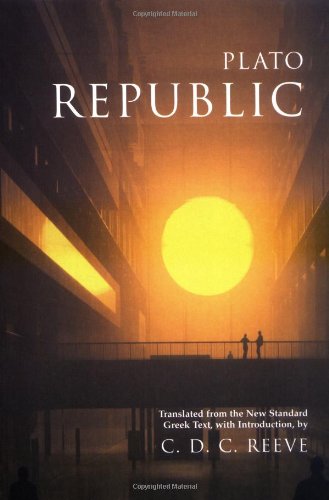
5. Republic
$3.87
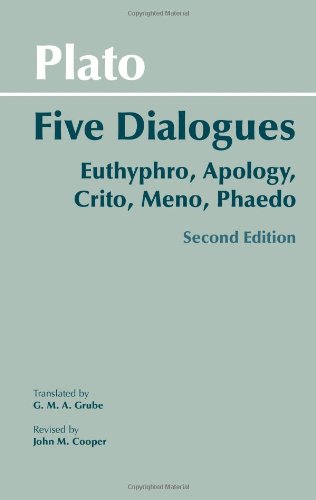
6. Five Dialogues
$6.95
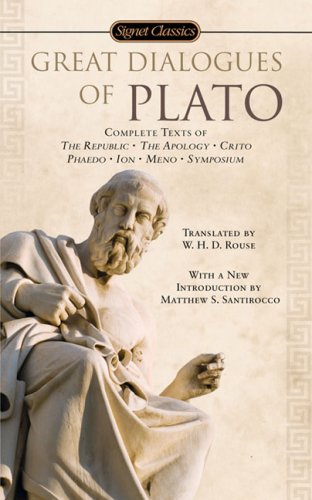
7. Great Dialogues of Plato
$57.41
8. Philosophic Classics: From Plato
$12.40
9. Plato and a Platypus Walk Into
$14.17
10. Escaping Plato's Cave: How America's
$36.00
11. The Collected Dialogues of Plato:
$4.65
12. The Symposium (Penguin Classics)
$12.11
13. Plato's Republic (Books That Changed
$3.95
14. Plato, Not Prozac!: Applying Eternal
$6.79
15. The Last Days of Socrates (Penguin
$17.00
16. A Guided Tour of Five Works by
$2.50
17. The Trial and Death of Socrates
$24.50
18. Preface to Plato (History of the
$4.65
19. Gorgias (Penguin Classics)
 
20. The Dialogues of Plato

1. Plato and a Platypus Walk into a Bar: Understanding Philosophy Through Jokes
by Thomas Cathcart, Daniel Klein
Hardcover: 208 Pages (2007-05-01)
list price: US$18.95 -- used & new: US$7.00
(price subject to change: see help)
Asin: 081091493X
Average Customer Review: 4.0 out of 5 stars
Canada | United Kingdom | Germany | France | Japan
Editorial Review

Book Description
Here’s a lively, hilarious, not-so-reverent crash course through the great philosophical traditions, schools, concepts, and thinkers. It’s Philosophy 101 for everyone who knows not to take all this heavy stuff too seriously. Some of the Big Ideas are Existentialism (what do Hegel and Bette Midler have in common?), Philosophy of Language (how to express what it’s like being stranded on a desert island with Halle Berry), Feminist Philosophy (why, in the end, a man is always a man), and much more. Finally—it all makes sense!

“I laughed, I learned, I loved it!”Roy Blount Jr. ... Read more

Customer Reviews (100)

5-0 out of 5 stars The Best philosophy book ever
What a relief to read a Philosophy book that one can actually understand.Giving the basic concepts thru the telling of jokes is brilliant, especially for the English reader. They carry meaning like parables. I appreciated their neutrality about the different schools of thought, even philosophy of religion.This book will be a great aid to students slogging through Philosophy 101, better than Coles notes.

4-0 out of 5 stars I laughed out loud, and stopped to think
Plato and a Platypus Walk into a Bar: Understanding Philosophy Through Jokes The jokes in here are timeless -- I've heard versions of some of them before, and learned some new ones.At times, I was laughing out loud, or reading the jokes to friends.

But there's more here, too.I've studied philosophy before, though I am not a master of the subject.This little book made me think about various schools of thought, and even clarified some points.A good read for anyone who's curious about philosophical thought, or who has a smattering, as I do, and would like an entertaining way to clarify the differences.Very amusing.

4-0 out of 5 stars humour helps - and this is the funniest book!
I have taken to reading philosophy quite recently, although related subjects like mathematics and linguistics (even perception and the brain) have interested me over a long period. I enjoyed this book immensely for its wonderful stories, and the fact that I already had some idea of philosophical concepts may have helped me see the connections. I'm not quite sure whether you could actually learn philosophy from the stories though!

other recommendations:

any of the books by John Allen Paulos who did similar things for mathematics - not so much by jokes, but by immensely amusing stories that illustrate mathematical principles (Yes, I do know how to forecast the outcome of a sequence of events to another person in a way that makes them think I have a real insight into the future - you too can find out how in 'Innumeracy')

5-0 out of 5 stars Wow! Funny and educational
Where were these guys in college? Probably in some obscure corner of the campus cracking each other up. What a great book that simultaneously reminds you of some classic jokes (or introduces new ones), while also zeroing in on the key philosophical ideas of human thought. A great book that merits more than one reading. And you get jokes besides!!

4-0 out of 5 stars An Amusing Place to Start
If you're looking for a basic understanding of philosophical frameworks, this book is a good place to start.It is quite funny in some places and mildly amusing in others.It won't, however, give you a functional understanding and best serves as a jumping off point.The range of information presented is a mile wide, but only a couple of inches deep.That being said, I think this book is well-written, entertaining and a worthwhile way to pass the time. ... Read more


2. The Republic (Penguin Classics)
by Plato
Paperback: 496 Pages (2003-02-25)
list price: US$10.00 -- used & new: US$25.11
(price subject to change: see help)
Asin: 0140449140
Average Customer Review: 4.5 out of 5 stars
Canada | United Kingdom | Germany | France | Japan
Editorial Review

Book Description
Ostensibly a discussion of the nature of justice, The Republic presents Plato's vision of the ideal state, covering a wide range of topics: social, educational, psychological, moral, and philosophical. It also includes some of Plato's most important writing on the nature of reality and the theory of the "forms."

Translated with an Introduction by Desmond Lee ... Read more

Customer Reviews (83)

4-0 out of 5 stars A classic approach....
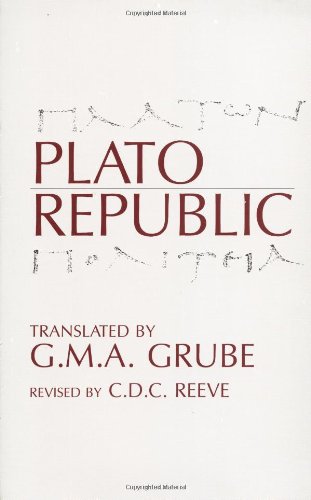
This review is of ISBN-10: 0-87220-136-8, Plato * Republic, translated by G.M.A. Grube and revised by C.D.C. Reeve.

I somehow made it through high school and college learning about Plato and Socrates without reading any full-length works. That's changing this spring as I'm taking a discussion-based class on Plato's Republic. This text was recommended by our instructor, and I can see why. The translation is not cumbersome by striving for sheer literalness, but instead seeks to capture the flavor of the discussions Socrates had with others that Plato as a youth observed.

Footnotes are provided to explain the occasional word that has a different classical than contemporary meaning -- and yet you can read each of the 10 books (chapters) that comprise this volume first without attending to the footnotes, then re-reading the books alongwith their footnotes.

After having seen what gifted vs. pedestrian translations can do to the vigor and beauty of classic works (Beowulf, the Epic of Gilgamesh and The Odyssey come to mind), I can understand why Grube's translation is highly regarded. According to the scholar who performed the revision, no such work was called for until 20 years after publication (I am guessing to introduce more current English idiom and turn of phrase). The person who conducted the revision was encouraged to do so by the translator's family, which speaks to continuity.

Given its impact on Western philosophy and thought, the book may at first seem slender to you. Keep in mind that much of it is in the form of dialog -- presented for the most part without space-consuming "I said"s and "he said"s (clarity is kept by paragraph indents.The brief italicized introductions help ensure ready comprehension without spoonfeeding any philosophy.

The index and bibliography also are clear, well-presented and helpful. Note that the latter is toward the front of the book.

I applaud the price point; however, I think purchasers would have been better served by paying a buck more for better-quality paper stock. This is a book that cries out to be kept on one's bookshelf well past the completion of a particular class or a once-over reading. Unfortunately, the paper stock already suffers from read-through, even before being subjected to the pencil/pen jottings that many readers will be compelled to make. Those of you who use a highlighter, I'd advise to try with caution because the paper seems pretty absorbent.

5-0 out of 5 stars The Republic Should Be Required Reading For All Students
This is my absolute favorite non religious text.

"The Republic" should be required reading for all students in western society before high school graduation.To understand western society and all things or anything political past the days of barbarians and cave persons this book is the foundation. This book teaches the structure of western civilization, organization of government and definitively answers the question as to why borders must be respected, governments must be organized, the rule of law must be respected and why we must have a strong military force if we wish to live above the standards of barbarians. Without these standards and rules a civilized existence would be impossible because there would be no protection from those w/o a moral code.

2-0 out of 5 stars I like it. But...
Immanuel Kant critiques for pure practical reason is still my favorite! Does anyone know any other good sites for Christmas shopping?...

5-0 out of 5 stars Classic Discourse on the Polity
Plato sets up a fascinating, and in some ways scary, argument for a utopian society run by the "philosophy kings" or the head intellectuals.For someone interested in theories of the "good society," this is a must along with Hobbes' Leviathan, Rousseau's Social Contract, Marx's German Ideology, and Huxley's The Island.

5-0 out of 5 stars Genius
If you can only have five books on your library shelf, this book has to be one of them. Plato argues against democracy and total freedom and does such an amazing job. You may not agree with him, but after reading the book you will have so much respect for someone that is seeking the absolute truth no matter what it turns out to be. ... Read more


3. The Republic of Plato
by Plato
 Paperback: 487 Pages (1991-09)
list price: US$22.95 -- used & new: US$7.00
(price subject to change: see help)
Asin: 0465069347
Average Customer Review: 4.5 out of 5 stars
Canada | United Kingdom | Germany | France | Japan
Editorial Review

Book Description
Long regarded as the most accurate rendering of Plato's Republic that has yet been published, this widely acclaimed work is the first strictly literal translation of a timeless classic. This second edition includes a new introduction by Professor Bloom, whose careful translation and interpretation of The Republic was first published in 1968. In addition to the correct text itself there is also a rich and valuable essay--as well as indexes and a glossary of terms--which will better enable the readerto approach the heart of Plato's intention. ... Read more

Customer Reviews (38)

5-0 out of 5 stars Great Political Theory and Philosophy
The main arguments of The Republic are so well known that they hardly need restatement in this review. The central issues in this book are of great importance, but one should also take note of the side issues that Plato raises in political theory and philosophy.

Perhaps the most remarkable aspect of this book is its coverage of issues in theoretical politics. The Republic covers so much ground in Political Theory and Political Philosophy that it is hard to see any other great thinker as completely original. Plato hinted at or mentioned ideas in politics later developed by Rousseau, Marx, Nietche, Hayek... All political theorists should cite Plato, because he thought of practically everything of importance in political theory.

Personally, I find Rousseau more interesting as a pure political philosopher, but that is not saying much. Rousseau was an absolute genius. Plato had brilliant insights in political philosophy, and he anticipated important elements of Rousseau's work anyway.

The Republic does have an Achilles heel: economics (or political economy). The problem here is not so much that he was wrong about economics, but rather than he passed over this subject. Much of what Plato wrote about his ideal Republic is hard to defend in light of economic theory. Some might think me unfair for criticizing Plato by modern standards, but general economic laws were neither different nor unintelligible in Plato's time. Furthermore, Aristotle had a few insights that fit with what we now know as economics. How could someone as brilliant as Plato not see the issues in his book from "the economic point of view"? After all, key elements of modern economics boil down to common sense. Furthermore, there are subtleties to modern economics that raise serious problems with his idea of rule by a philosopher-king.

The lack of economic reasoning in The Republic does not really detract much from its greatness. Given the situation in the ancient world, it was only natural that great thinkers would focus on politics, and pass over economics. Economic issues did not really become apparent until the first wave of Globalozation began, so Plato should have focused on politics instead. That being said, Plato's Republic stands as THE most important book of Political Theory ever written.

This edition of The Republic is important because it includes Alan Blooms interpretive essay. Bloom makes you think more deeply about Plato. This book is a must-have for anyone with serious interest in political or interdisciplinary academic interests.

5-0 out of 5 stars Best Literal Translation
Thank you Dr. Bloom,
i'll simply say i've never enjoyed reading the Republic that much. It's indeed the best literal translation for such a great work, and i encourage everyone to have it.

5-0 out of 5 stars a translation of substance and a great edition
i add my praise of bloom's *translation*, which avoids many of the historical pitfalls in rendering plato's language and concepts and, on the whole, is idiomatic, consistent and accurate. the few criticisms of the translation posted here seem to me to turn on bloom's educational background, which is a silly cavil, or on his translation, which as far as i can tell is objectionable only to readers lacking greek themselves.

i especially praise bloom's *edition*, which provides excellent endnotes to some of the disputed passages and, in particular, clarifies the meaning of key greek words (eidos, doxa, nomos, arete, politeia, etc.) and the translation difficulties the words create. i cite for example his gloss on greek "thymos" (passion) which bloom represents as "the seat of anger" (a common straussian misconception) but consistently translates as "spirit" or "spiritedness", which is about as accurate as english can render its complex meaning. the point is that without this kind of annotation the reader is hostage to the translator's whims. bloom discloses his choices at every turn, so that the reader is aware of the translator's challenge, can approve or evaluate his translation choices, and has the context for further exploration of plato's ideas if that seems fruitful. in this respect, the endnotes are at least as stimulating as the text.

the edition also includes a very useful index to proper names and a separate index to subjects (really, a synoptic index of concepts such as "virtue" or "justice"), which allows the reader to retrace page by page the steps in the argument that hinge on particular words (in the original greek) or specific philosophical ideas. of course the edition uses the berlin marginal numbering which is the standard method to cite passages in plato, but the indices are conveniently keyed to pages or endnote numbers.

finally, bloom's apparently controversial interpretative essay does presume a careful and skeptical reader. while clearly tendentious in certain respects it is also an excellent gloss on the outline and argument of the dialog; a kind of cliff's notes for the mature reader. i see this essay as a culmination in the invitation -- through the text, the notes to the text, the inquiry through the indices, and the questions all these raise -- to encounter the book in a spirit of self inquiry and self education. the book is a fine example of "paideia".

my disappointments are with the typeface, which is a bit small and stodgy, with the paper (too rough and heavy), and with the binding: as with many basic books paperbacks, the glue will split and shed pages if the book is used too familiarly.

materials aside: for a modern american reader with little knowledge of classical greek or of the three centuries of philological and literary scholarship laid over it, this is far and away the best english translation and nonscholarly edition for getting back at least part of the original meaning of plato's supreme political tract, with all the tools necessary for a lifetime of self study.

5-0 out of 5 stars A note on the unending work of Political Philosophy: Republic, Statesman, Laws
A great source of perplexity to students beginning to study Plato's political philosophy is the question of how the three political dialogues -Republic, Statesman, Laws- hang together. In this brief note I would like to touch on how these three dialogues might be related. At first blush it might seem they have very little in common. Indeed, they do not even share a common primary speaker! The Republic has Socrates, the Statesman has the stranger from Elea, and the Laws has an Athenian Stranger as the primary speaker. We tend to think of the Republic as a revolutionary utopianism, the Statesman as a somewhat aloof, and occasionally absurd, philosophical description of politics, and the 'Laws' as a conservative paean to the traditional virtues. But is there a way of showing that these three dialogues (and the three speakers) do not merely contradict each other but rather correct each other thanks to Plato's allowing each dialogue to represent only a partial truth that we readers must put together with the others in order to see the whole Plato was aiming at? Let's start at the beginning:

Political philosophy truly begins with Plato. There is a crisis in Athens, various sophists and rhetoricians are spreading disrespect for the traditional gods and morality of Athens. In this manner, Athens reminds us of modernity and its fundamental disbelief in traditional values. In 'The Republic' Plato has Socrates (remember, Socrates is only another character in Plato's dialogues, and for all interpretive intents and purposes he is nothing more; the Platonic dialogues are not to be confused with biography) silence the rhetor Thrasymachus by demonstrating the chaos that ensues if everyone does as he pleases. That is, Thrasymachus learns from Clitophon and Polemarchus parroting his points (Book I) the consequencesof his sophistry of power. The consequence being that rhetors and sophists will no longer be necessary (or employed) if everyone comes to think exactly as Thrasymachus does... Socrates then demonstrates to Thrasymachus that seductive rhetoric (and, of course, seductive rhetors) will have a role to play in the newly made Platonic Republic. Socrates, with his city built in speech, successfully seduces Glaucon, his brother, and the rest to accept a suitably modified 'city of pigs' - that is, a city in which all mind their own business. The 'city of pigs' (Book II, 372d), of course, is how Glaucon describes the moderate city that the philosopher Socrates is perfectly content to live in. The rest of the Republic, as I said, is little more than Socrates skillful seduction of Glaucon and the rest to accept a modified version of this moderate city. That is, they are to come to accept a city in which everyone minds his own business and has only one job, which is what Socrates' definition of justice demands. But is Socrates' moderate city, once modified, still moderate?

Another question that each of us must decide as we read this text; does Plato's Socrates deceive? - Oh my! At 389b-d Socrates tells us that the ruler of the City, and only he, may lie. Now, are Philosophers rulers? But the whole point of the Republic is to show that there can be no peace or justice until philosophers do indeed rule! Thus we are led to suspect that it is only the Philosopher-King who may tell 'noble lies'. But before philosophy actually rules must it not also tell lies to non-philosophers in oder to achieve the crown? Now, note that near the beginning of Book I (331e) Socrates asks if it is just to lie to the insane. But certainly, I hear many of you objecting, Socrates cannot possiblymean this of the splendid exceptional young men presently (i.e., in this dialogue) gathered around him. Indeed, later at 459c-d, Socrates seems to argue that the lying ruler is only a type of physician. Perhaps philosophical ruling is necessary only because of the sickness in the souls of non-philosophers? What!?! ...It really is quite remarkable how often the insane do not even know they are insane! Now, is the 'treatment' that the philosopher-physician Socrates demonstrates in this dialogue always and everywhere effective? No, for instance, there is nothing that either converts or silences Callicles in the 'Gorgias'. Thus Socrates, and his utopian revolution, fails to bring peace to Athens. (True, at the end of Plato's Symposium 'peace' finally reigns, but everyone has been seduced by words and sedated by drink.) Indeed, the historical Socrates is in fact understood by Athens to be part of the problem, and not a solution. Thus the later Plato elects to modify (or correct) the famous, garrulous Socrates with the silent, unknown Eleatic Stranger.

In Plato's 'Sophist' and 'Statesman' the taciturn Eleatic Stranger is forced to speak. Philosophy must battle Sophists and Statesmen over what can be said and what can be done. The Stranger demonstrates (i.e., acts out, not explains) the difficulty of seeing (and showing) the differences between Sophist, Statesman and Philosopher. Also, note that in the 'Sophist' he shows us how difficult it is to `know' as opposed to (and distinct from) making while in the Statesman he shows the impossibility of mixing (or weaving) flawed types of people into an unflawed whole. Since the weaving of flawed types into a supposedly 'unflawed' whole is an example of making the resulting 'unflawed whole' cannot, in fact, be an example of knowledge. This means that the Eleatic Stranger could not bring philosophy to the City any more than Socrates could. Thus no matter who rules the City Socrates is going to die... Also, always keep in mind that the dramatic date of the action of Sophist/Statesman coincides with the beginning of Socrates trial. Thus the Statesman ends with the Eleatic Stranger leaving the City behind and, in effect, saying to Socrates that there is nothing in the city, for us, but death. I would be remiss if I did not mention that in the 'Statesman', a rather short Platonic dialogue, there are more confusions, errors and repetitions than in any other dialogue that I am aware of. This is due to the fact that the Eleatic Stranger, unlike Socrates, views the political from the viewpoint of theoretical philosophy. From this viewpoint the political is madness itself! But does the Eleatic Stranger also tell 'noble lies'? In a sense yes, at 242b (in the Sophist) the Eleatic Stranger tells Theaetetus that everything he (i.e., the Eleatic Stranger) says is said out of regard for Theaetetus. But note that these philosophically 'noble' lies that the Eleatic Stranger is 'forced' to tell are not really said for the sake of the City; they are only necessitated by theory and pedagogy. The Eleatic Stranger doesn't seem to have the slightest interest in changing the City.

Now, be that as it may, we wonder what becomes of those that must continue to live in a world that condemns a Socrates to death? Plato rejects both the irresponsible silence of the Eleatic Stranger and the responsible silence that results from Socrates' murder by Athens. In 'The Laws' Plato has the Athenian Stranger (Socrates returned from the dead, according to Aristotle) teach the sovereignty of Nomos (law), while in Plato's 'Timaeus' Plato has Timaeus spins fabulous myths about creation and the God to enchant everyone. Thus Plato strove to save philosophy from the city and the city from philosophy by allowing philosophy to be seen revering what the city reveres - that is, laws and myths. But do note that the Laws dialogue ends with the concoction of the so-called 'Nocturnal Council' which is to have power to revise all the Laws (keep in mind that this must also mean laws regarding the gods) in the city whenever necessary. It is in this manner that the 'noble lies' philosophy tells are embodied in an institution hidden within the city itself. Thus the philosophical 'conservatism' of the aged Plato is in reality the founding document of the permanent revolution of Western Philosophy. Or, to put all this yet another way, the utopian revolution that was loudly proclaimed in the Republic has been replaced, in the Laws, by the machinations of the nocturnal council, which operates behind everyones back. Thus the 'philosophical conservatism' in the 'Laws', that has been so-often denounced by modern scholars, is in reality a call, but a call only made to to genuine philosophers, to permanent revolution!

There are those among us who are coming to believe that the 'History of Philosophy' is, in reality, nothing but the record of the maneuvers of our philosophical 'nocturnal council'. But this would be how the Platonic Revolution became perpetual philosophical reform; there is simply no end to it...

3-0 out of 5 stars The First Communist Outlines His Program
This book has to be read, as a defense, especially by freedom loving people, because Plato outlines his "ideal" society. Think Soviet Union, Nazi Germany, today's Iran, the Inquisition, and today's American "Nanny/Theraputic State" all rolled into one mega dictatorship, with of course, the omnipotent and authoritarian "philosopher-king" in charge. Now, philosophy is a science crucially needed today, but it has to be the right philosophy. Sadly, we live in a Platonic age and the continuting disintegration of America into a fascist/religious nightmare. Let's hope the pendulum is swinging toward the antidote: Aristotle's "pursuit of happiness". Obviously, the [so far] lone commentor hasn't a clue. ... Read more


4. Plato Complete Works
by Plato
Hardcover: 1808 Pages (1997-05)
list price: US$52.00 -- used & new: US$40.00
(price subject to change: see help)
Asin: 0872203492
Average Customer Review: 4.5 out of 5 stars
Canada | United Kingdom | Germany | France | Japan

Customer Reviews (44)

4-0 out of 5 stars a must-have
Highly recommended for any reader or thinker. The complete work of Plato, with helpful footnotes on translations and culture. Easy to navigate through, considering the size, and the margins leave enough space for highlighed scribbles and your own notes. Great price for even greater product, one that you will surely refrence multiple times.

5-0 out of 5 stars This is the business!
This is the edition of Plato that you would have as required reading on an English medium Greek philosophy course. All the texts are translated and annotated by the relevant experts. In an ideal world you would have some kind of interlinear translation provided from the original Greek on the page facing the Greek translation, rather like the Interlinear New Testament as well as the translation into English prose. But then it would be incredibly expensive and very big I suppose.

Anyway if you like Plato, this is the one! Though it is very large. If you were interested in a particular text, e.g. The Republic, and were planning to read it on the train, you might be better off with buying the Penguin or Wordsworth el cheapo editions that you can carry around with you. This one is quite big.


1-0 out of 5 stars CD-ROM not the Cooper & Hutchinson edition
Note that the CD-ROM linked to this edition does not reflect the Cooper & Hutchinson selections and notes, but is comprised of pdf files of the Jowett translations.

4-0 out of 5 stars Recommended, but use with care
If you are at all inclined to get all of Plato in one volume then you are well advised to get this volume, for lack of viable alternatives.

The translations are a mixed bag. Cooper had little choice except to take over Grube's translations which inaugurated Hackett editions of Plato. While Grube delivers idiomatic English, he's inaccurate on so many key points that he will simply lead you into dead corners. (Instructurs should seriously avoid him in classroom use. There are worthwhile Penguin volumes of "Euthyphro" and "Republic".)

That said, there are real gems in this collection: Burnyeat's "Theaetetus", Frede's "Philebus", Gill's "Parmenides", Zeyl's "Timaeus", Reeve's "Cratylus", Rowe's "Stateman". But if you are a real fan of (any of) those, you should seriously consider getting the individual volumes (also by Hackett) with their substantial introductions (all of them highly recommended) woefully if understandably omitted from this volume. (Why can't there by a Norton Plato? 3000 pages with all of the individual Hackett's... I know, the market.)

Apart from this alternative (or complementation), you should also consider getting or borrowing items of the Clarendon Plato series: Gallop's "Phaedo", McDowell's "Theaetetus", Irwin's "Gorgias", and Taylor's "Protagoras" - philosophical commentaries and translations which have no superior (not so happy on Gallop, but you'll have to avoid Grube's "Phaedo" anyway).

A final comment. If you are new to Plato, Cooper's volume can be a pleasure to start with. Begin with the first "Alcibiades" and the "Symposium" (both beautifully translated here) and then read Cooper's wonderful introduction to the volume. I very much doubt you'll ever live life without Plato afterwards.

5-0 out of 5 stars This is it
This is the edition I used in college.It is the most thorough reference on Plato that I think exists and helped me get through a number of courses.Plus for all who are interested in philosophy it is an excellent introduction without being intimidating.I highly recommend this version to all. ... Read more


5. Republic
by Plato
Paperback: 392 Pages (2004-09-30)
list price: US$9.95 -- used & new: US$8.00
(price subject to change: see help)
Asin: 0872207366
Average Customer Review: 5.0 out of 5 stars
Canada | United Kingdom | Germany | France | Japan

Customer Reviews (5)

4-0 out of 5 stars Plato republic
This was a Christmas gift for my college age son. Book was in excellent shape and delivered in a timely manner.

5-0 out of 5 stars The Noble Lie and the body politic
Plato's philosophies regarding how to organize society is very real in today's modern world. The ideas regarding the honor class are clearly seen if one looks closely. I think this book should be required reading at some point in high school--perhaps people would be better able to see the reasoning behind many social structures thereby allowing them to make more informed decisions about what they believe and to whom they consider to be good leaders.

5-0 out of 5 stars Many people know about its importance although nowadays, just a few read it!
The Republic is a grandiose work, without doubt the most important of Plato and one of the most impressive mankind' s intellectual monuments. Although it has regarded the Republic as the first politic utopia, one must not interpret this book solely as a work that it purposed itself as the description of an ideal State, but, above all as a text disposed to offer norms that, applied to the existent regimes at its historical moment, would rectify its deficiencies, specially in what concerned to Athenian democracy.

According Plato, the foru historical regimes are: the timocracy, the oligarchy, the democracy and the tyranny. So the democracy remained in a transient state between oligarchy and tyranny.

But this extraordinary essay does not exhaust itself in the theory of the State. Also contains the essence of the metaphysics and the theory of the knowledge. Specially famous the cavern's allegory, that exposes through a myth ( what so weird didn'tyou?) the platonic theory of the knowledge.

It has been said - with knack - that Peloponnesian War was the first ideological war in the history, dispute in which Esparto and Athens confronted themselves I mean the authoritarianism of the first one against the Athenian democracy, a true maritime Empire in those ages. and I think to myself that for Athens, the dispute was still more dramatic whereas some of their main families were traditionally enemies of its democratic system and obviously were congenial with Esparto, being perhaps the fundamental device that impulsed Plato to write this supreme bequeath for the posterity.

5-0 out of 5 stars Thrasymachus was right, Socrates was wrong
I just had one brief comment to make, more on the concept of justice as a whole as expounded on in The Republic, rather than on the many other facet's of Plato's classic.

Early on in the book there is the famous exchange between Socrates and the Sophist, Thrasymachus. Socrates asks him for his definition of Justice, and Thasymachus responds that "Justice is the interest of the stronger."

Socrates then uses his famous eponymous method to seemingly demolish the Sophist's position, and then presents his own view instead.

Unfortunately, I have to agree with Thrasymachus here, if only on practical and historical grounds. Justice usually is the interest of the stronger. Perhaps this is not what Justice should be in human and social terms, but that's the reality.

Socrates' definition is a nice ideal to strive for, but it rarely works out that way in practice. If one thinks of Thrasymachus' definition as simply pragmatic and realistic, and Socrates' definition as being the ideal that a true republic (or whatever society) should strive for, then I think this is a more accurate view of the situation. Socrates makes Thrasymachus' idea appear invalid, but in fact, his idea is more accurate in terms of how things actually work out in most parts of the world (and even in the US) than is Socrates' idea.

Furthermore, one only has to think of the U.S. and how much influence the special and monied interests have on the political process to see that Thrasymachus is basically right. Money is power, and power is what politics is all about. And whoever has money controls the political process.

Not that this is right or even desirable, it's just the way things are. Finally, it seems to be human nature to falsely profess to high ideals that one has no real intention of following oneself, but that if one can get others to ascribe to them, you will have an advantage. Perhaps this is another factor at the root of politics, in addition to the obvious ones, which are the money, power, and sex that ultimately drive it.

5-0 out of 5 stars Life in an unreal ideal world
Plato's 'Republic' is one of the most important works of ancient Greek philosophy, and one of the foundation pieces of political science and political philosophy of that and subsequent ages. It was one of the first pieces I read when undertaking a political science degree.

Plato was not only a great philosopher, but also a great writer. While few master the classical Greek language sufficient to undertake its study in the original language, the text appears in countless translated forms of varying degrees of integrity. This particular translation is one that is often used in schools, and is fairly careful to the original text.

The text is traditionally divided into ten sections, although some scholars see this as being a function of the papyrus and scrolls of original composition more than being integral to the structure of the text itself. One of the interesting features of the Republic is that it was not originally intended for scholars and philosophers primarily, but for the common (albeit educated) reader, and remains one of the more accessible texts of ancient Greek philosophy.

In typical fashion, this is done in a dialogue fashion, with the lead character Socrates (fashioned after Plato's teacher, the great philosopher Socrates, although the words Socrates utters in this and many other Platonic dialogues are undoubtedly Plato's own). There is a discussion on method (the Sophist Thrasymachus shows up early to make disparaging comments about the Socratic method) whilst trying to determine an adequate definition of justice, as well as a discussion on the virtues and/or utility of wealth and old age early in the text. Socrates moves the discussion of justice away from the individual toward the communal, and this is where the political philosophy gets played out in full.

Book II shows the setting out of an ideal city (city-states being the most common form of political organisation in Greece at the time of Plato, with Athens and other cities competing for dominant role). Division of labour becomes an immediate necessity if a city grows beyond a small village setting, according to the theory here. These essentially become classes of people, with different rights and responsibilities, and different expectations of education and material well-being. The guardians or army class is the first one introduced, including an extensive discussion of the type of education and indoctrination such a class should have - this involves political and religious aspects.

It follows from this discussion that censorship is not only tolerated, but selectively preferred. The guardian class is elaborated upon - they are to be divided into rulers and helpers (officer and enlisted class, perhaps?), and they should live separately from the city they guard, owning no private property so as to not be corrupted or corruptible.

After establishing the just foundation of the city, the discussion returns to justice for the individual (interesting to note that what is not discussed is if justice is attainable in a non-ideal city). Justice, after all, is that state when everyone is doing what he or she should be doing, not meddling in other affairs, and exhibiting the virtues of moderation, wisdom, and courage. Justice becomes one of the virtues, and is part of an inner state of the soul of one living in such a society.

Interesting parts of the Republic include the very early idea for equal rights and responsibilities for women, particularly in the guardian class. It is unclear whether Plato was aware of how self-serving his dialogue would seem, since his argument leads to the `natural' conclusion that the only ones who could really be in charge in such an ideal city would be the philosophers. Plato is not an advocate for democracy, and pokes fun quite a bit at democratic structures; he similarly disapproves of most of other types of government (oligarchy, plutocracy, timocracy, etc.) - one can discern the frustrated politician here.

However, the real power of the Republic lies in Plato's remarkable images and metaphoric stories in the second half of the dialogue. These include his expositions on theories of the Forms, and trying to explain what the Good is, and how humankind interprets such things. The images of the ship, the Sun, and the men in the cave are powerful images that have lasted in popular literature since the time of Plato.

This is a classic of Western literature and of world literature.
... Read more


6. Five Dialogues
by Plato
Paperback: 156 Pages (2002-10)
list price: US$6.95 -- used & new: US$3.87
(price subject to change: see help)
Asin: 0872206335
Average Customer Review: 4.5 out of 5 stars
Canada | United Kingdom | Germany | France | Japan
Editorial Review

Book Description
The second edition of Five Dialogues presents G. M. A. Grube's distinguished translations, as revised by John Cooper for Plato, Complete Works. A number of new or expanded footnotes are also included along with an updated bibliography. ... Read more

Customer Reviews (9)

5-0 out of 5 stars A Great Read for anyone who desires a great lesson in Logic!
If you are entering college as a freshman and especially if you are entering the field of Philosophy, I urge you to buy this book!Read it, study it, and learn its' tools of wisdom!In fact, no matter what field of study you are going into, you will appreciate the use of logic presented in this fantastic "story" format.

In sum, I highly recommend this booklet as a prerequisite to beinning any study of philosophy, hence, logic.

Gary L. Foley, MBA

3-0 out of 5 stars Comprehensible Philosophy
I had to buy this book for a freshmen philosophy course, five years later I decided to read it cover to cover and see what all the real fuss was about.

First off, between the back-and-forth of Socrates and the excellent translation by Grube, this book is much easier to read then many other philosophy texts (most notably, Descartes).I am not going to argue the logic of the book here, but since most of it is repetitive questions, use of analogies, and point-counterpoint, I found this very easy to follow and understand.I would reread sections mainly to see the the delicacy of the argument, not because certain concepts were too philosophical and hard to grasp.

All the same, it's five books on philosophy, though the bulk of the text is Phaedo, so you have to be in the mindset to read that material.

4-0 out of 5 stars The trial, imprisonment, and death of Socrates
These Five Dialogues cover the most famous (or infamous) portion of Socrates life--his trial and subsequent execution.In this they are historically invaluable.

Plato lays out each dialogue with great artistic prowess (and the translators, for their part, keep everything smooth and pleasant).Society has fully internalized this art and anyone unfamiliar with it is at a disadvantage when considering anything subsequent found in the Western tradition.In this they are culturally invaluable.

One finds also in these dialogues the very basics of Platonic thought--most notably the theory of Forms.There are, of course, many other concepts introduced, from politics to metaphysics.In this the dialogues are philosophically invaluable.

If I haven't yet convinced you to pick up a copy of Five Dialogues I don't know what will, but perhaps you would be interested to know that the book contains good (but short) introductions to each dialogue, informative (although rare) footnotes, and an extensive (if outdated) suggested reading list?I hope that did the trick, because this set of dialogues is, well, invaluable.

5-0 out of 5 stars The Core of Greek Philosophy Contained 156 Pages
I am not going to give you a synopsis of each dialogue. What I will say is that this is easily one of the most important reads of modern times. Most people would say that if you are interested in the art of philosophy then this is a must. I am willing to go a step further. If you are interested in life and the social aspects of life then this is a must read. Therefore almost everyone capable should read this. If you read these dialogues, and I mean really read them, it will have a profound effect on how you view life and interaction. I am by no means a philosopher, but a political scientist. The only problem is that you really have to want to read it to get. When you are ready to commit, buy this book, read it, and watch your outlook on how you view life change before your very eyes. What makes this very book so great, is that you get all 5 dialogues for such a small price.

5-0 out of 5 stars SUPER FAST
I recieved the book faster than promised, in the exact condition listed. Thank you! ... Read more


7. Great Dialogues of Plato
by Plato
Paperback: 656 Pages (2008-03-04)
list price: US$6.95 -- used & new: US$6.95
(price subject to change: see help)
Asin: 0451530853
Average Customer Review: 4.5 out of 5 stars
Canada | United Kingdom | Germany | France | Japan
Editorial Review

Book Description
"In Rouse's pages, Soctrates' strength of mind, his dedication to the philosophical truth, are borne in on the modern reader with something of the power that impressed and disturbed the ancient Greeks."--Time

"There has been no adequate translation of Plato since Jowett...and I think Rouse has done it." --Dudley Fitts

* Rouse is one of the world's most respected classical scholars ... Read more

Customer Reviews (12)

3-0 out of 5 stars Great collection/translation but bad print quality.
The translation and collection is admirable, but the quality of this Signet paperback I received is very cheap looking. For some reason it just seems crammed and most pages seem like they are typed in bold and others normal. Sometimes there will be a diagonal bolding of a page (like a line of bold going through from top left to bottom right) to the point where an "a" will have the entire bottom filled in. Not sure if I got a bad copy, but this isn't something I've ever noticed in a book before. This also makes some of the footnotes hard to read because they are even smaller so a "w" is all filled in and looks like an upside down triangle with the tip cut off.

5-0 out of 5 stars Good
The book was delivered fast and in excellent conditions. I recommend doing business with this member.

5-0 out of 5 stars Great introduction to the philosophies of Plato and Socrates
Love him or hate him (and there are plenty who feel both ways), Plato is essential reading for anyone interested in Western thought. So much so that A. N. Whitehead made the famous, if controversial, comment that "all of philosophy is but a series of footnotes to Plato." Even if that's a bit over the top, Plato is still simply one of those "must reads," for philosophy in particular, and for the humanities in general. Plato raised questions about virtue, justice, love, government, god, society, epistemology and metaphysics that we still wrestle with today, and his answers, for better or worse, have greatly impacted our culture and history.

If you're new to Plato, this edition is a good start. I've had my copy of the Great Dialogues of Plato-now dog-eared, scribbled in, and Scotch-taped together-since I first wrestled with the Apology and the Republic in my high school humanities class. These are hardly Plato's only dialogues, but they are arguably the most important, especially for general students. Rouse's translations are highly readable. He captures the flavor of what Plato wanted to say and how he wanted to say it, without sounding antiquated or artificially modern.

It's worth noting that this edition does not present the dialogues in the order in which Plato probably wrote them, but in the order which seems to represent the unfolding of the particular events described. Thus, the Apology, Crito and Phaedo-describing the trial and death of Socrates-come together at the end, even though the Apology was one of the first dialogues written by Plato, and the Phaedo was among his middle dialogues. This is important because earlier dialogues are probably more representative of Plato's teacher, Socrates, while later dialogues reflect increasingly Platonic thinking, even though Plato continued to use "Socrates" as a character. The Socratic ethics of the Apology and Crito, for instance, seem sharply at odds with the ethics of the Republic, probably Plato's most complete and representative work.

So you might want to read the dialogues in the following order: Apology, Crito, and Ion, for roughly Socratic thought; Meno and Phaedo, for transitional dialogues; and Symposium and Republic for solidly Platonic thinking. Of course, there is no universal agreement on the order of Plato's dialogues, nor as to which represents whose views most faithfully.

As for drawbacks to this edition, there are no introductions to the individual dialogues, Rouse's general "Preface" is short and weak, and the standardized reference numbers to the original Greek pages are only summarized at the top of odd pages, instead of given as line-by-line annotations, which makes cross-referencing a chore. (Because of the lack of introductions, you should read at least an article or two on Socrates and Plato from any general history of philosophy.) Nonetheless, I like Rouse's translations, and the edition is worthy of five stars despite its shortcomings. I still refer to my banged up copy, which I'll keep on my bookshelf as long as the pages hold together.

4-0 out of 5 stars Republic: Greatest Book of the Western Civilisation
I was looking for Jowett's translation of 'The Republic'. I couldn't find it, so I bought this one.

'The Republic' is, quite simply, the greatest book produced by the Western civilisation. It has everything in it: metaphysics, ethics, epistemology, logic, aesthetics and politics. Someone said that Western philosophy began with Plato and ended with Aristotle. He was wrong; it began and ended with Plato.

The book is best known for its noble idea that philosophers should be kings. The authoritarian system that Plato proposes to ensure this may not be desirable or feasible (Democracy is here to stay). But the course of study and training that he prescribes for the philosopher-king can certainly be taken to heart by those who want to serve their countries.

There are strong parallels with the Bhagavad Gita. Plato's vision of a three-class society (philosophers, warriors, masses) mirrors the original Aryan society (Brahmanas, Kshatriyas, Vaishyas). His division of the primary tendencies corresponds with the modes of Sattva, Rajas and Tamas. Above all, his definition of justice (each doing his own thing) is identical with the concept of Swadharma.

The translation is adequate. Plato is supposed to be the greatest Greek prose writer, and one of the greatest in the world. That doesn't exactly show in Rouse's version. But Jowett may be too outdated for today's readers.

A useful summary is provided for each book of 'The Republic'.

5-0 out of 5 stars Great!
For those who do not know, Plato was Socrates' preeminent student. The dialogues are treatises on various interesting questions, such as what is love, virtue, etc.... The style of the texts are based on the Socratic method of asking questions and use of analogy to test an hypothesis. This gives the texts the style of mysteries as you follow the twists and turns of the arguments to get to the conclusion. Socrates is often the protagonist guiding the reader so it also gives the texts a sense of biography.

This collection contains probably the best works, and Rouse's translation is clear and easy to read. Enjoyable, entertaining, mind-opening. ... Read more


8. Philosophic Classics: From Plato to Derrida (5th Edition) (Philosophic Classics)
by Forrest E. Baird, Walter Kaufmann
Paperback: 1248 Pages (2007-04-29)
list price: US$75.60 -- used & new: US$57.41
(price subject to change: see help)
Asin: 0131585916
Average Customer Review: 5.0 out of 5 stars
Canada | United Kingdom | Germany | France | Japan
Editorial Review

Book Description

This anthology of readings in Western philosophy-from the Ancient Greeks to the 20th Century-is designed to be readable and accessible. Striking a balance between major and minor figures in philosophy, it features the best available translations of texts, while still being faithful to the original works. This anthology uses the best translations, drawings, diagrams, photographs, and a timeline to cover philosophy throughout the ages; and includes works by Plato, Aristotle, Epicurus, Epictetus, Plotinus, Augustine, Boethius, Anselm, Maimonides, Aquinas, William of Ockham, Descartes, Hobbes, Pascal, Spinoza, Locke, Leibniz, Berkeley, Hume, Kant, Hegel, Mill, Kiegegaard, Marx, Nietzsche, Husserl, Russell, Heidegger, Wittgenstein, Sartre, and Derrida. For anyone wishing to own a fabulous, readable collection of some of the greatest philosophical works throughout the ages.

... Read more

Customer Reviews (2)

5-0 out of 5 stars Who thought philosophy would be fun??
Great study of major philosophies that have impacted our western culture.Very enjoyable and easy reading, yet stimulating and intellectual...Loved the book!

5-0 out of 5 stars Excellent Introduction to Philosophy Text
If you teach Introduction to Philosophy using a historical approach, this is the text I recommend. I used "The Philosophic Classics 2nd edition, From Plato to Nietzsche" for my classes and was looking for a textwith the same basic works with some more contemporary materials. I find theupdated 3rd edition, "From Plato to Derrida" the perfectsolution. Instead of having to look through more textbooks for the rightstuff, this is it. ... Read more


9. Plato and a Platypus Walk Into a Bar...: Understanding Philosopy Through Jokes
by Thomas Cathcart, Daniel Klein
Audio CD: Pages (2007-07)
list price: US$19.99 -- used & new: US$12.40
(price subject to change: see help)
Asin: 1428173765
Average Customer Review: 3.0 out of 5 stars
Canada | United Kingdom | Germany | France | Japan

Customer Reviews (2)

1-0 out of 5 stars plato and platypus walk into a bar...
Very boring, immediately!!!!Would not reccomend this unless you need a
sedative to get to sleep.
G.

5-0 out of 5 stars Witty and Instructive
If you would like a review of basic concepts and figures in the history of philosophy, here is the audio set you need.You will be laughing from the first to the last, whether the subject is cows and pi, blondes and craps, or women in a fitness club dressing room.Hilarious and educational:what more could you want?The title joke is the climax, and it will have you at once cracking up and realizing how much you've learned along the way.You'll love it! ... Read more


10. Escaping Plato's Cave: How America's Blindness to the Rest of the World Threatens Our Survival
by Mort Rosenblum
Hardcover: 288 Pages (2007-10-02)
list price: US$25.95 -- used & new: US$14.17
(price subject to change: see help)
Asin: 0312364407
Average Customer Review: 5.0 out of 5 stars
Canada | United Kingdom | Germany | France | Japan
Editorial Review

Book Description
Cave BlindnessLike Plato's cave-dwellers who only saw inaccurate reflections of reality on the wall, America has been blinded to dangerous realities inside and outside our borders, argues award-winning journalist Mort Rosenblum. Our ignorance is not just deplorable, it is literally killing us-and others. Rosenblum-who has reported from more than one hundred countries, many of which he has outlived-explains how we all can and must learn more about what's really happening in the Middle East, Europe, Africa, Asia, Latin America, in matters of war, peace, business, the environment, and education. This cri de coeur by one of our planet's most eloquent journalists is a must-read for anyone concerned about what they don't see in the newspaper or on TV. It offers both insight and practical ways for Americans to get out of the cave and see what's really going on around us. ... Read more

Customer Reviews (4)

5-0 out of 5 stars Deliver us from evil
Mort Rosenblum's book, Escaping Plato's Cave, is, alas, the kind of wisdom that those who would most benefit from it, are the very same that are least likely to seek it. This is a highly reommended present for George W. Bush and his most fervent supporters, Bill O'Reilly and those that nod in approval under his rants and finally as a teaching aid for all the budding reporters that dream of working for Rupert Murdoch. To those of you that are saying; well then, what about the terrorists; I say, Bush is not making it better.

5-0 out of 5 stars A veteran's perceptive take on the world
Mort Rosenblum's writings are always deeply perceptive, keenly observed and smartly composed. Those of us belonging to a certain journalistic generation know how wonderful Mort's dispatches were during his long tenure at The Associated Press. His books are something to look forward to, and "Plato's cave" is a delight. This kind of writing can only come from long experience and from personal knowledge of the world's complexities.

5-0 out of 5 stars excellent!
I found Escaping Plato's Cave to be an eye opening view of the corporate journalism in American now and a "must read book". It is well written and packed with a lifetime of tales of traveling to wars and disasters as a reporter. Like a good reporter, he speaks in a well modulated and clear voice throughout despite the horrible catastrophe he is describing. He is reporting a vast attack on journalism that is not being reported in the press. This is not some fringe lunatic, but a major mainstream professional writer and reporter who has been our trusted eyes and ears fro a long time.
This is a book by an insider about how and why the news is no longer accurate reports from the source at the scene. When organizations like the AP cut down the number of reporters on location, soon the news from many places is only available from official government sources.
How can you have news without reporters? As this books shows it maybe exactly what the major news organizations are doing.
It is a first hand account of the corporate takeover that is happening in many critical areas of American life. Like all news, it is meaningless unless you understand it and believe it to be true. The many ways the truth can be spun should not be the hallmark of good journalism.
Mort Rosenblum and many other experienced journalists have been gotten rid of as part of a downsizing trend. It is a trend that suits the new owners since it cuts costs and all the difficulties with reporters in the field whose stories don't agree with the press releases from Washington. With no reporters in the field who can disagree with the word from Washington?

5-0 out of 5 stars Thought provoking
Escaping Plato's Cave: How America's Blindness to the Rest of the World Threatens Our Survival

This is a must read.A personal first hand view of today's realities
by an outstanding author.A look at the world today and a call to action. ... Read more


11. The Collected Dialogues of Plato: Including the Letters (Bollingen Series LXXI)
by Plato
Hardcover: 1776 Pages (2005-09-15)
list price: US$49.50 -- used & new: US$36.00
(price subject to change: see help)
Asin: 0691097186
Average Customer Review: 4.0 out of 5 stars
Canada | United Kingdom | Germany | France | Japan
Editorial Review

Book Description

All the writings of Plato generally considered to be authentic are here presented in the only complete one-volume Plato available in English. The editors set out to choose the contents of this collected edition from the work of the best British and American translators of the last 100 years, ranging from Jowett (1871) to scholars of the present day. The volume contains prefatory notes to each dialogue, by Edith Hamilton; an introductory essay on Plato's philosophy and writings, by Huntington Cairns; and a comprehensive index which seeks, by means of cross references, to assist the reader with the philosophical vocabulary of the different translators.

... Read more

Customer Reviews (11)

4-0 out of 5 stars "Discovering things that might also be remembered". Good Book
Plato and Socrates Dialogues stand on their own andin a short review attempt to say that they are "good or not worth it" seems a little shallow.

The chapter Gorgias it reaches out and offers some direction. It says "This is the truth of the matter, as you will acknowledge if you abandon philosophy and move on to more important things is perhaps that philosophy is no doubt a delightful thing, Socrates, as long as one is exposed to it in moderation at the appropriate time in life. But if one spends more time with it than he should, it's his undoing.

So maybe it is just a delightful book if you like Plato and Socrates. It is nice to have this all in one book. I recommend it.

Reading all of the dialogues develops thoughts on specific themes best. It helps to have them in this format. I especially like the to follow the question of whether knowledge is discovered or remembered, whether justice is absolute or relative, whether virtue can be taught, and of course a great deal more in these chapters.

It brings together enough to find out what Plato's epistemology is and how his ethics relates to his metaphysical theory. Lots more.

I found the chapter overviews useful. It pointed the way that the chapters would take and suggested some core issues but didn't pretend to have been answers than the chapters themselves did.

A book like this is a better way to own and read "The Collected Dialogues"

3-0 out of 5 stars This is the wrong collection to buy.
You could do worse than to buy this collection -- after all, there are translations of the complete works of Plato into English that date to the 18th century.But you could sure do a whole lot better.

By and large -- and with the exception, perhaps, of what is now the standard translation of Laws -- modern translations of Plato are more evenhanded, better researched, and more frank than old ones.And this edition, unfortunately, has some very old ones indeed, like those of Jowett.Moreover, it includes -- according to no particular logic -- a few works many consider spurious, while omitting others whose status is in debate, and it places the dialogues in an order that is not easy to justify.

The edition to buy, if you want a complete Plato without the benefit of the Greek text (if you want the Greek, buy the Loeb, and know that the facing-pages English translations aren't much worse than the ones offered here!), is the one edited by Cooper and published by Hackett.This one will suffice -- but that one is excellent.Few instructors will insist that you buy some edition in particular, and fewer still will insist that you buy this edition -- so don't, buy that one.

5-0 out of 5 stars it's better than...
As if after reading Plotinus, Augustine and all those Arabian philosophers with those names one can never recall, we needed another commentary on the works of Plato. Cela va de soi (it goes without saying), Plato has been remembered for a reason. Although, there are some philosophers who would consider Plato a mistake (Quine for example, if I remember rightly, refused to teach a class on Plato), I think it would be absurd not to consider Plato at all. There are some dialogues in this book (such as the Timaeus) that will make you yawn, others, like Gorgias, the Symposium and the Laws will make you wide-awake in wonder. But most importantly, these dialogues will introduce you to Socrates. Although, there is no way to ascertain whether it was Plato or Socrates speaking in these dialogues, most assume that in The Apology, The Crito and a few of Plato's other early dialouges, one gets a glimpse of the real Socrates. Socrates, in Plato's (and also Xenophanes) dialouges is a good man, one who will inspire you. He'll teach you the advantages of being open-minded, of realizing human ignorance, and above all, self-knowledge ('know thyself', 'the unexamined life is a life not worth living'). Which, in my opinion, makes Plato worth reading. I would encourage you to read these dialogues and take what you can, and then go on to Aristotle.

Also recommended: Toilet: The Novel, by Michael Szymczyk. The Oxford Companion to Philosophy. The Complete Works of Aristotle. Early Greek Philosophy by Jonathan Barnes. Lives of Eminent Philosophers by Diogenes Laertius.

4-0 out of 5 stars I Hate Plato
Yes, I think Plato's philosophy is one of the most despicable things unleashed on this Earth. His idea that this world we live in is only semi-real has lead to most of the bad philosphy in recorded history. Only a few philosphers have escaped from under his glare. It's most ironic that one of those is his most famous student: Aristotle.
However, as a lover of knowledge and a student of philosophy, I realize the tremendous debt owed to Plato. First, he understood how imprtant it was to record his ideas. Socrates did not and for this the world is almost assuredly the worst for it. Secondly, he was and absolutely amazing writer. His ability to put his ideas forth in a lucid manner that anyone can uderstand is amazing. Thirdly, he was the first philosopher who devised a full system of knowledge. He wrote on metaphysics, epistemology, ethics, politics and aesthetics.
It is further unfortunate that this text has become the standard by which philosphy students must study Plato. The text is rigid, and as an earlier reviewer noted, Hamilton's intros suck. It is ridiculous to think of her as a serious Platonic scholar. But the Cooper text is much harder to come by, and the Hamilton is required in most courses on Plato. If you have the means, secure yourself a copy of both.

5-0 out of 5 stars The Collected Dialogues of Plato
I have read several of the translations of Plato's dialogues by different scholars... this is the best one that I have come across. Granted Ms. Hamilton's introductions are a little sparce, but that leaves the reader to form a better opinion... not one jaded. This edition is one of the most complete volumes available... where Letters, Menexenus, Lesser Hippias and Ion are found with a rather extensive index and the standard numbering lines from the Greek text.

We have meaningful translations, translations of what Plato was trying to say in todays English language... I know that over time languages grow and evolve but here we read the dialogues like a short story full of life and viable.

The translations in this volume are from: Lane Cooper, F.M. Cornford, W.K.C. Guthrie, R. Hackforth, Michael Joyce, Benjamin Jowett, L.A. Post, W.H.D. Rouse, Paul Shorey, J.B.Skemp, A.E. Taylor Hugh Tredennick, W.D. Woodhead, and J. Wright.

For being a one volume set, this is about as complete as it gets. ... Read more


12. The Symposium (Penguin Classics)
by Plato
Paperback: 144 Pages (2003-04-29)
list price: US$9.00 -- used & new: US$4.65
(price subject to change: see help)
Asin: 0140449272
Average Customer Review: 4.0 out of 5 stars
Canada | United Kingdom | Germany | France | Japan
Editorial Review

Book Description
Translated with an Introduction and Notes by Christopher Gill. ... Read more

Customer Reviews (4)

3-0 out of 5 stars Great Book, Less than Great Edition
"The Symposium" is one of those books that everyone should read. In it, Plato explores, through a series of speeches, the nature and origins of love and passion. However, the Penguin edition fails to clearly distinguish when one speech begins and one ends. It will be confusing for students studying this work to reference a certain speech; however, the "paragraph markers" in the text are helpful. Also, the text incorporates "end notes," but for lay readers of Greek Literature, footnotes may be more useful.

5-0 out of 5 stars The Conversation
We all like to chat about romance around a dinner table but what is romance and love all about?Well, Symposium is one of the most serious discussions about this issue datable to the 5th century BCE.At that time, Greeks at dinner parties used to sprawl themselves on couches with food and wine and a little music, be ministered by slaves and while eating or after have a spirited conversation/discussion.Well this "soire" takes place with Socrates, and its details are related second hand by the author Plato.

As translations go, this particular issue is one of the best on the market and the author had discussed it's details with a Kabbalist teacher of mine Glynn Davies.A translation is dependent to a greater or lesser extent on the author's appreciation and interpretation of the sorts of contents involved - and this translation is pretty current.There is a good introduction about the characters, especially Alcibiades and Xenophon who were real people from the time.

I think this book is a wonderful evocation of deep thinking from the Greek world starting with sensual love and then going on to describe a sort of spiritual love that subverts our expectations of what we would understand by Love personified as a deity.Socrates is in the beginning seen to enter into a meditational reverie which probably indicates that some such sages did meditate as in Indian traditions in order to obtain wisdom.Later, Socrates recounts the wisdom transmitted by an Oracle called Diotima (almost as if to say, "this is not what I think (though it is actually) but it was conveyed to me as follows by this trustworthy source".

Some of your friends should appreciate the wisdom of this book.Above all, it is The Symposium, the important conversation among friends at dinner talking about something of the sublime in a way that echoes but also seriously deepens the level of our own more mundane discussions on romance and true love that crop up regularly if you're at that sort of age.

5-0 out of 5 stars It's all in love
If there are few things that almost all species seems to discuss, it's love.that desire, the longing to connect with another human being in this chaotic world.although there have been many plights about the desire for love, lack of love, or the quest to get love, it all seems to tie back to one of the most popular (and i will guess earliest?) works on love published, Plato's symposium.
The plot, like all Greek works, is pretty simple.A couple of men get together, get drunk, and talk about praising Eeros, the god of erotic love.Some of the speeches (I can't really remember them) are in praise of a god, and other speak of how to respect Eros properly, whom to love, and how poeple came to love others.Some were dry, some were entertaining, but all were informative and made me think of love in a new light.
There's not much action in this play, but I think that is a trait of all Greek plays.Plato is more concerned about the philosophy and dialouge than the action behind it.Symposium i think inspired many of the dramas and romantic comedie currently out there.I just wish films about love were as smart and as intelligent as this one.

4-0 out of 5 stars Ups and downs
I was assigned this book for a college class. I read it a couple times, and overall I think it was a good read.

This story details a night of speeches and eulogies on the ways of love. Some of the speeches are entertaining, and others are rather dry. Towards the end, I got the feeling that no one really knew anything about love. Gill's translation is up to par with the subject he writes of, and the language flows nicely.

I guess the reason I gave it four stars is because there is not much excitement here. If you are the intellectual type who gets excited about dry recollections of speeches, then you will enjoy this and contemplate what has been said. But if you prefer something more interesting, then try something a little more modern and enjoy that. ... Read more


13. Plato's Republic (Books That Changed the World)
by Simon Blackburn
Hardcover: 192 Pages (2007-06-10)
list price: US$19.95 -- used & new: US$12.11
(price subject to change: see help)
Asin: 087113957X
Average Customer Review: 3.0 out of 5 stars
Canada | United Kingdom | Germany | France | Japan
Editorial Review

Book Description

Plato is perhaps the most significant philosopher who has ever lived and The Republic, composed in Athens in about 375 BC, is widely regarded as his most famous dialogue. Its discussion of the perfect city—and the perfect mind— laid the foundations for Western culture and, for over two thousand years, has been the cornerstone of Western philosophy. As the distinguished Cambridge professor Simon Blackburn points out, it has probably sustained more commentary, and been subject to more radical and impassioned disagreement, than almost any other of the great founding texts of the modern world. In Plato’s Republic, Blackburn explains the judicial, moral and political ideas in the Republic with dazzling insight and clarity. Blackburn also examines Republic’s remarkable influence and unquestioned staying power, and shows why, from St. Augustine to twentieth century philosophers such as Ludwig Wittgenstein and Henri Bergson, Western thought is still conditioned by this most important, and contemporary, of books.
... Read more

Customer Reviews (6)

2-0 out of 5 stars It's not a biography
This is a hard one to recommend. I have three major problems with this book. The first is truth in advertising. Because the book is called "A Biography," I purchased it thinking that it would be about the history and impact of Plato's Republic. What I got instead was simply one more author's engagement with the Republic. While there is of course nothing inherently wrong with that, if that's what you're presenting, please don't label it a "biography." Other works in this series, for example, "The Qur'an," are indeed biographies and as such discuss the impact and history of the work. My second problem is the author's political bias. As others have noted, Blackburn regularly interjects his anti-Bush political views into his writing. Again, nothing wrong with having such views; I just don't see this as the appropriate forum. My third problem is the smug tone of some of the material. It's clearly written with a marketing angle in mind: "See, even a book by a 60-something Cambridge professor about a 2,500-year old work can be cool." It just tries too hard to be jaunty and it seems forced in my opinion. For what it's worth, my advice to a prospective reader is to use the time that would have been spent on this book by reading Plato's Republic instead and forming your own opinions.

3-0 out of 5 stars Plato's Republic: A Biography
I was disappointed by this book. The analysis of the book as a whole was Plato-lite and the injection of the author's political bias was jejune and unbecoming an academic of his caliber. If you must read it, wait for your local library to get a copy.

3-0 out of 5 stars mixed
lots of name dropping and quoting others' opinions of republic--i wanted more from the author himself and more from the republic--more direct analysis by the author.he admits several times that he does not like plato and seems to think himself above the subject matter.it is good to hear from a doubting thomas, but i think he enjoyed complaining about the republic and plato more than providing a critique.

5-0 out of 5 stars A Scathing Indictment of the Fatal Flaws in Plato's philosophy
Simon Blackburn, professor of philosophy at the University of Cambridge, calls Plato's Republic "the greatest and most fertile single book of the Western philosophical canon." Plato has strongly influenced modern philosophers such as Kant, Schopenhauer, Bergson, and Wittgenstein, and his influence on the development of Christianity has been immeasurable. Nevertheless, Blackburn has strong objections to Plato.

The mathematician and philosopher Alfred North Whitehead wrote, "The safest general characteristic of the European philosophical tradition is that it consists of a series of footnotes to Plato. This famous quotation contains an element of truth.

In reply to Whitehead, however, Blackburn replies: "Whitehead's famous remark is wrong as it stands. Much of the European tradition in philosophy contains vehement rejections of Plato, rather than footnotes to him. We can scarcely hold that the great materialist and scientific philosophers, from Bacon and Hobbes through Locke, to Hume and Nietzsche simply write footnotes to the Plato they regarded as the fountain of error."

Plato's Republic: A Biography does not consist of the text of Plato's seminal work, but rather is a critique of Plato and his philosophy. On the penultimate page of the book, Blackburn grudgingly admits an admiration for Plato's dogged pursuit of wisdom, knowledge, and truth: "I find I am less unconvinced than I had been eight books previously" (a reference to the ten "books" of Republic). He especially approves of Plato's persistent inquiry into the question, "How are we to live our lives?"

The burden of Blackburn's critique, however, is negative than positive. His intellectual affinity is with the assessment advanced by Nietzsche, the great anti-Platonist, that Plato'sphilosophy marked a fatal turn that has corrupted clear thinking for millennia.

Blackburn writes: "In Raphael's famous painting in the Vatican,known as The School of Athens, Plato and Aristotle together hold centre stage, but while Aristotle points to the earth, Plato points upwards to the Heavens. The poet Coleridge made the same contrast, saying that everyone was born either a Platonist or an Aristotelian."

Blackburn sides with the this-worldly Aristotle contra the otherworldly Plato: "[This book] is written, as is perhaps already apparent, by a natural sceptic. My temperament is irreligious and empiricist, down with Aristotle and the reality-based community, rather than up with Platonism in the heavens."

Francis Bacon regarded Plato as having "contaminated and corrupted" any chance of Greek natural science by an admixture of speculation and theology. And Lord Macaulay wrote: "This celebrated philosophy ended in nothing but disputation. It was neither a vineyard nor an olive-ground, but an intricate wood of briars and thistles, from which those who lost themselves in it brought back many scratches and no food."

In Plato's philosophical system, as in its "vulgarization in Christianity" (Blackburn's phrase), the mundane world in which we live is disparaged as being merely a shadow, or imperfect image, of the "real" world, which he called the realm of Forms or Ideas. Later neo-Platonists viewed existence in the same two-tiered fashion. Immanuel Kant spoke of the noumenon (or thing-in-itself) and phenomena; Arthur Schopenhauer spoke of the world as "will" (the blind, irrational, malignant essence of the universe) and "representation" (a reproduction, such as when an artist reproduces an image of some particular object).

Nietzsche rejected Plato's so-called "real world" and Kant's so-called " thing-in-itself," and denied the existence of "will" (in Schopenhauer's meaning of the term). He asserted that there is no "real world" (some supernatural, super-sensible, or idealistic realm); there is only the actual world in which we live. Expressed otherwise, there is no absolute, eternal, unchanging realm of "being"(no "Absolute Spirit," as in Hegel); there is only an eternal "becoming" (the ceaseless evolution of the universe).

So what? What does all this have to do with the price of tea in China? What relevance, if any, does a study of Plato's philosophy have to do with our contemporary world?

The crucial point is that our thoughts influence our actions. Our weltanschauung affects our ethics and politics. If people are wrong in their creed, their conduct will be compromised. Political blunders often spring from misguided metaphysics.

Writing as a advocate of political liberalism and "republicanism" (in the non-partisan sense of the world), Blackburn looks askance at the neoconservative regime in Washington--which he describes as the cynical and ideologically driven realpolitik of George W. Bush's White House--a regime which contemptuously pooh-poohs the "reality-based community" (the community which believes that "solutions emerge from the judicious study of discernible reality").

Blackburn sees Plato, "the patron saint of ascent away from the reality-based community," as the seminal inspiration for reactionary conservatism, authoritarianism, and, in its final form, totalitarian dictatorship, such as under Hitler and Stalin.

Nor does Blackburn, writing as a secular humanist, have any love lost for Christianity, whose "cloud cuckoo-land metaphysics" brand it basically as an otherworldly religion. Blackburn implies that Christianity, because of its emphasis on the immortality of the soul and eternal bliss is the "real world" of a heavenly realm, owes more to Greek philosophy and in particular to Platonism (compare Nietzsche's aphorism, "Christianity is Platonism for the people"--a watered-down, simplified version for hoi polloi)than it does to the Judaic Old Testament, with its passion for social justice.

In Blackburn's assessment, therefore, Plato is the secret source for the disparagement of the empirical world, the world of the senses, and is the hidden inspiration for a reactionary realpolitik that seeks to impose its theological, political, social, and economic system on the rest of humankind. Blackburn points out that this is as true of the Islamic tradition, much influenced by Plato, as it is true of the Bush administration.

Plato wrote Republic about 375 B.C., a time of political turmoil when the old securities were threatened. Apparently fearing disorder more than the potential dangers of too much order, Plato concocted an "ideal society" that was a rigidly stratified caste system, with its tripartite division: the educated intelligentsia (guardians), the "spirited" auxiliaries (the military), and the artisans (the common workers). At the apex of this elitist system is the "philosopher-king," someone suspiciously like Plato himself, who knows all and sees all.

True, Plato apparently meant his vision of an ideal republic to be a paradigm of the best possible system of government, according to which his "faith-based initiative" would be a template against which to judge and correct inferior systems. Trouble is, the template itself may be defective; his project for a stable and secure government may sacrifice the freedom of its citizens. Plato's brave new world can easily degenerate into an Orwellian 1984.

A highly provocative and controversial work, Plato's Republic: A Biography will be hated by Plato's admirers but loved by his detractors. It is an eye-opening work with particular relevance and importance for our post-9/11 world.

1-0 out of 5 stars painful
I have really enjoyed the "Books That Changed The World" series so far.The series has wonderfully accomplished the goal of producing book-biographies with deep analysis, an emphasis on how the ideas connect with the bigger picture, and all while delivered in an accessible format for a novice reader.

Which is why I was extremely disappointed after finishing Plato's Republic.Mr. Blackburn writes like a Cambridge philosopher, with plenty of obscure name-dropping, pointless details rather than the bigger picture, and a dense and overly-analytical prose.When will academia learn that the average reader wants your ideas, not your writing.

But what bothered me most was that it was no different than the typical Plato dissection sitting in a college library.Mr. Blackburn never really answers why this book changed the world.There is little effort to connect Plato's ideas to our daily lives, and that is why this book gets 1 star.

Also slightly annoying, Mr. Blackburn weaves his politics throughout the book, which reflects his sheltered academic environment.Both sides of the political spectrum have their own fair share of naive Platonic utopianism; singling out one for all of your analogies is nothing but a cheap shot.

If you are a philosophy student, I suppose this book could be a helpful primer.But it you are a reader like me, with little philosophical background but independently interested in big ideas, I'd try (free) Spark Notes before I'd buy this book. ... Read more


14. Plato, Not Prozac!: Applying Eternal Wisdom to Everyday Problems
by Lou Marinoff
Paperback: 320 Pages (2000-08-01)
list price: US$13.00 -- used & new: US$3.95
(price subject to change: see help)
Asin: 0060931361
Average Customer Review: 3.0 out of 5 stars
Canada | United Kingdom | Germany | France | Japan
Editorial Review

Book Description

If you're facing a dilemma -- whether it's handling a relationship, living ethically, dealing with a career change, or finding meaning in life -- the world's most important thinkers from centuries past will help guide you toward a solution compatible with your individual beliefs. From Kirkegaard's thoughts on coping with death to the I Ching's guidelines on adapting to change, Plato, Not Prozac! makes philosophy accessible and shows you how to use it to solve your everyday problems.

Gone is the need for expensive therapists, medication, and lengthy analysis. Clearly organized by common problems to help you tailor Dr. Lou Marinoff's advice to your own needs, this is an intelligent, effective, and persuasive prescription for self-healing therapy that is giving psychotherapy a run for its money.

... Read more

Customer Reviews (30)

1-0 out of 5 stars Poorly labeled commercial or a fantastic piece of crap-writing, take your pick
Amusingly enough this book was shelved in the psychology section of my local mega-bookstore. It's amusing because what the author does is systematically tear down psychology, as well as systematically and excessively plug his own brand of philosophical counseling (which sounds little better than the most mediocre methods of psychological counseling). Admittedly there are wacky psychological practices out there, but most of the time the author builds up straw men, picking the most ridiculous examples as standard depictions of psychology. I appreciated the sprinkling of philosophical quotes throughout the book, but I found the writing poor and pedantic, I was also irritated that the case studies were frustratingly short and very airy. Oh, and of a 271 page book I only made it to page 163; I just don't have that much time to waste. Maybe it gets better after page 164, but I doubt it.

1-0 out of 5 stars You can cure cancer this way too!
C'mon people, depression is a chemical imbalance in the brain.No good advice is going to magically change that.You wouldn't try to eliminate a brain tumor or diabetes through the power of positive thinking, would you?So why try it with depression?Drugs and psychotherapy have lots of evidence to back them up.This book (and so many others like it) sound too good to be true, and THEY ARE!Best of luck if you still wanna wish your depression away!

3-0 out of 5 stars Socratic Method
If I follow the thesis then the ideal might be to stand up, go to the pine forest, drain the tree of sap, drink the hemlock and imitate the philosophy that advocated ultimate integrity.

Well I'm not so hard core you know? And I don't exercise quite like I suspect I ought that muscle that can help enormously in finding a way through life stresses. So I read this book quickly leaning against the counter(opps column) in the local library watching my kids check out books on "really great Greek and philosophical learnings"...well we had a Dickens in the pile too....and lots of good intentions. Myself, I'm pretty much convinced I need to stay out of Aristotelean constructs.So I check out general semantics.

Here's my take on this book. If books heal you, if intellectualizing, or reading, or writing of man and soul, if you are helped by Tolstoy and turned on by poetry and taken with Euripides..then I think it might be worthy to read and apply the text to your life and see if you feel any better. If the real issue is working too hard, being stressed, underpaid,needing love,bills, relationships, working for a boss or in a work structure stultifyingly oppressive with humans dying and ill and relatives straining at the bit to devalue you, maybe a bit fat and other kinds of inadequacies...say you have Puer Complex...well then you might consider it's a bit much to sort with text in hand.But it can't hurt to look inside yourself and make a few decisions.Get to the gym, decide you can live simply and happily, praise your mate more. Evaluate priorities. Use some structures intellectually, especially if Prozac came up recently at the doctor's office. If that seemed unhelpful.And after all most philosophies are very supportive of personal decision making based on logical processing. So just another book to help with a perspective. Nothing more. It was where the "philosophies came from", a note for my commenter below. The book, it was the book.

Me, I just visited a neurological doctor that recommended I remain in secrecy if taking Prozac, told me I was a "dog" (not like a dog) and if so if overweight and dealing with throwing up my food I'd get Prozac(not exactly my issue). He twice called it "your crazy pill" and held up a noose to his neck twice in a kind of signing death way to obliquely hint at suicide in depression and my not "being in that place". Thanks Dr. L. I'll delay that return visit until your personality is re-inserted. He alsoinformed me that he "wasn't my father" or working for the drug company, called me fat, told me that in nerve pain brains can't get enough happy stuff in 10% of "kind of not quite made right people".So then. Time to use Prozac to get the good happy stuff. Well with information presented like that font of knowledge this self proclaimed "Man of Science" really gave me the concrete tools to make a decision.

Frankly I consider taking a med. like Cymbalta or Prozac with complete care. But not as a closed book.

If the ancients had had them, they'd have used them.
If you don't know that you don't get the Greeks(and their Latin brothers) at all.Physicians, prescription, elixir, hey medicate...look up the roots of some of the medical language, get back to me. Look only at what was used in these worlds, good grief.... Have some more wine Bacchus, okay. Anyway I have severe pain all the time except occasionally from a spinal problem and other issues, plusstresses anyway from the pain and weight gain the probability I'm slightly depressed-I own that.Yeah.

I do have my humor. And a match to light my way just like everyone else.

So I have to decide if I want to try what to use to address the issues of my unhappiness and pain. Perhaps application of ancient philosophies has a place in my decision tree which at the moment seems only to sprout two branches...no, and I don't like that.I'm looking for new buds.

I think one place to start is getting a good handle on figuring out what you want, what's something you can take, what risks are involved, what your hang ups are about it, what others might do. We used to do this in therapy talking but ok..anyway...now we blink lights and you get a seizure possibly or waves realign. This book might help you give it all a good think. So go Greek.Not to trivialize. It matters. I found the book not a tremendous boon.

And I hope it all gets better but whatever you chose don't forget that if the philosophers really had it all together they might not have been asking so many questions....so you are in good company trying to find your way. That alone is reassuringfor me.

3-0 out of 5 stars not bad
this book is not nearly as bad as some here seem to think, and it's not nearly as good as some others think. It's okay, presents a fairly interesting thesis, even if it's forced and formulaic, it still jarred my thinking at least a little.

1-0 out of 5 stars Lou: a very arrogant man
Another glaring example of a book about depression by someone who has obviously never been depressed in his life.

As another reviewer has commented, the title says it all here. The author is a know-it-all with no real insight into the lives of the people he is writing about, and his ideas are (again, as another reviewer has said), flat-out dangerous.

I've read every philosopher this man has read (sometimes he seems merely to have read a list of "important quotes" from these philosophers) and have probably studied twice as much literature. And that ain't where I've found my happiness, folks.
Lou likes to toss around quotes--a good sign that he's no more than a dilettante in the intellectual world; "quoters" are nearly always poor, amateur intellectuals.

The only people this book can hope to sit comfortably with are the kinds who don't really need it. It will appeal to folks who, like Lou, like to gloat (without really realizing that what they are doing amounts to gloating) over how much more correct their form of living is than the form of certain folks around them. Lou and his crowd should all be ashamed of themselves--but of course they never will be, for such people are rarely capable of legitimate self criticism of this type. Leave the serious scholarship to the depressed people, folks! We know how to think for real. Instead, go out there and do what you're actually good at--have fun, play in the pretty sand!

If you are depressed, this book will do nothing but tick you off--save your money.
... Read more


15. The Last Days of Socrates (Penguin Classics)
by Plato
Paperback: 272 Pages (2003-04-29)
list price: US$12.00 -- used & new: US$6.79
(price subject to change: see help)
Asin: 0140449280
Average Customer Review: 5.0 out of 5 stars
Canada | United Kingdom | Germany | France | Japan

Customer Reviews (8)

5-0 out of 5 stars How is one to rate...
...a 2400 year old work of philosophy?The question, itself, is not without philosophic interest.

Rather than presume to judge Plato, or Socrates, or Plato-as-Socrates, I will simply add my own voice to the chorus of general opinion and say: TLDoS is as resonant and, in its way, relevant, today as it was so many aeons ago.Though hardly a work of unassailable logic it is, nonetheless, a deeply thoughtful, imaginative, and passionately argued one.As I made my way through it, I had to remind myself, from time to time, that what I had before me was a work of ancient literature.Tredennick and Tarrant are to be commended for their eminently readable translation.As I am not a classicist, I cannot speak to the quality of the translation, but if the quality of the endnotes serves as any indication, I would venture to guess that the translation is first-rate.

A very complex Socrates -- as remembered, as imagined, and perhaps also as invented -- emerges from the four dialogues in TSDoS.That this same Socrates still has power to reach across the ages to confound, inspire, frustrate, entertain, and teach is as sure a testament to his legacy, and to the legacy of classical Greek philosophy, as any.

Read and learn.

5-0 out of 5 stars THE INDIVIDUAL AGAINST THE STATE
THE DEATH OF SOCRATES is a very inspiring book to read, especially now, when many of us may be facing the same situation he faced--though with a crucial difference.Whatever distortion of the real Socrates may have been introduced by Plato or other writers, enough comes through to paint a portrait of the first true individual in history-- the first person to be guided by his own individual conscience to do what is right, regardless of the consequences.Reading the Apology, one thrills to Socrates intransigence in the face of the Athenian jury which sentenced him to death.CRITO presents the best argument for government under law ever offered, and thus the beginning of the tradition of civil disobedience later taken up by Thoreau, Gandhi, and Martin Luther King Jr.When Socrates' friend Crito urges him to flee, saying that most people will think he was really guilty if he does not, Socrates says, "Why should we pay so much attention to what most people think?"Then he engages in a symbolic dialogue with the Law of Athens, which can be thought of as comparable to the US Constitution.It is clear that he is grateful to the Laws for having given him the opportunity to be a dissenter.The crucial fact is that they have permitted him the right to attempt to persuade his fellow citizens by permitting him free speech.Even when he was arrested for his teachings, he was allowed to speak in his own defense.Although the verdict was unjust, he was a victim not of the Laws but of his fellow men. (p. 95)

However, the tradition of civil disobedience which Socrates founded is only meaningful in a democracy, where people have the right to dissent and to have a fair and public trial.And it is rapidly becoming obsolete.For on October 17, 2006, President Bush signed into law the Military Commissions Act, initiating the gravest crisis in US history, not excepting the Civil War, Pearl Harbor, and 9/11 itself.Congress has had over a year to repeal or amend that act but has failed to do so.Now it is up for review by the Supreme Court.If that body, now nearly half-filled with "rubber stamp" justices, fails to strike down the law as unconstitutional we shall have to resort to a very different tradition than that of Socrates, one which has its roots in medieval England, and was transformed in the 17th century into John Locke's social contract theory.Jefferson expressed it in the immortal words of the Declaration of Independence: speaking of the American colonists, he wrote, "But when a long train of abuses and usurpations, pursuing invariably the same object, evinces a design to reduce them to absolute despotism, it is their right, it is their duty, to throw off such government and provide new guards for their future security."Faced with the prospect of living in a society which would have made his dissenting individualism impossible, I'm sure Socrates would have agreed.

4-0 out of 5 stars The Last Days of Socrates. Plato. (Penguin)
Although many accounts of Socrates' trial are known to have existed for some time after the actual events described by Plato, only Plato's and Xenophon's accounts survive. Both writers were sympathetic to Socrates, and so are somewhat suspect as to whether they adequately and accurately describe the full nature of the charges against Socrates. Plato, a 27-year-old admirer of Socrates at the time of the trial, describes the charges as being impiety (questioning the state sanctioned [poly]theology) and, thereby supposedly corrupting the minds of Athens' youth. A similar charge had, years earlier, driven Anaxagoras from Athens, but many scholars believe there were probably other factors involved in the case against Socrates. Here we find an intractable mystery (and some unwarranted speculations that are merely libelous)*.

Plato's telling of Socrates' last days consists in four parts:
(1.) Euthyphro: Socrates in Action. (2.) The Apology: Socrates on Trial. (3.) Crito: Socrates in Prison. (4.) Phaedo: The Last Conversation.

Euthyphro, The Apology, and Crito are better paced and more interesting than Phaedo, which is a long Socratic argument that the soul must possess some extra-material existence, which continues, or is somehow renewed, beyond corporeal death. I suspect that most readers will enjoy the first three sections of this text, but find the last (and longest) more of a chore; at least that is my opinion. Throughout the text, Plato presents Socrates as a man of both relentless curiosity and an admirable ethical heroism.

* As to the rather facile side bar discussion that seems to have been present in earlier reviews in this forum (while noting the forensic evidence indicating that the worst of these comments was deleted): Given the full weight of the available evidence, Socrates' supposed bisexuality can add up to nothing more than idle speculation. As to his relationships with young men, it cannot be confirmed that they involved males that were considered to be below an age at which they could accountably assent--and even more importantly, IF any such relationships were of a sexual nature at all. Given the available accounts, arguments that these were NOT sexual relationships seem clearly more defensible than (slanderous?) accusations that they were. In other words, as regards this charge, we simply enter an arena of irresolvable facts and potential slander. Why go there?! What we CAN glean from the only extant accounts of Socrates' character is that he considered himself to be one who strove to consistently abide by the highest ethical standards, and that this is consistent with Plato's account here. As cited in Phaedo, these comments of Socrates' seem particularly relevant to this [particular slander]:". . . true philosophers abstain from all bodily desires and withstand them and do not yield to them. . . those who care about their souls and do not subordinate them to the body dissociate themselves firmly from these others and refuse to accompany them on their haphazard journey; and, believing that it is wrong to oppose philosophy with her offer of liberation and purification, they turn and follow her wherever she leads."

5-0 out of 5 stars The Last Days of Socrates
In this simply-organized compilation of Socratic Dialogues, I would offer that the way Penguin Classics presents them cannot be outdone. The playfully loquacious dialogues are pure-gold bricks of logic, and should therefore be cherished greatly. This book is easy to understand because there are endnotes on every page. Spanning the entirety of over 200 juicy pages, Harold Tarrant and Hugh Tredennick present The Last Days of Socrates to the reader in an easy to follow pattern of notes. These final works of Plato should not be thought of as poor entertainment, but rather highly intense and compelling Greek discussions. It is very well-done and should be read over and over again.


Although every Socratic dialogue is absolutely riddled with complacent people for Socrates to question, this collection actually reveals the largest variety of listeners. From crazy commoners to cynical and court-goers, a critical criminal and the crowd of conflicting friends, Socrates caught every category and class of character off guard. At first, the evidence that hints at Socrates' trial is a mere conviction and nothing more. He had been free then. He had boldly questioned commoners at the very steps to the courthouse that he would defend himself in later. This penniless philosopher inquired of many people during his spare time.


In this collection, the second and third dialogues are the ones that depict the powerful defense of Socrates using logic to its full extent.In brilliantly defending himself, Socrates caressed, persuaded, and rallied only just under half of the jury. Unfortunately, he had failed to win the jury over completely, but he had come so close. Sleeping in the cell that was later constructed for him, Socrates was aroused by Crito, a man who had been a believer in Socrates.The extent of the discussion is contained in the third dialogue titled Crito.Anyhow, the general public hated Socrates so much that only death would avenge their flaming lust for revenge. The second and third dialogues depict Socrates' infamous apologetics and must be read. That is not all, however.


In Phaedo, Socrates calmly awaited his own death by hemlock, in a full chamber of the courthouse. He first addressed his followers and comrades alike concerning the meaning of life. He wanted to reassure them that there was indeed life after death, and that he would be going to a better place. Before he drank the poison, however, Socrates spurred a discussion of the soul and its immortality, or at least as logic had presented it to him. (Of course he had to argue it.) When two of his followers timidly provided Socrates with their opposing views, he only smiled and destroyed each argument consecutively. This he did because he wanted to share his hopes with his friends and did not want them to doubt his reincarnation. Nobody could fight back tears as he took the poison and perished. Socrates' legend now carries from there on. In Phaedo, the philosopher convinced his pals that his soul had not been dying, but had rather been transcending.


I love how Penguin has organized these significant conversations. Socrates is much easier to comprehend because of this book. Socrates had been last heard saying, "Crito, we ought to offer a cock to Asclepius. (This is because Asclepius had been the god of pleasure.) See to it and don't forget." Buy this book. See to it and do not forget.When I purchased this book, which was in a used condition, it only cost two cents and has not disappointed me. Since it is known that Socrates is always welcome to thinkers, the price feels reduced even further for those who love logic. You will deprive yourself if you miss out on this intellectual classic of the Father of Greek philosophy.

4-0 out of 5 stars let's not argue
First, let me commend this book on it's ability to maintain relevance over the course of hundreds, even thousands of years. It is a necessity to any "rooty" student of philosophy.

Secondly, let me acknowledge that Socrates was a seemingly unhuman grace to the acomplishments of the human race. However, as he encouraged us to face rational facts as opposed to common beliefs, you must face the reality that in fact Socrates had sex with young boys, as was the norm for that era in Greek history. There are no questions. Most of the great minds did, though I am both a devotee to their teachings and wise to the ugliness of those actions.

If Aristotle killed a stranger would that make his work of lesser importance?

Let me stress that dignity in experiences (your 4 years of study) should not extend to close the mind but to expand it. We are reading passionate works of a man who shaped our world.

To argue irrationally on the topic of Socrates is to hit a man who disrespects Gandhi. ... Read more


16. A Guided Tour of Five Works by Plato: Euthyphro, Apology, Crito, Phaedo (Death Scene), Allegory of the Cave
by Christopher Biffle
Paperback: 114 Pages (2000-06-23)
list price: US$30.94 -- used & new: US$17.00
(price subject to change: see help)
Asin: 0767410335
Average Customer Review: 5.0 out of 5 stars
Canada | United Kingdom | Germany | France | Japan
Editorial Review

Book Description
This accessible supplement makes Plato’s texts come alive for students by showing them how to read, think critically, and write about these key classic works. Engaging interactive devices draw students into an intimate philosophical encounter that they can model in later work in philosophy. ... Read more

Customer Reviews (2)

5-0 out of 5 stars Ideal introduction to the study of philosophy
Christopher Biffle's A Guided Tour of Five Works by Plato is an ideal introduction to the study of philosophy as an academic activity. While there are several introductory philosophy books that allow the reader to wander and ponder through the dreamy early stages of philosophical wonder, this book gets down to business. Biffle structures his guided tour as an interactive reader of five of Plato's most important and most accessible dialogues: Euthyphro, Apology and Crito complete; the "Death Scene" from Phaedo, and the "Allegory of the Cave" from Republic.

Through this tour students will have an opportunity to actively engage in philosophy as they move through the text. Biffle prepares the reader for the journey by providing just enough background about Socrates,Plato and the history of Athens to satisfy a rudimentary curiosity. As the reader embarks, he will begin to encounter some of the features which make Biffle's book so valuable. This tour is an adventure in thinking, and the reader is challenged to summarize and extract important developments as the tour progresses. The reader is asked to respond to prompts such as "The main things I want to remember about Socrates and the history of Athens are..." Thus the reader himself becomes a participant in the dialogue.

From this introduction Biffle guides us into the dialogues themselves, beginning with Euthyphro. Each selection is introduced with a series of questions designed to open up the reader's mind to some of the ideas and issues to be explored in the dialogues themselves. During the reading of the dialogue, the reader is asked to underline and annotate the text as he goes; thus the reader becomes actively and critically engaged in the text rather than passively drifting through it. By clarifying and analyzing Plato, the student begins to clarify and analyze his own thinking. This approach to philosophy is also an ideal approach to developing reading, writing and critical thinking skills for students.

Although Biffle's tour can be taken solo (in the capable hands of both Biffle and Plato), it is best taken with a group of fellow travelers who can share the journey. It is a fantastic text for use in a class or as the basis for a philosophy discussion group. There are quizzes and exercises to check understanding, but the book really encourages the reader to develop his own thinking, and ultimately to become a curious and critical questioner of the world--what Socrates or Plato would have called a philosopher.

5-0 out of 5 stars Best Plato Textbook is a Superb Teaching Tool
The book is an excellent teaching tool for undergraduate and graduate level Philosophy courses.This text would be the only one I would use at the high school level (and Plato should be taught in GATE and AP type English classes, as he was back in the "good old days" when the goal of academic 'arete' had real importance in lesson planning).The book includes the dialogues surrounding the trial and death of Socrates, Euthyphro, Crito, and Apology, the Death Scene of Socrates from the Phaedo, and the "Allegory of the Cave" from the Republic.While the translations are not always the best, they are very good, come from the greatest source (Jowett) and quite sufficient for communicating all the important points in the dialogues.
Best of all are the copious margins which surround the text on every page and serve the wonderful purpose of teaching students to annotate their text with marginalia. The creation of marginalia is an ancient scholarly art, quintessentially described by Edmond Bourdoux Szekeley, one of the last of the old world scholars of that grand continental tradition known as the Sorbonne Method, which he describes in his now out of print masterpiece, "The Art of Study".In that book, Szekeley details the method by which, through nearly a millinium, successive generations of Sorbonne scholars (dating back before Aquinas), parsed and analyzed arguments and extracted the hermaneutic esssence of their texts.
Biffle provides cues and prompts with relevant and incisive questions (he knows Bloom's Taxonomy as well as he knows his Philosophy), which not only makes students accountable to do the reading (you can collect your students' texts to see if their doing it), but provides the student with a time-proven, eminently productive study skill.
Biffle also provides excellent background material, supplementary writing exercises, and material for quizzes, all you really need.
A few points which Biffle addresses "to the teacher" in his introduction are in order: 1) "My philosophy students need a lot of practice in orderly thinking and writing. They need practice in following a logical pattern, giving reasons for assertions, clarifying points with examples, and quoting supporting material from a text. There is plenty of practice here." 2) "The truth is most students will read Plato's dialogues only once in their lives.We need to slow down that precious reading and make it as fruitful as possible. The reading and writing tasks I have incorporated in this book are designed to help students underline, write in margins, reread, paraphrase, outline, and eventually analyze philosophical classics in an orderly way." ... Read more


17. The Trial and Death of Socrates
by Plato
Paperback: 64 Pages (2001-06)
list price: US$4.95 -- used & new: US$2.50
(price subject to change: see help)
Asin: 0872205541
Average Customer Review: 5.0 out of 5 stars
Canada | United Kingdom | Germany | France | Japan
Editorial Review

Book Description
The third edition of The Trial and Death of Socrates presents G. M. A. Grube's distinguished translations, as revised by John Cooper for Plato, Complete Works. A number of new or expanded footnotes are also included along with a Select Bibliography.Download Description
Includes Euthyphro, Apology, Crito, Phaedo. The speeches and teachings of Socrates at the time of his trial, and the doctrine of the immortality of the soul. ... Read more

Customer Reviews (12)

5-0 out of 5 stars The Trial and Death of Socrates (3rd Edition) by Plato, John M. Cooper
This purchase saved me a lot of money compared to the price in the campus bookstore.

3-0 out of 5 stars Expensive
Of the eight books I bought, it was the most expensive (cost per page) for all that I received. Although it was in great condition, so were some of the others.

5-0 out of 5 stars In the name of Iran
This book was pleseant to read because Socrates was accused of corrupting of young Greek people's mind. Socrates made mockery of his trial. Eventually, he was convicted and was order to drink poison to die.

5-0 out of 5 stars The Trial and Death of Socrates
I was totally pleased with the entire process.The book arrived surprisingly quickly and was in perfect condition.

5-0 out of 5 stars The Trial and Death of Socrates
This is a must for anyone who is interested in the writings of Plato and what little we know about Socrates.The footnotes provide excellent refrences to phrases, gods and place names that the average reader may not be familiar with. ... Read more


18. Preface to Plato (History of the Greek Mind,)
by Eric Havelock
Paperback: 342 Pages (2006-06-10)
list price: US$26.50 -- used & new: US$24.50
(price subject to change: see help)
Asin: 0674699068
Average Customer Review: 5.0 out of 5 stars
Canada | United Kingdom | Germany | France | Japan
Editorial Review

Book Description

Plato's frontal attack on poetry has always been a problem for sympathetic students, who have often minimized or avoided it. Beginning with the premise that the attack must be taken seriously, Mr. Havelock shows that Plato's hostility is explained by the continued domination of the poetic tradition in contemporary Greek thought.

The reason for the dominance of this tradition was technological. In a nonliterate culture, stored experience necessary to cultural stability had to be preserved as poetry in order to be memorized. Plato attacks poets, particularly Homer, as the sole source of Greek moral and technical instruction--Mr. Havelock shows how the Illiad acted as an oral encyclopedia. Under the label of mimesis, Plato condemns the poetic process of emotional identification and the necessity of presenting content as a series of specific images in a continued narrative.

The second part of the book discusses the Platonic Forms as an aspect of an increasingly rational culture. Literate Greece demanded, instead of poetic discourse, a vocabulary and a sentence structure both abstract and explicit in which experience could be described normatively and analytically: in short a language of ethics and science.

... Read more

Customer Reviews (2)

5-0 out of 5 stars Plato would substitute reason for emotionalism
Frequently I receive comments via the Internet some of which prove to be of value.One such was the Class of 2000/2002 that points out that these graduates have very little direct knowledge of even their recent past.It only proves that if they are to be enculturated, they must first be taught.In Plato's day, the means was by oral transmission, the effect of which was to perpetuate what might not be true."Memesis," the total act of representation, that part of of our individual consciousness to which it is designed to appeal, is the area of the non-rational, of the pathological emotions, the unbridled and fluctuating sentiments with which we feel but never think. It is the affect imagery of emotion that hits us directly in the gut before being filtered through the brain, there to be digested before accepted. When indulged in this way emotion weakens and destroys that rational faculty in which alone lies hope of personal salvation and scientific assurance.Memesis is the "active" personal identification with which the audience sympathies and is enculturated because it is taught.He who cannot justify his own conclusions cannot be considered a totally educated person.Still,there is a need for guidance if the pupil is not to get in over his head and tend to drown rather than learn to swim and particpate for the good of all.

5-0 out of 5 stars The place to start with Plato
If you want to start with Plato, this is the place. Plato, through Socrates, indulges in a huge polemic. The problem with a polemic is that unless you have a clear idea of who he is arguing against and why you won'tunderstand what is being said. Havelock's aim is to situate you in theancient Greece of Plato's day and explain exactly what Plato is on about.Suddenly Plato doesn't seem quite so bizarre if you have some idea why hesays what he says. Havelock starts with the tenth book of the Republic: whydoes Plato ban poets and poetry (especially Homer) from his utopia? Platowas no mean poet himself, so what does this mean? Havelock tells you intechnicolor the why's and wherefore's of the historical situation so thatyou can read Republic (and the other dialogues as well) without flyingblind. ... Read more


19. Gorgias (Penguin Classics)
by Plato
Paperback: 208 Pages (2004-06-29)
list price: US$9.00 -- used & new: US$4.65
(price subject to change: see help)
Asin: 0140449043
Average Customer Review: 4.0 out of 5 stars
Canada | United Kingdom | Germany | France | Japan
Editorial Review

Book Description
Taking the form of a dialogue among Socrates, Gorgias, Polus, and Callicles, the Gorgias debates crucial questions about the nature of government. While the aspiring politician Callicles propounds the view that might is right, and the rhetorician Gorgias argues that oratory and the power to persuade represent “the greatest good,” Socrates insists on the duty of politicians to consider the welfare of their citizens—a duty he believed had been dishonored in the Athens of his time. The dialogue offers fascinating insights into how classical Athens was governed and creates a theoretical framework that has been highly influential on subsequent political debate. ... Read more

Customer Reviews (6)

1-0 out of 5 stars out of stock
I did not receive the item because they were out of stock, so I really can not rate the service. This is the first time that I have bought from this particular company, so I have no comment. However, if i was to rate this particular occasion, i would give it a 1 because I could not get what i wanted.

4-0 out of 5 stars Talks About Rhetoric Versus Philosophy
I've been reading some of Plato's diologues to find out more about Plato himself.

I consider these books to be light reading.They have a certain charm and you can relate to the various speakers of which Socrates is the main one for the dialogues I have read so far.

The main point here is comparing rhetoric or the art of verbal persuasion to philosophy.

Socrates' two great loves were beautiful boys and philosophy so you can guess which side Socrates was on.

He considers rhetoric to be a form of deception really which only superficially informs people for the sake of pursuasion for selfish motives.

Philosophy on the other hand is the real truth.

It talks about how if Socrates was ever pulled into court his lack of skills with rhetoric would make him easy prey for his accusers.

Since Socrates was executed perhaps this is what really happened I don't know.

I find these books interesting because Plato and those others believed in the mythological gods.

The explantory notes indicate that the three brothers Zeus, Poseidon, and Pluto divided up this earthly domain.

Zeus took the realm of the sky, Poseidon took the surface of the earth which includes the sea, and Pluto took the underworld.

Plato apparently didn't think too much of cooks.He calls cooking a knack and compares it to medicine which is a skill he says.

Plato gets carried away sometimes with his analogies.

Undoubtedly Plato's thoughts evolved throughout his life.

All of his many writings are I guess a snapshot of his thought processes at a particular time.

After I finish a few more of these dialogues I'll read 'The Laws' which I think was one of Plato's last works.

The next one on my list is 'Symposium'.

Jeff Marzano

5-0 out of 5 stars A great translation
Nichols' translation of Gorgias is indeed impressive. I have heard and read other translations of Gorgias- but the word choice of those other translation is too unadmirable(like "knack"-a word that is not fitted with Platonic dialogues). Nichols keeps consistent and easily understandable words. He doesn't go about saying "smart" words- unlike others who seem to try and exhaust their vocab. before they finish the work.

5-0 out of 5 stars A great introduction to Plato's philosophy
This is one of my favorite Socratic dialogues.The evidence suggests that Plato wrote it soon after the execution of Socrates, and while I would not say there is a bitter edge to this Gorgias dialogue, I can definitely say that the exchanges do get a little lively at times.At one point, I could almost hear the voices of Socrates and Polus being raised as they argued.Another positive aspect of this dialogue is the fact that it is comparatively easy to understand.Socrates does not start spouting ideas about true Forms or using geometry to prove his points; the more esoteric, more advanced Platonic ideas are to be found in Plato's later writings.In many ways, this dialogue also serves as an introduction to Plato's masterpiece The Republic.Socrates' ideas on some things seem nascent at this point, and he actually contradicts some points he would later make, but the heart of Socratic thought lies within easy grasp in the pages of this dialogue.

The dialogue begins as a discussion about the true nature of oratory.The famed orator Gorgias is in town, and Socrates is most anxious to have a discussion with him.At first, Gorgias' younger friend Polus desires to speak for Gorgias, but he proves little match for Socrates.When Gorgias enters the discussion, Socrates treats him very well, as a respectable man with whom he disagrees, and Gorgias for his part is never flustered by Socrates' description of his art as a knack and as a form of pandering.Later, Callicles bravely jumps into the mix, and things really get interesting.Socrates seemingly admires Callicles' courage to state what he means without shame, yet he winds up getting Callicles to agree with his points in the end.What is it all about?The main points that Socrates makes are that it is better to suffer wrong than to do wrong, and that it is better for a man to be punished for his wrongs than to escape punishment.Implicit in his argument is the belief that all wrongdoing is the result of ignorance; following up on this idea, he declares that dictators and politicians who hold vast powers are the most miserable men of all.He goes so far as to describe Athenian heroes such as Pericles as bad men because the state was less healthy when they left office than when they took office, the proof being that such men eventually lost power and were even ostracized.

For Socrates, happiness comes from being virtuous and self-disciplined.The orator can make a great speech and convince his peers that he is right, but he does this by inculcating belief rather than knowledge in the minds of his audience; he requires no knowledge to win such a debate, and as a result he tells the people what he knows they want to hear rather than what is truly best for them.Right and wrong are immaterial to the orator, Socrates charges.Callicles urges Socrates to give up his immature fixation on philosophy and become a public speaker; were he to be brought to court and charged with a wrong, Callicles tells him that he would be unable to defend himself.Much of the concluding pages consist of a wonderful defense by Socrates of his way of life.He agrees that a court could rather easily try and execute him, but if that were to happen, only his accusers would suffer for it.His thoughts are for the next world, and he has no fear of death because he believes a man with a clean, healthy soul such as his will be given immediate access to the isles of the blessed.The execution of Socrates was clearly on Plato's mind as he wrote this particular discourse.

I would recommend this dialogue to individuals seeking an introduction to Plato's philosophy.The entire discussion is clear throughout and easily comprehensible, and it proves interesting to see how some of Plato's thoughts changed between the years separating this dialogue and The Republic.

5-0 out of 5 stars Excellent introduction to moral philosophy
Plato's Gorgias is one of the masterpieces not just of the Western, but of any Canon, and Waterfield's translation for Oxford World's Classics adds an informative introduction and many helpful explanatory notes. I have used this text for years in my ethics classes, and every time I read it I come away with something new. Plato pits Socrates, the defender of moral realism, against three opponents who represent varying degrees of moral relativism: Gorgias, the Elder Statesman of Sophistry, Polus, a young turk who is quickly trapped by Socrates, and Callicles, one of the greatest characters in all of philosophical literature, who presents a case not unlike that of Nietzsche's Uebermensch. Though it is difficult to say whether Socrates is fully successful in refuting his interlocutors, watching him try is both exciting and informative, and can serve as an excellent introduction to moral philosophy. ... Read more


20. The Dialogues of Plato
by Plato
 Hardcover: 3428 Pages (1997-01-03)
list price: US$475.00
Isbn: 1855065142
Average Customer Review: 4.5 out of 5 stars
Canada | United Kingdom | Germany | France | Japan
Editorial Review

Book Description

Many would consider Plato not only the greatest philosopher ever, but the greatest Greek prose writer too. Numerous English translations have been attempted, largely to be criticized and forgotten. Over a hundred years after the first edition of his translation in 1871, Benjamin Jowett's reputation remains resilient to time. Jowett (1817-93) was a great classical scholar and Master of Balliol College, Oxford, who spent over fifty years translating and revising these dialogues. He was keen to convey the literariness of Plato's writings and to offer up a cohesively readable translation that would appeal equally to classics scholars and readers with no knowledge of ancient Greek.

This 1892 third edition of Jowett's translation reveals his clearest vision, with his final editorial selections, ordering, and word-polishing. Thus, it includes the Eryxias, the Second Alcibiades, twenty-one of Jowett's essays, and, most usefully, marginal analyses, all subsequently omitted. Though Jowett wanted his translation to be improved and corrected from time to time, for its overall consistency and fluidity, this third edition remains a classic that both Plato and Jowett scholars will wish to read and consult.

--Contains all Jowett's final amendments
--Twenty-one of Jowett's essays subsequently omitted
--Unique marginal analyses to each dialogue

... Read more

Customer Reviews (5)

5-0 out of 5 stars The Socratic method is still valid.
This Bantam Classics edition presents, through translations by different sources, eight of Plato's "early" dialogues, all involving Socrates, his apotheosized master.Written in the form of question-and-answer sessions, these dialogues profile a man in a continuous quest for the truth, even when he is awaiting his execution, and demonstrate a particular system of gathering information and building knowledge, a system that is nothing less than the foundation of Western thought.

The oracle at Delphi stated that Socrates was the wisest of men because he knew that his wisdom was paltry -- unlike the Sophists, who not only thought they could teach things like virtue and "excellence" to the youth of Athens but also charged money for their tutelage.Since Socrates admits to knowing nothing, he gains all his knowledge through inquiry, deferring to his interlocutors' presumed knowledge, often using sarcasm with the Sophists.His questions commonly use logic of the form "If A is the same as B and B is the opposite of C, isn't A the opposite of C?"

Socrates saw himself as a "gadfly" to Athenian society, always seeking truth -- an absolute truth, as opposed to the moral relativism taught by the Sophists and practiced by the Athenians.His basic interest was inquiring of the way a man should live his life, one conclusion being that to suffer is better than to cause suffering, since the immortal soul is judged constantly by the gods.

Some of the arguments might seem specious to the modern reader, but the importance of reading the dialogues is not necessarily to agree with any particular argument presented but to observe an intensely systematic and organized method of gaining knowledge through interrogatory dialogue.First-hand experience tells me that asking and answering questions is a better way to learn than listening to a one-sided lecture, and reading Plato's Socratic recollections confirms my opinion.

5-0 out of 5 stars A must read for logically-challenged Liberals!
Unfortunately, the public school system of America has eradicated all courses relative to developing a student's ability to reason, and reason well.Rhetoric,and the 'Socratic Method' were essential parts of a collegiate student's curriculum in medieval Europe, and the universities of America would not be remiss in re-introducing this dynamic type of verbal intercourse today.

2-0 out of 5 stars inadequate description, translation
The pleasure of Plato is as much from his literary as from his philosophical acumen. The choice of the public-domain Jowett translation is unhappy for bringing out the literary merit of the original. This Victorian prose, while usually competent as translation, does not ring true to the original and certainly does nothing for the late 20th century American ear. One wonders why the set is so expensive when the translation was had for nothing. And why doesn't Amazon print the contents of these cassettes in their bibliographical information. Does one have to buy the set to find out exactly what its contents are>

5-0 out of 5 stars Simply Wonderful!
Plato's work is brilliant!Socrates was the greatest philosopher of all time, and reading about his wisdom and virtue is absolutely moving.Socrates is such an inspiration to the world, and this book should be required reading for all human beings to teach them how to be truly good people.Socrates is my role model, and this book is absolutely wonderful in showing the incredible wisdom of this divine man.

5-0 out of 5 stars This book is simply a piece of art
If you are an amateur philosopher like me, this is a great book to start.

Surprisingly it is easy to read!!!

At the beginning looks boring, but when you start feeling the taste of it, you will LOVE it. ... Read more


  1-20 of 100 | Next 20
A  B  C  D  E  F  G  H  I  J  K  L  M  N  O  P  Q  R  S  T  U  V  W  X  Y  Z  

Prices listed on this site are subject to change without notice.
Questions on ordering or shipping? click here for help.

site stats