e99 Online Shopping Mall

Geometry.Net - the online learning center Help  
Home  - Authors - Percy Walker (Books)

  Back | 21-40 of 100 | Next 20
A  B  C  D  E  F  G  H  I  J  K  L  M  N  O  P  Q  R  S  T  U  V  W  X  Y  Z  

click price to see details     click image to enlarge     click link to go to the store

$38.50
21. Eudora Welty and Walker Percy:
 
22. Love in the Ruins: The Adventures
$7.50
23. Walker Percy: A Comprehensive
 
24. Lancelot
$5.50
25. Walker Percy: The Last Catholic
 
$47.65
26. Walker Percy and the Postmodern
 
$12.80
27. Understanding Walker Percy (Understanding
 
$30.58
28. Walker Percy's Search for Community
$5.47
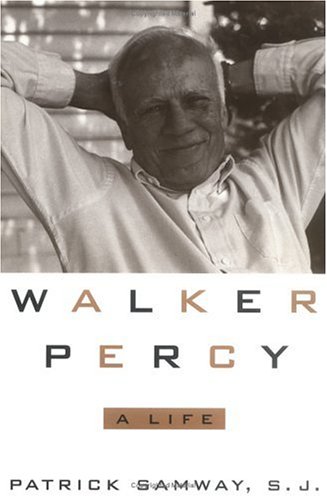
29. Walker Percy: A Life
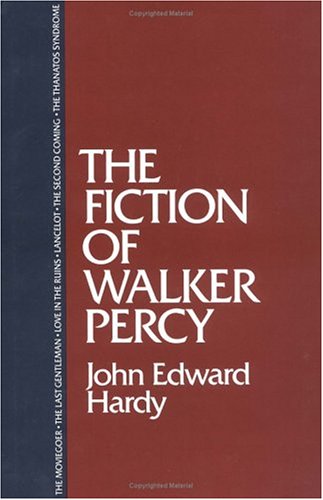
30. The Fiction of Walker Percy
$38.50
31. Desire, Violence, & Divinity
 
$9.95
32. Religion Booknotes.(Pascal's Wager:
 
$5.95
33. "Where is that voice coming from?":
 
$5.95
34. The Myth of the Fall and Walker
 
35. The Correspondence of Shelby Foote
 
36. Love in the Ruins
 
37. Lancelot
 
$93.00
38. The Gift of the Other: Gabriel
$30.00
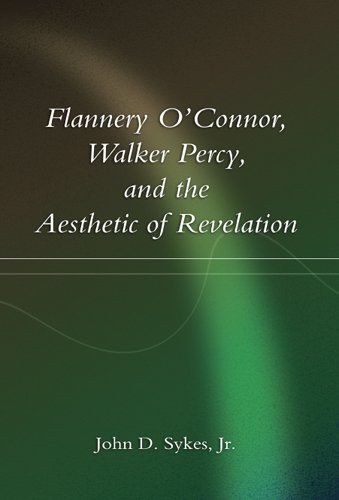
39. Flannery Oconnor, Walker Percy,
 
40. Lancelot

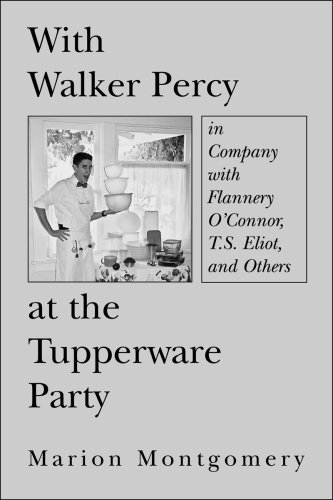
21. Eudora Welty and Walker Percy: The Concept of Home in Their Lives and Literature
by Marion Montgomery
Paperback: 272 Pages (2003-12)
list price: US$38.50 -- used & new: US$38.50
(price subject to change: see help)
Asin: 0786416637
Canada | United Kingdom | Germany | France | Japan
Editorial Review

Book Description
Eudora Welty and Walker Percy were friends but very different writers, even though both were from the Deep South and intensely interested in the relation of place to their fiction. This work explores in each the concept of home and the importance of home to the homo viator ("man on his way"), and anti-idealism and anti-romanticism.

The differences between Welty and Percy and in their fiction were revealed in the habits of their lives. Welty spent her life in Jackson, Mississippi, and was very much a member of the community. Percy was a wanderer who finally settled in Covington, Louisiana, because it was, as he called it, a "noplace." The author also asserts that Percy somewhat envied Welty and her stability in Jackson, and that for him, place was such a nagging concern that it became a personal problem to him as homo viator. ... Read more


22. Love in the Ruins: The Adventures of a Bad Catholic at a Time Near the End of the World
by Walker Percy
 Hardcover: Pages (1971)

Asin: B000O7NJQQ
Canada | United Kingdom | Germany | France | Japan

23. Walker Percy: A Comprehensive Descriptive Bibliography
by Linda Whitney Hobson
Hardcover: 115 Pages (1988-05)
list price: US$35.00 -- used & new: US$7.50
(price subject to change: see help)
Asin: 0917905067
Canada | United Kingdom | Germany | France | Japan

24. Lancelot
by Percy Walker
 Hardcover: Pages (1977)

Asin: B000UDA2T6
Canada | United Kingdom | Germany | France | Japan

25. Walker Percy: The Last Catholic Novelist (Southern Literary Studies)
by Kieran Quinlan
Paperback: 242 Pages (1998-04)
list price: US$17.95 -- used & new: US$5.50
(price subject to change: see help)
Asin: 080712298X
Average Customer Review: 1.0 out of 5 stars
Canada | United Kingdom | Germany | France | Japan

Customer Reviews (2)

1-0 out of 5 stars Not "The Last Gentleman" but truly "Lost in the Cosmos"
I too wasted time with this book (money also, unfortunately). I have to agree with the previous reviewer's comments, particularly in not seeing why Quinlan chose to write this sorry book. He lets it slip in a footnote that he was once a seminarian, and I strongly suspect he still has some "issues" regarding the Catholic Church in particular and religious life in general. There is such an obvious bias throughout this book against religious faith that the author ultimately convicts himself rather than Walker Percy, as he attempts to do. While he feigns openness and balance early in the book, soon his condescending, dismissive, and arrogant attitude comes through in ever heavier tones. There is such an angry, bitter undercurrent thoughout the book that it led me to suspect some personal bias, even jealousy, directed at Mr. Percy. Perhaps it is the bitterness of one who has lost his faith towards someone who clearly maintained his throughout his life. And it may be that a faith with the degree of intellectual rigor of Percy's is the most irritating of all. His conclusion is most telling: there can be no more Catholic novelists because "there is no such goal toward which an intellectually informed and honest human being can now aspire."
Quinlan relishes pointing out "the trouble with Walker Percy's faith" and suggests that his appeal in the future will be similar to that of the New Agers, to "some of his less discriminating readers." The tone throughout this book is so persistently against Percy and Catholicism that it is easy to dismiss the author's rantings by the end of the book. Quinlan's lack of true credibility to write this book becomes obvious. While posing as a fellow wayfarer, he reveals himself as a cynical, intellectually arrogant bore. Anyone who has abandoned "the search" should not attempt to evaluate an author like Walker Percy.This, alone, is perhaps the only (inadvertently) positive quality of this book: it is easily dismissed, forgettable, and does not leave any lasting impression on the reader (other than the author's bitterness). Quite the exact opposite of any of Walker Percy's writings.

1-0 out of 5 stars A Disappointment
I borrowed this book from the library hoping that it would provide better insight into the mind of the man I call "My Mentor From Beyond the Grave."To the author's credit, he states in the Introduction that he is not a believer in the Catholic faith, but that he hopes he can be considered one of Percy's "wayfarers."Based on what I know of what Percy said about his concept of the wayfarer, Quinlan's hope is in vain.

I don't quite know why Quinlan wrote this book.He seems more concerned with avoiding the opporobrium of his fellow academics than writing an insightful treatment of Percy's life and work.I grew weary of the author's characterization of the Catholic faith as a source of easy answers for people who have need of "structure" in their lives.To put things way over the top, he even "outs" Percy's Uncle (author of "Lanterns on the Levee") on flimsy evidence at best.

I suggest that those who share Percy's convictions on Life's Big Questions look elsewhere for helpful insights into the mind of this extraordinary man, and avoid Quinlan's facile trivialization of religious belief and the quest for Truth.

I'm just glad I didn't spend any money on the book. ... Read more


26. Walker Percy and the Postmodern World (Campion Book)
by Mary K. Sweeny
 Hardcover: 85 Pages (1987-05)
list price: US$2.50 -- used & new: US$47.65
(price subject to change: see help)
Asin: 0829405410
Canada | United Kingdom | Germany | France | Japan

27. Understanding Walker Percy (Understanding Contemporary American Literature)
by Linda Whitney Hobson
 Paperback: 203 Pages (1988-07)
list price: US$14.95 -- used & new: US$12.80
(price subject to change: see help)
Asin: 0872495493
Canada | United Kingdom | Germany | France | Japan

28. Walker Percy's Search for Community
by John F. Desmond
 Hardcover: 282 Pages (2004-05)
list price: US$39.95 -- used & new: US$30.58
(price subject to change: see help)
Asin: 0820325880
Canada | United Kingdom | Germany | France | Japan
Editorial Review

Book Description
In the first undertaking of its kind in Percy criticism, John F. Desmond traces--through Walker Percy's six published novels--the writer's central and enduring concerns with community. These concerns, Desmond argues, were grounded in the realism of such Scholastics as Aquinas and Duns Scotus--realism as updated by the semiotic theory of Charles Sanders Peirce, the American philosopher whose work Percy studied for more than forty years. Percy gleaned from Peirce the basic truth that humans are by nature relational beings, a truth reinforced by Percy's Catholic belief in mystical community.

Desmond shows how Percy's theosemiotic outlook shaped each of his novels, from The Moviegoer (1961) to The Thanatos Syndrome (1987), and provided a foundation for his analysis of alienation, his critique of scientism, and his vision of community. Percy's vision of community extended from the flawed social world of modern America and Western society to the mystical community beyond time and place prophesied in the Hebrew-Christian scriptures. This vision grew more explicit as Percy's novelistic career unfolded and was of a piece with the ideas developed in his many essays and in his "self-help" parable, Lost in the Cosmos (1983).

Percy saw himself as a witness to the collapse of scientific humanism in the face of consumerism, self-absorption, and violence. However, Desmond says, Percy also looked forward to a reconciliation of science, religion, and art. In one of his last public lectures, "The Fateful Rift: The San Andreas Fault in the Modern Mind," Percy called for a "new anthropology" based on a Peircean realism that accurately accounted for man's true nature as a wayfarer on a journey with others toward God. This call is echoed in the novels, in which, according to Desmond, Percy explores his vision of community "through representation of the shattered and deformed state of society and the searching of his protagonists, and through suggesting possibilities for healing their riven state." ... Read more


29. Walker Percy: A Life
by Patrick Samway
Paperback: 506 Pages (1999-04)
list price: US$19.95 -- used & new: US$5.47
(price subject to change: see help)
Asin: 0829412689
Average Customer Review: 3.0 out of 5 stars
Canada | United Kingdom | Germany | France | Japan
Editorial Review

Amazon.com
The author is particularly well qualified to evaluate novelist Walker Percy's philosophical interests and 1947 conversion to Catholicism: Patrick Samway, a Jesuit priest, edited a volume of Percy's uncollected essays and another of his correspondence on the subject of American semiotician Charles Sanders Pierce. Although he knew Percy (1916-90) personally in his final years, Samway maintains a scholarly distance in this meticulously researched biography. It does not supplant Jay Tolson's more passionate 1992 assessment, but offers a valuable additional perspective. ... Read more

Customer Reviews (1)

3-0 out of 5 stars Teaching in the Ruins
Years ago I immersed myself in the world of Percy: the fiction and nonfiction, the two books of conversations, the literary criticism, the correspondence with Shelby Foote, the biography by Jay Tolson, John Kennedy Toole's Confederacy of Dunces, and even some Kierkegaard. I became a disciple. Years later, after some living and re-evaluating, I realized that Percy had taken some wrong turns. What nagged me most was Percy's ambivalence if not hostility toward psychiatry, especially considering the large role suicide and depression played in his life and work.

His only direct experience with psychiatry came in the late 1930s, while in medical school, when he underwent Freudian psychoanalysis. This was a purely behavioral and cognitive approach in which self-awareness was intended to help the patient overcome his problems through force of will. Mind over matter, in other words. After three years he concluded that it had failed to cure what ailed him. During recuperation from TB, when he read various works of books of philosophy, religion, and fiction, he discovered his vocation as a writer and began to develop the core and motive force of his life's work: the search for meaning against the forces of "malaise." The physician became a metaphysician. He applied his diagnostic skills to his fiction and nonfiction, attempting to diagnose and treat mankind. He transformed his own predicament, which he often labelled melancholy or laziness, to mankind's predicament. At one point he even suggested that depression was the natural condition of man. I saw no evidence that he ever located its proper definition: a persistent illness caused by abnormal brain chemistry, not by external events, weak will, or insufficient faith.

Over the years Freudian analysis was superseded by other methods, such as the combination of cognitive therapy with psychotropic medication. But Percy distanced himself from these advances. He created a false dichotomy between "science" and religion -- either man was a biological being or a spiritual one, never both -- and set up psychiatry as a straw man. Psychopharmacology appeared only in his last novel, The Thanatos Syndrome, where it was lampooned as a tool of evil scientists. There were additional obstacles: old southern and Roman codes of honor and stoicism, conflicts with his metaphysical search, and the fact that he was treating his depression on his own with alcohol, reading and writing. Although he admitted that his search had yielded no answers, he did not feel compelled to seek psychiatry again. He never received the medication that might have turned his life around. This is the great tragedy of his life.

But that is my view. Samway spends more time portraying Percy as a civil rights activist than as a victim of depression. Although he tends to get bogged down it detail, he gives a fairly objective presentation of the facts, spending little time on interpretation (cf. Tolson). He is particularly good at conveying the influence Percy had among friends, admirers, and students. And he brings a great deal of tact to the life of a man who cherished his privacy. But he adds little to our existing knowledge of Percy. Readers might want to take a look at Pilgrim in the Ruins by Jay Tolson and The House of Percy by Bertram Wyatt-Brown. ... Read more


30. The Fiction of Walker Percy
by John Hardy
Hardcover: 317 Pages (1987-10-01)
list price: US$32.50
Isbn: 0252013875
Canada | United Kingdom | Germany | France | Japan

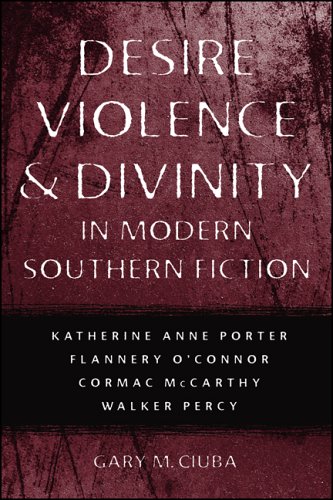
31. Desire, Violence, & Divinity in Modern Southern Fiction: Katherine Anne Porter, Flannery O'connor, Cormac McCarthy, Walker Percy (Southern Literary Studies)
by Gary M. Ciuba
Hardcover: 287 Pages (2007-01)
list price: US$47.50 -- used & new: US$38.50
(price subject to change: see help)
Asin: 080713175X
Canada | United Kingdom | Germany | France | Japan
Editorial Review

Book Description
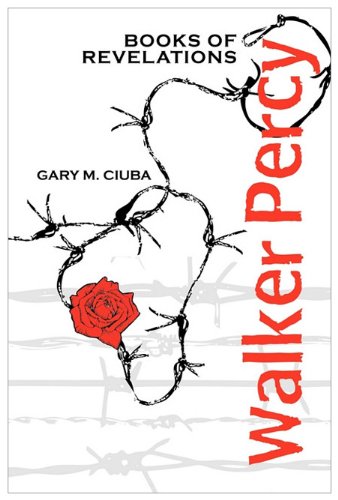
In this groundbreaking study, Gary M. Ciuba examines how four of the South's most probing writers of twentieth-century fiction—Katherine Anne Porter, Flannery O'Connor, Cormac McCarthy, and Walker Percy—expose the roots of violence in southern culture. Ciuba draws on the paradigm of mimetic violence developed by cultural and literary critic René Girard, who maintains that individual human nature is shaped by the desire to imitate a model. Mimetic desire may lead in turn to rivalry, cruelty, and ultimately community-sanctioned —and sometimes ritually sanctified—victimization of those deemed outcasts. Ciuba offers an impressively broad intellectual discussion that gives universal cultural meaning to the southern experience of desire, violence, and divinity with which these four authors wrestled and out of which they wrote. In a comprehensive analysis of Porter's semiautobiographical Miranda stories, Ciuba focuses on the prescribed role of women that Miranda imitates and ultimately escapes. O'Connor's The Violent Bear It Away reveals three characters whose scandalous animosity caused by religious rivalry leads to the unbearable stumbling block of violence. McCarthy's protagonist in Child of God, Lester Ballard, appears as the culmination of a long tradition of the sacred violence of southern religion, twisted into his own bloody faith. And Percy's The Thanatos Syndrome brings Ciuba's discussion back to the victim, in Tom Moore's renunciation of a society in which scapegoating threatens to become the foundation of a new social regime. From nostalgia for the old order to visions of a utopian tomorrow, these authors have imagined the interrelationship of desire, antagonism, and religion throughout southern history. Ciuba's insights offer new ways of reading Porter, O'Connor, McCarthy, and Percy as well as their contemporaries who inhabited the same culture of violence—violence desired, dreaded, denied, and deified. AUTHOR BIO: Gary M. Ciuba is the author of Walker Percy: Books of Revelations and numerous articles on modern southern fiction.He is a professor of English at Kent State University. ... Read more


32. Religion Booknotes.(Pascal's Wager: The Man Who Played Dice with God)(Walker Percy Remembered)(Christ Is the Question)(Book review): An article from: Commonweal
by Lawrence S. Cunningham
 Digital: 10 Pages (2007-01-12)
list price: US$9.95 -- used & new: US$9.95
(price subject to change: see help)
Asin: B000TJ012O
Canada | United Kingdom | Germany | France | Japan
Editorial Review

Book Description
This digital document is an article from Commonweal, published by Thomson Gale on January 12, 2007. The length of the article is 2799 words. The page length shown above is based on a typical 300-word page. The article is delivered in HTML format and is available in your Amazon.com Digital Locker immediately after purchase. You can view it with any web browser.

Citation Details
Title: Religion Booknotes.(Pascal's Wager: The Man Who Played Dice with God)(Walker Percy Remembered)(Christ Is the Question)(Book review)
Author: Lawrence S. Cunningham
Publication: Commonweal (Magazine/Journal)
Date: January 12, 2007
Publisher: Thomson Gale
Volume: 134Issue: 1Page: 24(6)

Article Type: Book review

Distributed by Thomson Gale ... Read more


33. "Where is that voice coming from?": Walker Percy and the Demonic. (Special Feature).(Critical Essay): An article from: Christianity and Literature
by John F. Desmond
 Digital: 17 Pages (2002-06-22)
list price: US$5.95 -- used & new: US$5.95
(price subject to change: see help)
Asin: B0008FIQV2
Canada | United Kingdom | Germany | France | Japan
Editorial Review

Book Description
This digital document is an article from Christianity and Literature, published by Conference on Christianity and Literature on June 22, 2002. The length of the article is 4894 words. The page length shown above is based on a typical 300-word page. The article is delivered in HTML format and is available in your Amazon.com Digital Locker immediately after purchase. You can view it with any web browser.

Citation Details
Title: "Where is that voice coming from?": Walker Percy and the Demonic. (Special Feature).(Critical Essay)
Author: John F. Desmond
Publication: Christianity and Literature (Refereed)
Date: June 22, 2002
Publisher: Conference on Christianity and Literature
Volume: 51Issue: 4Page: 621(11)

Article Type: Critical Essay

Distributed by Thomson Gale ... Read more


34. The Myth of the Fall and Walker Percy's Last Gentleman. (book reviews): An article from: The Mississippi Quarterly
by Axel Knoenagel
 Digital: 4 Pages (1994-03-22)
list price: US$5.95 -- used & new: US$5.95
(price subject to change: see help)
Asin: B00092V4R2
Canada | United Kingdom | Germany | France | Japan
Editorial Review

Book Description
This digital document is an article from The Mississippi Quarterly, published by Mississippi State University on March 22, 1994. The length of the article is 1019 words. The page length shown above is based on a typical 300-word page. The article is delivered in HTML format and is available in your Amazon.com Digital Locker immediately after purchase. You can view it with any web browser.

Citation Details
Title: The Myth of the Fall and Walker Percy's Last Gentleman. (book reviews)
Author: Axel Knoenagel
Publication: The Mississippi Quarterly (Refereed)
Date: March 22, 1994
Publisher: Mississippi State University
Volume: v47Issue: n2Page: p324(3)

Article Type: Book Review

Distributed by Thomson Gale ... Read more


35. The Correspondence of Shelby Foote & Walker Percy
by Jay Tolson
 Hardcover: Pages (1997)

Asin: B0011E5DKG
Canada | United Kingdom | Germany | France | Japan

36. Love in the Ruins
by Walker Percy
 Paperback: 384 Pages (1989)

Isbn: 0586087753
Canada | United Kingdom | Germany | France | Japan

37. Lancelot
by Walker Percy
 Hardcover: Pages (9999)

Asin: B000XTEE00
Canada | United Kingdom | Germany | France | Japan
Editorial Review

Product Description
Date not stated ... Read more


38. The Gift of the Other: Gabriel Marcel's Concept of Intersubjectivity in Walker Percy's Novels
by Mary Deems Howland
 Hardcover: 179 Pages (1990-03)
list price: US$29.95 -- used & new: US$93.00
(price subject to change: see help)
Asin: 0820702110
Canada | United Kingdom | Germany | France | Japan

39. Flannery Oconnor, Walker Percy, and the Aesthetic of Revelation
by John D., Jr. Sykes
Hardcover: 216 Pages (2007-09-30)
list price: US$37.50 -- used & new: US$30.00
(price subject to change: see help)
Asin: 0826217575
Canada | United Kingdom | Germany | France | Japan
Editorial Review

Product Description
According to Sykes, the fiction of Flannery O Connor and Walker Percy provides occasions for divine revelation. He traces their work from its common roots in midcentury southern and Catholic intellectual life to show how the two adopted different theological emphases and rhetorical strategies O Connor building to climactic images, Percy striving for dialogue with the reader as a means of uncovering the sacramental foundation of the created order. Through sustained readings of key texts, Sykes focuses on the intertwined themes of revelation, sacrament, and community. By disclosing how O Connor and Percy made aesthetic choices based on their Catholicism and their belief that fiction by its very nature is revelatory, Sykes demonstrates that their work cannot be seen as merely a continuation of the historical aesthetic that dominated southern literature for so long. ... Read more


40. Lancelot
by Walker Percy
 Hardcover: 272 Pages (1977)

Isbn: 0436366630
Average Customer Review: 4.5 out of 5 stars
Canada | United Kingdom | Germany | France | Japan

Customer Reviews (18)

5-0 out of 5 stars From Despair to Evil
Percy's Lancelot draws on a thought from Kierkegaard that begins his book the Moviegoer (paraphasing), "The worst thing about being in despair is not knowing one is in despair." From his despair, Lancelot's anger and rage drive him on a quest for the Holy Grail of Evil that leads to ultimately great crimes. But, in his quest he discovers the truth about evil, that it is in fact a "nothing" because it exists only in relation to the good. However, thediscovery of the "nothingness" of evil has grave consequences which Lancelot describes through much of the novel.
The dialgoue of Lancelot and Percival does a great job of showing that one's "character" is the sum total of his/her moral choices. Lancelot makes a choice for evil and reaps the consequences that spin him into moral chaos, while Percival (his friend the priest-psychiatrist) has chosen to follow the path of goodness. The book is a great comparison and contrast of the battle of good and evil that occurs in every one of us.

4-0 out of 5 stars Like strolling down a hospital corridor and trying not to look in the half-cracked doors
Reading Walker Percy's "Lancelot" is like strolling down a hospital corridor and trying not to look in the half-cracked doors where there are likely sites best unseen-but failing. Mr. Percy, who was one of the best writers in the last quarter of the 20th Century, took the quest motif from medieval literature-specifically the quest for the Holy Grail-and inverted it so that the quest now centers on finding the darkest evil, in order to prove that good exists beyond the abstract.

His main character, Lancelot, is the sole speaker in the book, the entire novel a refraction of his recovering memory, shattered by the horrific murders he committed as a reaction to the decaying morality and facile values here amplified by a Hollywood film crew and his adulterous wife. The only other character who exists in "real time" is Lancelot's lifelong friend, Perceval, now a Catholic priest, who serves a touchstone for the ranting Lancelot.

Both characters are either recovering or evolving, or both, from their encounters with life's vicissitudes. If there is a take home message, then it might be the value of staying aware and alert to one's self amidst the mind-numbing banality that rises to the surface of modern life.

Putting aside the story, theme, and plot, it's a pleasure to read "Lancelot" because of Mr. Percy's thoughtfully paced and measured prose and his slow revelation of character and motive. He turns out many brilliant, indelible phrases throughout the book, creating indelible images that linger long after the details of the story fade and blur.

3-0 out of 5 stars Not Percy's Best, But...
Quite frankly, I found this the most difficult and least enjoyable of Percy's books.

Percy is at his usual cranky self, poking at the delusions of modern life and ridiculing our self-assurance in spite of the fact that we're all rather lost. Good questions are asked. What is love and is it real? Is secular liberalism or Christianity true? What does sex mean? How can we escape boredom? Is life just some cosmic joke?

What is missing in Lancelot, in my opinion, is the sly humour found in The Second Coming or Love in the Ruins. Lancelot is a departure from Percy's typical protagonist, not because he is some crazy, libidinal loner who concocts an apocalyptic scheme to prove some cosmic point (because all of Percy's protagonists fit that bill), but because he isn't particularly funny. Lancelot lacks the sense that the world is bigger than himself, and is so serious that he rarely cracks a joke. His soliloquies, therefore, end up as overly explicit narratives concerning other humourless characters. This is especially true of the play within the play --- the movie making subplot which gets a little self-referential (after all, isn't this the most cinematic of Percy's novels?).

Still, enjoy Percy's craftsmanship, for there are far too few of his novels to be too fussy. What else is a crazy, libidinal, apocalyptic loner to do?

4-0 out of 5 stars Modern Literature at its Best
This novel is wonderfully written.Walker Percy has quite a unique way of expressing thought in the English language.Unfortunately, unique does not always mean well done.In the case of Walker Percy, however, this novel is a masterpiece of prose.

The first couple of pages take the reader into the mind of a man (Lancelot) at an insane asylum who is recollecting his crimes against his now dead wife.Percy uses Lancelot as a foil to pose many questions regarding our humanity and morality.

For example, what is the sexual act?Why should it mean anything other than a biological act between two humans?What is it that causes man to be so grievously injured by adultery if the act is nothing but biology?Lancelot ponders these questions throughout the novel as he talks to his childhood friend who has become a priest.Percy gives no answers except to demonstrate through Lancelot that Lancelot's answers are lacking.Lancelot's answers form no moral basis.

The story moves quickly as Lancelot recalls the events leading up to his crime.To that end, the clipped pace of the narrative suits the urgency of the action.

The reader will understand just what he/she is getting in this novel within the first 20 pages.I recommend it highly, but do issue a caution that there is some quite honest dialogue in the novel that includes a fair amount of profanity.Though probably necessary to develope the character, some may be offended.

Purchase the book and enjoy modern literature at its best.

5-0 out of 5 stars Confidentially, It's Walker Percy's Best Book . . .
After I read this book I had no choice but to immediately consume Walker Percy's novels.Reading Lancelot was like having the top of my head blown off and surviving the experience more awake and alive than ever.In an era where no one is really sure what they believe anymore, Percy sets out an interesting test.If you discovered clear evidence of evil, what would that tell you about the existence of good and maybe even God?I strongly suggest you take this journey and pay very close attention to the parallel travels of the main character's confidant, a priest-psychologist who is himself in crisis.If you do so, the ending will make the hairs stand up on the back on your neck. ... Read more


  Back | 21-40 of 100 | Next 20
A  B  C  D  E  F  G  H  I  J  K  L  M  N  O  P  Q  R  S  T  U  V  W  X  Y  Z  

Prices listed on this site are subject to change without notice.
Questions on ordering or shipping? click here for help.

site stats