e99 Online Shopping Mall

Geometry.Net - the online learning center Help  
Home  - Authors - Percy Walker (Books)

  1-20 of 100 | Next 20
A  B  C  D  E  F  G  H  I  J  K  L  M  N  O  P  Q  R  S  T  U  V  W  X  Y  Z  

click price to see details     click image to enlarge     click link to go to the store

$8.44
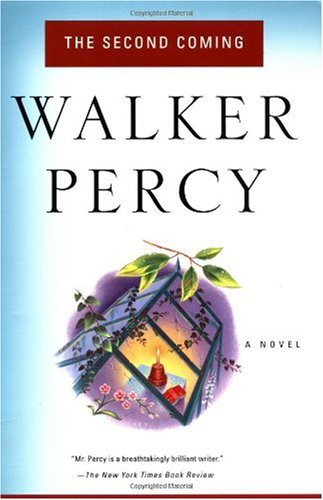
1. The Second Coming: A Novel
$7.90
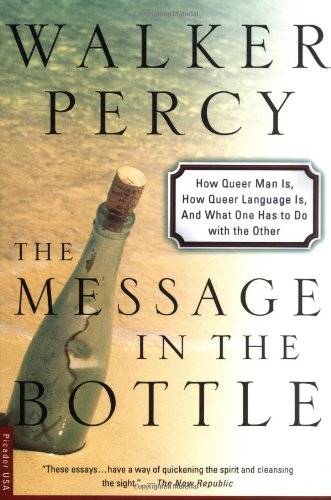
2. The Message in the Bottle: How
 
$7.75
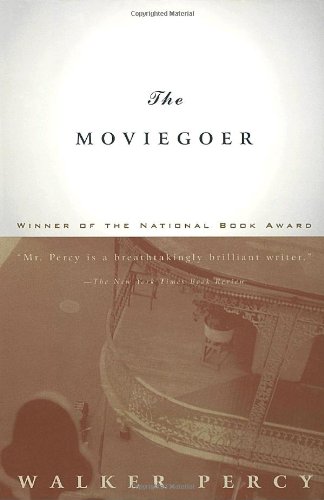
3. The Moviegoer
$7.89
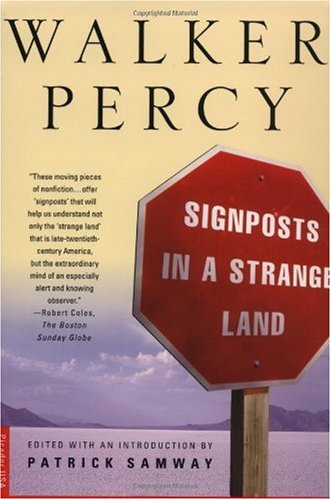
4. Signposts in a Strange Land: Essays
$12.70
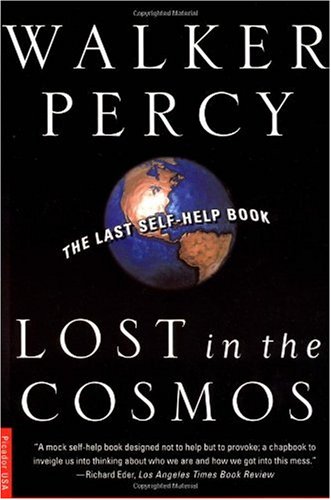
5. Lost in the Cosmos: The Last Self-Help
 
$7.18
6. The Last Gentleman: A Novel
$14.95
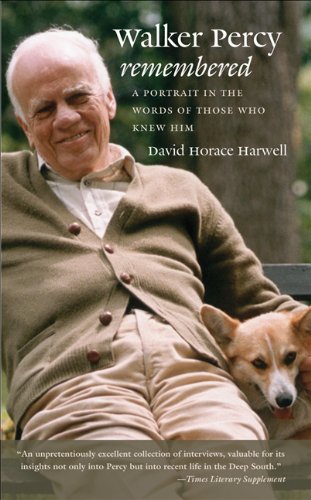
7. Walker Percy Remembered: A Portrait
 
8. LOVE IN THE RUINS
 
$21.62
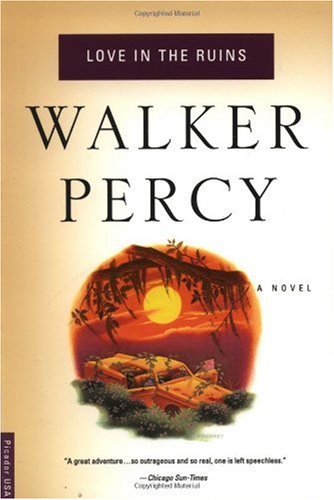
9. Love in the Ruins: A Novel
 
$16.50
10. Walker Percy (Bloom's Modern Critical
 
$4.89
11. The Thanatos Syndrome: A Novel
$20.00
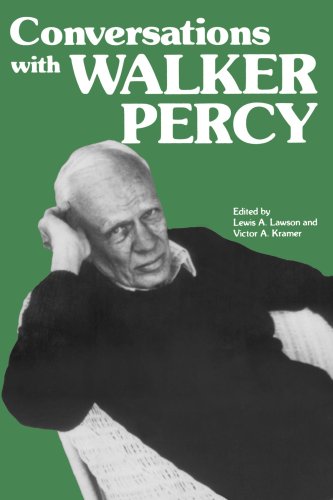
12. Conversations With Walker Percy
 
13. Love in the Ruins
$28.60
14. Walker Percy's Voices
 
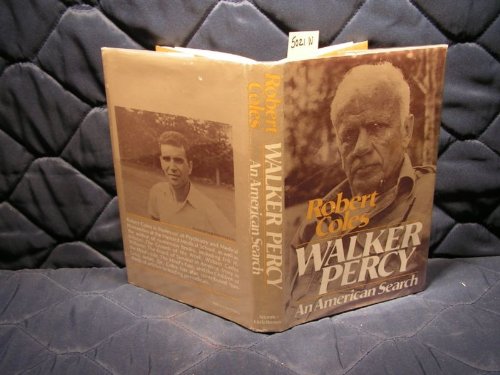
15. Walker Percy: An American Search
 
16. Lancelot / Walker Percy
$16.49
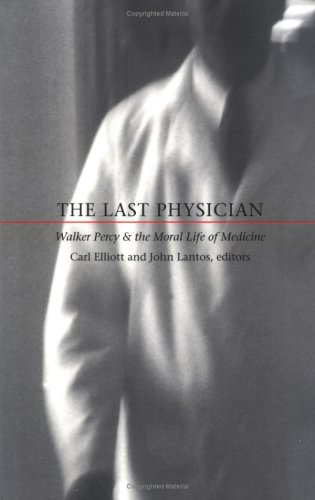
17. The Last Physician: Walker Percy
$29.70
18. With Walker Percy at the Tupperware
$22.95
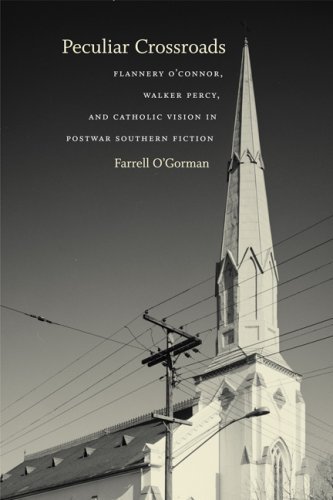
19. Peculiar Crossroads: Flannery
$8.34
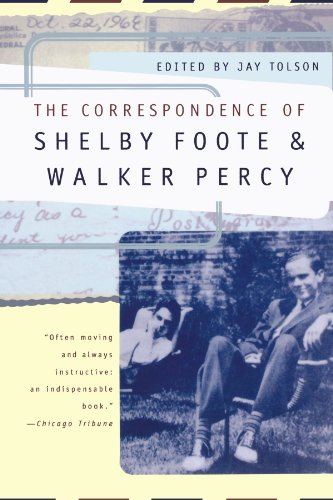
20. The Correspondence of Shelby Foote

1. The Second Coming: A Novel
by Walker Percy
Paperback: 368 Pages (1999-09-13)
list price: US$15.00 -- used & new: US$8.44
(price subject to change: see help)
Asin: 0312243243
Average Customer Review: 4.5 out of 5 stars
Canada | United Kingdom | Germany | France | Japan
Editorial Review

Book Description
Will Barrett (also the hero of Percy's The Last Gentleman) is a lonely widower suffering from a depression so severe that he decides he doesn't want to continue living. But then he meets Allison, a mental hospital escapee making a new life for herself in a greenhouse. The Second Coming is by turns touching and zany, tragic and comic, as Will sets out in search of God's existence and winds up finding much more. ... Read more

Customer Reviews (22)

2-0 out of 5 stars Meandering stretch of a story
This is the first Walker Percy book I have read. I don't believe I'll choose another unless there's compelling reason. Mr. Percy started off well with a good writing style; a little more than half-way through, I realized he was padding the book with irrelevant, fantastic vignettes. This is one of the few books I threw away rather than pass on to a friend.

4-0 out of 5 stars Rewarding for a certain kind of reader
I first read this novel when I was quite young.I found the chapters about Allie fascinating, and the chapters about Will perplexing and boring, so I skimmed them.This was of course a mistake.As I re-read the novel recently, I realized how huge my mistake was.I was inspired to re-read the novel following the psychiatric hospitalization of a family member, who seemed to communicate easily with his fellow patients and less well with us.I dimly recalled reading a novel about two people who are experiencing some mental problems and connect with each other much better than with the world at large.After a long and peculiar conversation with a book store clerk, I found this book again.Now that I am in my forties, I am a more patient and careful reader, and my life experience has made me far more interested in the ruminations of Will Barrett.It is important to understand that the author is letting us experience what it feels like to be in Will's head, and it is sometimes a strange place to be, where the narrative does not flow easily, and important insights and plot points pop up unexpectedly.I loved every moment of my second reading of this book, and I expect it will become one of the books that I re-read periodically, like Middlemarch.

2-0 out of 5 stars Loose Ends
This is a very scattered novel with lots of needless repetitions. What was Percy on when he wrote this thing? There are so many loose ends it would take an additional book just to tie them all together. My response to this book is similar to the incessant grunts of the protagonist Will Barrett--"Huh"?, "What"?, "Who"? "Eh"?For me a poor ending and an unsatisfying read. Perhaps I should go back and read it again to see what all these five stars are about.

5-0 out of 5 stars Marvelous
What's so special about this novel is that the characters maintain complete credibility in almost incredible circumstances. I kept rooting for them al.l the way, hopingtheir completely impossible romance would issue inter sober (and sanctified) reality. But that's what this author lived.

5-0 out of 5 stars Have to read it again
This book is filled with quotations and observations that are so easy to fly by.The plot is out there, the characters odd.It is hard to describe it as 'good', rather I would say it is exceptional. Who else today writes this stuff?Simply, Walker Percy is a genius.I have to read it again. ... Read more


2. The Message in the Bottle: How Queer Man is, How Queer Language Is, and What One Has to Do With the Other
by Walker Percy
Paperback: 272 Pages (2000-04-01)
list price: US$14.00 -- used & new: US$7.90
(price subject to change: see help)
Asin: 0312254016
Average Customer Review: 4.5 out of 5 stars
Canada | United Kingdom | Germany | France | Japan
Editorial Review

Book Description
In Message in the Bottle, Walker Percy offers insights on such varied yet interconnected subjects as symbolic reasoning, the origins of mankind, Helen Keller, Semioticism, and the incredible Delta Factor. Confronting difficult philosophical questions with a novelist's eye, Percy rewards us again and again with his keen insights into the way that language possesses all of us. ... Read more

Customer Reviews (5)

5-0 out of 5 stars brilliant
In a see of charlatans, hucksters, half-truths and snake-oil salesmen, we find this island of wisdom.Percy, a psychiatrist turned novelist, was ever a scientist.He takes his aim at a very difficult scientific issue-the study of man.It is very hard for many to study himself, but percy believes the answer to understand man lies in the study og language. As Percy himself said, just because a primate can be taught sign-language words doesn't mean we are anywhere close to understanding human language.It is a shame this author isn't more well-known.

5-0 out of 5 stars Always the Novelist
The precursor to the, in comparision, pithy 'Lost in the Cosmos,' Message in a Bottle is less accessible than his later, more famous, book. However, Message... provides all of the necessary academic rigor that 'Lost in the Cosmos' lacks (not that LC is not a great book, it is).

Percy claims that he is, in fact, not philosopher or scientist. Rather, he wishes to be thought of as mere novelist writing as he perceives scientists and philosophers. In fact, this is a sort of claim of superiority in the sense that Percy thinks he knows more about philosophers and scientists than they know about themselves (which may be true). Even so, Percy's methods are quite scientific and philosophic. Message in a Bottle deals with the most important question of all: What is Man? Percy contends, as any good Heideggerian would, that we are essentially castaways on an island. We aren't quite sure how we got here and we don't quite know what we're supposed to do now that we are here. But Percy is a Thomist, not an existentialist (although the two are connected). While Percy finds the greatest evidence for our essential 'lostness' in the altogether baffling phenomenon of language, Percy is nevertheless concerned with what we are to do about out anxiety about existence. Percy is interested in pursuing the Thomistic project; 'completing' reason with revelation.

5-0 out of 5 stars Essential Percy
A few of the essays in this collection make for somewhat dry reading (Percy even says so himself), but if wonder and enlightenment are your goals, then this is an extremely rewarding book.His insights on symbolicreasoning, the origins of mankind, Hellen Keller, Semioticism, and theincredible Delta Factor are invariably fresh and thought-provoking.Percyis really onto something here; he may have only scratched the surface, butwhat he has revealed has powerful implications for all of us.

5-0 out of 5 stars A brilliant and relatively unknown work
This dense, well-written and extraordinary book is an excellent introduction to the works of a great 20th century thinker.In this collection of essays, Percy manages to confront some difficultphilosophical questions in an exciting and readable context.Percy wasfirst a novelist, and his writing is seldom inaccesible. He deals ineverything from religion to science, from literary theory to travel.Hisbest writing relates to theories of language and the human being.Yet likesome of the greatest X-Files episodes, Percy leaves many things unresolved,liminal, only suggested.Message in a Bottle is designed to stimulate thereader rather than fill them with useless information. I finished readingthis book with the desire to read it again, and whenever I see it on thebookshelf I am comforted by the thought that there are people in the worldwho think for themselves, and who have the courage to print what theythink.

2-0 out of 5 stars Dense essays about man's 20th century blahs
There are very few books that I have been unable to finish because of ennui, but this was one of them.I made it about 2/3 of the way through and had to call it quits.This book badly needs editing.Percy asks some engaging questions to begin the book, but it is all downhill from there. ... Read more


3. The Moviegoer
by Walker Percy
 Paperback: 256 Pages (1998-04-14)
list price: US$13.95 -- used & new: US$7.75
(price subject to change: see help)
Asin: 0375701966
Average Customer Review: 4.0 out of 5 stars
Canada | United Kingdom | Germany | France | Japan
Editorial Review

Amazon.com
This elegantly written account of a young man's search for signs of purpose in the universe is one of the great existential texts of the postwar era and is really funny besides. Binx Bolling, inveterate cinemaphile, contemplative rake and man of the periphery, tries hedonism and tries doing the right thing, but ultimately finds redemption (or at least the prospect of it) by taking a leap of faith and quite literally embracing what only seems irrational.Book Description
Winner of the 1961 National Book Award

The dazzling novel that established Walker Percy as one of the major voices in Southern
literature is now available for the first time in Vintage paperback.

The Moviegoer is Binx Bolling, a young New Orleans stockbroker who surveys the world with
the detached gaze of a Bourbon Street dandy even as he yearns for a spiritual redemption he
cannot bring himself to believe in. On the eve of his thirtieth birthday, he occupies
himself dallying with his secretaries and going to movies, which provide him with the
"treasurable moments" absent from his real life. But one fateful Mardi Gras, Binx embarks
on a hare-brained quest that outrages his family, endangers his fragile cousin Kate, and
sends him reeling through the chaos of New Orleans' French Quarter. Wry and wrenching, rich
in irony and romance, The Moviegoer is a genuine American classic. ... Read more

Customer Reviews (107)

3-0 out of 5 stars Of the Very Best in Novels?
I have been wanting to read this book for some time as it is on many of the top 100 lists for novels. While I was able to finish the work, I found myself questioning what it shares with greats such as The Great Gatsby, Brave New World, Huckleberry Finn, Crime and Punishment etc.
The narrating character, Binx Bolling, is like the boy next door, the rather dull and boring boy next door. While I can certainly appreciate the movie references etc., I just cannot make heads or tails of the point. The book did not leave me with a change in perspective, or even a recommendation to make to fellow readers. I would almost rather have hated the book, because hatred involves passion. In this case, I am left rather indifferent.
I am glad to have read it because it does offer a little piece of American history. As an avid reader, however, I am left feeling slightly cheated. If you want to read truly great southern literature, start with Flannery O'Connor's "A Good Man is Hard to Find." Save Percy's book for a rainy day (when you are broke and without a friend or a ride to someplace even remotely interesting).

3-0 out of 5 stars Only recommended for the genre
If you wish to get a better handle of the general premise, your best bet is to read the reviews noted on this page. The book's description on the back cover does not provide an accurate account of the content.I did enjoy this book, and do understand its significance.However, the genre really isn't up my alley.Percy's prose is amazing, to say the least.His description of the environment (emotionally, socially, physically - and/or metaphysically) is almost Shakespearean.A technically brilliant writer.

4-0 out of 5 stars Great existentialist novel
Binx Bolling is on a search for the meaning of life... the meaning of HIS life.His search is conducted in a non-judgmental manner, observing others, listening to what they have to say, watching how they conduct themselves.He is attempting to create his own definition and is unwilling to accept the meaning of life which is handed down to him by cultural expectations.His life of observation extends to the movie theatre as well, hence the title.For him, all of life is a movie, a series of experiences which are meant to be viewed, categorized, and assimilated, if possible.Such a life tends to lack a moral compass, and, because of that, Binx descends into hedonism (an important archetypal activity within existentialist behavior) in the form of sexual encounters with his secretaries and Kate, the one possible love of his life.
Percy's writing is like a snake, constantly slithering here and there, surprising the reader.When we expect Percy to describe his budding relationship with Sharon, we instead get a page description on the manner in which a minor character ties his shoes.As a reader, I felt this was an older version of Holden Caulfield, or perhaps a younger version of the main character in "On The Road."The book, though written in the early 60s, feels as current today as any new titles.

5-0 out of 5 stars No visit to the Filet of Soul
The back of the book seems to describe something like (the film version, at least, of), "Live and Let Die," but no, nothing like that.A most intriguing of books written in first person: the similarities and incongruities of what the narrator tells and exposes about himself, are written without the heaviness that's usually involved with that sort of thing.There is much racing about, though, but it is within and between characters and expressed in a wonderfully palpable disorientation.

2-0 out of 5 stars Hard to Read
This book was recommended in Francine Prose's book on writing.Being a good-student type of guy, I jumped in and was quickly disillusioned. After twenty pages or so, I was looking around nervously for the exit.
This is a book about ennui-a deep, down-in-the-bones boredom. Unfortunately, the subject has infected the telling. Even New Orleans becomes boring. There also seems to have been some editorial confusion with whole unconnected narratives stuck in the middle of others and a sudden address to the reader somewhere towards the end.Some sharp observations are there to keep the reader going, but in the end it's not enough.
It was neither edifying or entertaining-I would have been better off going to the movies.

--Lynn Hoffman, author of THE NEW SHORT COURSE IN WINE New Short Course in Wine,The and the easy-to-read bang BANG: A Novel

... Read more


4. Signposts in a Strange Land: Essays
by Walker Percy
Paperback: 432 Pages (2000-04-01)
list price: US$15.00 -- used & new: US$7.89
(price subject to change: see help)
Asin: 0312254199
Average Customer Review: 4.5 out of 5 stars
Canada | United Kingdom | Germany | France | Japan
Editorial Review

Book Description
At his death in 1990, Walker Percy left a considerable legacy of uncollected nonfiction. Assembled in Signposts in a Strange Land, these essays on language, literature, philosophy, religion, psychiatry, morality, and life and letters in the South display the imaginative versatility of an author considered by many to be one the greatest modern American writers. ... Read more

Customer Reviews (6)

2-0 out of 5 stars off the beaten track of modern life
a better title for this book might be, strange signposts in an otherwise interesting world.He became a devout Catholic while the rest of us were questioning its relevance. C. Pierce's psychologic discovery or insight does not seem especially significant.This MD does not provide the right presciption for our times.

4-0 out of 5 stars Repetitive, But Revealing
This is not the place to start, if you haven't read Percy before.When read fresh, much of this collection of essays comes across as rambling, with the themes of "Southerner," "Catholic," "Author," "Southern Catholic Author," and "Fan o' Kierkegaard & Dostoevsky" running incessantly throughout the volume.

However, Percy's engaging wit keeps the essays entertaining, and it is interesting to watch his fixations and how they change (or don't change) over time.

Of particular value is the discourse on semiotics, which is a nice primer to the uninitiated, but doesn't help one make heads or tails of Umberto Eco.

Still, I would recommend reading Percy's fiction before tackling this collection.

5-0 out of 5 stars Outstanding Percy Compilation
This book is perfect as either an introduction to Walker Percy's thought or as a final collection of essays for the longtime fan."Signposts" is the only book available that provides Percy's writing from virtually every stage of his life, including the period when he was completely unknown.That fact alone makes it worth the purchase.

5-0 out of 5 stars Great introduction to a great American thinker
Though better known as a novelist, Walker Percy began his writing career with non-fiction pieces of a philosophical bent.He remains one of the most philosophical novelists of the late 20th century, and his first novel,The Moviegoer, is widely acknowledged as one of the masterpieces ofcontemporary literature. This collection covers Percy's major interestsover the span of his career:the literally miraculous ability of humans tocommunicate with language, the unique qualities of Southern writing (andwhy, for instance, there are no great Los Angeles novelists or Zen Buddhistnovelists), and the curious fact that late-twentieth century western man isbored, weary, and sad, despite living in the most affluent period in humanhistory.

Like C. S. Lewis, Percy became a Christian after spending hisyoung adult years as a confirmed atheist.For this reason, he isparticularly adept at addressing the intellectual impediments to belief. His work is the perfect antidote to those who think that smart people don'tbelieve in God.He was also a scientist, having been trained as a medicaldoctor.Science, he believed, has discovered how the universe works buthas been unable to address the most important fact of our existence:thateach of us is a self-aware human being who will one day die.Percy wasprofoundly influenced by Kierkegaard and thus has been called a Christianexistentialist, though he finds the term has become meaningless throughoveruse.

This is a fascinating overview of Percy's ideas.As a bonus,the book concludes with a whimsical self-interview that lets us see what adelightful man he would have been to know.Highly recommended, along withhis Lost in the Cosmos, which further develops many of the ideas here inthe mock format of a self-help book.

5-0 out of 5 stars Great introduction to a great American thinker
Though better known as a novelist, Walker Percy began his writing career with non-fiction pieces of a philosophical bent.He remains one of the most philosophical novelists of the late 20th century, and his first novel,The Moviegoer, is widely acknowledged as one of the masterpieces ofcontemporary literature. This collection covers Percy's major interestsover the span of his career:the literally miraculous ability of humans tocommunicate with language, the unique qualities of Southern writing (andwhy, for instance, there are no great Los Angeles novelists or Zen Buddhistnovelists), and the curious fact that late-twentieth century western man isbored, weary, and sad, despite living in the most affluent period in humanhistory.

Like C. S. Lewis, Percy became a Christian after spending hisyoung adult years as a confirmed atheist.For this reason, he isparticularly adept at addressing the intellectual impediments to belief. His work is the perfect antidote to those who think that smart people don'tbelieve in God.He was also a scientist, having been trained as a medicaldoctor.Science, he believed, has discovered how the universe works buthas been unable to address the most important fact of our existence:thateach of us is a self-aware human being who will one day die.Percy wasprofoundly influenced by Kierkegaard and thus has been called a Christianexistentialist, though he finds the term has become meaningless throughoveruse.

This is a fascinating overview of Percy's ideas.As a bonus,the book concludes with a whimsical self-interview that lets us see what adelightful man he would have been to know.Highly recommended, along withhis Lost in the Cosmos, which further develops many of the ideas here inthe mock format of a self-help book. ... Read more


5. Lost in the Cosmos: The Last Self-Help Book
by Walker Percy
Paperback: 272 Pages (2000-04-01)
list price: US$14.00 -- used & new: US$12.70
(price subject to change: see help)
Asin: B0013TMN6G
Average Customer Review: 4.5 out of 5 stars
Canada | United Kingdom | Germany | France | Japan
Editorial Review

Amazon.com
The late Walker Percy's mordant contribution to the self-help book craze of the 1980s deals with the heavy abstraction of the Western mind and speculates about why writers may be the most abstracted and least grounded of all. (Before taking up novel writing, Percy was a medical doctor who became a patient in the very institution where he had worked.) The book disappeared for a time. Now it's back in print. Take the quizzes in it, then take a walk--you need to be back in the world before you write another word.Book Description
Walker Percy's mordantly funny and wholly original contribution to the self-help book craze deals with the Western mind's tendency toward heavy abstraction. This favorite of Percy fans continues to charm and beguile readers of all tastes and backgrounds. Lost in the Cosmos invites us to think about how we communicate with our world. ... Read more

Customer Reviews (35)

5-0 out of 5 stars BULLSEYE
Walker Percy is very much a modern-day Pascal, in that he is wrapped up in the project of waking up modern man from his numb, jaded, over-entertained stupor into realizing what a predicament he is in. It's an existentialist concern, in the Christian-existentialist sense of Kierkegaard, especially insofar as both Percy and the Melancholy Dane are obsessed with the problem of subjectivity, and our awareness of it, and the paltry ways we try, unsuccessfully, to transcend it.

So, this is NOT really a humor/satire book, per se, although the dust jacket's description tries to bill it as such (perhaps to expand the market appeal? Feh!). Early on, though, there is a send-up of the Phil Donahue show that is just *hilarious*. Most of the book is a series of (fairly involved) rhetorical questions, about such things as who in a hypothetical situation you would identify with the most, and why. The way the questions are counterposed, one could accuse Percy of making his points backhandedly via strawman-demolition, but that would be beside the point. Percy's overall aim is to get at the background of all our operating assumptions, and the ways in which we judge and evaluate others in relation to self, and what that says about what kind of thing man is.

In the middle of the book is a digression on semiotics, the theory of signs. One of Percy's central ideas here is that man's cardinal innovation over other animals is his use of signs and not just signals. The "sign" usage is essentially triangular, involving subject, object, and the intersubjective sign, whereas an animal "signal" is two-dimensional, such as "danger, run away." All of our thought and communication is predicated on that sign-based three-dimensional framework. The self constantly has to situate oneself with respect to other selves and in the intersubjective framework that marks our communicative network.

The main human predicament is that that intersubjective framework is essentially unstable due to our confusion about ourselves, and our desire to cover up our insecurities. No solution to this problem is forced upon the reader, although some suggestion of one is implied. The humanist and religious outlooks are both presented, fairly, I think, and the reader is left to evaluate the human condition as portrayed.

The book ends with a couple of arresting sci-fi scenarios, that for thought-provocation, I haven't seen since the likes of Arthur C. Clarke's _Childhood's End._ This is a no-holds-barred look at ourselves that is rewarding as it is unflinchingly realistic, and I highly recommend it.

5-0 out of 5 stars No Chicken Soup Here
Walker Percy is at his best in this fiendishly clever parody of a self-help book. Through a series of provocative questions, he forces the reader to recognize how complicated as well as downright peculiar the human being is, a creature whose nature and deepest desires can not be satisfied by the cheaply proffered "self-esteem" or other banalities of the self-help movement.Not only are we odd, according to Percy, but equally so is the very planet on which we find ourselves. Percy's ultimate aim, then, is a metaphysical one, to reawaken the reader to a concrete sense of mystery within and without. He seeks to upset the apple cart of complacency induced by many self-help gurus fully at home in the world. He challenges their readers to engage instead in a deeper search for meaning and truth.

4-0 out of 5 stars A worthwile read . . .
As some of the other reviews suggest, this is not a book full of side-splitting humor.However, it is humorous and contains a number of worthwhile observations about everyday life.

One review describes it as "nihilistic," but I cannot agree.I found this book to be the exact opposite.

If you have already made up your mind that God/religion/spirituality have no part to play in modern life, then you will probably not care for this book.For everybody else, it is definitely a worthwhile read.

1-0 out of 5 stars Beauty is in the eye....
Clearly I was not the target audience for old Walker. I've read obituaries funnier than this, and as another reviewer pointed out, it reminded me as well of long and pointless and self-satisfied conversations with other guys in the dorm, although we occasionally arrived at a conclusion. I was hoping for a spoof, so that's my fault, but even after I had shifted gears on my expectations I could never get into his post-modern, nihilistic points. The only other re-occurring theme seemed to be that if you don't know who you are, where you are, why you're here, or where you're going- then you are certainly superior to those fundamentalist hicks.

I thought I was as neurotic as the next guy, but I'm a piker by Walker P's standards. In fact, I think if you can get up and dress yourself you're probably too healthy and decisive for this book.

I will acknowledge that the book has a bit of a pre-test, and if you score about anything on the pre-test then he candidly admits the book is not for you. I bought the book on Amazon- hard to thumb through and take the pre-test. Score one for the old-fashioned book buying method.

If you are not already a Percy fan and have dreams of becoming one, I'd skip this book for now and go with one of his other books first; that is unless you really enjoy unfunny, open-ended, pseudo-philosophical questions.

5-0 out of 5 stars Lost in the Cosmos: Essential 21st Cen. Reading
Walker Percy was a practicing MD who contracted TB, moved to a warm, dry climate to heal and never looked back.His works sparkle with analytical diagnosis of societal illnesses we all carry.A devout Roman Catholic, Dr. Percy would call that sickness "sin" and see it as an infection we both invent for ourselves and that's been spread to us by others.We become vectors for disease.And at the core of all such infections he sees moral relativism ("Does it meet my needs") as the chief cause.The cure he points out in his "Last Self-Help Book" is accepting a moral absolute ("Is it Right").He sees that as a hard but ultimately satisfying way to live in the final chapter of the book.But instead of taking away the reader's right to choose as a free moral agent, Dr. Percy gives opposing scenarios: "Do you like this or that? Choose (a) or (b)."
This is a must read for everyone who is sick of the "you owe it to yourself" crap Madison Ave. plays off of to sell us things we don't need and really don't want.This is a must read for right-wingers who think everyone must agree with them or go to Hell; it is equally a must read for liberal elitists who think they can (and have the right to by virtue of special class &/or educations) make moral choices that Dr. Percy believes belong solely to individuals.
If you are searching, buy and read (and re-read) this book. ... Read more


6. The Last Gentleman: A Novel
by Walker Percy
 Paperback: 416 Pages (1999-09-04)
list price: US$15.00 -- used & new: US$7.18
(price subject to change: see help)
Asin: 0312243081
Average Customer Review: 4.0 out of 5 stars
Canada | United Kingdom | Germany | France | Japan
Editorial Review

Book Description
Will Barrett is a 25-year-old wanderer from the South living in New York City, detached from his roots and with no plans for the future, until the purchase of a telescope sets off a romance and changes his life forever. ... Read more

Customer Reviews (18)

5-0 out of 5 stars Bored and Confused
This is actually my favorite Percy novel. While I believe the Moviegoer uses an excellent device, watching movies, to depict the alienation of the moder/post-modern man I identified much more closely with the engineer in this novel. Percy believed that boredom and a sense of disconnection were the ultimate products of the modernist agenda. I believe Barret perfectly describes the average denizen of modernity who doesn't know who he is, where he is going, or what he is for.
Autobiographically, I grew up as a transplanted midwesterner in the deep south. What I loved so much about this novel is how much I could identify with the main character's sense of rootlessness.

3-0 out of 5 stars The Last Gentleman
The year this book was published, I was a college student taking whatever liberal arts piqued my interest. My Abnormal Psychology course was a favorite. In those times, the classification of people was thought important, and I recall memorizing the various symptoms to be seen in each of the eight types of schizophrenia delineated by my textbook.My instructor knew that each person is crazy in his own way, and encouraged us to focus on the bigger picture. One of his final exam questions was "Why do so many psychological problems have to do with sex or religion?" I don't remember what I responded, but I've always remembered the question for its classic illumination of two areas that will always keep psychiatrists and novelists in business. A classmate had read this book, thought it illustrative of weirdness and I made a mental note to see for myself. Had I not delayed my promise for 40 years, I would probably have held the work in higher esteem.

The novel is in third person and overflows with asides and incidentals. Percy provides a constant flow of tangential remarks that keep the action in flux. There is little excavation to expose the root of things, though one feels a flicker of truthiness in some of the dialog. Billy, the main character, goes careening around in fugue at stressful times and the offhanded, existential immediacy of the style enhances his abnormality. At bottom, the book is about sex and religion, though the absolutes that seem to have inspired Percy make for thin spackle. Had I read this in '66 before Gonzo lit, I would have given it 5 stars.

A final remark as to the talented author. I assume wide ranging life experience and spectacular trauma may result in a deep reservoir from which to draw. Read Walker Percy's bio in Wickipedia. Taking up the pen was a great career move.

5-0 out of 5 stars Going beyond the personal to the universal
Will Barrett is a confused young man. A drop-out, not only of Princeton, but basically of life in general, in this picaresque novel Barrett goes on a "spiritual quest" that takes him from NYC to his ancestral home in the Mississippi Delta to the desert around Santa Fe in search of answers on how to live. He falls in love with Kitty, encounters her family, faces ghosts from his own past, and breaks from his self-imposed stupor and acts. Will spends much of the novel observing: he views life through a telescope and spends a lot of time in front of a TV set. Gradually he learns to free himself from this bondage (he says he wanted to view life as a scientist might) and begins living life as a participant and not just as an observer. Will doesn't forget the value of contemplation and at the end of the novel is still a "watcher and listener," but by this stage has a better idea of who he is. Percy is a comic writer and many of the scenes are funny (and symbolic): the ending with Sutter Vaught and his Edsel is hilarious. Well written and searching, Percy's novel insists that people must reach out beyond themselves to find happiness and sanity.

5-0 out of 5 stars A Latter day Camus
First of all, I do not bother to review a work I do not like. I am a writer myself and no one likes to get a bad review. Why should I upset another writer on Amazon? So, unless I am paid or asked to review a book in my professional capacity, I only comment on really good books. The Last Gentleman is such a book. It reminds me of Camus, Herman Hesse, or Franz Kafka at their best. There are enough previous reviews on Amazon to relate the plot outline; I need not repeat this. Those who only gave this book 2 or 3 stars admitted that they "didn't get it" or could not understand what the book is about. Existentialism is not for everyone. Nor is satire of the Percy genre.

But I loved it. Almost as much as Love in the Ruins

Edward C. Green
Harvard University

3-0 out of 5 stars Hopefully number 3 will be better
I picked up Percy's second work, The Last Gentleman, after reading his initial book, The Movie Go-er a few years ago while in Massachusetts. In the end, I found it hard to get into the story. I could not identify with the characters. They seemed a little unreal. I could not identify with Will Barrett. I could not comprehend his inner dispositions, or how his personal history formed the person he was. The same thing with Sutter, although his ramblings in his notebook were interesting. Val was in another world for me. No doubt this probably says more about me. I don't know if that says something about how I might view southerners. I hope not. Although there were moments I truly enjoyed, I could not get into the plot. It just seemed a tad far-fetched. I didn't mind hearing the names of dated appliances or food stuffs. I derived pleasure from that, the so-called "blast from the past". I like how Percy drops here and there the strange things we humans do. There is too much that is still unresolved. I think it needs a sequel. Maybe it is just me.
I intend to pick up and read Love in the Ruins, as well as all of Walker Percy's works (non-fiction as well). That is definitely me. ... Read more


7. Walker Percy Remembered: A Portrait in the Words of Those Who Knew Him
by David Horace Harwell
Hardcover: 200 Pages (2006-09-04)
list price: US$24.95 -- used & new: US$14.95
(price subject to change: see help)
Asin: 0807830399
Average Customer Review: 4.5 out of 5 stars
Canada | United Kingdom | Germany | France | Japan
Editorial Review

Book Description
Walker Percy (1916-1990), the reclusive southern author most famous for his 1961 novel The Moviegoer, lived most of his adult life in Covington, Louisiana. In the spirit of traditional southern storytelling, this biography of Percy takes its shape from candid interviews with his family, close friends, and acquaintances. Their voices—sometimes in agreement, sometimes not—reveal the ways Percy interacted with the people in his very deliberately chosen environment.

In thirteen interviews, we get to know Percy through his lifelong friend Shelby Foote, his brothers LeRoy and Phin Percy, his former priest, his housekeeper, and former teachers, among others, all in their own words. Over the course of the interviews, readers learn intimate details of Percy's writing process; his interaction with community members of different ethnic, religious, and socioeconomic backgrounds; and his commitment to civil rights issues. Presenting Percy from a variety of vantage points, David Harwell provides new material to help us better understand Percy's existential questionings and offers a more comprehensive treatment of the writer's character than traditional biographies provide. What emerges is a multidimensional portrait of Percy as a man, a friend, and a family member. ... Read more

Customer Reviews (3)

5-0 out of 5 stars I wish I had met Walker Percy myself!
After reading this book, I regretted (and still regret) that I never had the pleasure of meeting Walker Percy myself. I knew all along that he turned from medicine to writing, and one of the awards he received was the Doctor of Humane Letters from Tulane University in 1977. I have read LANCELOT. And the book mentions several persons he came to know whom I vividly recall, such as Dr. V. Malcolm Byrnes (incorrectly spelled Burns in the book), who was one of the best teachers I ever had, and who opened up several avenues which I heretofore had not even known about. But there were also Dr. Charles W. Hill and Dr. Curtis Thomsen, both of whom were scientists at the Delta Primate Center in Covington, and they also knew Walker Percy. (I am mentioning the Primate Center because my late father, Dr. Helmut Hofer, was on the faculty there.) A lady with whom I attended church in Covington also knew him. And another association I had, and still have, that could have given me the opportunity to meet him was/is the Maple Street Book Shop in New Orleans, LA, whose owner, Rhoda Faust, was yet another one of his friends. Through all these associations, I knew that Walker Percy was not only a great scholar and writer but also an outstanding citizen.

5-0 out of 5 stars Walker Percy Remembered
Walker Percy best described by his brothers Phin and Roy, and Shelby Foote. In Walker's books there appears to be no influence by Shelby, and in Shelby's books there is not a hint of Walker, but these friends from childhood were always a part of each other's life. The person who knew Walker Percy the least appears to be the ex-priest, James Boulware and sadly, the person who knew him best, his wife Bunt, is not heard from. A marvelous little book...will make you want to read all of Walker Percy's books!

4-0 out of 5 stars Unique windows into Walker Percy through his friends
Nicely packaged little treat for Walker Percy junkies, it can also serve as a fine introduction to the man.Harwell gives us an intelligent and well researched, but utterly unpretentious and accessible, set of interviews with some of Percy's closest associates.The reader is given insights from brothers of Percy, his priest, Shelby Foote, his teachers, housekeeper, New Orleans bookstore owner Rhoda Faust, and, most interesting of all if illusive, Rev. Will Campbell.

The picture that emerges is beautiful and complex.Percy is the committed Catholic convert, yet forever questioning.He is warm and social, yet private.Civil RIghts activist, but Vietnam War supporter to the end.

Takes its place alongside Ralph Wood as my favorite work on Percy. ... Read more


8. LOVE IN THE RUINS
by Walker Percy
 Paperback: Pages (1971)

Asin: B000GQNDDO
Canada | United Kingdom | Germany | France | Japan

9. Love in the Ruins: A Novel
by Walker Percy
 Paperback: 416 Pages (1999-09-04)
list price: US$15.00 -- used & new: US$21.62
(price subject to change: see help)
Asin: B000S1KZRO
Average Customer Review: 4.5 out of 5 stars
Canada | United Kingdom | Germany | France | Japan
Editorial Review

Book Description
Dr. Tom More has created a miraculous instrument -- the Ontological Lapsometer, a kind of stethoscope of the human spirit. With it, he plans to cure mankind's spiritual flu. Though scorned by the experts, Tom embarks on an outrageous odyssey to prove himself. Attempting to save the world from destruction, Tom ultimately begins to understand what he can never really know -- the quality and caprices of life and the uncontrollable vagaries of time and chance. ... Read more

Customer Reviews (18)

5-0 out of 5 stars An all-time favorite
Like a good doctor, Percy distracts you with charm or by saying something funny and then sticks you with a shot of the truth while you're off-guard. There are a lot of truths in this zany book that features a lot of Percy's wry humor, perhaps the most important being that the hypersexualization of our society is the product (or perhaps cause) of the deadening of our souls.You'll like the protaganist, Dr. Tom More, enough to want to read the sequel "The Thanatos Syndrome."Finally, if you Google "Ralph Wood Love in the Ruins" you'll find an English professor's insightful notes on this book.They draw out some meaning that I'd missed.I usually don't read books twice but I had seconds on this one.

1-0 out of 5 stars Great reading?Are you kidding me?
Who could possibly claim the following sentence (which DOES occur in this novel) is in any way good, or that it was written by an author with even a shred of skill?:"High though he was getting, Chuck, what with his three years at M.I.T. and his 800 SAT score, is digging me utterly."

Flannery O'Connor, in a letter to one of her friends, wrote of Thomas Wolfe that anyone who admired his novels liked good fiction only by accident.The same holds true for Walker Percy.

5-0 out of 5 stars The End Is Near
What do you do when the world is coming to an end right before your very eyes, but no one seems to believe you?That is the concept facing Dr. Thomas More, distant relation to the famous/infamous Saint Thomas More, in Walker Percy's novel "Love In The Ruins".The United States is at a time of crisis, but few seem to understand the implications of the events unfolding around them.It is up to Dr. More, who knows how to diagnose the problem, but not necessarily treat it, to try to prevent the chaos from happening.

The story begins on a hot fourth of July, with Doc staking out the abandoned Howard Johnsons motel in town.In three separate rooms he has cocooned his three paramours and he is waiting for an event that he knows is going to happen; an event that could very possibly bring about the end of the world.The novel then shifts back in time to the three previous days, tracing Doc's journey that led him to seek refuge at the motel.The reader learns that he has created a Ontological Lapsometer, a sort of "stethoscope of the human spirit", through which he can diagnose exactly what ails a person's soul, and finally discovers how to treat it.Meanwhile, there is a revolution brewing; the Bantus and love children are ready to take over what the white man has destroyed, if a major catastrophe doesn't befall everyone before that can happen.

"Love In The Ruins" is a truly southern novel, crafted through Percy's intelligence and tempered with the same absurdity that is a trademark of great southern writers such as Percy and Flannery O'Connor.The reader must suspend disbelief as to the events unfolding, even though they are frighteningly realistic, and not so far-fetched in this present day.Percy's hero Doc More is an antihero on par with those of Hemingway; flawed, prone to drink, forever chasing after women who are wrong for him.This novel is his coming-of-age, in a sense, because Doc learns what it is he wants out of life, and how to best achieve that.Subtitled "The Adventures of a Bad Catholic at a Time Near the End of the World", "Love In The Ruins" is a deliciously funny and poignant look at a near-apocalyptic America.

4-0 out of 5 stars Saying a little bit in a glorious way
Walker Percy was a little too much of a child of post-WWII America, taking himself, his Catholicism, the South, and Manifest Destiny entirely too seriously.That being said, he was a gifted author, and "Love in the Ruins" showcases his keen powers of observation, a Chestertonian ability to wonder at triviality, and an incisive wit.

I cannot help but compare Percy to John Barth.Love in the Ruins bears similarity to Giles Goat-Boy in the sense that both are thoroughly informed by the temporal abortion of the 1960's.But where Barth never emerged from his cocoon of depravity, Percy walks the same ground and retains a vestigal morality.Though the majority of Love in the Ruins is a dystopic fantasy, Percy is able to communicate real and heartrending emotion through Dr. Tom More's periodic memories of his daughter.Outside of this one thread (never fully developed) Percy's work is synthetic: brilliant, but inhuman.

There is an interesting bit of commentary on the Catholic Church as seen through the lens of post Vatican II confusion, and it is hard not to see a parallel between the three "loves" of Dr. More and the three pieces of the splintered Catholic Church.Whereas Percy invents a schism in which the American Catholic Church, the Dutch Schismatics, and the Roman Catholic Church compete with varying effectiveness for the Catholic population, so do Lola, Moira, and Ellen lay different claims to More's ultimate allegience.Lola, like the (Tridentine) American Catholic Church, is big, graceless, but a talented classical cellist.Commitment to Lola would bring More into the goodwill of society and offer a comfortable life in the presence of a hollow classicism.Moira, like the Dutch Schismatics, is shallow, sexual and effortless; offering little but expecting nothing.Ellen, like the Roman Church, is demanding, presumptuous, somewhat naive, but salvific.

Love in the Ruins is a novel of tensions, with the protaganist held in a sort of self-imposed exile in the midst of those tensions: neither Knothead or Leftist, scientist or layman, AmChurch or Roman.The novel concerns the inflection points associated with the inability to sustain these tensions.Percy paints man as a being with a deep rift in his nature, paved with a thin veneer that disguises the self divorced from itself.And, being a novel concerned ultimately with God, Percy paints a tantalizing picture: his image of man forsaken of himself gives a clue to the fullness of the human condition expressed as God forsaken of God in the cry: "Eloi, Eloi, Lama Sabachthani?"

While taken as a whole, the ending is not satisfying in the Dickensian sense, Love in the Ruins is not a morbid novel.Nor is it a progressive novel.Adherents of Call to Action and modern Amchurch afficianados will find an unstable ally in Percy, for his soteriology is as fully developed as his catechism.Percy, through Dr. More, emerges from the fog of zeitgeist intact, which is much more than can be said of most of his generation.

5-0 out of 5 stars Morality and Honor in a Declining Culture
Walker Percy was a shrewd observer of culture: locally in the South of his birth, more broadly in the western world of the late 20th century. The author's pessimism speaks broadly of decline and loss; yet in the midst of it all, his protagonist clings to hope. Why? Rather than resolving our questions, this book raises them in tribute and salute. This book will linger in your awareness. ... Read more


10. Walker Percy (Bloom's Modern Critical Views)
 Library Binding: 167 Pages (1986-08)
list price: US$29.95 -- used & new: US$16.50
(price subject to change: see help)
Asin: 0877547149
Canada | United Kingdom | Germany | France | Japan

11. The Thanatos Syndrome: A Novel
by Walker Percy
 Paperback: 416 Pages (1999-09-04)
list price: US$15.00 -- used & new: US$4.89
(price subject to change: see help)
Asin: 0312243324
Average Customer Review: 4.0 out of 5 stars
Canada | United Kingdom | Germany | France | Japan
Editorial Review

Book Description
Returning home to the small Louisiana parish where he had praticed psychiatry, Dr. Tom More quickly notices something strange occuring with the townfolk, a loss of inhibitions. Behind this mystery is a dangerous plot drug the local water supply, and a discovery that takes More into the underside of the American search for happiness. ... Read more

Customer Reviews (18)

5-0 out of 5 stars Indeed the apes are our cousins
Only we are not descended from them but have descended into them.

A terrifying look at what we've become. words,words, words. Words disconnected from words, from reality. Mind disconnected from reality. In sum words without meaning, sex without meaning = life without meaning. As usual, Percy tries to focus our attention on postmodern man's meaningless.

Frightening indeed.

If you don't get it, I'm sorry. A small caveat: this is Percy at his most obscene also. Personally, I prefer Helprin. Percy is a bit depressing.

5-0 out of 5 stars Great Book
This is an exciting mystery novel that talks about a doctor who gets back from jail and notices changes in his hometown which leads him on an investigation as to what is going on.Huge subtle theme on human life/euthanasia

1-0 out of 5 stars Yuck!
Man, oh man, I think this is one of the worst books I've ever read.If I could give The Thanatos Syndrome negative stars, I would!

Seriously, half way through, I came to Amazon to see how bad other people thought it was.Boy was I shocked to see that almost all of these reviews were positive!

I found the book bizarre, unfocused and poorly written.The volcabulary repeatedly seems misused.The plot is not reasonable given the safeguards that US funding agencies have in place with regards to human experimentation.The physics, engineering, psychology, medical chemistry and biology are uninformed and unrealistic.Characters are introduced as though they will be important to the outcome, only to have them dissipate.And so on.

The characters don't even seem like real people.For example, the main character recognizes his cousin by seeing her ankles - and only her ankles - flashing below a curtain, and yet he is apparently unaware of what degree of cousins they are.How could someone know a person that well, but still only have a vague idea of how they were related by blood?Or:one of the more reliable male characters blows duck hunting calls at women he finds attractive - as though he really thinks this will attract them.C'mon, if the guys a nut (and anyone who tries to seduce women by talking 'duck' to them is nuts!), write him as a nut the whole way through, don't make him the cornerstone of reliability at the book's climax!

The book's title isn't even explained, for crying out loud.Thanatos means death in Greek, I believe, but I could never understand what the author/editors/audience thought was dying.

I won't read this one again, nor will I look for anything else by Percy Walker.

4-0 out of 5 stars A Smart Book
The Thanatos Syndrome was Percy's last novel before his death, and in many ways it is his final triumph.

It is one of Percy's great gifts to use absurdity and humour to introduce the gravest of concerns. Not surprisingly, therefore, Percy uses the comic genre of a detective novel. Thanatos breezes through a series of interviews with aberrant and suspicious characters,sleuthing, romance and false leads, en route to the creation of a casefile of premeditated wrongdoing. But like Dostoevsky (who also made use of the detective novel), Percy's intent is not primarily on spinning a good whodunnit, but on motivation and human character. The picture is shocking and even funny (particularly in the denouement), but it is certainly not pretty.

Readers looking for a joyous romp through the bayous or else the pacified work of a Catholic apologist need not bother with this book. Not only is this novel disturbingly explicit at times, it contains a Grand Inquisitorial holocaust memoir. While connections to late 20th century America and the Weimar elite run the risk of exaggeration, Percy's AWOL anchorite priest, Father Smith, certainly gives much to think about. Does tenderness really lead to the gas chambers?

Thanatos is actually a sequel to another dystopian drama, Love in the Ruins (1971). Connections to the earlier book, however, are broad and thematic. The protagonist is still Dr. Tom More, the randy bad catholic, fence-sitting introvert, and disturbed, marginalized expert on cortical functions and heavy sodium. Little mention is made, however, of More's lapsometer, of futuristic technology, the Ecuadorian conflict, or the racial and partisan conflict characteristic of Percy's earlier book. It is less a novel about 'the end of the world' than it is about the decay of civilization.

A disarming, smart book.

4-0 out of 5 stars A Brave New World
This is my first book by Walker Percy, but it won't be my last.*

The asterisk? I give this story only a luke-warm review. Yes, the plot does have a thought-provoking dystopian element to it, and it does include the kind of important and bold examination of good and evil that I have heard Mr. Percy is known for. But it can also be blunt at times, and also I wonder if some of the sex-related discourse and the protagonist's navel gazing were necessary parts of the story.

What saved the day here was the talented Mr. Percy's crisp and compelling writing style. By the time I was finished with The Thanatos Syndrome, I had the impression that Mr. Percy could make a computer instruction manual seem gripping. His turns of phrase, characterizations, efficient dialogue, and ability to move the narrative forward with apparent effortlessness are rare qualities indeed.

What makes the writing work so well is its subtlety -- it all seems to mesh so naturally. And that is something that in some ways works against a story line that is at least on some level obvious and predictable.

But that doesn't dissuade me from wanting to seek out another of Mr. Percy's books. I think that his enjoyable writing style combined with a more balanced story could yield stunning results. I can hardly wait. ... Read more


12. Conversations With Walker Percy (Literary Conversations Series)
by Walker Percy, Lewis A. Lawson
Paperback: 325 Pages (1985-06)
list price: US$20.00 -- used & new: US$20.00
(price subject to change: see help)
Asin: 0878052526
Average Customer Review: 5.0 out of 5 stars
Canada | United Kingdom | Germany | France | Japan
Editorial Review

Book Description
These collected interviews, like a visit with Percy at hishome on the Bogue Falaya River, provide refreshing close-up encounters withone of America's most celebrated writers.

These twenty-seven interviews cover a period of twenty-two years, from thetime of the publication of Percy's first novel, The Moviegoer, in1961, until 1983, when he was interviewed about his friendship with ThomasMerton.

This volume is the second in the Literary Conversations series.These unabridged interviews, collected from a variety of sources, will givereading pleasure to general readers who wish to know Percy and his worksmore closely, and they will be of great use to Percy scholars. ... Read more

Customer Reviews (2)

5-0 out of 5 stars Deeply satisfying addition to your Walker Percy Collection
Although Percy's output was prodigious compared to some literary greats, his six novels and two major non-fiction works leave his still-growing network of fans looking for more."Conversations with Walker Percy" meets that need.While the biographies of Percy are helpful, there's nothing quite like hearing it straight from the author in this series of interviews.I finished the volume feeling ready to tackle his novels again prepared to look for gems I'd missed the last time around.

5-0 out of 5 stars Essential Reading for Percy Enthusiasts
This volume (and its companion, More Conversations With Walker Percy) offers a fascinating and compelling glimpse into the mind of Walker Percy and a valuable study of the development of his literary and philosophical convictions as his career progressed. Though Percy's funny satirical piece "Questions They Never Asked Me" would seem to indicate that he found interviews dull and repetitive, the best pieces here clearly demonstrate the pleasure he took in discussing his ideas with an interested, engaged interviewer. ... Read more


13. Love in the Ruins
by Percy Walker
 Hardcover: Pages (1971)

Asin: B000J4JV9S
Canada | United Kingdom | Germany | France | Japan

14. Walker Percy's Voices
by Michael Kobre
Hardcover: 238 Pages (1999-11)
list price: US$34.95 -- used & new: US$28.60
(price subject to change: see help)
Asin: 0820321400
Average Customer Review: 5.0 out of 5 stars
Canada | United Kingdom | Germany | France | Japan

Customer Reviews (1)

5-0 out of 5 stars Accessible and Useful
No better book has been written on the subject. ... Read more


15. Walker Percy: An American Search
by Robert Coles
 Hardcover: 250 Pages (1979-01)
list price: US$12.50
Isbn: 0316151602
Canada | United Kingdom | Germany | France | Japan

16. Lancelot / Walker Percy
by Walker (1916-1990) Percy
 Hardcover: Pages (1977)

Asin: B000VZVYRC
Canada | United Kingdom | Germany | France | Japan

17. The Last Physician: Walker Percy and the Moral Life of Medicine
Paperback: 167 Pages (1999-12)
list price: US$19.95 -- used & new: US$16.49
(price subject to change: see help)
Asin: 0822323699
Canada | United Kingdom | Germany | France | Japan
Editorial Review

Book Description
Walker Percy brought to his novels the perspective of both a doctor and a patient. Trained as a doctor at Columbia University, he contracted tuberculosis during his internship as a pathologist at Bellevue Hospital and spent the next three years recovering, primarily in TB sanitoriums. This collection of essays explores not only Percy’s connections to medicine but also the underappreciated impact his art has had—and can have—on medicine itself.
The contributors—physicians, philosophers, and literary critics—examine the relevance of Percy’s work to current dilemmas in medical education and health policy. They reflect upon the role doctors and patients play in his novels, his family legacy of depression, how his medical background influenced his writing style, and his philosophy of psychiatry. They contemplate the private ways in which Percy’s work affected their own lives and analyze the author’s tendency to contrast the medical-scientific worldview with a more spiritual one. Assessing Percy’s stature as an author and elucidating the many ways that reading and writing can combine with diagnosing and treating to offer an antidote to despair, they ask what it means to be a doctor, a writer, and a seeker of cures and truths—not just for the body but for the malaise and diseased spirituality of modern times.
This collection will appeal to lovers of literature as well as medical professionals—indeed, anyone concerned with medical ethics and the human side of doctoring.

Contributors
. Robert Coles, Brock Eide, Carl Elliott, John D. Lantos, Ross McElwee, Richard Martinez, Martha Montello, David Schiedermayer, Jay Tolson, Bertram Wyatt-Brown, Laurie Zoloth-Dorfman
... Read more


18. With Walker Percy at the Tupperware Party: in Company with Flannery O'Connor, T.S. Eliot, and Others
by Marion Montgomery
Hardcover: 420 Pages (2008-04-28)
list price: US$45.00 -- used & new: US$29.70
(price subject to change: see help)
Asin: 1587319284
Canada | United Kingdom | Germany | France | Japan

19. Peculiar Crossroads: Flannery O'Connor, Walker Percy, and Catholic Vision in Postwar Southern Fiction (Southern Literary Studies)
by Farrell O'Gorman
Paperback: 272 Pages (2007-10-10)
list price: US$22.95 -- used & new: US$22.95
(price subject to change: see help)
Asin: 0807133353
Canada | United Kingdom | Germany | France | Japan
Editorial Review

Book Description
The two southern fiction writers most informed by orthodox religion, Flannery O'Connor and Walker Percy were also among the most influential southern writers of their generation. In Peculiar Crossroads, Farrell O'Gorman explains that the radical religiosity of O'Connor and Percy's vision is precisely what made them so valuable as both southern fiction writers and social critics. Via their spiritual and philosophical concerns, O'Gorman asserts, these two unabashedly Catholic authors bequeathed to even their most unorthodox successors a postmodern South of shopping malls and interstates imbued with as much meaning as Appomattox or Yoknapatawpha.O'Gorman builds his argument with biographical, historical, literary, and theological evidence, examining the two writers' work through intriguing pairings-such as O'Connor's Wise Blood with Percy's The Moviegoer, and O'Connor's A Good Man Is Hard to Find with Percy's Lancelot. He traces the influence exerted on their thought by the mid-century transatlantic Catholic Revival and by their relationships with southern modernists Caroline Gordon and Allen Tate. Ultimately, Percy and O'Connor embraced a Christian existentialist view that led them to dissent from both the historical, tragic mode of the Southern Renascence and the absurdist apocalypticism of much postwar American fiction. They were, O'Gorman concludes, transitional figures, more optimistic about their culture's future than the modernists and more optimistic about the truth-telling capacities of language and literature than the postmodernists. An impeccable exercise in literary history and criticism, Peculiar Crossroads renders a genuine understanding of the Catholic sensibility of both O'Connor and Percy and their influence among contemporary southern writers. ... Read more


20. The Correspondence of Shelby Foote & Walker Percy
by Shelby Foote, Walker Percy, Jay Tolson
Paperback: 310 Pages (1998-05)
list price: US$14.00 -- used & new: US$8.34
(price subject to change: see help)
Asin: 0393317684
Average Customer Review: 4.0 out of 5 stars
Canada | United Kingdom | Germany | France | Japan
Editorial Review

Amazon.com
Mississippi has produced some of the nation's finest literary voices, includingShelby Foote and Walker Percy. Foote spent much of his career reconstructing the Civil War in a 1.6 million-word trilogy (he was the smooth-drawling storyteller in Kenneth Burns's television series on the conflict). Percy was a philosophical novelist whose work includes The Moviegoer and The Thanatos Syndrome. Not only were the two friends, but they corresponded for years, leaving behind a series of letters unearthed by biographer Jay Tolson.Tolson, the author of an exhaustive book on Percy, Pilgrim in the Ruins, shows that, unlike other Southern writers such as William Faulkner, Foote and Percy always acted as quite decent fellows, Southerners with manners and brains.Book Description
In the late 1940s, Walker Percy and Shelby Foote, friends since their teenage years in Greenville, Mississippi, began a correspondence that would last until Percy's death in 1990. Walker Percy, the highly regarded author of The Moviegoer, wrote six novels, two volumes of philosophical writings, and numerous essays. Shelby Foote met with early success as a novelist, but his reputation today rests more upon his massive three-volume narrative history of the Civil War, and his role as commentator in Ken Burns's documentary The Civil War. The correspondence between Percy and Foote traces their lives from the beginning of their respective careers, when they were grappling fiercely and openly with their ambitions, artistic doubts, and personal problems. Although they discuss such serious matters as the death of Foote's mother and Percy's battle with cancer, their letters are full of sly humor and good-natured ribbing. Jay Tolson has selected, edited, and annotated the letters of these two remarkable writers to shed light on their relationship and their literary careers. Includes an eight-page insert with photographs of the writers chronicling their friendship. ... Read more

Customer Reviews (8)

4-0 out of 5 stars Essential reading for Percy or Foote fans
It is a rare treasure to find a book like this. "Correspondence" gives insight to the artistry, friendship, and psychology of two gifted writers/curmudgeons.

A little advice to the prospective reader. Forgive Shelby Foote his apparent crankiness, which may be the most notable feature of this book. As other reviews note, Percy is absent through much of the volume. Foote's tone, already tinged with youthful didacticism, is transformed into a soliloquy which is boastful and (at times) rude.

Appearances may be misleading, however. While on the surface egotistical, Foote's often incisive letters betray far more complex motives. He searches for true conversation, for a way to gauge his art (his central pursuit). Percy may come across as aloof, or even vague, but this may be due to the hidden lifelong friendship behind these letters.

A wonderful read

3-0 out of 5 stars Too much Foote, Not enough Percy!
I bought this book because of an enduring love affair with the literary works of Walker Percy.As an addition to the literary biographies of Percy written by Samway and Tolson, the letters serve their purpose well.As a letters volume on its own merits, The Correspondence of Shelby Foote and Walker Percy is unbalanced.Apparently, Foote didn't start saving Percy's letters until the exchange had been occurring for some time.Nevertheless, it is thoroughly interesting to observe Foote's massive ego as he lectures Percy, having the knowledge that Percy ultimately became the far greater literary star.If you've already delved deeply into the work and history of Walker Percy, you'll need this book.If not, find a different starting place, this is not a good place to begin.

5-0 out of 5 stars Pity poor Shelby Foote
Pity Shelby Foote.Most people know his as a writer of books on the Civil War.But when you read this book of letters you see that what thrilled him most was reading great literature.

The reader of this book of letters between two friends will be thrilled by talk of literature.Foote is like Herr Settembrini of Thomas Mann's "The Magic Mountain".He is so overwhelmed by humantistic learning that he finds he must educate his friend and mentor Hans Castrop, in this case Walker Percy.

It is ironic that the prodigy in this case, Walker Percy, soon eclipses the mentor.Walker Percy agonizes in his early letters about his inability to have his novels published while Foote publishes his books in rapid succession.But today Percy's "Moviegoer" and other books are still read while only Foote's "Shiloh" is really still popular.It seems Foote is stuck with Civil War fame have written his long classic on the war.

Reading Foote's letters is where I discovered Flanney O'Connor.Walker Percy and Shelby Foote spoke highly of her here.They also talk about the important of reading Marcel Proust, Faulkner, and a dozen others.Toward the end Foote begins to spew forth on the merits of reading the Greek classics.It is his description of these books and their authors that adds to one's own literary education.

The first part of the book is a little annoying because Shelby Foote threw away the letters that Walker Percy sent to him for the first many years of their correspondence.So you keep reading Shelby Foote but are not privvy to what Walker Percy as to say.

4-0 out of 5 stars interesting but unsettling
This was a great read, but each of the correspondents disappointed in their own ways. Percy's letters are written in an intelligent but notably vague style; Foote's have more bite and literary polish, but at the sametime display a nasty streak in his personality that remained invisible inhis brilliant _Civil War_.

It's a bit sickening to watch on as Footeseduces the wife of a local doctor, and later recommends to Percy (oh sowittily) that he use pillows to prop up the crotches of female UNCundergrads so that they might better serve his wishes.

On the brightside, it is hilarious to watch Foote react to a letter from a cluelesslibrarian accusing him of failing to mention Gettysburg in his history (sheseems not to have realized that it was a multi-volume work). Even moreimportantly, the entire collection is thought-provoking.

5-0 out of 5 stars Like eavsedropping on a fabulous conversation
I don't know when I have enjoyed a book of letters so much. Usually such things represent only a given writer's letters to a variety of people. This volume is a correspondence between two friends that covers five decades andin it one is able to see them grow, change and take delight in a constantverbal duel that must have been going on from the time they first met asteenagers. For two decades this 'conversation' is mostly a monologuebecause Foote didn't start saving Percy's letters until the 70's, but it isoften easy to imagine Percy's letters from Foote's responses - hisanswering specific questions and arguing against certain statements.

Itis so much fun to see Foote trying for 50 years to get Percy to readProust, and Percy simply ignoring the injunctions. This is just one of theongoing literary 'wars' that are fought between these two significantwriters who, while being diametrically different in style and theme, werethe closest of friends from the age of 14.

I found that once started, Icouldn't stop reading. From the first chatty letter from Foote in which heproposes his desire to be a great novelist to the last 'letter' - a messageread at Percy's memorial service - the book has the forward momentum of agood novel, the intellectual give and take of a Platonic dialogue and thewarmth and humor that only good friends can bring to lifelongdisagreements. I think this is a great book and, for all who think thatliterature is important, a wonderful window into the thinking of two fineminds. ... Read more


  1-20 of 100 | Next 20
A  B  C  D  E  F  G  H  I  J  K  L  M  N  O  P  Q  R  S  T  U  V  W  X  Y  Z  

Prices listed on this site are subject to change without notice.
Questions on ordering or shipping? click here for help.

site stats