
|
Help |
| Home - Authors - Nabokov Vladimir (Books) | |
e99 Online Shopping Mall
|
|
Help |
| Home - Authors - Nabokov Vladimir (Books) | |
| Back | 21-40 of 100 | Next 20 |
click price to see details click image to enlarge click link to go to the store
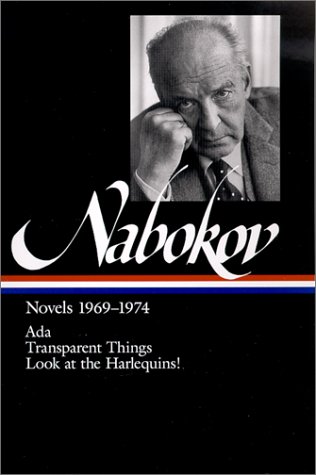
| 21. Nabokov: Novels, 1969-1974 (Library of America) by Vladimir Nabokov | |
 | Hardcover: 825
Pages
(1996-10-01)
list price: US$40.00 -- used & new: US$19.94 (price subject to change: see help) Asin: 1883011205 Average Customer Review: 
Canada | United Kingdom | Germany | France | Japan |
Customer Reviews (2)
Picture Vladimir Nabokov. In the hall of mirrors that is popular culture, he is the dirty man who wrote the dirty book "Lolita,"about a 12-year-old "nymphet" -- he invented the term, by the way-- and her affair with an older man. Angle the mirror another way, andhe is one of the founders of the modernist novel, which to some people --myself included -- that's a damning phrase. "Modernist" and"post-modernist" literature seems a) self-referencing to thepoint of egotism; b) dedicated to the advancement of decedent themes, andto score big points as a writer, pile it on, brother; and c) obsessed withthe discovery that the "arts" -- whether books, pictures ormovies -- are artificial, and that we use them to create, well, books,pictures and movies. Unless you think I am making it up, here's anexample drawn from real life: a few years back, a Charlotte museum mountedan exhibition of a painter's work, one of which was a canvas whose frontside was turned toward the wall, exposing a paint-stained frame. Anewspaper reviewer breathlessly informed the reading public that the artistdid this "to inform the viewer that most paintings arerecetangular." Now, a reasonably intelligent person could probablyreach that conclusion without much effort, but discoveries like these seemto drive those who tread into the "modern" era of art. SoVlaidmir Nabokov's reputation is caught between two very opposing poles. Heeither panders to the worst tastes of man, or the worst tastes of art. Fortunately, he is neither, and the Library of America agrees. Thenon-profit publisher throws its reputation behind Nabokov as a writer worthreading by publishing all of his English-language novels in three volumes.The first volume covers his work from 1941 to 1951: "The Real Life ofSebastian Knight," "Bend Sinister," and his memoir,"Speak, Memory." The middle work contains the notorious"Lolita," "Pale Fire," "Pnin," and the"Lolita" screenplay Nabokov wrote for Stanley Kubrick. Theconcluding volume contains "Ada," "Transparent Things,"and "Look at the Harlequins!" But of these works, only"Lolita" stands alone. It is not a dirty book, and one shouldpity those American and British tourists who, in the mid-1950s, bought thepale olive-green two-volume paperbacks published in Paris by the notoriousOlympia Press. Those expecting frankly pornographic stories like "TheStory of O" and "How to Do It" would have been sorelydisappointed in Humbert Humbert's self-confessed defense of his rape (not"seduction," which implies a willingness to be seduced) andexploitation of Delores Haze, "Lolita, light of my life,fire of myloins. My sin, my soul. Lo-lee-ta: the tip of the tongue taking a trip ofthree steps down the palate to tap, at three, on the teeth. Lo. Lee.Ta." Even Olympia's publisher was taken in, telling a mutual friendthat he though Nabokov was Humbert, and that he was attempting topopularize nymphet love. What does become apparent after reading throughthe volumes (and aided by an excellent two-volume biography by Brian Boyd)is that there is much more to Nabokov than meets the eye. Delving deeper inhis works reveals a funhouse hall of mirrors that can lead to a definitiveend, and there's not much in modernist fiction that could substantiate thatclaim. What sets Nabokov off from other writers is his use of thelanguage. Raised in Tsarist Russia, Nabokov was a child prodigy who wastaught Russian, French and English at an early age. His prose is elegent,his command of English astounding. It's close to the prose of Henry James,but except for the foreign phrases, which the Library editionsprovidetranslations and explanations, far more understandable. Descriptionspulled at random from "Lolita" ring as if English was a newlyminted language, capable of expressing humor ("The bed was a frightfulmess with overtones of potato chips") and snobbish anger ("Lo hadgrabbed some comics from the back seat and, mobile white-bloused, one brownelbow out of the window, was deep in the current adventure of some clout orclown"). Even, when Humbert meets his Lolita long after she escapedhis clutches, when he believes that he still loves her, heart-rending:"In her washed-out grey eyes, strangely spectacled, our poor romancewas for a moment reflected, pondered upon, and dismissed like a dull party,like a rainy picnic to which only the dullest bores had come, like ahumdrum exercise, like a bit of dry mud caking her childhood." Thisis not casual reading, but neither is it reading-as-masochistic exercise,with furrowed brows and an exasperated flipping of once-read pages. Thereis a surface meaning that is easily accessible, but there are deepermeanings, in-jokes, ironies and moral questions worthy of consideration. The best volume of the three is the second, which contains"Lolita," the screenplay he wrote for Stanley Kubrick (which wasnot used), the comic novel (for Nabokov at least) "Pnin" and"Pale Fire." But good works can be found in the other volumesas well. "The Real Life of Sebastian Knight," in the firstvolume, is the author's account of his biographical research on hishalf-brother, the brilliant writer Sebastian Knight, who had died recentlyof a heart condition after writing a half-dozen novels. It bears all thehallmarks of the post-modernist novel replete with a self-absorption withwriters, spurious biography, an unreliable narrator and ironicalreferences."Speak, Memory," also in the first volume, isNabokov's memoirs about growing up in Russia. Indeed, the onlydisadvantage to reading Nabokov is that it may cause a nagging niggling inthe back of your head, while reading novels in the future, that they justcannot compare to those composed by the American from Russia.
| |
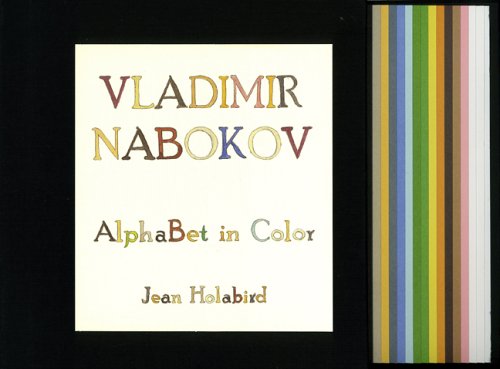
| 22. Vladimir Nabokov, Alphabet in Color by Vladimir Vladimirovich Nabokov | |
 | Hardcover: 48
Pages
(2006-01-30)
list price: US$25.00 -- used & new: US$15.99 (price subject to change: see help) Asin: 1584231394 Average Customer Review: 
Canada | United Kingdom | Germany | France | Japan |
|
Editorial Review Product Description Customer Reviews (5)
| |
| 23. Vladimir Nabokov : Novels and Memoirs 1941-1951 : The Real Life of Sebastian Knight, Bend Sinister, Speak, Memory (Library of America) by Vladimir Nabokov | |
 | Hardcover: 710
Pages
(1996-10-01)
list price: US$40.00 -- used & new: US$21.36 (price subject to change: see help) Asin: 1883011183 Average Customer Review:
Canada | United Kingdom | Germany | France | Japan |
|
Editorial Review Product Description Customer Reviews (4)
Picture Vladimir Nabokov. In the hall of mirrors that is popular culture, he is the dirty man who wrote the dirty book "Lolita,"about a 12-year-old "nymphet" -- he invented the term, by the way-- and her affair with an older man. Angle the mirror another way, andhe is one of the founders of the modernist novel, which to some people --myself included -- that's a damning phrase. "Modernist" and"post-modernist" literature seems a) self-referencing to thepoint of egotism; b) dedicated to the advancement of decedent themes, andto score big points as a writer, pile it on, brother; and c) obsessed withthe discovery that the "arts" -- whether books, pictures ormovies -- are artificial, and that we use them to create, well, books,pictures and movies. Unless you think I am making it up, here's anexample drawn from real life: a few years back, a Charlotte museum mountedan exhibition of a painter's work, one of which was a canvas whose frontside was turned toward the wall, exposing a paint-stained frame. Anewspaper reviewer breathlessly informed the reading public that the artistdid this "to inform the viewer that most paintings arerecetangular." Now, a reasonably intelligent person could probablyreach that conclusion without much effort, but discoveries like these seemto drive those who tread into the "modern" era of art. SoVlaidmir Nabokov's reputation is caught between two very opposing poles. Heeither panders to the worst tastes of man, or the worst tastes of art. Fortunately, he is neither, and the Library of America agrees. Thenon-profit publisher throws its reputation behind Nabokov as a writer worthreading by publishing all of his English-language novels in three volumes.The first volume covers his work from 1941 to 1951: "The Real Life ofSebastian Knight," "Bend Sinister," and his memoir,"Speak, Memory." The middle work contains the notorious"Lolita," "Pale Fire," "Pnin," and the"Lolita" screenplay Nabokov wrote for Stanley Kubrick. Theconcluding volume contains "Ada," "Transparent Things,"and "Look at the Harlequins!" But of these works, only"Lolita" stands alone. It is not a dirty book, and one shouldpity those American and British tourists who, in the mid-1950s, bought thepale olive-green two-volume paperbacks published in Paris by the notoriousOlympia Press. Those expecting frankly pornographic stories like "TheStory of O" and "How to Do It" would have been sorelydisappointed in Humbert Humbert's self-confessed defense of his rape (not"seduction," which implies a willingness to be seduced) andexploitation of Delores Haze, "Lolita, light of my life,fire of myloins. My sin, my soul. Lo-lee-ta: the tip of the tongue taking a trip ofthree steps down the palate to tap, at three, on the teeth. Lo. Lee.Ta." Even Olympia's publisher was taken in, telling a mutual friendthat he though Nabokov was Humbert, and that he was attempting topopularize nymphet love. What does become apparent after reading throughthe volumes (and aided by an excellent two-volume biography by Brian Boyd)is that there is much more to Nabokov than meets the eye. Delving deeper inhis works reveals a funhouse hall of mirrors that can lead to a definitiveend, and there's not much in modernist fiction that could substantiate thatclaim. What sets Nabokov off from other writers is his use of thelanguage. Raised in Tsarist Russia, Nabokov was a child prodigy who wastaught Russian, French and English at an early age. His prose is elegent,his command of English astounding. It's close to the prose of Henry James,but except for the foreign phrases, which the Library editionsprovidetranslations and explanations, far more understandable. Descriptionspulled at random from "Lolita" ring as if English was a newlyminted language, capable of expressing humor ("The bed was a frightfulmess with overtones of potato chips") and snobbish anger ("Lo hadgrabbed some comics from the back seat and, mobile white-bloused, one brownelbow out of the window, was deep in the current adventure of some clout orclown"). Even, when Humbert meets his Lolita long after she escapedhis clutches, when he believes that he still loves her, heart-rending:"In her washed-out grey eyes, strangely spectacled, our poor romancewas for a moment reflected, pondered upon, and dismissed like a dull party,like a rainy picnic to which only the dullest bores had come, like ahumdrum exercise, like a bit of dry mud caking her childhood." Thisis not casual reading, but neither is it reading-as-masochistic exercise,with furrowed brows and an exasperated flipping of once-read pages. Thereis a surface meaning that is easily accessible, but there are deepermeanings, in-jokes, ironies and moral questions worthy of consideration. The best volume of the three is the second, which contains"Lolita," the screenplay he wrote for Stanley Kubrick (which wasnot used), the comic novel (for Nabokov at least) "Pnin" and"Pale Fire." But good works can be found in the other volumesas well. "The Real Life of Sebastian Knight," in the firstvolume, is the author's account of his biographical research on hishalf-brother, the brilliant writer Sebastian Knight, who had died recentlyof a heart condition after writing a half-dozen novels. It bears all thehallmarks of the post-modernist novel replete with a self-absorption withwriters, spurious biography, an unreliable narrator and ironicalreferences."Speak, Memory," also in the first volume, isNabokov's memoirs about growing up in Russia. Indeed, the onlydisadvantage to reading Nabokov is that it may cause a nagging niggling inthe back of your head, while reading novels in the future, that they justcannot compare to those composed by the American from Russia.
| |
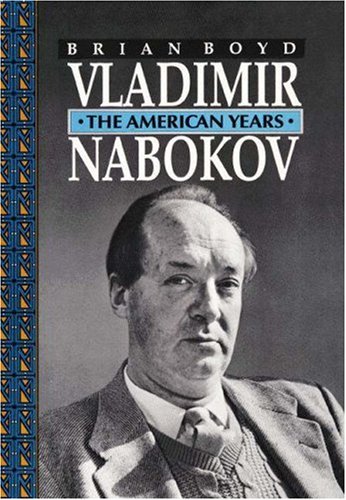
| 24. Vladimir Nabokov : The American Years by Brian Boyd | |
 | Paperback: 804
Pages
(1993-01-11)
list price: US$49.00 -- used & new: US$10.98 (price subject to change: see help) Asin: 0691024715 Average Customer Review:
Canada | United Kingdom | Germany | France | Japan |
|
Editorial Review Product Description Customer Reviews (2)
As a professor of literature atCornell, Nabokov taught his students to focus on the details of literature. He taught them that the small details of a fictional world were far moreimportant than broad generalizations about literary trends.One infamousmidterm question asked the students to describe the wallpaper in acharacter's bedroom--a description that was only provided in a single lineof the novel.Nabokov believed that good readers paid attention to detailslike this, and specific, startling detail was what made reality beautiful. I think Nabokov would have approved of Boyd's detailed, beautifulbiography. Boyd is a good Nabokovian.He sees the details of Nabokov'slife and presents them to us vividly.He also analyzes the details ofNabokov's work, and provides us with lucid, and often surprising, readingsand interpretations's of Nabokov's novels. In The American Years Boydreminds us why Nabokov was once hailed as perhaps the greatest writer ofthe latter half of the 20th Century.And after staying up all night tofinish the enthralling story of Nabokov's life, I would have to say thatBoyd is right. Nabokov will certainly be remembered as one of thegreats, and Boyd has given Nabokov the biography he deserves. ... Read more | |
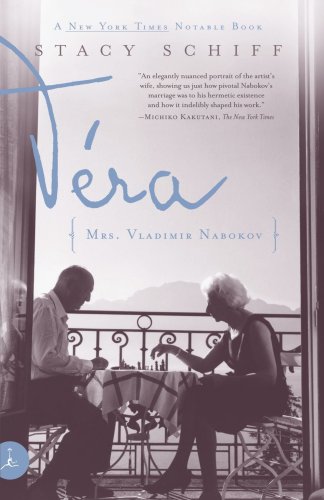
| 25. Vera (Mrs. Vladimir Nabokov) by Stacy Schiff | |
 | Paperback: 480
Pages
(2000-04-04)
list price: US$23.00 -- used & new: US$6.88 (price subject to change: see help) Asin: 0375755349 Average Customer Review: 
Canada | United Kingdom | Germany | France | Japan |
|
Editorial Review Product Description Customer Reviews (24)
| |
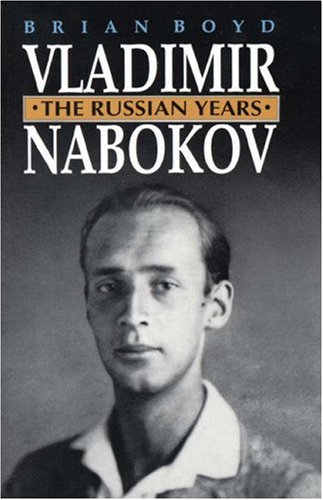
| 26. Vladimir Nabokov : The Russian Years by Brian Boyd | |
 | Paperback: 619
Pages
(1993-01-11)
list price: US$49.00 -- used & new: US$32.00 (price subject to change: see help) Asin: 0691024707 Average Customer Review:
Canada | United Kingdom | Germany | France | Japan |
|
Editorial Review Product Description In the course of his ten years' work on the biography, Boyd traveled along Nabokov's trail everywhere from Yalta to Palo Alto. The only scholar to have had free access to the Nabokov archives in Montreux and the Library of Congress, he also interviewed at length Nabokov's family and scores of his friends and associates. For the general reader, Boyd offers an introduction to Nabokov the man, his works, and his world. For the specialist, he provides a basis for all future research on Nabokov's life and art, as he dates and describes the composition of all Nabokov's works, published and unpublished. Boyd investigates Nabokov's relation to and his independence from his time, examines the special structures of his mind and thought, and explains the relations between his philosophy and his innovations of literary strategy and style. At the same time he provides succinct introductions to all the fiction, dramas, memoirs, and major verse; presents detailed analyses of the major books that break new ground for the scholar, while providing easy paths into the works for other readers; and shows the relationship between Nabokov's life and the themes and subjects of his art. Customer Reviews (5)
I would have to say that this two-volume biography of Nabokov is the mathematical proof that disproves the formula above.Boyd plays the role of historian/biographer, spending time explaining the political scene of Russia early on in N's life, and traces the movements of the most significant person in N's first twenty years; his father.Of course, this is probably out of necessity considering his father's position in the whole political mish-mash that was fin-de-siecle Russia.I might gripe and say that there's too much attention paid to the politics, but that's because I'm an English major, not a historian or a politician, and I'm reading for pleasure.Were I reading for a thesis, these excerpts would be invaluable. I'm thrilled about the chapters of Russian emigre life in Europe following the Bolshevik Revolution.Not only does it trace the influence that wafts through N's early stuff (and follows through his life), but it also gives us a taste of the climate of those years, plus a roster of sorts of who was part of that microcosm.This is going to be, in my estimation, a highly researched period of literature, once it becomes fashionable that is, and this biography will be a resource for all those students looking for a glimpse into that world.Studies in Nabokov are really beginning to blossom, and this will spur interest in that era as well. N's life is portrayed as an emerging talent, rather than a natural genius who could command language and characters as well at 20 as at 70.This humanizes Nabokov, a figure who can sometimes seem a little god-like to his devotees.Expelling mist and myth is the mark of a good biography, next to joyously reporting the life of the subject.The analysis provided by Boyd in the sections dealing with early literature (such as the comparative criticism of his first novel "Mary" and the story "Return of Chorb") is revealing in this case because he can explain what Nabokov lacks here, or does not do so well early on. Extensive references and a collection of satisfying photographs complete the package.One of the best photos being a shot of the Rohzdestveno manor that Nabokov inherited from his Uncle Vasily at age 17.A 17 year-old with his own mansion.Can you say harem?
The elegiac childhood that Nabokov enjoyed as the son of an upper class family of political liberals and Russian patriots is hard to imagine given the awfulness of Russian history since the 1905. After the death of his grandfather Nabokov became a millionaire at age 10. His family was close knit and loving (which may explain his deep love for his wife Véra and his son Dmitri, named after Vladimir's father). The Nabokovs managed to escape Russia from their Crimean summer house and eventually ended up in Germany, where they endured hardship and persecution. Nabokov's father, who had been an Education Minister during Kerensky's brief democratic administration, was murdered by an extreme-nationalist from the "Black Hundreds", a paramilitary organisation. Amazingly, Nabokov never bored to learn German although he lived in Germany for twenty years because he felt German would destroy his gift for Russian. His French was flawless, though (he died in French Switzerland). His meeting of the beautiful, brilliant Véra is touching, a rare moment of perfection on this cursed globe, and they became a very close couple. Mrs Nabokov was much more than a wife: she was a soul-mate and a loving collaborator in all Nabokov's efforts. Nabokov, in spite of his poverty managed to continue to live with aristocratic non-chalance and was always able to afford extensive and elaborate holidays that nowadays are only possible for the very well-to-do. The book ends as the Nabokovs and young Dmitri move to America, barely escaping France before the German invasion. Better times were yet to come, and they are aptly told in the second volume. Most of the books Nabokov wrote in this period were in Russian and thus they have not been as widely divulged as his books in English. I can't appreciate their quality, not reading Russian, but Boyd notes many references of experts which regarded them as some of the best writing in Russian in the 20th century, and more deserving of a Nobel prize than either Pasternak or Solzhenitzn. The title of my review will probably be deplored by many Nabokov fans, but in fact I was deeply attracted to Nabokov's elegance, charm and tolerance, by his revulsion to snobbery (he was always annoyed by some Europeans' disdain for US culture or some Russian emigrés' disgust at the accent of Jewish Russian speakers), by his unerring political sense that led him to distrust most extremisms of the last century (he was one of the few important authors not to have written blatant political nonsense), and very much enjoyed his curious interest in butterflies (his fantasy of a lavish, multi-volume Encyclopedia of butterflies of the Russian Empire smacks of Borges to me), and his extensive work at Harvard concerning them (he does have a species to his name). Boyd's descriptions led to me seek Nabokov's literal translation of Pushkin's epical poem, Eugene Onegin (I found the translation unreadable, as many people have), and, in spite of Boyd's wonderful summaries, I couldn't really get into some of Nabokov' other works in English (Ada or Ardor and Pale Fire I thought too modernist for my taste- his literary criticism was great, although I winced at his evident distaste for Jane Austen- and shared his love for Dickens). But Nabokov is as great a writer as he as a biographer's subject, and Boyd's book is probably the best literary biography after The Life of Johnson. I heartily recommend it (it's great even if you haven't actually read Nabokov).
When I purchased the two volumes of the biography, Iwas a bit intimidated by their sheer size.The Russian Years alone isnearly 700 pages, and The American Years even larger.Yet I soon foundmyself enthralled in Boyd's detailed portrait of Nabokov and his work. InThe Russian Years, Boyd, as a good non-Freudian reader of Nabokov (asNabokov would have wished), provides intimate details of Nabokov's earlyfamily life and his trials and tribulations as an emigre writer in Europe. Boyd provides a fascinating account of Nabokov's father, who'sassassination would impact young Nabokov so much (and later, provideinspiration for the "assassination" in Pale Fire).But Boyd,thankfully, does not try to explain Nabokov through the death of hisfather; he meticulously lays out the facts and builds a complex portait ofthe man, and his fiction. To be honest, I was far more interested inreading about Nabokov's American years, but after reading this book, I amgrateful to Boyd for his serious scholarship, his lively prose, and hisclose analysis of Nabokov's oeuvre.I'm glad that I didn't pass up thechance to read this wonderful work. ... Read more | |
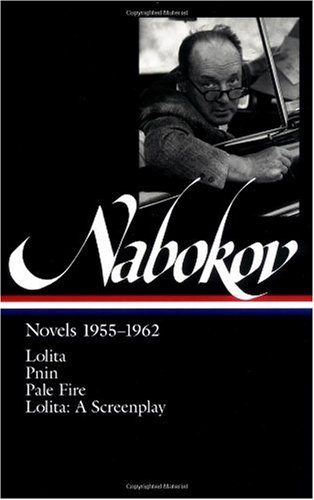
| 27. Nabokov: Novels 1955-1962: Lolita / Pnin / Pale Fire (Library of America) by Vladimir Nabokov | |
 | Hardcover: 904
Pages
(1996-10-01)
list price: US$35.00 -- used & new: US$18.69 (price subject to change: see help) Asin: 1883011191 Average Customer Review:
Canada | United Kingdom | Germany | France | Japan |
|
Editorial Review Amazon.com Review Customer Reviews (5)
"Lolita" is the tale for which Nabokov is best known. The redundantly-named, middle-aged (dirty old man) Humbert Humbert is haunted by some teenage love he had long ago, and which he thinks he has refound in the prepubescent Delores Haze (called "Lolita" by Humbert). He sets out to seduce the unsuspecting girl, but her mom is standing in the way... "Pnin" is a gently comic tale about Timofey Pnin, a timid, moderately neurotic Russian professor who now lives in the United States. He's amazed by technology, fussy, a bit weird about his health, and has problems with American train schedules. The unfortunate Pnin stumbles from one problem to another, trying to keep everything under control in uncontrollable circumstances. "Pale Fire" is perhaps the best literary satire out there. Poet John Shade wrote the sprawling 999-line poem "Pale Fire," shortly before being murdered. After his death, the poem is being painstakingly dissected and annotated by his neighbor, Charles Kinbote. Except Kinbote is a nutjob, who interprets "Pale Fire" as being all about him, and will come up with weird symbolism to justify his belief. "Lolita: A Screenplay" is almost a different version of "Lolita." Here Nabokov recounted the same events of the novel, but from an ominiscent perspective -- that of the person who would be watching the movie. Very rich, very well-adapted, very evocative for a screenplay, this is almost as good as a book in itself. Nabokov could handle just about any kind of writing, this collection shows us. From the opulent poetry of "Pale Fire" to the solid screenplay, from the erotic drama of "Lolita" to the chuckling comedy of "Pnin," he handles it all. His writing is detailed and lush, rich almost to the point of choking. He shifts perspectives, tells a story through annotation, sees through the eyes of a pedophile, and does it all with a certain winking flair. Nabokov's writing is a combination of believable characterizations and rich language. Humbert Humbert, for example, is a horrendously believable person, especially since he makes constant excuses for his pedaphilic behavior -- the characterization is so good, in fact, that newcomers might even think (incorrectly) that Nabokov sympathized with the creep. At the same time, he creates the rather pitiful, absentminded Pnin, the self-serving nutcase Kinbote -- and they're all delightfully three-dimensional. You could bump into people like these on the bus at any time, and they would be just as he describes them. Comedy, drama, satire and screenwriting are collected in the second Library of America collection of Nabokov's novels. Sexy, funny, brilliant and exquisitely written, these are among the best of Vladimir Nabokov's works.
Picture Vladimir Nabokov. In the hall of mirrors that is popular culture, he is the dirty man who wrote the dirty book "Lolita,"about a 12-year-old "nymphet" -- he invented the term, by the way-- and her affair with an older man. Angle the mirror another way, andhe is one of the founders of the modernist novel, which to some people --myself included -- that's a damning phrase. "Modernist" and"post-modernist" literature seems a) self-referencing to thepoint of egotism; b) dedicated to the advancement of decedent themes, andto score big points as a writer, pile it on, brother; and c) obsessed withthe discovery that the "arts" -- whether books, pictures ormovies -- are artificial, and that we use them to create, well, books,pictures and movies. Unless you think I am making it up, here's anexample drawn from real life: a few years back, a Charlotte museum mountedan exhibition of a painter's work, one of which was a canvas whose frontside was turned toward the wall, exposing a paint-stained frame. Anewspaper reviewer breathlessly informed the reading public that the artistdid this "to inform the viewer that most paintings arerecetangular." Now, a reasonably intelligent person could probablyreach that conclusion without much effort, but discoveries like these seemto drive those who tread into the "modern" era of art. SoVlaidmir Nabokov's reputation is caught between two very opposing poles. Heeither panders to the worst tastes of man, or the worst tastes of art. Fortunately, he is neither, and the Library of America agrees. Thenon-profit publisher throws its reputation behind Nabokov as a writer worthreading by publishing all of his English-language novels in three volumes.The first volume covers his work from 1941 to 1951: "The Real Life ofSebastian Knight," "Bend Sinister," and his memoir,"Speak, Memory." The middle work contains the notorious"Lolita," "Pale Fire," "Pnin," and the"Lolita" screenplay Nabokov wrote for Stanley Kubrick. Theconcluding volume contains "Ada," "Transparent Things,"and "Look at the Harlequins!" But of these works, only"Lolita" stands alone. It is not a dirty book, and one shouldpity those American and British tourists who, in the mid-1950s, bought thepale olive-green two-volume paperbacks published in Paris by the notoriousOlympia Press. Those expecting frankly pornographic stories like "TheStory of O" and "How to Do It" would have been sorelydisappointed in Humbert Humbert's self-confessed defense of his rape (not"seduction," which implies a willingness to be seduced) andexploitation of Delores Haze, "Lolita, light of my life,fire of myloins. My sin, my soul. Lo-lee-ta: the tip of the tongue taking a trip ofthree steps down the palate to tap, at three, on the teeth. Lo. Lee.Ta." Even Olympia's publisher was taken in, telling a mutual friendthat he though Nabokov was Humbert, and that he was attempting topopularize nymphet love. What does become apparent after reading throughthe volumes (and aided by an excellent two-volume biography by Brian Boyd)is that there is much more to Nabokov than meets the eye. Delving deeper inhis works reveals a funhouse hall of mirrors that can lead to a definitiveend, and there's not much in modernist fiction that could substantiate thatclaim. What sets Nabokov off from other writers is his use of thelanguage. Raised in Tsarist Russia, Nabokov was a child prodigy who wastaught Russian, French and English at an early age. His prose is elegent,his command of English astounding. It's close to the prose of Henry James,but except for the foreign phrases, which the Library editionsprovidetranslations and explanations, far more understandable. Descriptionspulled at random from "Lolita" ring as if English was a newlyminted language, capable of expressing humor ("The bed was a frightfulmess with overtones of potato chips") and snobbish anger ("Lo hadgrabbed some comics from the back seat and, mobile white-bloused, one brownelbow out of the window, was deep in the current adventure of some clout orclown"). Even, when Humbert meets his Lolita long after she escapedhis clutches, when he believes that he still loves her, heart-rending:"In her washed-out grey eyes, strangely spectacled, our poor romancewas for a moment reflected, pondered upon, and dismissed like a dull party,like a rainy picnic to which only the dullest bores had come, like ahumdrum exercise, like a bit of dry mud caking her childhood." Thisis not casual reading, but neither is it reading-as-masochistic exercise,with furrowed brows and an exasperated flipping of once-read pages. Thereis a surface meaning that is easily accessible, but there are deepermeanings, in-jokes, ironies and moral questions worthy of consideration. The best volume of the three is the second, which contains"Lolita," the screenplay he wrote for Stanley Kubrick (which wasnot used), the comic novel (for Nabokov at least) "Pnin" and"Pale Fire." But good works can be found in the other volumesas well. "The Real Life of Sebastian Knight," in the firstvolume, is the author's account of his biographical research on hishalf-brother, the brilliant writer Sebastian Knight, who had died recentlyof a heart condition after writing a half-dozen novels. It bears all thehallmarks of the post-modernist novel replete with a self-absorption withwriters, spurious biography, an unreliable narrator and ironicalreferences."Speak, Memory," also in the first volume, isNabokov's memoirs about growing up in Russia. Indeed, the onlydisadvantage to reading Nabokov is that it may cause a nagging niggling inthe back of your head, while reading novels in the future, that they justcannot compare to those composed by the American from Russia.
| |
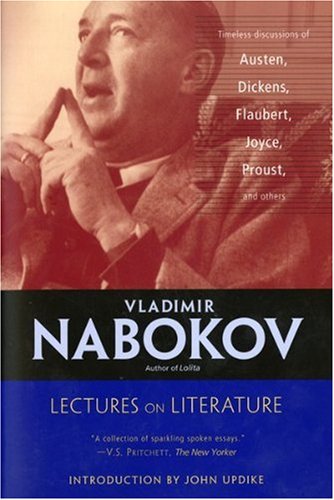
| 28. Lectures on Literature by Vladimir Nabokov | |
 | Paperback: 416
Pages
(2002-12-16)
list price: US$18.00 -- used & new: US$11.02 (price subject to change: see help) Asin: 0156027755 Average Customer Review:
Canada | United Kingdom | Germany | France | Japan |
|
Editorial Review Product Description Customer Reviews (19)
| |
| 29. Vladimir Nabokov: 'Lolita' (Literature Insights) by John Lennard | |
 | Kindle Edition:
Pages
(2010-05-18)
list price: US$8.00 Asin: B003N3V2J4 Average Customer Review:
Canada | United Kingdom | Germany | France | Japan |
|
Editorial Review Product Description Customer Reviews (1)
| |
| 30. Vladimir Nabokov's Lolita: A Casebook (Casebooks in Criticism) | |
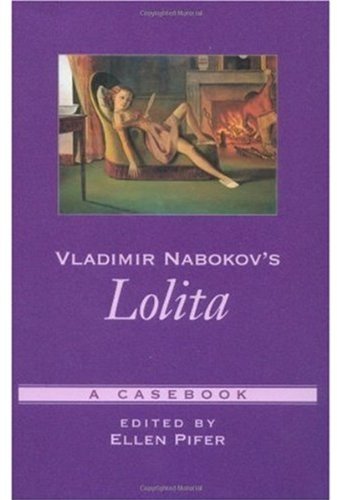 | Paperback: 224
Pages
(2002-11-21)
list price: US$35.00 -- used & new: US$19.51 (price subject to change: see help) Asin: 0195150333 Average Customer Review:
Canada | United Kingdom | Germany | France | Japan |
|
Editorial Review Product Description Customer Reviews (1)
| |
| 31. The Enchanter by Vladimir Nabokov | |
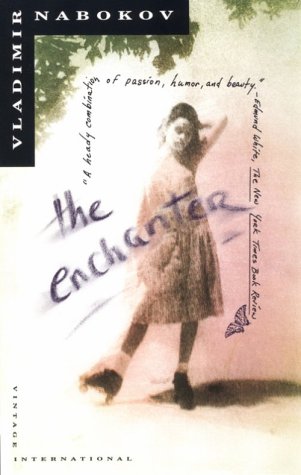 | Paperback: 144
Pages
(1991-07-20)
list price: US$13.95 -- used & new: US$7.88 (price subject to change: see help) Asin: 0679728864 Average Customer Review:
Canada | United Kingdom | Germany | France | Japan |
|
Editorial Review Product Description Customer Reviews (15)
| |
| 32. Ada, or Ardor: A Family Chronicle by Vladimir Nabokov | |
 | Paperback: 624
Pages
(1990-02-19)
list price: US$18.00 -- used & new: US$10.75 (price subject to change: see help) Asin: 0679725229 Average Customer Review:
Canada | United Kingdom | Germany | France | Japan |
|
Editorial Review Product Description This is the first American edition to include the extensive and ingeniouslysardonic appendix by the author, written under the anagrammatic pseudonym Vivian Darkbloom. Customer Reviews (56)
| |
| 33. The Eye by Vladimir Nabokov | |
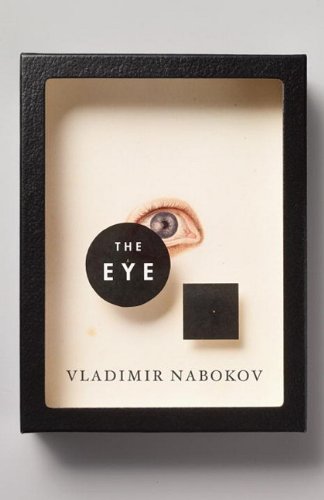 | Paperback: 128
Pages
(1990-09-05)
list price: US$15.00 -- used & new: US$8.31 (price subject to change: see help) Asin: 067972723X Average Customer Review:
Canada | United Kingdom | Germany | France | Japan |
|
Editorial Review Product Description Customer Reviews (17)
| |
| 34. Style Is Matter: The Moral Art of Vladimir Nabokov by Leland de la Durantaye | |
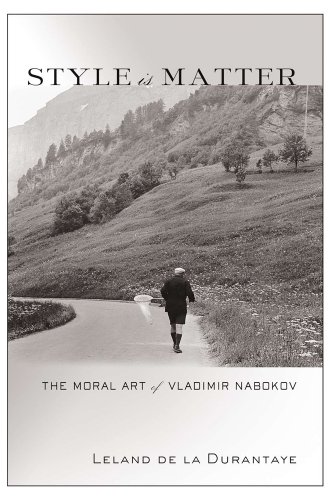 | Paperback: 224
Pages
(2010-10-14)
list price: US$22.50 -- used & new: US$16.17 (price subject to change: see help) Asin: 080147664X Average Customer Review: 
Canada | United Kingdom | Germany | France | Japan |
|
Editorial Review Product Description Customer Reviews (2)
| |
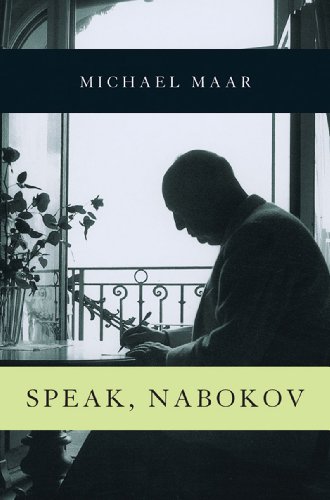
| 35. Speak, Nabokov by Michael Maar | |
 | Hardcover: 160
Pages
(2010-01-04)
list price: US$24.95 -- used & new: US$13.95 (price subject to change: see help) Asin: 1844674371 Canada | United Kingdom | Germany | France | Japan |
|
Editorial Review Product Description | |
| 36. Glory by Vladimir Nabokov | |
 | Paperback: 224
Pages
(1991-11-05)
list price: US$15.00 -- used & new: US$5.59 (price subject to change: see help) Asin: 0679727248 Average Customer Review:
Canada | United Kingdom | Germany | France | Japan |
|
Editorial Review Product Description Customer Reviews (16)
| |
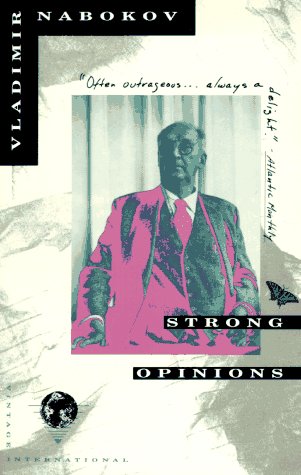
| 37. Strong Opinions by Vladimir Nabokov | |
 | Paperback: 368
Pages
(1990-03-17)
list price: US$16.00 -- used & new: US$8.47 (price subject to change: see help) Asin: 0679726098 Average Customer Review:
Canada | United Kingdom | Germany | France | Japan |
|
Editorial Review Product Description Customer Reviews (7)
Nabokov's opinions in a nutshell? Thought everything written by James Joyce was completely mediocre except for "Ulysses," which towered above the rest of his ouvre as one of the supreme literary masterpieces of the 20th century. Loved Flaubert and Proust and Chateaubriand, did not like Stendhal (simple and full of cliches) or Balzac (full of absurdities). Loved Tolstoy's "Anna Karenina" (considered it the greatest novel of the 19th century) and "Death of Ivan Illych," hated "Resurrection" and "Kreutzer sonata." Liked Gogol, despised Dostoevsky as a melodramatic mystic (he even once gave a student an F in his course for disagreeing with him). Loathed Conrad and Hemingway, but liked the description of the fish in "Old Man and the Sea" and the short story "Killers." Hated Andre Gide, T.S.Eliot, Faulkner, Thomas Mann and D.H.Lawrence and considered them all frauds. Thought Kafka was great, Orwell mediocre. Despised Camus and Sartre, considered Celine a second rater, but liked H.G.Wells. Loved Kubrick's film of Lolita (thought it was absolutely first-rate in every way) but later in the '70s regretted that Sue Lyon (though instantly picked by Nabokov himself along with Kubrick out of a list of thousands) had been too old for the part & suggested that Catherine Demongeot, the boyish looking 11 year old who appeared in Louis Malle's 1960 film "Zazie dans le Metro" would've been just about perfect to induce the right amount of moral repulsion in the audience towards Humbert (and prevent them from enjoying the work on any superficial level other than the purely artistic). Liked avant-garde writers like Borges and Robbe-Grillet and even went out of his way to see Alain Resnais' film with Robbe-Grillet: "Last Year at Marienband." Didn't care for the films of von Sternberg or Fritz Lang, loved Laurel and Hardy. Made a point of saying how much he hated Lenin when it was fashionable to blame the disasters of the Soviet Union on Stalin. Supported the War in Vietnam and sent President Johnson a note saying he appreciated the good job he was doing bombing Vietnam. Never drove an automobile in his life & his wife was the one who drove him through the United States onscientific butterfly-hunting expeditions, all through the many locales & motels & lodges that later appeared in "Lolita." Seem interesting? You're bound to be offended even if Nabokov is one of your favorite writers. Genius or madman? I would say both, the 'divine madness' of the greatest of artists. Highly recommended for a peek inside the artistically fertile mind, and the tensions that need to be maintained to produce it. ... Read more | |
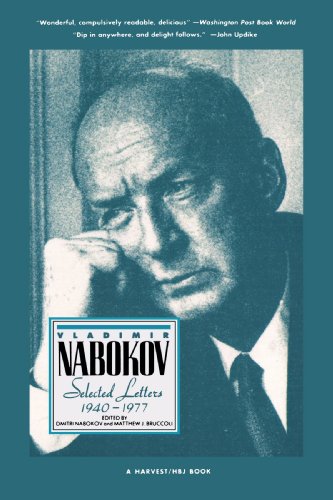
| 38. Vladimir Nabokov: Selected Letters 1940-1977 by Vladimir Nabokov | |
 | Paperback: 624
Pages
(1990-10-29)
list price: US$36.00 -- used & new: US$22.00 (price subject to change: see help) Asin: 0156936100 Average Customer Review:
Canada | United Kingdom | Germany | France | Japan |
|
Editorial Review Product Description Nabokov's son, Dmitri, and Matthew Bruccoli have created the fullest,and by far the most amusing, portrait of the serious artist astrickster. There's the famous letter to Burma-Vita, in which Nabokovoffers the company an advertising jingle (alas, they turned himdown). There's the best, and most amusing, account of "l'affaireLolita." Here is his response to his New Yorkereditor, Katharine White: "Let me thank you very warmly for yourfrank and charming letter about LOLITA. But after all how many arethe memorable literary characters whom we would like our teen-agedaughters to meet? Would you like our Patricia to go on a date withOthello? Would we like our Mary to read the New Testament templeagainst temple with Raskolnikov? Would we like our sons to marry EmmaRouault, Becky Sharp or La belle dame sans merci?" In another letter, however, he takes care to thank White for a"chubby check." (One wishes this phrase had gained greatercirculation.) Nabokov again and again comes off as a difficult author,challenging his publishers left, right, and center over issues large(and there were many) and as well as those that were niggling. Callingthe British paperback cover of Laughter in the Dark"atrocious, disgusting, and badly drawn besides having nothing todo whatever with the contents of the book," he tells hisU.K. publisher, "I would appreciate if you would use yourinfluence and have them substitute a pretty dark-haired girl, or apalmtree, or a winding road, or anything else for this tastelessabomination." Still, one is most often convinced that he's right,even when he makes the large claim that the French film LesNymphettes infringes on his rights, "since this term wasinvented by me for the main character in my novel Lolita." Not only is this volume endlessly quotable, it also reads like a greatepistolary novel--fraught with high thought, high drama, and thedelightfully unexpected. Who would have guessed that Nabokov would askHugh Hefner, "Have you ever noticed how the head and ears of yourBunny resemble a butterfly in shape, with an eyespot on onehindwing?" Customer Reviews (1)
| |
| 39. Chasing Lolita: How Popular Culture Corrupted Nabokov's Little Girl All Over Again by Graham Vickers | |
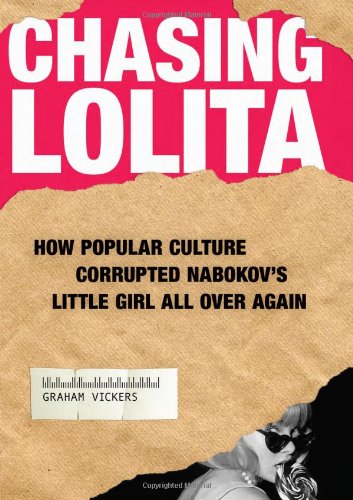 | Hardcover: 256
Pages
(2008-08-01)
list price: US$24.95 -- used & new: US$15.09 (price subject to change: see help) Asin: 1556526822 Average Customer Review:
Canada | United Kingdom | Germany | France | Japan |
|
Editorial Review Product Description In the summer of 1958, a twelve-year-old girl took the world by storm—Lolita was published in the United States. This child, so fresh and alive, yet so pitiable in her abuse at the hands of the novel's narrator, engendered outrage and sympathy alike, and has continued to do so ever since. Yet Lolita's image in the broader public consciousness has changed. No longer a little girl, Lolita has come to signify a precocious temptress, a cunning underage vixen who'll stop at nothing to get her man. How could this have happened? Chasing Lolita, published on the fiftieth anniversary of Lolita's American publication, is an essential contemporary companion to Vladimir Nabokov's great novel. It establishes who Lolita really was back in 1958, explores her predecessors of all stripes, and examines the multitude of movies, theatrical shows, literary spin-offs, artifacts, fashion, art, photography, and tabloid excesses that have distorted her identity and stolen her name. It considers not just the "Lolita effect" but shifting attitudes toward the always volatile mix of sex, children, and popular entertainment—from Victorian times to the present. And it also looks at some real-life cases of young girls who became the innocent victims of someone else’s obsession—unhappy sisters to one of the most affecting heroines in American fiction, and one of the most widely misunderstood. Customer Reviews (2)
| |
| 40. Eugene Onegin: A Novel in Verse, Vol. 1 by Aleksandr Sergeevich Pushkin | |
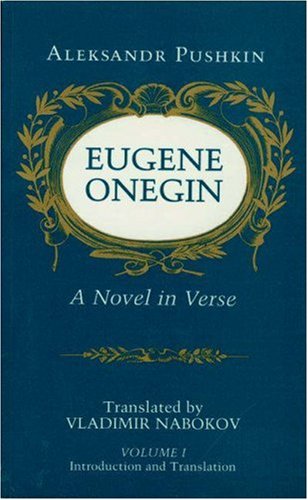 | Paperback: 362
Pages
(1991-01-01)
list price: US$24.95 -- used & new: US$16.90 (price subject to change: see help) Asin: 0691019053 Average Customer Review:
Canada | United Kingdom | Germany | France | Japan |
|
Editorial Review Product Description Customer Reviews (11)
| |
| Back | 21-40 of 100 | Next 20 |
 Only slightly amused.
 yes, but....
 Sawing the usual saws.