e99 Online Shopping Mall

Geometry.Net - the online learning center Help  
Home  - Authors - Davies Robertson (Books)

  Back | 21-40 of 100 | Next 20
A  B  C  D  E  F  G  H  I  J  K  L  M  N  O  P  Q  R  S  T  U  V  W  X  Y  Z  

click price to see details     click image to enlarge     click link to go to the store

 
21. Studies in Robertson Davies' Deptford
 
22. The Manticore
$13.00
23. Conversations With Robertson Davies
$9.95
24. For Your Eye Alone : Robertson
 
25. The Lyre of Orpheus
 
26. Robertson Davies: Life, Work,
 
27. A Mixture of Frailties
$15.19
28. Robertson Davies: An Appreciation
$9.75
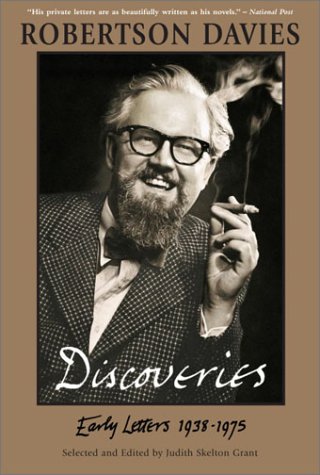
29. Discoveries: Letters 1938-1975
$14.96
30. Happy Alchemy: On the Pleasures
$8.80
31. One Half of Robertson Davies
$0.69
32. What's Bred in the Bone (Cornish
33. A Mixture of Frailties (Salterton
 
34. One half of Robertson Davies ;
 
35. Robertson Davies
 
36. A Checklist of Robertson Davies.
 
37. The Enthusiasms of Robertson Davies.
 
38. Robertson Davies Fifth Business
 
39. 4 Canadian playwrights: Robertson
$70.95
40. Robertson Davies's Cornish Trilogy:

21. Studies in Robertson Davies' Deptford trilogy (ELS monograph series)
 Paperback: 123 Pages (1980)

Isbn: 0920604382
Canada | United Kingdom | Germany | France | Japan

22. The Manticore
by Robertson Davies
 Paperback: Pages (1976)

Asin: B000SC1ZPY
Canada | United Kingdom | Germany | France | Japan

23. Conversations With Robertson Davies (Literary Conversations Series)
Paperback: 308 Pages (1989-09)
list price: US$20.00 -- used & new: US$13.00
(price subject to change: see help)
Asin: 0878053840
Average Customer Review: 4.0 out of 5 stars
Canada | United Kingdom | Germany | France | Japan
Editorial Review

Book Description
CONVERSATIONS WITH ROBERTSON DAVIES is a long overdue anthology of interviews with Canada's most respected literary figure. Journalist, essayist, reviewer, playwright, and novelist, Robertson Davies has not only been a leading figure in Canadian literature since World War II, but, since the publication of FIFTH BUSINESS in 1970, he has become known throughout the world.

CONVERSATIONS WITH ROBERTSON DAVIES will be of interest both to the student of Canadian literature and culture and to the scholar examining Davies's plays and novels as well as to the general reader who would like to know more about the awesome man behind the Salterton and Deptford trilogies, WHAT'S BRED IN THE BONE, and THE LYRE OF ORPHEUS.

A majority of this anthology of twenty-eight interviews has never before appeared in print. Along with these previously unpublished interviews, the reader finds a selection of the best print interviews: Tom Harpur of the TORONTO STAR proves Davies's spiritual beliefs, Ann Saddlemyer looks into his dreams, and author Terence M. Green questions Davies on the supernatural. ... Read more

Customer Reviews (1)

4-0 out of 5 stars Interesting for Robertson Davies fans
For people who have loved reading Robertson Davies' books, this is an interesting and enlightening compendium of interviews with one of Canada's foremost men of letters.The reading itself is a little tedious at times (though Davies is always lively) and if you haven't read any of Davies' other books, don't start with this one. ... Read more


24. For Your Eye Alone : Robertson Davies' Letters, 1976-1995
by Robertson Davies
Hardcover: 416 Pages (1999)
-- used & new: US$9.95
(price subject to change: see help)
Asin: 0771035411
Canada | United Kingdom | Germany | France | Japan
Editorial Review

Book Description
Robertson Davies brought a great sense of style to everything he wrote. Whether it was a letter to his daughter (“Love from us both, Daddy”) or a formal letter to the editor disembowelling a hostile reviewer that concludes humbly (“I am content to remain, Yours, writhing in deserved ignominy…”), he wrote with care, with zest, and in a clearly distinctive voice.

Since these letters written by Davies have been selected from the years when he was at the height of his fame, the recipients range widely, from Sir John Gielgud to Margaret Atwood, and from Greg Gatenby (“You are a merciless man and God will punish you in the next world”) to his publishers abroad. Naturally, like all the best letters, they contain fascinating gossip: “…and Salvador Dali, at the next table, raised his eyebrows and popped his eyes to such a degree that I feared they might leave their moorings and bounce about the floor.”

The title of the book comes from a confidential letter to Jack McClelland and hints at the secrets to be learned from these letters. This “over the shoulder” look at his private correspondence shows us Davies in a variety of roles: as an old friend consoling Horace Davenport on the loss of his son; as a university administrator bewailing the miseries of fundraising; as a keen theatre-goer writing a letter of congratulations to an actor after a fine performance; as a professional writer advocating fair rates for authors to a cabinet minister; as a husband constructing a handwritten circular card to convey loving birthday greetings to his wife; as a bearer of health-giving good cheer to an ailing friend; and as a novelist struggling with his new books, and admitting to his doubts about them.

The letters are frequently testy, tart, and not always “politically correct.” Among those who felt his sting are Judith Skelton Grant, his biographer, and Douglas Gibson, his publisher, but other, more deserving, targets are suitably chastised. And whether they are funny, moving, or thought-provoking, these private letters provide a new look at the private Davies, revealed in his own vigorous words. ... Read more


25. The Lyre of Orpheus
by Robertson Davies
 Paperback: 480 Pages (1997)

Isbn: 0140264337
Average Customer Review: 3.5 out of 5 stars
Canada | United Kingdom | Germany | France | Japan

Customer Reviews (11)

4-0 out of 5 stars An intellectual romp
This is the third book in a trilogy.I hadn't read the first two, which in one way was an advantage: there is a certain amount of background material provided which would no doubt be dull for someone already familiar with it.At the same time, while I found many of the secondary characters nicely developed and interesting, I was left cold by two of the main characters, Arthur and Maria, and perhaps they would have meant more to me had I read the whole trilogy.The gypsy angle seemed forced and would better have been edited out.

In any event, the major reason for reading this novel is the sparkling conversation, whether it be about the personal, or about painting and especially opera; aesthetics, criticism, music, theater, myth, current and historical perspectives and stagecraft are all discussed in a fun manner, and all are germane to the plot. The novel is truly an intellectual romp.

4-0 out of 5 stars Characters are the Treasure Here
The Lyre of Orpheus is the concluding novel in Robertson Davies's Cornish Trilogy, and it stands as a strong work within the context of that collection.Like The Rebel Angels (the first book), The Lyre of Orpheus is very much dependent upon the two other books and does not do well as a stand-alone.

In many ways, The Lyre of Orpheus was surprising to this reader.Its plot revolves around an Arthurian quest (loosely) to put on a production of a long-dead composer whose opera had fallen short of completion at the time of his death in the early 19th century.The task was to write an opera that was sufficiently of his spirit, so as to be called his, and then produce it according to the conventions of the theatre of the day.Honestly, I would be hard-pressed to think of a plot that would be less likely to rouse my interest, personally (my apologies to all those truly devoted to early 19th century opera!).Having invested myself in the first two books of the trilogy, however, I resigned myself to the task of reading this last installment (lest I have to chastise myself in future years for having gone so far and then turned back).The `round table' of this tale was, for me, the most tedious of experiences (except when a drunken, rude Scandinavian music scholar provided me with some humour to console my page-turning drudgery).Indeed, the book often wanders with Davies's own apparent unclear quest to find his way from one cover to the next.BUT - all of that said, I found myself falling in love with this book, the more I read of it.

Robertson Davies has (though he is gone, he is not really) a delightful gift of making us find joy in the chatter and company of our own lives.This book, perhaps more than many of his creation, takes us through a luxurious indulgence in the meanderings of days strung together whose meaning can only be guessed, or retroactively assigned.The `round table,' though often a great annoyance to this reader, began to feel as beloved (and despised) as the Thanksgiving table filled with family and friends.The treasure of this book is to be found in the characters, not in the plot (which is a mere backdrop - and excuse for the story - just as the libretto is an excuse for the opera's music (according to Davies)).

I give high marks to this book.I expected not to like it; but I did.Very much so, in fact.I commend it to your reading.

1-0 out of 5 stars Unless your an Welsh Opera fanatic
After reading "The Rebel Angels" and "What's Bred in the Bone", two five star novels, I expected to thoroughly enjoy the last segment of the trilogy.Well, the only reason I made it through the novel was that I wanted to say that I read the entire trilogy.The book completely changes in tone from the first two.Professors I respected in the first books are buffoons in this one.There are an untold number of quotations from opera librettos, medieval poems, etc. that were not relevant to me at all.One of the characters is incapable of appearing without making multiple references to Wales, Welsh literature and history.This would not have been a problem except that this is one of the main characters.The whole gypsy theme, which was so fascinating in the rebel angels gets overwhelmed by the Welshness.

In sum, it turned its back on wonderful characters, made obscure references to poems I never read, focused too much on opera and changed in tone from the first two books in a rather dissappointing way.Alas.

3-0 out of 5 stars Fun, But The Weakest of the Trilogy
The Lyre of Orpheus continues the story of the characters introduced inThe Rebel Angels -- Maria and Arthur Cornish, Simon Darcourt, ClementHollier, etc.I read the Cornish Trilogy straight through, and while Ivery much enjoyed it, I thought Davies ran out of gas somewhere in the Lyreof Orpheus.What I liked so much about the first two books was Davies'delving into the personalities of the characters; What's Bred in the Bonedeals more with Francis Cornish, but goes very deeply into the forces thatshaped his life.Davies has great insight into human nature.In The Lyreof Orpheus, the characters' motivations are not well explored.Forexample, we learn that a character's wife has an affair that results inpregnancy, and that the man, with apparently little ado, not only forgiveshis wife and treats her with undiminished devotion, but also continues toregard her lover as the dear friend he had been.Well, that's great, butuncommon, and Davies makes no attempt to explain this astounding level ofgenerosity other than to analogize it to the Arthurian legend (but that wasa legend).Similarly, we learn that Simon Darcourt has taken something ofa new path in his life, but for motivation we are told little more thanthat, after taking a walk in woods, he has decided to view his lifedifferently.Instead of helping us to relate to these characters, Daviesspends a great deal of time educating us about how to produce an opera,evidently a great love of his.Opera fans will find this great fun, but itdoesn't make for a great story.Finally, the analogizing to Arthurianlegend of the characters' lives that permeates the entire work as aleitmotif becomes increasingly heavyhanded as time wears on, almost to thepoint of self-parody.In short, it's an entertaining read, but not up tothe level of the first two parts of the trilogy.

3-0 out of 5 stars Pretty good...
This is a pretty good book...it kept my attention and had enough pull to take me out of the real world for a time.Just one warning, however--do not go into this book expecting it to have very much to do with Arthurianlegend! ... Read more


26. Robertson Davies: Life, Work, and Criticism
by Lynne Diamond-Nigh
 Paperback: 59 Pages (1997-09-01)
list price: US$9.95
Isbn: 1896761097
Canada | United Kingdom | Germany | France | Japan

27. A Mixture of Frailties
by Robertson Davies
 Hardcover: Pages (1958)

Asin: B000OCOB5Y
Canada | United Kingdom | Germany | France | Japan

28. Robertson Davies: An Appreciation
Paperback: 250 Pages (1991-11)
list price: US$16.95 -- used & new: US$15.19
(price subject to change: see help)
Asin: 0921149816
Canada | United Kingdom | Germany | France | Japan

29. Discoveries: Letters 1938-1975
by Robertson; Grant, Judith Skelton Davies
Hardcover: 432 Pages (2002)
-- used & new: US$9.75
(price subject to change: see help)
Asin: 0771035403
Canada | United Kingdom | Germany | France | Japan
Editorial Review

Book Description
On his publishers: They are so insufferably pretentious in theory and such botchers in practice.

On his role as Master: God, how I loathe the young. Do you suppose we were such grasping, crooked, self-important cabbageheads as these?

On projected BBC radio talks: They want me to give Marchbanks’ impressions of Britain. They seem to have some notion that I am a newcomer to these shores, chewing tobacco and swinging my lariat as I gape at the sights. I shall strive to oblige.

Robertson Davies was 25 and a student at Oxford when these letters begin. By the end of the book, in 1975, he has become the magisterial author of the Deptford Trilogy, Fifth Business, The Manticore and World of Wonders.

The letters show us his career in all its variety. He was – among other things – an actor at the Old Vic in London, a newspaperman in Peterborough, Ontario, and a playwright who writes despairingly that “I am getting to hate and despise actors more every day.” A surprising theme is his constant disappointment with his achievements.Although happily married with three daughters, the editor of a respected newspaper, a major national book reviewer, and the author of several well-received plays and half a dozen books, he feels that he has failed. Even when in 1961 he switches careers to become the founding Master of Massey College and to teach Drama at the University of Toronto his doubts persist. It is only in the later years that he begins to sense that his life has not been wasted.

The book’s greatest charm, however, lies in his letters to the great (letters to H.L. Mencken, Alfred Knopf, Hugh Maclennan, Tyrone Guthrie, Margaret Laurence, among others) and to the not-so-great – like the arrogant applicant for a job at his newspaper who received blistering advice on professionalism. All are written with great style appropriate to the occasion. For above all Robertson Davies was a professional. His astonishingly revealing letters show a promising young man turning into a great literary figure. ... Read more


30. Happy Alchemy: On the Pleasures of Music and the Theatre
by Robertson Davies, Brenda Davies
Hardcover: 400 Pages (1998-07-01)
list price: US$27.95 -- used & new: US$14.96
(price subject to change: see help)
Asin: B000H2N7MY
Average Customer Review: 4.0 out of 5 stars
Canada | United Kingdom | Germany | France | Japan
Editorial Review

Amazon.com
The following passage reveals Robertson Davies's great love of the theater, and it shows that these collected pieces, numbering 33, transcend mere criticism: "For as long as I can remember, playgoing has stood first among all pleasures with me, and although to most people it is simply a pastime, I think that I have brought qualities to it which raised it above that.... I sincerely believe that I have been a good playgoer, and that is something better, perhaps, than having been a well-known critic."

One's admiration for this literary master doubles when remembering that drama was Davies's academic field, and it constituted one of his three successful careers (he acted with the Old Vic in England). By 1962, Davies had begun to craft his playgoing notes into the Theatre Diary--snippets of which appear in this posthumously published collection. Each of these 33 pieces, introduced by the author and followed by a diary entry or two, demonstrates Davies's enormous and diverse erudition. Included are speeches, prologues to plays, articles about the theatre and opera, a discussion of folksong, a children's opera, a story set to music, and a preliminary sketch of a film script. Several personal essays shed light on his own ambitions as a playwright.

Many of these pieces were lectures, and they enjoy the immediacy and cadence of the spoken word. A spacious tone ensues; that is, complex ideas are delivered clearly, because they are intended for a listening audience. Surprisingly, this enhances the pleasure of reading them. Happy Alchemy may not appeal to the reader whose interest in theater and opera is only occasional but certainly will to any ardent Robertson Davies fan who delights in the turnings of a learned and sophisticated mind. --Hollis Giammatteo Book Description
A posthumous treasury of brilliant essays that shines with Davies's unmistakable wit, erudition, and magic.

One of Canada's--and the world's--most beloved authors, Robertson Davies was also a devoted fan of opera and the theater. In this follow-up to his first posthumous collection, A Merry Heart, Davies ruminates on these lifelong passions, offering a diverse sampling of personal reflections on everything from the ancient Greeks to Lewis Carroll, Scottish folklore to Laurence Olivier, the sins of Verdi to the virtues of melodrama. The combined effect of these thirty-three essays, lectures, plays, and librettos-- edited by his widow and daughter--is true alchemy, as "readers . . . come away with a renewed appreciation of the ease with which Davies routinely transformed his sometimes erudite passions into delightful entertainments" (The New York Times Book Review).

The book in thoroughly entertaining fashion acquaints us with Davies' expansive erudition and gift for rendering literary and historical complexities in simple, human terms." --The New York Times

"Lovingly collected. . . . A welcome addition to a corpus like no other in contemporary literature." --Kirkus Reviews ... Read more

Customer Reviews (2)

4-0 out of 5 stars Interesting for a Davies' fan
Although I'm not a big theatre fan, I do enjoy reading Robertson Davies.He is one of two writers whose work I will read even when the subject is not up my alley; so when C.S. Lewis writes about Medieval English Literature or Robertson Davies writes about the theatre, I still read them.It brings me great pleasure to experience their writers' craftsmanship and I know I will learn something.(I also know I'm going to enjoy their humor.)Happy Alchemy's subtitle reads, "On the Pleasures of Music and the Theatre", and this work present 33 Davies pieces, including "Lewis Carroll in the Theatre", "Opera for the Man Who Reads Hamlet", "Dickens and Music", "How I Write a Book", and the humorously self-depreciating "My Musical Career."Happy Alchemy shares many fine insights about humanity while also providing many historical and literary lessons for the reader.To read Davies (or Lewis) is to expand one's view of the world.

4-0 out of 5 stars Great book by a great author.
This is a delightful collection of Davies's thoughts on the theater in all its myriad forms, including opera, melodrama, tragedy, and comedy. Davies has a perfect mix of wit, erudition, and curmudgeonly attitude, and in addition to being a terrific writer, he is an ardent devotee of the stage.

This comes forth in all the pieces, and is further emphasized by excerpts from his "Theater Diary," provided by the editors, his wife and daughter. While some of the pieces are there just for amusement (e.g., a libretto Davies wrote for a children's opera), others are very thought-provoking (such as his "Opera and Humour" talk), and still others are a melding of the two extremese (for instance, his talk on "Lewis Carroll and the Theater").

Some of the pieces repeat themselves, as they are based on talks he gave and pieces he wrote throughout his life, and obviously certain comments which are redundant to the reader would no doubt have been fresh to the audience.

All in all, I recommend this book very highly, for anyone with an interest in theater, or a love of Davies. I would have liked more of his thoughts about theater and less of things like his libretto (though I did find that amusing), as it felt more like that was included to meet some page count demanded by the publisher. However, this may not have been possible given the material at hand. ... Read more


31. One Half of Robertson Davies
by Robertson Davies
Paperback: 30 Pages (1978-09-28)
list price: US$9.95 -- used & new: US$8.80
(price subject to change: see help)
Asin: 0140049673
Canada | United Kingdom | Germany | France | Japan

32. What's Bred in the Bone (Cornish Trilogy)
by Robertson Davies
Paperback: 448 Pages (1986-11-04)
list price: US$15.00 -- used & new: US$0.69
(price subject to change: see help)
Asin: 0140097112
Average Customer Review: 4.0 out of 5 stars
Canada | United Kingdom | Germany | France | Japan

Customer Reviews (17)

5-0 out of 5 stars Brilliant through and through, absolutely one of my favorite novels
I first read this book about 20 years ago. I still remember it vividly.Francis Cheggin Cornish seems less like a fictional character to me than a real person a favorite uncle told me stories about.Actually, that's as apt a description of Davies as a novelist/persona I can think of.

At the simplest level, this book is about the life of an artist -- but that gross simplification doesn't even scratch the surface of Davies' rich exercise in fictionalized biography.To me, this book is nothing less than a contemplation of how life experience makes a person what they are.A simple enough idea, but one that opens up to infinite complexities.It is rare to encounter a life (real or imagined) unspooled with such fascinating lucidity and a deft insight.

What's that mean?Basically, Davies' writes about the character Francis Cornish in a way that draws you in at every level.By the end, you will feel as if you KNOW him.Again, it sounds like a simple literary idea -- fictionalized biography -- but you feel free to hunt around for other examples as good as this.You won't be finding many, I'd be so bold to wager.

This is the "middle" book of Davies' Cornish Trilogy (my favorite of his trilogy of trilogies, though you can't go wrong with any of 'em) though, chronologically, the first in the story.I read it that way, way back when, and I actually recommend that.Maybe I'm off-base here but I think the first book (The Rebel Angels) works better when you know this one, regardless of the order Davies wrote the works in.I dunno.You decide.

Anyway, a heck of a book.A heck of writer. Can't recommend it enough.

-- mm

5-0 out of 5 stars Blairlogie
I didn't know of Davies' history - except that he went to UCC and Queens and UofT - and that he was a wonderful storyteller.

What's Bred in the Bone tells the story of Francis Cornish, beginning with his birth and childhood in Blairlogie.As I read on, I soon realized that Blairlogie was in fact Renfrew Ontario, my hometown... I didn't know how he had been able to describe my hometown so well, but I was knew it was Renfrew - physically, historically, economically and personally.

I later learned that Davies had been able to draw such a devastatingly clear, ironic and satirical portrait of Renfrew, because he too grew up there.He attended the same public school as me (although we had proper plumbing by the time I went there) and attended the same church.The story is populated with Renfrew names... Cornish was the Anglican Minister, Froats - the Monument Maker - and so on.

It is a wonderful story - and all the more so because Renfrew continues with much the same social system, which includes an annual "Lumber Baron Days," while ignoring the wonderful love letter from a homegrown son. Too Rich!

4-0 out of 5 stars An astonishing book.
I, at first, did not enjoy this book since I am not a fan of the rather cold English way of writing which lacks empathy and joy and is full of cynicism and an almost brutal acceptance of suffering without any concomitant emotions. This changed throughout however and the book is almost a work of art.

The book concerns itself with the life of Francis Cornish from his childhood to middle age with almost no mention of his later life up to his death. There are really two distinct parts to the book, the first deals with Francis's childhood and is written in that witty (and a little dry) style so characteristic of British humour. His childhood encompasses Francis's experiences of the Catholic and Protestant faiths as practised among his relatives who represent almost cliches in this sense. His impressive Grandfather, warm aunt, rarely seen mother and distant father as well as a range of fascinating characters such as Victoria Cameron the Scottish Protestant cook, Zadok the coachman and enbalmer and finally the crusty old doctor. This part builds the final character of Francis, except in one aspect, and gives an idea of why and how his life proceeds.

The second part is really about two people, Francis and Tancred Saraceni the Meister of Art who teaches Francis all about art restoration as well as much that is wise and deep. It is Saraceni who I believe to be the most interesting character and the last step in building Francis as a man, or as Saraceni calls him Corniche. This final part of his character one would call "Bildung" in German with all that this entails. As Francis develops his art, which started as a little boy with sketches of just about anything, his true talent is revealed. The moment when the Maestro tells him he is a master now is, I think, the finest moment in the book. It is unfortunate that Francis's talent is not further developed after he completes his only Masterpiece "The Marriage at Cana" a magnificent large oil painting in the 16th Century style. This painting really tells the story of Francis's soul and could have been the start of an incredible career of the Alchemical Master as Saraceni puts it. Unfortunately his career as an artist never takes off and one is disappointed with his lack of drive and passion to continue. It is this last third of the book where it becomes difficult to really enjoy it as much. It must not be forgotten how well Davies writes in this section about art and especially about the soul of art. This is why the book itself is perilously close to a work of art itself.

The last part deals with Francis's life as, first, a low grade spy in the service of MI5 during WWII and finally as an art dealer in Canada. Here too we learn a little more about his father and his one love affair with Ismay, the passion driven beauty of his life. His father never really steps out of his "Wooden Soldier" shoes but Ismay represents some real women I have known.

An astonishing book and hopefully the remaining ones in the trilogy are as good.

5-0 out of 5 stars Forged Truth
What's Bred in the Bone is the one true stand-alone novel in the Cornish Trilogy.This middle volume is a superb telling of the life of Francis Cornish, the hinge upon whom all of the trilogy is supported.Some elements of the story are clearly reminiscent (to readers of Davies) of his earlier book, Fifth Business.But this is no mere reworking of an old theme.There is a freshness to this novel that makes for a story well worth the read.

This book takes the reader back into rural Ontario of the early 20th century, filling us with fictionalized visions of Davies's own childhood.Lest that be off-putting to some, however, it should be noted that this is a novel that also takes the main character to far away Europe, into the intrigues of war, and the mysteries of forged (and not-quite-forged) artworks.What this story misses, relative to the first and third books of the trilogy, is the spice given to us by Maria's mother and uncle, who are absent here.Theirs is the archetypal energy that finds no true parallel in this book.The reader is compensated for this absence, however, by the personage of the coachman/undertaker, a rich character indeed!

I give this book my solid and hearty recommendation.It is suitable for anyone interested in reading a book by this master of the pen, whether or not they care to read the other volumes of the trilogy (though I sincerely hope that you will read the other books!).Superb.

3-0 out of 5 stars Not Robertson's strongest offering
I have a conflicted view of this novel. On the one hand, almost all characters (except Francis himself) are unreal, unsympathetic, contrived, flat like papercut. The plot is outrageous and sophomoric (the spying career makes no sense whatsoever, either as a personality builder or plot mover; there are many more). The biggest complaint is characters: they are chess pieces the author moves on the board to move his story, with no lives of their own.

Yet, somehow Mr. Davies managed to keep me reading, despite the exasperation and the knowledge that I was being taken for a sucker. This has to do with his trademark erudition and good writing. Depsite the bad story, there are flashes of interesting passage and musing (particularly as related to arts) that keeps one from throwing the book in complete disgust.

Because it is Davies, I give it a three star. For lesser writers, it would a 2. ... Read more


33. A Mixture of Frailties (Salterton Trilogy)
by Robertson Davies
Paperback: 1 Pages (1980-08-28)
list price: US$4.95
Isbn: 0140054324
Average Customer Review: 3.5 out of 5 stars
Canada | United Kingdom | Germany | France | Japan

Customer Reviews (2)

3-0 out of 5 stars The weakest of the trilogy
In my opinion he should have kept The Salterton Trilogy in Salterton.The characters in Europe where too real.I enjoyed the caricaturish Saltertoncharacters much better.This book does seem to have a bit more of a plotthan the first two but I'm not sure Davies is that worried about plot inhis books.Guess I'll have to read the other two trilogies to find out.

4-0 out of 5 stars Davies hits his stride
To my taste, with this book Davies hit the big time. It's a wonderful story of a developing artist, instantly familiar to anyone who has beeninvolved with the performing arts. Add to that the fact that Davies beginsto really hit his stride in developing his mature style, with offbeat butrecognizable characters, a plot that drives forward without ever seeming torush, and his real appreciation for artists and students, and you have areal winner. ... Read more


34. One half of Robertson Davies ; provocative pronouncements on a wide range of topics
by Robertson Davies
 Unknown Binding: 286 Pages (1977)

Isbn: 0770515797
Canada | United Kingdom | Germany | France | Japan

35. Robertson Davies
by Judith Skelton Grant
 Hardcover: Pages (1994)

Asin: B000GQOOQO
Canada | United Kingdom | Germany | France | Japan

36. A Checklist of Robertson Davies.
by Robertson]. Stephens, Christopher P. [DAVIES
 Pamphlet: Pages (1991)

Asin: B000UFZC0I
Canada | United Kingdom | Germany | France | Japan

37. The Enthusiasms of Robertson Davies.
by Robertson. DAVIES
 Paperback: Pages (1990)

Asin: B000U2HB5A
Canada | United Kingdom | Germany | France | Japan

38. Robertson Davies Fifth Business Coles Notes
 Paperback: Pages (2003)

Isbn: 0774032960
Canada | United Kingdom | Germany | France | Japan

39. 4 Canadian playwrights: Robertson Davies, Gratien Gelinas, James Reaney, George Ryga (Aspects of English)
by Mavor Moore
 Unknown Binding: 92 Pages (1973)

Isbn: 0039299902
Canada | United Kingdom | Germany | France | Japan

40. Robertson Davies's Cornish Trilogy: A Reader's Guide
by Victor J. Lams
Hardcover: 228 Pages (2008-03)
list price: US$70.95 -- used & new: US$70.95
(price subject to change: see help)
Asin: 1433102285
Canada | United Kingdom | Germany | France | Japan
Editorial Review

Book Description
Robertson Davies's Cornish Trilogy: A Reader's Guide is the first book-length study of Davies's best work: The Rebel Angels, What's Bred in the Bone, and The Lyre of Orpheus. In The Rebel Angels, Maria and Darcourt alternate in narrating the novel's theme (obsession) before escaping from its grip by their mutual assistance, while other characters are less fortunate. What's Bred in the Bone narrates the artistic development of Canadian painter Francis Cornish, which is crowned by his stunning Marriage at Cana, an iconographic presentation of his personal myth; a color reproduction of Bronzino's Allegory exemplifies their stylistic kinship. While The Lyre of Orpheus is ostensibly focused on the completion and staging of an unfinished Hoffmann opera, it narrates the ameliorative personal development of the characters who interact during that project. ... Read more


  Back | 21-40 of 100 | Next 20
A  B  C  D  E  F  G  H  I  J  K  L  M  N  O  P  Q  R  S  T  U  V  W  X  Y  Z  

Prices listed on this site are subject to change without notice.
Questions on ordering or shipping? click here for help.

site stats