e99 Online Shopping Mall

Geometry.Net - the online learning center Help  
Home  - Authors - Davies John (Books)

  1-20 of 100 | Next 20
A  B  C  D  E  F  G  H  I  J  K  L  M  N  O  P  Q  R  S  T  U  V  W  X  Y  Z  

click price to see details     click image to enlarge     click link to go to the store

$28.82
1. Works In Verse And Prose Of Sir
$20.00
2. A History of Wales
 
3. Newman Against the Liberals: 25
$4.25
4. The Secret Book Of John: The Gnostic
$8.80
5. The $100,000+ Career
$36.91
6. The British Landscape
 
$5.95
7. From a View to a Discovery: Edmund
$9.95
8. Biography - Davies, John Paton,
 
9. Phrenology: fad and science;:
10. Send Him to Hell: John Davies'
$33.94
11. Daily Life in the Early Church:
 
$5.95
12. Four businessmen join race for
13. John Baldessari: National City
14. A Man before Others: Rudolf Steiner
$49.00
15. Towards the Semantic Web: Ontology-Driven
 
16. Philosophy in poetry;: A study
$21.64
17. Shakespeare, 'A Lover's Complaint',
 
$99.64
18. Silver Poets of the Sixteenth
 
$9.95
19. Shakespeare's Sonnet CXI and John
 
20. Sir John Davies(Teas 175)

1. Works In Verse And Prose Of Sir John Davies (1869)
by John Davies
Paperback: 480 Pages (2007-11-10)
list price: US$38.95 -- used & new: US$28.82
(price subject to change: see help)
Asin: 0548752745
Canada | United Kingdom | Germany | France | Japan

2. A History of Wales
by John Davies
Hardcover: 736 Pages (1994-01-04)
list price: US$34.95 -- used & new: US$20.00
(price subject to change: see help)
Asin: 0713990988
Average Customer Review: 5.0 out of 5 stars
Canada | United Kingdom | Germany | France | Japan

Customer Reviews (10)

5-0 out of 5 stars History of Wales,John Davies
Well written and well researched.It is an exhaustive history that will not exhaust you.I am reading it for general interest and find it hard to put down.

4-0 out of 5 stars A History that will Endure
John Davies covers a lot of territory (in terms of time, if not in space) in his "A History of Wales", originally published (1990) in Welsh as "Hanes Cymru". This will probably stand as the definitive general history of this fascinating country for years to come.

Beginning with the earliest evidence for human occupation of Wales, Davies brings us up to the end of the 1980s. Each of his ten chapters covers a particular time period, and each chapter title features three place names that represent, and figure into, the theme of that chapter/period. Davies touches on nearly every aspect of Welsh history--the political, the social, and the cultural. If some themes garner less attention than others, that is to be expected in a survey of this kind. One theme, of course, dominates this volume (as it should), and that is the relationship between the Welsh and their much more populous English neighbors to the east. That the Welsh were able to resist English domination for so long is miraculous; despite eventual English hegemony, the Welsh have managed to preserve their language, while over the past century there has been a revival of Welsh culture.

The writing is clear and concise, a testament to Davies' skill as both writer and translator. Davies has included a wealth of maps and graphs to illustrate many of his themes. If I have one complaint about "A History of Wales" it is the complete absence of photographs and other illustrations that would have benefited Davies' narrative immensely. That being said, however, this is a fine introduction to a part of the British Isles that we in the US hear very little about. Four and a half stars.

5-0 out of 5 stars Long overdue
Even in the great 'Celtic revival' of the past generation, where the cultures of the Celtic fringes of Britain and continental Europe have re-exerted themselves in various political and non-political ways, the Welsh revival has been late in coming, and a little less forceful in affect and event.

Perhaps history is to blame here -- the Welsh have been only marginally protected by geography; the mountainous area was difficult terrain to conquer, but the supply lines to those mountains were relatively easy to maintain and sustain, unlike the trek to the northern reaches of Scotland or crossing the sea into Ireland, areas that (however much English history might want to contradict this statement) never were completely conquered and subdued, remaining under the hegemony but outside the total control of Londinium/London from Roman times to the recent past. Wales was never so fortunate. Indeed, it is a miracle that the Welsh survive. The Scots lost land, language and independence, but retained administrative and legal systems separations that preserved many aspects of nationhood. The Irish never completely lost independence. The Welsh, however, lost everything of nationhood, and barely sustained an independent culture. Thus, when the 'nations' of the British Isles began to re-exert their independent interpretations of history, the Welsh were among the last.

However, sometimes the last shall be first. In terms of quality of writing and interpretation, the volume by John Davies, `A History of Wales', is indeed in a class of its own in terms of Welsh history. Dafydd Elis Thomas read into the `Hansard' (the British Parliamentary equivalent of the `Congressional Record') that this is 'the greatest of book of Welsh history ever written'.

It was, in fact, originally published in Welsh, under the title of `Haynes Cymru' in 1990. From the Ice Age to the 1980s miners strikes and efforts to reassert a national identity, Davies traces in some detail a history of Wales from a Welsh perspective, inextricably tangled with English and continental history, but nonetheless deserving of its own perspective as one of the last major surviving Celtic groups.

`A number of factors, the increasing prominence of the European dimension in particular, have caused the devolution issue to return to the political agenda.... From 1911 to 1981 the number of Welsh speakers declined census by census. In 1991, however, those claiming a knowledge of the language were marginally more numerous than had been the case in 1981, and the increase among the younger age groups was especially remarkable.'

Davies confesses that he contemplated writing a different book in English, as this was meant to be a Welsh book, and he would have envisioned a different book had his first thought been in English. However, given the demand of non-Welsh readers to read the same history treatment as those who do read Welsh, Davies consented to a translation rather than a re-write.

The time frames are not the same as those of standard British histories, which tend to follow the broad sweep of royal affairs. While there is some parallel of necessity, the time factors and dates here have far more interest to the direct concerns of Wales than to the rest of Britain.

The reader should also be prepared for an array of names, of both persons and places, that are very confusing to the average reader of English -- Gwydir, Llangeitho, Aberffraw, Catraeth, Llantwit, Penmynydd and Llyn Cerrig Bach. However, it is worth the effort to learn these names and places. Particularly in America, where so many people have Welsh ancestry (the Jones now outnumber the Smiths in America as the greatest number of people by last name, and Jones is a Welsh name by and large), this is part of the collective history of America, too.

Well written, well researched (Davies was educated in Wales and at Cambridge, taught Welsh history at University College in Wales), this is perhaps the currently-accepted definitive history of Wales available today.

5-0 out of 5 stars definitive book for the history of Wales
While Scotland and the medieval periods is my area of history, I often have need to know what is going on in England, Ireland and Wales, to fully understand what is going on in the 'big picture'.The history of Scotland, England, Wales and Ireland did not happen individual vacuums, you so need to know all their histories to fully comprehend external pressures as well as the inner problems of each nation.So I have found this a wonderful work for reference on Wales.

It covers the history of the country from the dawn of time to 20th Century.So if you wish to know about Ffynnon Beuno or the Rebecca Wars, this is your book.

Excellent reference for Historical writers.

5-0 out of 5 stars IN DEPTH HISTORY OF WALES...................
IF YOU WANT AN IN DEPTH HISTORY OF WALES THIS IS IT.YOU REALLY HAVE TO WADE THROUGH ALOT OF THE OLD LANGUAGE TO UNDERSTAND IT, BUT IT IS STILL A WONDERFUL BOOK.IT IS VERY THROUGH AND INTERESTING IF YOU STAY WITH IT.I RECOMMEND IT FOR THOSE TRULY
INTERESTED IN THE HISTORY OF WALES......... ... Read more


3. Newman Against the Liberals: 25 Classic Sermons By John Henry Newman
by John Henry; Preface By Michael Davies Newman
 Hardcover: Pages (1978)

Asin: B000J19LXM
Canada | United Kingdom | Germany | France | Japan

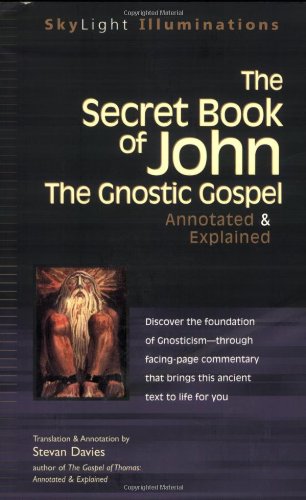
4. The Secret Book Of John: The Gnostic Gospel / Annotated & Explained (Skylight Illuminations)
Paperback: 166 Pages (2005-02-25)
list price: US$16.99 -- used & new: US$4.25
(price subject to change: see help)
Asin: 1594730822
Average Customer Review: 4.5 out of 5 stars
Canada | United Kingdom | Germany | France | Japan
Editorial Review

Book Description
This ancient Gnostic text can be a companion for your own spiritual quest

The Secret Book of John is the most significant and influential text of the ancient Gnostic religion. Part of the library of books found in Nag Hammadi, Egypt, in 1945, this central myth of Gnosticism tells the story of how God fell from perfect Oneness to imprisonment in the material world, and how by knowing our divine nature and our divine origins—that we are one with God—we reverse God's descent and find our salvation.

The Secret Book of John: The Gnostic Gospel—Annotated & Explained decodes the principal themes, historical foundation, and spiritual contexts of this challenging yet fundamental Gnostic teaching. Drawing connections to Christianity, Buddhism, Hinduism, kabbalistic Judaism, and Sufism, Davies focuses on the mythology and psychology of the Gnostic religious quest. He illuminates the Gnostics' ardent call for self-awareness and introspection, and the empowering message that divine wholeness will be restored not by worshiping false gods in an illusory material world but by our recognition of the inherent divinity within ourselves.

Now you can experience and understand this foundational teaching even if you have no previous knowledge of Gnosticism. This SkyLight Illuminations edition presents the most important and valued book in Gnostic religion with insightful yet unobtrusive commentary. It provides deeper insight into the understanding that in Gnosticism the distinction between savior and saved ceases to exist—you must save yourself and in doing so save God. ... Read more

Customer Reviews (4)

5-0 out of 5 stars A big piece to the puzzle
I read this book years ago and didn't get nearly as much out of it as today. I doubt that first time readers are going to penetrate any book by John easily. The cosmology expressed needs commentary for modern man, or traditional Christians, who have been trained a different way.

What I like about this book is the way it explains the Godhead as male and female, the various layers of the universe, the various co-creators with God that hurt his creation, and the clear references to karma (called fate), and reincarnation, that were probably a part of the original teachings of Jesus. I also see possible references to Aliens and UFO's in this book, which were also a part of Gnostic teaching.

Some people might think that Jesus doesn't sound like "Jesus" in this book due to his longer discourses. If so, try reading "Love without End", "The Aquarian Gospel of Jesus the Christ", or other books in the Gnostic collection. I think that you will see that Jesus spoke at length about the subjects he loved, with higher initiates, every chance he got. He's just that kind of a person.

4-0 out of 5 stars much to be considered
Reading this item is an excellent way to begin a study of the forty-eight gnostic tracts in the Nag Hammadi Library. However, a reader should know that Davies believes that the Gospels' bifurcated Jesus was a historical person, as do all other translators of the tracts in theLibrary. Their translations and commentary are tainted by this a priori belief. The historical evidence upon which they rely does not include relevant material, such as the Dead Sea Scrolls' Teacher of Righteousness and his ideological opposite, referred to only as The Liar, whose ideologies can be found in the words and deeds attributed to Jesus, John the Baptist and Paul. Also relevant are the Mandean scriptures which reveal that the relationship between Jesus and the Baptist was not as pictured in the Gospels. This accounts for the fact that the Nag Hammadi tracts, read as a whole, clearly show that some gnostics supported, while others rejected, two basic tenets of the Christian faith, namely, repentance and baptism. They also disagree on whether everyone will eventually return by way of reincarnation to whence theycame or whether some will be eternally tormented. The Secret Book of John takes both positions. I discuss the source of disagreement in a manuscript presently being reviewed by historian David Blair and Watkins Publishing Company. There is much to be learned about gnosticism and the origin of Christianity, and Davies' work is a significant contribution.


4-0 out of 5 stars Cornerstone of Gnostic Mythos
The Secret Book of John was a difficult read,at first. More so, possibly because I had originally read it in James M. Robinson's Nag Hammadi Library collection. I appreciate the classic value of the Robinson edition, but since then other interpretors have better clarified the secret texts, in comprehensible and succinct language. Davies' book is one such basic read, although I still call Marvin Meyer's "The Gnostic Teachings of Jesus" my favorite. However, Davies' "Annotated & Explained" goes further than Myers, so now I have two on my shelves. The more interpretation samples we read, the better our understanding of such esoteric material. "John" is not at all like the Secret Gospel of Thomas, or the Gospel of Mary, which were short, and "sayings". This book is more like a "cosmology according to the Christ".

What throws so many people off from The Secret Book/Teaching/Apocryphon of John is that the story doesn't resemble anything else Jesus said in the New Testament. People also tend to condemn it because it stands rather disconnected from other gospel, apocrypha and epistles, and has a sense of fantasy about it. Jesus explains Sophia, the feminine wisdom who gave virgin birth to Yaldabaoth, the demiurge. It discusses the role of archons, even naming the Archons of Yaldabaoth. It is highly revelatory, but so are the writings of Swedenborg, J. Smith and John Ballou Newbrough, to name just a few latter day prophets. The Secret Book of John is a syncretism of Greek ideas and Judaic Genesis mythology. If you give it a chance, you can come away with meaningful and life changing knowledge. One thing it did for me was answer the eternal question of "why bad things happen to good people".

That question has never been answered satisfactorily by more traditional (note, I avoid the term "Orthodox", my bias--sorry) priests and pastors, because they don't teach that it was an imperfect demiurge that made an imperfect world. Once you accept that premise, everything else falls into place. For any reader serious about Gnosticism or Gnostic-curious, this is the book to start with.

5-0 out of 5 stars The Foundation Text of Gnosticism
The Secret Book, or Apocryphon, of John is perhaps the most important text of classic Gnosticism. It is also one of the most complex, difficult to follow in the standard translations, its meaning more or less impenetrable without a commentary. In The Secret Book of John: Annotated and Explained, Gospel of Thomas expert Stevan Davies provides a clear and accessible introduction to this important text. Step by step Davies steers the reader through the different layers of the text, outlining the structure of its thought and even providing diagrams. The translation is straightforward and formatted in such a way that the reader cannot get lost in the maze of terminology and ideas. What is more, the introduction is the best short explanation of Gnosticism that I have ever read. Davies sketches out the fundamentals of Gnosticism clearly, appealing to contemporary spiritality without compromising historically accuracy. Anyone genuinely interested in understanding ancient Gnosticism should start here. ... Read more


5. The $100,000+ Career
by John Davies
Paperback: 256 Pages (2007-03-01)
list price: US$18.95 -- used & new: US$8.80
(price subject to change: see help)
Asin: 1402209282
Average Customer Review: 5.0 out of 5 stars
Canada | United Kingdom | Germany | France | Japan
Editorial Review

Book Description
The $100,000+ Career unlocks the power of networking to help build your executive career and land the job you want. It's not enough to find an executive job - this guide will show you how to land a job you love and are well-compensated for.

By following Davies's method, you'll discover which industry, job type, location, company size, salary and other factors are right for you. And the best part about it is that you'll have other people helping you land that dream job, and advancing your career.

The $100,000+ Career is more than just a job search technique - it is a brand new way to build your career at the top of the ladder.
... Read more

Customer Reviews (6)

5-0 out of 5 stars Practical Job Search Methodology
This is not a theoretical book, which can be quite important to the job-seeker who isn't looking for a theoretical job!This is a very practical book born out of Davies' alarming job search realization that, after 18 years of running a company, he was 287th in line for the CEO job he wanted!

He realized he needed to dramatically change his job search approach and this book documents the detailed and pragmatic process he created to land the right job.

Davies covers a lot of useful ground -- business cards, executive biographies, getting over the 2nd call hurdle, the targeted number of calls / emails a week, how to use a database to track a job search, how to leverage online networks and how many new people to meet to get the perfect job - and does it with good examples, wizards, pictures etc.

I am currently in the middle of a job search where I've employed the author's methodology with good success.It has led me to 80 new relevant contacts, 50 of whom I've now met, spoken, or emailed with.It has also led to meetings with eight CEOs for the VP-level job I am targeting.

I was curious if Davies himself would help me in my job search.I didn't know him but he works in my industry and we had a common contact who recommended his book to me in the first place.I called him up (he was my 66th new contact) and used the techniques he outlines in his book to explore how we could help each other.He introduced me to several very helpful folks, including the co-founder of a company I am targeting.

It doesn't get much more practical than that!Highly recommended.

5-0 out of 5 stars The Business Book You'll Read Again
It's difficult to advance the eloquent and thoughtful reviews provided below. But, I'd like to add my recommendation for "The $100,000+ Career".

Unlike most business books, it's a quick, entertaining read. John has a gift for driving complex ideas into simple, easy to understand prose. If you're looking for an elaborate expose on business networking, this book is not for you. If, however, you're looking to advance your career in a positive way, apply basic networking techniques to all facets of your life, and enjoy yourself in the process, you've come to the right place.

I have been a successful professional for 20 years. Networking has been, and continues to be, a key component of that success. In fact, effective networking kept me employed over the last 10 years. I never used a resume. Once, I had to rush to put a resume together the night before I met executives just so HR could attach it to my file. When I was on the market, people called me.

Enter John Davies. Surely, a seasoned professional like me doesn't need another book telling me what I already know?! Not true. I work in a high-turnover environment. I recently discovered my small network of business professionals wasn't enough. It literally dried up of all opportunities. No one had a position available, and everyone I knew was aware of the same jobs. Obviously, painfully, for the first time in many years, I needed to expand my network.

I've practiced many of John's fundamental techniques over the years. But, I rarely organized my networking activities in a meaningful, consistent way. His methodology reinforced my previous behavior and offered new approaches to my current "transition".

The genius of John's book is in its application beyond the job search. His common sense approach can be used in all aspects of your professional and personal life.

I have personally recommended "The $100,000+ Career" to several people. I already know it is destined to become the first business book I re-read. Whether you're just starting a job search or are an experienced, employed networker, I suspect this book will also become the one you reference again and again.

4-0 out of 5 stars Excellent guidance for creating career and personal happiness (or, How I Learned to Stop Worrying and Love the Job Search)
The $100,000+ Career is good reading, period.I started the book with connotations of this being a business book, but I ended knowing this is a book about people.By humanizing the frigid concept of networking, John Davies shows how getting the job we want, or conceiving of that job in the first place, is achievable.His current job, as highlighted in the book, is proof that his ideas work.

The book bridges the gap between old-fashioned communication (you know, talking to people) and how we communicate now: sending and receiving to the world, but in isolation.With thoughtful advice and engaging anecdotes, Davies offers practical steps for how to be introduced to 100 new people, the "Law of 100" that he says can get anyone the job she wants.The trick is not in meeting 100 anybodies, but knowing how to meet the right people to help you on your job search.In this book, he shows the way.

Davies clearly embraces his own advice, using his job search experience to show the Law of 100 in action.The book extends into of social networking, being marketable without being a commodity, practical tools for organizing these efforts, co-conspirators, terrible caddies, and even a phone call to Bob Marley.It's an unusual and exciting read.

Finally, any book that begins with a quote from John Waters has to be, at the very least, interesting.Anyone, not just businesspeople, will take a lot from this book.Personally, I enjoyed the advice for how to take control of my career.More valuable that that, I also learned that networking isn't about using people to get jobs.It's about developing relationships that improve and enrich our lives (no, seriously!)

5-0 out of 5 stars An enjoyable read with a fresh perspective .
I enjoyed this a lot and found that many of John's ideas are applicable for all , not only executives in transition . A wonderful "gift" book for those who are stuck and in need of some inspiration .

5-0 out of 5 stars Surprising Twists On The Well-Worn Subject of Finding The Job You Really Want Through Networking
I like a book that takes an idea that I may think I may know well, like networking, and gives it some surprising twists that, in the end,has me thinking differently about that subject. John Davies' book is like that. What do I mean?

We all network to some extent. But, one of Davies' points, in your search for a new job, is that networking isn't just about establishing a new contact. It's about establishing a trusting relationship with someone new, who can then introduce you to someone who may, in the end, offer you a job. Instead of a cold call then, your contact creates an instant credibility with the person you want to speak to.

In fact, he isn't speaking of one introduction, but of setting a goal where you end up with 100 introductions, which he calls the "Rule Of 100."Why 100? Because, like with direct marketing where the response rate is in the range of 1 to 3%, going after 100 introductions significantly raises the likelihood of successfully ending up with a new job.

This is just one of the twists in Davies' book that had me re-examining how I think about and what I do when I network.

One suggestion I would make to supplement Davies' book has to do with the awkwardness of meeting new people. I don't know about you, but, oftentimes, I am at a loss as to what to say. To help, I found the book "The Fine Art of Small Talk" by Debra Fine useful.

... Read more


6. The British Landscape
by John Davies
Hardcover: 112 Pages (2006-09)
list price: US$60.00 -- used & new: US$36.91
(price subject to change: see help)
Asin: 095468947X
Average Customer Review: 5.0 out of 5 stars
Canada | United Kingdom | Germany | France | Japan
Editorial Review

Book Description

Presented in a luxurious edition and on a spectacular scale, this album reveals the beauty and history of Britain. From positions of elevation, John Davies surveys the landscape-from its mountains to its city centers-making compelling views layered with social and historical detail. Includes detailed captions and an introduction by Guardian columnist and popular broadcaster Jonathan Glancey. ... Read more

Customer Reviews (1)

5-0 out of 5 stars The B-I-G picture
If you buy this stunning book you'll have to consider (only for a few seconds though) where you'll keep it because the photos are 14.5 inches wide by 10 deep which is an impressive size for an admittedly large subject and printed in 200dpi helps.

The editorial format is quite interesting with the first five landscapes, as you would expect, looking down on the Scottish and English countryside but by photo six John Davies concentrates on man-made Britain and in particular the industrial Midlands and North.Fortunately nearly all the photos are taken from a higher vantage point, which gives plenty of scope to show masses of detail layered off to the horizon.

These photos are definitely not the conventional landscape Britain but the gritty city, energy producing and manufacturing part of the Nation.The front cover shot of the Salford power station cooling towers sum up Davies' style because as well as the four huge structures there is a football match in progress in the foreground.Nicely many of the photos show people in the landscape, working, walking, talking or just kids playing.

This book is a remarkable landscape view of contemporary Britain made all the more powerful because of the large image size.Another reason I like the book is because all the photos have detailed captions with plenty of historical detail.So many photobooks these days seem reluctant to give the viewer any information other than a picture on a page.

***FOR AN INSIDE LOOK click 'customer images' under the cover.
... Read more


7. From a View to a Discovery: Edmund Spenser, Sir John Davies, and the defects of law in the realm of Ireland.: An article from: Canadian Journal of History
by D. Alan Orr
 Digital: 23 Pages (2003-12-01)
list price: US$5.95 -- used & new: US$5.95
(price subject to change: see help)
Asin: B00082H9SG
Canada | United Kingdom | Germany | France | Japan
Editorial Review

Book Description
This digital document is an article from Canadian Journal of History, published by University of Saskatchewan on December 1, 2003. The length of the article is 6772 words. The page length shown above is based on a typical 300-word page. The article is delivered in HTML format and is available in your Amazon.com Digital Locker immediately after purchase. You can view it with any web browser.

From the author: Nous procedons, dans cet article, a une analyse comparee de l'oeuvre d'Edmund Spenser A View of the Present State of Ireland et de celle de Sir John Davies A Discovery of the True Causes Why Ireland Was Never Entirely Subdued ... Until the Beginning of His Majesty's Happy Reign. Durant les deux dernieres decennies, Nicholas Canny a affirme que le View de Spenser avait un role central dans l'entreprise coloniale britannique en Irlande au dix-septieme siecle, tout en suggerant que le Discovery de Davies adherait de tres pres aux idees de Spenser sur les affaires irlandaises. Ces idees etaient impregnees par un plaidoyer sans pudeur pour la violence militaire et judiciaire et un scepticisme profond envers l'efficacite du droit coutumier anglais, ses procedures et ses valeurs dans le reglement des affaires irlandaises. Nous mettons au defi cette interpretation de Canny soutenant alternativement que ces deux textes n'ont non seulement des opinions opposees sur l'efficacite de la loi anglaise en Irlande en tant qu'agent de changement culturel mais aussi comme des modeles rivaux pour ecrire l'histoire du debut de l'Irlande moderne, l'un ethnologique provenant du View de Spenser et l'autre, ancre dans la souverainete, du Discovery de Davies.

Citation Details
Title: From a View to a Discovery: Edmund Spenser, Sir John Davies, and the defects of law in the realm of Ireland.
Author: D. Alan Orr
Publication: Canadian Journal of History (Refereed)
Date: December 1, 2003
Publisher: University of Saskatchewan
Volume: 38Issue: 3Page: 395(14)

Distributed by Thomson Gale ... Read more


8. Biography - Davies, John Paton, Jr. (1908-1999): An article from: Contemporary Authors
by Gale Reference Team
Digital: 3 Pages (2002-01-01)
list price: US$9.95 -- used & new: US$9.95
(price subject to change: see help)
Asin: B0007SB5M2
Canada | United Kingdom | Germany | France | Japan
Editorial Review

Book Description
This digital document, covering the life and work of John Paton Davies, Jr., is an entry from Contemporary Authors, a reference volume published by Thompson Gale. The length of the entry is 733 words. The page length listed above is based on a typical 300-word page. Although the exact content of each entry from this volume can vary, typical entries include the following information:

  • Place and date of birth and death (if deceased)
  • Family members
  • Education
  • Professional associations and honors
  • Employment
  • Writings, including books and periodicals
  • A description of the author's work
  • References to further readings about the author
... Read more

9. Phrenology: fad and science;: A 19th-century American crusade,
by John Davies
 Unknown Binding: 203 Pages (1971)
list price: US$22.50
Isbn: 0208009523
Canada | United Kingdom | Germany | France | Japan

10. Send Him to Hell: John Davies' 17 Years of Suffering in Thailand's Prisons
by Sebastian Williams
Paperback: 480 Pages (2008-02)

Isbn: 184018986X
Canada | United Kingdom | Germany | France | Japan

11. Daily Life in the Early Church: Studies in the Church Social History of the First Five Centuries
by John Gordon Davies
Paperback: 184 Pages (2002-09-01)
list price: US$35.00 -- used & new: US$33.94
(price subject to change: see help)
Asin: 0718890191
Canada | United Kingdom | Germany | France | Japan
Editorial Review

Book Description
Short description: What did the early Christians wear? What did they eat? What did they talk about over the dinner table? What recreations did they enjoy? These are among the questions answered in this study. ... Read more


12. Four businessmen join race for local Grand Prix. (John G. Davies, Murray L. Galinson, Kip Howard and Rug Cunningham make up steering committee of San Diego ... An article from: San Diego Business Journal
by Todd Lassa
 Digital: 2 Pages (1991-09-02)
list price: US$5.95 -- used & new: US$5.95
(price subject to change: see help)
Asin: B00092HZKC
Canada | United Kingdom | Germany | France | Japan
Editorial Review

Book Description
This digital document is an article from San Diego Business Journal, published by CBJ, L.P. on September 2, 1991. The length of the article is 561 words. The page length shown above is based on a typical 300-word page. The article is delivered in HTML format and is available in your Amazon.com Digital Locker immediately after purchase. You can view it with any web browser.

Citation Details
Title: Four businessmen join race for local Grand Prix. (John G. Davies, Murray L. Galinson, Kip Howard and Rug Cunningham make up steering committee of San Diego Grand Prix Inc.)
Author: Todd Lassa
Publication: San Diego Business Journal (Magazine/Journal)
Date: September 2, 1991
Publisher: CBJ, L.P.
Volume: v12Issue: n34Page: p3(1)

Distributed by Thomson Gale ... Read more


13. John Baldessari: National City
by Hugh Davies, Anne Rorimer, John Baldessari
Paperback: 112 Pages (1997-02-02)
list price: US$24.95
Isbn: 0934418497
Canada | United Kingdom | Germany | France | Japan
Editorial Review

Book Description
Artwork by John Baldessari. Contributions by Andrea Hales. Text by Hugh Davies, Anne Rorimer. ... Read more


14. A Man before Others: Rudolf Steiner Remembered
by Rudolf Steiner Press, John Davy, George Adams, Eleanor C. Merry
Hardcover: 230 Pages (1993)
list price: US$30.00
Isbn: 1855840073
Canada | United Kingdom | Germany | France | Japan

15. Towards the Semantic Web: Ontology-Driven Knowledge Management
by Frank van Harmelen
Hardcover: 328 Pages (2003-01-21)
list price: US$99.95 -- used & new: US$49.00
(price subject to change: see help)
Asin: 0470848677
Average Customer Review: 3.0 out of 5 stars
Canada | United Kingdom | Germany | France | Japan
Editorial Review

Book Description
With the current changes driven by the expansion of the World Wide Web, this book uses a different approach from other books on the market: it applies ontologies to electronically available information to improve the quality of knowledge management in large and distributed organizations. Ontologies are formal theories supporting knowledge sharing and reuse. They can be used to explicitly represent semantics of semi-structured information. These enable sophisticated automatic support for acquiring, maintaining and accessing information. Methodology and tools are developed for intelligent access to large volumes of semi-structured and textual information sources in intra- and extra-, and internet-based environments to employ the full power of ontologies in supporting knowledge management from the information client perspective and the information provider.
The aim of the book is to support efficient and effective knowledge management and focuses on weakly-structured online information sources. It is aimed primarily at researchers in the area of knowledge management and information retrieval and will also be a useful reference for students in computer science at the postgraduate level and for business managers who are aiming to increase the corporations' information infrastructure.

The Semantic Web is a very important initiative affecting the future of the WWW that is currently generating huge interest. The book covers several highly significant contributions to the semantic web research effort, including a new language for defining ontologies, several novel software tools and a coherent methodology for the application of the tools for business advantage. It also provides 3 case studies which give examples of the real benefits to be derived from the adoption of semantic-web based ontologies in "real world" situations. As such, the book is an excellent mixture of theory, tools and applications in an important area of WWW research.
* Provides guidelines for introducing knowledge management concepts and tools into enterprises, to help knowledge providers present their knowledge efficiently and effectively.
* Introduces an intelligent search tool that supports users in accessing information and a tool environment for maintenance, conversion and acquisition of information sources.
* Discusses three large case studies which will help to develop the technology according to the actual needs of large and or virtual organisations and will provide a testbed for evaluating tools and methods.
The book is aimed at people with at least a good understanding of existing WWW technology and some level of technical understanding of the underpinning technologies (XML/RDF). It will be of interest to graduate students, academic and industrial researchers in the field, and the many industrial personnel who are tracking WWW technology developments in order to understand the business implications. It could also be used to support undergraduate courses in the area but is not itself an introductory text.Download Description
"Generating huge interest and backed by the global WorldWideWeb consortium the semantic web is the key initiative driving the future of the World Wide Web. Towards the Semantic Web focuses on the application of Semantic Web technology and ontologies in particular to electronically available information to improve the quality of knowledge management in large and distributed organizations. Ontologies are formal structures supporting knowledge sharing and reuse. They can be used to represent explicitly the semantics of structured and semi-structured information which enable sophisticated automatic support for acquiring, maintaining and accessing information. Covering the key technologies for the next generation of the WWW, this book is an excellent mixture of theory, tools and applications in an important area of WWW research. Aims to support more efficient and effective knowledge management and focuses on weakly-structured online information sources. Covers highly significant contributions to the semantic web research effort, including a new language for defining ontologies, several novel software tools and a coherent methodology for the application of the tools for business advantage.Provides guidelines for introducing knowledge management concepts and tools into businesses. Introduces an intelligent search tool that supports users in accessing information and a tool environment for maintenance, conversion and acquisition of information sources. Also describes information visualisation and knowledge sharing tools. Describes a state-of-the-art system for storage and retrieval of metadata expressed in RDF and RDF Schema. Also discusses a system for automatic metadata extraction. Examines three significant case studies providing examples of the real benefits to be derived from the adoption of semantic-web based ontologies in ""real world"" situations. ... Read more

Customer Reviews (5)

4-0 out of 5 stars speculative but exciting
Davies et al take us on a tour of a possible future Web. A very ambitious project, whose remit is to enable a far more automated knowledge processing of web pages. Various ontologies and schemas are proposed. Notably the RDF schema.

Overall, there is no dispute in the book that XML will be used as the default low level representation. It is the higher level issues that are cloudier. Much harder to evaluate. Like how to evolve a given ontology and how to couple this to a reasoning software package.

The book also finds time to look briefly at involving a peer-to-peer method for aiding knowledge management and for building ontologies. A so-called Knowledge Grid is proposed. Speculative but exciting.

2-0 out of 5 stars A Presentation of Tools
This is a book about what has Ontoprise(in other words Karlsruhe Uni.) done in asocciation with Innsbruk and Amsterdam (and probably Manchester I cannot recall) for the development of software tools about the semantic web. That's why the title of the book has the word "Towards" before "Semantic Web" and it is not just called "The Semantic Web". It talks very little about the Semantic Web, Ontologies and the problems that we face in the realization of these concepts and is limited to just introducing some concepts without defining and explaining them in detail.
The only pesron that this book might seem usefull is someone who is prety aware of the semantic web and ontology technologies and wants to find more information about the way the way some problems are dealt in software.

1-0 out of 5 stars Just a compilation of papers
This books is nothing but just a compilation of papers persented by various researchers. You can just look at the table of contents of this book, search the paper on the internet and download it. Don't see the point in buying this book.

5-0 out of 5 stars Semantic futures
This book comprises a comprehensive overview of the application of semantic web technologies to knowledge management. The first few chapters discuss theoretical underpinnings before moving on to knowledge management tools that can exploit semantically-annotated information. A methodology is also described for the introduction of these technologies into an organisation, along with a couple of case studies. As such, it is one of the first books describing a whole-hearted attempt to apply semantic web technology to an important industrial/commercial area.

The book is not primarily an introductory text and is for people who already have at least an understanding of existing WWW technology and probably of XML and RDF. As such, I believe that its main appeal will be to graduate students; researchers, developers and technologists in industry; and the academic community. For this readership, this is an excellent text describing some ground-breaking research in the field, and giving pointers to the future research agenda.

2-0 out of 5 stars Need a lot of Ontology based Knowledge to use this book
This book often introduces terms with little or no meaning.In the early chapters, it refers to various ontologies assuming the reader knows terms like frames, slots, ...etc.Ex: pg. 18"Class Defintion (frames) have an (optional) addtional field that specifies whether the class definition is primitive (a subsumption axiom) or a non-primitive (an equivalence axiom)."I was more confused after reading the definition.The book has very few diagrams and does not always realize how important it is for a reader to understand a fundamental concept before they go on to learning new concepts - which are based on solid fundamentals.
In later chapters, the case studies are helpful as one can start relating the myriad of concepts learned in previous chapters.
It is obvious that the authors know their stuff but their teaching style has a lot to be desired. ... Read more


16. Philosophy in poetry;: A study of Sir John Davies's poem "Nosce teipsum" (Library of English Renaissance literature)
by E. Hershey Sneath
 Unknown Binding: 319 Pages (1970)

Isbn: 0836954084
Canada | United Kingdom | Germany | France | Japan

17. Shakespeare, 'A Lover's Complaint', and John Davies of Hereford
by Brian Vickers
Hardcover: 342 Pages (2007-03-05)
list price: US$96.00 -- used & new: US$21.64
(price subject to change: see help)
Asin: 0521859123
Canada | United Kingdom | Germany | France | Japan
Editorial Review

Book Description
When Shakespeare's Sonnets were published in 1609 a poem called A Lover's Complaint was included by the publisher, Thomas Thorpe, who was notorious for several irregular publications. Many scholars have doubted its authenticity, but recent editions of the Sonnets have accepted it as Shakespeare's work. Now Vickers, in the first full study of the poem, shows it to be un-Shakespearian both in its language and in its attitude to women. It is awkwardly constructed and uses archaic Spenserian diction, including many unusual words that never occur in Shakespeare. It frequently repeats stock phrases and rhymes, distorts normal word order far more often and more clumsily than Shakespeare did, while its attitude to female frailty is moralizing and misogynistic. By close analysis Vickers attributes the poem to John Davies of Hereford (1565-1618), a famous calligrapher and writing-master who was also a prolific poet. Vickers' book will re-define the Shakespeare canon. ... Read more


18. Silver Poets of the Sixteenth Century: Wyatt, Surrey, Relegh, Philip Sidney, Mary Sidney, Michael Drayton and Sir John Davies (Everyman's Library (Paper))
 Paperback: 288 Pages (1992-05)
list price: US$10.95 -- used & new: US$99.64
(price subject to change: see help)
Asin: 046087103X
Canada | United Kingdom | Germany | France | Japan

19. Shakespeare's Sonnet CXI and John Davies of Hereford's Microcosmos (1603).(Critical essay): An article from: The Modern Language Review
by McDonald P. Jackson
 Digital: 20 Pages (2007-01-01)
list price: US$9.95 -- used & new: US$9.95
(price subject to change: see help)
Asin: B001268H0Q
Canada | United Kingdom | Germany | France | Japan
Editorial Review

Book Description
This digital document is an article from The Modern Language Review, published by Thomson Gale on January 1, 2007. The length of the article is 5874 words. The page length shown above is based on a typical 300-word page. The article is delivered in HTML format and is available in your Amazon.com Digital Locker immediately after purchase. You can view it with any web browser.

Citation Details
Title: Shakespeare's Sonnet CXI and John Davies of Hereford's Microcosmos (1603).(Critical essay)
Author: McDonald P. Jackson
Publication: The Modern Language Review (Magazine/Journal)
Date: January 1, 2007
Publisher: Thomson Gale
Volume: 102Issue: 1Page: 1(11)

Article Type: Critical essay

Distributed by Thomson Gale ... Read more


20. Sir John Davies(Teas 175)
by James L. Sanderson
 Textbook Binding: 170 Pages (1975-06)
list price: US$8.50
Isbn: 0805711414
Canada | United Kingdom | Germany | France | Japan

  1-20 of 100 | Next 20
A  B  C  D  E  F  G  H  I  J  K  L  M  N  O  P  Q  R  S  T  U  V  W  X  Y  Z  

Prices listed on this site are subject to change without notice.
Questions on ordering or shipping? click here for help.

site stats