e99 Online Shopping Mall

Geometry.Net - the online learning center Help  
Home  - Authors - Basho (Books)

  1-20 of 100 | Next 20
A  B  C  D  E  F  G  H  I  J  K  L  M  N  O  P  Q  R  S  T  U  V  W  X  Y  Z  

click price to see details     click image to enlarge     click link to go to the store

$7.34
1. The Narrow Road to the Deep North
$10.43
2. Basho's Narrow Road: Spring &
$14.31
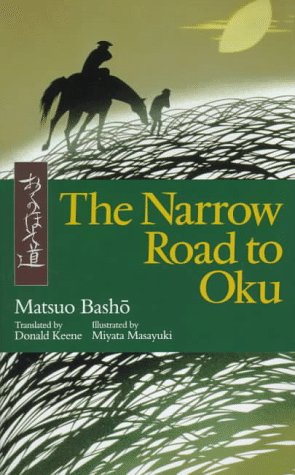
3. The Narrow Road to Oku (Illustrated
$9.46
4. Matsuo Basho (Illustrated Japanese
$16.47
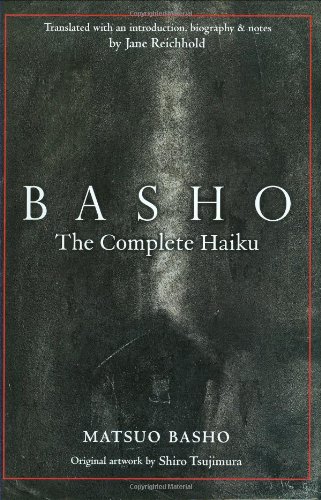
5. Basho: The Complete Haiku
$9.57
6. Narrow Road to the Interior: And
$17.78
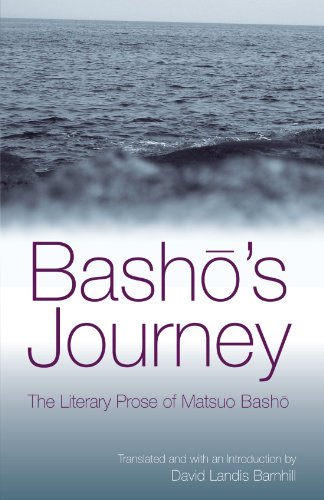
7. Basho's Journey: The Literary
$10.20
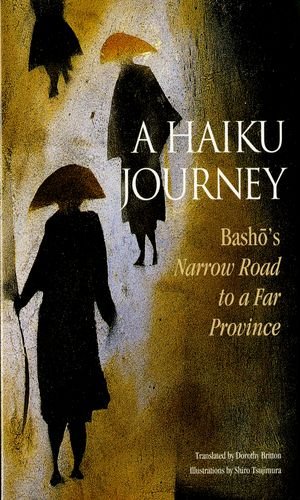
8. A Haiku Journey: Bashos Narrow
$10.39
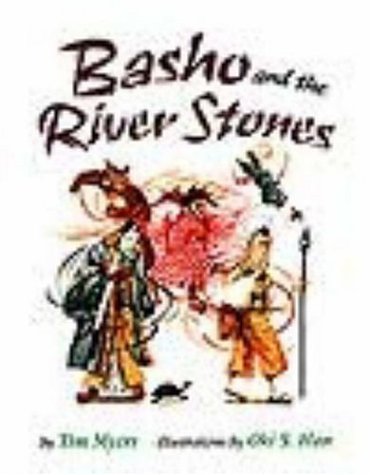
9. Basho and the River Stones
$17.00
10. Basho's Haiku: Selected Poems
$5.30
11. The Sound of Water: Haiku by Basho,
$4.89
12. Narrow Road to the Interior (Shambhala
$11.28
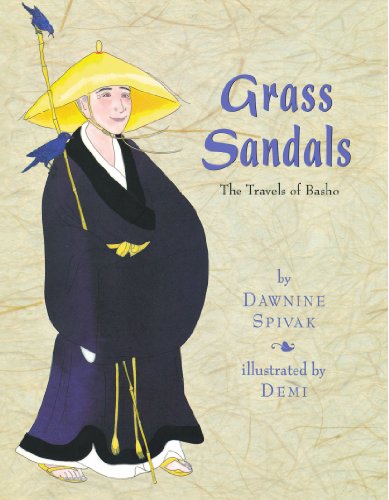
13. Grass Sandals : The Travels of
$7.34
14. Back Roads To Far Towns: Basho's
$3.36
15. Basho and the Fox
$7.01
16. Classic Haiku: The Greatest Japanese
$50.65
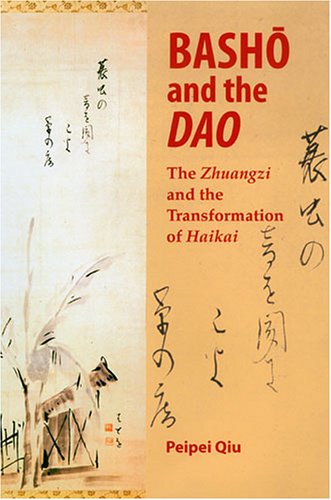
17. Basho And The Dao: The Zhuangzi
$109.99
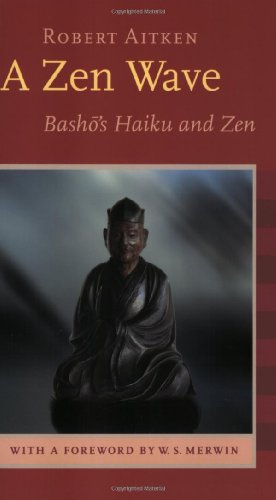
18. A Zen Wave: Basho's Haiku &
$6.68
19. The Complete Basho Poems
$8.43
20. An Introduction to Haiku: An Anthology

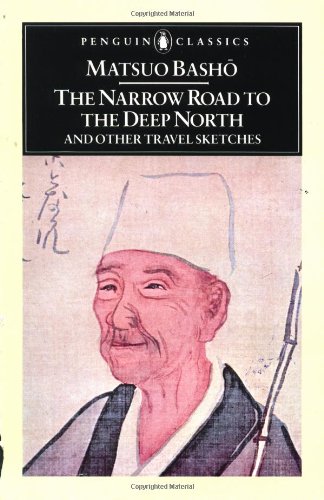
1. The Narrow Road to the Deep North and Other Travel Sketches (Penguin Classics)
by MatsuoBasho
Paperback: 176 Pages (1967-02-28)
list price: US$13.00 -- used & new: US$7.34
(price subject to change: see help)
Asin: 0140441859
Average Customer Review: 3.5 out of 5 stars
Canada | United Kingdom | Germany | France | Japan

Customer Reviews (9)

4-0 out of 5 stars Surprised...
This is a wonderful collection of travel sketches and poetry.Albeit, I was slightly disappointed in the translation and format.One who is used to the traditional 3 line haiku may have to relax their preconception of how a haiku should look.The other elements are there, except in an entry made by Basho himself whereas he noted that he'd neglected including a "season word."One would read this to relive the writer's journeys- the poetry, while closely associated with Basho, should be accepted as inspirations of the journey and not the reason for reading the collection.

3-0 out of 5 stars Seminal work marred by questionable translation
"Narrow Road to the Deep North" is one of the classics of Japanese literature, and a seminal work by Matsuo Basho, possibly Japan's greatest poet. A wandering spirit, he traveled across his home nation during a time when travel was dangerous, arduous, and almost impossible to the average citizen. Not only did he perfect his medium, the haiku, during his travels, but he also introduced the rare sights of Japan to his audience, painting a canvas of imagery that few would ever be able to see with their own eyes.

Unfortunately,this classic work is not fully realized in this translation.The translator, Nobuyuki Yuasa, is himself not a native speaker of English.Poetic translation is difficult under any circumstances, and when translating into a non-native language the task is made even more difficult.Yuasa makes use of fairly grandiose English words where Basho used simple language, and he attempts to fill in perceived gaps of foreign understanding with additional lines not included in the original. (Example: Basho's most famous poem includes the stanza "Mizu no oto" literally "The Sound of Water." Yuasa has given this as "A Deep Resonance" ) Yuasa also made use of a 4-stanza method of translating the haiku, which he defends in the introduction, but does not transfer the original intent of the form.

Unfortunately, the original Japanese versions of the haiku are not included, so a capable reader is not even able to attempt their own understanding.

Included in this single volume are several of Basho's travelogues, including "The Records of a Weather-Exposed Skeleton," "A Visit to Kashima Shrine," "The Records of a Travel-Worn Satchel" and "A Visit to Sarasina Village." The works are heavily end-noted, to clarify culture terms and names of note.Unfortunately, this is another flaw in the volume, as the end-notes are often short, and checking them interrupts the flow of the tale.Foot-notes would have been a better choice.

For a more capable translation of Basho's poetry, see Makoto Ueda's biography "Matsuo Basho."Hopefully in the future a better translation of all of these wonderful and important travelogues will be issued.

3-0 out of 5 stars Unquenchable love of poetry
Basho's combination of prose and poetry is attractive indeed.
It contains excellent images:
'I wavered ceaselessly like a bat that passes for a bird at one time and for a mouse at another.'
'A thicket of summer grass is all that remains of the dreams and ambitions of ancient warriors.'

The author's goal is 'to obey nature, to be one with nature.'
His literary goal is 'l'art pour l'art': 'Whatever such a mind sees is a flower, and whatever such a mind dreams of is the moon. It is only a barbarous mind that sees other than flower, merely an animal mind that dreams of other than the moon.'

But he remains completely insensitive for real barbarous practices:
'I saw a child, hardly three years of age, crying pitifully on the bank, obviously abandoned by his parents. ... Alas, it seems to me that this child's undeserved suffering has been caused by something far greater and more massive - by what one might call the irresistible will of heaven.'
Besides abandoned children, there are also abandoned ageing mothers and drifting concubines. 'Their life was such that they had to drift along even as the white froth of waters that beat on the shore.'

The author's real belief is fatalism: the irresistible will of heaven and the eternal law.

These more or less innocent travel sketches are only for haiku aficionados.

4-0 out of 5 stars Enjoyable.
A book with five autobiographical travels, three of them being his expectant last journey of life, with required farwell party etc., of Basho with haiku injected by the author, his traveling companions, or persons met along the way. It was quite an interesting read on culture and the way of life in Japan during Basho's day. The book was satisfying and interesting as a travel journal and for a taste of Basho's personality and of the cultural mores of Japanese feudal society.A sense of the Japanese appreciation of nature and of symbols in nature was also conveyed. Haiku seems to embody something beyond words, natural symbols that we observe everyday captured; a sometimes great ineffable meaning in the mundane.

Some of the poetry was good, as far as the translation communicated, however quite a lot also seemed lost in translation that might have been expounded upon. Yuasa Noboyuki, the translator, and writer of the forward, might have done better by talking about these difficulties and that might have brought some light to many of the haikus. The translating haiku with all of the original sense is almost impossible, so I have been told. I also have been told that Ezra Pound expounded, someplace, on just how impossible translating haiku into English is. Noboyuki might have done better to expound on his difficulties translating Japanese haiku into English and his futile attempts to convey the totality of the haiku, which could have raised the vibrancy of some of them; it was vague effort that he included in talking about this aspect.

The poems were charming, as were the autobiographical travel stories of Basho. A good read.

4-0 out of 5 stars Wonderful Material, Questionable Translation
Tension.We all feel it, though for many different reasons.Sometimes it's as if we're caught between two worlds, being pulled in different directions by different aspects of our lives, of our selves.Basho felt it, too, I think, which was one of the reasons he took to the road, leaving hearth and home for weeks, even months at a time, travelling around Japan in search of history, beauty, poetry, and himself.

As a travel narrative the book excels, describing, as Basho himself states, all the unique and arresting things he has encountered while omitting a bland historic report of every person and place he saw.The result is a dreamlike narrative, bouncing from rainy nights spent in temples to the solitude of a moonlit beach.He never sacrifices clarity for style, though.In fact, the raw, physical immediacy of his poetry is what struck me most my first time (and so far only) time through.The prose, too, is excellent, conveying his thoughts on art, his musings on Buddhism, and describing scenes with nearly as much flavor as the poetry.

My one problem with this text has more to do with the translation.I am not an expert on the Japanese language, but some of the terms employed seem a little loaded to an English reader, making me wonder whether Basho really meant some of the implications of the English words.In addition, as other reviewers have noted, the poems lose a lot in translation, including much of what makes haiku such an interesting form.

Granted, these are problems with any translation of poetry, but I still feel unsatisfied with this translation in a way I am not with other translations from Japanese.Perhaps it is a problem with the translation, or perhaps I find Basho so amazing that I just want his text to shine completely unhindered by the problems of my language. ... Read more


2. Basho's Narrow Road: Spring & Autumn Passages : Narrow Road to the Interior and the Renga Sequence : A Farewell Gift to Sora : Two Works (Rock Spring Collection of Japanese Literature)
by Matsuo Basho
Paperback: 186 Pages (1996-09-01)
list price: US$16.95 -- used & new: US$10.43
(price subject to change: see help)
Asin: 1880656205
Average Customer Review: 5.0 out of 5 stars
Canada | United Kingdom | Germany | France | Japan
Editorial Review

Book Description
Matsuo Basho (1644-94) is considered Japan's greatest haiku poet. Narrow Road to the Interior (Oku no Hosomichi) is his masterpiece. Ostensibly a chronological account of the poet's five-month journey in 1689 into the deep country north and west of the old capital, Edo, the work is in fact artful and carefully sculpted, rich in literary and Zen allusion and filled with great insights and vital rhythms. In Basho's Narrow Road: Spring and Autumn Passages, poet and translator Hiroaki Sato presents the complete work in English and examines the threads of history, geography, philosophy, and literature that are woven into Basho's exposition. He details in particular the extent to which Basho relied on the community of writers with whom he traveled and joined in linked verse (renga) poetry sessions, an example of which, A Farewell Gift to Sora, is included in this volume. In explaining how and why Basho made the literary choices he did, Sato shows how the poet was able to transform his passing observations into words that resonate across time and culture. ... Read more

Customer Reviews (3)

5-0 out of 5 stars A Japanese journey during the 17th century
Reviewed by Paige Lovitt for Reader Views (9/06)

Matsuo Basho (1644-94) was a famous Japanese haiku poet.In 1689, he took a 1,233 mile journey across Japan.His travels lasted five months.He was joined by his friend Kawai Sora. Basho wrote about this trip. He titled it, "Oku No Hosomichi," which translates to "Narrow Road to the Interior."This story is considered to be a masterpiece of Japanese literature.He took four years to write it and revise it.

Basho started this trip when his house burned down.He had two goals.One goal was spiritual; it involved "poetic truth."The other goal was a practical one in which he would use his travels to become well known as a poet.Sora developed stomach problems and had to end his travels with Basho.Basho wrote a short piece for him.In the second part of this book, there is a translation of "A Farewell Gift to Sora."

Basho funded his travels with donations from wealthy friends and students.He felt that there were three types of poets.The first type is confused noisemakers.The second type is wealthy people who desire to write instead of gossip.The third type is poets who work hard at writing true poetry.These poets write to "soothe their heart."Basho was the third type of poet.

Hiroaki Sato includes annotations to go along with the writings.This adds richness to the story and helps explain more about the culture and what was happening at the time.I read the story first with the annotations to gain understanding of what I was reading; then I went back and reread the story by itself so that I could feel how it flowed.Without the annotations, I would have enjoyed Basho's story, but I would not have understood much of what was written.Sato also includes pages of notes and commentaries.This is a well researched piece."Basho's Narrow Road" is a beautiful story about Basho's travels.In it he reflects on the beauty of the countryside and the spirit of the people that he encounters.

I recommend "Basho's Narrow Road" to people that enjoy Japanese poetry, especially Haiku.It would also be a great book to use for a college literature class.I really enjoyed Basho's journey.

5-0 out of 5 stars Nice
This was the first time that I have read Basho's Narrow Road to Oku, snd I enjoyed it a great deal. Actually I read it twice this week. The first time I read through it I tried to read it without using the notes. I was lazy, so it came out that I really didn't enjoy what I was reading because I really didn't know what was going on throughout most of the book, so I read it again using the notes, and I got much more out of it. The annotations are on the left page while the actual text is on the right page, so there is no flipping to the back of the book every time that you need to look up something. There are endnotes that give more information about the haiku Basho writes. This is a very cool book, that gives the reader a glimpse at the literary world of japan back during the 17th century.

5-0 out of 5 stars To start with it's Basho.
This is a very well translated and annotated edition of this great work. ... Read more


3. The Narrow Road to Oku (Illustrated Japanese Classics)
by Matsuo Basho
Paperback: 188 Pages (1997-04-15)
list price: US$25.00 -- used & new: US$14.31
(price subject to change: see help)
Asin: 4770020287
Average Customer Review: 5.0 out of 5 stars
Canada | United Kingdom | Germany | France | Japan
Editorial Review

Book Description
In the account which he named The Narrow Road to Oku, Basho makes a journey lasting 150 days, in which he travels, on foot, a distance of 600 ri.

This was three hundred years ago, when the average distance covered by travelers was apparently 9 ri per day, so it is clear that Basho, who was forty years old at the time, possessed a remarkably sturdy pair of walking legs. Nowadays with the development of all sorts of means of transportation,
travel is guaranteed to be pleasant and convenient in every respect, so it's almost impossible for us to imagine the kind of journey Basho undertook, "drifting with the clouds and streams," and "lodging under trees and on bare rocks."

During my countless re-readings of The Narrow Road to Oku, I would bear that in mind, and the short text, which takes up less than 50 pages even in the pocket-book edition, would strike me as much longer than that, and I would feel truly awed by Basho's 2,450-kilometer journey.

I chose The Narrow Road to Oku as the theme of the exhibition marking the thirtieth anniversary of my career as an artist. As somebody who has been illustrating works from Japanese literature for many years, the subject naturally attracted and interested me. But once I'd embarked on the project, it
wasn't long before I realized I'd chosen a more difficult and delicate task than I ever imagined, and I wanted to reprove myself for my naivete.

Last year, to mark the centenary of Tanizaki Jun'ichiro's birth, I produced a set of 54 pictures for his translation of The Tale of Genji. This was a formidable undertaking, as I had to grapple with the achievement of a literary genius whom I had personally known. But if producing a single picture
to represent each chapter in The Tale of Genji was a matter of selecting a particular "face," or "plane" to represent the whole, producing a picture to represent each haiku in The Narrow Road to Oku was without a doubt a matter of having to select one tiny "point"-a mere "dot." One misjudgment in my
reading, and the picture would lose touch with the spirit of Basho's work, and end up simply as an illustration that happened to be accompanied by a haiku. I had to meticulously consider every word in those brief 17-syllable poems. Then, if I was fortunate, from the vast gaps and the densely packed
phrases a numinous power would gather and inspire me: at times I felt as if I was experiencing what ancient people called the "kotadama," the miraculous power residing in words.

A self-styled "beggar of winds and madness," Basho originated and refined a unique genre of fictional travel literature, which used poetry that enabled one to render, empty-handedly, all of creation. But Basho also left us the following poem:

Journeying is the flower of elegance
Elegance, the spirit of travelers long gone:
The places seen and recorded
by Saigyo and Sogi -
All those are the heart of haikai.

I believe that I could ask for no greater favor from my painter's brush than that I too be able to glean the merest fragment of what the saint of haiku Basho saw, and be able to reproduce it in my work.

Miyata Masayuki ... Read more

Customer Reviews (4)

5-0 out of 5 stars A True Work of Art
While a translation can always be disputed, it is the illustrations that make this book worth the having.The incredible images are supposedly cut from paper and layered into a collage, yet some could pass for silk screen prints with their intricate detail.

5-0 out of 5 stars Simply beautiful
"The Narrow Road to Oku" is about as close to perfection as one can get.First you have Matsuo Basho, Japan's greatest poet, chronicling his hundred and fifty day journey into Oku to visit the grave of his mother, who had died the previous year. Translating this masterpiece is Donald Keene, possibly the greatest modern interpreter and translator of the Japanese mind.If this wasn't enough, Miyata Masayuki has taken Basho's poetry and created stunning works of Kiri-e, torn paper art, that provides a visual to match the written imagery.

"The Narrow Road to Oku" was the last of Basho's five travelogues, and he finally attained the essential balance between observation and inspiration, between prose and poetry.Along the narrow road he and his traveling companion, student Kawai Sora, experienced the highs and lows of ancient Japan.The Tokugawa Shrine at Nikko, the famed Bridge of Heaven at Matsushima and the ancient Ise Shrine were all stops on this fantastic voyage.As well as these wonders, he encountered poor prostitutes and fishermen, giving them equal time to his poetic genius.

Miyata Masayuki, as he has with other books in this series such as "The Tale of the Bamboo Cutter" and "Love Songs from the Man'Yoshu," has created delightful and whimsical artwork that enhances rather than distracts from Basho's musings.There is a hint of Ukiyo-e in his style, but not enough to consider it redundant.The art is fresh and lively. sometimes powerful and bittersweet.

The original Japanese text is preserved alongside Keene's translation, which I think is essential of a work of this type."The Narrow Road to Oku" is 100% authentic, and 100% beautiful.Definitely a treasure in my library.

4-0 out of 5 stars "The Narrow Road To Oku"
This book is a must have for any fan of Kiri-E, or Masayuki Miyata.His illustrations are beautiful...it is easy to see why he has become one of Japans modern masters of this traditional artform.Great Stuff!

5-0 out of 5 stars ...lovely...
If anyone adores the simple beauty and truth of haiku, this is the text to own.Not only are the Japanese characters printed alongside the inquisitive English translations, but the accompanying collages arebreathtaking interpretations of the works.The entire book is a work ofart. ... Read more


4. Matsuo Basho (Illustrated Japanese Classics)
by Makoto Ueda
Paperback: 192 Pages (1983-05-15)
list price: US$14.00 -- used & new: US$9.46
(price subject to change: see help)
Asin: 0870115537
Average Customer Review: 5.0 out of 5 stars
Canada | United Kingdom | Germany | France | Japan
Editorial Review

Book Description
Behind the life and work - the prose and poetry - of a literary genius. The only comprehensive study that examines all areas of Basho's work, including haibun, renku and critical commentaries. ... Read more

Customer Reviews (4)

5-0 out of 5 stars a great find!
I am fairly new to haiku and this poet.Was recommended to me, and I now do the same to anyone wanting to read and be calmed by the depth of understanding of our lives, animals, all nature around us, that is presentedby Matsuo Basho.I now have two of his books, his travel journals, and return to them often whenever I need to mentally take a trip myself to another time and place.Everyone should read some Basho.I recommend this book.

4-0 out of 5 stars Critique and Commentary
If you are looking for a complete collection of Matsuo Basho's poetry, this is not what you are looking for.However, if you are looking for a personal and literary biography of the haiku master and his influence on Japanese literature, this is what you are looking for.

The writing is clear and interesting and the text is liberally studded with examples of not only Basho's, but the the work of his contemporaries and students.

Definately for the literary minded.

5-0 out of 5 stars An introduction to haiku and its master
While reading this book I realized that I knew nothing about haiku.I had always thought that the form of haiku, the 5-7-5 pattern was important but I had never really considered why this pattern mattered, or what one tried to accomplish with a haiku that could not be accomplished with a more free-form style of poetry.

This book, "Matsuo Basho," not only supplies an interesting history of the undisputed master of Japanese haiku, but it also contains an introductory lesson on the different forms of poetry that Basho utilized, the haiku, the renku and the haibun.Many of Basho's poems are included, both in the original Japanese as well as with a translation, and then interpreted.The author puts the poem in historical context, as well as gives an idea of the scene that Basho was describing.It is truly amazing how complete a scene Basho could bring forth using such a limited palette of words.

Also included are descriptions of Basho's travel guides, that he wrote on his many voyages across Japan, some highlights of Basho's thoughts on poetry as well as the author's personal interpretation of why Basho has remained a relevant poet, and will continue to remain so.

A fascinating book overall, and one that has led me to become interested in haiku and seeking out more books by this amazing writer, Matsuo Basho.

5-0 out of 5 stars Highly recommended
This delightful little book deserves a brief review, some stars. I read it twenty-five years ago, and can remember the experience with great clarity (which I can only say of a select few books). I didn't have high expectations when I picked it up, but found it surpisingly exciting and deeply satisfying - and grew to care for the book, and Matsuo Basho, long before I was done. If you have an interest in Basho or haiku poetry, this is a marvellous and friendly guide. As well as being a very readable biography of the man, it's also an excellent means of understanding and appreciating the poetry he wrote - what it was, why he wrote it, with whom, what they accomplished, and why it matters. And it's written with love as well as with knowledge. It's not dry at all. Ueda later compiled "Basho and His Interpreters: Selected Hokku With Commentary", which is a great collection if you want to go in deeper. But start here. ... Read more


5. Basho: The Complete Haiku
by Matsuo Basho
Hardcover: 432 Pages (2008-07-01)
list price: US$24.95 -- used & new: US$16.47
(price subject to change: see help)
Asin: 4770030630
Canada | United Kingdom | Germany | France | Japan
Editorial Review

Book Description
Basho stands today as Japans most renowned writer, and one of the most revered.Wherever Japanese literature, poetry or Zen are studied, his oeuvre carries weight.Every new student of haiku quickly learns that Basho was the greatest of the Old Japanese Masters.

Yet despite his stature, Bashos complete haiku have not been collected into a single volume. Until now.

To render the writers full body of work into English, Jane Reichhold, an American haiku poet and translator, dedicated over ten years of work.In Basho: The Complete Haiku, she accomplishes the feat with distinction.Dividing his creative output into seven periods of development, Reichhold frames
each period with a decisive biographical sketch of the poets travels, creative influences and personal triumphs and defeats.Scrupulously annotated notes accompany each poem; and a glossary and two indexes fill out the volume.The Foreword has been contributed by two-time U.S. Poet Laureate Billy
Collins; and original sumi-e ink drawings by artist Shiro Tsujimura open each chapter.

Reichhold notes that, Basho was a genius with words.He obsessively sought out the right word for each phrase of the succinct seventeen-syllable haiku, seeking the very essence of experience and expression.With equal dedication, Reichhold sought the ideal translations.As a result, Basho: The
Complete Haiku is likely to become the essential work on this brilliant poet and will stand as the most authoritative book on the subject for many years to come.
... Read more


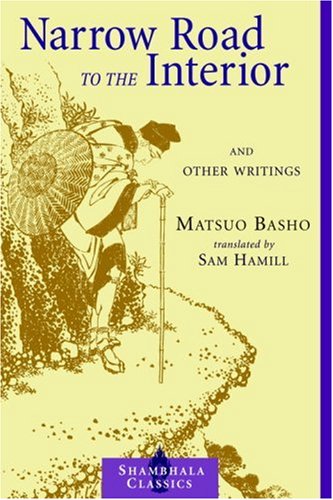
6. Narrow Road to the Interior: And Other Writings (ShambhalaClassics)
by Matsuo Basho
Paperback: 224 Pages (2000-09-26)
list price: US$16.95 -- used & new: US$9.57
(price subject to change: see help)
Asin: 1570627169
Average Customer Review: 4.0 out of 5 stars
Canada | United Kingdom | Germany | France | Japan
Editorial Review

Book Description
Here is the most complete single-volume collection of the writings of one of the great luminaries of Asian literature. Basho (1644-1694)—who elevated the haiku to an art form of utter simplicity and intense spiritual beauty—is best known in the West as the author of Narrow Road to the Interior, a travel diary of linked prose and haiku that recounts his journey through the far northern provinces of Japan. This volume includes a masterful translation of this celebrated work along with three other less well-known but important works by Basho: Travelogue of Weather-Beaten Bones, The Knapsack Notebook, and Sarashina Travelogue. There is also a selection of over two hundred fifty of Basho's finest haiku. In addition, the translator has provided an introduction detailing Basho's life and work and an essay on the art of haiku. ... Read more

Customer Reviews (5)

4-0 out of 5 stars A trip to the past
I am not a scholar or a critic, I am just a person who really enjoys haiku and as such am familiar with Basho's poetry.I bought this book because it was cited in so many other books that I have read that I just had to read it for myself.I am very glad I did.

A good portion, but not all, of the haiku contained in this book you have read countless times before, though they are translated slightly differently here.To me the real value of this book is that the poems are put in context of Basho's larger world by the prose that surrounds them.Basho's haibun tells of his various journeys around Japan, the people he meets, the sites he sees and how this all affects him.

I love history as much as haiku, and this book is a real window on the past through the eyes of a man who could relate his world in a way that is both clear and yet filled with beautiful imagery, so that 17th century Japan comes alive for you.

If you like haiku and are interested in what goes into a great poet's creative process, I feel you will enjoy this book, I know I did.

4-0 out of 5 stars *TheGreatMatsuoBashoLeadsUsINWARD*

Matsuo Basho's "Narrow Road to the Interior" is translated by Sam Hamill, an accomplished poet who also translated the haiku of ISSA in "The Spring of my Life"(isbn # 1570621446)As B. Watson, professorat Columbia University has said, "Hamill achieves a kind of luminosity of language that I find unparalleled in other translations of the work."

Basho lived from 1644-1694 and achieved acclaim as the greatest writer of haiku and.this book of his last travels is a classic in Asian literature. His stature must have made the task of translating more difficult, even intimidating.The title is of course a metaphor for traversing life to find one's spiritual center or soul.

Amateur western writers who become enamored of writing haiku soon realize there are depths to which their studies may never take them. The sounds, the Zen way of thinking --bring much more to the equation than mere playfulness (as in senryu), or a built-in sense of syllables, and fondness for epigrams.

Basho set off on his long journey & early in his travels was loaned a horse because "it is easy to get lost."The horse carried the poet, then stopped, and returned home without the rider but carrying Basho's gift tied to the saddle.The route of Basho's travels is printed inside the covers -- he describes "pines shaped by salty winds, trained into sea-wind bonsai." In other centuries men walked hundreds of miles, giving & receiving haiku as gifts - many about history, and some memorials.His lodgings were often noted, probably because they were more often miserable than not. His writings often included geographical 'markers' -- these speak of much more than PLACE to Japanese readers.One who had been a companion on the road wrote:
"All night long
listening to the autumn winds
wandering in the mountain"
Basho himself wrote for another companion as he turned back:
"Written on my summer fan
torn in half
in autumn"
And so he gave his thanks to those who shared his journeys and the quest for answers each of us asks on our own "narrow road."

3-0 out of 5 stars nice of Hamill to try
There is only one other book where you can find these four of Basho's "travel diaries" in one volume and that is Nobuyuki Yuasa's. This compilation also includes a generous selection of Basho's hokku. These are the book's pluses. Unfortunately though, Hamill is much too intent on presenting you with Basho as a sort of haiku-zen master, an identity that Basho himself created as a voice through which to narrate. Mr Hamill would have us believe that Basho wrote poetry for the sake of zen, but the truth is that Basho studied zen for the sake of poetry. Also, Hamill's insistence upon translating in the 5-7-5 form ruins quite a few poems: you get sort of overexplanatory, prosaic verses much of the time. It is almost as if he were translating the explanations you will find in Japanese collections of Basho's verse. For example:

Hamill translates "fuyu no hi ya bajou ni kooru kageboushi" as

Crossing long fields,
frozen in its saddle,
my shadow creeps by

though it should probably (more accurately) be rendered:

winter sun...
on horse's back
a frozen shadow

Hamill dropped the phrase "fuyu no hi ya" entirely and replaced it with "Crossing long fields." I don't know why Hamill rids Basho of suggestion and nuance. Maybe he doesn't think the western reader can find poetry in hokku/haiku as they truly are.

The verse quoted by another reviewer

Your song caresses
the depths of loneliness,
high mountain bird.

might as well not be considered a translation at all. There is almost nothing of the original poem remaining except for the notion of loneliness and the kankodori, which is translated as "high mountain bird." "uki ware o sabishi-garase yo kankodori" would be translated literally as

make this sorrowful self feel lonely, cuckoo!

sabishi-garase is the imperative form of the verb that means "to cause to feel lonely." As a translator one of the worst things you can do is to try to improve upon a poem, though, personally, I don't think Hamill's versions actually do. If you don't trust the poet you're translating, then why are you doing it at all?

At the moment I am in the middle of translating Basho's "Oi no Kobumi" ("Backpack Notes") into English, and when I get stuck on an obscure phrase it helps to consult other translations to see how that translator interpreted it, but oftentimes Hamill (Yuasa is guilty of this too) just glosses over a phrase, which in the end robs the text of any of the interesting quirks in Basho's prose. I wonder if Hamill hit the same tough spots as I and just decided to gloss rather than really try to understand it.

I do not mean to be overly critical of Hamill. It is obvious that he is a good writer and some of his translations are successful but I wonder how much he really considered his renderings. In the end we are reading Hamill, not Basho.

Unfortunately, there are not many alternative translations of Basho's other haibun, but there are plenty of his "Oku no Hosomichi."Hiroaki Sato's is probably the best, since it is very faithful and it gives the most background info (including linked-verse sequences written during the journey), but Cid Corman's is nice too because he does a pretty good job at reproducing Basho's prose style.Also, if you're looking for a good collection of Basho's hokku, check out Makoto Ueda's work. For a good critical study of Basho look at Haruo Shirane's Traces of Dreams. A good internet analysis of Oku no Hosomichi: http://darkwing.uoregon.edu/~kohl/basho/

5-0 out of 5 stars The Definitive Source
Perhaps the most brilliant offering of Basho's beloved poetry.Excellent in composition, translation, as well as the breadth of Basho's work presented.

5-0 out of 5 stars Clouds of Cherry Blossoms
Narrow Road to the Interior and other writings
by Matsuo Basho
translated by Sam Hamill

This is the most complete collection of Basho's writings translated into English available in a single volume.Aficionados of Japanese culture keen on exploring the haiku literature would be hard-pressed to find a better book to start with.

Matsuo Basho (1644-1694) lived during the Genroku period in Japan.The Tokugawa shogunate had unified the country and it was a time of relative peace, which allowed those so inclined afreedom of travel not usual in many periods of Japanese history.Basho was so inclined.At the age of forty his restless feet led him on several walking tours of Japan, and he left behind collected impressions of these journeys in both prose and haiku.

Thoroughly versed in the Chinese and Japanese poetic traditions prevalent among the literati of his time, Basho was also an ardent disciple of Zen.He devoted his life to refining, clarifying, and simplifying his poetry.In the brief haiku form he found the perfect vehicle through which to realize his poetic ideals, and the poems he wrote have inspired and captivated readers and poets throughout the world with their elegance, insight, and simple brilliance.

This volume collects together four travelogues (Narrow Road to the Interior, Travelogue of Weather-Beaten Bones, The Knapsack Notebook, and Sarashina Travelogue) and over 250 of Basho's haiku.The translator has provided an introductory essay and an afterward revealing many aspects of Basho's life, work, and the haiku form itself.Also included are a chronology of Basho's life, a map detailing his journeys, and a bibliography.

Sam Hamill's translation is marvelously clear and uncluttered, and allows the glow of Basho's awareness to somehow peek through the words in his poems.The book itself is a Shambala edition, and so quite beautiful: printed on high-quality paper in a gorgeous typeface with lovely endpapers.This book is a gem.

Your song caresses
the depths of loneliness,
high mountain bird. ... Read more


7. Basho's Journey: The Literary Prose Of Matsuo Basho
by David Landis Barnhill, Basho Matsuo
Paperback: 191 Pages (2005-07-30)
list price: US$19.95 -- used & new: US$17.78
(price subject to change: see help)
Asin: 0791464148
Average Customer Review: 5.0 out of 5 stars
Canada | United Kingdom | Germany | France | Japan

Customer Reviews (1)

5-0 out of 5 stars A Journey with Basho
This is one of the latest books out on the travel journals of Matsuo Basho and this lovely book contains all five journals.The translator David Landis Barnhill has arranged the journals in chronological order to show how Basho's writing developed over the years.The journals included are 'Journey of Bleached Bones in a Field' [Nozarashi Kiko], 'Kashima Journal' [Kashima Kiko], 'Knapsack Notebook' [Oi No Kobumi], 'Sarashina Journal' [Sarashima Kiko], and 'The Narrow Road to the Deep North' [Oku No Hosomichi]. Basho's 'Saga Diary' [Saga Nikki] is also included along with a massive 80 of Basho's haibun (short poetic prose pieces that include haiku) and over 320 of Basho's haiku are scattered throughout the book, which also includes maps of each of the five journeys and extensive notes and a glossary. ... Read more


8. A Haiku Journey: Bashos Narrow Road to a Far Province (Illustrated Japanese Classics)
by Matsuo Basho
Paperback: 124 Pages (2002-03-01)
list price: US$15.00 -- used & new: US$10.20
(price subject to change: see help)
Asin: 477002858X
Average Customer Review: 2.0 out of 5 stars
Canada | United Kingdom | Germany | France | Japan
Editorial Review

Book Description
In the seventeenth century, the pilgrim-poet Basho undertook on foot a difficult and perilous journey to the remote northeastern provinces of Honshu, Japan's main island. Throughout the five-month journey, the master of haiku kept a record of his impressions in a prose-poetry diary later
called The Narrow Road to a Far Province. His diary was to become one of the classics of Japanese literature.

Noted professor of Japanese literature J. Thomas Rimer wrote of this classic: "In his diary, which Basho kept reworking and revising until his death, he mixed fact, fiction, poetry, and prose to create the record of a journey that moves both geographically and spiritually, one strand mixing with the
other on virtually every page. Read and reread with care, The Narrow Road to a Far Province can reveal more qualities still basic to Japanese cultural attitudes than perhaps any other work in the whole canon of classical literature. For once, the highest of reputations is truly deserved."

This new edition is illustrated with sumi-e ink sketches by Japanese artist Shiro Tsujimura. ... Read more

Customer Reviews (4)

2-0 out of 5 stars Nice volume, but not the best translation
Although Ms. Bitton's translations of Basho's prose are not far off from other versions of this title, many have complained of the rhyming scheme she employs when translating the haiku verses of the author's most famous work.I do agree, that these translations are somewhat jarring and just a little cumbersome (especially if one has knowledge of other translations of this haibun).But Bitton's effort was devoted to making the verses more accessible to Western readers accustomed to the perceived elegance of the rhyme in popular Western poetry.This, one may argue, is the job of a translator, and thus is not an all too terrible introduction to "The Narrow Road," especially for younger readers.However, if one truly wishes to enjoy this, one of Japan greatest literary volumes, please seek other versions as well.The difficult art of translation is in itself a fascinating study.

4-0 out of 5 stars Can Haiku Be Translatable?
We can find Basho almost everywhere in Japan. My hometown is close to the Tokaido-highway and easy to find stone monuments with Basho's haiku inscribed in it.

Dorothy Britton did fine job in the mission-impossible task of
translating Basho haiku into palpable English. I am not well versed in poetry so I do not know how great her translation is with respect to literal viewpoint. She created the method by which peculiarly styled Japanese poem is converted into that of rhyme based western poem. Her English translation is easy to understand so it could be enjoyed by huge number of people not limited to those highly educated. As a Japanese who usually reads this essay in archaic Japanese of 17th century, her translation is instrumental in understanding what difficult Japanese words mean.

As far as Haiku translation goes English language has huge disadvantages.
1: Deletion of subject is difficult while in old Japanese it is really common.
2: Phonetically Japanese and English is so different. For example, in Japanese, common English words such as STRIKE is
pronounced SU-TO-RIE-KU. In Englsih one syllabled but in Japanese phonetics it requires four syllables.

So as syllable based translation. Basho's haiku will be translated rather explanatory than its original Japanese form.

In conclusion, I think she did a great job as a translator and her translation quite natural. No wonder Kodansha International adopted her translation for Japanese English learners.

Recommended for wide range of Japanese culture appreciators.

1-0 out of 5 stars Don't buy this one!
There are several different translations of Basho's Narrow Road extant and without doubt this is the worst generally available. Dorothy Britten's translations of both the text and verse cloy terribly, and betray her shallow understanding of the form. Her translations of some of Basho's best haiku rhyme, which should be enough to put anyone off.

If you want to buy a translation of this wonderful work, I recommend a different Kodansha publication -- the edition featuring Masayuki Miyata's breathtaking illustrations and Donald Keene's somewhat academic but still vastly superior translations. Don't buy this one!

1-0 out of 5 stars This translation is laughable!
This is the worst translation of Basho that I have ever seen.She makes all the haiku rhyme!!!Ugh!I suppose in Lady Bouchier's idle mind that's how poetry should appear.

Here's a quote: "Life itself is a journey; and as for those who spend their days upon the waters in ships and those who grow old leading horses, their very home is the open road."

Now compare that to Sam Hamill's translation: "A lifetime adrift in a boat, or in old age leading a tired horse into the years, every day is a journey, and the journey itself is home."

This book is embarrassing.Don't buy it. ... Read more


9. Basho and the River Stones
by Tim J. Myers
Hardcover: 32 Pages (2004-10)
list price: US$16.95 -- used & new: US$10.39
(price subject to change: see help)
Asin: 076145165X
Average Customer Review: 5.0 out of 5 stars
Canada | United Kingdom | Germany | France | Japan
Editorial Review

Book Description
The great poet Basho lives in the woods and shares the cherries from his cherry tree with the local foxes. But one tricky fox becomes greedy--He uses his magic to turn three river stones into gold coins, and then tricks Basho into giving up all of the cherries. When the fox returns to gloat over his victory, he discovers that Basho is content.Wiser than the fox, Basho knows that a poem inspired by the beauty of the river stones is more valuable than gold. Oki S. Han's watercolors evoke ancient Japan in this sequel to the New York Times bestseller Basho and the Fox. ... Read more

Customer Reviews (3)

5-0 out of 5 stars A very thoughtful and lovely book
I have given this wondrous book to a number of friends and relatives.It is a trickster tale that is delightful, humane, and highly poetic.The artwork is lovely and vibrant.This is a book to treasure, share and read aloud to people you care about.

5-0 out of 5 stars Like Bread into Chocolate! well, except that it's stones into gold...
This beautifully illustrated book imagines the 17th century inventor of haiku, Matsuo Basho, and his encounters with the magical foxes of Fukagawa.We first see Basho asleep under a cherry tree, surrounded by a fraternity of suspicious looking foxes clad in Hugh Hefner-esque silk kimonos.Initially, Basho and the foxes shared great "wa," or harmony.(Tim Myers deserves kudos for using the interesting and accurate Japanese words in a kids' book!)One fox, "particularly fond of cherries" wants them all, and so he uses his trickster powers to transform himself into the figure of a "'yamabushi,' a wandering monk."The fox turns three stones into gold, and enters into an exclusive rights-to-the-cherry-tree contract with the money-strapped poet.

The next day the gold reverts to the stones, but they inspire a haiku:

How many years have
These stones loved the river, not
Knowing they were poor?

Basho, ever the poet, tells the fox, "A good poem is worth more than money--and it lasts much longer."The fox admits his deception, and then seeks to make it up to him. In the process, the fox learns much about cultural attitudes towards charity, and, especially, honor. The repentant, wiser fox uses his magic again--this time to procure enough money for Basho to buy food for the long winter ahead.

Oki S. Han delivers some of the best illustrations I've seen recently; her watercolors have both power and grace (a grace found also in Myers' flowing language). We see traditional Japanese dwellings and marvelously colorful, variegated foliage. Even the ornamental designs framing the text are beautiful, sometimes staggeringly so.Han is a master of light and dark, and she uses close-ups, scene-setting panoramas, and overhead views in an incredibly beautiful display of illustrative mastery. The story has a very satisfying ending (which includes the fox writing his own haiku), and Myers' "author's note" talks about Basho, the deeper meanings of haiku (he wrote the two in the book), and his own heartfelt gratitude ("ongaesha") for Basho's inspiration.Very enthusiastically recommended!

5-0 out of 5 stars From Tim Myers, author of "Basho and the River Stones"
One of the things I most love about stories is their ability to present us with simple truths in compelling fashion.That's part of what I tried to do with "Basho and the River Stones."Naturally, I wanted this story to entertain readers (adults and children alike).But my years as a writer and a professional storyteller have taught me that even entertainment is more successful when it carries some resonating truth.In this book, the fox is capable of selfishness and deception--he's quite "human" in that way.But when Basho's shining example is set before him, he's also capable of shame and a determination to do better.We're all like that, I suppose, to whatever degree--I can certainly see both sides of human nature in myself!So I'm uplifted and comforted at the thought that, like the fox, I can learn, grow, come to a new vision of things, deepen my values, realize what's most important--even if it takes a little trickery to set things right. After all, we have to use the gifts we were given, eh? I hope you enjoy my story!May the river stones in your life turn to gold, and the gold to river stones.Regards, Tim Myers ... Read more


10. Basho's Haiku: Selected Poems of Matsuo Basho
by Matsuo Basho, Basho Matsuo
Paperback: 331 Pages (2004-08-12)
list price: US$25.95 -- used & new: US$17.00
(price subject to change: see help)
Asin: 0791461661
Average Customer Review: 5.0 out of 5 stars
Canada | United Kingdom | Germany | France | Japan

Customer Reviews (1)

5-0 out of 5 stars Several ways in to the heart of Basho's poetry
I wanted to read more Basho after reading The Narrow Road to Oku, and this book provides several ways into an understanding of the man, his work, and the culture around him.I particularly enjoyed the explication of the allusions to other literary works in the Notes, and the list of nature-words and their use in defining seasons in the specialized Glossary.I still can't read these poems as if I were versed in Japanese literary traditions, but they have gained additional dimensions in my mind.

Also, after reading this book I was looking at a Japanese print by Hiroshige Ando and realized that what I was seeing was not an actual landscape, but an illustration of a haiku--there were all the autumn flowers growing with careful casualness, and wild geese flying south, with a distant view of Fuji. It was great to feel that little snap of recognition.

I also appreciated the way the translator doesn't add words to explain what's supposed be suggested, as well as the way that a transliteration of the sounds of the words is included.The rhythm of the poems is more clearly heard than seen, so the transliteration is very helpful. ... Read more


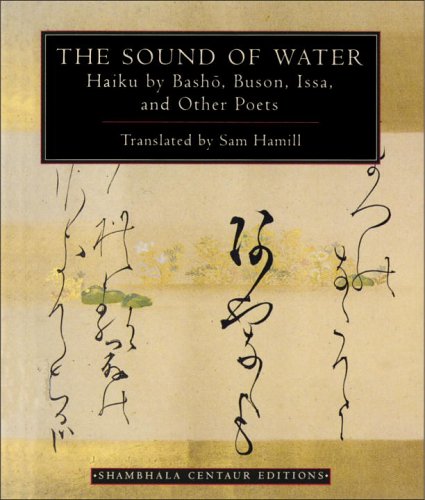
11. The Sound of Water: Haiku by Basho, Buson, Issa, and Other Poets (Shambhala Centaur Editions)
Paperback: 152 Pages (2006-11-14)
list price: US$9.95 -- used & new: US$5.30
(price subject to change: see help)
Asin: 1570620199
Average Customer Review: 4.5 out of 5 stars
Canada | United Kingdom | Germany | France | Japan
Editorial Review

Book Description
Here are more than two hundred of the best haiku of Japanese literature translated by one of America’s premier poet-translators. The haiku is one of the most popular and widely recognized poetic forms in the world. In just three lines a great haiku presents a crystalline moment of image, emotion, and awareness. This illustrated collection includes haiku by the great masters from the seventeenth to the early twentieth century. ... Read more

Customer Reviews (5)

5-0 out of 5 stars The sound of Water.

Mi idioma es el español, pero puedo
leer este valioso librito en Ingles.
Basho, Buson, Issa, y otros writers
of Haiku son joyas que permanecen
en la mente. Altamente les recomiendo
tener esta miniatura de libro.
Martha

5-0 out of 5 stars Take It With You On A Walk In The Woods

I brought this small book of haiku along with me on a nature walk last autumn to read for the first time. Being rather small it easily fit inside my jacket pocket. It was a little after the beginning of the hike that I pulled it out and began to read the haiku starting in the section of Basho's poems.

I would read a haiku and then think about it as I walked along the path. I can only describe it as being a wonderfully therapeutic process for the mind and spirit, and for the body too (from the walking itself).

I thoroughly enjoyed Hamill's renderings of the haiku from the three recognized Japanese haiku masters and I also liked the poems from other somewhat lesser known Japanese poets.

I recommend this for reading anywhere if you enjoy the haiku poetic artform -- but I especially recommend it to read on a walk in the woods.

3-0 out of 5 stars A Good Start...
The Shambhala Centaur editions are essentially introductions to mostly Asian genres, authors, and philosophies. The Sound of Water focuses on Zen haiku, as written by Basho, Issa, Buson, and a dozen or so other Japanese writers. It's an appealing little book - small enough to fit in a jacket pocket - with charming illustrations. Sam Hamill's translations, many of which have appeared in other books, are superlative. The Sound of Water would make a nice gift for a novice, but for those who are seriously interested in haiku or Zen, there are better choices.

5-0 out of 5 stars The Sound of Enlightenment in Few Words
Oh, such a delightful book! The title is taken from one
of my favourites by Basho beautifully and interestingly
translated as:

At the ancient pond
a frog plunges into
the sound of water

The book has over two hundred treasures. Buy copies
for your friends and don't forget one for yourself!

5-0 out of 5 stars Wonderful!!!
I've been a fan of Basho and the others since I was in college.They have such a wonderful way of capturing the subtlties of nature in their poems and the haikus in this little book are no exception.It amazes me how with so few words so much activitiy and imagery can be conveyed.The Great Mystery is captured through these haiku.The book is small, about 4"x4" which is a nice size to take on a walk.

Here are a couple to sample:

At a roadside shrine,
before the stony buddha
a firefly burns

The clouds come and go,
providing a rest for all
the moon viewers

Anyway, I'm really happy with this set of Haiku.Highly recommended!! ... Read more


12. Narrow Road to the Interior (Shambhala Centaur Editions)
by Matsuo Basho
Paperback: 136 Pages (2006-11-14)
list price: US$9.95 -- used & new: US$4.89
(price subject to change: see help)
Asin: 0877736448
Canada | United Kingdom | Germany | France | Japan
Editorial Review

Book Description
Basho is best known in the West as the author of Narrow Road to the Interior, a travel diary of linked prose and haiku that recounts his journey through the far northern provinces of Japan. This volume includes beautiful Japanese-style illustrations by Stephen Addiss. ... Read more


13. Grass Sandals : The Travels of Basho
by Dawnine Spivak
Hardcover: 40 Pages (1997-04-01)
list price: US$18.99 -- used & new: US$11.28
(price subject to change: see help)
Asin: 0689807767
Average Customer Review: 4.5 out of 5 stars
Canada | United Kingdom | Germany | France | Japan

Customer Reviews (3)

4-0 out of 5 stars I liked the pictures!
Grass Sandals is a great book about friendship and poems.The main character's name is Basho.Basho liked to have tea on his porch every morning under his basho tree.Basho lives in Edo.Basho likes to travel around his country.When Basho is traveling he gets many gifts from his friends.Basho is great for his blue grass sandals (from his friend) and for haikus.This story took place 300 years ago in Japan.

I really liked this book because of its illustrations and of how well it is written.I think that this book would be good for people who like books from other countries.I also think parents would enjoy this story too!

4-0 out of 5 stars A great book!
I read the book Grass Sandals.The main character is Basho.In the story, Basho travels all over Japan.He lives in Edo.The story takes place in the 1600's.Basho wrote poems about nature and by listening and looking at his surroundings.

It liked this book because it made me feel like I was there with Basho.

5-0 out of 5 stars An adventurous book!
In the story Grass Sandals, there is a Japanese man named after a banana tree called basho.Basho loved nature so much that he wrote about it as a haiku poet.He lived in his small house in Edo surrounded by the morning glories in the 1600's.But one day, Basho decides he wants to travel because he is restless back at his home in Edo.Before his trip, Basho's friends give him supplies for his trip including grass sandals.On the trip he writes about what he sees, meets friends, and discovers different places in this adventurous book!

I enjoyed this book very much because I loved all the places he traveled and all the creative poems he wrote.I recommend this book for all afes.It is very well written! ... Read more


14. Back Roads To Far Towns: Basho's Travel Journal (Companions for the Journey)
by Matsuo Basho, Cid Corman, Basho Matsuo
Paperback: 93 Pages (2004-10-15)
list price: US$13.00 -- used & new: US$7.34
(price subject to change: see help)
Asin: 189399631X
Average Customer Review: 5.0 out of 5 stars
Canada | United Kingdom | Germany | France | Japan
Editorial Review

Book Description

Basho (1644–1694) is the most famous Haiku poet of Japan. He made his living as a teacher and writer of Haiku and is celebrated for his many travels around Japan, which he recorded in travel journals. This translation of his most mature journal, Oku-No-Hosomichi, details the most arduous part of a nine-month journey with his friend and disciple, Sora, through the backlands north of the capital, west to the Japan Sea and back toward Kyoto. More than a record of the journey, Basho's journal is a poetic sequence that has become a center of the Japanese mind/heart. Ten illustrations by Hide Oshiro illuminate the text.

Cid Corman was well-known as a poet, translator and editor of Origin, the ground-breaking poetry magazine.

... Read more

Customer Reviews (1)

5-0 out of 5 stars Gives The Feeling of the Original
(Please see William J. Higginson's excellent review of the earlier, Echo Press edition of this book.)I have Ueno Yozo's scholarly edition of Oku No Hosomichi which I've been going over, section by section, with a real scholar of Edo Japanese.My little knowledge of Japanese allows me to understand the differences between modern Japanese and the original, and yes, there's a density, a quickness, and a terseness, in the original that Cid Corman's translation faithfully captures in English.I give a great deal of credit for this to Cid's co-translator, Kamaike Susumu, and to Cid's love for just these qualities in poetry, which he learned from such earlier masters as Ezra Pound, and of course from his great teacher William Carlos Williams, and was on the road to perfecting for himself when he did this project and published it (in 1961) in Origin magazine.Cid's style was a good "fit" for this project--in other words, as the Japanese put it--Cid had "en" or destiny when he undertook this translation with Kamaike-san, for the plain truth is, Cid Corman did not know Japanese.Even after all of his many years of living in Japan, he was not able to speak, read or write it.Cid was absolutely honest about this, however, and you'll see that he shares top billing with Kamaike-san on the title page.Startled?Well, I'd argue that the top English translation of this Japanese classic being produced by a non-Japanese reader, writer, and speaker, is not quite as startling as Stephen Crane's Red Badge of Courage being hailed by Civil War veterans as being the most accurate rendition of their experience of war in print.Scholars argue that Crane's psychological dynamic allowed him to present the "truth" of conflict.I'd argue that the same sort of dynamic--albeit stylistic--was at work with Cid and Basho.On this point, I differ from Higginson. ... Read more


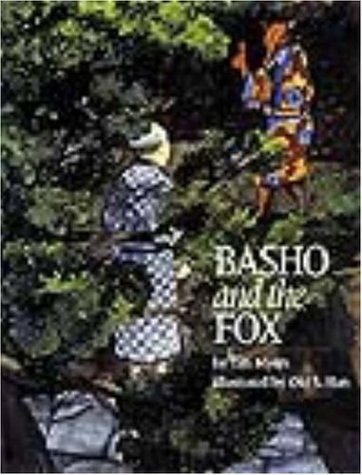
15. Basho and the Fox
by Tim Myers
Paperback: 32 Pages (2004-10)
list price: US$5.95 -- used & new: US$3.36
(price subject to change: see help)
Asin: 0761451900
Average Customer Review: 4.0 out of 5 stars
Canada | United Kingdom | Germany | France | Japan

Customer Reviews (6)

5-0 out of 5 stars A Beautiful Book
I bought this book yesterday for my two daughters, both toddlers, and I'm absolutely in love with it. The storytelling and descriptions are minimalist, as is appropriate for a book about a haiku poet.Han's beautiful illustrations compliment the story well.But first and foremost, I loved the characterization of the kitsune. It comes across as quite a haughty creature in the beginning, telling Basho that the kitsune are far better poets than humans could ever be. But in the end, when Basho finally comes up with a poem that the kitsune enjoys, the reader finds out just how hilariously self- absorbed the kitsune can be. There are small references to the kitsune's family, which I appreciated, since kitsune in Japanese folklore are always concerned, first and foremost, with their families. Another thing I love about this book is that there isn't too much text on each page. As a mother of toddlers, I often find it difficult to keep their interest when a book has too many words on a page; they like to keep the pages turning quickly. I think this will be a wonderful introduction to haiku for them, as well as an interesting glimpse into the mysterious world of the kitsune. Next on my list to buy is Myers' _Tanuki's Gift_.

5-0 out of 5 stars My four-year-old son loves this book!
What a beautifully illustrated, powerfully written book!I was so surprised that my wildly energetic little boy (who does love books) wanted to read this book again and again.I love how the author teaches some Japanese words and how the pictures capture the essence of Japanese life in a simpler era.And I'm always thrilled when a children's book incorporates authentic, adult-level literature (the three haiku used would delight readers of any age.)The best picture is that of Basho's house and the cherry tree and the forest and the river from a bird's eye view, like a map, or rather, like all maps should be!

4-0 out of 5 stars Simply fun
This book is simple, entertaining, lovely and smart.I enjoyed reading it and wished for more, even though I am considerably over the targeted age level.The poems in the story are enough to make the reader interested in more haiku.

1-0 out of 5 stars Unappealing
The story is mediocre and the illustrations are somber and static.This book was a great disappointment to my child.

5-0 out of 5 stars Basho would have loved it
What greater honor to the great poet himself than to write such an imaginative, witty, well-wrought book, and what better way to introduce a young child to the joy of haiku? I can think of none. This book embodies everything I look for in children's literature, from its playful premise, engaging story line and evocative illustrations, to the valuable lesson it imparts. If I could, I would give Basho and the Fox a 6-star rating. ... Read more


16. Classic Haiku: The Greatest Japanese Poetry from Basho, Buson, Issa, Shiki, and Their Followers (Eternal Moments)
Hardcover: 176 Pages (2007-11-01)
list price: US$12.95 -- used & new: US$7.01
(price subject to change: see help)
Asin: 1844834867
Canada | United Kingdom | Germany | France | Japan
Editorial Review

Book Description

Poetry aficionados will appreciate this beautifully designed and illustrated collection of 200 haiku by the four most celebrated Japanese poets of the 17th, 18th, and 19th centuries: Basho, Buson, Issa, and Shiki, who modernized the form and coined the very term haiku. Enhancing their work are four seasonally-themed groups of verse, many written by Basho’s students and associates. The translation is thoroughly readable and contemporary, and the images evocative. An enlightening introduction offers biographical information on the featured poets, background on the nature of haiku and its development within the Japanese poetic tradition, and a short account of the Buddhist practice to which most of the writers were connected.
... Read more

17. Basho And The Dao: The Zhuangzi And The Transformation Of Haikai
by Peipei Qiu
Hardcover: 248 Pages (2005-08-30)
list price: US$55.00 -- used & new: US$50.65
(price subject to change: see help)
Asin: 0824828453
Average Customer Review: 5.0 out of 5 stars
Canada | United Kingdom | Germany | France | Japan
Editorial Review

Book Description
Although haiku is well known throughout the world, few outside Japan are familiar with its precursor, haikai (comic linked verse). Fewer still are aware of the role played by the Chinese Daoist classics in turning haikai into a respected literary art form. Bashô and the Dao examines the haikai poets' adaptation of Daoist classics, particularly the Zhuangzi, in the seventeenth century and the eventual transformation of haikai from frivolous verse to high poetry. The author analyzes haikai' s encounter with the Zhuangzi through its intertextual relations with the works of Bashô and other major haikai poets, and also the nature and characteristics of haikai that sustained the Zhuangzi's relevance to haikai poetic construction. She demonstrates how the haikai poets' interest in this Daoist work was rooted in the intersection of deconstructing and reconstructing the classical Japanese poetic tradition.

Well versed in both Chinese and Japanese scholarship, Qiu explores the significance of Daoist ideas in Bashô's and others' conceptions of haikai. Her method involves an extensive hermeneutic reading of haikai texts, an in-depth analysis of the connection between Chinese and Japanese poetic terminology, and a comparison of Daoist traits in both traditions. The result is a penetrating study of key ideas that have been instrumental in defining and rediscovering the poetic essence of haikai verse.

Bashô and the Dao adds to an increasingly vibrant area of academic inquiry—the complex literary and cultural relations between Japan and China in the early modern era. Researchers and students of East Asian literature, philosophy, and cultural criticism will find this book a valuable contribution to cross-cultural literary studies and comparative aesthetics. ... Read more

Customer Reviews (1)

5-0 out of 5 stars Chapter on Furyu worth the price of the book
I purchased this book after an extended period of research on Basho for a piece I was writing. The chapter on Furyu and Daoist Traits in Chinese Poetry contains the following sentence about fifteenth century priest-poet Ikkyu Sojun, "Having denounced the contemporary values of the Zen communities, Ikkyu turned to poetry and a furyu aesthetic for spiritual sustenance." This sentence confirmed my own research, and supported the idea that poetry and furyu have a capacity to nourish a person on her spiritual journey in a way that other disciplines and experiences can not.

If you are interested in Eastern philosophy, particularly Daoism, and its relationship to the artist's way, this book will provide you with solid scholarly material to ponder.

The 29 page glossary reveals Qiu's linguistic prowess and is extremely helpful both for reading this book and for studying Chinese or Japanese poetry, especially haiku.

I wasn't sure if I should spend the $63.00 for this book but it provided me with a deep and thorough study of Basho and the religious and philosophical underpinnings to his creative genius.
... Read more


18. A Zen Wave: Basho's Haiku & Zen
by Robert Aitken
Paperback: 191 Pages (1979-04)
list price: US$16.95 -- used & new: US$109.99
(price subject to change: see help)
Asin: 083480137X
Average Customer Review: 5.0 out of 5 stars
Canada | United Kingdom | Germany | France | Japan

Customer Reviews (3)

5-0 out of 5 stars Zen, poetry, and (worthwhile) literary criticism
Aitken Roshi is considered by many the dean of American Zen masters.In this book he combines his Zen insight with his university training in liturature to explain Basho's poetry.The book should be read by anyone interested in Zen, and perhaps even more by anyone interested in poetry or literary criticism, since it shows what a wise person can do improve our reading of poetry.If you love Basho or haiku in general, then this book is a must have.

It is terrible that this book is out of print.

5-0 out of 5 stars Self-effacement as the path to authenticity.
A ZEN WAVE :Basho's Haiku and Zen.Translated by Robert Aitken. 192 pp.New York and Tokyo : Weatherhill, 1978 and Reissued.

All of us, perhaps, need a bit of help when starting to read haiku. As the shortest of all verse forms, with its mere seventeen syllables,it doesn't look like much of a poem at all to the uninitiated, andthey may wonder what the fuss is all about.

In 'A Zen Wave,' Robert Aitken, who is a noted American Zenist and competent in Japanese, has had the extremely useful idea of compilinga small anthology of haiku by Basho (1644-1694), and providing eachhaiku with its own full commentary.After finishing the book, readers will have acquired a background in both haiku and Zen, and will be able to further explore haiku by themselves in an informed way.

In his brief 5-page Introduction Aitken writes:

"... the heart of Basho's haiku is the very foundation of human perception of things - mind itself.Operating superficially, the mind is random in its activity and stale in its insights and images. With practice and experience, however, it is recognized as the empty infinity of the universe and of the self" (pages 18-19).

This statement may gain in meaning if we set it alongside anobservation made the great Zen Master Dogen (1200-1253), who wrote:

"Conveying the self to the myriad things to authenticate them is delusion; the myriad things advancing to authenticate the self is enlightenment" (Tr., F. H. Cook, 'Sounds of Valley Streams,' page 66).

The haiku poet is a person who has 'emptied' himself or herself, who has created a space, an "empty infinity" or 'openness,' in whichthe myriad things can come forward and declare themselves.Haiku capture those moments, and the greatest haiku present us with "the vital experience of the thing itself" (Aitken, page 21).Haiku, therefore, are not so much words about things; they aim rather to present us witha true perception of the thing itself.

'A Zen Wave' presents us with a total of twenty-six of Basho's haiku.For each of them we are given Aitken's translation, the romanized Japanese of the original, and its literal word-by-word translation. Then follow a few words on THE FORM, which in turn are followed by Aitken's very full COMMENTARY.These commentaries are enriched by the inclusion of many other poems, both Japanese and Chinese.The book, which is illustrated with eight photographs, is rounded out with a Glossary of Selected Terms, a table of Japanese Equivalents of Chinese Names, and a short section of Notes giving details of sources.

Here, with my slash marks to indicate line breaks, is how Aitken has handled the first haiku, one of Basho's most famous:

"The old pond; / A frog jumps in - / The sound of the water.

Furu ike ya / kawazu tobikomu / mizu no oto

Old pond! / frog jumps in / water of sound" (page 25).

Simple though it may seem, we should note that Basho hadto work very hard to attain the state of 'openness' that we find in this poem.Itwas written when he was forty-two years old after many years of effort, and it marks his coming of age as a mature poet.Aitken comments:"Basho presents his own mind as this timeless, endless pond, serene andpotent" (page 26).

Ideally haiku should be like a gentle explosion in the mind.Better still, they are the frog which plops into the pond of our mind, and sets up an ever-widening series of ripples, concentric circles which as they spread outwards to embrace more and more, end up by bringing the whole cosmos into view.

What is the "old pond"?Basho's mind and your mind certainly.But what else?Could it be the Unborn Buddha Mind which we all share?And what about the frog?Is it 'just a frog'?Or is it something infinitely precious?As for the "sound" - this too should be allowed to work on one's sensibility, forit will suggest different things to different readers.

There is much excellent commentary in this book, andmany other fine haiku.A particular favorite of mine deals with a tiny plant, thenazuna or Sheperd's Purse, which reads:

"When I look carefully - / Nazuna is blooming / Beneath the hedge (page 74).

Five pages of Aitken's interesting comment follow the poem, which include a quotation from the famous Zen scholar, D. T. Suzuki, who wrote of the nazuna, a plant which many would dismiss as 'just a weed' :

"We are blatantly given up to the demonstration of self-conceit, self-delusion, and unashamed arrogance.We do not seem now to cherish any such feelings as inspired Basho to notice the flowering nazunaplant. . . . (page 75).

Aitken feels that "Basho is teaching us religion with his nazuna haiku," and how the denial of the nazuna is, as Suzuki points out, "self-delusion" (page 75), and I quite agree.One of the more important things we have to learn from haiku is the importance of the ordinary - because, in fact, nothing is ordinary, and we shouldlearn to distrust the word 'just.'

For readers of Aitken's book whose appetite has been whetted, there aremany other books of haiku.One particular work I can strongly recommend (if you can find it), and which Aitken himself regarded highly, is the 4-volume 'Haiku' by R. H. Blyth, volumes which like Aitken's are also bilingual, rich in commentary, and illustrated.I can't resist ending with one of my favorites by another famous haiku poet, Buson (1715-1783), from Blyth Volume 4 'Autumn - Winter' (page 224):

"The drizzling winter rain / Quietly soaks / The roots of the camphor tree."

Allow these words to quietly penetrate your sensibility, just as therain quietly soaks the roots of the camphor tree.

Are we wise to dismiss such events as being beneath our notice because merely 'ordinary'?Or should we rather, like the haiku poets, get self out of the way and allow the myriad things to come forward and disclose themselves, and in authenticating themselves authenticate us?

5-0 out of 5 stars The best translation of Basho's haiku
"In this book, Robert Aitken gives us the haiku in Japanese, then a word-for-word translation, as well as his own translation.He then goes on to comment on why he chose the translation he did, and also how each haikurelates to the practice of Zen. ... Read more


19. The Complete Basho Poems
by Keith Harrison
Paperback: 101 Pages (2002-11-30)
list price: US$11.95 -- used & new: US$6.68
(price subject to change: see help)
Asin: 093939409X
Average Customer Review: 1.0 out of 5 stars
Canada | United Kingdom | Germany | France | Japan

Customer Reviews (2)

1-0 out of 5 stars misrepresented
the book was pressented as being basho poetry but was bat poetry by harrison

1-0 out of 5 stars Nonsense
First, do not be deceived by this title.This volume has nothing to do with hokku/haiku poet Basho.NONE of his verses (in translation) are included within.Instead we have a collection of juvenile poems, limericks, random thoughts and utter nonsense supposedly inspired by the real Basho.Everything within (including a fictitious "interview" with Basho) is written